Managing Late-Planted Wheat: Insights from Ongoing Research

Amanda de Oliveira Silva, Small Grains Extension Specialist

In recent years, we have received numerous questions about the potential yield losses associated with planting wheat later in the fall. Farmers often ask if variety selection or management practices, like adjusting seeding rates, should change when planting is delayed.

As weather patterns become more unpredictable, with fall droughts and floods causing planting delays, this topic has become even more critical. Additionally, the late harvest of summer crops like soybeans and cotton in double-cropping systems further pushes wheat planting into late fall. The rise of herbicide-resistant weeds has also led farmers to delay planting as they work to control late-fall emerging weeds culturally.

Recognizing these challenges, our program has focused on studying wheat performance under late planting conditions. We aim to:

  1. Estimate potential yield penalties and understand the factors contributing to them when planting is delayed from October to December in north central Oklahoma.
  2. Evaluate variety performance under late planting, particularly focusing on varieties with different maturity ranges.
  3. Determine the need to adjust seeding rates as planting is delayed.

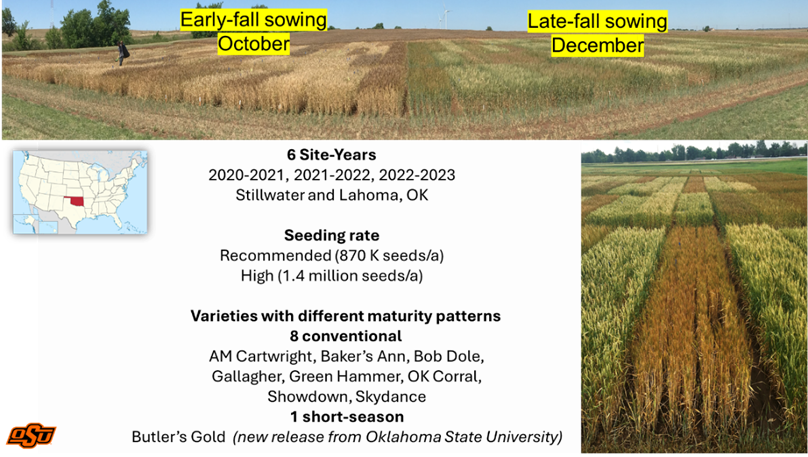
From 2021 to 2023, we conducted a study in Stillwater and Lahoma to evaluate how delaying planting dates from October to December would affect wheat performance (Figure 1). We tested two seeding rates, and nine winter wheat varieties adapted to Oklahoma, including a short-season variety covering a range of maturity classes (Table 1). The standard seeding rate of 870,000 seeds per acre reflects the average rate used in Oklahoma, equivalent to about 60 lbs/acre for wheat with an average seed size of 14,500 seeds per pound. To compensate for the approximately 40-day delay in planting between the October and December treatments, we increased the seeding rate by about 60%.

Figure 1. Treatment structure for field trials conducted in Stillwater and Lahoma during three growing seasons. All varieties but Butler’s Gold were released with the expected adoption at conventional planting dates.

Table 1. Information of historical maturity patterns of all varieties tested in this study at early-fall planting date.

Based on the data from this study, surprisingly, late-fall planting yields (79 bu/ac) exceeded early-fall planting yields (54 bu/ac) in four of six site-years, or by 5 bu/ac averaged across all site-years (Figure 2).

Figure 2. Grain yield for early-fall and late-fall planting dates averaged across nine varieties and two seeding rates for each site-year. Asterisks represent statistical differences between planting dates at p < 0.05.

Does delayed planting affect wheat development?

In our trials, late-fall planting was delayed by 41 days compared to early-fall planting. Wheat varieties planted later reached heading and maturity five days later than when planted earlier.

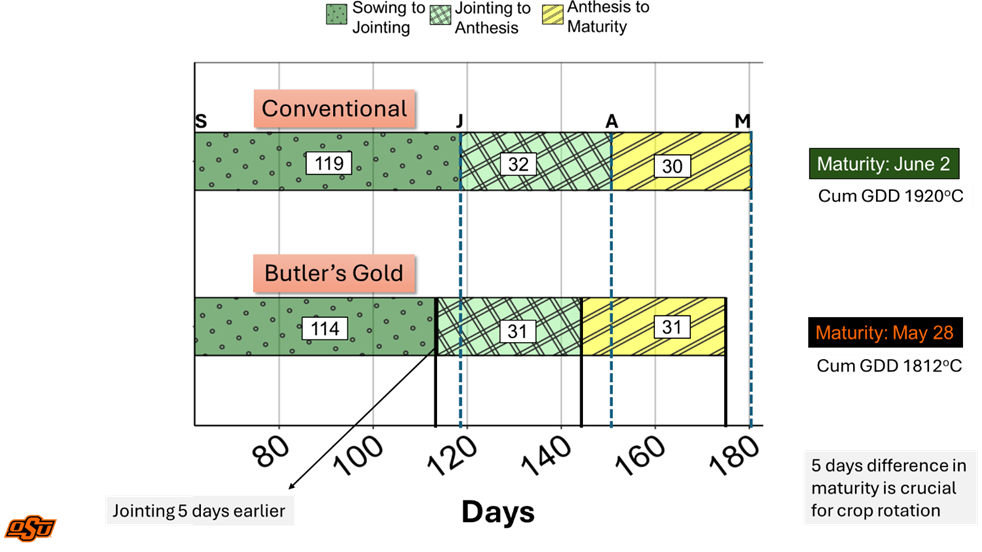
Late-fall planting reduced the period from planting to jointing by 28 days. The critical period from jointing to heading, which is vital for yield formation, was shortened by only seven days. The grain-filling period was shortened by only two days compared to early planting. Interestingly, varieties that reached jointing, heading, and maturity early at early-fall planting did so when planted late. For example, the variety Butler’s Gold reached jointing, heading, and maturity earlier than the other varieties in late-fall planting. Baker’s Ann followed closely, reaching these stages within the same day or up to three days later, while Bob Dole reached jointing and heading five days later and maturity six days later than Butler’s Gold.

Figure 3. Number of days from planting to jointing, jointing to anthesis, and anthesis to maturity between conventional and short-season varieties averaged across site-years.

Do wheat varieties perform similarly when planted late in the fall?

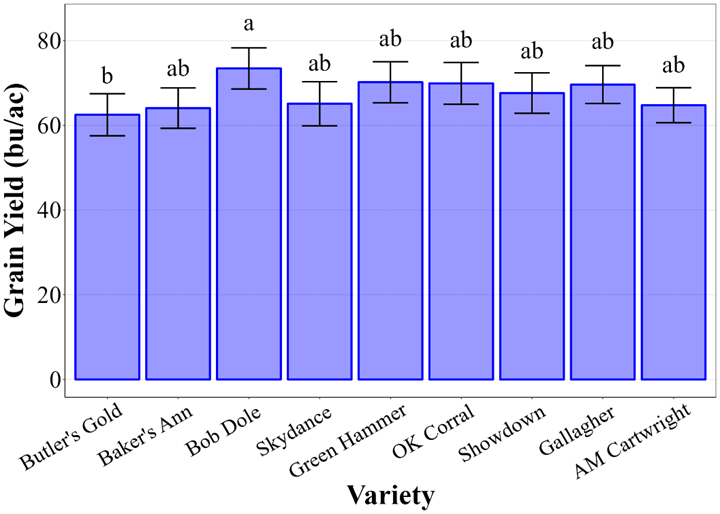
In our trials across multiple sites and seeding rates, Bob Dole was the top-yielding variety, producing 73 bu/ac in late-fall planting. However, its yield was not statistically higher than most other varieties tested, except for Butler’s Gold, which yielded 62 bu/ac (Figure 4). Varieties that performed well tended to accumulate more biomass by harvest and produced more grains per unit area (Figure 5).

A key observation was the trade-off between biomass production and maturity. Early maturing varieties like Butler’s Gold and Baker’s Ann had the lowest biomass production when planted late. This suggests that developing early maturing varieties with the ability to accumulate more biomass could improve their adaptability to late planting conditions. Further, the short-season variety Butler’s Gold had greater grain weight and above average grain protein concentration than the other varieties tested (Figure 5).

Figure 4. Average grain yield of nine varieties at late-fall planting date averaged over two seeding rates and six site-years. Plots with the same alphabetical letter are not statistically different from each other (p value < 0.05).
Figure 5. Aboveground biomass (BM) at maturity, grain number per unit area, average grain weight (AGW) and grain protein concentration of nine varieties at late-fall planting date averaged over two seeding rates and six site-years. Plots with the same alphabetical letter are not statistically different from each other (p value < 0.05).

Does seeding rate need to be adjusted for delayed wheat planting?

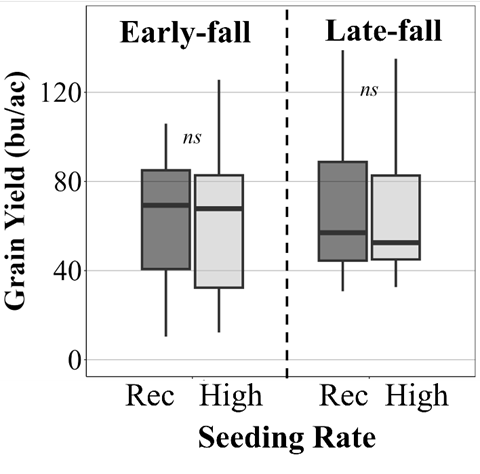
Our trials showed that increasing seeding rate did not result in a yield increase at late-fall planting across all varieties and site-years (Figure 6). Although the seeding rate affected some yield components, it did not translate into higher yields. The higher seeding rate increased the number of wheat heads per unit area but reduced the number of grains per head compared to the recommended seeding rate (data not shown). As a result, the total grain number per unit area — and ultimately the yield — remained the same for both seeding rates. Thus, our results suggest that increasing the seeding rate in late planting may not provide a yield advantage.

Figure 6. Grain yield under recommended (Rec.) and high seeding rates (i.e., 870K and 1.4 million seeds per acre, respectively) at early-fall (mid-October) and late-fall (early-December) planting dates averaged across nine genotypes and six site-years.

Take home
• Late planted wheat in Oklahoma showed no consistent yield loss compared to early-fall planting
• While the designated short-season variety, Butler’s Gold, did not outperform the other varieties at late sowing, its true value in a late-planted management system is derived from its one-week earlier harvest maturity. It also showed good end-use quality characteristics with heavier grain and above-average grain protein concentration than the other varieties .
• Varieties with better biomass production and grain number performed better with late sowing.
• Though this may defy logic, farmers do not need to increase seeding rate when facing the need to sow late, based on our results thus far.

Contributors:
Israel Molina Cyrineu, PhD student
Brett Carver, OSU Wheat Breeder
Tyler Lynch, Senior Agriculturalist for the Small Grains Extension Program

This research has been partially supported by OSU Wheat Research Foundation and Oklahoma Wheat Commission

Wheat Harvest Near Complete with Producers Being Slowed in the Panhandle Due to More Rain

By: The Oklahoma Wheat Commission

Wheat harvest is pretty-well wrapped up in all areas of the state but producers in the Panhandle still have had challenges on getting the irrigated wheat crop out as they have had more rains over the weekend that hindered them.  It is thought that 35% to 40% of the crop within this region remains to be harvested.  Test weights have dropped on the irrigated wheat from previous rain events, but overall statewide averages still look favorable.  This will be the last harvest report of the season as the Oklahoma Wheat Commission is calling the state 97% complete with harvest.

General Report  At the time of reporting today, test weights across the state were ranging from 56 to 64 lbs. per bushel, with lighter test weights in the Panhandle region due to the heavy rains over the past couple weeks. Statewide averages for test weights ranging from 60lbs. to 61 lbs. per bushel.  Proteins ranging from 9% to 13.5% with an overall average of proteins being at 11.8% as of today.  Yields being reported at 40 to 50 bushels per acre in most regions.  Higher yields being reported on intensively managed wheat with some yields on a few fields being reported in the mid 60’s to low 80’s. Irrigated wheat in the Panhandle reported to be making 75 to 85 bushels per acre, with some higher yields noted in a few places.  This will be the last harvest report of the season published by the Oklahoma Wheat Commission.

Statewide average numbers for Oklahoma

Statewide test weight average 60 lbs. to 61 lbs. per bushel

Statewide protein average 11.8%

Statewide yield average 40 to 45 bushels per acre

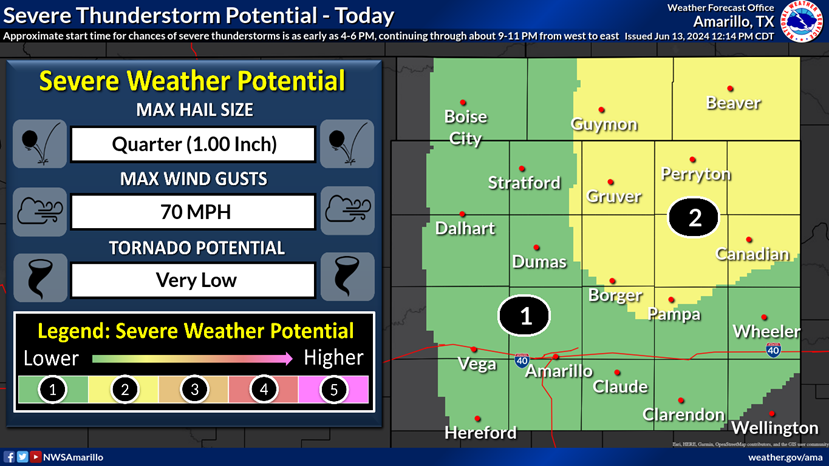
Below see the Tuesday evening Thunderstorm potential and rain chances for the Panhandle over the Independence Day weekend.

Oklahoma Wheat Harvest Moves Along With Great Progress

By: The Oklahoma Wheat Commission

Oklahoma wheat harvest continues to move along in all areas of the state. Elevator locations reporting a lot of movement in all areas with many of the Southern and Central regions getting closer to the finish line. Great progress has also been made the last few days in North Central and Northeastern Oklahoma. Oklahoma Wheat Commission is calling wheat harvest for the state 75% complete.

Southwest and Western Oklahoma

Grandfield/Chattanooga/Lawton- Test weight have dropped slightly in all regions with some weights now coming in at 57lbs. to 59lbs. per bushel. It should be noted that some 60 lb. per bushel test weight wheat is still being taken in after rains. It has been reported by producers some varieties have certainly been better at holding test weights.  (A large portion of this region was harvested before the heavy rains, so this area will still be looking at above 60 plus test weights for the harvest season.)  Yields are still favorable ranging from the low 40’s to low 50’s. Protein averages being reported from 10.5% to 12%, with overall average at 11.0% to 11.2%. These locations reporting 95%complete.

Altus/Roosevelt/Lone Wolf/Hobart- A large amount of progress has been made the last couple of days but in some areas at the beginning of the week it was slower to start due to heavy rains. Test weights have dropped slightly this week but still holding a 60 plus average for the entire region. Yields reported as ranging from the low 40’s to mid 50’s.  Some higher intensively managed wheat making in the low 60’s to low 70’s.  Proteins in the region ranging from 9% to 14%.  Protein average for the region coming in at 11.8%.  These locations are reported at 85% complete.

Sentinel/Rocky- Harvest in the area has made further progress over the past few days. Test weights are still holding up ranging from 60lbs. to 62lbs. per bushel for the most part. Yields ranging from the mid 40’s to mid 50’s. Some highly intensive managed production have reports of some fields making in the 70’s. Proteins in this area are averaging 11.5% to 12%. These locations are reporting 96% complete

Central Oklahoma

El Reno- Harvest in this region made better progress over the past couple of days. Yields in the region ranging from the mid 40’s to the mid 50’s for the most part. Test weights averaging 60 lbs. per bushel and above. Proteins varying across the board from 9% to 13%.  More higher than lower proteins reported for the region calling the average 11.5% to 12%.  This location is reported at 90% complete.

Reeding/Kingfisher/Omega/Loyal/Okeene- Test weights ranging from 60 lbs. to 62 lbs. per bushel, as they have dropped slightly with the rains but overall are holding up. Yields ranging from mid 40’s to low 50’s for the most part.  Some higher yields have been noted in low to mid 60’s on fields with some pushing 70 on wheat that was intensively managed. Protein ranging from 9% to 13.5%. Right now it is looking like an 11.0% to 11.8% average for the region.  Harvest in the Kingfisher and Reeding locations reported at 95% complete.  Harvest at Omega is 85% complete, Harvest in Loyal and Okeene considered 75% complete.

Northern Oklahoma

Kremlin/Hunter/Lamont- Harvest has made strong progress in this area over the past few days. Test weights ranging from 60lbs. to 62 lbs. per bushel. Yields ranging in the low 40’s to low 50’s for the most part. Fields with high management intensive systems being reported with yields as high as 70 bushels per acre, with some yields being reported in the high 80’s and low 90’s.  The higher yields were management and variety dependent.  Early reports on protein showing an 11.5% to 12% average.  These locations reported at 70% complete.

Tonkawa/Blackwell/Ponca City- Harvest had good movement over the weekend in this region.  Test weights have been favorable at 60lbs. per bushel and above. Yields being reported in the mid 40’s to mid 50’s for the most part.  Protein being reported at 11.5% to 13.5%. These locations reported at 30% to 35% complete.

Burlington-A lot of movement took place in this area over the week. Test weights are ranging from 59lbs. to 62lbs. per bushel depending on variety. Most test weights are still 60lbs. per bushel and above.  Yields in the region are ranging from the low 40’s to mid 50’s for the most part.  Fields that struggled due to lack of rain earlier had been abandoned so those numbers are not reported in this report. It is expected custom harvesters will be pulling out of the area on Friday. Proteins being reported at 11.2% to 11.8%. This location is reported at 80% complete.

Camargo/Shattuck/Fort Supply- Producers also got rolling in these areas over the weekend.  Much of this region had extreme drought conditions although the wheat in the Camargo area is reported to be doing better as they had more moisture over the season. Test weights reported at 61 lbs. per bushel and above. Yields being reported at 25 bushels per acre for the most part, but down by Camargo some higher yields around 40 bushels per acre have been reported.  Proteins averaging 11% to 11.8%.  These locations are reported at 35-40% complete.

Panhandle of Oklahoma

Turpin/Baker/Hooker- Producers have made good movement on dryland wheat in these regions, but are just getting a good start.  It is thought irrigated wheat harvest will be a little slower than what was predicted earlier in the week, but right now producers are thinking harvest on irrigated wheat will be in 10 days. Dryland yields being reported from high 20’s to mid 40’s for the most part depending on rainfall and management practices. Test weights ranging from 60 lbs. to 61 lbs. per bushel.  Proteins ranging from 12.5% to 13%.  These locations reported at 15% complete. 

Northeast Oklahoma

Afton/Miami- Harvest made good strides in the region this past week. Yields on the Hard Red Winter (HRW) reported at 50 to 70 bushels per acre.  Yields on the Soft Red Winter (SRW) reported at 60 to 90 bushels per acre.  Test weights ranging from 58 lbs. to 60 lbs. per bushel, with some higher test weights being reported as they get into better wheat.  No proteins reported for the wheat in this area.  In this region 40% of the production will be HRW and 60% will be SRW wheat. These locations reported at 50% complete.

Wheat Classes And What They Are Used For

Hard Red Winter (HRW) – A versatile wheat with excellent milling and baking characteristics for pan bread.   Hard Red Winter wheat is also a choice for Asian noodles, hard rolls, flat breads, general purpose flour and cereal.

Soft Red Winter (SRW) – A versatile, weak-gluten wheat with excellent milling and baking characteristics suited for cookies, crackers, pretzels, pastries and flat breads.

General Report  At the time of reporting today test weights were ranging from 58 to 64 lbs. per bushel for the most part. Most test weights are now ranging from 60lbs. to 61 lbs. per bushel across the state. Proteins ranging from 9% to 13.5%, with an overall average of proteins being at 11.8% as of today.  Yields being reported at 40 to 50 bushels per acre in most regions.  Higher yields being reported on intensively managed wheat with some yields on a few fields being reported in the mid 60’s to low 70’s. The Oklahoma Wheat Commission is calling the state 75% complete with harvest.  The next Oklahoma Wheat Commission Harvest report will be published on Monday, June 17, 2024.

Below, see the 7-day forecast provided by the Oklahoma Mesonet, with storm alerts for the Panhandle and Northwestern Oklahoma for this Thursday afternoon/evening.

Harvest Makes Minor Strides Over the Past Weekend

By: The Oklahoma Wheat Commission

Oklahoma wheat harvest moved at an extremely slow pace over the weekend in most regions due to continued rains and high humidity.  We had a few locations take in large amounts in the Central part of the state late Saturday afternoon.  The wheat across the state is ready in most all regions, but rainfall is keeping producers from making progress. We had some small amounts taken in as far North as Shattuck, and have heard test cutting on dryland wheat in the Panhandle, but no reports on what was harvested in the Panhandle out by Hooker. If it turns dry it is thought dryland wheat harvest in the Panhandle will get a good start either the middle of this week or by late week.  In the Northeast part of the state over by Afton and Miami the wheat will most likely be ready by the end of the week, once things dry out.  The Oklahoma Wheat Commission is calling wheat harvest for the state 21% complete.

Southwest and Western Oklahoma

Grandfield/Chattanooga/Lawton-  Wheat harvest made some progress in this region before the weekend, but heavy rains delayed much greater progress from being made from previous reports. Yields ranging from the low 40’s to low 50’s. Heavily grazed wheat having the lower yields in the high 20’s to low 30’s.  It has been noted some intensively managed fields have been yielding 50, with a few yields in the lower 70’s being reported.  Test weights ranging from 60lbs. to 65lbs. per bushel with an occasional 59 lb. test weight now being reported.   Protein averages being reported from 10.5% to 12%, with the overall average being around 11.0% to 11.2%.  These locations reporting 50 to 60 percent complete.

Altus/Roosevelt/Lone Wolf/Hobart- Wheat harvest in this region has been slowed by rains and high humidity days.  Some places around Altus received 2 to 3 inches of moisture over the weekend.  Test weights on wheat cuttings prior to the rains this weekend were 61 plus for the area. Yields reported as ranging from the low 40’s to mid 50’s.  Some higher intensively managed wheat making in the low 60’s to low 70’s.  Proteins in the region ranging from 9% to 14%.  Protein average for the region coming in at 11.5%.  These locations reporting 25 percent complete.

Sentinel/Rocky-Producers had a good start last weekend but high humidity days and moisture over the past week have hindered much progress from being made. Test weights ranging from 60 to 62 lbs. per bushel.  Yields being reported from 30 bushels to mid 50’s.  The lower yields are on heavily grazed fields.  Some higher yields are expected once producers start getting into better wheat.  Proteins in this region have been favorable ranging from 12% to 15%.  They are calling the average in this region at 13%.  These locations reporting 5 percent complete.

Central Oklahoma

Okarche/Piedmont- Producers struggled with high humidity days and small amounts of moisture this past week.  A large amount of wheat was taken in at these locations on Saturday afternoon/evening. Test weights reported at 60 plus on what was taken in before the rains this morning.  Protein reports on early cuttings ranging all over the board from 9% to 13.5%. Right now it looks like the region is averaging 11.5%. Proteins are extremely favorable in the Eastern part of this region.  Yields are being reported from the mid 40’s to mid 50’s, with some higher yields being reported in the mid 60’s to low 70’s on fields with intensive management.  These locations reporting 25 to 30 percent complete

Reeding/Kingfisher/Omega/Okeene- Test weights ranging from 61 lbs. to 65 lbs. per bushel, on wheat taken in before the rains this morning.  Yields ranging from mid 40’s to low 50’s for the most part.  Some higher yields have been noted in low to mid 60’s on fields with some pushing 70 on wheat that was intensively managed. Protein ranging from 9% to 13.5%. Right now it is looking like an 11.0% to 11.2% average for the region.  Harvest in the Reeding/Kingfisher locations reported at 15 to 25 percent complete, in the Omega/Okeene regions reported at less than 5 percent complete.

Northern Oklahoma

Medford/Pond Creek/Ponca City/Blackwell- Early cuttings showing test weight ranging from 60lbs. to 62 lbs. per bushel before the rains this morning.  Yields ranging in the low 40’s to low 50’s on early cuttings. No protein on early cuttings reported at this time. These locations reporting less than 5 percent complete.

Burlington- Nothing has been taken in at this location as of today. Rains will most likely delay harvest until late in the week, if it does start to dry out.  It is thought custom harvesters will start to arrive later this week.

Shattuck- Some small amounts were taken in over the weekend.  Test weights on what was received had a 61lb. per bushel average. Protein average on early loads at 11.2%.  No yields on early cuttings reported, but a lot of wheat in this area planned to make around 20 to 25 bushels per acre due to the long period of drought up until this point.  Heavy rains today will hinder much progress until late in the week if it does start to dry out.

Camargo/Fort Supply- Nothing has been taken in at these locations as of today.

Panhandle of Oklahoma

Hooker- Some test cutting took place over the weekend in parts of Texas County but nothing has been reported on what was harvested.  It is thought that dryland harvest will begin in the middle or by the end of the week depending on if it rains or not.

Northeast Oklahoma

Afton/Miami- No wheat has been taken in at these locations as of today.  The wheat would be ready to harvest on early varieties, but more rainfall is predicted over the next two days for this region, so producers are hopeful to get into the fields this coming weekend or early next week.

General Report

Reports in all locations show test weights ranging from 60 to 65 lbs. per bushel for the most part.  We have some regions now reporting an occasional 59 lb. test weight in parts of South Central Oklahoma. These numbers are reported on what was hauled in before the rains that came across the state this morning. Proteins ranging from 9% to 13.5%, with an overall average of proteins being reported at 11.0% to 11.2%. We are hearing reports of higher proteins in parts of Central Oklahoma, that hopefully will help with the overall state-wide averages. Early yields being reported at 40 to 50 bushels per acre in most regions.  Higher yields being reported on intensively managed wheat with some yields on a few fields being reported in the mid 60’s to low 70’s.  It is thought that in parts of Northwest Oklahoma the wheat in some areas has recovered however we are hearing predictions that we will see a lot of 25 bushel wheat in far regions of Northwest Oklahoma. Also some areas of the Panhandle that received timely moisture will have some good dryland wheat, but several areas will not be harvested on the dryland. The Oklahoma Wheat Commission is calling the state 21% complete with harvest.  The next Oklahoma Wheat Commission Harvest report will be published on Thursday, June 6, 2024.

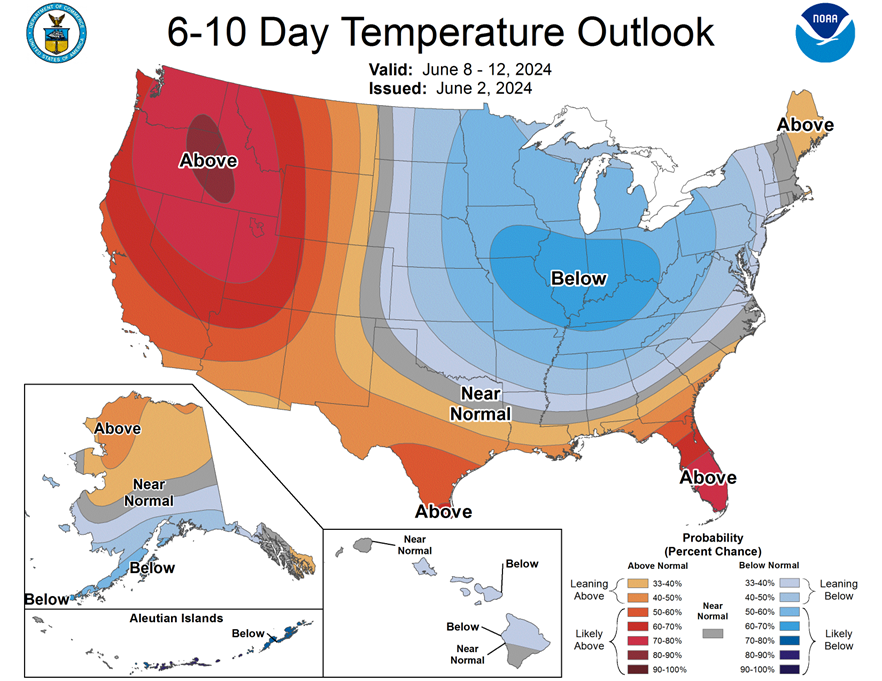
Below, see the 6-10 day temperature outlook and storm potential outlook for this evening and Tuesday provided by the Oklahoma Mesonet.

2024 OSU Wheat Plot Tours and wheat status

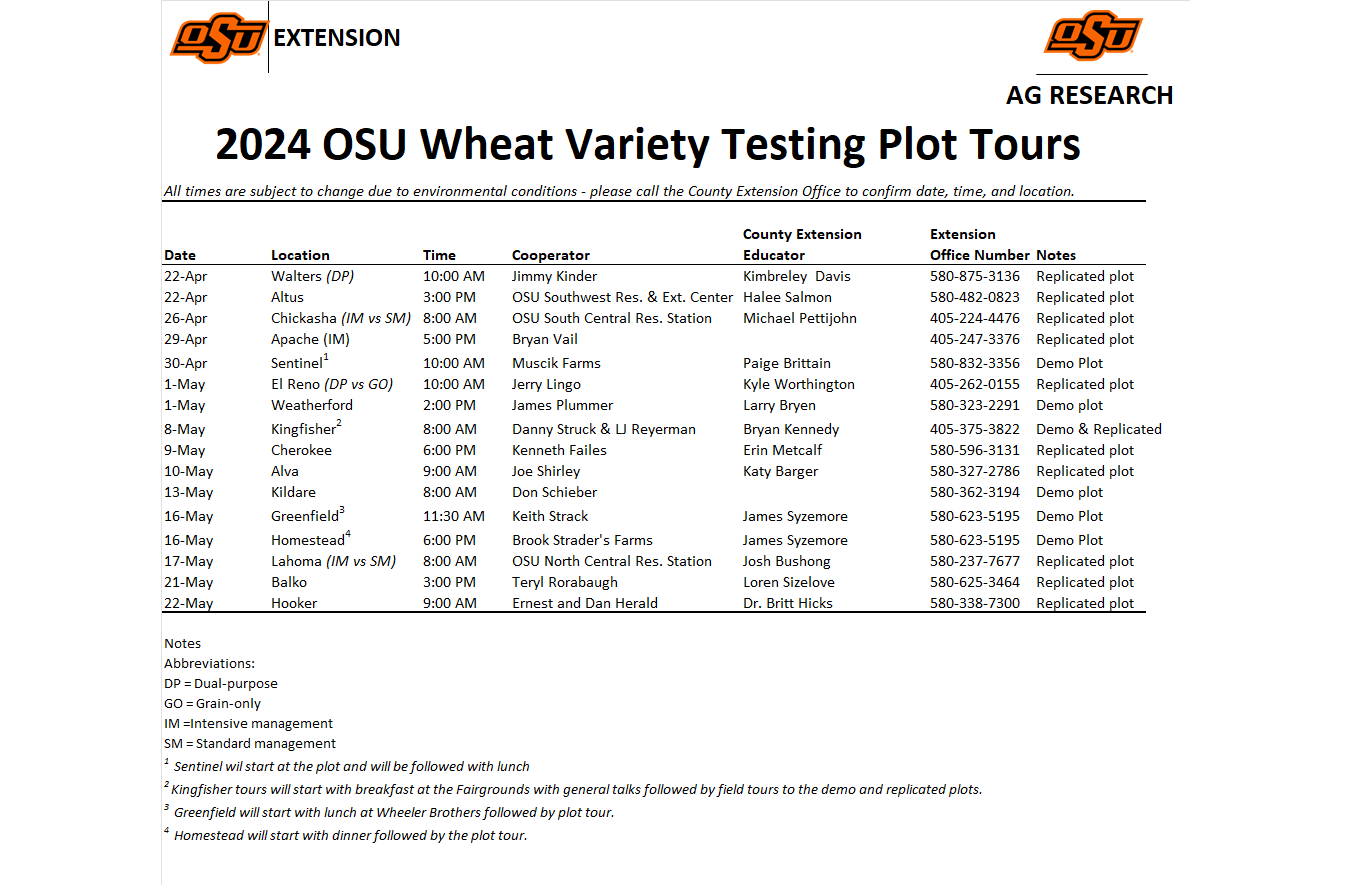
Howdy folks! It is that time of the year. The OSU Wheat Plot Tours have been scheduled, and the schedule is posted on the wheat website click here and also pasted below.

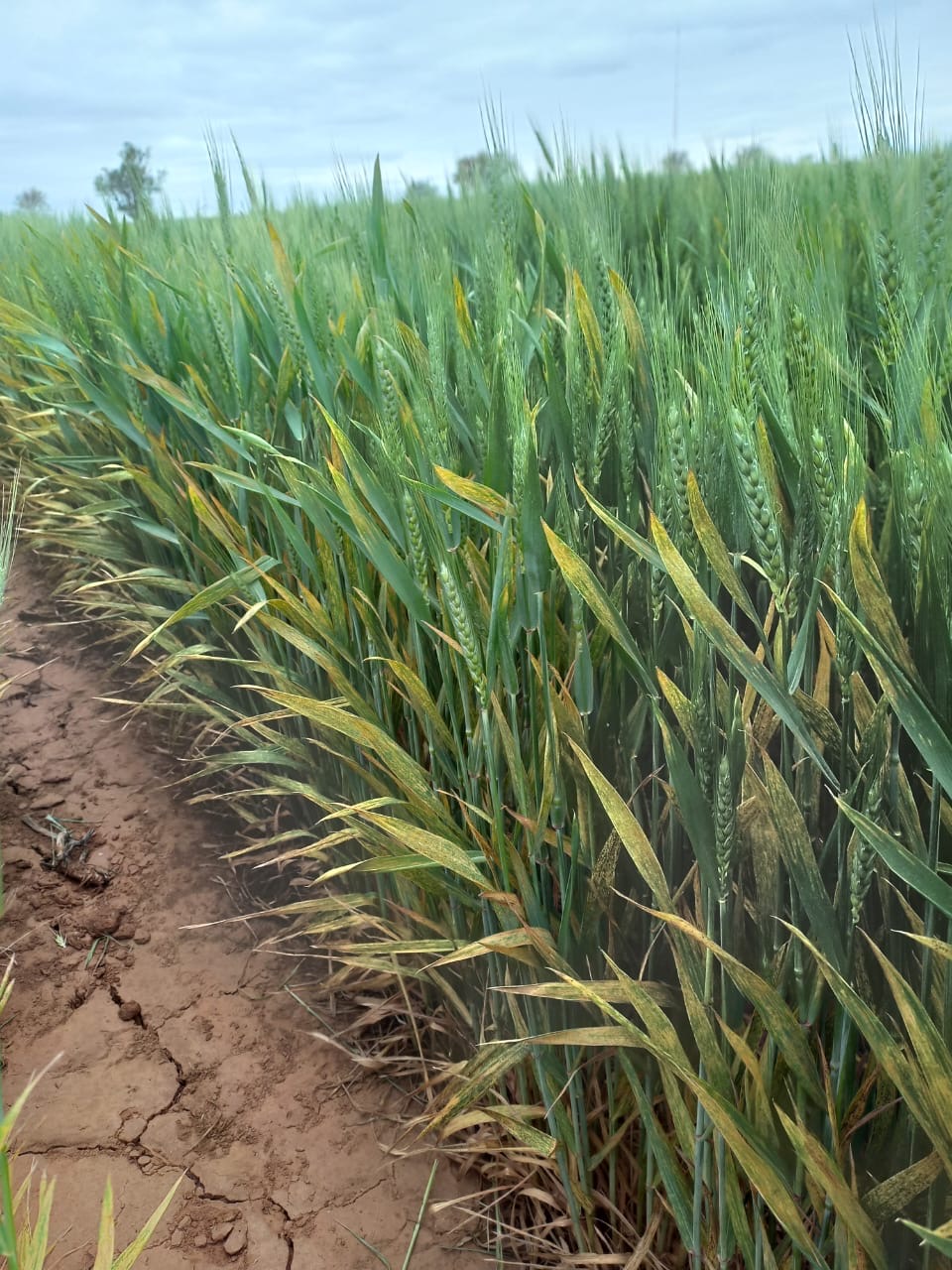
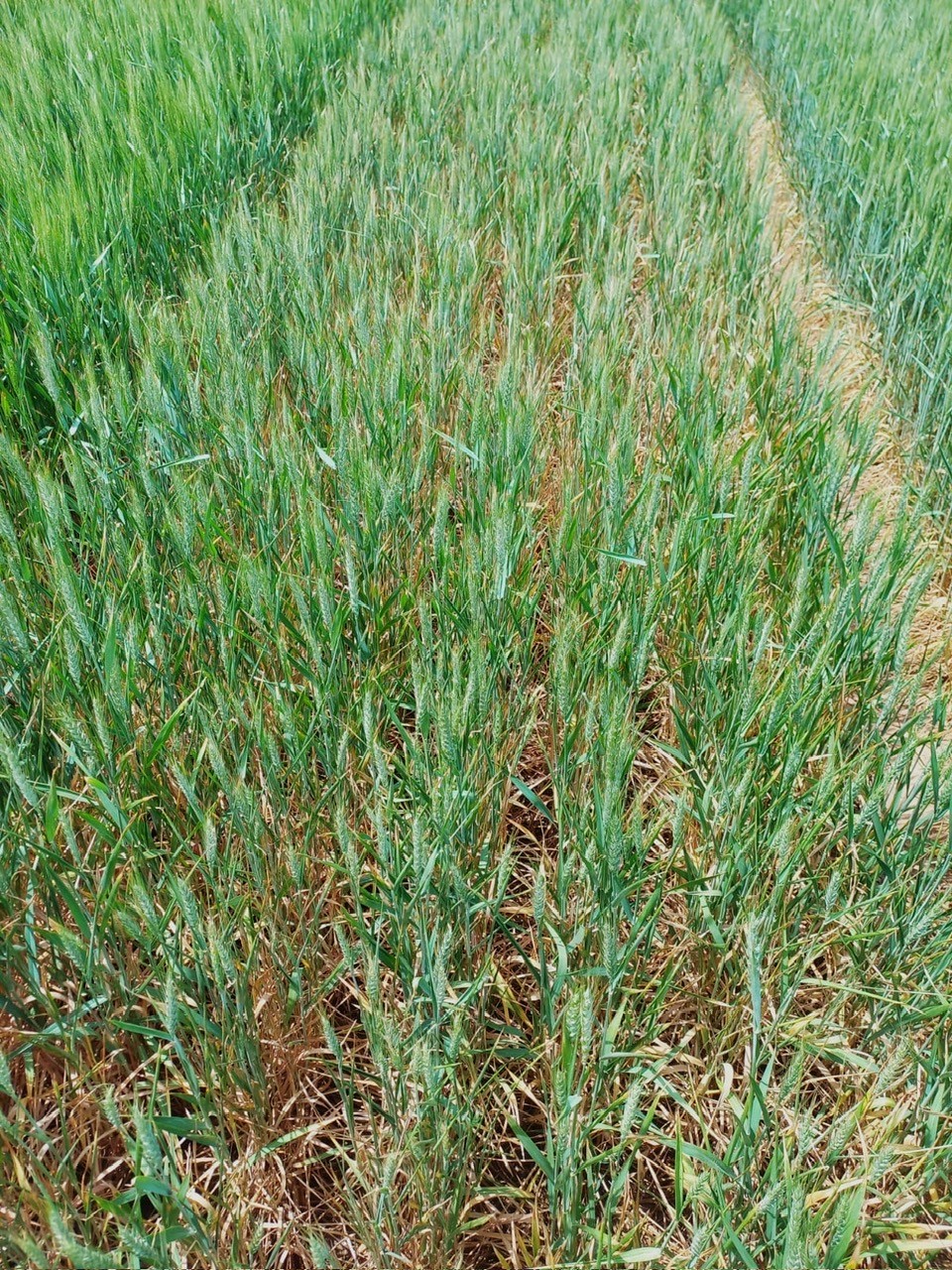
Wheat is looking good for the most part, especially when compared to last year. Some parts of the state are very dry (see picture below of the wheat in Cherokee). We could use some rain. Stripe rust showed up early in the season, which caused wheat leaf damage, especially on the wheat in the southwest region. We are still seeing it spreading throughout the state. Many fungicide applications happened in the past weeks.

In the plot tours, we will discuss wheat management practices and varieties, including their differences in disease resistance, grazing and yield potential, and other traits. In Apache and Kildare, you will be able to see our research on planting date, seeding rate, and varieties.

We will also have a field day at Rendel Farms in Miami, OK, on May 2nd. We will discuss the on-farm research being conducted there on planting date, seeding rate, and varieties. Drs. Arnall and Lofton will discuss their work as well.

We hope to see you there!

Cheers,

Amanda

Wheat variety trial at Chickasha on April 3rd, 2024. Photo: Joao Ferro, undergraduate visiting scholar in the Small Grains Lab
Wheat with stripe rust at the Lahoma variety trial on April 18, 2024. Photo: Juan Dietz, visiting research scholar in the Small Grains Lab.
Wheat variety trial at Cherokee on April 19th, 2024. Photo: Juan Dietz, visiting research scholar in the Small Grains Lab.

First Hollow Stem Update – 3/6/2024

Amanda de Oliveira Silva, Small Grains Extension Specialist

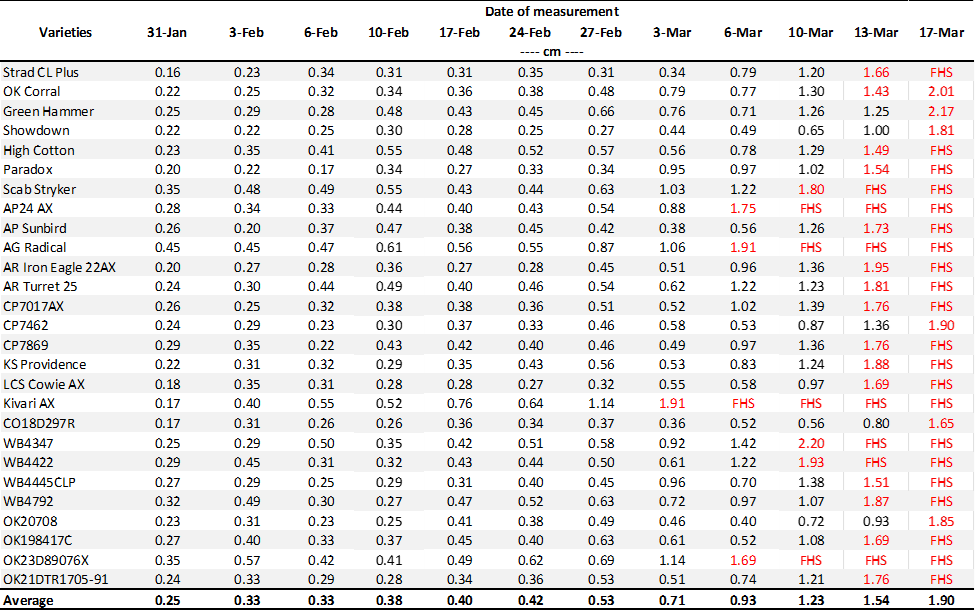
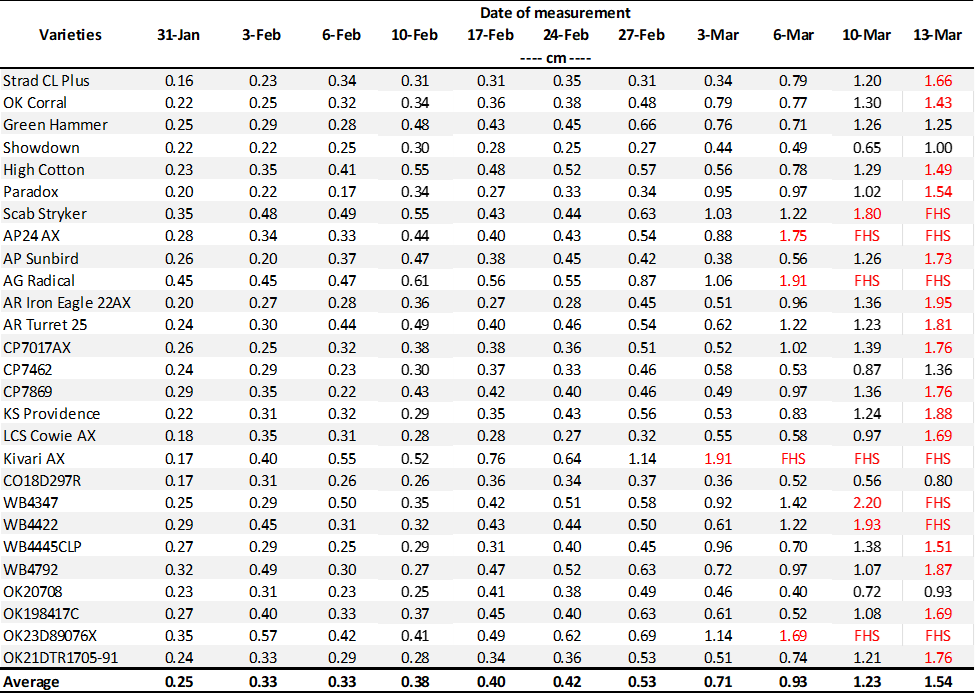
First hollow stem (FHS) is the optimal time to remove cattle from wheat pasture. This occurs when there is 1.5 cm (5/8”, or the diameter of a dime) of hollow stem below the developing grain head (see full explanation). The latest FHS results from OSU forage trials in Stillwater (Table 1) and Chickasha (Table 2) are listed below. For an additional resource and wheat update on FHS, see the Mesonet First Hollow Stem Advisor

We use an accelerated growth system to report the earliest onset of FHS stage. Trials are seeded early to simulate a grazed system, but the forage is not removed. Varieties reported here with the earliest FHS date should be the first to monitor in commercial fields. In practice, wheat that is grazed will likely reach FHS stage later than reported here, and differences between varieties will likely be moderate.

Table 1. First hollow stem (FHS) results for each variety collected at Stillwater. Plots were planted on 09/18/23 but not grazed or clipped. The threshold target for FHS is 1.5 cm (5/8″ or the diameter of a dime). The value of hollow stem for each variety represents the average of ten measurements. Varieties exceeding the threshold are highlighted in red.

Table 2. First hollow stem (FHS) results for each variety collected at Chickasha. Plots were planted on 09/21/23 but not grazed or clipped. The threshold target for FHS is 1.5 cm (5/8″ or the diameter of a dime). The value of hollow stem for each variety represents the average of ten measurements. Varieties exceeding the threshold are highlighted in red.

Contact your local Extension office and us if you have questions. 

Additional resources available:

Acknowledgments: 

Tyler Lynch, Senior Agriculturalist

Israel Molina Cyrineu, Graduate Research Assistant

Samson Abiola, Graduate Research Assistant

Lettie Crabtree, Undergraduate Student

Joao Ferro, Undergraduate Student

First Hollow Stem Update – 3/01/2024

Amanda de Oliveira Silva, Small Grains Extension Specialist

First hollow stem (FHS) is the optimal time to remove cattle from wheat pasture. This occurs when there is 1.5 cm (5/8”, or the diameter of a dime) of hollow stem below the developing grain head (see full explanation). The latest FHS results from OSU forage trials in Stillwater (Table 1) and Chickasha (Table 2) are listed below. For an additional resource and wheat update on FHS, see the Mesonet First Hollow Stem Advisor

We use an accelerated growth system to report the earliest onset of FHS stage. Trials are seeded early to simulate a grazed system, but the forage is not removed. Varieties reported here with the earliest FHS date should be the first to monitor in commercial fields. In practice, wheat that is grazed will likely reach FHS stage later than reported here, and differences between varieties will likely be moderate.

Table 1. First hollow stem (FHS) results for each variety collected at Stillwater. Plots were planted on 09/18/23 but not grazed or clipped. The threshold target for FHS is 1.5 cm (5/8″ or the diameter of a dime). The value of hollow stem for each variety represents the average of ten measurements. Varieties exceeding the threshold are highlighted in red.

Table 2. First hollow stem (FHS) results for each variety collected at Chickasha. Plots were planted on 09/21/23 but not grazed or clipped. The threshold target for FHS is 1.5 cm (5/8″ or the diameter of a dime). The value of hollow stem for each variety represents the average of ten measurements. Varieties exceeding the threshold are highlighted in red.

Contact your local Extension office and us if you have questions. 

Additional resources available:

Acknowledgments: 

Tyler Lynch, Senior Agriculturalist

Israel Molina Cyrineu, Graduate Research Assistant

Samson Abiola, Graduate Research Assistant

Lettie Crabtree, Undergraduate Student

Joao Ferro, Undergraduate Student

First Hollow Stem Update – 2/26/2024

Amanda de Oliveira Silva, Small Grains Extension Specialist

First hollow stem (FHS) is the optimal time to remove cattle from wheat pasture. This occurs when there is 1.5 cm (5/8”, or the diameter of a dime) of hollow stem below the developing grain head (see full explanation). The latest FHS results from OSU forage trials in Stillwater (Table 1) and Chickasha (Table 2) are listed below. For an additional resource and wheat update on FHS, see the Mesonet First Hollow Stem Advisor

We use an accelerated growth system to report the earliest onset of FHS stage. Trials are seeded early to simulate a grazed system, but the forage is not removed. Varieties reported here with the earliest FHS date should be the first to monitor in commercial fields. In practice, wheat that is grazed will likely reach FHS stage later than reported here, and differences between varieties will likely be moderate.

Table 1. First hollow stem (FHS) results for each variety collected at Stillwater. Plots were planted on 09/18/23 but not grazed or clipped. The threshold target for FHS is 1.5 cm (5/8″ or the diameter of a dime). The value of hollow stem for each variety represents the average of ten measurements. Varieties exceeding the threshold are highlighted in red.

Table 2. First hollow stem (FHS) results for each variety collected at Chickasha. Plots were planted on 09/21/23 but not grazed or clipped. The threshold target for FHS is 1.5 cm (5/8″ or the diameter of a dime). The value of hollow stem for each variety represents the average of ten measurements. Varieties exceeding the threshold are highlighted in red.

Contact your local Extension office and us if you have questions. 

Additional resources available:

Acknowledgments: 

Tyler Lynch, Senior Agriculturalist

Israel Molina Cyrineu, Graduate Research Assistant

Samson Abiola, Graduate Research Assistant

Lettie Crabtree, Undergraduate Student

Joao Ferro, Undergraduate Student

First Hollow Stem Update – 2/20/2024

Amanda de Oliveira Silva, Small Grains Extension Specialist

First hollow stem (FHS) is the optimal time to remove cattle from wheat pasture. This occurs when there is 1.5 cm (5/8”, or the diameter of a dime) of hollow stem below the developing grain head (see full explanation). The latest FHS results from OSU forage trials in Stillwater (Table 1) and Chickasha (Table 2) are listed below. For an additional resource and wheat update on FHS, see the Mesonet First Hollow Stem Advisor

We use an accelerated growth system to report the earliest onset of FHS stage. Trials are seeded early to simulate a grazed system, but the forage is not removed. Varieties reported here with the earliest FHS date should be the first to monitor in commercial fields. In practice, wheat that is grazed will likely reach FHS stage later than reported here, and differences between varieties will likely be moderate.

Table 1. First hollow stem (FHS) results for each variety collected at Stillwater. Plots were planted on 09/18/23 but not grazed or clipped. The threshold target for FHS is 1.5 cm (5/8″ or the diameter of a dime). The value of hollow stem for each variety represents the average of ten measurements. Varieties exceeding the threshold are highlighted in red.

Table 2. First hollow stem (FHS) results for each variety collected at Chickasha. Plots were planted on 09/21/23 but not grazed or clipped. The threshold target for FHS is 1.5 cm (5/8″ or the diameter of a dime). The value of hollow stem for each variety represents the average of ten measurements. Varieties exceeding the threshold are highlighted in red.

Contact your local Extension office and us if you have questions. 

Additional resources available:

Acknowledgments: 

Tyler Lynch, Senior Agriculturalist

Israel Molina Cyrineu, Graduate Research Assistant

Samson Abiola, Graduate Research Assistant

Lettie Crabtree, Undergraduate Student

Joao Ferro, Undergraduate Student

First Hollow Stem Update – 2/19/2024

Amanda de Oliveira Silva, Small Grains Extension Specialist

First hollow stem (FHS) is the optimal time to remove cattle from wheat pasture. This occurs when there is 1.5 cm (5/8”, or the diameter of a dime) of hollow stem below the developing grain head (see full explanation). The latest FHS results from OSU forage trials in Stillwater (Table 1) and Chickasha (Table 2) are listed below. For an additional resource and wheat update on FHS, see the Mesonet First Hollow Stem Advisor

We use an accelerated growth system to report the earliest onset of FHS stage. Trials are seeded early to simulate a grazed system, but the forage is not removed. Varieties reported here with the earliest FHS date should be the first to monitor in commercial fields. In practice, wheat that is grazed will likely reach FHS stage later than reported here, and differences between varieties will likely be moderate.

Table 1. First hollow stem (FHS) results for each variety collected at Stillwater. Plots were planted on 09/18/23 but not grazed or clipped. The threshold target for FHS is 1.5 cm (5/8″ or the diameter of a dime). The value of hollow stem for each variety represents the average of ten measurements. Varieties exceeding the threshold are highlighted in red.

Table 2. First hollow stem (FHS) results for each variety collected at Chickasha. Plots were planted on 09/21/23 but not grazed or clipped. The threshold target for FHS is 1.5 cm (5/8″ or the diameter of a dime). The value of hollow stem for each variety represents the average of ten measurements. Varieties exceeding the threshold are highlighted in red.

Contact your local Extension office and us if you have questions. 

Additional resources available:

Acknowledgments: 

Tyler Lynch, Senior Agriculturalist

Israel Molina Cyrineu, Graduate Research Assistant

Samson Abiola, Graduate Research Assistant

Lettie Crabtree, Undergraduate Student

Joao Ferro, Undergraduate Student