Amanda de Oliveira Silva, Small Grains Extension Specialist
Soil moisture conditions are currently favorable for wheat planting across much of Oklahoma. Many of you may be eager to get seed in the ground, but before moving ahead, it is important to consider a few key points.
Planting date
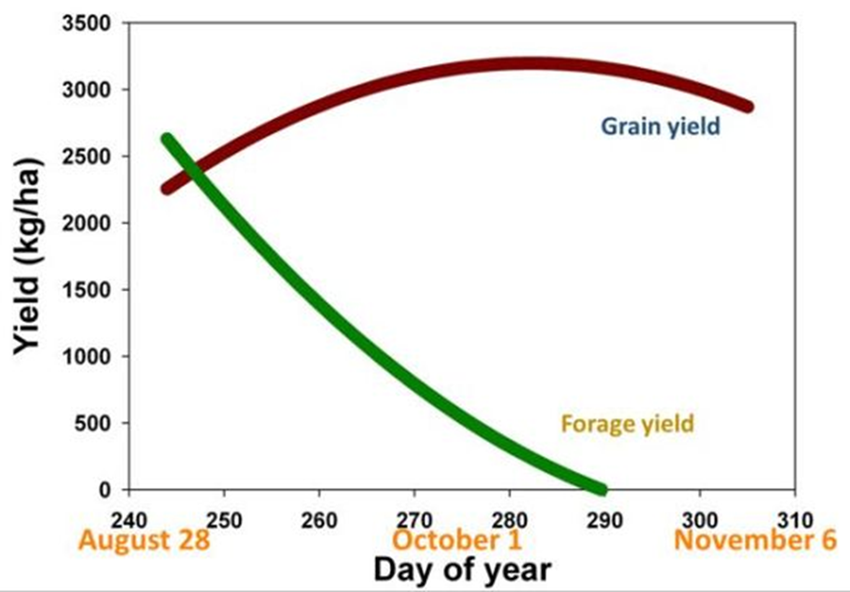
For dual-purpose wheat (grazing + grain), the optimal planting window in most of Oklahoma is mid-September (Figure 1). Planting during this period provides the best balance between fall forage production and maintaining grain yield potential.
Early planting may increase fall forage production but also raises the risk of pests and diseases. It’s usually only recommended for wheat intended for graze-out or dual-purpose.
Grain-only wheat should generally be planted about 3-4 weeks later (mid-October, Figure 1) in many parts of the state. Our recent work shows there is more flexibility than we thought, and planting a little later can still work well depending on the weather.
Figure 1. Forage and grain yield potential in relation to the day of the year. Every 1,000 kg/ha is equal to approximately 900 lb/acre or 15 bu/acre. Ideal planting dates for dual-purpose wheat in Oklahoma are mid-September (i.e., approximately day 260). Planting for grain-only should occur at least 3-4 weeks after dual-purpose planting (i.e., mid-October or approximately day 285).
Watch for Fall Armyworms
Planting too early increases the chance of fall armyworm infestations. These pests are small and easy to miss, but you might notice “window-pane” feeding on leaves (Figure 2). Check beneath crop residue as well, since they often hide there during the heat of the day (Figure 3).
Figure 2. Symptom of “window paned” leaves shows severe feeding from the fall armyworm. Photo taken on October 2, 2019, at Canadian County by Amanda Silva.
Figure 3. Fall armyworms may be found under crop residue during the day. Photo taken on October 2, 2019 at Canadian County by Amanda Silva.
Volunteer wheat and Virus Risk
Early planting also raises the risk of wheat streak mosaic and Triticum mosaic viruses, spread by the wheat curl mite. Because seed treatments do not control these viruses and few varieties have strong resistance (i.e., Breakthrough), cultural practices are critical:
Control volunteer wheat and other grassy hosts as much as possible.
Ensure volunteer wheat is completely dead for at least two weeks before planting. This breaks the “green bridge” that mites use to move into new seedlings.
Planting a little later can also help lower virus pressure.
We saw significant wheat streak mosaic issues last year, making these steps especially important in 2025.
Other Planting Considerations
Before planting:
Soil test to guide fertility needs and reduce input costs.
Use high-quality seed to promote good germination and stand establishment.
Consider fungicide and insecticide seed treatments to protect against soilborne diseases and early pest pressure such as root rots.
Need More Information?
Your county OSU Extension office is a great resource for information. You can also reach out directly to us:
Amanda de Oliveira Silva, Small Grains Extension Specialist, Oklahoma State University
The Oklahoma wheat harvest was delayed in many areas this year due to frequent rainfall events. I have received several questions about sprouted wheat seeds and potential issues with post-harvest dormancy, especially when using that grain for seed this fall. So, I would like to share a few considerations.
Pre-harvest sprouting
Pre-harvest sprouting refers to wheat grains that begin to germinate while still on the wheat head, before harvest. Once wheat reaches physiological maturity, it can begin to germinate if exposed to ideal moisture and warm temperatures for just a few days. That is what happened in some locations in northcentral OK this season.
The risk of sprouting depends on both genetics and environmental conditions. Wheat varieties differ in their resistance to sprouting (i.e., some are more prone to sprouting than others).
Can I use sprout-damaged wheat for seed?
It depends, especially on the level of sprouting.
If wheat kernels appear swollen or with a cracked seed coat, but with no visible root or shoot emerging from the seed, they might still be viable to be used as seed. In this case, run a germination test to assess seed quality before planting.
However, if you see visible roots or a developing coleoptile emerging from the seed (see Picture 1), those seeds should not be used. They will likely have poor viability and may fail to emerge.
Picture 1. Pre-harvest sprouted wheat damage, showing grain with split seed coat and radicle starting to become visible. The photo was taken on June 10, 2022 by Glen Calvert, former Extension Ag Educator at Washita County.
Will pre-harvest sprouting damage affect wheat quality?
Yes. As wheat starts to sprout (i.e., begins to germinate), it produces alpha-amylase and other enzymes that break down starch and protein in the grain. Increased enzyme activity can reduce flour and baking quality, affecting dough strength, loaf volume, and crumb structure. The more severe the sprouting, the greater the loss in marketability and end-use quality.
Post-harvest seed dormancy
Since harvest was late this year, will post-harvest dormancy affect planting this fall?
It is possible. Wheat seed is considered dormant when it fails to germinate even under favorable conditions or take so long that emergence is delayed, thus causing poor stands. Dormancy can be worsened when planting in warm soil (above 70F), which is typical during early sowing of graze-out or dual-purpose systems in Oklahoma.
Some level of seed dormancy is beneficial as it helps prevent pre-harvest sprouting as previously discussed. Dormancy is highest right before harvest and gradually decreases over time. But the rate at which it decreases depends on genetics and several other factors, including:
Seed coat properties: Inhibitory compounds in the seed coat of hard red winter wheat varieties can extend post-harvest dormancy.
Storage conditions: Seed stored at extreme temperatures (hot or cold) tend to lose dormancy faster than those stored at ambient air temperatures. This is why placing seed samples in a refrigerator for a day or two before conducting germination tests is a common practice.
Grain-fill environment: Cooler and wetter conditions during grain fill result in stronger dormancy than hot and dry conditions during this period. This means that the same wheat variety may exhibit different germination behavior depending on the environment in which the seed was produced.
For most hard red winter wheat varieties, dormancy naturally dissipates by October. However, early sowing shortens the interval between harvest and planting, which increases the risk of planting dormant seed, leading to delayed emergence and poor stands.
Dormancy can be mistaken by other problems like dead or damaged seeds. Running a germination test can help to identify what is going on.
What to check before planting saved seed:
Germination Test
Even if the grain didn’t visibly sprout in the head, it may have undergone internal changes (like enzyme activity) that reduce vigor. A standard germination test is the best way to assess viability.
Prolonged wet conditions during grain filling and harvest can lead to seed-borne fungal diseases. These can reduce seed quality and emergence. Consider using a fungicide seed treatment to reduce this risk.
3. Test weight and shrunken kernels
Low test weight and shriveled seeds often indicate poor grain fill. These seeds might have reduced starch reserves, which weakens seedling growth.
Aim for test weight above 58 lb/bu for seed use.
Summary
Delayed harvest increases the risk of pre-harvest sprouting.
Both can impact seed viability and plant emergence this fall.
Before using your own grain as seed, be sure to run a germination test and assess overall seed quality.
Resources:
If you have questions about testing, seed treatment, or variety selection, feel free to reach out to your local Extension office or to me.
Oklahoma wheat harvest moved forward at a slow pace over the 4th of July weekend, with rain showers hitting several parts of the Panhandle, Northern and Northeast Oklahoma at different times. There is a region in the Goodwell, Guymon and Hooker area that is still working on irrigated wheat production that has been delayed due to rains this past week. In North Central Oklahoma, little progress has been made, with producers cutting just to check moisture samples while fighting with mud. In Northeast Oklahoma progress was made over the weekend, but rain showers yesterday evening have put harvest at a standstill as of today.
Several producers are weighing options as weeds become more of an issue. Test weights have dropped significantly in many parts of North Central Oklahoma in the 56 lbs. to 58 lbs. per bushel. Many producers have been surprised test weights have been holding up as good as they have been despite everything the crop has been through.
The statewide average for test weight is still reported at 59 lbs. as much heavier weights were harvested earlier in the season. Yields across the state are ranging from the mid 40’s to mid 50’s for the most part, with some lower yielding wheat being reported due to heavy rains.
Management intensive producers have reported higher yields ranging in the mid 60’s to mid 80’s. Producers had better wheat in many Northern parts of the state but now will see some yield loss due to lower test weights. Protein ranges have been all over the board from 9.8% to 14.2% depending on management and location. Protein average for the state of Oklahoma is at 11.2%.
The Oklahoma Wheat Commission is calling harvest 85% completed as of today. This will be the last harvest report of the season and will be considered a fair representation of quality in the state, even though some quality targets will be lower than expected on what remains.
**It should be noted some minor instances of sprout has been reported at a 1% to 3% level, but in most regions the crop is still holding up without much sprout damage. If sprout becomes more of an issue, then producers will most likely opt to utilize for feed wheat.
Intensivelymanaged wheat reported to be making in the mid 60’s. No protein was reported at this time.This region is considered to be 95% harvested.
Garber/Kremlin/Hunter/PondCreek- Producers have been fighting mud in this region all harvest, with little movement over the past 5 days. Test weights have declined some ranging from 55 lbs. to 58 lbs. per bushel. Yields reported in the mid 40’s to mid 50’s for the most part. Some intensively managed fields making in the mid 60’s. Protein averaging 11.2%.This region considered to be 57% harvested.
Tonkawa/PoncaCity/Blackwell/Braman– Test weights being reported at 56 lbs. to 58 lbs. per bushel. This region has had heavy rains the last 5 days putting harvest at a standstill for the past week. Yields on early cuttings ranging from low 40’s to mid 50’s for the most part. It should be noted that a large area in this region has suffered severe flooding and hail events. Also several fields will most likely be abandoned due to heavy weed issues. Protein on early cuttings averaging 11.1%. This region is considered 52% harvested.
Northeast Oklahoma
Afton/Miami- Producers have fought rain in this region all harvest, but towards the beginning of the weekend a couple days was suitable for cutting, with producers making progress. Rain showers yesterday also halted further progress. This region reporting two classes — Hard Red Winter and Soft Red Winter wheat.This region reported at 80% percent complete.
**Hard Red Winter Class, test weights have been averaging 56 lbs. per bushel. Yields are ranging in the mid 20’s to mid 50’s depending on variety and location.
**Soft Red Winter Class, test weights have been averaging 56 lbs. per bushel. Yields are ranging in the mid 20’s to mid 50’s depending on variety and location. We did have a couple of yields reported in the low 70’s.
Wheat Classes And What They Are Used For
Hard Red Winter (HRW) – A versatile wheat with excellent milling and baking characteristics for pan bread. Hard Red Winter wheat is also a choice for Asian noodles, hard rolls, flat breads, general purpose flour and cereal.
Soft Red Winter (SRW)– A versatile, weak-gluten wheat with excellent milling and baking characteristics suited for cookies, crackers, pretzels, pastries and flat breads.
Panhandle
Balko/Goodwell/Guymon/Hooker-A large portion of dryland harvest has now been completed in all regions of the Panhandle. Dryland wheat harvest is 98 percent complete. A great deal of irrigated wheat harvest has taken place in central regions of the Panhandle around the Balko area, while producers in the Guymon and Hooker region have been delayed with rains and high humidity. Dryland wheat yields reported from 20 bushels to 50 bushels per acre depending on variety and location. Irrigated wheat yields from 80 bushels to 120 bushels per acre. Test weights on dryland wheat ranging from 55 lbs. to 62 lbs. per bushel depending on variety and location. Test weight on irrigated wheat that was reported ranging from 57 lbs. to 61 lbs. per bushel. Protein average for the Panhandle has varied more so than other years but many parts of the region looking at 12% averages. The Panhandle region is considered 75 percent completed with harvest.
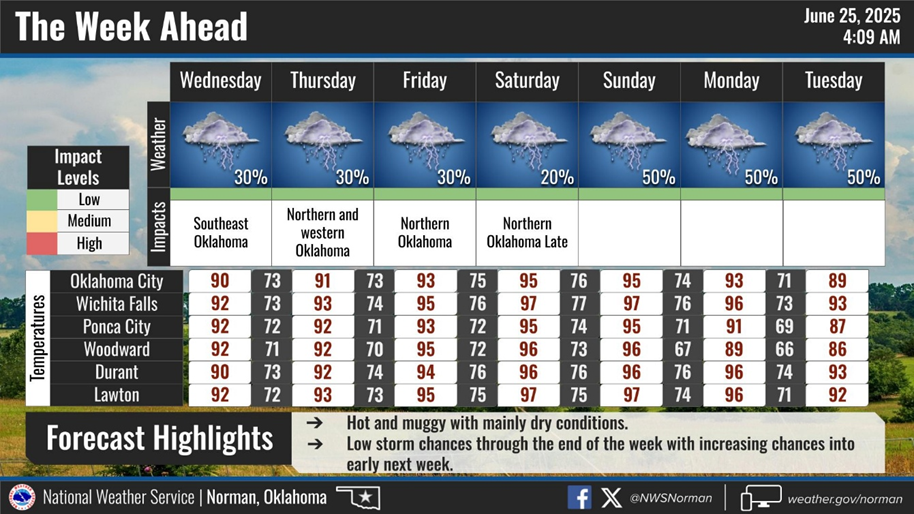
Below, see the 7-day forecast provided by the Oklahoma Mesonet.
NWS Days 1-5 Precipitation Forecast
The Days 1-5 Precipitation Forecast is produced by the National Weather Service’s Weather Prediction Center for July 7-12, 2025.
Oklahoma wheat harvest moves forward the last couple of days with harvesting still going on in Central and Northern parts of the state where rains have been missed. Large portions of North Central Oklahoma along the I-35 corridor have been plagued with rain this past week which has hindered any movement in that region. Some producers in that area were going to try this afternoon, but many think it will be tomorrow or Friday at the earliest before they can get back in fields if it doesn’t rain again. The majority of harvest today and the last couple days has been taking place in the Panhandle and in Northeast Oklahoma, where they finally missed out on heavy rains.
The statewide average for test weight is still reported at 59 lbs. as much heavier weights were harvested earlier in the season. (Test weights are ranging now from 55 lbs. to 60 lbs. per bushel depending on variety, environment and location.) Yields across the state are ranging from the mid 40’s to mid 50’s for the most part, with some lower yielding wheat being reported due to heavy rains.
Management intensive producers have reported higher yields ranging in the mid 60’s to mid 80’s. Producers had better wheat in many Northern parts of the state but now will see some yield loss due to lower test weights. Protein ranges have been all over the board from 9.8% to 14.2% depending on management and location. Protein average for the state of Oklahoma is at 11.2%. The Oklahoma Wheat Commission is calling harvest 82% completed as of today.
**It should be noted some minor instances of sprout has been reported at a 2 to 3% level, but in most regions the crop is still holding up without much sprout damage.
North Central and Northern Oklahoma
Okeene/Fairview/Ringwood/Lahoma- Test weights still coming in favorable ranging from 58 lbs. to 60 lbs. per bushel with many still 60 plus. Yields ranging from the mid 40’s to mid 50’s for the most part, with intensive management fields making 60 to 80 bushels. Protein reports are varying across this area with lower than expected proteins in some areas and much higher than expected proteins in other parts. The protein average in this region is at 11.8%. The Fairview/Ringwood/Lahoma areas are reported at 95% complete.
McWillie/Helena/Goltry- Test weights still averaging 60 lbs. per bushel on later cuttings. Yields ranging from high 30’s to mid 50’s depending on management practices. Some intensively managed wheat reported to be making in the mid 60’s. No protein was reported at this time.This region is considered to be 95% harvested.
Kremlin/Hunter/PondCreek-Producers have been fighting mud in this region all harvest, with little movement over the past 5 days. Test weights have declined some ranging from 55 lbs. to 58 lbs. per bushel. Yields reported in the mid 40’s to mid 50’s for the most part. Some intensively managed fields making in the mid 60’s. Protein averaging 11.2%. This region considered to be 55% harvested.Harvest has been at a standstill the last couple days, some producers were planning on trying to get into the field this afternoon if moisture dries down and no more rain comes.
Tonkawa/PoncaCity/Blackwell/Braman– Test weights being reported at 56 lbs. to 58 lbs. per bushel. This region has had heavy rains the last 5 days putting harvest at a standstill for the past week. Yields on early cuttings ranging from low 40’s to mid 50’s for the most part. It should be noted that a large area in this region has suffered severe flooding and hail events. Also several fields will most likely be abandoned due to heavy weed issues. Protein on early cuttings averaging 11.1%. This region is considered 50% harvested. One producer was going to try to get back into the fields today, while others think it will be tomorrow or Friday at the earliest, if no more rain comes.
Northeast Oklahoma
Afton/Miami- Producers have fought rain in this region all harvest, but the last couple days they have not received heavy rains in this region like in other parts of Northern Oklahoma, which has allowed them to make great progress. This region reporting two classes — Hard Red Winter and Soft Red Winter wheat. This region reported at 60% percent complete.
**Hard Red Winter Class, test weights have been averaging 56 lbs. per bushel. Yields are ranging in the mid 20’s to mid 50’s depending on variety and location.
**Soft Red Winter Class, test weights have been averaging 56 lbs. per bushel. Yields are ranging in the mid 20’s to mid 50’s depending on variety and location.
Wheat Classes And What They Are Used For
Hard Red Winter (HRW) – A versatile wheat with excellent milling and baking characteristics for pan bread. Hard Red Winter wheat is also a choice for Asian noodles, hard rolls, flat breads, general purpose flour and cereal.
Soft Red Winter (SRW)– A versatile, weak-gluten wheat with excellent milling and baking characteristics suited for cookies, crackers, pretzels, pastries and flat breads.
Panhandle
Balko/Goodwell/Guymon/Hooker-A large portion of dryland harvest has now been completed in all regions of the Panhandle. Dryland wheat harvest is 90 percent complete. A great deal of irrigated wheat harvest has taken place in central regions of the Panhandle around the Balko area, while producers have started to get into irrigated wheat around the Guymon and Hooker areas the last couple days. Dryland wheat yields reported from 20 bushels to 50 bushels per acre depending on variety and location. Irrigated wheat yields from 80 bushels to 120 bushels per acre. Test weights on dryland wheat ranging from 55 lbs. to 62 lbs. per bushel depending on variety and location. Test weight on irrigated wheat that was reported ranging from 58 lbs. to 61 lbs. per bushel. No protein reported.
Below, see the 7-day forecast provided by the Oklahoma Mesonet.
NWS Days 1-5 Precipitation Forecast
The Days 1-5 Precipitation Forecast is produced by the National Weather Service’s Weather Prediction Center for July 2-7, 2025.
Oklahoma wheat harvest has been moving at a fast pace the last two days. Several producers and custom harvesters wrapping up in Southwest, Oklahoma. Great strides also have been made in central and far western regions of the state. Producers are cutting in all regions even in the North Central, I-35 corridor on the Oklahoma/Kansas line. (Producers continue to battle mud from heavy rains in Northern, Oklahoma from Kremlin to the Blackwell/Ponca City, Braman region. Mud is also giving producers challenges in the Afton and Miami area.) It should be noted several locations from all central regions to most northern regions have several fields that are partially harvested with producers and harvesters planning to come back for the wetter lower lying areas. Rain has also hindered progress on some of the dryland wheat areas in the Panhandle that was received on Monday evening. **Test weights across the state have dropped due to all the heavy rains last week, but statewide we are still looking at a 59 lb. per bushel average despite some lower test weights reported based on location and variety. Yields across the state are being reported from the mid 30’s to mid 50’s for the most part. Producers with management intensive plans have been reporting yields in the mid 60’s to low 80’s. Protein across the state averaging 11.1%. The Oklahoma Wheat Commission is calling harvest 55% completed as of today. The next harvest report will be published on June 30, 2025.
**It should be noted in locations between Wichita Falls, Texas, and Lawton, Oklahoma, many acres were flooded and those fields will never be harvested. The same statement applies to several locations around the Tonkawa, Blackwell, Ponca City region. It is predicted in these areas it will impact production by a 1/3 of what is normally taken in at these locations. Weeds also a bigger issue in these fields as producers have not been able to get to them in time to harvest.
Southwest and Western Oklahoma-
Walters/Temple/Ahpeatone/Ryan/Hulen–Harvest has made great progress in this region over the past 5 days. Despite lower test weights due to rains last week, these locations looking at 58 lb. to 59lb. averages for the region. Yields are ranging all over the board from 20 bushels per acre to 40 bushels per acre, with some higher yields noted on earlier cuttings. Protein averaging 11.9%. It should be noted this region will take in 1/3 less than the five year average due to excessive flooding on wheat that will never be harvested.This region is 95% harvested.
Carter/Brinkman/Altus/Lone Wolf– Test weights have dropped some but this region still looking at 59 lbs. per bushel average test weight for the entire harvest. Yields being reported in the mid 30’s to mid 40’s, with some intensively managed wheat reported to be making in the low 50’s to mid 60’s. Proteins averaging 11.2%. These regions are 97% harvested.
Hobart- This area has not moved along as fast due to heavier rains at times earlier in the season. Test weights averaging 59 lbs. per bushel for the location. Yields ranging in the mid 30’s to mid 50’s with some management intensive wheat making in the high 70’s to low 80’s. Protein is averaging 11.2%.This region reported to be 90% harvested.
Gotebo-This area has not moved along as fast due to heavier rains at times. Test weights averaging 58 lbs. per bushel. Yields ranging from mid 30’s to mid 50’s. Protein is averaging 11.2%.This region is 60% harvested.
Sentinel/Rocky-Producers have made great progress in these regions. Test weights for the entire region averaging 59 lbs. per bushel. Early yields reported in the mid 30’s to mid 40’s on heavily grazed wheat. As producers get further into harvest the yields have gotten better in the mid 40’s to low 50’s in some instances. Protein averaging 11.8%. The Sentinel region is 95% harvested, the Rocky region has received more rain and is 85% completed.
Central Oklahoma
Greenfield-Harvest in this region has made great progress. Test weights ranging from 58.5 lbs. to 62 lbs. per bushel depending on variety and location. Yields being reported from the mid 40’s to mid 60’s, with even some higher yields on management intensive wheat. Protein ranging from 10.7% to 11.1%.This area being reported as 75 percent harvested.
Okarche/Piedmont – Producers making progress in this region but still continue to fight mud. Test weights now averaging 59 lbs. for the region. Yield averages reported in the mid 40’s with some management intensive wheat reported to be making in the mid 50’s to low 60’s. Protein is varying in this region, but East of Okarche into Piedmont region several higher proteins being reported above 12%.This region is 70% harvested.
Kingfisher/Omega/Loyal/Reeding – Some lower test weights now coming in the region. The area still looking at 58 lb. per bushel to 59 lb. per bushel average for the region. Yields ranging in the mid 30’s to mid 50’s depending on management practices. Several producers have grazed heavily in this region which has impacted yield. Producers that did not graze heavily with management intensive plans reporting yields in the mid 50’s to mid 60’s. Proteins ranging from 10.5% to 11.2%. The Kingfisher, Reeding and Omega locations are 70 percent complete. Loyal locations are 65% completed.
North Central and Northern Oklahoma
Okeene/Fairview/Ringwood/Lahoma- Producers in the Fairview, Ringwood and Lahoma region seem to be further ahead than in the region West of Okeene. Test weights still coming in above 60 lbs. per bushel in several of these locations. Yields ranging from the mid 40’s to mid 50’s for the most part, with intensive management fields making 60 to 80 bushels. Protein reports are varying across this area with lower than expected proteins in some areas and much higher than expected proteins in other parts. The protein average in this region is at 11.5%.The Fairview/Ringwood/Lahoma areas are reported at 60% complete, the Okeene region going west is reported at 40% harvested.
McWillie/Helena/Goltry- Producers in McWillie/Helena area made great progress this past 5 to 6 days. Test weights still averaging 60 lbs. per bushel on later cuttings. Yields ranging from high 30’s to mid 50’s depending on management practices. Some intensively managed wheat reported to be making in the mid 60’s. No protein was reported at this time.This region is considered to be 70% harvested.
Kremlin/Hunter/Pond Creek-Producers continue to make progress in this region while still fighting mud. Test weights are still holding up remarkably well with ranges from 58 lbs. to 61 lbs. per bushel depending on location and variety. Yields reported in the mid 40’s to mid 50’s on these early cuttings for the most part. Some intensively managed fields making in the mid 60’s. Protein averaging 11.2%. This region is considered to be 35% harvested.
Tonkawa/Ponca City/Blackwell/Braman–Great progress has been made the last couple days in the area, but producers still fighting mud. Test weights being reported at 58 lbs. to 59 lbs. per bushel. This region has had extremely heavy rains and for test weights to be holding at these averages is a welcome surprise. Yields on early cuttings ranging from low 40’s to mid 50’s for the most part. It should be noted that a large area in this region has either suffered severe flooding and hail events. Also several fields will most likely be abandoned due to heavy weed issues. Protein on early cuttings averaging 11.1%. This region is considered 25% harvested.
Northwest Oklahoma
Shattuck/Comargo- Producers have made great strides in this region over the last 5 days. Yields reported as making in the low 30’s to mid 40’s. This area has also been heavily grazed and for this reason yields are a bit lower. Test weights coming in at 60 lbs. or higher. Protein averaging 11.1%.This region is considered to be 75% harvested.
Burlington- Producers have made great strides in this region over the last 5 days. Yields being reported from mid 50’s to mid 60’s for the most part. Some intensively managed production making in the mid 80’s. Test weights averaging 60 or above. Protein reported at 11.1%. This region is considered 75% harvested.
Northeast Oklahoma
Afton/Miami- Producers have made great progress the last couple of days, still fighting extremely muddy conditions. This region reporting two classes — Hard Red Winter and Soft Red Winter wheat. This region reported at 30% percent complete.
**Hard Red Winter Class, test weights have been averaging 55 lbs. per bushel. Yields are ranging in the mid 20’s to mid 50’s depending on variety and location.
**Soft Red Winter Class, test weights have been averaging 56 lbs. to 58 lbs. per bushel. Yields are ranging in the mid 20’s to mid 50’s depending on variety and location.
Wheat Classes And What They Are Used For
Hard Red Winter (HRW) – A versatile wheat with excellent milling and baking characteristics for pan bread. Hard Red Winter wheat is also a choice for Asian noodles, hard rolls, flat breads, general purpose flour and cereal.
Soft Red Winter (SRW)– A versatile, weak-gluten wheat with excellent milling and baking characteristics suited for cookies, crackers, pretzels, pastries and flat breads.
Panhandle
Texhoma/Goodwell/Guymon/Hooker-A large portion of dryland harvest has taken place over the past week in the Panhandle. Yields on dryland wheat ranging from 20 bushels per acre to 50 bushels per acre depending on variety and location. Test weights on dryland wheat ranging from 55 lbs. to 61 lbs. per bushel depending on variety and location. Proteins averaging 11.5% for the region. Heavy rains on Monday evening hindered harvest in some locations on Tuesday, but producers are hopeful to get back in the fields today. At the time of this report, no irrigated wheat has been reported as being harvested. It is thought producers will start getting into irrigated wheat the end of this week. The dryland wheat in this region is considered 70 to 75% harvested depending on location.
Below, see the 7-day forecast provided by the Oklahoma Mesonet.
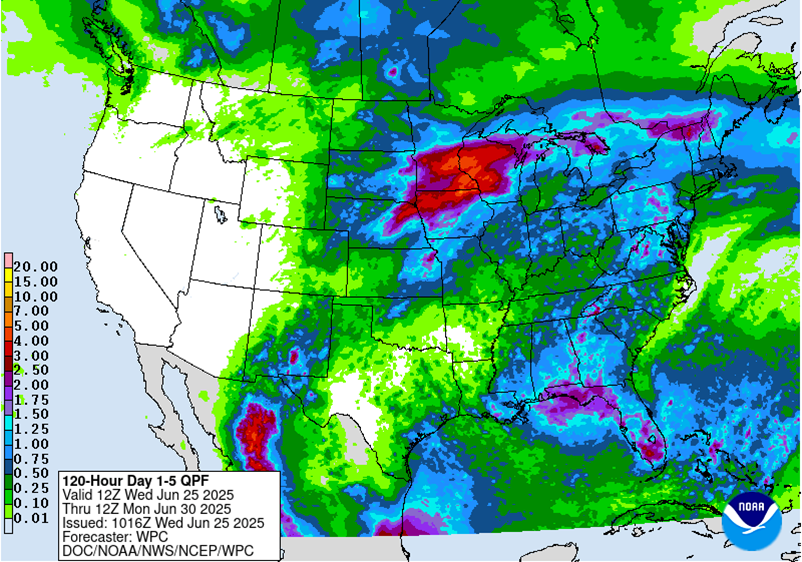
NWS Days 1-5 Precipitation Forecast
The Days 1-5 Precipitation Forecast is produced by the National Weather Service’s Weather Prediction Center for June 25-30, 2025.
Oklahoma wheat harvest continues with producers making great strides despite fighting mud in several locations across central and Northern Oklahoma. **Test weights across the state have dropped due to all the heavy rains last week, but statewide we are still looking at a 59 lb. per bushel average despite some lower test weights reported based on location and variety. Yields across the state are being reported from the mid 30’s to mid 50’s for the most part. Producers with management intensive plans have been reporting yields in the mid 60’s to low 80’s. Protein across the state averaging 11.1%. Due to several locations making great progress in parts of Southwest, Central, and North Central, OK the OWC is calling harvest 37% completed at the time of this report. The next OWC harvest report will be published on Wednesday June 25, 2025.
Southwest and Western Oklahoma-
Walters/Temple/Ahpeatone/Ryan/Hulen–Harvest has made great progress in this region over the past 5 days. Despite lower test weights due to rains last week, these locations looking at 58 lb. to 59lb. averages for the region. Yields are ranging all over the board from 20 bushels per acre to 40 bushels per acre, with some higher yields noted on earlier cuttings. Protein averaging 11.9%. It should be noted this region will take in 1/3 less than the five year average due to excessive flooding on wheat that will never be harvested.This region is 90% harvested.
Carter/Brinkman/Altus/Lone Wolf– Test weights have dropped some but this region still looking at 59 lbs. per bushel average test weight for the entire harvest. Yields being reported in the mid 30’s to mid 40’s, with some intensively managed wheat reported to be making in the low 50’s to mid 60’s. Proteins averaging 11.2%. These regions are 95% harvested.
Hobart- This area has not moved along as fast due to heavier rains at times earlier in the season. Test weights averaging 59 lbs. per bushel for the location. Yields ranging in the mid 30’s to mid 50’s with some management intensive wheat making in the high 70’s to low 80’s. Protein is averaging 11.2% Several reports from producers also show good wheat in this region if they are just able to get into the fields to get it harvested. This region reported to be 70% harvested.
Gotebo-This area has not moved along as fast due to heavier rains at times. Test weights averaging 58 lbs. per bushel. Yields ranging from mid 30’s to mid 50’s. Protein is averaging 11.2%. This region is 40% harvested.
Sentinel/Rocky-Producers have made great progress in these regions. Test weights for the entire region averaging 59 lbs. per bushel. Early yields reported in the mid 30’s to mid 40’s on heavily grazed wheat. As producers get further into harvest the yields have gotten better in the mid 40’s to low 50’s in some instances. Protein averaging 11.8%.The Sentinel region is 95% harvested, the Rocky region has received more rain and is 70% completed.
Central Oklahoma
Greenfield-Harvest in this region has made great progress on sandier ground over the weekend. Test weights ranging from 58.5 lbs. to 62 lbs. per bushel depending on variety and location. Yields being reported from the mid 40’s to mid 60’s, with even some higher yields on management intensive wheat. Protein ranging from 10.7% to 11.1%. This area being reported as 50 percent harvested.
Okarche/Piedmont –Producers making progress in this region but have really been fighting mud over the weekend which has hindered the ability for many to get back into fields. Test weights now averaging 59 lbs. for the region. Yield averages reported in the mid 40’s with some management intensive wheat reported to be making in the mid 50’s to low 60’s. Protein is varying in this region, but East of Okarche into Piedmont region several higher proteins being reported above 12%.This region is 50 percent harvested.
Kingfisher/Omega/Loyal/Reeding – Some lower test weights now coming in the region. The area still looking at 58 lb. per bushel to 59 lb. per bushel average for the region. Yields ranging in the mid 30’s to mid 50’s depending on management practices. Several producers have grazed heavily in this region which has impacted yield. Producers that did not graze heavily with management intensive plans reporting yields in the mid 50’s to mid 60’s. Proteins ranging from 10.5% to 11.2%. The Kingfisher region is 50 percent harvested, Omega location is 35% harvested, Loyal and Reeding locations are 30% completed.
North Central and Northern Oklahoma
McWillie/Helena/Goltry- Producers in McWillie/Helena area made great progress this past 5 to 6 days. Test weights still averaging 60 lbs. per bushel on later cuttings. Yields ranging from high 30’s to mid 50’s depending on management practices. Some intensively managed wheat reported to be making in the mid 60’s. No protein was reported at this time. This region is considered to be 50% harvested.
Kremlin/Hunter/Pond Creek-Producers have just gotten good starts over the weekend in this region and have been fighting mud. Test weights are still holding up remarkably well with ranges from 58 lbs. to 61 lbs. per bushel depending on location and variety. Yields reported in the mid 40’s to mid 50’s on these early cuttings for the most part. Some intensively managed fields making in the mid 60’s. Protein averaging 11.2%. This region considered to be 20% harvested.
Tonkawa/Ponca City/Blackwell/Braman– This region just getting a good start over the weekend. Test weights being reported at 58 lbs. to 59 lbs. per bushel. This region has had extremely heavy rains and for test weights to be holding at these averages is a welcome surprise. Yields on early cuttings ranging from low 40’s to mid 50’s for the most part. It should be noted that a large area in this region has either suffered severe flooding and hail events. Also several fields will most likely be abandoned due to heavy weed issues. Protein on early cuttings averaging 11.1%. This region is considered 8% harvested.
Northwest Oklahoma
Shattuck/Comargo- Producers have made great strides in this region over the last 5 days. Yields reported as making in the low 30’s to mid 40’s. This area has also been heavily grazed and for this reason yields are a bit lower. Test weights coming in at 60 lbs. or higher. Protein averaging 11.1% This region is considered to be 60% harvested.
Burlington- Producers have made great strides in this region over the last 5 days. Yields being reported from mid 50’s to mid 60’s for the most part. Some intensively managed production making in the mid 80’s. Test weights averaging 60 or above. Protein reported at 11.1%. This region is considered 60% harvested.
Northeast Oklahoma
Afton/Miami- Producers are just getting into fields over the weekend in this region. They have had to fight heavy rains and extremely muddy conditions. This region reporting two classes — Hard Red Winter and Soft Red Winter wheat. This region reported at 5 percent complete.
**Hard Red Winter Class, test weights have been averaging 55 lbs. per bushel. Yields are ranging in the mid 20’s to mid 50’s depending on variety and location.
**Soft Red Winter Class, test weights have been averaging 56 lbs. to 58 lbs. per bushel. Yields are ranging in the mid 20’s to mid 50’s depending on variety and location.
Wheat Classes And What They Are Used For
Hard Red Winter (HRW) – A versatile wheat with excellent milling and baking characteristics for pan bread. Hard Red Winter wheat is also a choice for Asian noodles, hard rolls, flat breads, general purpose flour and cereal.
Soft Red Winter (SRW)– A versatile, weak-gluten wheat with excellent milling and baking characteristics suited for cookies, crackers, pretzels, pastries and flat breads.
Panhandle
Texhoma/Goodwell/Guymon/Hooker-A large portion of dryland harvest has taken place over the past week in the Panhandle. Yields on dryland wheat ranging from 20 bushels per acre to 50 bushels per acre depending on variety and location. Test weights on dryland wheat ranging from 55 lbs. to 61 lbs. per bushel depending on variety and location. Proteins averaging 11.5% for the region. At the time of this report, no irrigated wheat has been reported as being harvested. It is thought producers will start getting into irrigated wheat the end of this week. The dryland wheat in this region is considered 50 percent harvested.
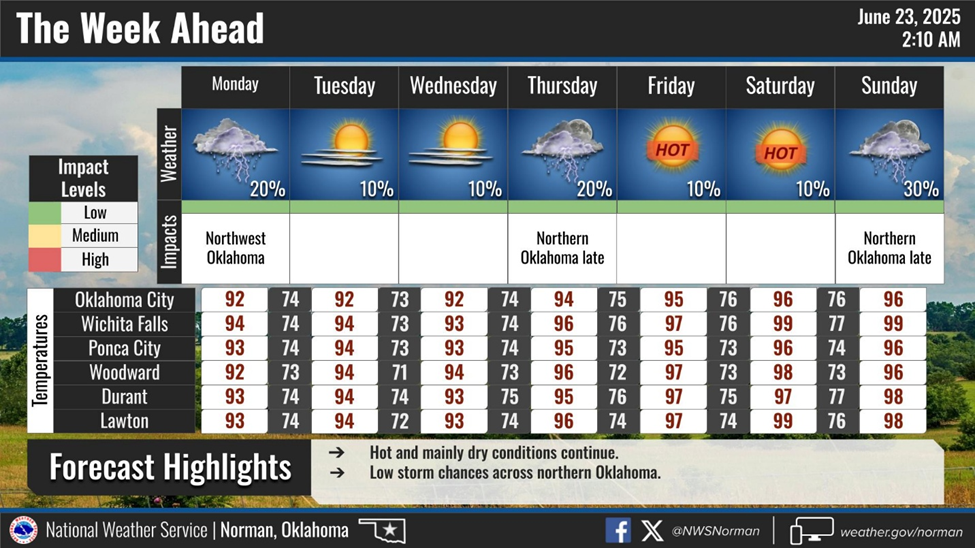
Below, see the 7-day forecast provided by the Oklahoma Mesonet.
NWS Days 1-5 Precipitation Forecast
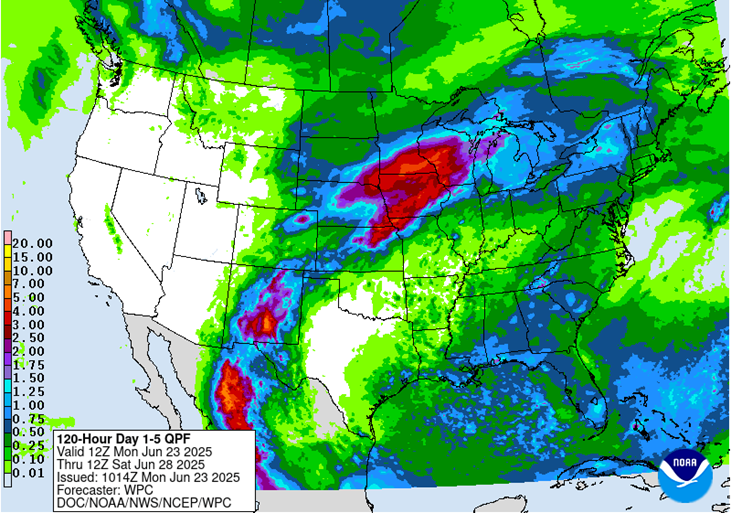
The Days 1-5 Precipitation Forecast is produced by the National Weather Service’s Weather Prediction Center for June 23-28, 2025.
The Oklahoma Harvest Report will be brief today as harvest is virtually at a standstill in all locations across the state due to rains over the weekend. Some producers were hoping the ground would be able to carry them in parts of central and north central Oklahoma late this afternoon.
Oklahoma wheat harvest made strides Wednesday through Friday of last week, but then statewide rains across most all regions of the wheat belt have hindered progress. Producers and custom harvesters have been getting late starts even on the days they could get into the fields due to high humidity. Test weights have dropped in some locations of Southwest and Central Oklahoma, but overall test weights across the state were still 60 plus in most locations up until Friday evening. It is thought that in Northern Oklahoma where wheat has a later maturity date that hopefully test weights will hold up in those regions once producers get into the fields. Yields across the state have been ranging from 30 bushels per acre to 50 bushels per acre depending on management practices. Producers with management intensive plans have been reporting yields in the mid 60’s to mid 80’s, depending on weather and location. Proteins have been ranging from 10.5% to 11.4% with higher proteins noted in parts of south central and central Oklahoma where proteins are as high as 13.7%. The Oklahoma Wheat Commission is calling harvest 30% completed.
Panhandle Dryland Harvest Begins
**Dryland wheat harvest has begun in the Oklahoma Panhandle, and harvest was proceeding forward in parts of the Panhandle this afternoon. Some areas of the Panhandle also got rain over the weekend, which will delay producers getting into fields in some locations. Harvest on dryland wheat was taking place around Turpin, Goodwell, Guymon and Hooker. Test weights on dryland wheat in the Panhandle were reported at 60 lbs. to 62 lbs. per bushel on early cuttings, with some poorer wheat having test weights reported at 56 lbs. to 59 lbs. per bushel. Yields on the early dryland wheat in the Panhandle ranging from 20 bushels to 60 bushels per acre depending on location. Some producers are hoping to start on irrigated wheat in this region by the end of the week if weather cooperates. No protein was reported on early cuttings.
Note: The OWC will not be putting a harvest report out this coming Wednesday but will plan to put a report out on Monday June 23, 2025.
NWS Days 1-5 Precipitation Forecast
The Days 1-5 Precipitation Forecast is produced by the National Weather Service’s Weather Prediction Center for June 16-21, 2025. See 2-Day Rainfall Accumulation (inches) measured by Oklahoma Mesonet. Please note several places have high humidity and received larger amounts of moisture than reported by the Mesonet over the past 2 days which has hindered harvest in many locations.
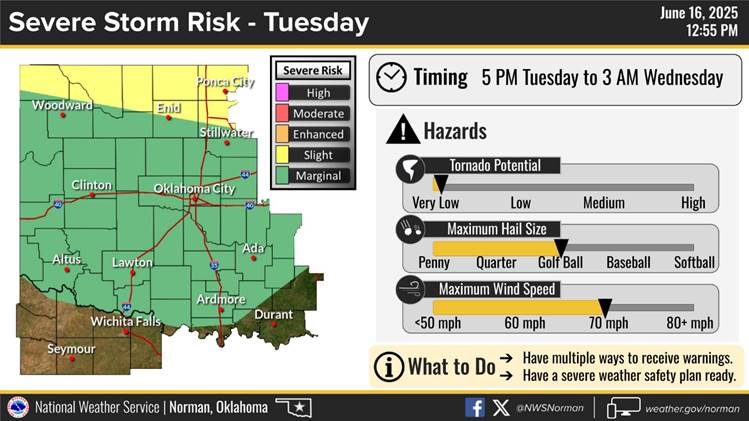
See Rain & Storm Chances for Tuesday and Wednesday of this week.
Oklahoma wheat harvest has producers cutting from the Oklahoma/Texas to Oklahoma/Kansas state line. Harvest is moving fast in several regions where producers and crews have been able to get across the ground. In several other locations producers have had to fight wet ground and mud making the process much slower.
**Test weights reported at all locations ranging from 58 lbs. to 63 lbs. per bushel, most of the wheat is still coming in at 60 lbs. per bushel or higher. We have seen lower test weights in parts of Southern Oklahoma along the Hwy 281 corridor due to heavier rains in this region. (Several fields have also been abandoned and will never be harvested along the 281 corridor due to excessive flooding.) Yields across the state are being reported from the mid 30’s to mid 50’s for the most part. Producers with management intensive plans have been reporting yields in the mid 60’s to low 80’s. Protein across the state averaging 11.1%. Due to several locations making great progress in parts of Southwest, Central, and North Central, OK the OWC is calling harvest 22% completed at the time of this report. The next OWC harvest report will be published on Monday, June 16, 2025.
Southwest and Western Oklahoma-
Walters/Temple/Ahpeatone/Ryan/Hulen–Harvest has not moved as fast in this region as in other locations in southwest Oklahoma due to excessive rain. Producers have made progress in the last two days but still are fighting mud. This region will have several fields abandoned due to excessive flooding. The wheat that is coming in is still weighing decent at 58 lbs. to 60 lbs. per bushel, considering what the crop has gone through, with up to 20 inches of moisture in some places the last two months. Yields ranging from the low 30’s to mid 40’s mostly for the wheat being harvested. Surprisingly, even with all the rain this area is reporting higher pockets of protein with a 12% protein average.
Apache- Producers have not been able to get into the fields in this region as they have been fighting excessive mud. Moisture has been extremely high in this region as well. One producer was reported to be harvesting and his test weight was averaging 61 lbs. per bushel. No yields reported in this region at this time.
Frederick/Davidson– Test weights on better wheat being harvested in this region reported higher than earlier in the week at 60 lbs. to 62 lbs. per bushel. Yields on wheat in this region reported to be making in the mid 30’s to mid 50’s depending on management practices. Proteins reported at 11.0% to 11.5%.
Carter/Brinkman/Lone Wolf– Test weights ranging from 59. lbs. to 61 lbs. per bushel. Yields being reported in the mid 30’s to mid 40’s, with some intensively managed wheat reported to be making in the low 50’s to mid 60’s. Proteins ranging from 11% to 12.2%.
Hobart- This area is just getting a good start as of yesterday, due to producers fighting excessive mud. Test weights are averaging 62 lbs. for this location on early wheat being taken in. Early reports of good wheat making in the mid 40’s to mid 50’s with some management intensive wheat making in the high 70’s to low 80’s. Several reports from producers also show good wheat in this region if they are just able to get into the fields to get it harvested.
Sentinel/Rocky-Producers in this region just getting a good start yesterday as they have been fighting mud and high humidity. Test weights on early cuttings reported at 59 lbs. to 61 lbs. per bushel. Yields being reported in the mid 30’s to mid 40’s. Several producers opted to graze the wheat in this region which has impacted yield on early cuttings. Protein ranging from 10.8% to 11.2%.
Cordell- No report today on early harvest cuttings. Several acres from Clinton to Cordell region will not be harvested due to loss from severe hail damage.
Central Oklahoma
Greenfield-Harvest is picking up in this region on the East side of town. Areas north and west of this region are still fighting mud with producers struggling to get into fields. Test weights ranging from 58.5 lbs. to 62 lbs. per bushel. Yields being reported from the mid 40’s to mid 60’s on the wheat being taken in today. Protein ranging from 10.7% to 11.1%.
Okarche/Piedmont –Producers getting a good start in this area as of yesterday. Test weights ranging from 59.1 to 62 lbs. per bushel. Yield averages reported in the mid 40’s with some management intensive wheat reported to be making in the mid 50’s to low 60’s. Protein is varying in this region, but East of Okarche into Piedmont region several higher proteins being reported with a 12.47% protein average on early cuttings.
Reeding- No report for this location as producers have been fighting mud. They are hoping harvest will get rolling better in this area late this afternoon.
Kingfisher/Lomega/Hennessey- Test weights ranging from 59 lbs. to 63 lbs. per bushel depending on location and variety. Yields ranging in the mid 30’s to mid 40’s depending on management practices. Several producers have grazed heavily in this region which has impacted yield. Producers that did not graze heavily with management intensive plans reporting yields in the mid 50’s to mid 60’s. Proteins ranging from 10.5% to 11.2%.
Loyal/Fairview/Okeene/Meno/Lahoma- These locations had a busy day yesterday with producers being able to get into fields. Test weight averages for the region ranging from 60lbs. to 61 lbs. per bushel. Some poorer fields making in the high 30’s to low 40’s, with other reports of good wheat to be making in the mid 40’s to low 50’s. Proteins ranging from 10.8 to 11.5%.
North Central and Northern Oklahoma
McWillie/Helena/Goltry- Producers in McWillie/Helena area made great progress this past two days. Harvest has been slower by Goltry due to heavier rains. Test weights ranging from 60lbs. to 62 lbs. per bushel. Yields ranging from high 30’s to mid 50’s depending on management practices. Some intensively managed wheat reported to be making in the mid 60’s. No protein was reported at this time.
Kremlin/Hunter/Pond Creek-Test cuttings have been going on with some producers in this region, but nothing reported being taken in at elevator locations at this time, as producers are fighting mud and humidity. Several of the later varieties of wheat are still green in many fields.
Tonkawa/Ponca City/Blackwell/Braman– As of this morning Blackwell had received one load of grain, test weights and yields were not reported on the early cutting. It is still extremely wet in this region.
Northwest Oklahoma
Shattuck- Producers just getting started in this region. Early cuttings are on heavily grazed wheat reported as making in the low 30’s. It is thought yields will get better if producers can get into the fields. Test weights coming in at 60lbs. or higher.
Burlington- Producers were just getting started in this region yesterday. No yields were reported at this location but test weights on early cuttings were 60 lbs. and higher.
Northeast Oklahoma
Afton/Miami- No grain has been taken in at these locations. Most wheat is ready in the region, but fields are too wet for combines to travel over. If weather cooperates it is predicted harvest should get rolling the beginning of next week.
Panhandle
**No wheat reported as being harvested in the Panhandle at this time. It is thought that producers will be trying dryland wheat harvest the beginning of next week if it stays dry.
Below, see the 7-day forecast provided by the Oklahoma Mesonet.
NWS Days 1-5 Precipitation Forecast
The Days 1-5 Precipitation Forecast is produced by the National Weather Service’s Weather Prediction Center for June 11-16, 2025. See 2-Day Rainfall Accumulation (inches) measured by Oklahoma Mesonet. Please note several places have high humidity and received large amounts of moisture over the past 5 days which has hindered harvest in many locations.
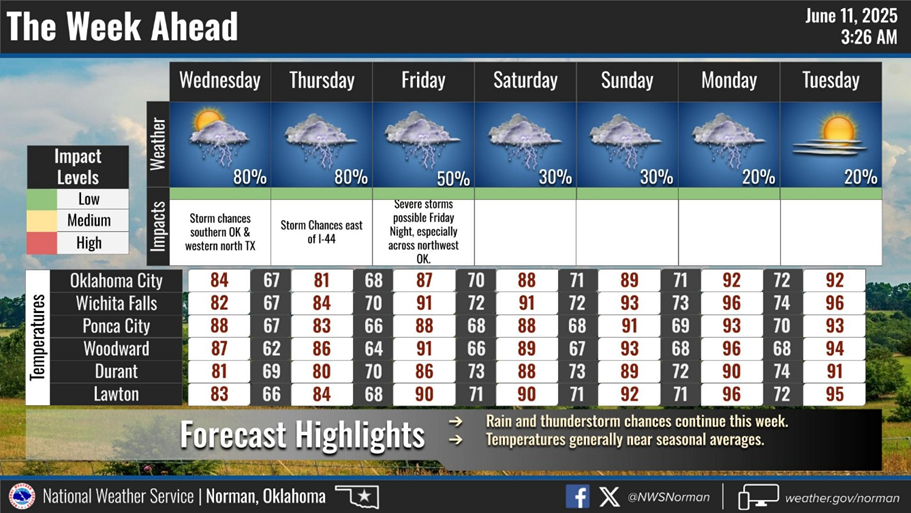
See Rain & Storm Chances for Wednesday and Thursday of this week.
Oklahoma wheat harvest had several locations in Southwest and Central Oklahoma taking small amounts of grain as producers were trying to get into fields on Saturday and Sunday. All locations were getting late starts due to high humidity and producers fighting mud from rains off and on over the past week. Producers are hoping to get back into the fields this afternoon.
**Test weights reported at all locations ranging from 58 lbs. to 64 lbs. per bushel, most of the wheat is still coming in at 60 lbs. per bushel or higher. Yields are being reported from the mid 30’s to mid 40’s for the most part. Producers with management intensive plans have been reporting yields in the mid 50’s to mid 60’s. Protein on early cuttings reported from 10.8% to 11.5%. Most locations reporting an 11% average.
Southwest and Western Oklahoma
Tipton-Test weights on early cuttings ranging from 60 lbs. to 61 lbs. per bushel. Yields on early cuttings ranging from mid 30’s to mid 40’s. Some management intensive wheat making in the mid 60’s. These are on early cuttings, moisture has been a challenge with producers getting early starts.
Frederick/Davidson– Test weights on early cuttings reported from 58 lbs. to 63 lbs. per bushel. Yields on early cuttings are decent with reports in the mid 30’s to mid 40’s. Early proteins reported at 11.0% to 11.2%.
Altus/ Roosevelt/Lone Wolf– Test weights on early loads ranging from 60 lbs. to 64 lbs. per bushel. Yields being reported in the mid 30’s to mid 40’s, with some intensively managed wheat reported to be making in the low to mid 50’s.
Sentinel-Test weights on early cuttings reported at 61 lbs. to 63 lbs. per bushel. Yields on early cuttings being reported in the mid 40’s. Protein ranging from 10.8% to 11.2%.
Rocky- No wheat had been taken in at this location over the weekend. Producers hoping to get into the fields later this afternoon or tomorrow.
Central Oklahoma
Greenfield-A couple loads were taken in over the weekend. Test weight was 58.5 lbs. per bushel. Yields not reported. Protein not reported. Moisture on this cutting was 13.2% but other samples in the area were 14% or higher yesterday. West of town got heavy rains last night, East and southeast of town producers are hopeful to get in the field late this afternoon. Heavy rains reported North of Watonga yesterday evening.
Okarche/ Reeding/Kingfisher/Lomega- Test weights on early cuttings reported at 60 lbs. to 63 lbs. per bushel. Yields reported in the mid 40’s with some management intensive wheat reported to be making in the mid 50’s. Protein reported from 10.9% to 11.2%.
No reports on wheat taken in at locations further North than Lomega, on the Hwy 33 corridor. We did have one report of a producer who did some test cutting by Lahoma, but nothing was reported on those early cuttings. A couple producers out by Fairview were hoping to try later this afternoon.The Oklahoma Wheat Commission is calling harvest 5% complete as of today.
Below, see the 7-day forecast provided by the Oklahoma Mesonet.
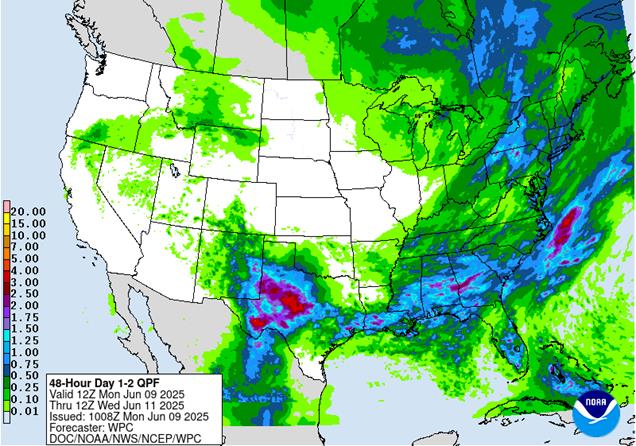
NWS Days 1-2 Precipitation Forecast
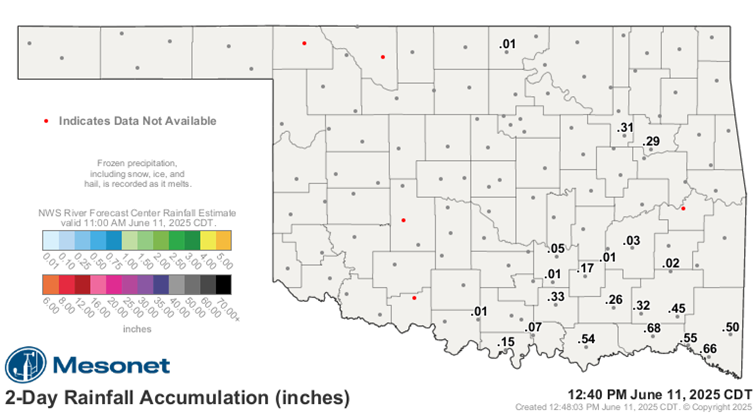
The Days 1-2 Precipitation Forecast is produced by the National Weather Service’s Weather Prediction Center for June 9-11, 2025. See 2-Day Rainfall Accumulation (inches) measured by Oklahoma Mesonet. Please note several places in the Panhandle, Northern and North Central Oklahoma got larger amounts of moisture than what has been reported by the Mesonet over the past 2 days.
Severe Weather Potential Indications for Thursday and Friday this week!
Oklahoma wheat harvest is at a standstill across the state today. Some minor harvesting continued in parts of Southwest Oklahoma yesterday, but most places were rained out. Southwest of Altus and North of Altus got heavy rains that moved East causing large amounts of moisture in Grady County and locations further east of the I-35 corridor. Rains and high humidity also delayed harvest from taking place in Central Oklahoma. More rains continue to be predicted starting tomorrow through the weekend across western Oklahoma. The next Oklahoma harvest report will be published on Monday, June 9, 2025.
There is no new harvest report at this time, as most locations have not seen any harvest activity since Monday. To view Monday’s report, please refer to my previous post.
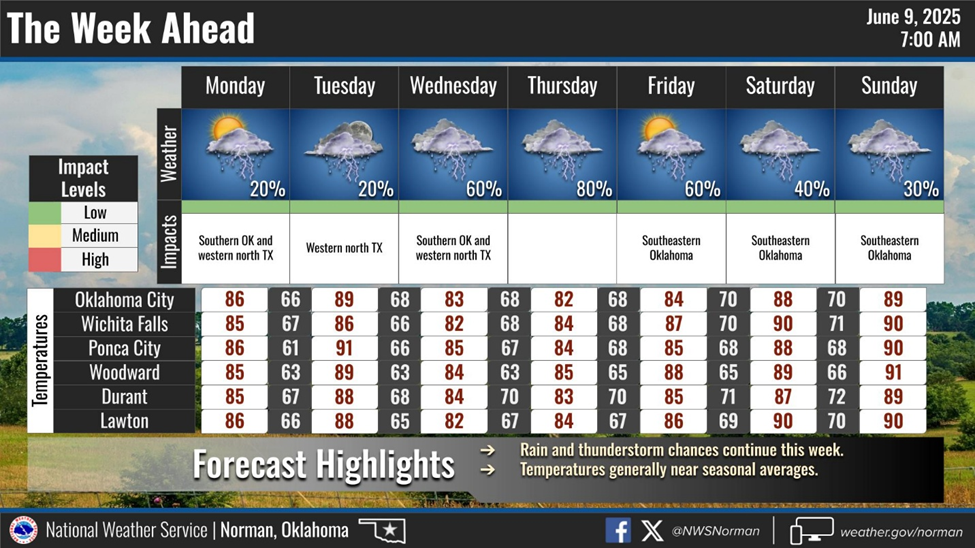
Below, see the 7-day forecast provided by the Oklahoma Mesonet and the 5-day precipitation forecast along with Monday and Tuesday storm potentials.
NWS Days 1-5 Precipitation Forecast
The Days 1-5 Precipitation Forecast is produced by the National Weather Service’s Weather Prediction Center for June 4-9, 2025. See 2-Day Rainfall Accumulation (inches) measured by Oklahoma Mesonet.
Severe Weather Potential Indications for Thursday and Friday this week!










 WORLD OF WHEAT