Oklahoma Wheat Crop Update – 2026

Amanda de Oliveira Silva, Small Grains Extension Specialist

The 2026 Oklahoma wheat crop got off to a challenging start. September was exceptionally hot, with a statewide average temperature of 83°F, or ~10°F above normal, making it the warmest September since records began in 1895 (Oklahoma Mesonet, 2026). Hot and dry conditions throughout much of August and September depleted soil moisture and delayed wheat planting, particularly for producers intending to use wheat for fall forage.

Conditions started to improve with widespread rainfall in late September and early October (Figure 1). Many producers in dual-purpose systems took advantage of the improved soil moisture and planted wheat. As rainfall continued across much of the state through October, planting of grain-only wheat also progressed rapidly.
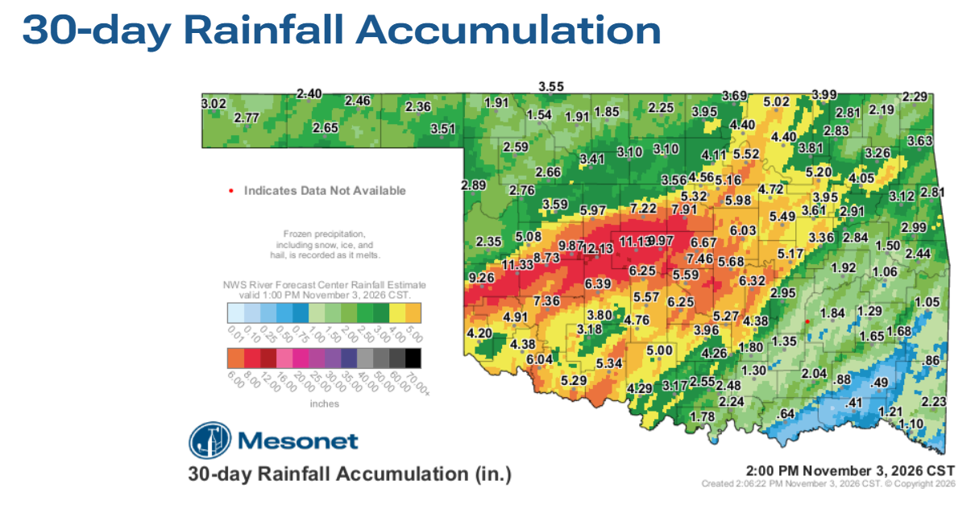
Figure 1. 30-day Rainfall Accumulation. Source: https://www.mesonet.org/weather/rainfall?ref=1208

As we entered November, 62% of Oklahoma wheat had been planted and 41% had emerged, compared with the five-year averages of 79% and 59%, respectively (USDA-NASS Crop Progress Report, November 2, 2026). Although planting progressed considerably following the October rainfall, it remains behind the historical average. Overall, wheat that has emerged is looking good across much of the state and fall forage production has improved considerably following the October rainfall (Figure 2). This is a welcome change after the difficult conditions Oklahoma wheat producers experienced last season.
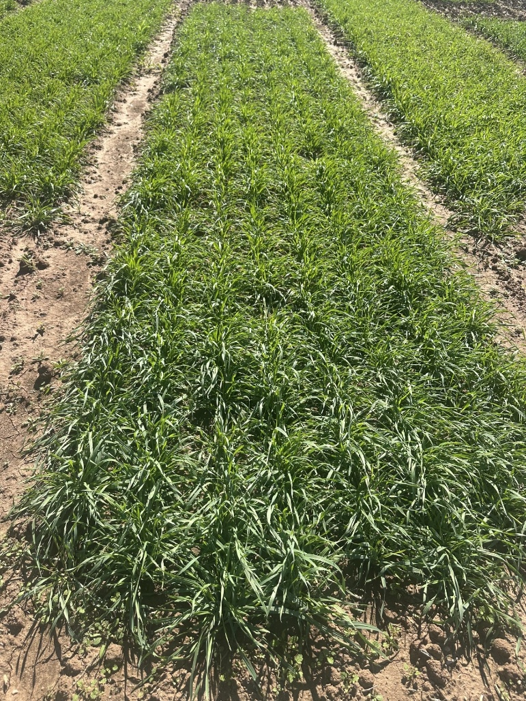
Figure 2. Wheat growth and forage conditions in Byron, Oklahoma. Wheat was planted in mid-September. Photo taken in mid-October 2026 by Brian Pugh, State Forage Specialist.

Despite the recent rainfall, drought conditions have not completely disappeared. October rainfall resulted in substantial improvements in drought conditions and soil moisture across Oklahoma, but longer-term moisture deficits remain in portions of the state (U.S. Drought Monitor; NIDIS, 2026) and (Figure 3). Rainfall and stored soil moisture will continue to be important as the crop moves into winter.
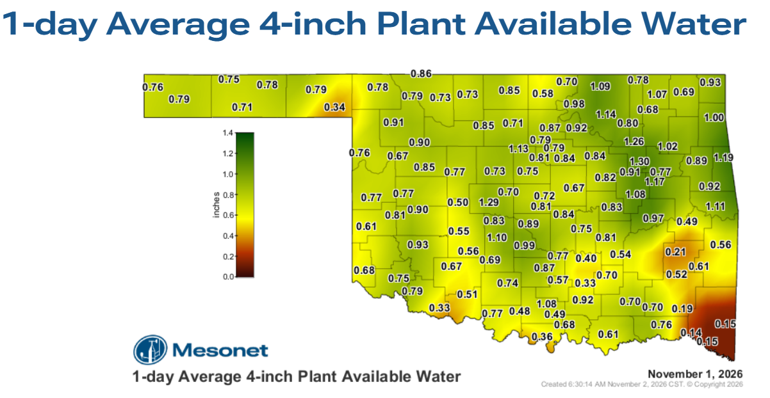
Figure 3. Average plant available water. Courtesy http://www.mesonet.org.

Still have wheat to plant or replant?

For producers who still have grain-only wheat to plant or fields that need replanting, there is still time to establish a productive crop. As planting moves further into November, wheat has less time for fall growth and tiller and root development before winter, making good stand establishment increasingly important.

Our recent research has shown that the critical seeding rate increases as wheat planting is delayed (Israel M. Cyrineu et al., 2026). However, this does not necessarily mean that producers should automatically increase their seeding rate when planting late. In our Oklahoma field experiments, increasing seeding rate under delayed sowing did not improve grain yield, suggesting that commonly used seeding rates may already be sufficient to maximize yield under certain conditions (Israel M. Cyrineu et al., 2025).

The practical message is to consider both planting date and the seeding rate already being used. Producers planting at relatively low seeding rates may benefit from increasing the rate as planting is delayed, whereas those already using moderate to high grain-only seeding rates may see little benefit from adding more seed.

Regardless of seeding rate, good seed placement, adequate seed-to-soil contact, and establishing a uniform stand become increasingly important as the planting window gets shorter.

Sources

Israel M. Cyrineu, Gustavo A. Slafer, Brett F. Carver, Amanda de Oliveira Silva. 2025. Delayed-sown winter wheat: The role of short-season genotype and seeding rate, European Journal of Agronomy, Volume 170, 2025, 127766, ISSN 1161-0301. https://doi.org/10.1016/j.eja.2025.127766.

Israel M. Cyrineu, Victor Sadras, Mariano Cossani, and Amanda de Oliveira Silva. 2026. Additive, synergistic, or antagonistic? Relationships between sowing date and seeding rate affecting yield of winter wheat. Crop Science, 66(2), e70252. https://doi.org/10.1002/csc2.70252

Oklahoma Mesonet. 2026. September Scorches Oklahoma, Then Delivers a Splash of Hope. https://www.mesonet.org/news/september-scorches-oklahoma-then-delivers-splash-of-hope

USDA National Agricultural Statistics Service. 2026. Crop Progress. November 2, 2026. https://esmis.nal.usda.gov/publication/crop-progress

National Integrated Drought Information System (NIDIS). 2026. Drought Status Update for the Southern Plains. October 22, 2026. https://www.drought.gov/drought-status-updates/drought-status-update-southern-plains-2026-10-22

Oklahoma Wheat Harvest Moves Slightly Forward over Last Week – July 7, 2025

By: The Oklahoma Wheat Commission

Oklahoma wheat harvest moved forward at a slow pace over the 4th of July weekend, with rain showers hitting several parts of the Panhandle, Northern and Northeast Oklahoma at different times. There is a region in the Goodwell, Guymon and Hooker area that is still working on irrigated wheat production that has been delayed due to rains this past week.  In North Central Oklahoma, little progress has been made, with producers cutting just to check moisture samples while fighting with mud. In Northeast Oklahoma progress was made over the weekend, but rain showers yesterday evening have put harvest at a standstill as of today.

Several producers are weighing options as weeds become more of an issue. Test weights have dropped significantly in many parts of North Central Oklahoma in the 56 lbs. to 58 lbs. per bushel. Many producers have been surprised test weights have been holding up as good as they have been despite everything the crop has been through.

The statewide average for test weight is still reported at  59 lbs. as much heavier weights were harvested earlier in the season. Yields across the state are ranging from the mid 40’s to mid 50’s for the most part, with some lower yielding wheat being reported due to heavy rains.

Management intensive producers have reported higher yields ranging in the mid 60’s to mid 80’s. Producers had better wheat in many Northern parts of the state but now will see some yield loss due to lower test weights. Protein ranges have been all over the board from 9.8% to 14.2% depending on management and location. Protein average for the state of Oklahoma is at 11.2%. 

The Oklahoma Wheat Commission is calling harvest 85% completed as of today. This will be the last harvest report of the season and will be considered a fair representation of quality in the state, even though some quality targets will be lower than expected on what remains.

**It should be noted some minor instances of sprout has been reported at a 1% to 3% level, but in most regions the crop is still holding up without much sprout damage.  If sprout becomes more of an issue, then producers will most likely opt to utilize for feed wheat.

Intensively managed wheat reported to be making in the mid 60’s. No protein was reported at this time. This region is considered to be 95% harvested.

Garber/Kremlin/Hunter/PondCreek- Producers have been fighting mud in this region all harvest, with little movement over the past 5 days. Test weights have declined some ranging from 55 lbs. to 58 lbs. per bushel. Yields reported in the mid 40’s to mid 50’s for the most part. Some intensively managed fields making in the mid 60’s.  Protein averaging 11.2%. This region considered to be 57% harvested.

Tonkawa/PoncaCity/Blackwell/Braman– Test weights being reported at 56 lbs. to         58 lbs. per bushel.  This region has had heavy rains the last 5 days putting harvest at a standstill for the past week. Yields on early cuttings ranging from low 40’s to mid 50’s for the most part. It should be noted that a large area in this region has suffered severe flooding and hail events.  Also several fields will most likely be abandoned due to heavy weed issues.  Protein on early cuttings averaging 11.1%.  This region is considered 52% harvested.

Northeast Oklahoma

Afton/Miami- Producers have fought rain in this region all harvest, but towards the beginning of the weekend a couple days was suitable for cutting, with producers making progress. Rain showers yesterday also halted further progress. This region reporting two classes — Hard Red Winter and Soft Red Winter wheat.  This region reported at 80% percent complete.

**Hard Red Winter Class, test weights have been averaging 56 lbs. per bushel.  Yields are ranging in the mid 20’s to mid 50’s depending on variety and location.

**Soft Red Winter Class, test weights have been averaging 56 lbs. per bushel. Yields are ranging in the mid 20’s to mid 50’s depending on variety and location. We did have a couple of yields reported in the low 70’s.

Wheat Classes And What They Are Used For

Hard Red Winter (HRW) – A versatile wheat with excellent milling and baking characteristics for pan bread. Hard Red Winter wheat is also a choice for Asian noodles, hard rolls, flat breads, general purpose flour and cereal.

Soft Red Winter (SRW) – A versatile, weak-gluten wheat with excellent milling and baking characteristics suited for cookies, crackers, pretzels, pastries and flat breads.

Panhandle

Balko/Goodwell/Guymon/Hooker- A large portion of dryland harvest has now been completed in all regions of the Panhandle.   Dryland wheat harvest is 98 percent complete. A great deal of irrigated wheat harvest has taken place in central regions of the Panhandle around the Balko area, while producers in the Guymon and Hooker region have been delayed with rains and high humidity. Dryland wheat yields reported from 20 bushels to 50 bushels per acre depending on variety and location.   Irrigated wheat yields from 80 bushels to 120 bushels per acre.  Test weights on dryland wheat ranging from 55 lbs. to 62 lbs. per bushel depending on variety and location.   Test weight on irrigated wheat that was reported ranging from 57 lbs. to 61 lbs. per bushel.   Protein average for the Panhandle has varied more so than other years but many parts of the region looking at 12% averages.  The Panhandle region is considered 75 percent completed with harvest.

Below, see the 7-day forecast provided by the Oklahoma Mesonet.

NWS Days 1-5 Precipitation Forecast 

The Days 1-5 Precipitation Forecast is produced by the National Weather Service’s Weather Prediction Center for July 7-12, 2025.