Amanda de Oliveira Silva, Small Grains Extension Specialist
The 2026 Oklahoma wheat crop got off to a challenging start. September was exceptionally hot, with a statewide average temperature of 83°F, or ~10°F above normal, making it the warmest September since records began in 1895 (Oklahoma Mesonet, 2026). Hot and dry conditions throughout much of August and September depleted soil moisture and delayed wheat planting, particularly for producers intending to use wheat for fall forage.
Conditions started to improve with widespread rainfall in late September and early October (Figure 1). Many producers in dual-purpose systems took advantage of the improved soil moisture and planted wheat. As rainfall continued across much of the state through October, planting of grain-only wheat also progressed rapidly.
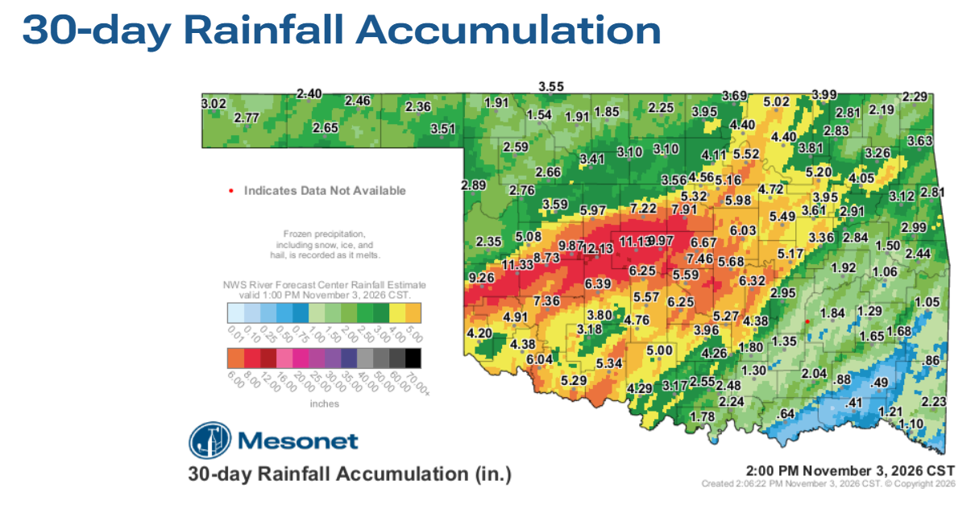
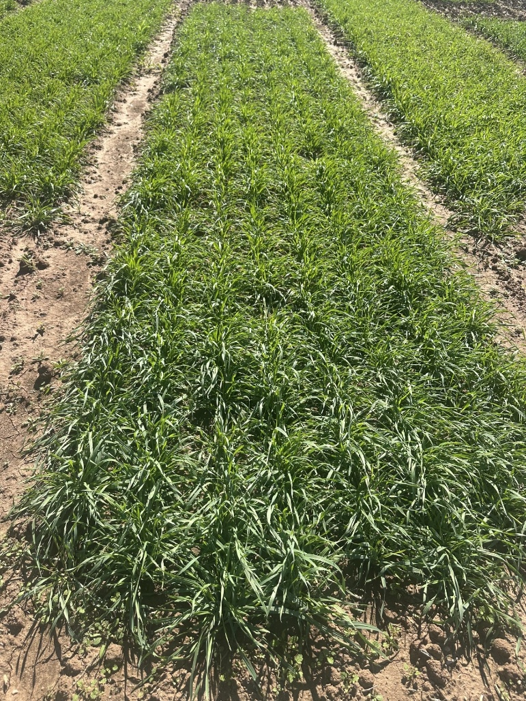
As we entered November, 62% of Oklahoma wheat had been planted and 41% had emerged, compared with the five-year averages of 79% and 59%, respectively (USDA-NASS Crop Progress Report, November 2, 2026). Although planting progressed considerably following the October rainfall, it remains behind the historical average. Overall, wheat that has emerged is looking good across much of the state and fall forage production has improved considerably following the October rainfall (Figure 2). This is a welcome change after the difficult conditions Oklahoma wheat producers experienced last season.
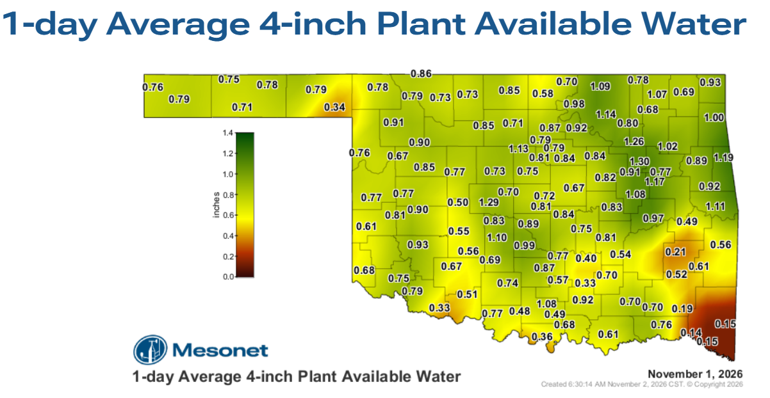
Despite the recent rainfall, drought conditions have not completely disappeared. October rainfall resulted in substantial improvements in drought conditions and soil moisture across Oklahoma, but longer-term moisture deficits remain in portions of the state (U.S. Drought Monitor; NIDIS, 2026) and (Figure 3). Rainfall and stored soil moisture will continue to be important as the crop moves into winter.
Still have wheat to plant or replant?
For producers who still have grain-only wheat to plant or fields that need replanting, there is still time to establish a productive crop. As planting moves further into November, wheat has less time for fall growth and tiller and root development before winter, making good stand establishment increasingly important.
Our recent research has shown that the critical seeding rate increases as wheat planting is delayed (Israel M. Cyrineu et al., 2026). However, this does not necessarily mean that producers should automatically increase their seeding rate when planting late. In our Oklahoma field experiments, increasing seeding rate under delayed sowing did not improve grain yield, suggesting that commonly used seeding rates may already be sufficient to maximize yield under certain conditions (Israel M. Cyrineu et al., 2025).
The practical message is to consider both planting date and the seeding rate already being used. Producers planting at relatively low seeding rates may benefit from increasing the rate as planting is delayed, whereas those already using moderate to high grain-only seeding rates may see little benefit from adding more seed.
Regardless of seeding rate, good seed placement, adequate seed-to-soil contact, and establishing a uniform stand become increasingly important as the planting window gets shorter.
Sources
Israel M. Cyrineu, Gustavo A. Slafer, Brett F. Carver, Amanda de Oliveira Silva. 2025. Delayed-sown winter wheat: The role of short-season genotype and seeding rate, European Journal of Agronomy, Volume 170, 2025, 127766, ISSN 1161-0301. https://doi.org/10.1016/j.eja.2025.127766.
Israel M. Cyrineu, Victor Sadras, Mariano Cossani, and Amanda de Oliveira Silva. 2026. Additive, synergistic, or antagonistic? Relationships between sowing date and seeding rate affecting yield of winter wheat. Crop Science, 66(2), e70252. https://doi.org/10.1002/csc2.70252
Oklahoma Mesonet. 2026. September Scorches Oklahoma, Then Delivers a Splash of Hope. https://www.mesonet.org/news/september-scorches-oklahoma-then-delivers-splash-of-hope
USDA National Agricultural Statistics Service. 2026. Crop Progress. November 2, 2026. https://esmis.nal.usda.gov/publication/crop-progress
National Integrated Drought Information System (NIDIS). 2026. Drought Status Update for the Southern Plains. October 22, 2026. https://www.drought.gov/drought-status-updates/drought-status-update-southern-plains-2026-10-22

