The drought is worsening and forage is getting harder and harder to come by. Crop residue that was once considered of little nutritional value for livestock has become a staple for Oklahoma cattle producers with depleted pasture and hay reserves. John Holman with KSU in Garden City indicated that grazing of sorghum stalks has become commonplace in western KS as well. Some crop residue can be removed without significant damage to long-term gains in soil structure associated with no-till, but overgrazing can lead to some real problems when the wind comes sweeping down the plain.
Wind erosion is commonly thought of as a conventional-till problem, but in an email exchange, Jason Warren recently indicated that there are a few scenarios where wind erosion could actually be worse in no-till than conventional till. No-till results in a relatively smooth, flat soil surface that, in the absence of residue, has few barriers to slow the wind. So, if we have an easily detached soil type (i.e. a sandy soil), a flat surface, and no residue to hold the ground, then we have a recipe for wind erosion. The same would be true for no-till wheat pasture that has been overgrazed. In a wind-erosion-fighting battle royale, I still prefer no-till to conventional till. However, no-till is not immune to wind erosion and it is important to keep some cover on the soil.
Aside from soil protection, it is important to remember that crop residues have value as reservoirs of nutrients. An estimate of nutrient removal of grain, fiber, and forage crops can be found on one of Brian Arnall’s Pete Sheets at http://npk.okstate.edu/petesheets If the cattle are grazing the residue in-field, most of the nutrients will be returned to the soil. If the residue is being baled, the nutrients are leaving with the hay bales. You can estimate the value of these removed nutrients using the linked Pete Sheet and current fertilizer prices.
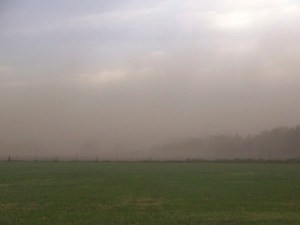
No-till practices to not make soil immune from wind erosion. Adequate cover must be maintained.

