Unknown's avatar

About Amanda De Oliveira Silva

I have served as an Assistant Professor and Small Grains Extension Specialist at Oklahoma State University since August 2019. I believe that close interaction with producers is vital to understand their production strategies and to establish realistic research goals. My program focuses on developing science-based information to improve the agronomic and economic viability of small grains production in Oklahoma and in the Southern Great Plains.

First Hollow Stem update – 2/21/2020

First hollow stem (FHS) is the optimal time to remove cattle from wheat pasture. This occurs when there is 1.5 cm (5/8” or the diameter of dime) of stem below the developing grain head (full explanation). To give you a point of reference, the average FHS date over the past 20 years at Stillwater is March 6.

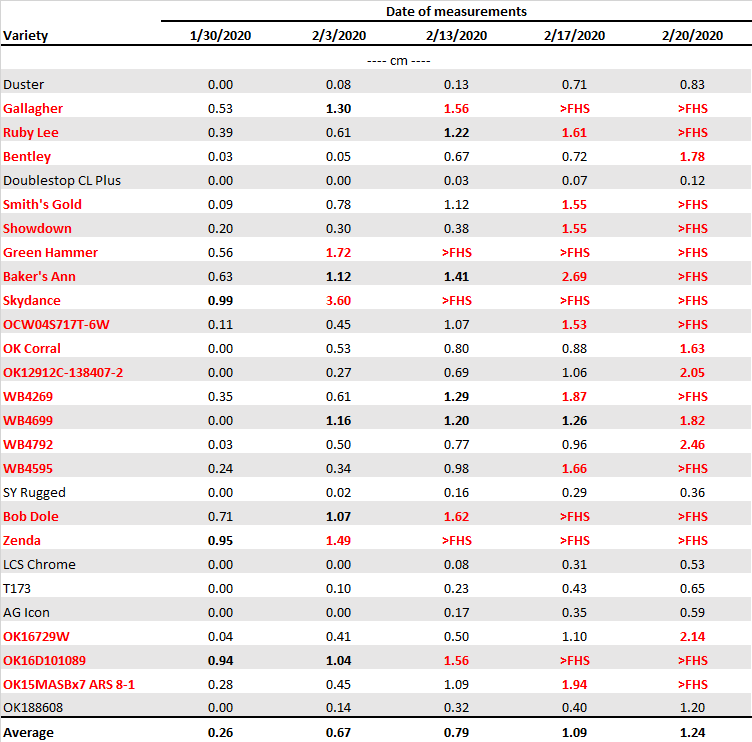
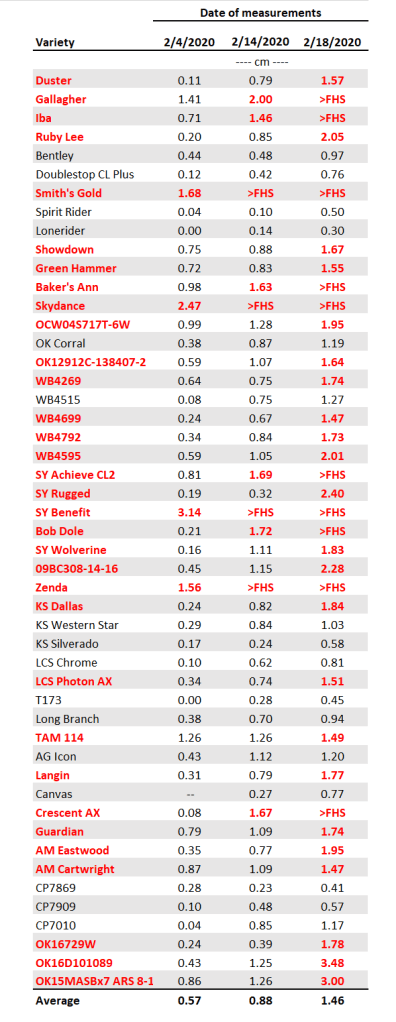
The latest FHS results from our forage trials in Chickasha (Table 1) and Stillwater (Table 2) are listed below. Almost all of the wheat varieties at Chickasha and Stillwater have passed the 1.5 cm threshold.

The Mesonet First Hollow Stem Advisor and the updates we provide give an indication of the FHS stem conditions in a particular area. However, because of the number of factors that can influence when FHS occurs, it is extremely important to check for FHS on a field-by-field basis

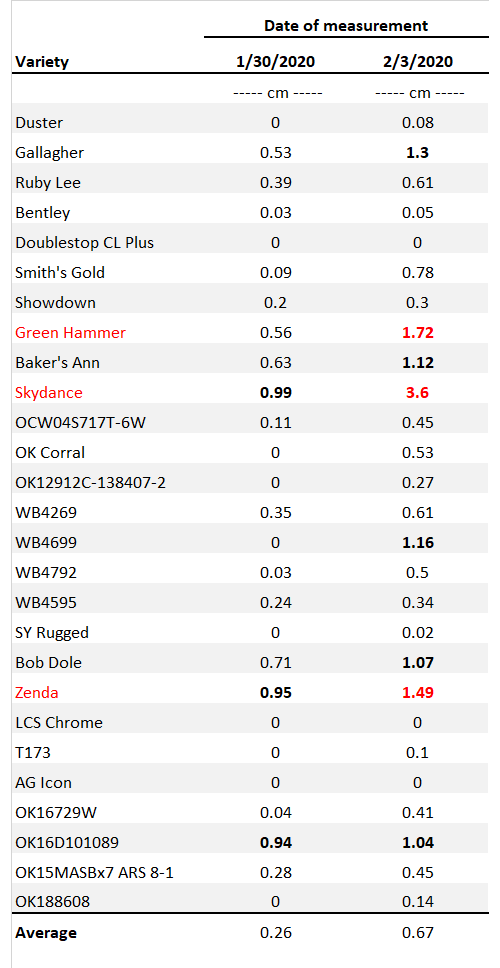
Table 1. First hollow stem (FHS) results for each variety collected at Chickasha. Plots were planted on 09/19/19. The threshold target for FHS is 1.5 cm (5/8″ or the diameter of a dime). The value of hollow stem for each variety represents the average of ten measurements from non-grazed plots. Varieties that have reached FHS are highlighted in red.

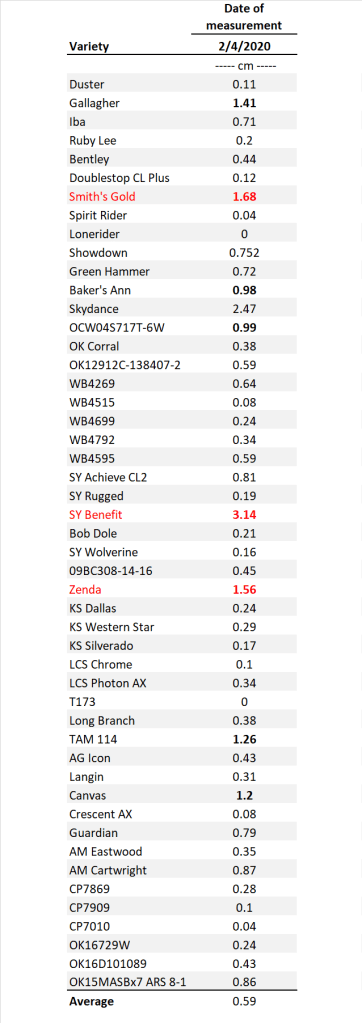
Table 2. First hollow stem (FHS) results for each variety collected at Stillwater. Plots were planted on 09/18/19. The threshold target for FHS is 1.5 cm (5/8″ or the diameter of a dime). The value of hollow stem for each variety represents the average of ten measurements from non-grazed plots. Varieties that have reached FHS are highlighted in red.

First Hollow Stem update – 2/18/2020

First hollow stem (FHS) is the optimal time to remove cattle from wheat pasture. This occurs when there is 1.5 cm (5/8” or the diameter of dime) of stem below the developing grain head (full explanation). To give you a point of reference, the average FHS date over the past 20 years at Stillwater is March 6.

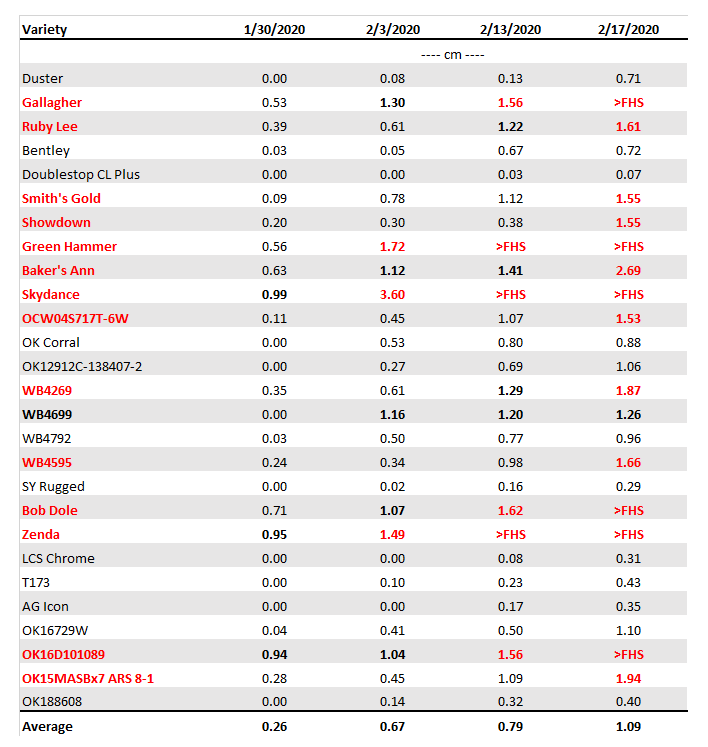
The latest FHS results from our forage trials in Chickasha (Table 1) and Stillwater (Table 2) are listed below. Most of wheat varieties at Chickasha and Stillwater have passed the 1.5 cm threshold.

The Mesonet First Hollow Stem Advisor and the updates we provide give an indication of the FHS stem conditions in a particular area. However, because of the number of factors that can influence when FHS occurs, it is extremely important to check for FHS on a field-by-field basis

Table 1. First hollow stem (FHS) results for each variety collected at Chickasha. Plots were planted on 09/19/19. The threshold target for FHS is 1.5 cm (5/8″ or the diameter of a dime). The value of hollow stem for each variety represents the average of ten measurements from non-grazed plots. Varieties that have reached FHS are highlighted in red.

Table 2. First hollow stem (FHS) results for each variety collected at Stillwater. Plots were planted on 09/18/19. The threshold target for FHS is 1.5 cm (5/8″ or the diameter of a dime). The value of hollow stem for each variety represents the average of ten measurements from non-grazed plots. Varieties that have reached FHS are highlighted in red.

First Hollow Stem update – 2/14/2020

First hollow stem (FHS) is the optimal time to remove cattle from wheat pasture. This occurs when there is 1.5 cm (5/8” or the diameter of dime) of stem below the developing grain head (full explanation). To give you a point of reference, the average FHS date over the past 20 years at Stillwater is March 6.

The latest FHS results from our forage trials in Chickasha (Table 1) and Stillwater (Table 2) are listed below. Few wheat varieties at Chickasha and Stillwater have reached or passed the 1.5 cm threshold.

The Mesonet First Hollow Stem Advisor and the updates we provide give an indication of the FHS stem conditions in a particular area. However, because of the number of factors that can influence when FHS occurs, it is extremely important to check for FHS on a field-by-field basis

Table 1. First hollow stem (FHS) results for each variety collected at Chickasha. Plots were planted on 09/19/19. The threshold target for FHS is 1.5 cm (5/8″ or the diameter of a dime). The value of hollow stem for each variety represents the average of ten measurements from non-grazed plots. Varieties that have reached FHS are highlighted in red.

Table 2. First hollow stem (FHS) results for each variety collected at Stillwater. Plots were planted on 09/18/19. The threshold target for FHS is 1.5 cm (5/8″ or the diameter of a dime). The value of hollow stem for each variety represents the average of ten measurements from non-grazed plots. Varieties that have reached FHS are highlighted in red.

Army Cutworms Reported in Some Wheat and Alfalfa Fields

This article was written by Tom Royer, Extension Entomologist and IPM Coordinator and Kelly Seuhs, Associate Extension Specialist.

Several people, including Lanie Hale, Rob Anderson, and Mike Rosen of Wheeler Brothers and Area Extension Agronomist Heath Sanders have reported possible army cutworm activity. These reports are based on direct observations and noticeable crow and blackbird “gatherings” in some wheat and alfalfa fields in areas of western Oklahoma. Infestation levels were at the “caution” stage at this time and caterpillars measured ¼ to ½ inches.

Army cutworms tolerate cold and feed throughout the winter months. Adult army cutworm moths migrate to Oklahoma each fall (August through October) from their grounds in the Rocky Mountains.  They seek bare or sparsely vegetated fields (like a newly prepared field ready for wheat planting, or a field that was “dusted in” and had not yet or just emerged, or a newly planted alfalfa stand). The eggs hatch soon after deposition.  A producer might see different sizes of larvae in a field due to the long migration period. Army cutworms feed throughout the winter and molt seven times before they turn into pupae in the soil.  Most larvae will have pupated by mid-late March. Adult moths begin emerging in April to fly back to the Rocky Mountains to spend the summer.

Army cutworms can severely damage wheat, canola, and newly planted stands of alfalfa if not controlled. Cutworm damage often goes unnoticed through much of the winter because the caterpillars grow slowly and don’t get big enough to cause noticeable damage until temperatures warm in the spring.  One early indication cutworm presence in a field is the gathering of blackbirds and or crows that seem to be actively feeding. It becomes important to check the fields for cutworms before they cause damage and stand loss.

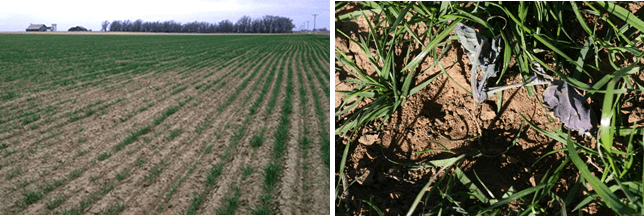
Figure 1. Wheat stand loss from army cutworm. Figure 2. Cutworm damage to canola

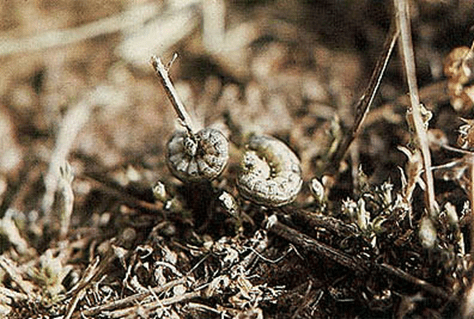
Sample a field by stirring or digging the soil to a depth of two inches at five or more locations.  The cutworms will be “greenish grey”, and will probably curl up into a tight “C” when disturbed. 

It is better to control army cutworms when they are small (½ inch long or less). Army cutworms are very susceptible to pyrethroid insecticides. At this time of year, an insecticide application can be combined with a late winter top-dress nitrogen application.  Suggested treatment thresholds for army cutworms in wheat are 2-3 worms per row foot when conditions are dry and 4-5 per row foot if moisture is adequate. Current recommendations for army cutworm control in small grains are listed in CR-7194, Management of Insect and Mite Pests in Small Grains

It is better to control army cutworms when they are small (½ inch long or less). Army cutworms are very susceptible to pyrethroid insecticides. At this time of year, an insecticide application can be combined with a late winter top-dress nitrogen application.  Suggested treatment thresholds for army cutworms in wheat are 2-3 worms per row foot when conditions are dry and 4-5 per row foot if moisture is adequate. Current recommendations for army cutworm control in small grains are listed in CR-7194, Management of Insect and Mite Pests in Small Grains

The suggested treatment threshold for cutworms in canola is 1-2 per row-foot.  Current recommendations for control of army cutworms in canola are listed in CR-7667, Management of Insect and Mite Pests in Canola.

In newly seeded alfalfa, the threshold is 1-2 larvae per square foot. In established alfalfa fields, the threshold is 2-4 larvae per square foot and should be adjusted based on the size of the caterpillars (2-3 per square foot if caterpillars are more than ½ inches, 3-4 per square foot if less than ½ inches). Current recommendations for control of army cutworms in alfalfa are listed in CR-7150, Alfalfa Forage Insect Control.

Wheat Disease Update – 13/02/2020

This article was written by Bob Hunger, Extension Wheat Pathologist

This is an early season update to summarize a few items that have come up during this week. To start however, I need to repeat that this past fall and winter have been amazingly lacking in diseases. The Diagnostic Lab only received a few wheat samples during the fall, none of which were found to be associated with a pathogen/disease. Causes included low pH, nutrition, and/or environment. This lack of disease still seems to be the predominate scenario. Around Stillwater, I was not able to find any rust or powdery mildew in any of the trials I examined this week. Additionally, it appears as though foliar disease is absent in south Texas as well as indicated by Dr. Amir Ibrahim (Regents Professor, Small Grains Breeder/Geneticist, Texas A&M University, College Station, TX) who indicated to me that, “It has been really quiet here. We have not seen stripe or leaf rust so far. I doubt the former will be an issue this year since it has not established yet and it is already getting warmer. However, I expect to see heavier leaf rust in mid-April if it continues to be this warm.”

Hence, it appears that early season stripe rust and leaf rust should not be a major concern in Oklahoma. In contrast, leaf spot diseases (especially tan spot) should be watched for if you have wheat planted into wheat residue. Josh Anderson (Senior Research Associate, Noble Research Institute, Ardmore, OK) found tan spot in no-till wheat plots planted into wheat residue near Burneyville in far south-central OK (Figure 1). Tan spot can be damaging to seedling wheat especially when it occurs in emerging spring wheat in northern states. However, tan spot also can be damaging to winter wheat if infection is severe in the spring as plants are coming out of winter dormancy. Often an early season fungicide application is used to control not only tan spot but also early season stripe rust and powdery mildew. Such an early season application (late February/March) will not provide protection from leaf rust later in the season (April/early May). If you do have wheat planted into wheat residue, I highly recommend scouting for the presence of not only tan spot, but other early season foliar diseases such as Septoria and Stagonospora leaf spots, powdery mildew, and early season stripe rust. If any of these diseases are seen as severe in late February or March, applying an early application of a fungicide may be beneficial. Keep in mind however, that the timing for an early season fungicide application does not coincide with the optimum timing for top-dressing with fertilizer. If it is likely that two applications will be used, I recommend making the first application with a lower cost generic and reserve the second application for a higher priced premium fungicide. For a photo guide to wheat diseases, go to: http://dasnr22.dasnr.okstate.edu/docushare/dsweb/Get/Document-11682/E1024%20Wheat%20Disease%20Identification.pdf

Figure 1. Leaf spotting of wheat due to tan spot on wheat growing in a no-till field near Burneyville, OK. Notice the small, tan spot present in many of the lesions as indicated by the arrows. [Photo credit: Josh Anderson, Noble Research Institute, Ardmore, OK]

For more information on fungicide applications, see: CR-7668 (Foliar Fungicides and Wheat Production in Oklahoma) and PSS-2138 (Split versus Single applications of Fungicide to Control Foliar Wheat Diseases)

First Hollow Stem update – 2/5/2020

First hollow stem (FHS) is the optimal time to remove cattle from wheat pasture. This occurs when there is 1.5 cm (5/8” or the diameter of dime) of stem below the developing grain head (full explanation). To give you a point of reference, the average FHS date over the past 20 years at Stillwater is March 6.

The latest FHS results from our forage trials in Chickasha (Table 1) and Stillwater (Table 2) are listed below. Few wheat varieties at Chickasha and Stillwater have reached or passed the 1.5 cm threshold.

The Mesonet First Hollow Stem Advisor and the updates we provide give an indication of the FHS stem conditions in a particular area. However, because of the number of factors that can influence when FHS occurs, it is extremely important to check for FHS on a field-by-field basis

Table 1. First hollow stem (FHS) results for each variety collected at Chickasha. Plots were planted on 09/19/19. The threshold target for FHS is 1.5 cm (5/8″ or the diameter of a dime). The value of hollow stem for each variety represents the average of ten measurements from non-grazed plots. Varieties that have reached FHS are highlighted in red.

Table 2. First hollow stem (FHS) results for each variety collected at Stillwater. Plots were planted on 09/18/19. The threshold target for FHS is 1.5 cm (5/8″ or the diameter of a dime). The value of hollow stem for each variety represents the average of ten measurements from non-grazed plots. Varieties that have reached FHS are highlighted in red.

It is time to check for first hollow stem in wheat

First hollow stem (FHS) is the optimal time to remove cattle from wheat pasture. This occurs when there is 1.5 cm (5/8” or the diameter of dime) of hollow stem below the developing grain head (Fig.1). To give you a point of reference, the average FHS date over the past 20 years at Stillwater is March 6.

Figure 1. First hollow stem occurs when hollow stem equivalent to the diameter of a dime (1.5 cm) is present below the developing grain head.

Several factors influence the onset of FHS. These include the wheat variety, location, temperature, available moisture, level of grazing, and planting date (later sown wheat will typically reach FHS later). Varieties can differ by as much as three weeks in onset of first hollow stem, and later maturity varieties generally reach first hollow stem later. Dual-purpose producers are encouraged to select varieties that are characterized as medium, late or very late in occurrence of FHS.

The latest FHS results for each variety planted in our forage trial at Chickasha are listed below (Table 1). None of the varieties are at FHS (all values are below 1.5 cm), but values are likely to change with current soil moisture conditions and warmer temperature predicted for the next couple days.

The First Hollow Stem Advisor and the updates we provide give an indication of the FHS stem conditions in a particular area. However, because of the number of factors that can influence when FHS occurs, it is extremely important to check for FHS on a field-by-field basis.

Table 1. First hollow stem results for each variety collected at Chickasha on 01/30/20. Plots were planted on 09/19/19. The threshold target for FHS is 1.5 cm. The value of hollow stem for each variety represents the average of ten measurements.

Weed management for slow-developing winter wheat.

Amanda de Oliveira Silva, Small Grains Extension Specialist and Misha Manuchehri, Weed Extension Specialist

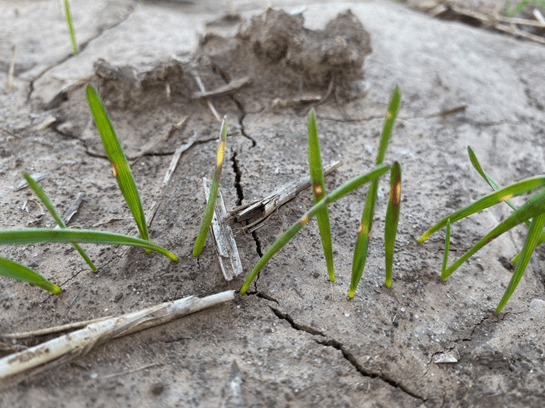
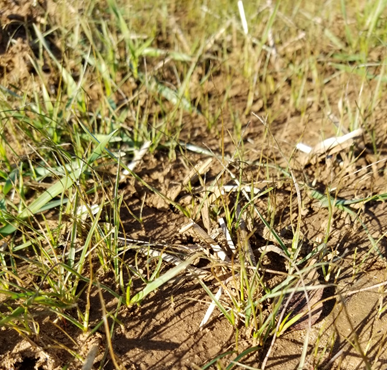
November has been cooler than normal and that has limited wheat growth across the state. Most of fields where wheat was planted earlier have the crown roots slowly developing and top growth is lower than expected. Many of these fields have very thin stands and will probably not have enough forage to feed the cattle. In many areas, planting was delayed due to either lack or excess of moisture. Most of fields that were planted late are at 1-2 leaf stage with seminal roots developing. Plants are showing signs of cold injury but should grow out of it well.

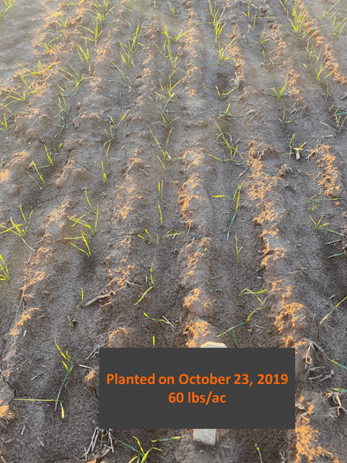
Slow developing wheat due to cold temperatures.
Photo taken on December 2, 2019 in Stillwater, OK by Amanda de O. Silva
Symptom of cold injury on wheat planted on November 4th, 2019.
Photo taken on December 6, 2019 at Kingfisher County by Amanda de O. Silva.

Fall or Spring Herbicide Application for a slow-developing wheat?

Moisture has been plentiful in many areas in Oklahoma this fall. As a result, several winter annual weeds have emerged. These weeds are competing well with our wheat crop, which is behind in many areas due to cold temperatures. If you are investing in a herbicide application this year, you may be thinking “when should I apply”? The answer is not always simple but there are several things to consider before making this decision.

A 2019 winter wheat field heavily infested with Italian ryegrass.
Photo taken by Misha Manuchehri.
Henbit seedlings in a November 2019 planted wheat field in Stillwater.
Photo taken by Misha Manuchehri.

1. Is your wheat at an approved growth stage per the herbicide label?

Many postemergence herbicides labelled for use in wheat recommend the crop be at 2 or 3 leaves. Be sure to check these requirements to ensure crop safety.

2. What are your target weeds?

Many producers chose to apply a postemergence herbicide in the spring when top-dressing N to limit the number of passes made across their fields. This often makes sense for weeds that have multiple flushes, as two applications often are not financially feasible. For example, Italian ryegrass that is not managed with a delayed preemergence herbicide (Anthem Flex, Axiom, or Zidua) may be sprayed in the late winter vs. fall to target multiple flushes. On the other hand, early emerging, difficult-to-control grasses like rescuegrass, are best managed in the fall before entering “dormancy”.

3. What are daytime temperatures like? Are your wheat and weeds actively growing?

All postemergence herbicides labelled in wheat move in living tissue. Herbicide application will be most successful when your wheat AND your weeds are actively growing.

4. Have you applied this product before? Was it successful at that timing?

We can learn a lot from field history. If a product wasn’t successful in the past, we need to learn why so that we can make the necessary changes to increase its success or perhaps it is time to use a new weed management method. Finally, selection for herbicide resistant weed biotypes can occur quickly. If you are unsure if you have resistance, please send in a seed sample to the weed science lab.

It is time to scout wheat fields for fall armyworm!

By Amanda de Oliveira Silva, OSU Small Grains Extension Specialist and Tom Royer, Extension Entomologist

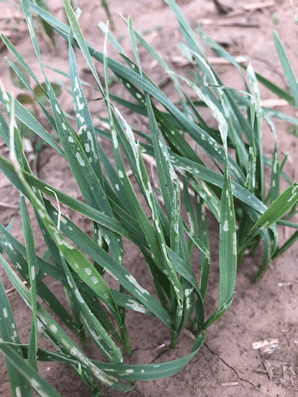
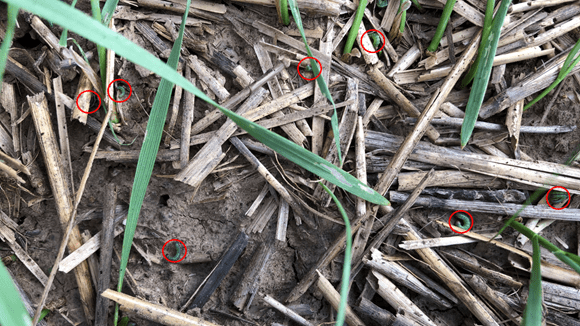
We are receiving reports of fall armyworms infestations and wanted to alert producers to check their wheat fields every day after seeding emergence. The worms can be very tiny and difficult to see it. Symptoms like “window pane” in the leaves indicate feeding from fall armyworm. Also, check under crop residue as they might try to hide from the heat.

Symptom of “window paned” leaves shows severe feeding from the fall armyworm. Photo taken on October 2, 2019 at Canadian County by Amanda de O. Silva.
Fall armyworms may be found under crop residue during the day. Photo taken on October 2, 2019 at Canadian County by Amanda de O. Silva.

Replanting decisions need to be made on field by field basis. Replanting might be best for producers taking the crop to a grain-only system. Also, allow some time to replant to avoid having infestations back again.

“We will not get relief from fall armyworms until we get a killing frost, so keep vigilant!” Tom Royer

Several helpful resources are available for producers. Contact your local county Extension office. For additional read refer to Pest e-alerts Reports of Seedling wheat Infested with Fall Armyworm 2019. Consult the newly updated OSU Fact Sheets CR-7193 Management of Insect Pests in Rangeland and Pasture and CR-7194 Management of Insect and Mite Pests of Small Grains for control suggestions.

OSU to open new Lahoma research station facility in honor of Raymond Sidwell on May 13

LAHOMA, Okla. – The life’s work of the late Raymond Sidwell of Goltry is continuing to provide benefits to agricultural producers across the region, thanks to a new facility that bears his name at the Oklahoma State University Division of Agricultural Sciences and Natural Resources’ North Central Research Station.

OSU to open new Lahoma research station facility in honor of Raymond Sidwell on May 13

Bambi (front), Brady (left) and Brenda Sidwell gear up for the grand opening of the Dr. Raymond Sidwell Research Facility on May 13

“We can think of nothing more suitable than to have our new Dr. Raymond Sidwell Research Facility’s grand opening be part of our May 13 Wheat Field Day, as Raymond worked diligently for decades to make the annual field day one of the premier agricultural events in the Southern Plains,” said Tom Coon, OSU vice president for agricultural programs.

Sidwell served as senior station manager for the 143-acre experiment station, located in the heart of wheat production country near Lahoma, from June of 1980 until his passing in December of 2013.

“We invite everyone to join us as we honor Dr. Sidwell and showcase the importance of crop research being conducted through our statewide Oklahoma Agricultural Experiment Station system,” Coon said. “Lahoma is situated on Highway 60 just west of Enid, for those who have never been to the experiment station. Signs will be posted.”

There is no cost to attend the 2016 Wheat Field Day, which will take place from 8:30 a.m. to approximately noon. Lunch will be provided free of charge thanks to the generosity of several sponsors.

Richard Austin, current station superintendent, said the state-of-the-art Dr. Raymond Sidwell Research Facility has a conference room, offices and restrooms compliant with the Americans with Disabilities Act, and features a large open bay design that will facilitate equipment and make possible field day events unimpeded by weather.

“There is a lot of orange integrated into the building, signifying it is an OSU facility, which everyone who knew Raymond recognizes would be important to him,” Austin said.

In addition, Sidwell was known to be fond of porches, so one was incorporated into the front of the facility.

“It’s a nice touch people can enjoy, allowing those who visit the facility to be outside but out of the sun and hopefully remember what Raymond meant to Oklahoma agricultural producers and agribusinesses,” said Randy Raper, OAES assistant director.

More than three decades of Sidwell’s meticulous management of the station allowed for major research efforts in wheat breeding and variety development, soil fertility, weed science, soybean varieties and cropping systems, grain sorghum variety trials, plant pathology and entomology.

Through station educational activities such as the annual Wheat Field Day, Sidwell hosted literally thousands of guests over the years, including agricultural producers, commodity groups, foreign dignitaries, national and state legislators and numerous other officials, representatives and individuals from the public and private sectors.

“Dr. Sidwell was an important part of our Wheat Improvement Team, working to ensure wheat growers were able to take advantage of improved crop varieties and research-based best management practices,” Coon said. “He really was one of the great ambassadors of the land-grant mission, helping Oklahomans improve the quality of life for them, their families and their communities.”

The Sidwells – Raymond, his wife Brenda and their children Bambi and Brady – have long been highly regarded members of Oklahoma’s agricultural and agribusiness communities, and are recognized by their farmer peers as very progressive and proactive production agriculturalists.

An OSU agricultural economics alumnus and president of Sidwell Seed and the newly established Enterprise Grain Company located in Kremlin, Brady Sidwell said his father implemented many science-proven practices into the family operation that were backed by cutting-edge research done at the North Central Research Station under his guidance.

“Our family is both extremely proud as well as humbled to have this opportunity to honor our father in such a way,” he said. “Research and Extension programs at land-grant institutions play a critical role in Oklahoma and American agriculture.”

Sidwell added the family is grateful to be able to do their part in further promoting the work being done by the OSU Wheat Improvement Team.

“As a longstanding certified seed wheat producer, we will continue to utilize the best-in-class seed genetics being released by OSU every year and know that the new Dr. Raymond Sidwell Research Facility will only help this already well-respected program reach new heights,” he said.

For Bambi Sidwell, she always knew how passionate her father was about agriculture, in general, and wheat improvement, in particular.

“Growing up on our family farm near Goltry, our dad had an excitement about continuously improving wheat production,” she said. “He enjoyed sharing ideas with other producers that would have a significant and positive impact on people’s lives and their farming operations. Our dad was keen on maintaining a meticulously clean operation, something we strive to continue today.”

An OSU agribusiness alumna, Bambi said the family is proud to be able to take part in honoring her father in a way that enhances research and educational programs conducted at the Lahoma experiment station. Funding for the new facility was made through the Sidwell family, the Sitlington Trust and OAES.