It is time to scout wheat fields for fall armyworm!

By Amanda de Oliveira Silva, OSU Small Grains Extension Specialist and Tom Royer, Extension Entomologist

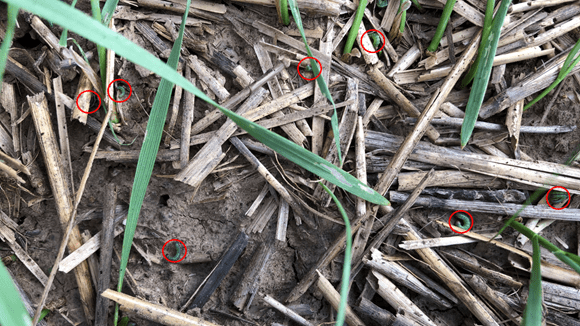
We are receiving reports of fall armyworms infestations and wanted to alert producers to check their wheat fields every day after seeding emergence. The worms can be very tiny and difficult to see it. Symptoms like “window pane” in the leaves indicate feeding from fall armyworm. Also, check under crop residue as they might try to hide from the heat.
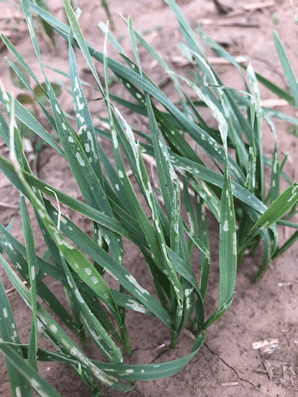
Symptom of “window paned” leaves shows severe feeding from the fall armyworm. Photo taken on October 2, 2019 at Canadian County by Amanda de O. Silva.
Fall armyworms may be found under crop residue during the day. Photo taken on October 2, 2019 at Canadian County by Amanda de O. Silva.

Replanting decisions need to be made on field by field basis. Replanting might be best for producers taking the crop to a grain-only system. Also, allow some time to replant to avoid having infestations back again.

“We will not get relief from fall armyworms until we get a killing frost, so keep vigilant!” Tom Royer

Several helpful resources are available for producers. Contact your local county Extension office. For additional read refer to Pest e-alerts Reports of Seedling wheat Infested with Fall Armyworm 2019. Consult the newly updated OSU Fact Sheets CR-7193 Management of Insect Pests in Rangeland and Pasture and CR-7194 Management of Insect and Mite Pests of Small Grains for control suggestions.

This entry was posted in Uncategorized by Amanda De Oliveira Silva. Bookmark the permalink.
Unknown's avatar

About Amanda De Oliveira Silva

I joined Oklahoma State University in 2019 as an Assistant Professor and Small Grains Extension Specialist and was promoted to Associate Professor in 2025. My program integrates applied research and Extension with the goal of improving the productivity, profitability, and sustainability of wheat production systems. While much of my work is rooted in Oklahoma and the Southern Great Plains, the questions I study—how agronomic management, crop physiology, and plant nutrition interact to influence yield, grain quality, and nutrient use efficiency—are relevant to wheat-growing systems around the world. By working closely with producers, industry partners, and researchers, my goal is to develop practical, science-based solutions that help growers navigate production challenges and improve the resilience of their farming systems.

Leave a comment