Unknown's avatar

About Amanda De Oliveira Silva

I have served as an Assistant Professor and Small Grains Extension Specialist at Oklahoma State University since August 2019. I believe that close interaction with producers is vital to understand their production strategies and to establish realistic research goals. My program focuses on developing science-based information to improve the agronomic and economic viability of small grains production in Oklahoma and in the Southern Great Plains.

2025 Oklahoma Wheat Harvest Starts in Southwest and Parts of Central Oklahoma

By: The Oklahoma Wheat Commission

Oklahoma wheat harvest has started in multiple locations with several locations reporting taking in wheat over this past weekend.  While harvest is getting a week later start than usual in Southwest Oklahoma, it appears earlier maturing varieties are set for cutting if producers can get over the ground. All locations in this report are considered to just be getting a good start. 

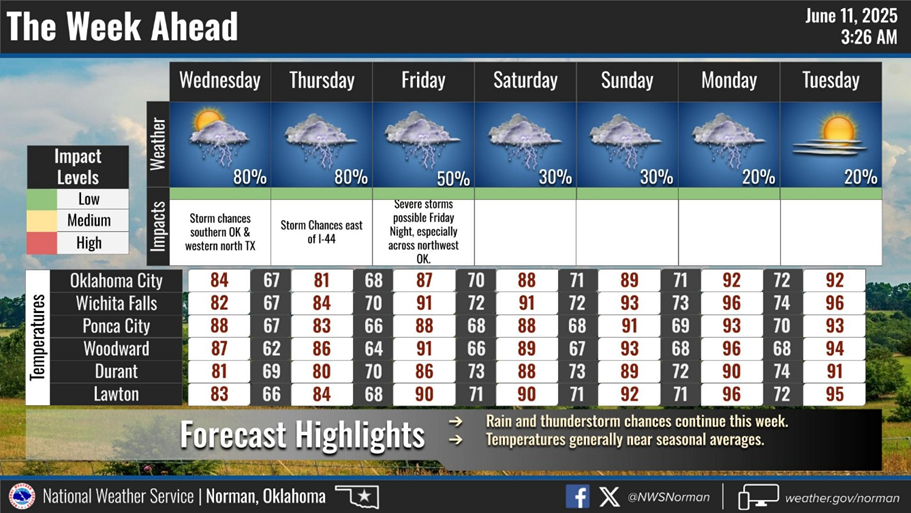
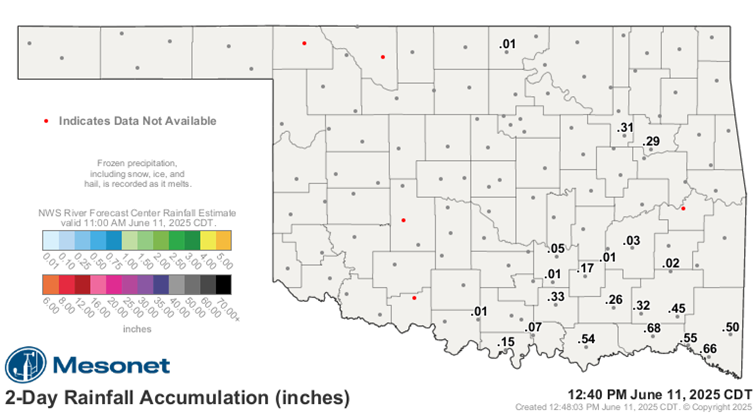
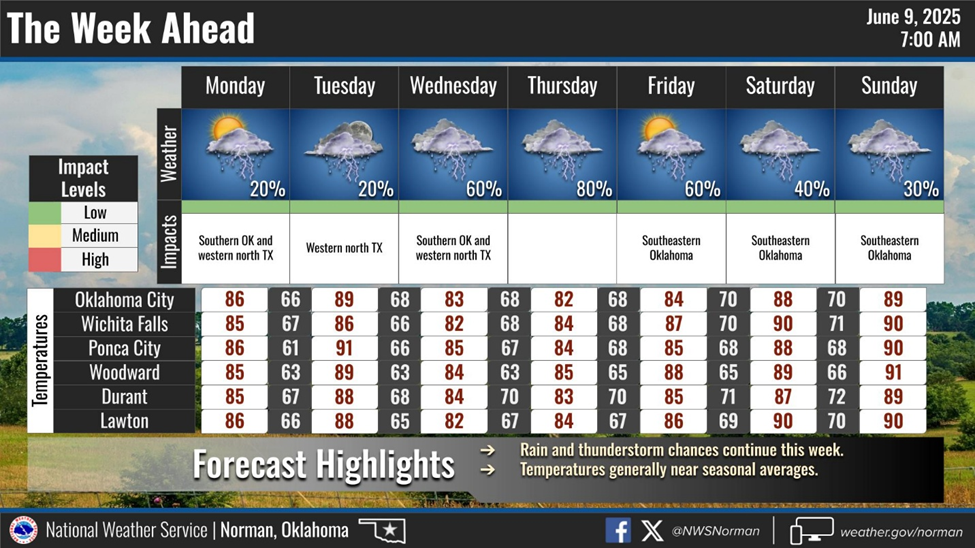
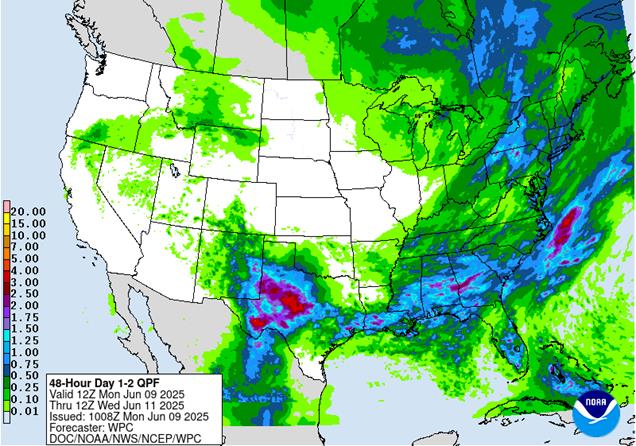
**Some test cutting began last week over Memorial Day weekend but nothing had been reported at elevator locations until this past weekend.  It appears a wider region of the state will be ready all at once when producers can get into fields.  Producers and elevator operators also have major concerns about the predicted moisture amounts for the coming week, starting tonight going through the overall week.   

Early reports in all locations show test weights ranging from 58.5 lbs. to 64 lbs. per bushel, with a large amount in the early reports coming in at 60 lbs. or higher.  Proteins on early reports ranging from 11.0% to 11.5%.  Early yields being reported at 25 to 45 bushels per acre for the most part.  Higher yields are predicted on intensively managed wheat with some smaller fields being reported in the mid 50’s.  It should be noted several acres across the state in Southern Oklahoma that were predicted to be harvested will never see a combine. (We have had some early county reports showing ½ the wheat acreage was lost due to severe flooding and lodging.    Several producers have also opted to cut down the crop for wheat hay in all areas of the state which is going to impact overall state yield.)

Southwest and Western Oklahoma

Grandfield/Devol/ChattanoogaTest weights on early cuttings reported at 58.5 lbs. to 61 lbs. per bushel. Yields ranging from the mid 20’s to mid 40’s depending on location.  Some reports on a smaller field that made in the low 50’s.  Protein ranging from 11.0% to 11.5%.

Walters/LawtonTest weights on early cuttings reported from 58.0 lbs. to 60.5 lbs. per bushel on limited cuttings. Yields ranging in the mid 20’s to mid 40’s. No protein reported on early cuttings.

Frederick/DavidsonTest weights on early cuttings reported from 58 lbs. to 63 lbs. per bushel. Yields on early cuttings are decent with reports in the mid 30’s to mid 40’s. Early proteins reported at 11.0% to 11.2%.

Brinkman/Altus/Lone WolfFirst load of wheat was taken in at Brinkman on Saturday, and Altus and Lone Wolf received grain yesterday. Test weights on early loads ranging from 62 lbs. to 64 lbs. per bushel.  No yields or protein was reported on early cuttings.  

Apache- No wheat has been taken at this location as of early this morning.

Cordell- No wheat has been taken at this location as of early this morning.

Central Oklahoma

Greenfield- One truck load was taken in over the weekend at 12.8 moisture.  Test weight was 60 lbs. per bushel.  Another 40 acre field was reported to be completed making a little over 50 bushels per acre. No protein reported on early cuttings.

Okarche/Kingfisher/Lomega- Test weights on early cuttings reported at 60 lbs. to 63 lbs. per bushel.  Yields reported in the mid 40’s with some management intensive wheat reported to be making in the mid 50’s. No protein reported on early cuttings.

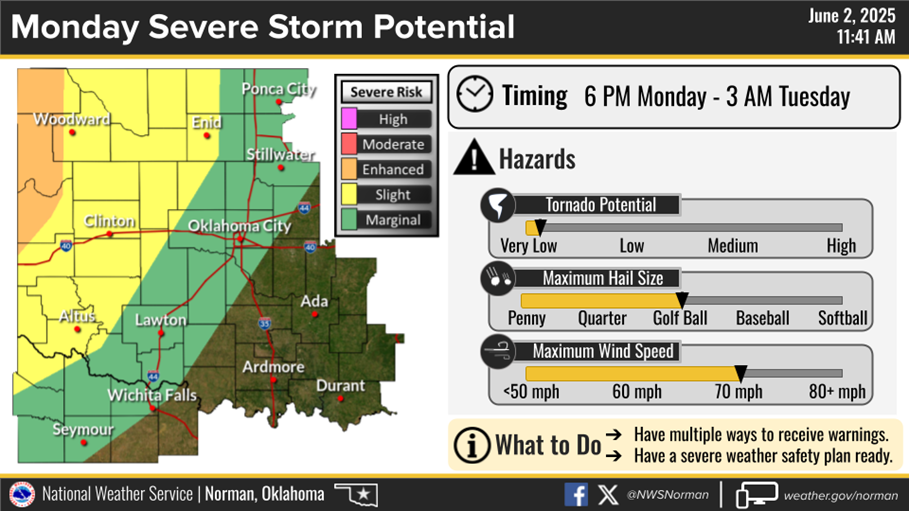
Below, see the 7-day forecast provided by the Oklahoma Mesonet and the 5-day precipitation forecast along with Monday and Tuesday storm potentials.

NWS Days 1-5 Precipitation Forecast

The Days 1-5 Precipitation Forecast is produced by the National Weather Service’s Weather Prediction Center

First Hollow Stem Update – 4/2/2025

Amanda de Oliveira Silva, Small Grains Extension Specialist

The first hollow stem stage indicates the beginning of stem elongation or just before the jointing stage. It is a good indicator of when producers should remove cattle from wheat pasture. This occurs when there is 1.5 cm (5/8”, or the diameter of a dime) of hollow stem below the developing grain head (see full explanation). 

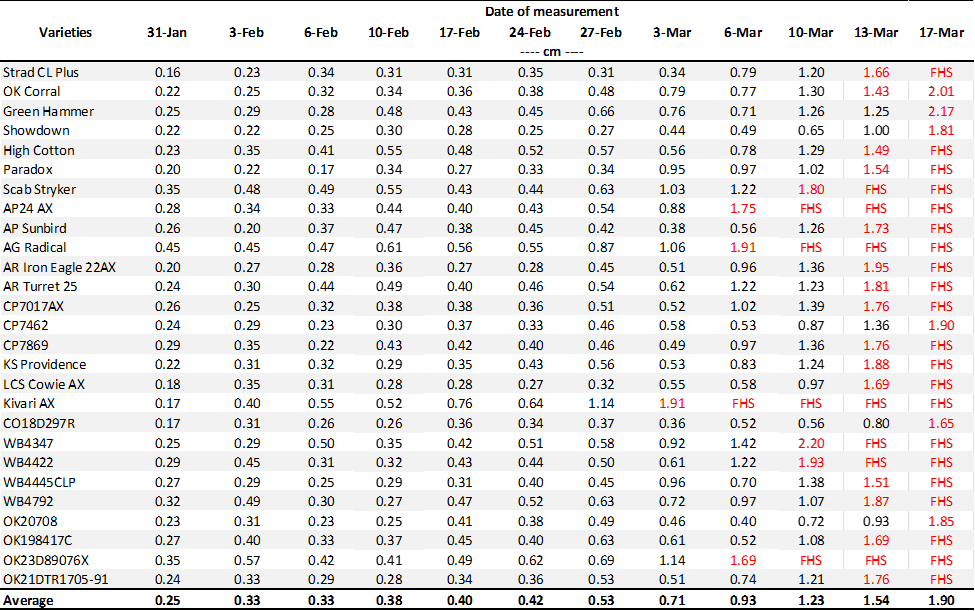
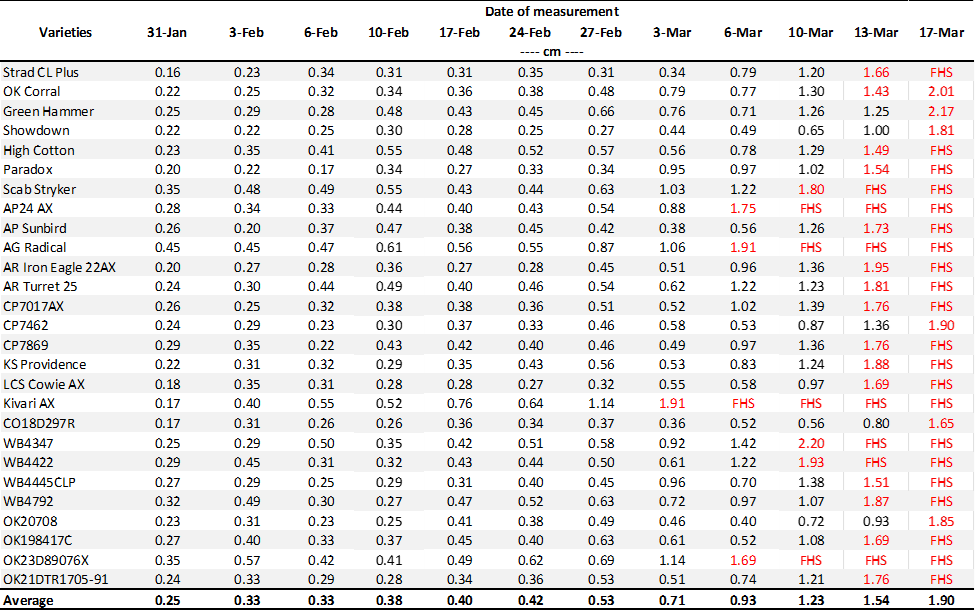
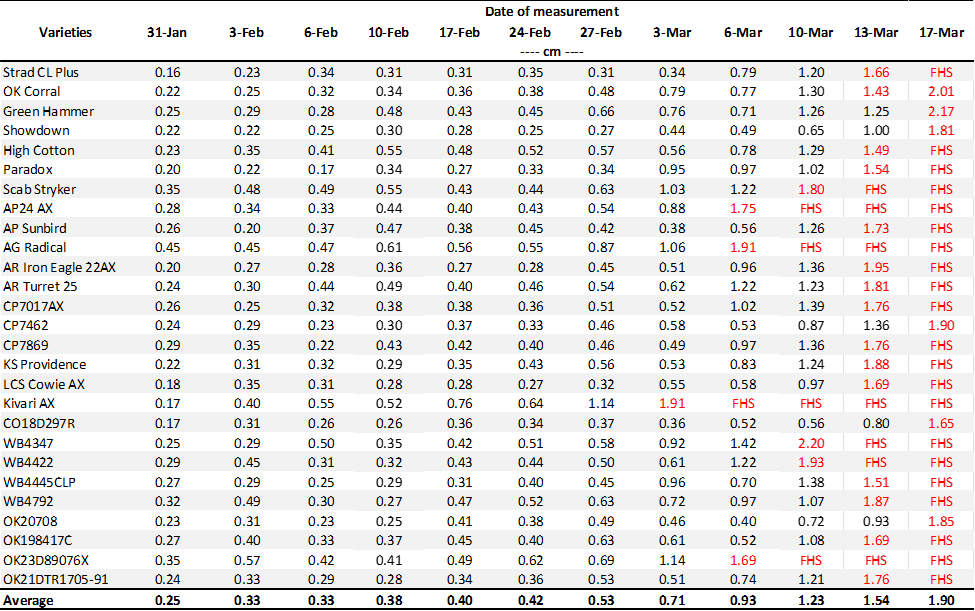
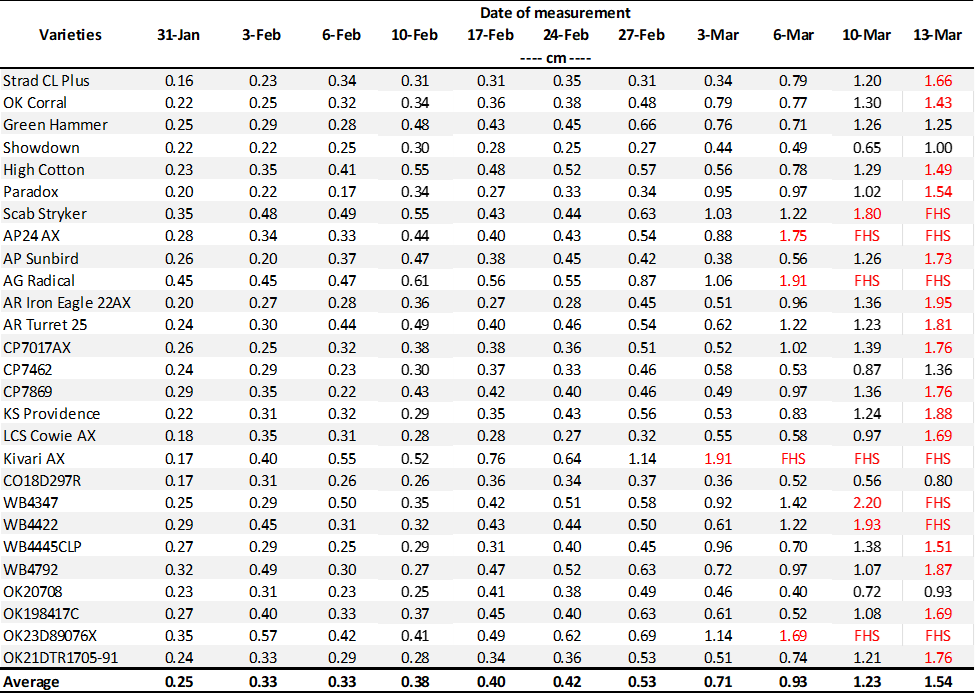
The latest FHS results from OSU forage trials in Stillwater (Table 1) and Chickasha (Table 2) are listed below. For an additional resource and wheat update on FHS, see the Mesonet First Hollow Stem Advisor

OSU Small Grains Program monitors FHS occurrence on a twice-per-week basis

As in previous years, we will continue monitoring FHS occurrence in our wheat plots at Stillwater and Chickasha and share updates on this blog. In past years, our forage trials—where FHS samples are collected—were seeded early to simulate a grazed system, though forage was not removed. This method created an accelerated growth environment, allowing us to identify the earliest onset of FHS. Varieties that reach FHS earliest in these trials should be closely monitored in commercial fields.

This year, we are introducing a new approach by simulating grazing with a mower in the forage trial in Stillwater. This will allow us to compare whether varieties reach FHS at different times when grazed versus non-grazed. We hypothesize that the simulated grazing treatment will likely delay FHS relative to the non-grazed treatment, with FHS differences among varieties becoming less pronounced. We also hypothesize that the amount of delay will vary among varieties, such that an early-FHS variety in the non-grazed environment may appear more intermediate in its FHS arrival with canopy removal. This comparison will provide insight into how canopy removal from grazing impacts the timing of reproductive development.

The latest FHS results for each variety planted in our forage trials at Stillwater and Chickasha are summarized below (Tables 1 and 2). All varieties have reached the FHS threshold in Chickasha and Stillwater.

Table 1. First Hollow Stem (FHS) results for each wheat variety collected at Stillwater. Plots were planted on 10/11/24, with one section left unclipped and the other clipped to simulate grazing. The FHS threshold is 1.5 cm (5/8″ or approximately the diameter of a dime). Reported values represent the average of ten measurements per variety. Varieties that exceed the threshold are highlighted in red. For the simulated grazing, plots were mowed on January 3rd, 15th, 28th, February 10th, March 6th and 12th at a 2.5-3” cutting height, with the frequency representing a light grazing treatment.

Table 2. First Hollow Stem (FHS) results for each wheat variety collected at Chickasha. Plots were planted on 10/02/24, with all sections left unclipped (i.e., not grazed). The FHS threshold is 1.5 cm (5/8″ or approximately the diameter of a dime). Reported values represent the average of ten measurements per variety. Varieties that exceed the threshold are highlighted in red.

Contact your local Extension office and us if you have questions. 

Additional resources available:

Acknowledgments: 

Tyler Lynch, Senior Agriculturalist

Israel Molina Cyrineu, Graduate Research Assistant

Gilmar Machado, Visiting scholar

Rafael Moreira, Visiting scholar

Kenderson Reis, Visiting scholar

Francisco Arana, Visiting scholar

First Hollow Stem Update – 3/28/2025

Amanda de Oliveira Silva, Small Grains Extension Specialist

The first hollow stem stage indicates the beginning of stem elongation or just before the jointing stage. It is a good indicator of when producers should remove cattle from wheat pasture. This occurs when there is 1.5 cm (5/8”, or the diameter of a dime) of hollow stem below the developing grain head (see full explanation). 

The latest FHS results from OSU forage trials in Stillwater (Table 1) and Chickasha (Table 2) are listed below. For an additional resource and wheat update on FHS, see the Mesonet First Hollow Stem Advisor

OSU Small Grains Program monitors FHS occurrence on a twice-per-week basis

As in previous years, we will continue monitoring FHS occurrence in our wheat plots at Stillwater and Chickasha and share updates on this blog. In past years, our forage trials—where FHS samples are collected—were seeded early to simulate a grazed system, though forage was not removed. This method created an accelerated growth environment, allowing us to identify the earliest onset of FHS. Varieties that reach FHS earliest in these trials should be closely monitored in commercial fields.

This year, we are introducing a new approach by simulating grazing with a mower in the forage trial in Stillwater. This will allow us to compare whether varieties reach FHS at different times when grazed versus non-grazed. We hypothesize that the simulated grazing treatment will likely delay FHS relative to the non-grazed treatment, with FHS differences among varieties becoming less pronounced. We also hypothesize that the amount of delay will vary among varieties, such that an early-FHS variety in the non-grazed environment may appear more intermediate in its FHS arrival with canopy removal. This comparison will provide insight into how canopy removal from grazing impacts the timing of reproductive development.

The latest FHS results for each variety planted in our forage trials at Stillwater and Chickasha are summarized below (Tables 1 and 2). All varieties have reached the FHS threshold in Chickasha. In Stillwater, all varieties have reached FHS in the non-grazed plots, with only two varieties yet to reach FHS in the simulated grazed plots.

Table 1. First Hollow Stem (FHS) results for each wheat variety collected at Stillwater. Plots were planted on 10/11/24, with one section left unclipped and the other clipped to simulate grazing. The FHS threshold is 1.5 cm (5/8″ or approximately the diameter of a dime). Reported values represent the average of ten measurements per variety. Varieties that exceed the threshold are highlighted in red. For the simulated grazing, plots were mowed on January 3rd, 15th, 28th, February 10th, and March 6th at a 2.5-3” cutting height, with the frequency representing a light grazing treatment.

Table 2. First Hollow Stem (FHS) results for each wheat variety collected at Chickasha. Plots were planted on 10/02/24, with all sections left unclipped (i.e., not grazed). The FHS threshold is 1.5 cm (5/8″ or approximately the diameter of a dime). Reported values represent the average of ten measurements per variety. Varieties that exceed the threshold are highlighted in red.

Contact your local Extension office and us if you have questions. 

Additional resources available:

Acknowledgments: 

Tyler Lynch, Senior Agriculturalist

Israel Molina Cyrineu, Graduate Research Assistant

Gilmar Machado, Visiting scholar

Rafael Moreira, Visiting scholar

Kenderson Reis, Visiting scholar

Francisco Arana, Visiting scholar

Picture showing a hollow stem and developing wheat head

First Hollow Stem Update – 3/25/2025

Amanda de Oliveira Silva, Small Grains Extension Specialist

The first hollow stem stage indicates the beginning of stem elongation or just before the jointing stage. It is a good indicator of when producers should remove cattle from wheat pasture. This occurs when there is 1.5 cm (5/8”, or the diameter of a dime) of hollow stem below the developing grain head (see full explanation). 

The latest FHS results from OSU forage trials in Stillwater (Table 1) and Chickasha (Table 2) are listed below. For an additional resource and wheat update on FHS, see the Mesonet First Hollow Stem Advisor

OSU Small Grains Program monitors FHS occurrence on a twice-per-week basis

As in previous years, we will continue monitoring FHS occurrence in our wheat plots at Stillwater and Chickasha and share updates on this blog. In past years, our forage trials—where FHS samples are collected—were seeded early to simulate a grazed system, though forage was not removed. This method created an accelerated growth environment, allowing us to identify the earliest onset of FHS. Varieties that reach FHS earliest in these trials should be closely monitored in commercial fields.

This year, we are introducing a new approach by simulating grazing with a mower in the forage trial in Stillwater. This will allow us to compare whether varieties reach FHS at different times when grazed versus non-grazed. We hypothesize that the simulated grazing treatment will likely delay FHS relative to the non-grazed treatment, with FHS differences among varieties becoming less pronounced. We also hypothesize that the amount of delay will vary among varieties, such that an early-FHS variety in the non-grazed environment may appear more intermediate in its FHS arrival with canopy removal. This comparison will provide insight into how canopy removal from grazing impacts the timing of reproductive development.

The latest FHS results for each variety planted in our forage trials at Stillwater and Chickasha are summarized below (Tables 1 and 2). In Chickasha, all varieties have reached the FHS threshold, and in Stillwater, most varieties have reached FHS.

Table 1. First Hollow Stem (FHS) results for each wheat variety collected at Stillwater. Plots were planted on 10/11/24, with one section left unclipped and the other clipped to simulate grazing. The FHS threshold is 1.5 cm (5/8″ or approximately the diameter of a dime). Reported values represent the average of ten measurements per variety. Varieties that exceed the threshold are highlighted in red. For the simulated grazing, plots were mowed on January 3rd, 15th, 28th, February 10th, and March 6th at a 2.5-3” cutting height, with the frequency representing a light grazing treatment.

Table 2. First Hollow Stem (FHS) results for each wheat variety collected at Chickasha. Plots were planted on 10/02/24, with all sections left unclipped (i.e., not grazed). The FHS threshold is 1.5 cm (5/8″ or approximately the diameter of a dime). Reported values represent the average of ten measurements per variety. Varieties that exceed the threshold are highlighted in red.

Contact your local Extension office and us if you have questions. 

Additional resources available:

Acknowledgments: 

Tyler Lynch, Senior Agriculturalist

Israel Molina Cyrineu, Graduate Research Assistant

Gilmar Machado, Visiting scholar

Rafael Moreira, Visiting scholar

Kenderson Reis, Visiting scholar

Francisco Arana, Visiting scholar

Picture showing a hollow stem and developing wheat head

First Hollow Stem Update – 3/21/2025

Amanda de Oliveira Silva, Small Grains Extension Specialist

The first hollow stem stage indicates the beginning of stem elongation or just before the jointing stage. It is a good indicator of when producers should remove cattle from wheat pasture. This occurs when there is 1.5 cm (5/8”, or the diameter of a dime) of hollow stem below the developing grain head (see full explanation). 

The latest FHS results from OSU forage trials in Stillwater (Table 1) and Chickasha (Table 2) are listed below. For an additional resource and wheat update on FHS, see the Mesonet First Hollow Stem Advisor

OSU Small Grains Program monitors FHS occurrence on a twice-per-week basis

As in previous years, we will continue monitoring FHS occurrence in our wheat plots at Stillwater and Chickasha and share updates on this blog. In past years, our forage trials—where FHS samples are collected—were seeded early to simulate a grazed system, though forage was not removed. This method created an accelerated growth environment, allowing us to identify the earliest onset of FHS. Varieties that reach FHS earliest in these trials should be closely monitored in commercial fields.

This year, we are introducing a new approach by simulating grazing with a mower in the forage trial in Stillwater. This will allow us to compare whether varieties reach FHS at different times when grazed versus non-grazed. We hypothesize that the simulated grazing treatment will likely delay FHS relative to the non-grazed treatment, with FHS differences among varieties becoming less pronounced. We also hypothesize that the amount of delay will vary among varieties, such that an early-FHS variety in the non-grazed environment may appear more intermediate in its FHS arrival with canopy removal. This comparison will provide insight into how canopy removal from grazing impacts the timing of reproductive development.

The latest FHS results for each variety planted in our forage trials at Stillwater and Chickasha are summarized below (Tables 1 and 2). All varieties have reached the FHS threshold in Chickasha. In Stillwater, most varieties have reached FHS in the non-grazed plots, while those in the simulated grazed plots need a few more days.

Table 1. First Hollow Stem (FHS) results for each wheat variety collected at Stillwater. Plots were planted on 10/11/24, with one section left unclipped and the other clipped to simulate grazing. The FHS threshold is 1.5 cm (5/8″ or approximately the diameter of a dime). Reported values represent the average of ten measurements per variety. Varieties that exceed the threshold are highlighted in red. For the simulated grazing, plots were mowed on January 3rd, 15th, 28th, February 10th, and March 6th at a 2.5-3” cutting height, with the frequency representing a light grazing treatment.

Table 2. First Hollow Stem (FHS) results for each wheat variety collected at Chickasha. Plots were planted on 10/02/24, with all sections left unclipped (i.e., not grazed). The FHS threshold is 1.5 cm (5/8″ or approximately the diameter of a dime). Reported values represent the average of ten measurements per variety. Varieties that exceed the threshold are highlighted in red.

Contact your local Extension office and us if you have questions. 

Additional resources available:

Acknowledgments: 

Tyler Lynch, Senior Agriculturalist

Israel Molina Cyrineu, Graduate Research Assistant

Gilmar Machado, Visiting scholar

Rafael Moreira, Visiting scholar

Kenderson Reis, Visiting scholar

Francisco Arana, Visiting scholar

First Hollow Stem Update – 3/17/2025

Amanda de Oliveira Silva, Small Grains Extension Specialist

The first hollow stem stage indicates the beginning of stem elongation or just before the jointing stage. It is a good indicator of when producers should remove cattle from wheat pasture. This occurs when there is 1.5 cm (5/8”, or the diameter of a dime) of hollow stem below the developing grain head (see full explanation). 

The latest FHS results from OSU forage trials in Stillwater (Table 1) and Chickasha (Table 2) are listed below. For an additional resource and wheat update on FHS, see the Mesonet First Hollow Stem Advisor

OSU Small Grains Program monitors FHS occurrence on a twice-per-week basis

As in previous years, we will continue monitoring FHS occurrence in our wheat plots at Stillwater and Chickasha and share updates on this blog. In past years, our forage trials—where FHS samples are collected—were seeded early to simulate a grazed system, though forage was not removed. This method created an accelerated growth environment, allowing us to identify the earliest onset of FHS. Varieties that reach FHS earliest in these trials should be closely monitored in commercial fields.

This year, we are introducing a new approach by simulating grazing with a mower in the forage trial in Stillwater. This will allow us to compare whether varieties reach FHS at different times when grazed versus non-grazed. We hypothesize that the simulated grazing treatment will likely delay FHS relative to the non-grazed treatment, with FHS differences among varieties becoming less pronounced. We also hypothesize that the amount of delay will vary among varieties, such that an early-FHS variety in the non-grazed environment may appear more intermediate in its FHS arrival with canopy removal. This comparison will provide insight into how canopy removal from grazing impacts the timing of reproductive development.

The latest FHS results for each variety planted in our forage trials at Stillwater and Chickasha are summarized below (Tables 1 and 2). All varieties have reached the FHS threshold in Chickasha.

Table 1. First Hollow Stem (FHS) results for each wheat variety collected at Stillwater. Plots were planted on 10/11/24, with one section left unclipped and the other clipped to simulate grazing. The FHS threshold is 1.5 cm (5/8″ or approximately the diameter of a dime). Reported values represent the average of ten measurements per variety. Varieties that exceed the threshold are highlighted in red. For the simulated grazing, plots were mowed on January 3rd, 15th, 28th, February 10th, and March 6th at a 2.5-3” cutting height, with the frequency representing a light grazing treatment.

Table 2. First Hollow Stem (FHS) results for each wheat variety collected at Chickasha. Plots were planted on 10/02/24, with all sections left unclipped (i.e., not grazed). The FHS threshold is 1.5 cm (5/8″ or approximately the diameter of a dime). Reported values represent the average of ten measurements per variety. Varieties that exceed the threshold are highlighted in red.

Contact your local Extension office and us if you have questions. 

Additional resources available:

Acknowledgments: 

Tyler Lynch, Senior Agriculturalist

Israel Molina Cyrineu, Graduate Research Assistant

Gilmar Machado, Visiting scholar

Rafael Moreira, Visiting scholar

Kenderson Reis, Visiting scholar

Francisco Arana, Visiting scholar

Photo of a wheat plant with stem split lengthways showing the hollow stem and the developing wheat head

First Hollow Stem Update – 3/14/2025

Amanda de Oliveira Silva, Small Grains Extension Specialist

The first hollow stem stage indicates the beginning of stem elongation or just before the jointing stage. It is a good indicator of when producers should remove cattle from wheat pasture. This occurs when there is 1.5 cm (5/8”, or the diameter of a dime) of hollow stem below the developing grain head (see full explanation). 

The latest FHS results from OSU forage trials in Stillwater (Table 1) and Chickasha (Table 2) are listed below. For an additional resource and wheat update on FHS, see the Mesonet First Hollow Stem Advisor

OSU Small Grains Program monitors FHS occurrence on a twice-per-week basis

As in previous years, we will continue monitoring FHS occurrence in our wheat plots at Stillwater and Chickasha and share updates on this blog. In past years, our forage trials—where FHS samples are collected—were seeded early to simulate a grazed system, though forage was not removed. This method created an accelerated growth environment, allowing us to identify the earliest onset of FHS. Varieties that reach FHS earliest in these trials should be closely monitored in commercial fields.

This year, we are introducing a new approach by simulating grazing with a mower in the forage trial in Stillwater. This will allow us to compare whether varieties reach FHS at different times when grazed versus non-grazed. We hypothesize that the simulated grazing treatment will likely delay FHS relative to the non-grazed treatment, with FHS differences among varieties becoming less pronounced. We also hypothesize that the amount of delay will vary among varieties, such that an early-FHS variety in the non-grazed environment may appear more intermediate in its FHS arrival with canopy removal. This comparison will provide insight into how canopy removal from grazing impacts the timing of reproductive development.

The latest FHS results for each variety planted in our forage trials at Stillwater and Chickasha are summarized below (Tables 1 and 2). Some varieties have reached the FHS threshold.

Table 1. First Hollow Stem (FHS) results for each wheat variety collected at Stillwater. Plots were planted on 10/11/24, with one section left unclipped and the other clipped to simulate grazing. The FHS threshold is 1.5 cm (5/8″ or approximately the diameter of a dime). Reported values represent the average of ten measurements per variety. Varieties that exceed the threshold are highlighted in red. For the simulated grazing, plots were mowed on January 3rd, 15th, 28th, February 10th, and March 6th at a 2.5-3” cutting height, with the frequency representing a light grazing treatment.

Table 2. First Hollow Stem (FHS) results for each wheat variety collected at Chickasha. Plots were planted on 10/02/24, with all sections left unclipped (i.e., not grazed). The FHS threshold is 1.5 cm (5/8″ or approximately the diameter of a dime). Reported values represent the average of ten measurements per variety. Varieties that exceed the threshold are highlighted in red.

Contact your local Extension office and us if you have questions. 

Additional resources available:

Acknowledgments: 

Tyler Lynch, Senior Agriculturalist

Israel Molina Cyrineu, Graduate Research Assistant

Gilmar Machado, Visiting scholar

Rafael Moreira, Visiting scholar

Kenderson Reis, Visiting scholar

Francisco Arana, Visiting scholar

First Hollow Stem Update – 3/10/2025

Amanda de Oliveira Silva, Small Grains Extension Specialist

The first hollow stem stage indicates the beginning of stem elongation or just before the jointing stage. It is a good indicator of when producers should remove cattle from wheat pasture. This occurs when there is 1.5 cm (5/8”, or the diameter of a dime) of hollow stem below the developing grain head (see full explanation). 

The latest FHS results from OSU forage trials in Stillwater (Table 1) and Chickasha (Table 2) are listed below. For an additional resource and wheat update on FHS, see the Mesonet First Hollow Stem Advisor

OSU Small Grains Program monitors FHS occurrence on a twice-per-week basis

As in previous years, we will continue monitoring FHS occurrence in our wheat plots at Stillwater and Chickasha and share updates on this blog. In past years, our forage trials—where FHS samples are collected—were seeded early to simulate a grazed system, though forage was not removed. This method created an accelerated growth environment, allowing us to identify the earliest onset of FHS. Varieties that reach FHS earliest in these trials should be closely monitored in commercial fields.

This year, we are introducing a new approach by simulating grazing with a mower in the forage trial in Stillwater. This will allow us to compare whether varieties reach FHS at different times when grazed versus non-grazed. We hypothesize that the simulated grazing treatment will likely delay FHS relative to the non-grazed treatment, with FHS differences among varieties becoming less pronounced. We also hypothesize that the amount of delay will vary among varieties, such that an early-FHS variety in the non-grazed environment may appear more intermediate in its FHS arrival with canopy removal. This comparison will provide insight into how canopy removal from grazing impacts the timing of reproductive development.

The latest FHS results for each variety planted in our forage trials at Stillwater and Chickasha are summarized below (Tables 1 and 2). Some varieties have reached the FHS threshold.

Table 1. First Hollow Stem (FHS) results for each wheat variety collected at Stillwater. Plots were planted on 10/11/24, with one section left unclipped and the other clipped to simulate grazing. The FHS threshold is 1.5 cm (5/8″ or approximately the diameter of a dime). Reported values represent the average of ten measurements per variety. Varieties that exceed the threshold are highlighted in red. For the simulated grazing, plots were mowed on January 3rd, 15th, 28th, February 10th, and March 6th at a 2.5-3” cutting height, with the frequency representing a light grazing treatment.

Table 2. First Hollow Stem (FHS) results for each wheat variety collected at Chickasha. Plots were planted on 10/02/24, with all sections left unclipped (i.e., not grazed). The FHS threshold is 1.5 cm (5/8″ or approximately the diameter of a dime). Reported values represent the average of ten measurements per variety. Varieties that exceed the threshold are highlighted in red.

Contact your local Extension office and us if you have questions. 

Additional resources available:

Acknowledgments: 

Tyler Lynch, Senior Agriculturalist

Israel Molina Cyrineu, Graduate Research Assistant

Gilmar Machado, Visiting scholar

Rafael Moreira, Visiting scholar

Kenderson Reis, Visiting scholar

Francisco Arana, Visiting scholar

Picture showing a hollow stem and developing wheat head

First Hollow Stem Update – 3/4/2025

Amanda de Oliveira Silva, Small Grains Extension Specialist

The first hollow stem stage indicates the beginning of stem elongation or just before the jointing stage. It is a good indicator of when producers should remove cattle from wheat pasture. This occurs when there is 1.5 cm (5/8”, or the diameter of a dime) of hollow stem below the developing grain head (see full explanation). 

The latest FHS results from OSU forage trials in Stillwater (Table 1) and Chickasha (Table 2) are listed below. For an additional resource and wheat update on FHS, see the Mesonet First Hollow Stem Advisor

OSU Small Grains Program monitors FHS occurrence on a twice-per-week basis

As in previous years, we will continue monitoring FHS occurrence in our wheat plots at Stillwater and Chickasha and share updates on this blog. In past years, our forage trials—where FHS samples are collected—were seeded early to simulate a grazed system, though forage was not removed. This method created an accelerated growth environment, allowing us to identify the earliest onset of FHS. Varieties that reach FHS earliest in these trials should be closely monitored in commercial fields.

This year, we are introducing a new approach by simulating grazing with a mower in the forage trial in Stillwater. This will allow us to compare whether varieties reach FHS at different times when grazed versus non-grazed. We hypothesize that the simulated grazing treatment will likely delay FHS relative to the non-grazed treatment, with FHS differences among varieties becoming less pronounced. We also hypothesize that the amount of delay will vary among varieties, such that an early-FHS variety in the non-grazed environment may appear more intermediate in its FHS arrival with canopy removal. This comparison will provide insight into how canopy removal from grazing impacts the timing of reproductive development.

The latest FHS results for each variety planted in our forage trials at Stillwater and Chickasha are summarized below (Tables 1 and 2). Most varieties are still well below the 1.5 cm FHS threshold.

Table 1. First Hollow Stem (FHS) results for each wheat variety collected at Stillwater. Plots were planted on 10/11/24, with one section left unclipped and the other clipped to simulate grazing. The FHS threshold is 1.5 cm (5/8″ or approximately the diameter of a dime). Reported values represent the average of ten measurements per variety. Varieties that exceed the threshold are highlighted in red. For the simulated grazing, plots were mowed on January 3rd, 15th, 28th and on February 10th at a 2.5-3” cutting height, with the frequency representing a light grazing treatment.

Table 2. First Hollow Stem (FHS) results for each wheat variety collected at Chickasha. Plots were planted on 10/02/24, with all sections left unclipped (i.e., not grazed). The FHS threshold is 1.5 cm (5/8″ or approximately the diameter of a dime). Reported values represent the average of ten measurements per variety. Varieties that exceed the threshold are highlighted in red.

Contact your local Extension office and us if you have questions. 

Additional resources available:

Acknowledgments: 

Tyler Lynch, Senior Agriculturalist

Israel Molina Cyrineu, Graduate Research Assistant

Gilmar Machado, Visiting scholar

Rafael Moreira, Visiting scholar

Kenderson Reis, Visiting scholar

First Hollow Stem Update – 2/26/2025

Amanda de Oliveira Silva, Small Grains Extension Specialist

The first hollow stem stage indicates the beginning of stem elongation or just before the jointing stage. It is a good indicator of when producers should remove cattle from wheat pasture. This occurs when there is 1.5 cm (5/8”, or the diameter of a dime) of hollow stem below the developing grain head (see full explanation). 

The latest FHS results from OSU forage trials in Stillwater (Table 1) and Chickasha (Table 2) are listed below. For an additional resource and wheat update on FHS, see the Mesonet First Hollow Stem Advisor

OSU Small Grains Program monitors FHS occurrence on a twice-per-week basis

As in previous years, we will continue monitoring FHS occurrence in our wheat plots at Stillwater and Chickasha and share updates on this blog. In past years, our forage trials—where FHS samples are collected—were seeded early to simulate a grazed system, though forage was not removed. This method created an accelerated growth environment, allowing us to identify the earliest onset of FHS. Varieties that reach FHS earliest in these trials should be closely monitored in commercial fields.

This year, we are introducing a new approach by simulating grazing with a mower in the forage trial in Stillwater. This will allow us to compare whether varieties reach FHS at different times when grazed versus non-grazed. We hypothesize that the simulated grazing treatment will likely delay FHS relative to the non-grazed treatment, with FHS differences among varieties becoming less pronounced. We also hypothesize that the amount of delay will vary among varieties, such that an early-FHS variety in the non-grazed environment may appear more intermediate in its FHS arrival with canopy removal. This comparison will provide insight into how canopy removal from grazing impacts the timing of reproductive development.

The latest FHS results for each variety planted in our forage trials at Stillwater and Chickasha are summarized below (Tables 1 and 2). Most varieties are still well below the 1.5 cm FHS threshold.

Table 1. First Hollow Stem (FHS) results for each wheat variety collected at Stillwater. Plots were planted on 10/11/24, with one section left unclipped and the other clipped to simulate grazing. The FHS threshold is 1.5 cm (5/8″ or approximately the diameter of a dime). Reported values represent the average of ten measurements per variety. Varieties that exceed the threshold are highlighted in red. For the simulated grazing, plots were mowed on January 3rd, 15th, 28th and on February 10th at a 2.5-3” cutting height, with the frequency representing a light grazing treatment.

Table 2. First Hollow Stem (FHS) results for each wheat variety collected at Chickasha. Plots were planted on 10/02/24, with all sections left unclipped (i.e., not grazed). The FHS threshold is 1.5 cm (5/8″ or approximately the diameter of a dime). Reported values represent the average of ten measurements per variety. Varieties that exceed the threshold are highlighted in red.

Contact your local Extension office and us if you have questions. 

Additional resources available:

Acknowledgments: 

Tyler Lynch, Senior Agriculturalist

Israel Molina Cyrineu, Graduate Research Assistant

Gilmar Machado, Visiting scholar

Rafael Moreira, Visiting scholar