Unknown's avatar

About Amanda De Oliveira Silva

I have served as an Assistant Professor and Small Grains Extension Specialist at Oklahoma State University since August 2019. I believe that close interaction with producers is vital to understand their production strategies and to establish realistic research goals. My program focuses on developing science-based information to improve the agronomic and economic viability of small grains production in Oklahoma and in the Southern Great Plains.

First Hollow Stem Update – 2/11/2025

Amanda de Oliveira Silva, Small Grains Extension Specialist

The first hollow stem stage indicates the beginning of stem elongation or just before the jointing stage. It is a good indicator of when producers should remove cattle from wheat pasture. This occurs when there is 1.5 cm (5/8”, or the diameter of a dime) of hollow stem below the developing grain head (see full explanation). 

OSU Small Grains Program monitors FHS occurrence on a twice-per-week basis

As in previous years, we will continue monitoring FHS occurrence in our wheat plots at Stillwater and Chickasha and share updates on this blog. In past years, our forage trials—where FHS samples are collected—were seeded early to simulate a grazed system, though forage was not removed. This method created an accelerated growth environment, allowing us to identify the earliest onset of FHS. Varieties that reach FHS earliest in these trials should be closely monitored in commercial fields.

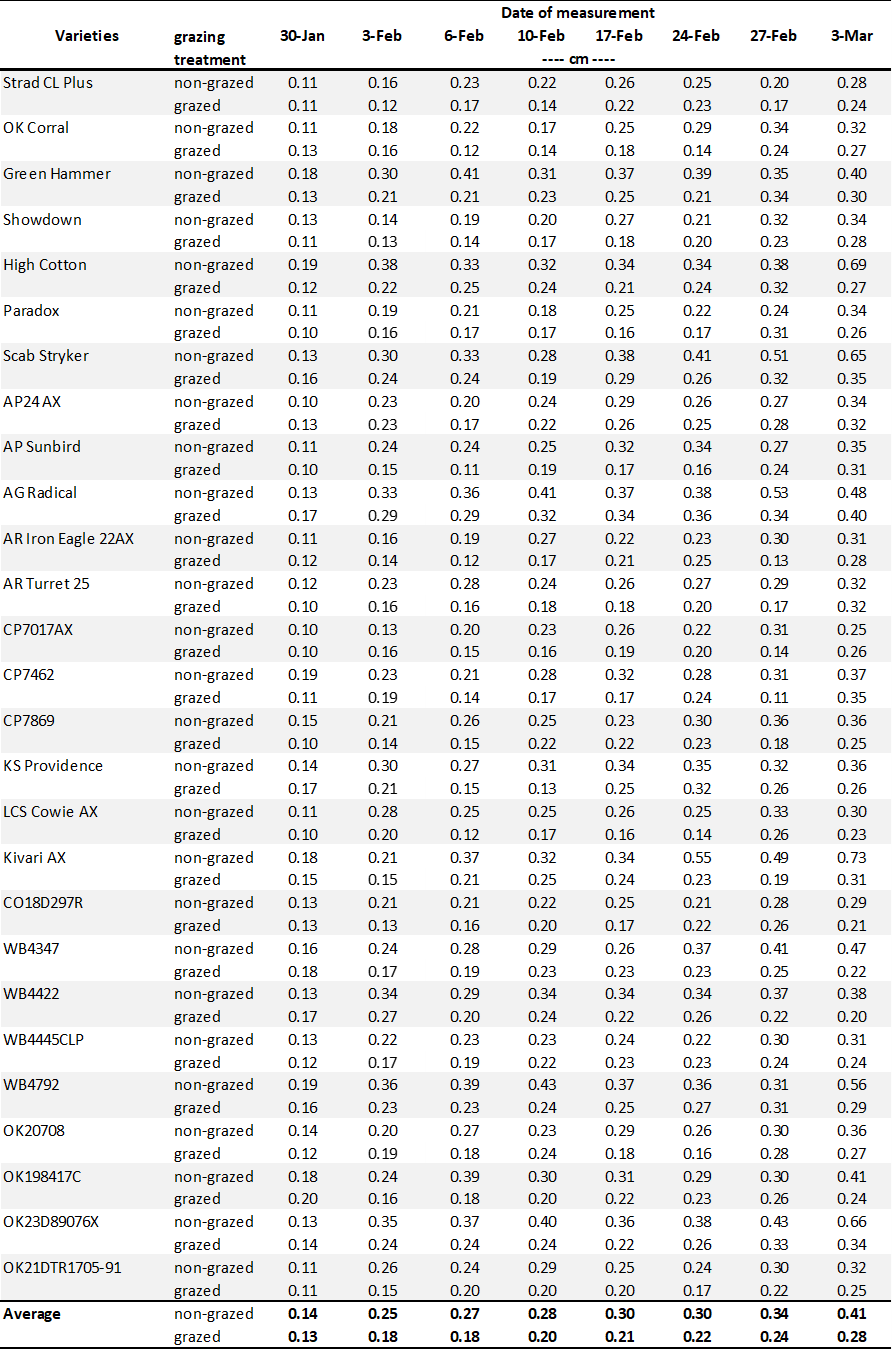
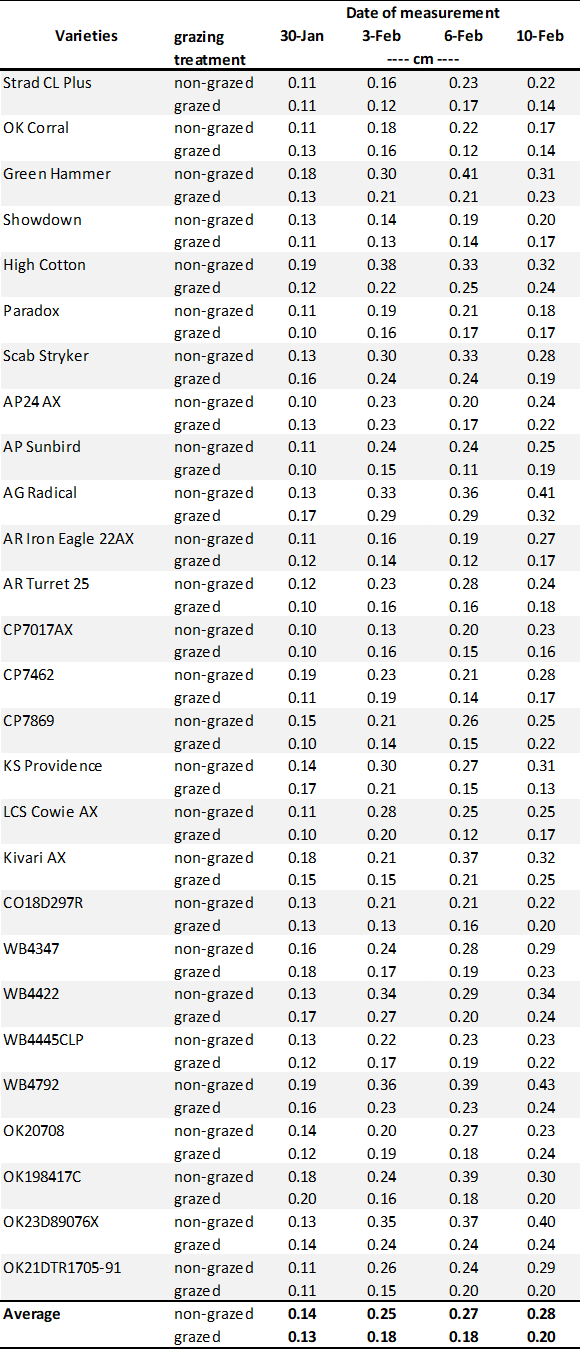
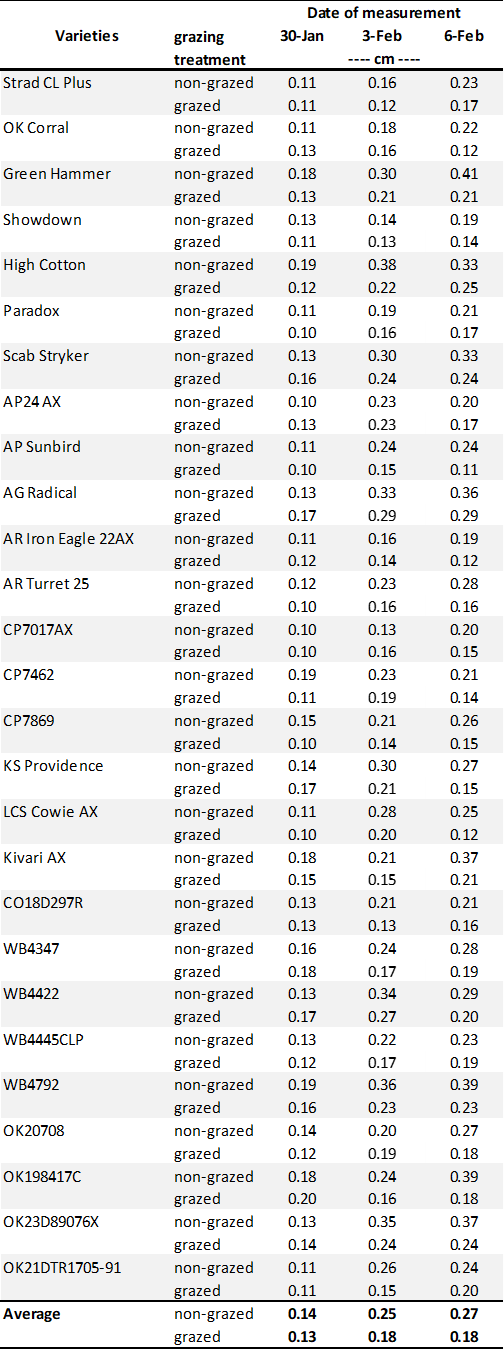
This year, we are introducing a new approach by simulating grazing with a mower in the forage trial in Stillwater. This will allow us to compare whether varieties reach FHS at different times when grazed versus non-grazed. We hypothesize that the simulated grazing treatment will likely delay FHS relative to the non-grazed treatment, with FHS differences among varieties becoming less pronounced. We also hypothesize that the amount of delay will vary among varieties, such that an early-FHS variety in the non-grazed environment may appear more intermediate in its FHS arrival with canopy removal. This comparison will provide insight into how canopy removal from grazing impacts the timing of reproductive development.

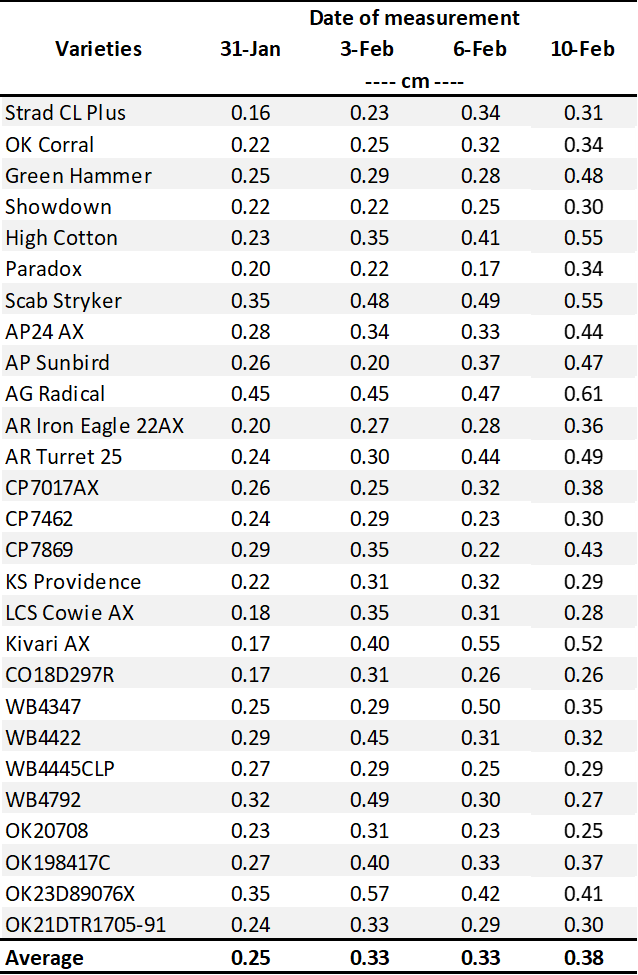
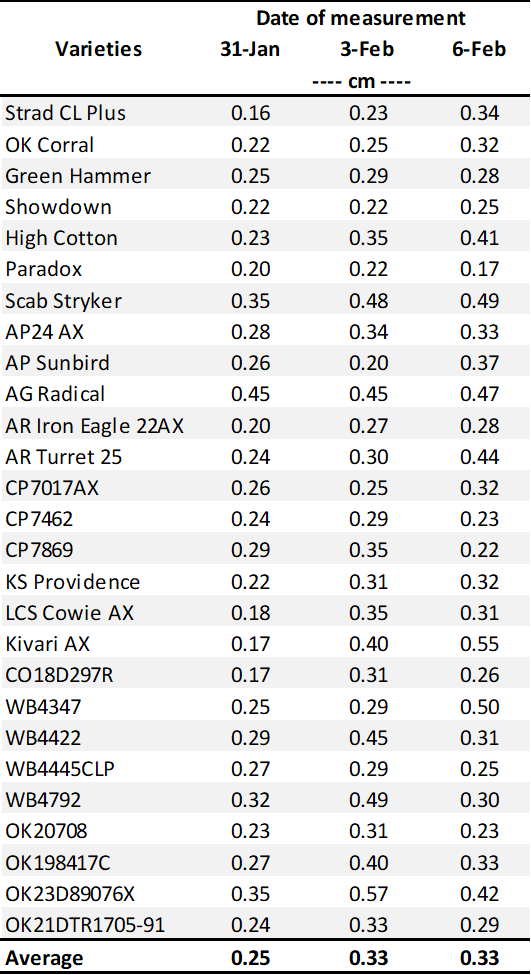
The latest FHS results for each variety planted in our forage trials at Stillwater and Chickasha are summarized below (Tables 1 and 2). Most varieties are still well below the 1.5 cm FHS threshold.

Table 1. First Hollow Stem (FHS) results for each wheat variety collected at Stillwater. Plots were planted on 10/11/24, with one section left unclipped and the other clipped to simulate grazing. The FHS threshold is 1.5 cm (5/8″ or approximately the diameter of a dime). Reported values represent the average of ten measurements per variety. Varieties that exceed the threshold are highlighted in red. For the simulated grazing, plots were mowed on January 3rd, 15th, and 28th at a 2.5-3” cutting height, with the frequency representing a light grazing treatment.

Table 2. First Hollow Stem (FHS) results for each wheat variety collected at Chickasha. Plots were planted on 10/02/24, with all sections left unclipped (i.e., not grazed). The FHS threshold is 1.5 cm (5/8″ or approximately the diameter of a dime). Reported values represent the average of ten measurements per variety. Varieties that exceed the threshold are highlighted in red.

Contact your local Extension office and us if you have questions. 

Additional resources available:

Acknowledgments: 

Tyler Lynch, Senior Agriculturalist

Israel Molina Cyrineu, Graduate Research Assistant

Gilmar Machado, Visiting scholar

Fall Season Review and Ideal Timing for Cattle Removal from Wheat Pasture

Amanda de Oliveira Silva, Small Grains Extension Specialist

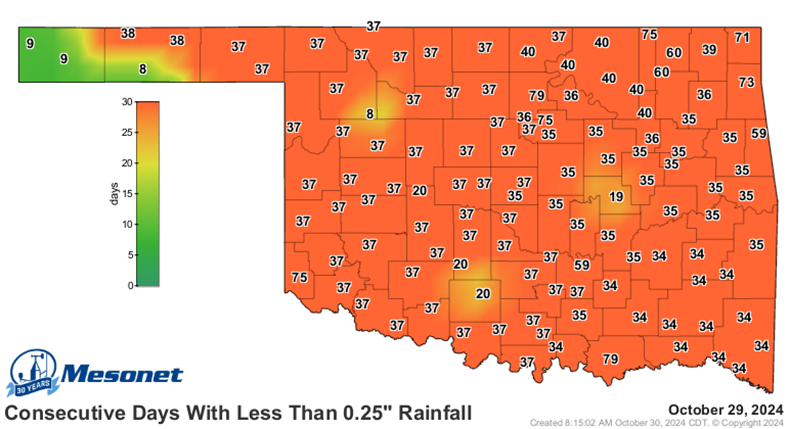
Oklahoma’s wheat planting season was heavily impacted by severe drought. The season was essentially divided into two main rain events that impacted crop growth. Dual-purpose producers who planted before September 22 established good stands in early fall. Warm temperatures promoted rapid growth, but the crop began to decline as drought conditions intensified (Figure 1).

The next significant rain event occurred about a month later, almost past the optimal wheat planting window in some areas. With rain in the forecast for late October, many farmers chose to “dust in” their wheat ahead of the rain, while others opted to wait.

In early November, wheat-growing regions across Oklahoma received between 1 and nearly 8 inches of rain, while the Panhandle saw up to 20 inches of snow from November 5–9 (Figure 2). These events quickly shifted conditions from extreme drought to flooding. Although November temperatures were above average (~53°F), seeds remained in cool, wet soils for weeks, leading to slow or failed germination. Some areas experienced standing water and soil crusting, causing plant losses. As a result, wheat stands across the state vary widely, with some fields establishing well while others remain highly uneven, contributing to overall low fall forage production.

For grain-only wheat sown in late fall, stands are just now closing in some areas. Though still small, the crop appears to be growing well.

Figure 1. Consecutive days with less than 0.25” rainfall as of October 29, 2024.
Figure 2. Four-day rainfall accumulation from November 2 to 6th, 2024.

Yield loss for grazing past first hollow

For the producers with available pasture for spring grazing, preserving some leaf tissue after grazing will be important for future grain crop. Ideally, at least 60% canopy coverage (as measured by the Canopeo app) should remain to support crop recovery after grazing (PSS-2170). Extending grazing for an additional two week past first hollow stem (FHS)—particularly under conditions unfavorable for plant regrowth and canopy recovery—could reduce wheat yield by approximately 60% of its potential (Figure 3).

Figure 3. Grazing past first hollow stem has been shown to reduce grain yield by as much as five percent per day or as little as one percent per day. This figure shows the anticipated yield loss for grazing past first hollow stem given favorable (solid line), unfavorable (dashed line) and average (dotted line) conditions for wheat regrowth following grazing termination (PSS-2147).

The first hollow stem stage as an indicator for cattle removal from wheat pasture

The first hollow stem stage indicates the beginning of stem elongation or just before the jointing stage. It is a good indicator of when producers should remove cattle from wheat pasture. This occurs when there is 1.5 cm (5/8”, or the diameter of a dime) of hollow stem below the developing grain head (Figure 4). This is the optimal period because it gives enough time for the crop to recover from grazing and rebuild the canopy. Also, the added cattle weight gains associated with grazing past the FHS are not enough to offset the value of the potential reduced grain yield (1-5% every day past FHS) (Figure 3). The wheat variety, severity of grazing, time when cattle are removed, and weather conditions after cattle removal determine how much grain yield potential might be reduced.

Figure 4. The first hollow stem growth stage is reached when there is 1.5 cm of hollow stem (about the diameter of a dime) below the grain head. 

Methods for scouting for FHS

  • Check for FHS in a non-grazed area of the same variety and planting date. Variety can affect FHS date by as much as three weeks, and planting date can affect it even more.
  • Dig or pull up a few plants, split the largest tiller longitudinally (lengthways), and measure the amount of hollow stem present below the developing grain head. Plant tissue must be removed below the soil surface, because the developing grain head may still be below the soil surface.
  • If there is 1.5 cm (~5/8″) of hollow stem present, it is time to remove cattle. 1.5 cm is about the same as the diameter of a dime (see picture below).
  • Find detailed information on FHS and grazing by clicking here.

OSU Small Grains Program monitors FHS occurrence on a twice-per-week basis

As in previous years, we will continue monitoring FHS occurrence in our wheat plots at Stillwater and Chickasha and share updates on this blog. In past years, our forage trials—where FHS samples are collected—were seeded early to simulate a grazed system, though forage was not removed. This method created an accelerated growth environment, allowing us to identify the earliest onset of FHS. Varieties that reach FHS earliest in these trials should be closely monitored in commercial fields.

This year, we are introducing a new approach by simulating grazing with a mower in the forage trial in Stillwater. This will allow us to compare whether varieties reach FHS at different times when grazed versus non-grazed. We hypothesize that the simulated grazing treatment will likely delay FHS relative to the non-grazed treatment, with FHS differences among varieties becoming less pronounced. We also hypothesize that the amount of delay will vary among varieties, such that an early-FHS variety in the non-grazed environment may appear more intermediate in its FHS arrival with canopy removal. This comparison will provide insight into how canopy removal from grazing impacts the timing of reproductive development.

The latest FHS results for each variety planted in our forage trials at Stillwater and Chickasha are summarized below (Tables 1 and 2). Most varieties are still well below the 1.5 cm FHS threshold. However, if moisture and warmer conditions develop in the coming weeks, values could increase quickly.

Table 1. First Hollow Stem (FHS) results for each wheat variety collected at Stillwater. Plots were planted on 10/11/24, with one section left unclipped and the other clipped to simulate grazing. The FHS threshold is 1.5 cm (5/8″ or approximately the diameter of a dime). Reported values represent the average of ten measurements per variety. Varieties that exceed the threshold are highlighted in red. For the simulated grazing, plots were mowed on January 3rd, 15th, and 28th at a 2.5-3” cutting height, with the frequency representing a light grazing treatment.

Table 2. First Hollow Stem (FHS) results for each wheat variety collected at Chickasha. Plots were planted on 10/02/24, with all sections left unclipped (i.e., not grazed). The FHS threshold is 1.5 cm (5/8″ or approximately the diameter of a dime). Reported values represent the average of ten measurements per variety. Varieties that exceed the threshold are highlighted in red.

Contact your local Extension office and us if you have questions. 

Acknowledgements: 

Tyler Lynch, Senior Agriculturalist

Israel Molina Cyrineu, PhD student

Gilmar Machado, Visiting Scholar

Rafael Moreira, Undergraduate Visiting Scholar

Managing Late-Planted Wheat: Insights from Ongoing Research

Amanda de Oliveira Silva, Small Grains Extension Specialist

In recent years, we have received numerous questions about the potential yield losses associated with planting wheat later in the fall. Farmers often ask if variety selection or management practices, like adjusting seeding rates, should change when planting is delayed.

As weather patterns become more unpredictable, with fall droughts and floods causing planting delays, this topic has become even more critical. Additionally, the late harvest of summer crops like soybeans and cotton in double-cropping systems further pushes wheat planting into late fall. The rise of herbicide-resistant weeds has also led farmers to delay planting as they work to control late-fall emerging weeds culturally.

Recognizing these challenges, our program has focused on studying wheat performance under late planting conditions. We aim to:

  1. Estimate potential yield penalties and understand the factors contributing to them when planting is delayed from October to December in north central Oklahoma.
  2. Evaluate variety performance under late planting, particularly focusing on varieties with different maturity ranges.
  3. Determine the need to adjust seeding rates as planting is delayed.

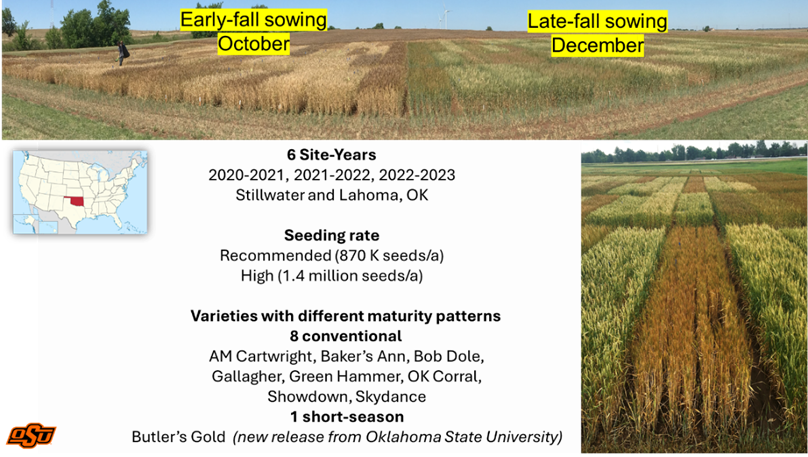
From 2021 to 2023, we conducted a study in Stillwater and Lahoma to evaluate how delaying planting dates from October to December would affect wheat performance (Figure 1). We tested two seeding rates, and nine winter wheat varieties adapted to Oklahoma, including a short-season variety covering a range of maturity classes (Table 1). The standard seeding rate of 870,000 seeds per acre reflects the average rate used in Oklahoma, equivalent to about 60 lbs/acre for wheat with an average seed size of 14,500 seeds per pound. To compensate for the approximately 40-day delay in planting between the October and December treatments, we increased the seeding rate by about 60%.

Figure 1. Treatment structure for field trials conducted in Stillwater and Lahoma during three growing seasons. All varieties but Butler’s Gold were released with the expected adoption at conventional planting dates.

Table 1. Information of historical maturity patterns of all varieties tested in this study at early-fall planting date.

Based on the data from this study, surprisingly, late-fall planting yields (79 bu/ac) exceeded early-fall planting yields (54 bu/ac) in four of six site-years, or by 5 bu/ac averaged across all site-years (Figure 2).

Figure 2. Grain yield for early-fall and late-fall planting dates averaged across nine varieties and two seeding rates for each site-year. Asterisks represent statistical differences between planting dates at p < 0.05.

Does delayed planting affect wheat development?

In our trials, late-fall planting was delayed by 41 days compared to early-fall planting. Wheat varieties planted later reached heading and maturity five days later than when planted earlier.

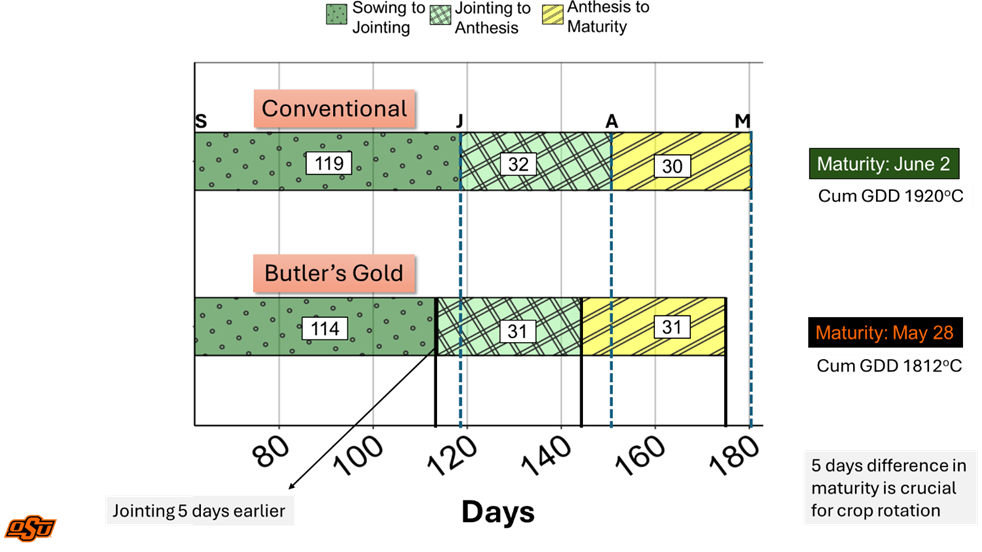
Late-fall planting reduced the period from planting to jointing by 28 days. The critical period from jointing to heading, which is vital for yield formation, was shortened by only seven days. The grain-filling period was shortened by only two days compared to early planting. Interestingly, varieties that reached jointing, heading, and maturity early at early-fall planting did so when planted late. For example, the variety Butler’s Gold reached jointing, heading, and maturity earlier than the other varieties in late-fall planting. Baker’s Ann followed closely, reaching these stages within the same day or up to three days later, while Bob Dole reached jointing and heading five days later and maturity six days later than Butler’s Gold.

Figure 3. Number of days from planting to jointing, jointing to anthesis, and anthesis to maturity between conventional and short-season varieties averaged across site-years.

Do wheat varieties perform similarly when planted late in the fall?

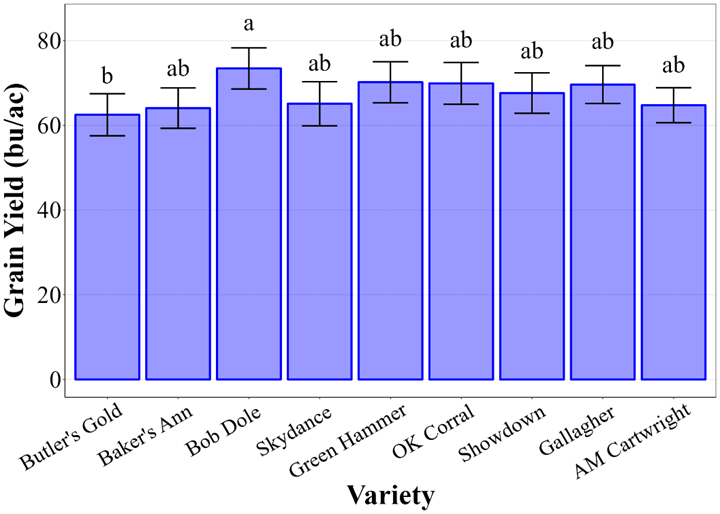
In our trials across multiple sites and seeding rates, Bob Dole was the top-yielding variety, producing 73 bu/ac in late-fall planting. However, its yield was not statistically higher than most other varieties tested, except for Butler’s Gold, which yielded 62 bu/ac (Figure 4). Varieties that performed well tended to accumulate more biomass by harvest and produced more grains per unit area (Figure 5).

A key observation was the trade-off between biomass production and maturity. Early maturing varieties like Butler’s Gold and Baker’s Ann had the lowest biomass production when planted late. This suggests that developing early maturing varieties with the ability to accumulate more biomass could improve their adaptability to late planting conditions. Further, the short-season variety Butler’s Gold had greater grain weight and above average grain protein concentration than the other varieties tested (Figure 5).

Figure 4. Average grain yield of nine varieties at late-fall planting date averaged over two seeding rates and six site-years. Plots with the same alphabetical letter are not statistically different from each other (p value < 0.05).
Figure 5. Aboveground biomass (BM) at maturity, grain number per unit area, average grain weight (AGW) and grain protein concentration of nine varieties at late-fall planting date averaged over two seeding rates and six site-years. Plots with the same alphabetical letter are not statistically different from each other (p value < 0.05).

Does seeding rate need to be adjusted for delayed wheat planting?

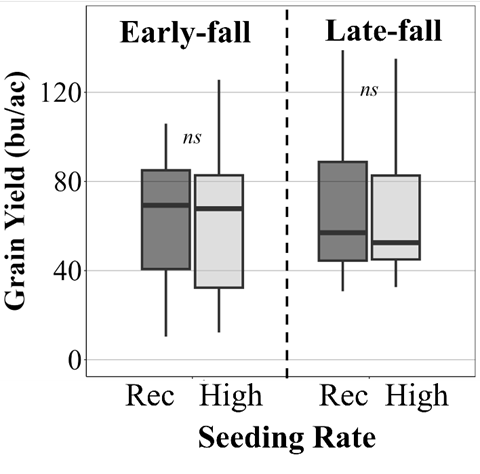
Our trials showed that increasing seeding rate did not result in a yield increase at late-fall planting across all varieties and site-years (Figure 6). Although the seeding rate affected some yield components, it did not translate into higher yields. The higher seeding rate increased the number of wheat heads per unit area but reduced the number of grains per head compared to the recommended seeding rate (data not shown). As a result, the total grain number per unit area — and ultimately the yield — remained the same for both seeding rates. Thus, our results suggest that increasing the seeding rate in late planting may not provide a yield advantage.

Figure 6. Grain yield under recommended (Rec.) and high seeding rates (i.e., 870K and 1.4 million seeds per acre, respectively) at early-fall (mid-October) and late-fall (early-December) planting dates averaged across nine genotypes and six site-years.

Take home
• Late planted wheat in Oklahoma showed no consistent yield loss compared to early-fall planting
• While the designated short-season variety, Butler’s Gold, did not outperform the other varieties at late sowing, its true value in a late-planted management system is derived from its one-week earlier harvest maturity. It also showed good end-use quality characteristics with heavier grain and above-average grain protein concentration than the other varieties .
• Varieties with better biomass production and grain number performed better with late sowing.
• Though this may defy logic, farmers do not need to increase seeding rate when facing the need to sow late, based on our results thus far.

Contributors:
Israel Molina Cyrineu, PhD student
Brett Carver, OSU Wheat Breeder
Tyler Lynch, Senior Agriculturalist for the Small Grains Extension Program

This research has been partially supported by OSU Wheat Research Foundation and Oklahoma Wheat Commission

Wheat update – Planting and fall armyworm

Amanda de Oliveira Silva, Small Grains Extension Specialist and Ashleigh Faris, Cropping Systems Extension Entomologist

Wheat planting in Oklahoma is off to a slow start due to extremely dry conditions, with only 32% of wheat planted as of October 7 (according to the USDA Crop Progress Report).

For most of Oklahoma, the optimal time to plant dual-purpose wheat is between September 10-20 (approximately day 260 in Figure 1). This period represents a balance between achieving good forage production and minimizing the risk of grain yield loss. Planting earlier can provide more fall forage potential but is usually only recommended if wheat is intended for grazing or “grazeout.” If you are planting wheat just for grain, you could wait at least 2-3 weeks after the dual-purpose planting window, which puts the best time for planting around mid-October (approximately day 285 in Figure 1) in many parts of the state. We have been evaluating how delayed wheat planting affects wheat yields, and it appears there might be more flexibility in the planting window than previously thought. I will be sharing more details about this research in an upcoming post!

Figure 1. Forage and grain yield potential in relation to the day of the year. Every 1,000 kg/ha is equal to approximately 900 lb/acre or 15 bu/acre. Ideal planting dates for dual-purpose wheat in Oklahoma are mid-September (i.e., approximately day 260). Planting for grain-only should occur at least 2-3 weeks after dual-purpose planting (i.e., mid-October or approximately day 285).

Rainfall on September 22 helped some fields in north-central, northwest, and Panhandle areas, and wheat that was planted before then has now emerged and looks good, though more rain would certainly help (Figure 2). In the fields we planted in Panhandle and northwest, we found moisture at about 1.5 inches deep, but the drought is holding us back in other parts of the state.

Figure 2. Wheat field planted before the September 22 rain event. Photo taken on October 8, 2024, near Goltry, OK by Josh Bushong.

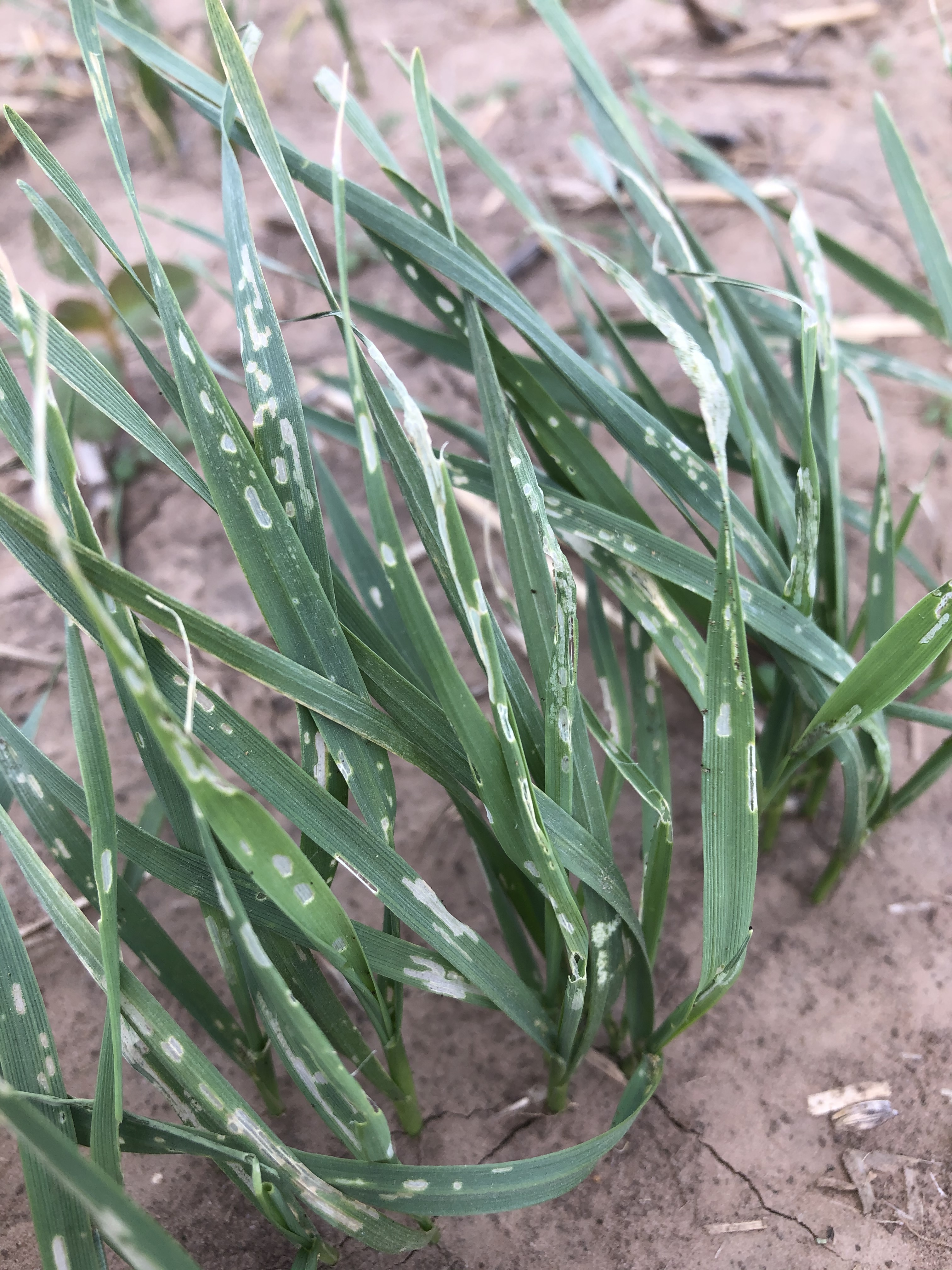
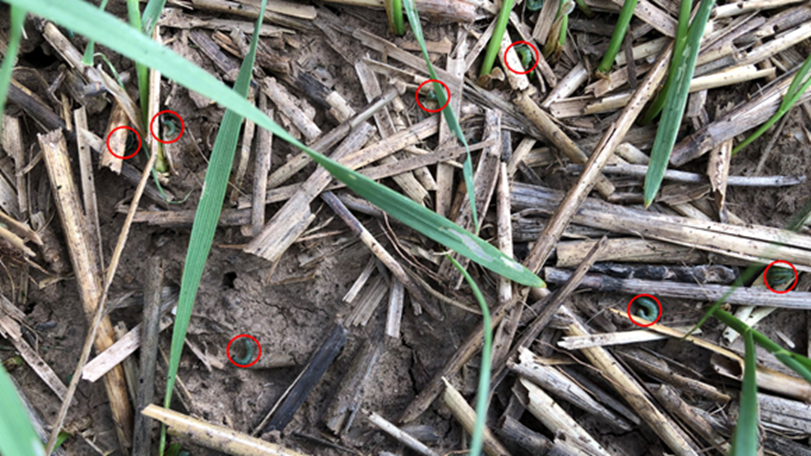
For fields where wheat was planted before the September rain, we are receiving reports of fall armyworms. They have been especially active in north-central Oklahoma over the past week. We recommend checking your fields daily after wheat emerges. The worms are small and hard to spot, but you may notice symptoms like “window pane” feeding on the leaves (Figure 3). Also, check under crop residue where they might be hiding from the heat (Figure 4).

Figure 3. Symptom of “window paned” leaves shows severe feeding from the fall armyworm. Photo taken on October 2, 2019, at Canadian County by Amanda Silva.
Figure 4. Fall armyworms may be found under crop residue during the day. Photo taken on October 2, 2019 at Canadian County by Amanda Silva.

Below is some information regarding monitoring and management of fall armyworms. Typically, fall armyworm population spikes are due to increases in precipitation in summer months. Fall armyworms are identifiable due to the light colored, inverted “Y” on their head (Figure 5). They are generally light tan to light green caterpillars that have a brownish-black head (may appear orangish). For more on the biology of the insect and its identification, check out the EPP-23-21 e-Pest Alert from this past summer.

Figure 5. Image of fall armyworm with two common features used to differentiate it from other caterpillar pests. Image: Corteva Agriscience.

Fall armyworm larvae will begin to consume vegetation in the early instars (1-3) but often this damage goes unnoticed because of the small amount consumed. As fall armyworms enter the later instars (4-6) the rate of consumption increases, and damage is more noticeable. The reason for rapid crop loss at this stage is caterpillars do most of their feeding (80-90%) in the final two instars. Fall armyworms cause damage by defoliating leaves and cutting seedlings at the surface level. Small larvae, unable to completely chew through the leaf, will often feed on vegetation by scraping it, lending to a windowpane appearance (as mentioned above, Figure 3).

Recommendations

Begin scouting for fall armyworms as soon as wheat emerges, particularly in the morning hours at the edges of wheat fields that share borders with pasture or road ditches. Look closely for signs of windowpaned leaves and the fall armyworms themselves. Treat if three to four larvae are found per foot of row AND feeding damage is evident. The early instars are more susceptible to insecticides so early detection is important for providing effective chemical control. While pyrethroid-based insecticides are low-cost, they are often ineffective when populations of fall armyworms are high. Instead, consider mixing a pyrethroid with another product that has chlorantraniliprole or diflubenzuron as an active ingredient which have a longer residual. Chlorantraniliprole products offer the advantage of being rainfast as well as protection against bigger fall armyworms. Products with diflubenzuron have a long residual but do not work well on larger worms. The good news is first frost will help knockback fall armyworm populations, until then producers are encouraged to have fall armyworm scouting as part of their daily routine and to be on the ready to spray when threshold is met.

We will not get relief from fall armyworms until we get a killing frost, so keep vigilant!

Reach out to us and contact your county Extension office for more information.

Amanda Silva – silvaa@okstate.edu

Ashleigh Faris – ashleigh.faris@okstate.edu

Wheat Harvest Near Complete with Producers Being Slowed in the Panhandle Due to More Rain

By: The Oklahoma Wheat Commission

Wheat harvest is pretty-well wrapped up in all areas of the state but producers in the Panhandle still have had challenges on getting the irrigated wheat crop out as they have had more rains over the weekend that hindered them.  It is thought that 35% to 40% of the crop within this region remains to be harvested.  Test weights have dropped on the irrigated wheat from previous rain events, but overall statewide averages still look favorable.  This will be the last harvest report of the season as the Oklahoma Wheat Commission is calling the state 97% complete with harvest.

General Report  At the time of reporting today, test weights across the state were ranging from 56 to 64 lbs. per bushel, with lighter test weights in the Panhandle region due to the heavy rains over the past couple weeks. Statewide averages for test weights ranging from 60lbs. to 61 lbs. per bushel.  Proteins ranging from 9% to 13.5% with an overall average of proteins being at 11.8% as of today.  Yields being reported at 40 to 50 bushels per acre in most regions.  Higher yields being reported on intensively managed wheat with some yields on a few fields being reported in the mid 60’s to low 80’s. Irrigated wheat in the Panhandle reported to be making 75 to 85 bushels per acre, with some higher yields noted in a few places.  This will be the last harvest report of the season published by the Oklahoma Wheat Commission.

Statewide average numbers for Oklahoma

Statewide test weight average 60 lbs. to 61 lbs. per bushel

Statewide protein average 11.8%

Statewide yield average 40 to 45 bushels per acre

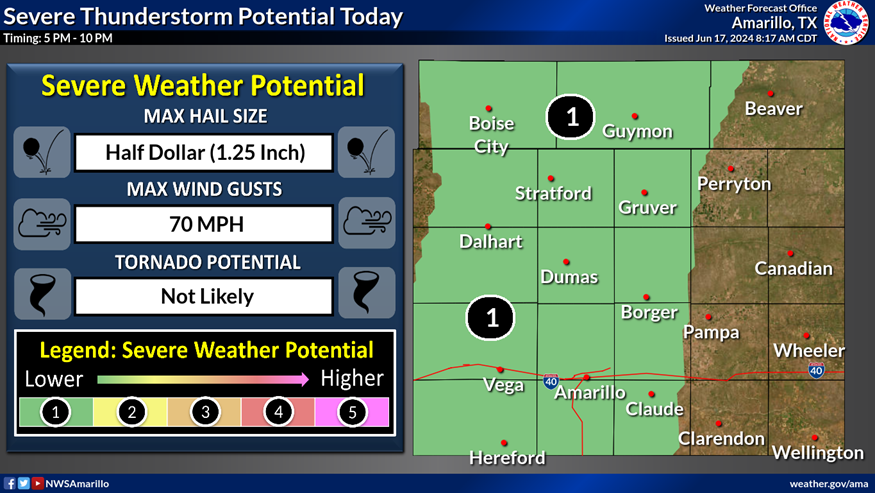
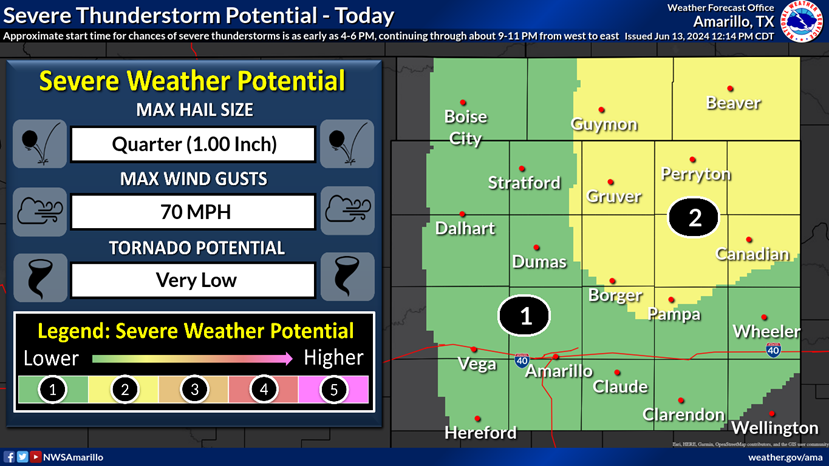
Below see the Tuesday evening Thunderstorm potential and rain chances for the Panhandle over the Independence Day weekend.

Oklahoma Wheat Harvest Nearing Completion in Several Areas 

By: The Oklahoma Wheat Commission

Oklahoma wheat harvest continues to move along in all areas of the state. Minor cutting continues in parts of Southwest Oklahoma down by Walters, Altus and Duke where rain hindered harvest in select areas. Elevator locations reporting a lot of movement over the weekend from South Central to North Central Oklahoma, progress has also been made in Northeast Oklahoma.  In the Panhandle producers have made good progress with dryland harvest and are hoping to start in irrigated wheat over the next couple of days. Oklahoma Wheat Commission is calling wheat harvest for the state 87% complete.

Southwest and Western Oklahoma

Grandfield/Chattanooga/Lawton- Test weights have dropped slightly in all regions with some weights now coming in at 57lbs. to 59lbs. per bushel. It should be noted that some 60 lb. per bushel test weight wheat is still being taken in after rains. It has been reported by producers some varieties have certainly been better at holding test weights.  (A large portion of this region was harvested before the heavy rains, so this area will still be looking at above 60 plus test weights for the harvest season.) Some harvest going on in these regions where producers have been fighting mud, but for the most part harvest is complete.  Yields are still favorable ranging from the low 40’s to low 50’s. Protein averages being reported from 10.5% to 12%, with overall average at 11.0% to 11.2% These locations reporting 98%complete.

Altus/Roosevelt/Lone Wolf/Hobart- Most of this region is complete with some minor cutting going on around the Altus and Duke areas where producers have fought mud. Test weights have dropped slightly this week but still holding a 60 plus average for the entire region. Yields reported as ranging from the low 40’s to mid 50’s.  Some higher intensively managed wheat making in the low 60’s to low 70’s.  Proteins in the region ranging from 9% to 14%.  Protein average for the region coming in at 11.8%.  These locations are reported at 98% complete.

Sentinel/Rocky- Harvest in this region is all but complete and should be wrapped up by Wednesday.  Test weights are still holding up ranging from 60lbs. to 62lbs. per bushel for the most part. Yields ranging from the mid 40’s to mid 50’s. Some highly intensive managed production have reports of some fields making in the 70’s. Proteins in this area are averaging 11.5% to 12%. These locations are reporting 99% complete

Central Oklahoma

El Reno- Yields in the region ranging from the mid 40’s to the mid 50’s for the most part. Test weights averaging 60 lbs. per bushel and above. Proteins varying across the board from 9% to 13%.  More higher than lower proteins reported for the region calling the average 11.5% to 12%.  This location is reported at 99% complete.

Reeding/Kingfisher/Omega/Loyal/Okeene- Test weights ranging from 60 lbs. to 62 lbs. per bushel, as they have dropped slightly with the rains but overall are holding up. Yields ranging from mid 40’s to low 50’s for the most part.  Some higher yields have been noted in low to mid 60’s on fields with some pushing 70 on wheat that was intensively managed. Protein ranging from 9% to 13.5%. Right now it is looking like an 11.5% to 11.8% average for the region.  Harvest in the Kingfisher and Reeding locations reported at 99% complete.  Harvest at Omega is 99% complete, Harvest in Loyal and Okeene considered 95% complete.

Northern Oklahoma

Kremlin/Hunter/Lamont- Harvest has made strong progress in this area over the past few days. Test weights ranging from 60lbs. to 62 lbs. per bushel. Yields ranging in the low 40’s to low 50’s for the most part. Fields with high management intensive systems being reported with yields as high as 70 bushels per acre, with some yields being reported in the high 80’s and low 90’s.  The higher yields are management and variety dependent.  Early reports on protein showing an 11.5% to 12% average.  These locations reported at 90% complete.

Tonkawa/Blackwell/Ponca City- Harvest had good movement over the weekend in this region.  Test weights have been favorable at 60lbs. per bushel and above. Yields being reported in the mid 40’s to mid 50’s for the most part.  Protein being reported at 11.5% to 13.5%. These locations reported at 80% complete.

Burlington-A lot of movement took place in this area over the past week. Test weights are ranging from 59lbs. to 62lbs. per bushel depending on variety. Most test weights are still 60lbs. per bushel and above.  Yields in the region are ranging from the low 40’s to mid 50’s for the most part.  Fields that struggled due to lack of rain earlier had been abandoned so those numbers are not in this report. Proteins being reported at 11.2% to 11.8% This location is reported at 99% complete.

Camargo/Shattuck/Fort Supply- Producers made great progress in this area over the weekend.  Much of this region had extreme drought conditions although the wheat in the Camargo area is reported to be doing better as they had more moisture over the season. Test weights reported at 61 lbs. per bushel and above. Yields being reported at 25 bushels per acre for the most part, but down by Camargo some higher yields around 40 bushels per acre have been reported.  Proteins averaging 11% to 11.8%.  These locations are reported at 65% complete.

Panhandle of Oklahoma

Turpin/Baker/Hooker- Producers have made good movement on dryland wheat in these regions, over the weekend. Dryland harvest for the most part seems to be going better than expected Dryland yields now being reported from the low 30’s to mid 50’s for the most part depending on rainfall and management practices. Test weights ranging from 60 lbs. to 62 lbs. per bushel.  Proteins ranging from 12.5% to 13%.  No reports of irrigated wheat harvest have been made at this time.  It is thought irrigated wheat harvest will later today or tomorrow in some parts of the region.   These locations reported at 25% complete. 

Northeast Oklahoma

Afton/Miami- Harvest made good strides in the region this past week. Yields on the Hard Red Winter (HRW) reported at 50 to 70 bushels per acre.  Yields on the Soft Red Winter (SRW) reported at 60 to 90 bushels per acre.  Test weights ranging from 58 lbs. to 60 lbs. per bushel, with some higher test weights being reported as they get into better wheat.  No proteins reported for the wheat in this area.  In this region 40% of the production will be HRW and 60% will be SRW wheat. These locations reported at 80% complete.

Wheat Classes And What They Are Used For

Hard Red Winter (HRW) – A versatile wheat with excellent milling and baking characteristics for pan bread.   Hard Red Winter wheat is also a choice for Asian noodles, hard rolls, flat breads, general purpose flour and cereal.

Soft Red Winter (SRW) – A versatile, weak-gluten wheat with excellent milling and baking characteristics suited for cookies, crackers, pretzels, pastries and flat breads.

General Report  At the time of reporting today test weights were ranging from 58 to 64 lbs. per bushel for the most part. Most test weights are now ranging from 60lbs. to 61 lbs. per bushel across the state. Proteins ranging from 9% to 13.5%, with an overall average of proteins being at 11.8% as of today.  Yields being reported at 40 to 50 bushels per acre in most regions.  Higher yields being reported on intensively managed wheat with some yields on a few fields being reported in the mid 60’s to low 80’s. The Oklahoma Wheat Commission is calling the state 87% complete with harvest.  The next Oklahoma Wheat Commission Harvest report will be published on Thursday, June 19, 2024.

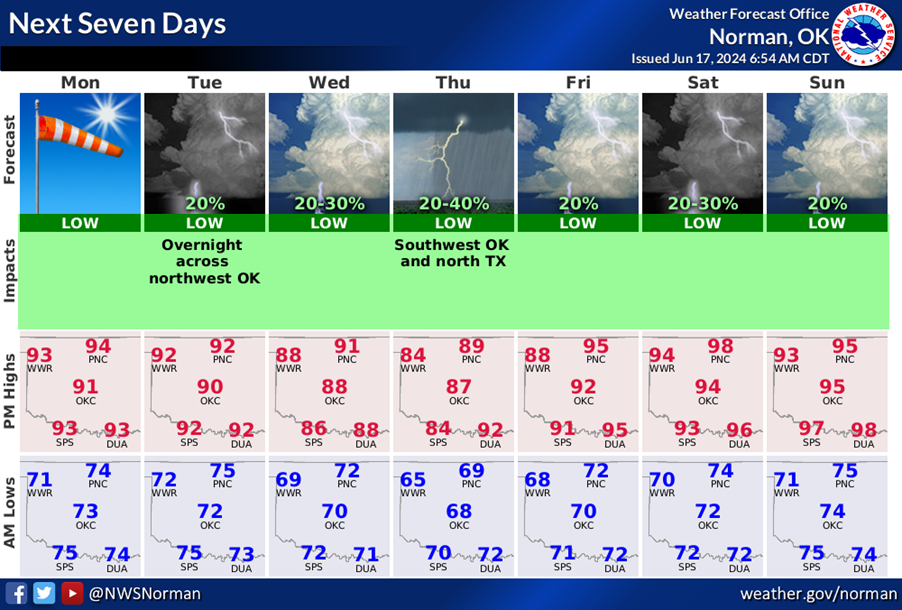
Below, see the 7-day forecast provided by the Oklahoma Mesonet, with wind advisories for Western part of the state along with storm alerts for the Panhandle region this Monday evening.

Oklahoma Wheat Harvest Moves Along With Great Progress

By: The Oklahoma Wheat Commission

Oklahoma wheat harvest continues to move along in all areas of the state. Elevator locations reporting a lot of movement in all areas with many of the Southern and Central regions getting closer to the finish line. Great progress has also been made the last few days in North Central and Northeastern Oklahoma. Oklahoma Wheat Commission is calling wheat harvest for the state 75% complete.

Southwest and Western Oklahoma

Grandfield/Chattanooga/Lawton- Test weight have dropped slightly in all regions with some weights now coming in at 57lbs. to 59lbs. per bushel. It should be noted that some 60 lb. per bushel test weight wheat is still being taken in after rains. It has been reported by producers some varieties have certainly been better at holding test weights.  (A large portion of this region was harvested before the heavy rains, so this area will still be looking at above 60 plus test weights for the harvest season.)  Yields are still favorable ranging from the low 40’s to low 50’s. Protein averages being reported from 10.5% to 12%, with overall average at 11.0% to 11.2%. These locations reporting 95%complete.

Altus/Roosevelt/Lone Wolf/Hobart- A large amount of progress has been made the last couple of days but in some areas at the beginning of the week it was slower to start due to heavy rains. Test weights have dropped slightly this week but still holding a 60 plus average for the entire region. Yields reported as ranging from the low 40’s to mid 50’s.  Some higher intensively managed wheat making in the low 60’s to low 70’s.  Proteins in the region ranging from 9% to 14%.  Protein average for the region coming in at 11.8%.  These locations are reported at 85% complete.

Sentinel/Rocky- Harvest in the area has made further progress over the past few days. Test weights are still holding up ranging from 60lbs. to 62lbs. per bushel for the most part. Yields ranging from the mid 40’s to mid 50’s. Some highly intensive managed production have reports of some fields making in the 70’s. Proteins in this area are averaging 11.5% to 12%. These locations are reporting 96% complete

Central Oklahoma

El Reno- Harvest in this region made better progress over the past couple of days. Yields in the region ranging from the mid 40’s to the mid 50’s for the most part. Test weights averaging 60 lbs. per bushel and above. Proteins varying across the board from 9% to 13%.  More higher than lower proteins reported for the region calling the average 11.5% to 12%.  This location is reported at 90% complete.

Reeding/Kingfisher/Omega/Loyal/Okeene- Test weights ranging from 60 lbs. to 62 lbs. per bushel, as they have dropped slightly with the rains but overall are holding up. Yields ranging from mid 40’s to low 50’s for the most part.  Some higher yields have been noted in low to mid 60’s on fields with some pushing 70 on wheat that was intensively managed. Protein ranging from 9% to 13.5%. Right now it is looking like an 11.0% to 11.8% average for the region.  Harvest in the Kingfisher and Reeding locations reported at 95% complete.  Harvest at Omega is 85% complete, Harvest in Loyal and Okeene considered 75% complete.

Northern Oklahoma

Kremlin/Hunter/Lamont- Harvest has made strong progress in this area over the past few days. Test weights ranging from 60lbs. to 62 lbs. per bushel. Yields ranging in the low 40’s to low 50’s for the most part. Fields with high management intensive systems being reported with yields as high as 70 bushels per acre, with some yields being reported in the high 80’s and low 90’s.  The higher yields were management and variety dependent.  Early reports on protein showing an 11.5% to 12% average.  These locations reported at 70% complete.

Tonkawa/Blackwell/Ponca City- Harvest had good movement over the weekend in this region.  Test weights have been favorable at 60lbs. per bushel and above. Yields being reported in the mid 40’s to mid 50’s for the most part.  Protein being reported at 11.5% to 13.5%. These locations reported at 30% to 35% complete.

Burlington-A lot of movement took place in this area over the week. Test weights are ranging from 59lbs. to 62lbs. per bushel depending on variety. Most test weights are still 60lbs. per bushel and above.  Yields in the region are ranging from the low 40’s to mid 50’s for the most part.  Fields that struggled due to lack of rain earlier had been abandoned so those numbers are not reported in this report. It is expected custom harvesters will be pulling out of the area on Friday. Proteins being reported at 11.2% to 11.8%. This location is reported at 80% complete.

Camargo/Shattuck/Fort Supply- Producers also got rolling in these areas over the weekend.  Much of this region had extreme drought conditions although the wheat in the Camargo area is reported to be doing better as they had more moisture over the season. Test weights reported at 61 lbs. per bushel and above. Yields being reported at 25 bushels per acre for the most part, but down by Camargo some higher yields around 40 bushels per acre have been reported.  Proteins averaging 11% to 11.8%.  These locations are reported at 35-40% complete.

Panhandle of Oklahoma

Turpin/Baker/Hooker- Producers have made good movement on dryland wheat in these regions, but are just getting a good start.  It is thought irrigated wheat harvest will be a little slower than what was predicted earlier in the week, but right now producers are thinking harvest on irrigated wheat will be in 10 days. Dryland yields being reported from high 20’s to mid 40’s for the most part depending on rainfall and management practices. Test weights ranging from 60 lbs. to 61 lbs. per bushel.  Proteins ranging from 12.5% to 13%.  These locations reported at 15% complete. 

Northeast Oklahoma

Afton/Miami- Harvest made good strides in the region this past week. Yields on the Hard Red Winter (HRW) reported at 50 to 70 bushels per acre.  Yields on the Soft Red Winter (SRW) reported at 60 to 90 bushels per acre.  Test weights ranging from 58 lbs. to 60 lbs. per bushel, with some higher test weights being reported as they get into better wheat.  No proteins reported for the wheat in this area.  In this region 40% of the production will be HRW and 60% will be SRW wheat. These locations reported at 50% complete.

Wheat Classes And What They Are Used For

Hard Red Winter (HRW) – A versatile wheat with excellent milling and baking characteristics for pan bread.   Hard Red Winter wheat is also a choice for Asian noodles, hard rolls, flat breads, general purpose flour and cereal.

Soft Red Winter (SRW) – A versatile, weak-gluten wheat with excellent milling and baking characteristics suited for cookies, crackers, pretzels, pastries and flat breads.

General Report  At the time of reporting today test weights were ranging from 58 to 64 lbs. per bushel for the most part. Most test weights are now ranging from 60lbs. to 61 lbs. per bushel across the state. Proteins ranging from 9% to 13.5%, with an overall average of proteins being at 11.8% as of today.  Yields being reported at 40 to 50 bushels per acre in most regions.  Higher yields being reported on intensively managed wheat with some yields on a few fields being reported in the mid 60’s to low 70’s. The Oklahoma Wheat Commission is calling the state 75% complete with harvest.  The next Oklahoma Wheat Commission Harvest report will be published on Monday, June 17, 2024.

Below, see the 7-day forecast provided by the Oklahoma Mesonet, with storm alerts for the Panhandle and Northwestern Oklahoma for this Thursday afternoon/evening.

Oklahoma Wheat Harvest Made Great Strides Over the Weekend

By: The Oklahoma Wheat Commission

Oklahoma wheat harvest made good progress in most regions over the weekend. Rain showers in parts of the Panhandle region delayed harvest on dryland production, but producers are hopeful to get moving again later today or tomorrow.  Some light showers in other parts of Western Oklahoma and Southern Oklahoma delayed producers in some parts, but for the most part it did not hinder combines from rolling over the weekend in those areas.   Elevator locations reporting a lot of movement in all areas.  Harvest still moving from the Oklahoma/Texas border to the Oklahoma/Kansas border, with larger percentages completed in Southwest, Western and Central Oklahoma. The Oklahoma Wheat Commission is calling wheat harvest for the state 55% complete.

Southwest and Western Oklahoma

Grandfield/Chattanooga/Lawton- Producers made great progress in the area over the weekend after heavy rains early last week delayed harvest.  Test weight has dropped slightly in all regions with some weights now coming in at 57lbs. to 59lbs. per bushel. (A large portion of this region was harvested before the heavy rains, so this area will still be looking at above 60 plus test weights for the harvest season.)  Yields are still favorable ranging from the low 40’s to low 50’s. Protein averages being reported from 10.5% to 12%, with overall average at 11.0% to 11.2%. These locations reporting 85%-90%complete.

Altus/Roosevelt/Lone Wolf/Hobart- A large amount of progress was made in these areas over the weekend. Test weights have dropped slightly this week but still holding a 60 plus average for the entire region. Yields reported as ranging from the low 40’s to mid 50’s.  Some higher intensively managed wheat making in the low 60’s to low 70’s.  Proteins in the region ranging from 9% to 14%.  Protein average for the region coming in at 11.5%.  These locations are reported at 70% complete.

Sentinel/Rocky-A large amount of the area was cut out over the weekend in this region. Test weights are still holding up ranging from 60lbs. to 62lbs. per bushel for the most part. Yields ranging from the mid 40’s to mid 50’s. Some highly intensive managed production have reports of some fields making in the 70’s. Proteins in this area are averaging 11.5% to 12%. These locations are reporting 60% complete

Central Oklahoma

El Reno- Producers made a great deal of progress in this region over the weekend. Yields in the region ranging from the mid 40’s to the mid 50’s for the most part. Test weights averaging 60 lbs. per bushel and above. Proteins varying across the board from 9% to 13%.  More higher than lower proteins reported for the region calling the average 11.5% to 12%.  This location is reported at 70% complete.

Reeding/Kingfisher/Omega/Okeene- Test weights ranging from 60 lbs. to 62 lbs. per bushel, as they have dropped slightly with the rains but overall are holding up. Yields ranging from mid 40’s to low 50’s for the most part.  Some higher yields have been noted in low to mid 60’s on fields with some pushing 70 on wheat that was intensively managed. Protein ranging from 9% to 13.5%. Right now it is looking like an 11.0% to 11.2% average for the region.  Harvest in the Kingfisher and Reeding locations reported at 60 to 65% complete.  Harvest in the Omega and Okeene regions reported at 30 to 40% complete.

Northern Oklahoma

Kremlin/Hunter/Lamont- Harvest had good movement over the weekend in this region. Test weights ranging from 60lbs. to 62 lbs. per bushel. Yields ranging in the low 40’s to low 50’s on early cuttings. Fields with high management intensive systems being reported with yields as high as 70 bushels per acre.  Early reports on protein showing an 11.5% to 12% average.  These locations reported at 25 percent complete.

Tonkawa/Blackwell/Ponca City- Harvest had good movement over the weekend in this region.  Test weights have been favorable at 60lbs. per bushel and above. Yields being reported in the mid 40’s to mid 50’s for the most part.  Protein being reported at 11.5% to 13.5%. These locations reported at 20 percent complete.

Burlington-A lot of movement took place in this area over the weekend. Test weights are ranging from 59lbs. to 62lbs. per bushel depending on variety. Most test weights are still 60lbs. per bushel and above.  Yields in the region are ranging from the low 40’s to mid 50’s for the most part.  Fields that struggled due to lack of rain earlier had been abandoned so those numbers are not reported in this report. Proteins being reported at 11.2% to 11.5% This location is reported at 30% to 40% complete.

Camargo/Shattuck/Fort Supply- Producers also got rolling in these areas over the weekend.  Much of this region had extreme drought conditions although the wheat in the Camargo area is reported to be doing better as they had more moisture over the season. Test weights reported at 61 lbs. per bushel and above. Yields being reported at 25 bushels per acre for the most part, but down by Camargo some higher yields around 40 bushels per acre have been reported.  Proteins averaging 11% to 11.2%.  These locations are reported at 10% complete.

Panhandle of Oklahoma

Turpin/Baker/Hooker- Rains in these regions delayed harvest over the weekend on dryland production.  It is thought producers might start getting into irrigated wheat by the end of this week. Dryland yields being reported from high 20’s to mid 40’s depending on rainfall and management practices. Test weights ranging from 60 lbs. to 61 lbs. per bushel.  Proteins ranging from 12.5% to 13%.  These locations reported at 10% complete. 

Northeast Oklahoma

Afton/Miami- Harvest made a good start in the region beginning on last Thursday.  Yields on the Hard Red Winter (HRW) reported at 60 to 70 bushels per acre.  Yields on the Soft Red Winter (SRW) reported at 70 to 90 bushels per acre.  Test weights ranging from 58 lbs. to 60 lbs. per bushel, with some higher test weights being reported as they get into better wheat.  No proteins reported for the wheat in this area.  In this region 40% of the production will be HRW and 60% will be SRW wheat. These locations reported at 30% complete.

Wheat Classes And What They Are Used For

Hard Red Winter (HRW) – A versatile wheat with excellent milling and baking characteristics for pan bread.   Hard Red Winter wheat is also a choice for Asian noodles, hard rolls, flat breads, general purpose flour and cereal.

Soft Red Winter (SRW) – A versatile, weak-gluten wheat with excellent milling and baking characteristics suited for cookies, crackers, pretzels, pastries and flat breads.

General Report.  At the time of reporting today, test weights were ranging from 58 to 64 lbs. per bushel for the most part. Most test weights are now ranging from 60lbs. to 61 lbs. per bushel across the state. Proteins ranging from 9% to 13.5%, with an overall average of proteins being at 11.8% as of today.  Yields being reported at 40 to 50 bushels per acre in most regions.  Higher yields being reported on intensively managed wheat with some yields on a few fields being reported in the mid 60’s to low 70’s.  The Oklahoma Wheat Commission is calling the state 55% complete with harvest.  The next Oklahoma Wheat Commission Harvest report will be published on Thursday, June 13, 2024.

Below, see the 7-day forecast provided by the Oklahoma Mesonet.  No storm alert advisories for the week were published at the time of this report.

Harvest Starts Rolling Again in Most Regions of the State

By: The Oklahoma Wheat Commission

Oklahoma wheat harvest just got started again late yesterday afternoon and last night in most regions, with a lot of test cutting going on in Northern Oklahoma.   Producers in all regions of the state are hopeful to get moving today. Harvest will be moving from the Oklahoma/Texas border to the Oklahoma/Kansas border. The Oklahoma Wheat Commission is calling wheat harvest for the state 25% complete.

Southwest and Western Oklahoma

Grandfield/Chattanooga/Lawton- This region has been plagued by heavy rains this past week.   Areas around Chattanooga received 4 to 5 inches of moisture while Grandfield and Lawton also received 1 inch to 1 ½ inches of moisture.  Test weight has dropped slightly in all regions with some weights now coming in at 58lbs. to 59lbs. per bushel. Yields are still favorable ranging from the low 40’s to low 50’s. Protein averages being reported from 10.5% to 12%, with overall average at 11.0% to 11.2%. These locations reporting 60 percent complete.

Southwest and Western Oklahoma

Altus/Roosevelt/Lone Wolf/Hobart- Wheat harvest in this region has been slowed by rains and high humidity days early in the week, but in most of these locations harvest got rolling again yesterday.   Test weights have dropped slightly this week but this region still holding 61lb. to 62lb. test weight averages depending on location. Yields reported as ranging from the low 40’s to mid 50’s.  Some higher intensively managed wheat making in the low 60’s to low 70’s.  Proteins in the region ranging from 9% to 14%.  Protein average for the region coming in at 11.5%.  These locations reporting 30 to 35 percent complete.

Apache- Harvest has been slower to start in this region with the on and off rains the past two weeks. Before the rains test weights were 61lbs. to 63lbs. per bushel.  Test weights  have dropped some but certain varieties are proving to hold up better. Yields being reported making low 40’s to low 50’s. Some highly intensive managers reporting yields in the 60’s to 70’s at this location, which tends to always be a bright spot for production.  Early protein reports show an average of 11.2% to 11.5%.  This area is 7 percent complete.

Cordell-Harvest got started again late yesterday afternoon in this area.   Test weights have dropped slightly with the rains this past week and are ranging from 59lbs. to 61lbs. per bushel.  Many varieties are still holding up well even with the rains.  Yields ranging from the mid 40’s to mid 50’s.  Proteins in this area are averaging 12%. This location is reporting 15 to 20 complete.

Central Oklahoma

Reeding/Kingfisher/Omega/Okeene- Test weights ranging from 60 lbs. to 62 lbs. per bushel, as they have dropped slightly with the rains but overall are holding up. Yields ranging from mid 40’s to low 50’s for the most part.  Some higher yields have been noted in low to mid 60’s on fields with some pushing 70 on wheat that was intensively managed. Protein ranging from 9% to 13.5%. Right now it is looking like an 11.0% to 11.2% average for the region.  Harvest in the Kingfisher locations reported at 20 percent complete.  Rains in the Omega/Loyal and Reeding areas hindered progress and are 10% complete.  

Northern Oklahoma

Kremlin/Hunter/Lamont- Early cuttings showing test weight ranging from 60lbs. to 62 lbs. per bushel as producers got into fields late yesterday in this area. Yields ranging in the low 40’s to low 50’s on early cuttings. Early reports on protein showing an 11.5% to 12% average. These locations reporting less than 5 percent complete.

Tonkawa/Blackwell Harvest still at a standstill at the time of this report today, due to heavy rains.  These regions reporting less than 5 percent complete.

Burlington- Last night harvest got a good start in this region.  Test weights are ranging from 59lbs. to 62lbs. per bushel depending on variety.   No yields on early cutting being reported but it is thought in some areas that production will be better than what was previously thought.  Locations based on rainfall and planting dates are showing their will be two different crops in this region.  Early protein reports ranging from 12% to 14%.  This region reporting less than 5% complete.

Panhandle of Oklahoma

Turpin/Baker/Hooker- Cutting on dryland wheat has begun out by Turpin and Baker.  Nothing had been taken in at Hooker as of this morning.  Yields ranging from 20 to 50 bushels depending on location and planting date.  No test weights or proteins reported at this time.

Northeast Oklahoma

Afton/Miami- No wheat has been taken in at these locations as of today.  Producers were hopeful to start cutting late this afternoon.

General Report

Reports in all locations show test weights ranging from 59 to 65 lbs. per bushel for the most part.  We have some regions now reporting some 58lb. to 59 lb. test weights in parts of Southern Oklahoma, but overall most test weights are still holding at 60lbs. or higher across the state. Proteins ranging from 9% to 13.5%, with an overall average of proteins being reported higher than last week now at 11.7%.  Early yields being reported at 40 to 50 bushels per acre in most regions.  Higher yields being reported on intensively managed wheat with some yields on a few fields being reported in the mid 60’s to low 70’s.  It is thought that in parts of Northwest Oklahoma the wheat in some areas has recovered, however there are still several parts in far Northwest Oklahoma and the Panhandle that will have lower yields due to persistent drought. The Oklahoma Wheat Commission is calling the state 25% complete with harvest.  The next Oklahoma Wheat Commission Harvest report will be published on Monday, June 10, 2024.

Below, see the 7-day forecast and storm potential outlook for this evening thru the weekend provided by the Oklahoma Mesonet.

Harvest Makes Minor Strides Over the Past Weekend

By: The Oklahoma Wheat Commission

Oklahoma wheat harvest moved at an extremely slow pace over the weekend in most regions due to continued rains and high humidity.  We had a few locations take in large amounts in the Central part of the state late Saturday afternoon.  The wheat across the state is ready in most all regions, but rainfall is keeping producers from making progress. We had some small amounts taken in as far North as Shattuck, and have heard test cutting on dryland wheat in the Panhandle, but no reports on what was harvested in the Panhandle out by Hooker. If it turns dry it is thought dryland wheat harvest in the Panhandle will get a good start either the middle of this week or by late week.  In the Northeast part of the state over by Afton and Miami the wheat will most likely be ready by the end of the week, once things dry out.  The Oklahoma Wheat Commission is calling wheat harvest for the state 21% complete.

Southwest and Western Oklahoma

Grandfield/Chattanooga/Lawton-  Wheat harvest made some progress in this region before the weekend, but heavy rains delayed much greater progress from being made from previous reports. Yields ranging from the low 40’s to low 50’s. Heavily grazed wheat having the lower yields in the high 20’s to low 30’s.  It has been noted some intensively managed fields have been yielding 50, with a few yields in the lower 70’s being reported.  Test weights ranging from 60lbs. to 65lbs. per bushel with an occasional 59 lb. test weight now being reported.   Protein averages being reported from 10.5% to 12%, with the overall average being around 11.0% to 11.2%.  These locations reporting 50 to 60 percent complete.

Altus/Roosevelt/Lone Wolf/Hobart- Wheat harvest in this region has been slowed by rains and high humidity days.  Some places around Altus received 2 to 3 inches of moisture over the weekend.  Test weights on wheat cuttings prior to the rains this weekend were 61 plus for the area. Yields reported as ranging from the low 40’s to mid 50’s.  Some higher intensively managed wheat making in the low 60’s to low 70’s.  Proteins in the region ranging from 9% to 14%.  Protein average for the region coming in at 11.5%.  These locations reporting 25 percent complete.

Sentinel/Rocky-Producers had a good start last weekend but high humidity days and moisture over the past week have hindered much progress from being made. Test weights ranging from 60 to 62 lbs. per bushel.  Yields being reported from 30 bushels to mid 50’s.  The lower yields are on heavily grazed fields.  Some higher yields are expected once producers start getting into better wheat.  Proteins in this region have been favorable ranging from 12% to 15%.  They are calling the average in this region at 13%.  These locations reporting 5 percent complete.

Central Oklahoma

Okarche/Piedmont- Producers struggled with high humidity days and small amounts of moisture this past week.  A large amount of wheat was taken in at these locations on Saturday afternoon/evening. Test weights reported at 60 plus on what was taken in before the rains this morning.  Protein reports on early cuttings ranging all over the board from 9% to 13.5%. Right now it looks like the region is averaging 11.5%. Proteins are extremely favorable in the Eastern part of this region.  Yields are being reported from the mid 40’s to mid 50’s, with some higher yields being reported in the mid 60’s to low 70’s on fields with intensive management.  These locations reporting 25 to 30 percent complete

Reeding/Kingfisher/Omega/Okeene- Test weights ranging from 61 lbs. to 65 lbs. per bushel, on wheat taken in before the rains this morning.  Yields ranging from mid 40’s to low 50’s for the most part.  Some higher yields have been noted in low to mid 60’s on fields with some pushing 70 on wheat that was intensively managed. Protein ranging from 9% to 13.5%. Right now it is looking like an 11.0% to 11.2% average for the region.  Harvest in the Reeding/Kingfisher locations reported at 15 to 25 percent complete, in the Omega/Okeene regions reported at less than 5 percent complete.

Northern Oklahoma

Medford/Pond Creek/Ponca City/Blackwell- Early cuttings showing test weight ranging from 60lbs. to 62 lbs. per bushel before the rains this morning.  Yields ranging in the low 40’s to low 50’s on early cuttings. No protein on early cuttings reported at this time. These locations reporting less than 5 percent complete.

Burlington- Nothing has been taken in at this location as of today. Rains will most likely delay harvest until late in the week, if it does start to dry out.  It is thought custom harvesters will start to arrive later this week.

Shattuck- Some small amounts were taken in over the weekend.  Test weights on what was received had a 61lb. per bushel average. Protein average on early loads at 11.2%.  No yields on early cuttings reported, but a lot of wheat in this area planned to make around 20 to 25 bushels per acre due to the long period of drought up until this point.  Heavy rains today will hinder much progress until late in the week if it does start to dry out.

Camargo/Fort Supply- Nothing has been taken in at these locations as of today.

Panhandle of Oklahoma

Hooker- Some test cutting took place over the weekend in parts of Texas County but nothing has been reported on what was harvested.  It is thought that dryland harvest will begin in the middle or by the end of the week depending on if it rains or not.

Northeast Oklahoma

Afton/Miami- No wheat has been taken in at these locations as of today.  The wheat would be ready to harvest on early varieties, but more rainfall is predicted over the next two days for this region, so producers are hopeful to get into the fields this coming weekend or early next week.

General Report

Reports in all locations show test weights ranging from 60 to 65 lbs. per bushel for the most part.  We have some regions now reporting an occasional 59 lb. test weight in parts of South Central Oklahoma. These numbers are reported on what was hauled in before the rains that came across the state this morning. Proteins ranging from 9% to 13.5%, with an overall average of proteins being reported at 11.0% to 11.2%. We are hearing reports of higher proteins in parts of Central Oklahoma, that hopefully will help with the overall state-wide averages. Early yields being reported at 40 to 50 bushels per acre in most regions.  Higher yields being reported on intensively managed wheat with some yields on a few fields being reported in the mid 60’s to low 70’s.  It is thought that in parts of Northwest Oklahoma the wheat in some areas has recovered however we are hearing predictions that we will see a lot of 25 bushel wheat in far regions of Northwest Oklahoma. Also some areas of the Panhandle that received timely moisture will have some good dryland wheat, but several areas will not be harvested on the dryland. The Oklahoma Wheat Commission is calling the state 21% complete with harvest.  The next Oklahoma Wheat Commission Harvest report will be published on Thursday, June 6, 2024.

Below, see the 6-10 day temperature outlook and storm potential outlook for this evening and Tuesday provided by the Oklahoma Mesonet.