Oklahoma wheat planting – 2025

Amanda de Oliveira Silva, Small Grains Extension Specialist

Soil moisture conditions are currently favorable for wheat planting across much of Oklahoma. Many of you may be eager to get seed in the ground, but before moving ahead, it is important to consider a few key points.

Planting date

For dual-purpose wheat (grazing + grain), the optimal planting window in most of Oklahoma is mid-September (Figure 1). Planting during this period provides the best balance between fall forage production and maintaining grain yield potential.

  • Early planting may increase fall forage production but also raises the risk of pests and diseases. It’s usually only recommended for wheat intended for graze-out or dual-purpose.
  • Grain-only wheat should generally be planted about 3-4 weeks later (mid-October, Figure 1) in many parts of the state. Our recent work shows there is more flexibility than we thought, and planting a little later can still work well depending on the weather.
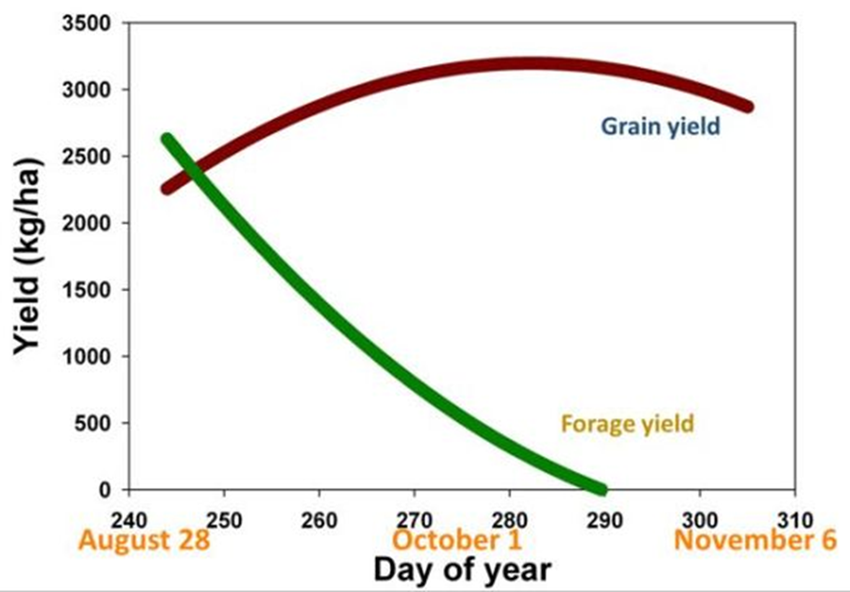
Figure 1. Forage and grain yield potential in relation to the day of the year. Every 1,000 kg/ha is equal to approximately 900 lb/acre or 15 bu/acre. Ideal planting dates for dual-purpose wheat in Oklahoma are mid-September (i.e., approximately day 260). Planting for grain-only should occur at least 3-4 weeks after dual-purpose planting (i.e., mid-October or approximately day 285).

Watch for Fall Armyworms

Planting too early increases the chance of fall armyworm infestations. These pests are small and easy to miss, but you might notice “window-pane” feeding on leaves (Figure 2). Check beneath crop residue as well, since they often hide there during the heat of the day (Figure 3).

Figure 2. Symptom of “window paned” leaves shows severe feeding from the fall armyworm. Photo taken on October 2, 2019, at Canadian County by Amanda Silva.
Figure 3. Fall armyworms may be found under crop residue during the day. Photo taken on October 2, 2019 at Canadian County by Amanda Silva.

Volunteer wheat and Virus Risk

Early planting also raises the risk of wheat streak mosaic and Triticum mosaic viruses, spread by the wheat curl mite. Because seed treatments do not control these viruses and few varieties have strong resistance (i.e., Breakthrough), cultural practices are critical:

  • Control volunteer wheat and other grassy hosts as much as possible.
  • Ensure volunteer wheat is completely dead for at least two weeks before planting. This breaks the “green bridge” that mites use to move into new seedlings.
  • Planting a little later can also help lower virus pressure.

We saw significant wheat streak mosaic issues last year, making these steps especially important in 2025.

Other Planting Considerations

Before planting:

  • Soil test to guide fertility needs and reduce input costs.
  • Use high-quality seed to promote good germination and stand establishment.
  • Consider fungicide and insecticide seed treatments to protect against soilborne diseases and early pest pressure such as root rots.

Need More Information?

Your county OSU Extension office is a great resource for information. You can also reach out directly to us:

Mites in Wheat Fields

Amanda de Oliveira Silva, Small Grains Extension Specialist

Areas of Oklahoma with dry conditions have begun to see some visible wheat injury due to brown wheat mite (Figure 1) and winter grain mite (Figure 2). Last week, Josh Bushong, OSU Northcentral Area Extension Agronomist, reported seeing fields with injury due to brown wheat mites in Alfalfa and Kingfisher counties (Figure 3). Later that week Tyler Lynch, the Senior Agriculturalist in the Small Grains Program also reported seeing wheat grain mites in our wheat plots at Alfalfa and Woods Counties.

Two common mites can injure wheat, the brown wheat mite and the winter grain mite. Producers need to remain alert so that they don’t mistake damaged wheat from small grains mites for drought or virus disease.

Figure 1. Brown wheat mite with oversummering egg

Brown wheat mite is small (about the size of this period.) with a metallic brown to black body and four pairs of yellowish legs (Figure 1). The forelegs are distinctly longer than the other three pairs. Brown wheat mites can complete a cycle in as little as 10-14 days. Oklahoma experiences multiple generations of brown wheat mites that usually peak in spring, and the last generation occurs in April. At that time, females produce a whitish egg that will over summer.

Figure 2. Winter grain mite with a kidney-shaped egg

Winter grain mite is small (about 1 mm long) with a dark blue to black body and four pairs of orange-red legs, and a small reddish spot on the top of its abdomen that can be seen under magnification (Figure 2). Winter grain mite eggs are kidney-shaped, and change from clear, to yellow to reddish-orange after several days. They are laid on leaf blades and stems or the roots near the crown. Besides wheat, many grasses serve as host plants, including barley, oats, ryegrass, and fescue. We typically experience two generations each year, a fall generation and a winter generation that cycles out in March.

Figure 3. Field infested with brown wheat mite. Photos taken by Josh Bushong at Kingfisher County on February 21, 2023.
Figure 4. Leaf stippling from brown wheat mite (left) and grain wheat mite (right) feeding. Photo on the right taken by Tyler Lynch at Alfalfa county on April 24, 2023.
Figure 5. Field infested with winter grain mite

Both mites feed by piercing plant cells in the leaf, which results in “stippling” (Figures 4 and 5). The leaves take on a characteristic brown-grayish or cast and could be mistaken for injury due to herbicide. These mites are more likely to cause injury in wheat stressed from lack of moisture or nutrients.

Figure 6. Winter grain mite hiding in residue

Threshold

Brown wheat mites are not light sensitive but are vulnerable to driving rains of more than 0.25 inches, which tend to reduce populations. Winter grain mites are more tolerant of rainfall but are very light sensitive and tend to avoid bright, sunny days and windy days, so adjust your scouting accordingly. It is best to scout for winter grain mites on still, cloudy days or early morning/late evening. On sunny or windy days, they hide under the soil surface (up to a couple of inches) or congregate under dirt clods (Figure 6). Both mites are associated with continuous wheat production. Research suggests that brown wheat mite can be economically treated when there are 25-50 mites per leaf in wheat that is 6-9 inches tall. An alternative estimation is “several hundred” per foot of a row. The best recommendation for winter grain mite is to treat when plants show visible injury, and there are still mites present.

Chemical control

Only a few insecticides include either mite species on their label. Work conducted by Dr. Gerald Wilde at Kansas State evaluated several insecticides for the control of winter grain mites. Of those registered for winter grain mites, the insecticide dimethoate (Dimethoate and other generics) is effective. Other pyrethroid insecticides, lambda-cyhalothrin (Karate, Warrior II, and its generics), gamma-cyhalothrin (Declare) and beta-cyfluthrin (Baythroid and its generics) are also effective for both mites, even if they are not specifically listed on the label.

Additional resources

Contact your County Extension office

For more information on these mites, consult fact sheet EPP-7093 Mites in Small Grains by clicking here. If you find active mite infestations in your field, consult fact sheet CR-7194 Management of Insect and Mite Pests in Small Grains for registered insecticides, application rates, and grazing/harvest waiting periods by clicking here.