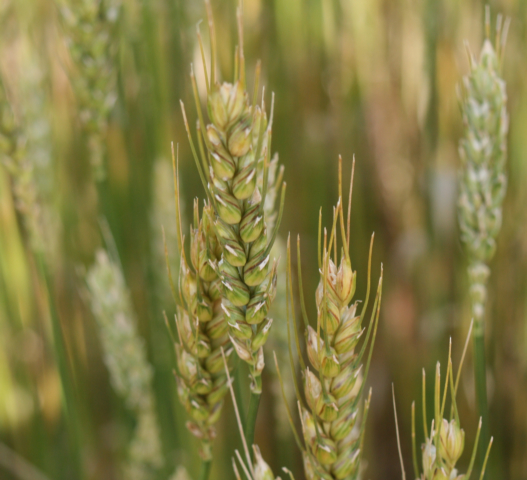
Brown wheat mite showing up in winter wheat

by: Tom Royer, OSU Extension Entomologist

Our winter wheat has taken a beating this winter, with cold weather hanging on and some areas not getting that thirst quenching precipitation to help it get a great jump start this spring.  In addition, I have received scattered reports of brown wheat mites showing up and causing problems.  Producers need to remain alert so that their wheat is not suffering dual problems of dry growing conditions PLUS brown wheat mite.

Brown what mite can severely damage wheat that is already stressed due to drought or other adverse environmental conditions.

Brown what mite can severely damage wheat that is already stressed due to drought or other adverse environmental conditions.

Brown wheat mite is small (about the size of this period.) with a metallic brown to black body and 4 pair of yellowish legs.  The forelegs are distinctly longer that the other three pair. Brown wheat mites can complete a cycle in as little as 10-14 days.  They will undergo up to 3 generations each year, but have probably already completed at least one or two by now. Numbers will likely decline if a hard, driving rain occurs.  Spring populations begin to decline in mid-late April when females begin to lay “diapause” eggs.

Brown wheat mite causes problems in wheat that is stressed from lack of moisture.  They feed by piercing plant cells in the leaf, which results in “stippling”.  As injury continues the plants become yellow, then dry out and die.  These mites feed during the day, and the best time to scout for them is in mid-afternoon.  They do not produce webbing and will quickly drop to the soil when disturbed. They are very susceptible to hard, driving rains, but until then they can cause yield loss when present in large numbers

A closeup of a brown wheat mite. Photo courtesy Franklin Peairs, CSU.
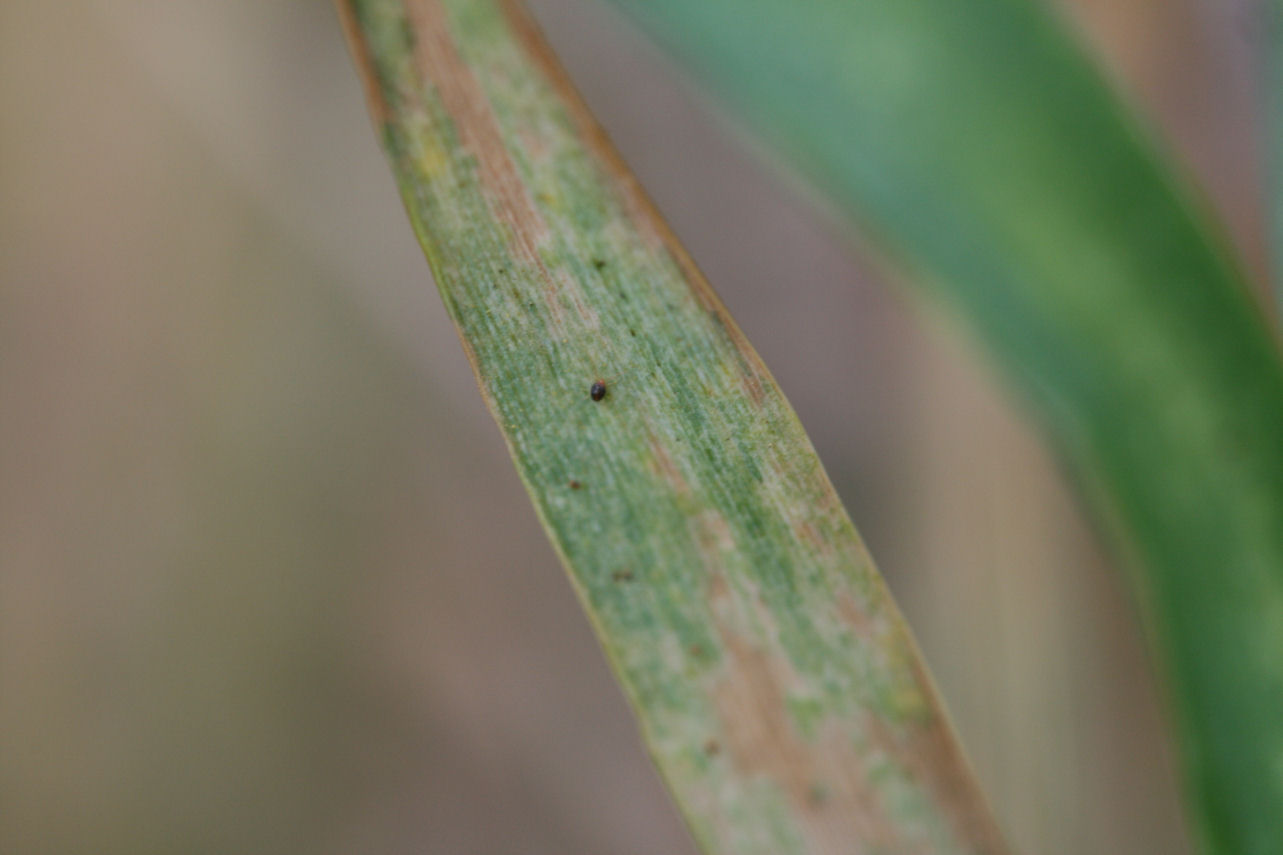
A closeup of a brown wheat mite. Photo courtesy Franklin Peairs, CSU.

Brown wheat mites are about the size of a period at the end of a sentence and can be difficult to see with the naked eye.

Brown wheat mites are about the size of a period at the end of a sentence and can be difficult to see with the naked eye.

Research suggests that a treatment threshold of 25-50 brown wheat mites per leaf in wheat that is 6-9 inches tall is economically warranted.  An alternative estimation is “several hundred” per foot of row.

Check CR-7194, Management of Insect and Mite Pests in Small Grains for registered insecticides, application rates, and grazing/harvest waiting periods. It can be obtained from any County Extension Office, at www.wheat.okstate.edu, or by clicking here.

Brown wheat mite eggs in soil.

Brown wheat mite eggs in soil.


Watch for armyworms in wheat

We have a late-maturing wheat crop that has fought its way through freezes, howling winds and it is now receiving some needed rain.  This cool weather is also helping slow the maturity of the wheat.  Right now, wheat is vulnerable to infestation from armyworms.  Armyworm infestations typically occur in late April through the first two weeks of May, but obviously, the cooler spring we have experienced this year has delayed their development.

Armyworm infestations occur more frequently around waterways, areas of lush growth, or areas with lodged plants. These areas should be checked first to determine the size of the infestation. Armyworm 2 Royer 2007

Early signs of an infestation include leaves with ragged margins that have been chewed.  You may find “frass” i.e. the excrement from armyworm caterpillars, around the base of wheat stems.  They also tend to clip heads from developing wheat plants. The head clipping I have noticed over the years us usually restricted to secondary tillers with very small, green heads that would not likely contribute much to yield.

Armyworm damaged wheat heads

Armyworm damaged wheat heads

Scout for armyworms, at 5 or more locations looking for “curled up worms”.  Armyworm caterpillars tend to feed at night, so a good strategy is to bring a flashlight and look at fields after dusk when they are feeding up on the plant stems.  The suggested treatment threshold for armyworms is 4-5 unparasitized caterpillars per linear foot of row.

Clipped heads from armyworm feeding

Clipped heads from armyworm feeding

Armyworms have a number of natural enemies that help keep populations in check, if given a chance.  In particular, parasitic wasps and flies attack them.  If you find small white cocoons littered on the ground that are about ¾ the size of a cue tip, the natural enemies have already taken care of the problem.


Parasitized armyworms

Parasitized armyworms

I have noticed that there has been some fungicides being applied during the past few weeks. If an insecticide was added to that spray, it is likely to have reduced any armyworm population already established in the field. Still, it is important to check the field.  Generally if wheat is past the soft dough stage, control is not warranted unless obvious head clipping can be seen, and caterpillars are still present and feeding.  Worms feeding on the awns when plants are past soft dough will not cause enough yield loss to justify the expense of an insecticide application.

Consult CR-7194 Management of Insect and Mite Pests of Small Grains for information on insecticides registered for control of armyworms.

For more information on this topic, contact Tom A. Royer, Extension Entomologist at tom.royer@okstate.edu

Insecticide-resistant greenbugs in TX Panhandle

By Tom Royer, OSU Extension Entomologist

I received some troubling news from the Texas Panhandle.  Dr. Ed Bynum, Extension Entomologist from Amarillo, reported finding some greenbug populations that were shown to be resistant to chlorpyrifos, the active ingredient in Lorsban 4E, and other generic products (Govern 4E, Hatchet, Nufos, Vulcan, Warhawk, Whirlwind).   You can read the full article by clicking on this url: http://texashighplainsinsects.net/april-12th-special-edition/  The bottom line:  he tested some suspect greenbug populations using a diagnostic test that he developed for testing greenbugs in sorghum in the 1990’s, and found that they were resistant to chlorpyrifos at labeled rates.

Greenbugs on wheat

Greenbugs on wheat

This should not raise panic among growers in Oklahoma for two reasons.  The first is that I have not heard of or received reports of any control failures for greenbugs in Oklahoma, in fact, generally greenbugs have been pretty scarce this winter.

The second reason is that it is late enough in the growing season to expect that the primary natural control of greenbugs, a tiny wasp called Lysiphlebus testaceipes (see picture to right), keeping greenbug numbers from becoming an outbreak.

Natural predators can keep greenbug infestations below economic thresholds

Natural predators can keep greenbug infestations below economic thresholds

The best course of action is to sample winter wheat fields with the Glance ‘n Go system.

Start by going to the Cereal Aphids Decision Support Tool on your computer http://entoplp.okstate.edu/gbweb/index3.htm and selecting the Greenbug Calculator.

By answering a few simple questions, you can determine an economic threshold for controlling greenbugs.  This threshold is based on the estimated cost of treating the field and the estimated price of wheat.  Once a threshold is calculated, you can print a Glance ‘n Go scouting form, take it to a field and record your sampling results.  The form will help you to decide if the field needs to be treatment for greenbugs.  There are several things that make Glance ‘n Go a good way to make such a decision. You only have to “Glance” at a tiller to see if it has greenbugs (no counting greenbug numbers).  You can make a decision to treat “on the Go” because you stop sampling once a decision is reached (no set number of samples).  Finally, you can account for the activity of the greenbug’s most important natural enemy, Lysiphlebus testaceipes.

Aphid Mummies (below)

When scouting with the Glance ‘n Go system, keep a running count of tillers that have aphid mummies and a running count of tillers that are infested with one or more greenbugs.  After each set of 5 stops, the Glance ‘n Go form directs you to look at your total number of infested tillers and tillers with mummies.  If there is enough parasitoid (mummy) activity, you will be directed to stop sampling and DON’T TREAT, even if you have exceeded the treatment threshold for greenbugs!  Why? Because research showed that at that level of parasitism, almost all of the healthy-looking greenbugs have been “sentenced to death” and will be ghosts within 3-5 days.  If they have received their “sentence” you can save the cost of an unnecessary insecticide application.

Treatment thresholds will probably fall around 2-4 greenbugs per tiller, but make sure you are using the Spring (January-May) form, not the Fall (Sept-December) form.  If a field needs to be treated, check with Current Report CR-7194, “Management of Insect and Mite Pests in Small Grains”.  If you treat for greenbugs and have a failure, please contact our Department and we will investigate further to determine