Amanda de Oliveira Silva, Small Grains Extension Specialist
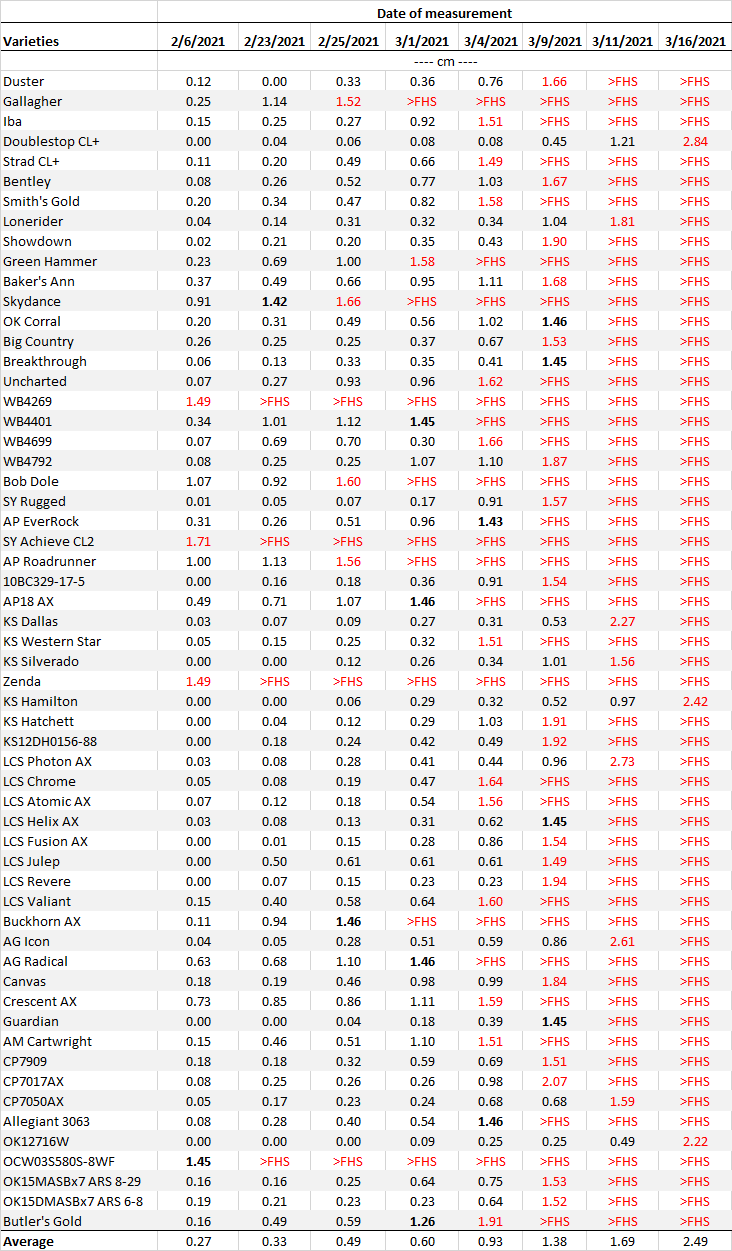
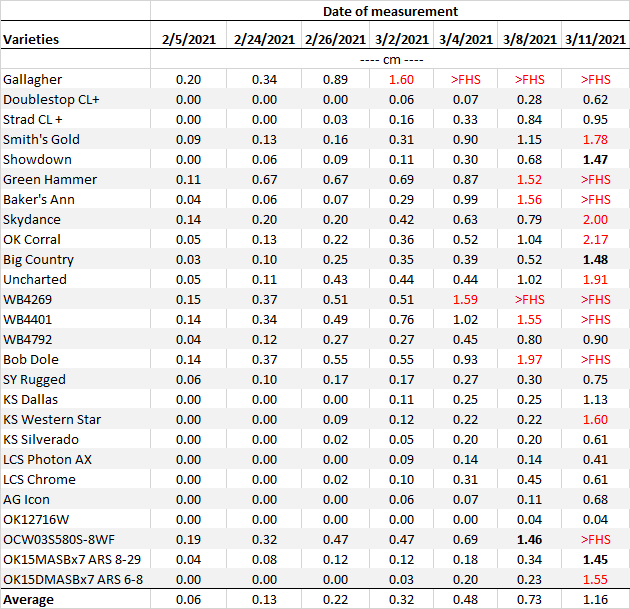
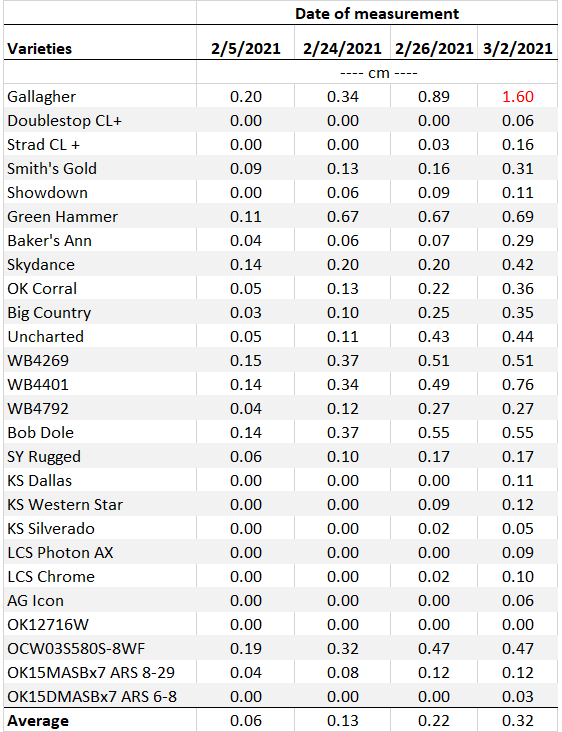
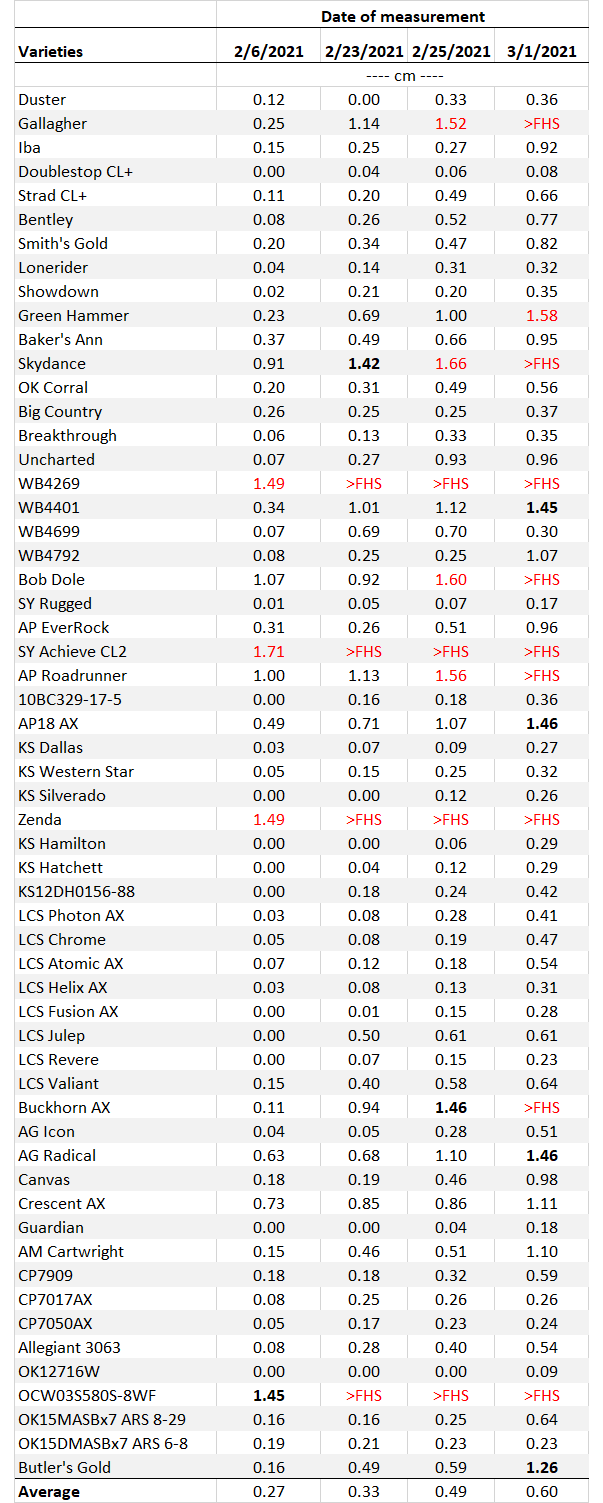
First hollow stem (FHS) is the optimal time to remove cattle from wheat pasture. This occurs when there is 1.5 cm (5/8”, or the diameter of a dime) of stem below the developing grain head (see full explanation). The latest FHS results from OSU forage trials in Chickasha (Table 1) and Stillwater (Table 2) are listed below. For an additional resource, see the Mesonet First Hollow Stem Advisor.
We use an accelerated growth system to report the earliest onset of FHS stage. Trials are seeded early to simulate a grazed system, but the forage is not removed. Varieties reported here with the earliest FHS date should be the first to monitor in commercial fields. In practice, wheat that is grazed will likely reach FHS stage later than reported here, and differences between varieties will likely moderate.
Table 1. First hollow stem (FHS) results for each variety collected at Chickasha. Plots were planted on 09/29/20 but not grazed or clipped. The threshold target for FHS is 1.5 cm (5/8″ or the diameter of a dime). The value of hollow stem for each variety represents the average of ten measurements. Varieties exceeding the threshold are highlighted in red.
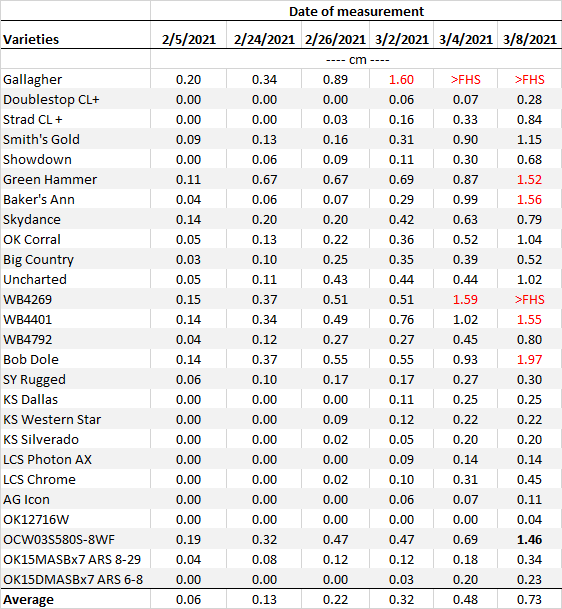
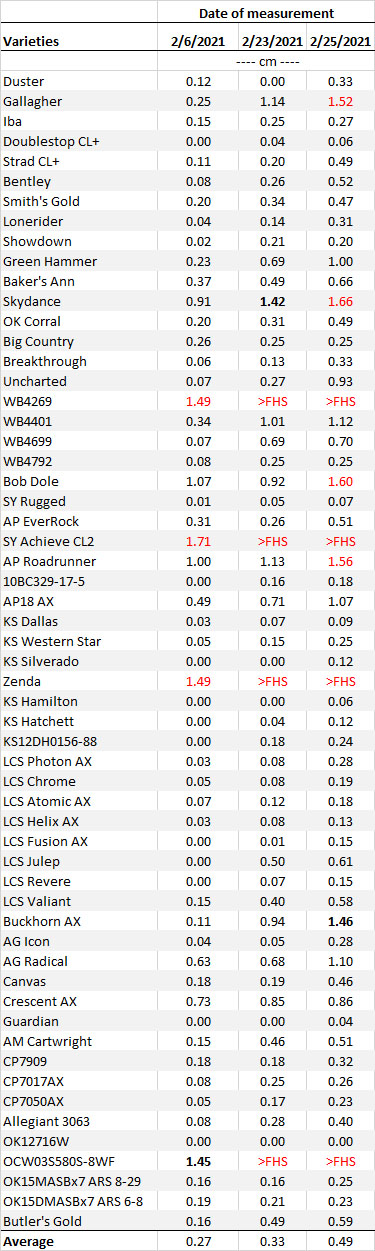
Table 2. First hollow stem (FHS) results for each variety collected at Stillwater. Plots were planted on 09/21/20 but not grazed or clipped. The threshold target for FHS is 1.5 cm (5/8″ or the diameter of a dime). The value of hollow stem for each variety represents the average of ten measurements. Varieties exceeding the threshold are highlighted in red.
Similar to previous years, we will monitor occurrence of FHS in our wheat plots at Stillwater and Chickasha and report the findings on this blog.
Amanda de Oliveira Silva, Small Grains Extension Specialist
First hollow stem (FHS) is the optimal time to remove cattle from wheat pasture. This occurs when there is 1.5 cm (5/8” or the diameter of dime) of stem below the developing grain head (full explanation). To give you a point of reference, the average FHS date over the past 20 years at Stillwater is March 6.
The latest FHS results from our forage trials in Chickasha (Table 1) and Stillwater (Table 2) are listed below. Several wheat varieties in Stillwater and a few in Chickasha have reached or passed the 1.5 cm threshold.
The Mesonet First Hollow Stem Advisor and the updates we provide give an indication of the FHS stem conditions in a particular area. However, because of the number of factors that can influence when FHS occurs, it is extremely important to check for FHS on a field-by-field basis.
Table 1. First hollow stem (FHS) results for each variety collected at Chickasha. Plots were planted on 09/29/2020. The threshold target for FHS is 1.5 cm (5/8″ or the diameter of a dime). The value of hollow stem for each variety represents the average of ten measurements from non-grazed plots. Varieties that have reached FHS are highlighted in red.
Table 2. First hollow stem (FHS) results for each variety collected at Stillwater. Plots were planted on 09/21/2020. The threshold target for FHS is 1.5 cm (5/8″ or the diameter of a dime). The value of hollow stem for each variety represents the average of ten measurements from non-grazed plots. Varieties that have reached FHS are highlighted in red.
Similar to previous years, we will monitor occurrence of FHS in our wheat plots at Stillwater and Chickasha and report the findings on this blog.
Amanda de Oliveira Silva, Small Grains Extension Specialist and Brian Arnall, Precision Nutrient Management Specialist
The forecast indicates hot (~75 F) and windy (~20-30 mph) conditions this week in Oklahoma (Mesonet). If you plan to topdress N to wheat, be aware that there is a high risk of causing leaf burn due to the predicted weather.
When comparing application methods, a stream bar is better than a flat fan for topdressing N in general. A flat fan would burn and even kill the wheat if used this week. However, using a stream bar under 20-30 mph wind is also problematic, as the wind will spread out the stream over the wheat, making it splash over larger areas result in more foliar burn.
Streamer nozzles provide uniform application of UAN in a wide variety of environmental conditions.
What rate can I apply without causing leaf burn from N this week?
There is a high risk of causing leaf burn by applying any rate (20 to 200lbs/ac) of N in the next 2-3 days (March 8-11, 2021). If using streamer nozzles the total amount of leaf damage could be small resulting in no yield loss. In this case, applying N this week may result in streaked fields later, but the wheat should grow out of it if conditions are appropriate. However, as you start to increase coverage (i.e. the amount of leaf burn) there is a threshold at which yield is lost. In cases with flat fan the high N rate will potentially kill the majority above ground biomass and negatively impact yield.
Other options to reduce the potential risk of injury. Wait to topdress N when the weather cools down (if you believe you will be able to get into the field before jointing) or split the N rate between now and sometime before jointing. If you want to apply and are very worried about tissue damage, one option is to dilute the UAN with water. Usually a 50/50 (UAN/H2O) ratio does a good job of reduction impact of the salt in UAN.
If you have questions, please feel free to reach out to us!
Amanda de Oliveira Silva, Small Grains Extension Specialist
First hollow stem (FHS) is the optimal time to remove cattle from wheat pasture. This occurs when there is 1.5 cm (5/8” or the diameter of dime) of stem below the developing grain head (full explanation). To give you a point of reference, the average FHS date over the past 20 years at Stillwater is March 6.
The latest FHS results from our forage trials in Chickasha (Table 1) and Stillwater (Table 2) are listed below. A few more wheat varieties in Stillwater have reached or passed the 1.5 cm threshold.
The Mesonet First Hollow Stem Advisor and the updates we provide give an indication of the FHS stem conditions in a particular area. However, because of the number of factors that can influence when FHS occurs, it is extremely important to check for FHS on a field-by-field basis.
Table 1. First hollow stem (FHS) results for each variety collected at Chickasha. Plots were planted on 09/29/2020. The threshold target for FHS is 1.5 cm (5/8″ or the diameter of a dime). The value of hollow stem for each variety represents the average of ten measurements from non-grazed plots. Varieties that have reached FHS are highlighted in red.
Table 2. First hollow stem (FHS) results for each variety collected at Stillwater. Plots were planted on 09/21/2020. The threshold target for FHS is 1.5 cm (5/8″ or the diameter of a dime). The value of hollow stem for each variety represents the average of ten measurements from non-grazed plots. Varieties that have reached FHS are highlighted in red.
Similar to previous years, we will monitor occurrence of FHS in our wheat plots at Stillwater and Chickasha and report the findings on this blog.
Amanda de Oliveira Silva, Small Grains Extension Specialist
First hollow stem (FHS) is the optimal time to remove cattle from wheat pasture. This occurs when there is 1.5 cm (5/8” or the diameter of dime) of stem below the developing grain head (full explanation). To give you a point of reference, the average FHS date over the past 20 years at Stillwater is March 6.
The latest FHS results from our forage trials in Chickasha (Table 1) and Stillwater (Table 2) are listed below. A few more wheat varieties in Stillwater have reached or passed the 1.5 cm threshold.
The Mesonet First Hollow Stem Advisor and the updates we provide give an indication of the FHS stem conditions in a particular area. However, because of the number of factors that can influence when FHS occurs, it is extremely important to check for FHS on a field-by-field basis.
Table 1. First hollow stem (FHS) results for each variety collected at Chickasha. Plots were planted on 09/29/2020. The threshold target for FHS is 1.5 cm (5/8″ or the diameter of a dime). The value of hollow stem for each variety represents the average of ten measurements from non-grazed plots. Varieties that have reached FHS are highlighted in red.
Table 2. First hollow stem (FHS) results for each variety collected at Stillwater. Plots were planted on 09/21/2020. The threshold target for FHS is 1.5 cm (5/8″ or the diameter of a dime). The value of hollow stem for each variety represents the average of ten measurements from non-grazed plots. Varieties that have reached FHS are highlighted in red.
Similar to previous years, we will monitor occurrence of FHS in our wheat plots at Stillwater and Chickasha and report the findings on this blog.
Amanda de Oliveira Silva, Small Grains Extension Specialist
First hollow stem (FHS) is the optimal time to remove cattle from wheat pasture. This occurs when there is 1.5 cm (5/8” or the diameter of dime) of stem below the developing grain head (full explanation). To give you a point of reference, the average FHS date over the past 20 years at Stillwater is March 6.
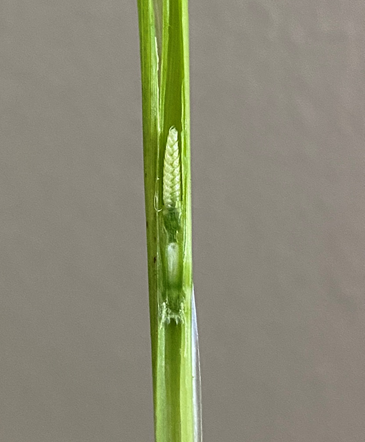
Figure 1. First hollow stem occurs when hollow stem equivalent to the diameter of a dime (1.5 cm) is present below the developing grain head.
The latest FHS results from our forage trials in Chickasha (Table 1) and Stillwater (Table 2) are listed below. Few wheat varieties in Stillwater have reached or passed the 1.5 cm threshold.
The Mesonet First Hollow Stem Advisor and the updates we provide give an indication of the FHS stem conditions in a particular area. However, because of the number of factors that can influence when FHS occurs, it is extremely important to check for FHS on a field-by-field basis.
Table 1. First hollow stem (FHS) results for each variety collected at Chickasha. Plots were planted on 09/29/2020. The threshold target for FHS is 1.5 cm (5/8″ or the diameter of a dime). The value of hollow stem for each variety represents the average of ten measurements from non-grazed plots. Varieties that have reached FHS are highlighted in red.
Table 2. First hollow stem (FHS) results for each variety collected at Stillwater. Plots were planted on 09/21/2020. The threshold target for FHS is 1.5 cm (5/8″ or the diameter of a dime). The value of hollow stem for each variety represents the average of ten measurements from non-grazed plots. Varieties that have reached FHS are highlighted in red.
Similar to previous years, we will monitor occurrence of FHS in our wheat plots at Stillwater and Chickasha and report the findings on this blog.
Amanda de Oliveira Silva, Small Grains Extension Specialist
Weather forecasts indicate that temperatures will continue to drop in the next few days. The extent of possible damage from these below-normal temperatures on wheat will depend on several factors such as wheat developmental stage, soil moisture, snow cover, field conditions, and how cold and for how long these cold weather stays.
Most of the wheat in Oklahoma was dormant or just starting to come out of dormancy before this extreme cold front came in. The more advanced in growth the wheat is, the more exposed the growing point is and susceptible to injury. On the other hand, wheat fields planted late in December are also vulnerable as the wheat may not have had the time to develop its crown roots and tiller to sustain these cold temperatures. The most important part of the plant is the crown at this moment. We may see leaf damage, but if the crown remains alive, the plant can survive. Figure 1 provides a general guide to the minimum temperature threshold and its impact on yield. Keep in mind these temperature thresholds are not exact but provide a decent rule of thumb. Temperatures closer to the soil surface might be higher than those reported by weather stations one meter above the soil surface, especially if moisture is present.
Figure 1. Temperatures that can cause injury to winter wheat at different growth stages. Source: Kansas State University publication C646: Spring Freeze Injury to Kansas Wheat.
Except for the western OK and Panhandle regions, most areas of the state were with adequate soil moisture, which helps to insulate the crop and improves survival chances. Also, if we receive the snow cover that is forecasted, the wheat will be more protected from the harsh conditions.
Regarding my last post that some varieties may have reached first hollow stem (FHS). Growers should keep in mind that FHS is based on the largest tiller on the plant. Even if we lose the largest tillers, we are fine as long as other tillers are viable and we have favorable growing conditions.
Figure 2. Leaf tips which have turned necrotic due to freezing temperatures. Photo taken in March 2017 courtesy of Josh Bushong, OSU Northwest area Extension agronomist.
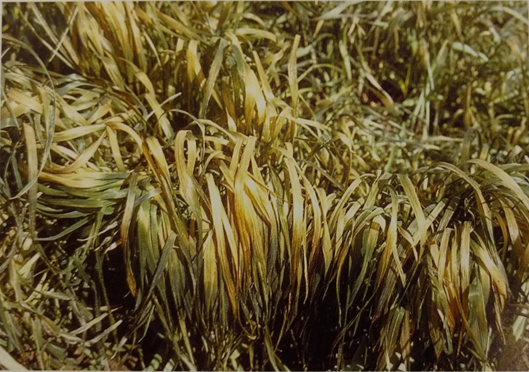
Figure 3. More severe freeze damage causing the leaves to turn yellow-white with plants losing their overall turgidity. Source: Kansas State University publication C646: Spring Freeze Injury to Kansas Wheat.
Each freeze event is unique. It will take some time (1-2 weeks after the cold weather passes) to assess the actual impact of the below-normal temperatures on wheat. We will have to keep watching it as it will vary on a field-by-field basis.
Amanda de Oliveira Silva, Small Grains Extension Specialist
First hollow stem (FHS) occurs just prior to jointing and is the optimal time to remove cattle from wheat pasture. This occurs when there is 1.5 cm (5/8” or the diameter of dime) of hollow stem below the developing grain head (Fig.1). To give you a point of reference, the average FHS date over the past 20 years at Stillwater is March 6.
Figure 1. First hollow stem occurs when hollow stem equivalent to the diameter of a dime (1.5 cm) is present below the developing grain head.
Several factors influence the onset of FHS. These include the wheat variety, location, temperature, available moisture, level of grazing, and planting date (later sown wheat will typically reach FHS later). Varieties can differ by as much as three weeks in onset of first hollow stem, and later maturity varieties generally reach first hollow stem later. Dual-purpose producers are encouraged to select varieties that are characterized as medium, late or very late in occurrence of FHS.
The latest FHS results for each variety planted in our forage trial at Stillwater are listed below (Table 1). A few varieties are at FHS (values at or above 1.5 cm), but values are likely to move slowly with current cold conditions in Oklahoma.
The First Hollow Stem Advisor and the updates we provide give an indication of the FHS stem conditions in a particular area. However, because of the number of factors that can influence when FHS occurs, it is extremely important to check for FHS on a field-by-field basis.
Methods for scouting for FHS:
Check for FHS in a non-grazed area of the same variety and planting date. Variety can affect FHS date by as much as three weeks and planting date can affect it even more.
Dig or pull up a few plants and split the largest tiller longitudinally (lengthways) and measure the amount of hollow stem present below the developing grain head. You must dig plants because the developing grain head may still be below the soil surface at this stage.
If there is 1.5 cm (~5/8″) of hollow stem present, it is time to remove cattle.
Table 1. First hollow stem results for each variety collected at Stillwater on 02/06/21. Plots were planted on 09/21/21. The threshold target for FHS is 1.5 cm. The value of hollow stem for each variety represents the average of ten measurements.
Similar to previous years, we will monitor occurrence of FHS in our wheat plots at Stillwater and Chickasha and report the findings on this blog.
Usually, the alarm for beginning wheat nitrogen (N) topdressing gets sounded right away in early January. A significant portion of the Oklahoma wheat belt has received a good amount of moisture in the past weeks, which was great to save the crop from the severe drought in the fall. However, some parts of the state would still benefit from additional moisture (Fig. 1).
In areas of the state where it is dry and dry deeper than the majority of the rooting zone (> 6”), you should not worry about filling up the nitrogen tank as long as the water tank is empty. In this case, the best option is to wait to apply N right in front of a real chance of rain. The good news is we still have time to get N applied and not limit yield potential if we do receive rain in those areas. For regions with good soil moisture, you could start making topdressing plans.
Fig 1. 30-day rainfall accumulation in Oklahoma. Figure courtesy from Mesonet.
Few crop inputs deliver as much return on investment as nitrogen fertilizer. It takes approximately two pounds of nitrogen, costing roughly $0.80-$1.00, to produce one bushel of grain worth about $5.60. Of course, nitrogen is not the only yield determining factor in a wheat crop. Also, the law of diminishing marginal returns eventually kicks in, but nitrogen fertilizer is still one of the safest bets in the house, especially when there is adequate soil moisture.
Topdress nitrogen fertilizer is especially important because it is applied and utilized when the plant is transitioning from vegetative to reproductive growth. Several things, including the number of potential grain sites, are determined just before jointing, and the plant must have the fuel it needs to complete these tasks. Jointing also marks the beginning of rapid nitrogen uptake by the plant which is used to build new leaves, stem, and the developing grain head. Our research has shown that approximately 20% of the aboveground nitrogen uptake at harvest is accumulated just prior to jointing, 50% at flag leaf emergence, and 70% at heading. The nitrogen stored in the plant vegetative parts is used to fill the grain later in the season, and the plant is dependent on this stored nitrogen to complete grain fill.
In the bullet points below, I will hit the major points regarding topdress nitrogen for wheat.
When to apply
To have full benefit, nitrogen must be in the rooting zone by the time wheat is jointing (which occurs around the end of February in southern OK and around mid-March in northern OK). Moisture is required to move nitrogen into the rooting zone. Since precipitation is usually very limited in January and February in Oklahoma, we need the nitrogen out on the field when the rain hopefully arrives back.
Suppose you decided to not apply any nitrogen prior to planting, due to residual soil nitrogen amounts or simply did not want to invest the money into the crop due to the dry weather. Did you happen to use an N-rich strip?
Yes, I did: If you currently see a difference between the N-rich strip and the rest of the field, then now would be time to begin making applications. For those producers who are using the Sensor Based Nitrogen Recommendation (SBNRC) system, your yield predictions and nitrogen recommendations generally become more accurate as the season progresses. However, growers wishing to hedge their nitrogen bet could apply a partial top dress now and supplement with a second top dress just before jointing, if SBNRC recommendations call for additional nitrogen. If you cannot see a difference, then wait until closer to jointing to make the call. https://osunpk.com/2014/02/24/sensing-the-n-rich-strip-and-using-the-sbnrc/
No, I did not: Now would probably be ideal to start making those applications depending on fall growth and soil moisture levels. If soil moisture is present, considering apply enough N to reach the farm’s break-even yield goal. An N-rich strip helps take the guesswork out of adjusting your top dress N up or down based on your current crop conditions. Also, it is not late to apply an N-rich strip. Your county extension educator can provide more information on N-rich strips, and you can find more information on the web at npk.okstate.edu
Do not apply nitrogen to frozen ground. Nitrogen will move with water. If melting snow or frozen rain moves to the ditch, so will nitrogen applied to the soil surface.
Consider splitting or delaying top dress nitrogen applications to sandy soils until closer to jointing, as leaching can occur.
How much to apply
On average, it takes about 2 lbs/ac of N to produce a bushel of wheat. In addition, dual-purpose wheat requires 30 lbs/ac of N for every 100 lbs/ac of beef or 1,000 lbs/ac of forage removed. You can subtract your soil test NO3-N from these total requirements. Keep in mind that being short in N will limit yield and protein concentration in the grain.
Did you do a soil test? It is okay to adjust top dress N plans based on your current yield potential. When you submitted your soil test, you might have stated a 50 bu/ac yield goal requiring 100 lbs/ac of nitrogen; however, it is important to take a hard look and determine if this yield goal is still realistic for your current crop status. This does not suggest to adjust based on what you think the weather might do. Still, it is okay to take inventory and adjust your top dress N up or down based on current field conditions.
If you have good soil moisture, even if you want to limit your input, you need 40 to 60 pounds/ac of nitrogen at a minimum based upon your soil test and yield goal. If you already have N in the system, make sure to apply enough N for a 30-40 bushel wheat.
What source to use
The plant does not care about nitrogen source. A pound of nitrogen is a pound of nitrogen. Focus on getting the correct amount applied at the proper time, and choose your product based on price and application uniformity.
Use a source that can be applied uniformly. In my experience, spinner trucks or buggies are generally the least uniform. Air trucks or streamers are the most uniform.
Streamer nozzles almost eliminate leaf burn from UAN; however, leaf burn is generally not an issue until temperatures warm and/or you are applying fairly large amounts of UAN. Streamer nozzles are also not affected much by wind and deliver a uniform pattern in various conditions. Some studies indicate that banding of UAN through streamer nozzles will reduce nitrogen immobilization on crop residue. Keep in mind that you cannot tank mix herbicides when using streamer nozzles.
One pass herbicide/topdress applications are very efficient in terms of time and input costs, but in some scenarios, it can end up costing you more money. Consider two-pass applications when dealing with no-till fields, especially when canopy coverage is below 70%. This is due to the high probability that the nitrogen will be tied up when it hits the residue and will not be available for the current wheat crop. For a more in-depth discussion on tank mixing herbicides and UAN for top-dress see https://osunpk.com/2016/02/07/herbicide-and-uan-tank-mixed-for-top-dress
Streamer nozzles provide uniform application of UAN in a wide variety of environmental conditions.
Poor nitrogen application can result in a streaked field. Some of the areas in this field were over fertilized while some where under fertilized, resulting in wasted nitrogen and less than optimal crop yield.
For more information, contact your local Extension office
Amanda de Oliveira Silva, Small Grains Extension Specialist
I have been watching some wheat fields consistently after that ice storm came in late October. I am currently seeing anything from good looking wheat fields to areas with incomplete, thin, and uneven stands. We might not see complete stands for a while as the wheat emergence seems to be very uneven, and the wheat is still slowly coming up (Figure 1).
Figure 1. Uneven wheat emergence in a field planted on October 16. Picture was taken on November 9, 2020.
The thin and uneven stand establishment of the current wheat crop is likely due to the severe drought from the end of September to most of October. Then, most of Oklahoma was hit by the ice storm during the last week of October, with some areas receiving up to 5 inches of rain. Although that rain came in a much-needed time, it could have created a crust in the soil preventing the coleoptile from breaking through the soil surface.
If the wheat fails to emerge as expected in your field, dig up the soil and look for an “accordion” like plant. If you see that wheat has emerged its first true leaf under the soil surface, and it has been sitting there for a week or more, it will probably not going make it (Figure 2).
Figure 2. Wheat that has emerged its first true leaf under the soil surface will lose viability after one week or so. Field planted on October 21. Picture taken on November 9, 2020.
However, I am seeing crinkled coleoptiles in fields around Stillwater that are coming up slowly and will be fine. The crinkles probably occurred when the heavy rain occurred during the ice storm, but it was not enough to prevent the coleoptile from continuing to grow and pushing through the soil surface for the most part (Figure 3).
Figure 3. Part of the coleoptile got crinkled due to heavy rain and light soil crusting during the emergence period. Still, most of the plants seem to continue growing and breaking through the soil surface. Field planted on October 21. Picture was taken on November 9, 2020.
Overall, our variety trials that were planted sometime in October are coming up nicely, but we might not have a complete stand for a little while in some locations. Robert Calhoun, the Senior Agriculturalist of OSU Small Grains Program.
Some fields that were planted in early-mid October is also just now starting to emerge near Kay County. Shannon Mallory, Kay County Extension Educator.
About 95% of the wheat in our variety trial at Altus has emerged and shows adequate stands (planted on September 29). Gary Strickland, the Jackson County Extension Agriculture Educator and Southwest Research and Extension Center Regional Agronomist.
Josh Bushong, the OSU Area Extension Agronomy Specialist, reported in his Ag Insights November report that most of the fields in the North Central region are showing thin and uneven stands. He also mentioned this would likely have a small effect for grain only-producers.
As a summary, most of the fields that I am seeing or hearing about that were planted in October are still coming up. Wheat growth is a function of temperature. The cooler temperatures and lower cumulative growing degree days in the coming months will slow down growth until March or so. Plants may compensate to a certain extent for that reduced stand, and wheat producers aiming for grain-only production should not be concerned yet.
The plant on the right is likely not going to make it as the first leaf seemed to be stuck in the leaf sheath and would not to be able to emerge properly.Incomplete wheat stand for a field near Stillwater planted on October 21. This field had enough moisture for wheat to begin germination as soon as it was planted, but emergence was hindered by the excessive rain from the ice storm that took place during the week of October 26, 2020.Wheat is looking good at the forage trial in Stillwater. Although, it would benefit for an additional drop of water. Planted on September 21, 2020. Picture taken on November 16, 2020.Wheat demonstration plots planted on September 21 (on the back) and on October 16 (in the front). Picture taken on November 16, 2020.