First Hollow Stem Update – 3/5

First hollow stem (FHS) is the optimal time to remove cattle from wheat pasture. This occurs when there is 1.5 cm (5/8” or the diameter of dime) of stem below the developing grain head (full explanation). To give you a point of reference, the average FHS date over the past 20 years at Stillwater is March 6.


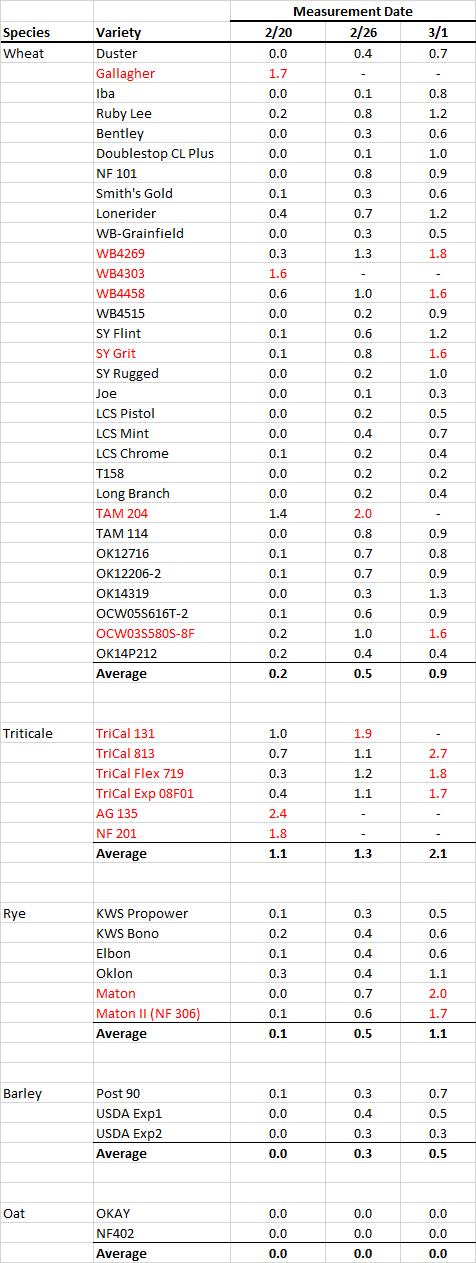
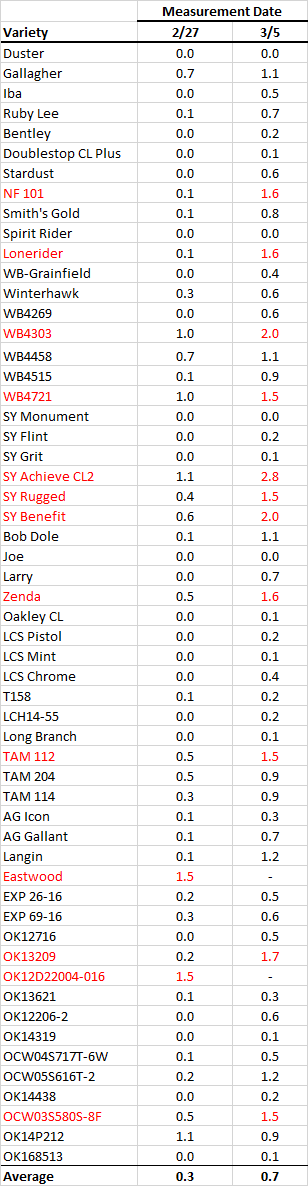
Results from measurements collected recently at Chickasha (Table 1) and Stillwater (Table 2) are listed below. Wheat stem elongation at both locations is progressing, and I believe it will progress a little more rapidly in these plots throughout this week. Keep in mind that several factors influence the onset of FHS. These include the wheat variety, location, temperature, available moisture, level of grazing, and planting date (later sown wheat will typically reach FHS later). The First Hollow Stem Advisor and the updates we provide give an indication of the FHS stem conditions in a particular area. However, because of the number of factors that can influence when FHS occurs, we cannot stress enough the importance of checking for FHS on a field-by-field basis.


Table 1. First hollow stem (FHS) results by wheat, triticale, rye, barley, and oat variety collected on 2/20/18, 2/26/18, and 3/1/18 at Chickasha. Plots were sown on 9/25/17. The threshold target for FHS is 1.5 cm (5/8” or the diameter of a dime). The amount of hollow stem for each variety represents the average of ten measurements from non-grazed plots. Varieties that have reached FHS are highlighted in red.

Table1chick3.5


Table 2. First hollow stem (FHS) results by wheat variety collected on 2/27/18 and 3/5/18 at Stillwater. Plots were dusted in on 9/15/18 and did not receive significant rainfall until 9/25/17. The triticale, rye, barley, and oat plots were abandoned due to emergence issues. The threshold target for FHS is 1.5 cm (5/8” or the diameter of a dime). The amount of hollow stem for each variety represents the average of ten measurements from non-grazed plots. Varieties that have reached FHS are highlighted in red.

Table2stw3.5

We are collecting measurements from Chickasha tomorrow and Stillwater on Thursday. The next update will be Thursday afternoon or Friday morning.

First Hollow Stem Update – Week of 2/26-3/2

First hollow stem (FHS) is the optimal time to remove cattle from wheat pasture. This occurs when there is 1.5 cm (5/8” or the diameter of dime) of stem below the developing grain head (full explanation). Each year, we collect FHS measurements from our forage variety trials. We have three forage variety trial locations this year: Chickasha, Haskell, and Stillwater. We are only collecting FHS measurements though at Chickasha and Stillwater. Both of these locations were sown in September. To give you a point of reference, the average FHS date over the past 20 years at Stillwater is March 6.


Results from measurements collected recently at Chickasha (Table 1) and Stillwater (Table 2) are listed below. Keep in mind that several factors influence the onset of FHS. These include the wheat variety, location, temperature, available moisture, level of grazing, and planting date (later sown wheat will typically reach FHS later). The First Hollow Stem Advisor and the updates we provide give an indication of the FHS stem conditions in a particular area. However, because of the number of factors that can influence when FHS occurs, we cannot stress enough the importance of checking for FHS on a field-by-field basis.


Table 1. First hollow stem (FHS) results by wheat, triticale, rye, barley, and oat variety collected on 2/20/18 and 2/26/18 at Chickasha. Plots were sown on 9/25/17. The threshold target for FHS is 1.5 cm (5/8” or the diameter of a dime). The amount of hollow stem for each variety represents the average of ten measurements from non-grazed plots. Varieties that have reached FHS are highlighted in red.

chick2


Table 2. First hollow stem (FHS) results by wheat variety collected on 2/27/18 at Stillwater. Plots were dusted in on 9/15/18 and did not receive significant rainfall until 9/25/17. The triticale, rye, barley, and oat plots were abandoned due to emergence issues. The threshold target for FHS is 1.5 cm (5/8” or the diameter of a dime). The amount of hollow stem for each variety represents the average of ten measurements from non-grazed plots. Varieties that have reached FHS are highlighted in red.

stw

We are collecting measurements from Chickasha today and Stillwater on Monday. The next update will be early next week.


Wheat Disease Update – 21 February 2018

This article was written by Dr. Bob Hunger, Extension Wheat Pathologist

Department of Entomology & Plant Pathology

Oklahoma State University – 127 Noble Research Center

405-744-9958


Foliar diseases such as leaf rust and stripe rust were scarce across Oklahoma last fall and into 2018 because of the drought. I have seen a few leaf rust pustules on wheat plants in trials around Stillwater and have heard of leaf and stripe rust as well as powdery mildew from growers across the state. However, my observations and these reports all indicate extremely light levels. More importantly, reports of foliar diseases from Texas were lacking until recently. These reports are critical because areas in Texas provide the inoculum for Oklahoma. On February 9th, Dr. Clark Neely (Small Grains/Oilseed Extension Specialist; Texas A&M AgriLife Extension) reported seeing stripe rust on the susceptible variety ‘Patton’ in trials near Uvalde, TX (Fig 1). Here is Dr. Neely’s report: “I wanted to notify everyone that we have our first stripe rust siting in Uvalde, TX as of last Friday (02/9/18). At the time, it was mainly limited to the susceptible border rows (‘Patton’). A few leaf rust pustules were present as well, but very few. Growth stage is around Feekes’ 5 with some already initiating jointing at Feekes’ 6. Central and South Texas has been experiencing very damp, overcast conditions for the past week and are expecting more of the same for the foreseeable future, so I would expect to see further development. Variety trials at Castroville, College Station, Thrall, Hillsboro, McGregor, and Muenster, TX have all appeared clean so far over the past couple of weeks while topdressing nitrogen.”


Figure 1. Stripe rust on wheat near Uvalde, TX observed on 2/9/18 by Dr. Clark Neely (Small Grains/Oilseed Extension Specialist – Texas A&M AgriLife Extension).

figure1


Remember, stripe rust typically forms stripes in older plants (Fig 2A), but early infections have pustules not typically in stripes (Fig 2B). In contrast, pustules of leaf rust are not formed in stripes and are more of a brownish-rust color as compared to the yellowish-golden rust color of stripe rust (Fig 2C).


Figure 2. Wheat stripe rust on adult plant (2A), an initial stripe rust infection in February (2B), and a wheat leaf with both stripe and leaf rust pustules (2C).

figure2


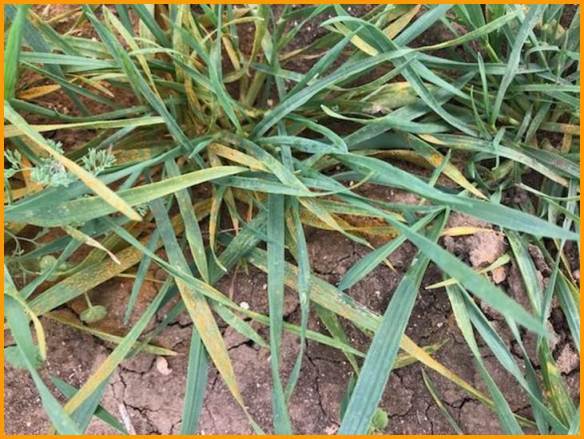
Other foliar diseases to watch for include tan spot, Septoria leaf blotch, and powdery mildew (Figure 3A-C). These diseases (especially tan spot and Septoria leaf blotch) are more likely to occur in no-till, continuous wheat fields. If sufficiently severe in a no-till field, spraying for these in March may be beneficial but only if young wheat plants are severely spotted with one of these diseases. Regarding leaf and stripe rust, there was not much rust overwintering in Oklahoma, and inoculum to start this disease in the spring will mostly come from Texas.


Figure 3. Wheat diseases typically observed in no-till, continuous wheat fields include (A) Tan spot; (B) Septoria leaf blotch; (C) Early season powdery mildew.

figure3


Finally, the recent rain events in Oklahoma will revive the wheat in the state, but also will provide conditions favorable for foliar diseases (especially as temperatures become more moderate). Hence, I recommend scouting fields for the foliar diseases discussed above during the coming weeks and paying attention to what is happening to the south of us in Texas. For additional information regarding early season foliar wheat diseases and possible control with an early fungicide application, please see our fact sheet (PSS-2138) that discusses split application of fungicides at www.wheat.okstate.edu.

Determining the optimal time to remove cattle from wheat pasture (if you still have pasture to graze…)

The wheat growing season up to this point has been extremely tough to say the least. The forage situation has been a kick-in-the-knees in addition to taking it on the chin with the grain prices. Trying to get wheat pasture established was hard enough between fighting off the fall armyworm and working around the rain. Then on top of all that after getting a stand established, it has not rained since. As a result, many producers have already grazed as much as they could and have removed their cattle, or they have not even had the chance to graze. For the few producers who still have pasture to graze, leaving some leaf material out there after grazing will be important for having any chance of a decent grain crop. Ideally, there should be a minimum of 60% canopy coverage left. It also does not look like we will have cool and wet conditions after cattle removal to allow the plants more time to recover from the grazing injury. This situation is shaping up to be similar to last year, and that puts even more emphasis on removing cattle from wheat pasture at the right time.


The optimal time to remove cattle from wheat pasture is at a growth stage called first hollow stem (FHS, between Feekes 5 and 6). This is the optimal time because the added cattle weight gains associated with grazing past first hollow stem are not enough to offset the value of the reduced grain yield (1-5% every day past FHS). The wheat variety, amount of grazing, time when cattle are removed, and weather conditions after cattle removal determine how much total grain yield potential might be reduced.


One of the moving targets each year is determining when to start scouting for FHS. To help combat this, the First Hollow Stem Advisor was developed by researchers at Oklahoma State University. This is an online tool available on the Mesonet website, https://www.mesonet.org/index.php/agriculture/category/crop/wheat/hollow_stem_advisor. This tool uses soil temperature data to show the current probability of FHS occurrence, as well as 1-week and 2-week projections. With this tool, producers can select their variety from a list of varieties that separates them into three FHS categories: early, middle, and late. Then, maps can be generated to provide the probability of FHS based on current conditions and the 1- and 2-week projections. Charts and tables can also be generated for individual Mesonet sites. Created maps have a color scheme to represent the probability of FHS occurrence. When using this tool, it is recommended to start scouting for FHS from a non-grazed part of the field once the 5% probability is reached (green color). Because stem elongation will begin moving quickly as the temperature warms up, starting your scouting at the 5% level will help give you the time it takes for making the preparations for cattle removal by the time FHS occurs. Methods on how to scout for FHS are listed at the end of this post. For producers who do not scout, it is recommended to remove cattle when the 50% probability level is reached. A 50% probability level indicates that over an evaluated period (e.g., 10 years), FHS would have occurred by that date in 50% of those years (e.g., 5 years). The same interpretation is used for other probability levels.


To give an example of what the tool provides and show some of the FHS conditions around Oklahoma, I have generated some statewide maps below. For producers along the southern Oklahoma border who planted an “early” wheat variety (e.g., Gallagher), now would be the time to go out and start scouting for FHS (Figure 1).

figure1

Figure 1. Current FHS probabilities for “early” wheat varieties.


Looking at the 1-week projection for “early” varieties, you can see how the probabilities have increased, and areas further north should begin scouting (Figure 2).

figure2

Figure 2. One-week FHS projection (i.e., through February 22) for “early” wheat varieties.


For producers who planted “middle” (e.g., Duster) or “late”  (e.g., Doublestop) FHS varieties, the 1-week projections indicate producers across much of the state still have a little bit of time yet before beginning to scout. However, producers along the southern border should begin scouting (Figure 3).
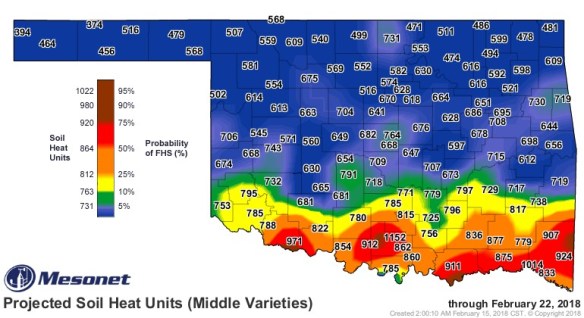
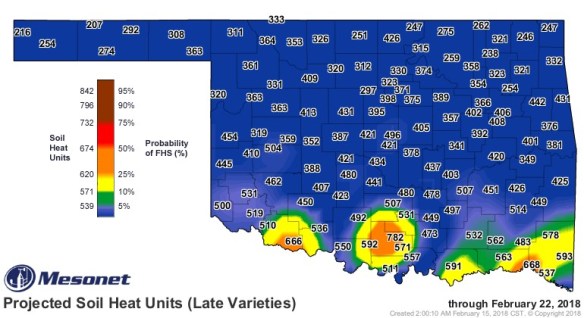
figure3a

figure3b

Figure 3. One-week FHS projections (i.e., through February 22) for “middle” (top) and “late” (bottom) wheat varieties.


Remember that this tool should be used as a proxy to begin scouting for FHS. The best estimate of FHS is still to split stems from plants in each field to determine where they are developmentally. Another word of caution I want to mention when using the tool for this year especially is to consider when you were finally able to get stand establishment. If this did not occur until the end of September to the beginning of October, this tool may be a little ahead of where your plants are developmentally. In this case, the tool can still give you the cue to start scouting, but checking for FHS in each field will let you know if you do have some grazing time left.


Methods for scouting for FHS:

  • Check for FHS in a non-grazed area of the same variety and planting date. Variety can affect FHS date by as much as three weeks and planting date can affect it even more.
  • Dig or pull up a few plants and split the largest tiller longitudinally (lengthways), and measure the amount of hollow stem present below the developing grain head. You must dig plants because the developing grain head may still be below the soil surface at this stage.
  • If there is 1.5 cm (~5/8″) of hollow stem present, it is time to remove cattle. 1.5 cm is about the same as the diameter of a dime (see picture below).
  • More detailed information on FHS can be found at wheat.okstate.edu under ‘Wheat Management’ then ‘Grazing’ or by clicking here.
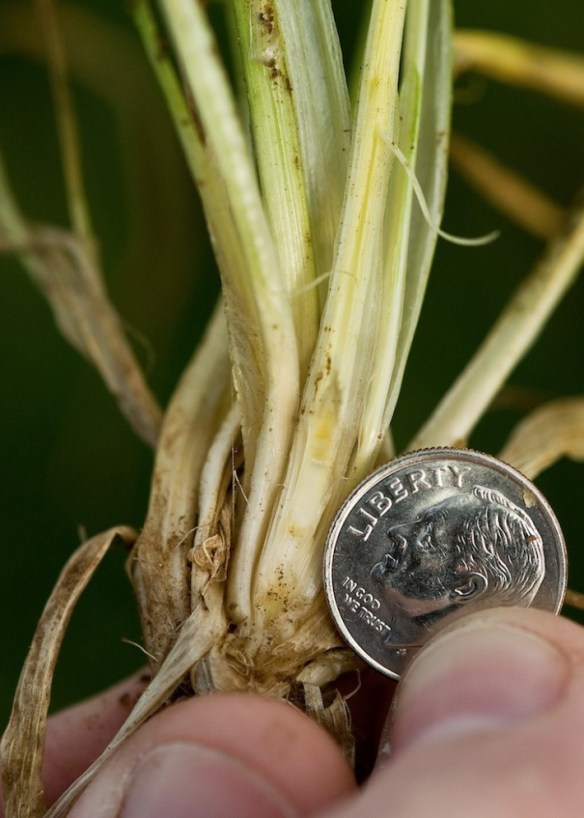
figure4

The first hollow stem growth stage is reached when there is 1.5 cm of hollow stem (about the diameter of a dime) below the grain head. 


Similar to previous years, we will monitor occurrence of FHS in our wheat plots at Stillwater and Chickasha and report the findings on this blog.
Spring-planted Oat for Forage

When wheat pasture fails due to drought, there are limited opportunities to recover lost forage production. Spring-planted oat is the best option to offset forage losses from wheat pasture and has been a “go to” forage crop in this case for southern Great Plains beef producers for years. The window for spring-planted oat is between February 15 and March 10. Forage production potential is around 1,500 to 2,00 lbs/acre, but you will need about 40 – 60 lbs/acre of nitrogen to make this type of yield. A fact sheet detailing spring oat production for hay and grazing can be found by clicking here or by going to www.wheat.okstate.edu under “Wheat Management” then “Seeding”. Some of the key points from that fact sheet are listed below.

oat

Spring oat can provide an alternative hay or forage source in the spring.


Seed — Plant 80 – 100 lbs/acre of good quality seed that has a germination of no less than 85%. There aren’t many options regarding varieties, so you will likely be limited to whatever seed is available in your area. The key is not to cut back on seeding rate, regardless of variety.


Seedbed — Sow oat seed at approximately 1/2 to 3/4 inches deep. Most producers will be better off with a conventionally-tilled seedbed. You are planting seed at a time of year when the ground is already marginal regarding temperature. Conventionally-tilled seedbeds warm more quickly, which should speed germination. There is one exception to the conventional till recommendation. If you are sowing into a stale seedbed or a failed wheat crop that is very thin, no-till should be okay. Just avoid situations where excessive residue will keep the soil cold.


Grazing — Oat plants should have a minimum of six inches of growth prior to grazing. Unlike fall-seeded cereals, you should not expect a large amount of tillering. A good stand of spring oat can provide a 750 lb animal approximately 60 days of grazing when stocked at 1.5 animals per acre.


Hay — Oat should be cut for hay at early heading to maximize yield and quality.


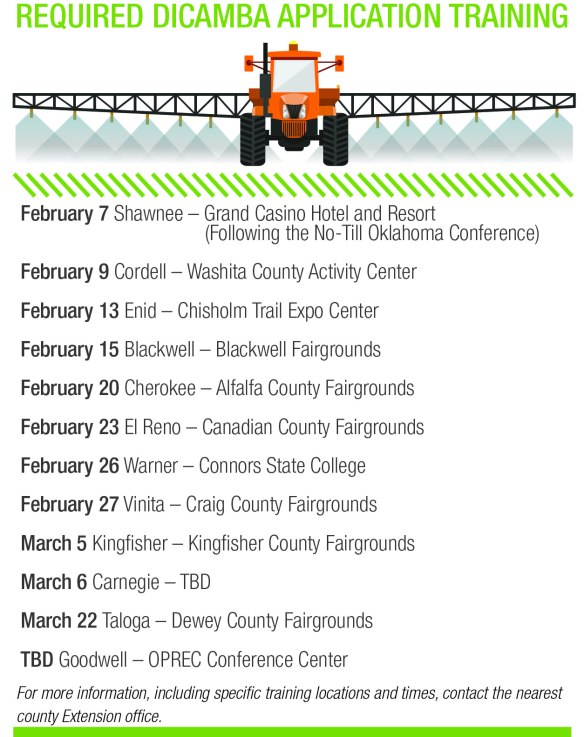
Dicamba Restricted Use Required Applicator Training Locations and Dates

In response to an elevated number of off-target movement claims in many states in 2017, this training has been mandated by the EPA for application of newly formulated dicamba products. The following formulations of dicamba are approved for use in the Roundup Ready® Xtend Crop System as of November, 2017 and are covered by these trainings:


  • XtendiMax® herbicide with VaporGrip® Technology (Monsanto)
  • DuPont® FeXapan® herbicide Plus VaporGrip® Technology
  • Engenia® Herbicide (BASF)


The application requirements in these trainings apply to all labeled uses of these products in Oklahoma. These trainings are designed to satisfy the federal requirement for mandatory dicamba applicator training and to satisfy the Oklahoma Department of Agriculture, Food & Forestry requirement for dicamba specific training. This training is not a substitute for the state-specific Certified Applicator training which is required to purchase and use Restricted Use Pesticides.


For more information contact the Oklahoma Department of Agriculture, Food & Forestry (Debbie Mandrell – 405.522.5949 – Debbie.Mandrell@ag.ok.gov) or your local Oklahoma Cooperative Extension Service county office.


Dicamba_gfx_final

It’s dry, and it’s time to topdress.

Normally the alarm for beginning wheat N topdressing gets sounded right away in early January. However, it might be understatement to say this year has been dry so far – “drier than a popcorn fart” may be a better description. At the time of writing this blog, a significant portion of the Oklahoma wheat belt has now gone 90+ days with less than 0.25” of rain. The great folks at Mesonet reminded us on January 18 that the long term forecast is not providing us much hope either (Fig. 1).

fig1

Figure 1. The Oklahoma Mesonet tweet from January 18.


Because it has been dry and no significant rain is in the current forecast, the question is what do we do now about topdressing? This is a tough question to answer as there is not a really “good” option at the moment to be honest. Here are some thoughts to consider:

  • In the parts of the state where it is dry and dry deeper than the majority of the rooting zone (> 6”), we should not worry about filling up the nitrogen tank as long as the water tank is empty. As it stands currently, the best option is to hold off for now and wait to apply topdress N right in front of a real chance of rain. The good news is we still have some time yet to get N applied and not limit yield potential if we do get that rain. Ideally, we need the N down in the rooting zone just prior to jointing. Several things, including the number of potential grain sites, are determined just prior to jointing, and it is imperative that the plant has the fuel it needs to complete these tasks. Jointing occurs around the end of February in southern OK and around the second week of March in northern OK. Jointing also marks the beginning of rapid nitrogen uptake by the plant which is used to build new leaves, stem, and the developing grain head. The nitrogen stored in these plant parts will be used to fill the grain later in the season, and the plant is dependent on this stored nitrogen to complete grain fill. And while it does seem like it right now, we still have the potential to make a decent crop if we can get rain before we break winter dormancy. If we do not get the rain though soon as it is appearing, we will not have spent as much money on this crop by holding off on topdress N, and the likelihood of getting the return on our N investment goes down as our yield potential goes down.
  • What we can and should do right now is apply N-rich strips. An N-rich strip can help put your mind more at ease by taking the guesswork out of knowing if nitrogen needs to be applied and how much should be applied. The N-rich strip can be as simple as using a small lawn fertilizer spreader with a bag of urea. You local county extension educator can also provide more information on N-rich strips and even has access to lending small fertilizer spreaders!


For those producers who have too much ground and cannot cover all of it just prior to a rain or for those who want to apply now as they are worried about nitrogen being limited after it does start raining, here are few more considerations:

  • For conventional-tilled fields that have limited to no residue, applying UAN through streamer nozzles is an okay option. Why? With UAN, there is a very high percentage of soil-fertilizer contact. This immediately improves the efficiency compared to urea. In fields with crop residue, flat fan nozzles are not recommended right now as the likelihood up of N tie-up is too high.
  • For no-till fields, the two big concerns are ammonia (NH3) volatilization with dry urea and tie-up on the residue with liquid UAN. Picking the best option in this scenario is a much tougher decision with not a real good conclusion. So, here it goes. If there is tall standing stubble with dry soil below, the dry urea gets the edge. Why? If the stubble is not in a mat, the urea prill can work its way down towards the soil surface. If it can get there, it is out of the high winds, and it will remain there until we get a rain, heavy dew, or increase in humidity. Is there still a chance for loss due to volatilization? Absolutely. Again, it goes back to whether there is any chance that you can wait to apply?
  • There have been some questions about using urease inhibitors with broadcasting urea. That is a good question, but it is hard to make an argument for their use until we get a good chance of rain in the 10-day forecast. Typically, these products do not have the life span to hold off urease (i.e., the enzyme that breaks urea into NH3) for more than 10-12 days.


The latter points also apply to those who use the local co-op or ag retailer for application.  Some of these groups require 30 days or more to cover all of the acres they service.


Since it is dry and we still have some time yet to apply N, this may turn out to be the perfect year to topdress urea with a grain drill (Fig. 2). For those interested in this method, you can find research results from last year on this topic, as well as a calibration guide, by clicking here. More information about nitrogen applications that are “thinking outside the box” can be found by clicking here.

fig2

Figure 2. Using a 3 pt conventional double-disk type drill to apply urea in-season.


For more information, contact Brian Arnall or David Marburger.

Considerations for Late-planted Wheat

Some producers throughout Oklahoma have been delayed in getting their wheat crop established due to fall armyworm and/or the rainfall we have had throughout October. While we are now outside of the optimum planting window for grain-only wheat production, the good news is that late-planted wheat can still yield well if environmental conditions cooperate and if producers make a couple management adjustments.


Seeding rates: The main problem with late-planted wheat is reduced tillering and slowed canopy closure when compared to earlier-planted wheat. On average, wheat plants sown in early- to mid-October will produce 2-3 tillers/plant. At a seeding rate of 60 lbs/acre (20-25 seeds/ft2 depending on seed size), the 2-3 tillers/plant can help us achieve the 60-70 heads/ft2 needed to maximize grain yield. Wheat planted in early- to mid-November may only produce 1-2 tillers/plant. Therefore, seeding rates right now should be increased by as much as 50% and increased by as much as 100% if planting gets delayed past mid-November. So, if a producer uses a 60 lbs/acre seeding rate during the optimum planting time, the seeding rate should be increased to around 90 lbs/acre for right now and then increased to 120 lbs/acre past mid-November.


There may be questions too on replanting decisions during this time of year. This can be a challenging decision, but the first step is to count the number of plants in different parts of the field to assess the stand. A thin but uniform stand will have more yield potential than one that is thick in some areas but nonexistent in others. During the optimum planting time, a thin but uniform stand (50% of the target stand for example) would likely be enough to keep, given adequate fertility and favorable weather conditions that would allow for tillering to help compensate. However, a similar scenario for a wheat field emerging at this time will need help. After assessing the stand, areas with thin or nonexistent stands should be filled in to reach your desired stand target. If replanting into an existing stand, it should be done at an angle (up to 45 degrees) to minimize damage to the existing stand.


Fertility: Late-planted wheat will need all the help it can get when it comes to fertility. The root system for late-planted wheat will likely not be extensive enough to intercept a significant amount of soil phosphorus until the spring. An in-furrow application a P fertilizer (50 lbs/acre of DAP for example) can be of great benefit. With this, the fertilizer is closer to the young seeding, and the plant can get to it sooner. Nitrogen fertilizer can also be used to encourage tillering. However, rather than increasing fall N rates, late-planted fields should be put at the top of the list for topdressing in January or February. There is most likely enough N available between residual soil N and any starter fertilizer N for growth this fall since wheat in grain-only production does not need much N (up to 20-25 lbs/acre) in the fall to get good establishment. Using N-rich strips can aid in determining when to apply topdress N, and a more accurate amount to apply can be determined using sensor-based methods.


Variety selection: It is most likely too late to make any switches in variety selection. If there is an opportunity to change varieties though, using a variety with good tillering ability and earlier maturity may be of benefit. A good tillering variety can help compensate for the less available time this fall for tiller development; whereas, a low-tillering variety may not be able to produce any tillers this fall. Late-planted wheat may also result in delayed development in the spring and force the grain fill period to be shorter by occurring later when environmental conditions are likely warmer and drier. An earlier maturing variety could be used to offset this chance that grain fill occurs during suboptimal conditions.


Pests: Finally, it is important not to short-change a late-planted wheat crop in terms of pest management. Remember that a late-planted crop has less competitive ability than an early-planted crop. Control insect pests as soon as thresholds are reached, and make herbicide applications while weeds are still small and have not yet removed large amounts of nutrients and soil moisture.

Fall Armyworm IN Wheat: Look Closely When Scouting Your Fields!

This article was written by Dr. Tom Royer, Extension Entomologist


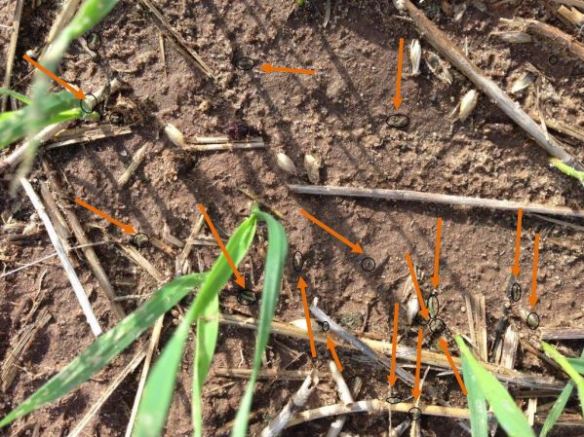
Lanie Hale, from Wheeler Brothers sent a picture of “window paned” wheat from a field that he had scouted. He counted 3 fall armyworms per row foot from his visual count (which is treatment threshold) but when he looked closely at his photo on his computer, he saw 15 worms in an area the size of his hand (they were very tiny, and probably newly hatched). It is easy to miss some of these little worms in the field because they hide in residue and are very tiny.

figure 1

figure 2.JPG

Look very closely for “window paned” leaves and count all sizes of larvae. Examine plants along the field margin as well as in the interior, because they sometimes move in from road ditches and weedy areas. The suggested treatment threshold is 2-3 larvae per linear foot of row in wheat with active feeding. Numerous insecticides are registered for control, but they are much more susceptible when caterpillars are small. We won’t get relief from fall armyworms until we get a killing frost, so keep vigilant!


Consult the newly updated OSU Fact Sheets CR-7194 Management of Insect and Mite Pests of Small Grains for control suggestions.

Wheat Germination and Emergence in Hot Soils

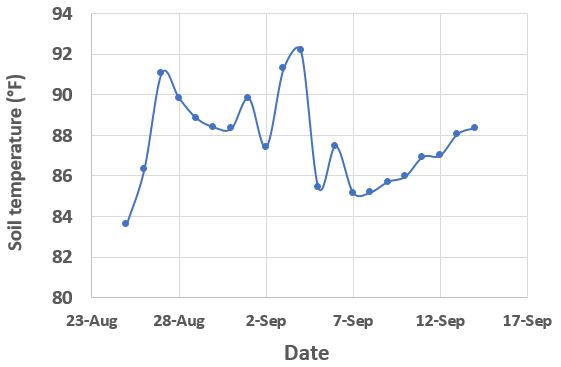
Soil temperatures in Oklahoma can be hot when planting in late August to early September for forage-only or dual-purpose wheat (Figure 1). Seed that was planted into soils with temperatures above 85° F may result in delayed germination or prevent wheat seedling emergence. In addition to the soil moisture status since planting, listed below are two factors that may cause poor early stand establishment when wheat is sown into hot soils.

soil temp

Figure 1. Maximum soil temperature at a 4 inch depth under bare soil over the past three weeks near Altus. We can assume that the maximum soil temperature at shallower depths was likely higher. Data is from Oklahoma Mesonet.


High temperature germination sensitivity: This is a more elaborate way of saying that some wheat varieties do not germinate well in hot soil conditions. This is not to say that the seed will not germinate at all, but it may not germinate until the soil temperature has lowered. Keep in mind too that this sensitivity can vary from year to year. For example, a sensitive variety like Ruby Lee may germinate fine in 90° F soils one year and only produce a 10% stand in the same soil conditions the next. When sowing early, it is best to plant varieties first that do not have high germination sensitivity (e.g., Duster, Gallagher). Soil temperatures typically begin to cool by about September 20 due to lower air temperatures and/or rainfall events. Waiting until at least mid September to plant sensitive varieties can help reduce the risk of this issue. A rating of high temperature germination sensitivity for wheat varieties can be found in the OSU Fact Sheet PSS-2256 Factors Affecting Wheat Germination and Stand Establishment in Hot Soils.


Coleoptile length: The coleoptile is the rigid, sheath-like structure which protects the first true leaf and aids it in navigating and reaching the soil surface. Once the coleoptile breaks the soil surface, it will stop growing, and the first true leaf will emerge. If the coleoptile fails to reach the soil surface, the first true leaf will emerge below ground and usually takes on an accordion-like appearance (Figure 2A-B). If this happens, the plant will die.

hot wheat

Figure 2A and 2B. Example of two different wheat seedlings in which the coleoptile failed to break the soil surface. The first true leaf emerged below the soil surface and resulted in this accordion-like appearance.


The coleoptile length for most wheat varieties today can allow for the seed to be safely planted up to 1.5 inches deep. Under hot soil conditions though, the coleoptile length tends to be decreased. Therefore, “dusting in” early-sown wheat at ¾ to 1 inch depth and waiting on a rain event may result in more uniform emergence than trying to plant into soil moisture at a deeper depth if soil moisture is not available in the top 1 to 1.5 inches of the soil profile. A rating for coleoptile length for wheat varieties can be found in the OSU Fact Sheet PSS-2142 Wheat Variety Comparison (P.S. we are working on updating this).