Mites in Wheat Fields

Areas of Oklahoma with dry conditions have begun to see to some visible wheat injury due to brown wheat mite and winter grain mite. Late last week, Darrell McBee, Harper County Ag Extension Educator, indicated to me that he had been fielding quite a few phone calls in regards to mites in wheat. Other areas, including the panhandle and areas closer to the north central part of the state, have also reported some mite injury.


The remainder of this article was written by Dr. Tom Royer, Extension Entomologist. He has provided comments below on how to identify these two different mite species, what symptoms to look for, and how to control them:


There are two common mites that can injure wheat, the brown wheat mite and the winter grain mite. Producers need to remain alert so that they don’t mistake damaged wheat from small grains mites for drought or virus disease.
brown mite

Brown wheat mite with oversummering egg


Brown wheat mite is small (about the size of this period.) with a metallic brown to black body and four pair of yellowish legs. The forelegs are distinctly longer that the other three pair. Brown wheat mites can complete a cycle in as little as 10-14 days. Oklahoma experiences multiple generations of brown wheat mite that usually peak in spring and the last generation occurs in April. At that time, females produce a whitish egg that will over summer.

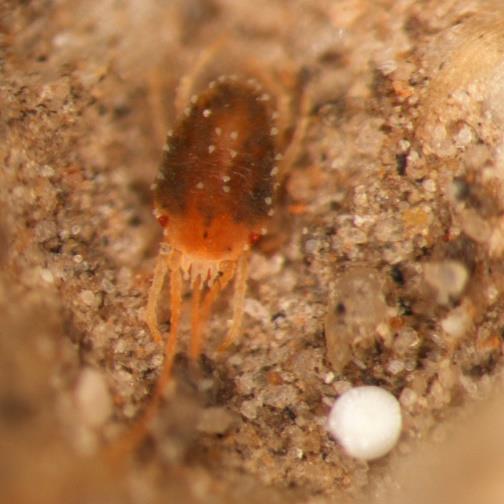
winter grain mite

Winter grain mite

winter grain mite egg

Winter grain mite egg


Winter grain mite is small (about the 1 mm long) with a dark blue to black body and four pair of orange-red legs and a small reddish spot on the top of its abdomen that can be seen under magnification. WGM eggs are kidney-shaped, and change from clear, to yellow to reddish-orange after several days. They are laid on leaf blades and stems or the roots near the crown. Besides wheat, many grasses serve as host plants, including barley, oats, ryegrass, and fescue. We typically experience two generations each year a fall generation and a winter generation that cycles out in March.

brown mite feeding

Leaf stippling from brown wheat mite feeding

field infested with winter grain mite

Field infested with winter grain mite


Both mites feed by piercing plant cells in the leaf, which results in “stippling”. The leaves take on a characteristic brown-grayish or cast and could be mistaken for injury due to herbicide. These mites are more likely to cause injury in wheat that is stressed from lack of moisture or nutrients.
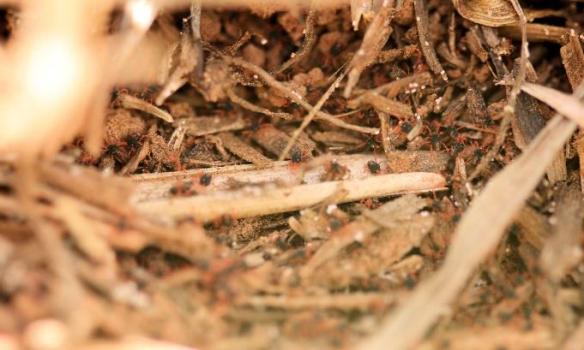
winter grain mite hiding in residue.jpg

Winter grain mite hiding in residue


Brown wheat mites are not light sensitive, but are vulnerable to driving rains of more than 0.25 inches, which tend to reduce populations. Winter grain mites are more tolerant of rainfall, but are very light sensitive and tend to avoid bright, sunny days and windy days, so adjust your scouting accordingly. It is best to scout for winter grain mite on still, cloudy days or early morning/late evening. On sunny or windy days, they hide under the soil surface (up to a couple of inches) or congregate under dirt clods. Both mites are associated with continuous wheat production. Research suggests that brown wheat mite can be economically treated when there are 25-50 mites per leaf in wheat that is 6-9 inches tall. An alternative estimation is “several hundred” per foot of row. The best recommendation for winter grain mite is to treat when plants show visible injury and there are still mites present.


Only a few insecticides include either mite species on their label. Work conducted by Dr. Gerald Wilde at Kansas State evaluated several insecticides for control of winter grain mites. Of those actually registered for winter grain mite, the insecticides dimethoate (Dimethoate and other generics) and chlorpyrifos (Lorsban and other generics) were effective. Other insecticides, lambda cyhalothrin (Karate and its generics) and beta cyfluthrin (Baythroid and its generics) were also effective at the high registered rate, even if they are not specifically listed on the label.


For more information on these mites consult fact sheet EPP-7093 Mites in Small Grains by clicking here. If you find active mite infestations in your field, consult fact sheet CR-7194 Management of Insect and Mite Pests in Small Grains for registered insecticides, application rates, and grazing/harvest waiting periods by clicking here.  Both fact sheets can also be obtained from any County Extension Office, or found at the OSU Extra Website at http://pods.dasnr.okstate.edu.
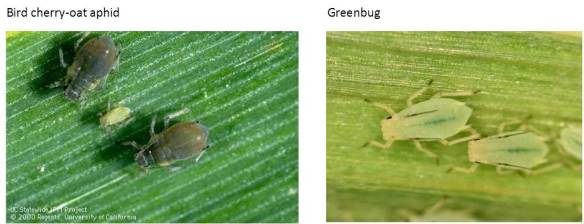


Greenbugs and Bird Cherry-Oat Aphids in Wheat: Decisions…

This article was written by Dr. Tom A. Royer, Extension Entomologist


Heath Sanders, OSU southwest area agronomist, reports of some wheat fields infested with bird cherry-oat aphids. I have seen low levels of greenbugs in some of our demonstration plots as well. The decision to control aphids is especially important right now so a producer can decide to add an insecticide with their top-dress fertilizer. Greenbug infestations results in visible injury to the plants, but bird cherry-oat aphid infestations do not produce visible damage and may go unnoticed.

fig1

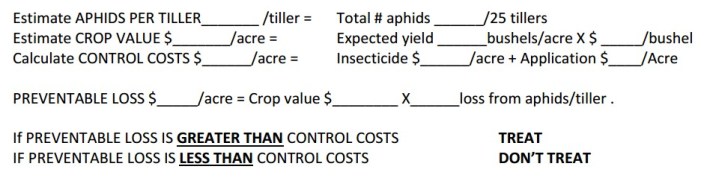
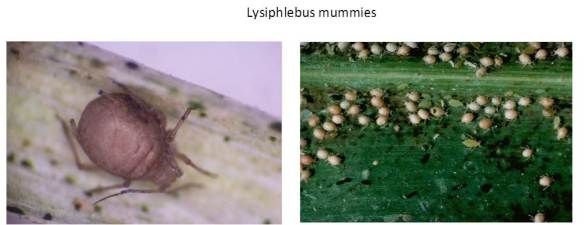
My suggestion is to scout the field beforehand to determine if there are GROWING numbers of either aphid that could be of concern. While scouting, keep track of Lysiphlebus mummies. Glance n’ Go accounts for aphid parasitism from Lysiphlebus wasps. If 5-10% of bird-cherry oat aphids are mummies, more than 90% of the rest are also parasitized, and control is probably not warranted.

fig2

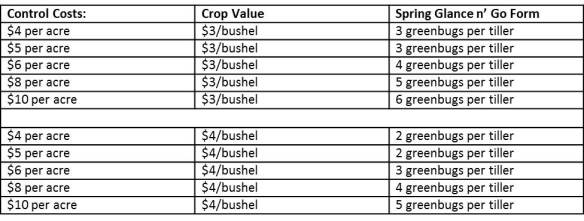
If greenbugs are present, use Glance n’ Go to scout. At current prices of $3.00 or $4.00 per bushel, and control costs of $4.00 to $10.00 per acre, you should select the spring Glance n’ Go forms on this link: http://entoplp.okstate.edu/gbweb/spring%20glance%20n%20go3.htm using the following guidelines:

pictable2

If aphids are mostly bird cherry-oat aphids, count the number of aphids on each of 25 randomly selected tillers across a zigzag transect of the field and note mummy activity. Unpublished research provided by Dr. Kris Giles (OSU) and Dr. Norm Elliott (USDA-ARS) combined with studies on spring wheat from the Dakotas and Minnesota indicate that 20-40 BCOA per tiller causes 5-9% yield loss before wheat reaches the boot stage. My suggestions: if BCOA numbers average 10-20 per tiller, figure on a 5% loss, if 20-40 per tiller, figure a 7% loss, and if BCOA aphids are more than 40 per tiller, figure a 9% loss.


fig3.jpg

Here is a Table of Preventable Loss estimates for bird cherry-oat aphids for expected yields of 30 to 50 bushels per acre, expected wheat prices of $3.00, $3.50, and $4.00 per bushel, and bird cherry-oat aphid numbers of 10-20, 20 to 40, and over 40 per tiller.

picture-table1

Check  CR-7194, “Management of Insect and Mite Pests in Small Grains” for registered insecticides, application rates, and grazing/harvest waiting periods. It can be obtained from any Oklahoma County Extension Office, or found at the OSU Extra Website at http://pods.dasnr.okstate.edu/docushare/dsweb/Get/Document-2601/CR-7194web2008.pdf

First hollow stem update – Chickasha 3/4/17

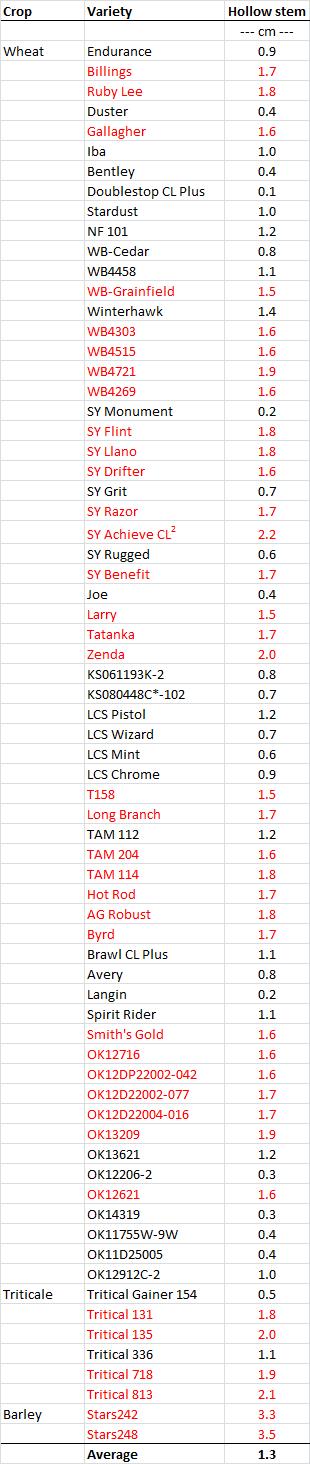
First hollow stem (FHS) is the optimal time to remove cattle from wheat pasture. This occurs when there is 1.5 cm (5/8” or the diameter of dime) of stem below the developing grain head (full explanation). Because of the progress the plants have now made at Chickasha, this update will be our final one for this location. Thirty-one of the 36 wheat varieties have reached or significantly surpassed the 1.5 cm threshold (Table 1). Given the measurements of the five remaining wheat varieties that have not yet reached FHS as of yesterday, I suspect they will reach the threshold by the time we collect our measurements on Monday. As a reminder, these measurements were collected from plots under simulated grazing. Grazing delays FHS, which is why we recommend checking plants from a non-grazed area of the field (e.g., just outside the hotwire). This helps provide time for finalizing plans to remove the cattle as the grazed area reaches FHS. Keep in mind that several factors in addition to grazing influence the onset of FHS. These include the wheat variety, location, temperature, available moisture, and planting date (later sown wheat will typically reach FHS later). The First Hollow Stem Advisor and the updates we provide give an indication of the FHS stem conditions in a particular area. However, because of the number of factors that can influence when FHS occurs, we cannot stress enough the importance of checking for FHS on a field-by-field basis. 


Table 1. First hollow stem (FHS) results by variety collected from simulated grazed plots at Chickasha on 2/16/17, 2/22/17, 2/28/17, and 3/3/17. Plots were sown on 9/15/16. The threshold target for FHS is 1.5 cm (5/8” or the diameter of a dime). The amount of hollow stem for each variety represents the average of ten measurements. Varieties that have reached FHS are highlighted in red.

table-1-chickasha-3-3-17

*triticale variety

First hollow stem update – Chickasha 3/1/17

First hollow stem (FHS) is the optimal time to remove cattle from wheat pasture. This occurs when there is 1.5 cm (5/8” or the diameter of dime) of stem below the developing grain head (full explanation). Wheat progress towards FHS is now beginning to advance quickly within our plots at the Chickasha location. Fifteen of the 36 wheat varieties (42%) have reached FHS, and more will be reaching the 1.5 cm threshold in the next few days. As a reminder, these measurements were collected from plots under simulated grazing. Grazing delays FHS, which is why we recommend checking plants from a non-grazed area of the field (e.g., just outside the hotwire). This helps provide time for finalizing plans to remove the cattle as the grazed area reaches FHS. For example, our border plots of Ruby Lee, sown at the same time, were at FHS during our last data collection (2/22); whereas, within the plots, Ruby Lee just reached FHS (1.6 cm) during our data collection yesterday (Table 1). Keep in mind that several factors in addition to grazing influence the onset of FHS. These include the wheat variety, location, temperature, available moisture, and planting date (later sown wheat will typically reach FHS later). The First Hollow Stem Advisor and the updates we provide give an indication of the FHS stem conditions in a particular area. However, because of the number of factors that can influence when FHS occurs, we cannot stress enough the importance of checking for FHS on a field-by-field basis. 


Table 1. First hollow stem (FHS) results by variety collected from simulated grazed plots at Chickasha on 2/16/17, 2/22/17, and 2/28/17. Plots were sown on 9/15/16. The threshold target for FHS is 1.5 cm (5/8” or the diameter of a dime). The amount of hollow stem for each variety represents the average of ten measurements. Varieties that have reached FHS are highlighted in red.

Table 1 3.1 Chickasha.jpg

*triticale variety

First hollow stem update – Stillwater 2/24/17

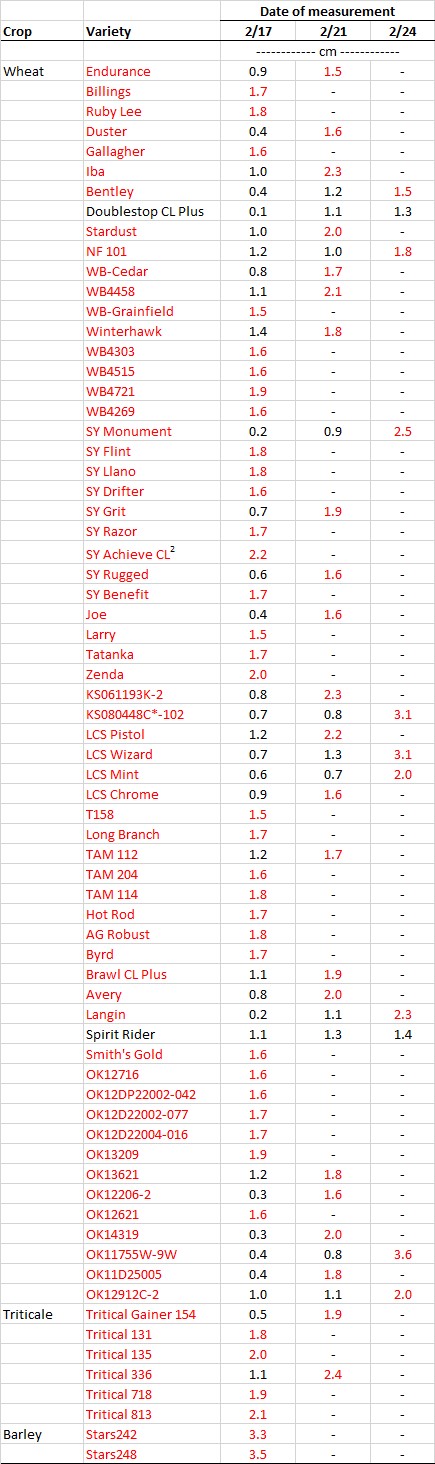
First hollow stem (FHS) is the optimal time to remove cattle from wheat pasture. This occurs when there is 1.5 cm (5/8” or the diameter of dime) of stem below the developing grain head (full explanation). Because of the progress the plants have made at Stillwater, this update will be our final one for this location. Nine of the 11 wheat varieties that were examined earlier today reached or significantly surpassed the 1.5 cm threshold (Table 1). Doublestop CL Plus and Spirit Rider remain the final two hold-outs as they barely missed the threshold. Keep in mind that several factors influence the onset of FHS. These include the wheat variety, location, temperature, available moisture, grazing, and planting date (later sown wheat will typically reach FHS later). The First Hollow Stem Advisor and the updates we provide give an indication of the FHS stem conditions in a particular area. However, because of the number of factors that can influence when FHS occurs, we cannot stress enough the importance of checking for FHS on a field-by-field basis.


Table 1. First hollow stem (FHS) results by variety collected from non-grazed plots at Stillwater on 2/17/17, 2/21/17, and 2/24/17. Plots were sown on 9/13/16. The threshold target for FHS is 1.5 cm (5/8” or the diameter of a dime). The amount of hollow stem for each variety represents the average of ten measurements. Varieties that have reached FHS are highlighted in red.

Table 1 2.24 Stillwater.jpg

First hollow stem update – Chickasha 2/23/17

First hollow stem (FHS) is the optimal time to remove cattle from wheat pasture. This occurs when there is 1.5 cm (5/8” or the diameter of dime) of stem below the developing grain head (full explanation). Wheat stem elongation at our Chickasha location has progressed but not as rapidly as we have observed in other areas. Listed below is the second set of FHS measurements from this location (Table 1). At this time, only 1 wheat variety has reached the 1.5 cm threshold. As a reminder, these measurements were collected from plots under simulated grazing. Grazing delays FHS, which is why we recommend checking plants from a non-grazed area of the field (e.g., just outside the hotwire). This helps provide time for finalizing plans to remove the cattle as the grazed area reaches FHS. For example, our border plots of Ruby Lee, sown at the same time, just reached FHS; whereas, within the plots, Ruby Lee measured 0.5 cm. Keep in mind that several factors in addition to grazing influence the onset of FHS. These include the wheat variety, location, temperature, available moisture, and planting date (later sown wheat will typically reach FHS later). The First Hollow Stem Advisor and the updates we provide give an indication of the FHS stem conditions in a particular area. However, because of the number of factors that can influence when FHS occurs, we cannot stress enough the importance of checking for FHS on a field-by-field basis. 


Table 1. First hollow stem (FHS) results by variety collected at Chickasha on 2/16/17 and 2/22/17. Plots were sown on 9/15/16. The threshold target for FHS is 1.5 cm (5/8” or approximately the diameter of a dime). The amount of hollow stem for each variety represents the average of ten measurements. Varieties that have reached FHS are highlighted in red.

table-1-2-22-chickasha

*triticale variety

First hollow stem update – Stillwater 2/21/17

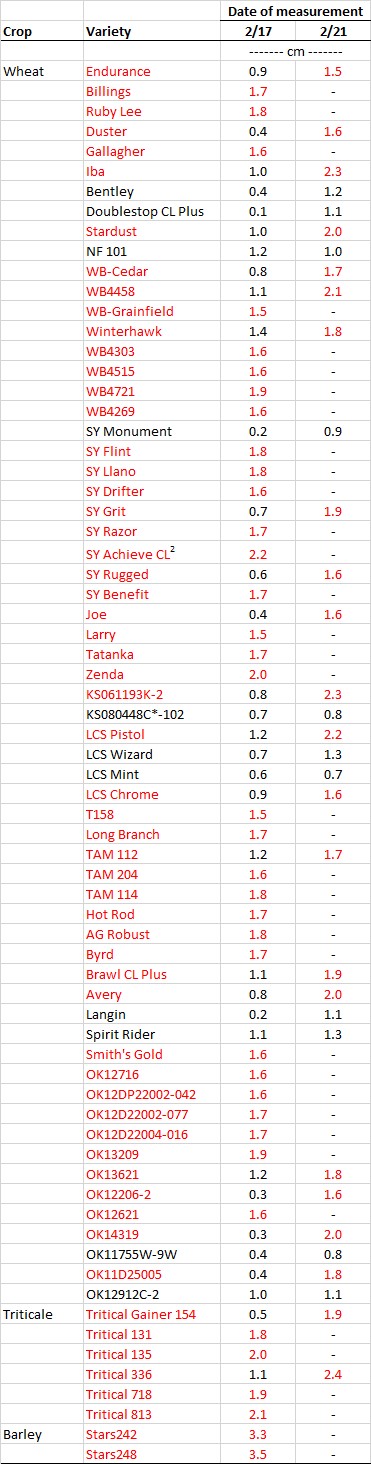
First hollow stem (FHS) is the optimal time to remove cattle from wheat pasture (full explanation). Wheat growth at our Stillwater location has continued to progress rapidly. Listed below is the second set of FHS measurements from this location (Table 1). These measurements were collected from plots that were not grazed. The point of reference I gave the last post was approximately 50% of the varieties reach or pass FHS by March 1 at Stillwater under normal conditions. Of the 31 wheat varieties we took measurements on today, 20 of those have reached FHS. That brings the total to 51 out of 62 wheat varieties (82%) which have reached FHS. Keep in mind that the numbers reported from Stillwater are likely behind those being observed in southern Oklahoma and ahead of those observed in northern Oklahoma. The First Hollow Stem Advisor can provide an estimate of first hollow stem progress in your area.


Table 1. First hollow stem (FHS) results by variety collected at Stillwater on 2/17/17 and 2/21/17. Plots were sown on 9/13/16. The threshold target for FHS is 1.5 cm (approximately the diameter of a dime). The amount of hollow stem for each variety represents the average of ten measurements. Varieties that have reached FHS are highlighted in red.

Table 1 2.21 Stillwater.jpg


Wheat Disease Update – 21 February 2017

This article was written by Dr. Bob Hunger, Extension Wheat Pathologist

Department of Entomology & Plant Pathology

Oklahoma State University – 127 Noble Research Center

405-744-9958

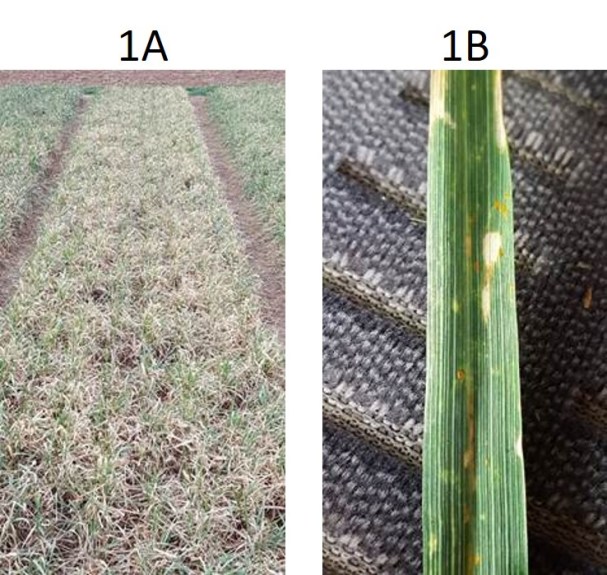
     I indicated last November that leaf rust was severe in many wheat varieties that had been planted early (mid-September) in Dr. David Marburger’s variety demonstration strips here at Stillwater. As we moved into December and January, there were two severe cold spells along with drought that caused significant death of the rank foliage.  Many of the burned/dead leaves were infected with leaf rust, and killing of these infected leaves stopped the spread of leaf rust to new/young foliage.  The burning of the foliage in these plots was quite noticeable in mid-January (Figure 1A).  Last week I examined these plots to see if leaf rust had overwintered, and sure enough, viable leaf rust pustules were present on some of the newer/younger leaves (Figure 1B).

figure-1

Figure 1. (A) Severe leaf burn of wheat in mid-January, 2017.  (B)  Leaf rust pustules as observed on leaves in mid-February in the same plots in (A).

     Hence, leaf rust has overwintered in much of Oklahoma and inoculum to start this disease in the spring will come not only from within the state, but also from Texas where widespread, moderate levels of leaf rust have been reported (see report below from Texas).  The two recent widespread rain events also will support the further infection and spread of leaf rust in Oklahoma, but weather through March and April still will be the ultimate determiner as to how severe leaf rust becomes in Oklahoma in 2017.  However, be sure to start checking your wheat over the coming weeks for the presence of leaf rust (especially if you have a moderately susceptible to susceptible variety).  I can’t imagine any spraying is needed at this time for leaf rust, but you should stay alert for the presence of this disease as we proceed into March and April when conditions for leaf rust infection and spread typically become more favorable.

     The other rust that can greatly impact yield in Oklahoma is stripe rust (Figure 2). Typically if stripe rust is going to be a problem in Oklahoma we start to see “hot spots” in fields from late February into early March.  Note that often early season stripe rust infections do not typically show the striping pattern associated with stripe rust but rather pustules tend to occur more in clusters as depicted in Figure 3.  Reports of moderate to severe stripe rust also typically are coming in from Texas by this time in years when stripe rust is severe in Oklahoma.  However, no stripe rust has yet been reported in Oklahoma this year, and reports indicate stripe rust is sparse in Texas (see below).  This is good news in terms of the likelihood of stripe rust in Oklahoma, but continue to watch for stripe rust when looking for leaf rust.

figure-2

Figure 2.  Early season infection of stripe rust.  Note that in contrast to later season stripe rust infection, early season infections do not show the “striping” typically associated with stripe rust.

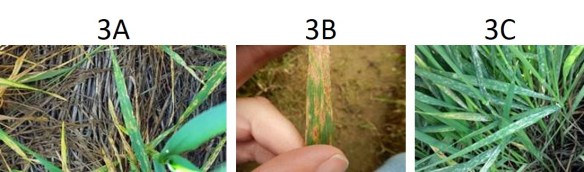
     Other foliar disease to watch for include tan spot, Septoria leaf blotch, and powdery mildew (Figure 3A-C).  These diseases (especially tan spot and Septoria leaf blotch) are more likely to occur in no-till, continuous wheat fields.  If sufficiently severe in a no-till field, spraying for these in March may be beneficial but only if young wheat plants are severely spotted with one of these diseases.  For additional information regarding early season foliar wheat diseases and possible control with an early fungicide application, please see our fact sheet (PSS-2138) that discusses split application of fungicides by clicking here.

figure-3

Figure 3. Wheat diseases typically observed in no-till, continuous wheat fields include (A) Tan spot; (B) Septoria leaf blotch; (C) Early season powdery mildew.

Reports/excerpts of reports from other states:

TexasDr. Clark Neely; Assistant Professor & Extension Small Grains and Oilseed Specialist; Texas A&M University; Feb 14, 2017: Weather conditions have been drier this fall and winter than the previous two years, which is having a positive impact on wheat rust presence across the state. This time last year, producers were dealing with widespread reports of stripe rust in their wheat fields due to wet conditions. This year, stripe rust has been reported in a few locations throughout Central and South Texas, however, pressure appears lighter overall and observed mainly in highly susceptible border plots (‘TAM 111’) in research trials. A few reports of very light stripe rust in producer fields in the central Blacklands was reported also. Light pressure was reported in an Ellis County trial and trace amounts were found in trials near Thrall and College Station. No stripe rust has yet been found in South Texas (Uvalde, Castroville, Corpus Christi), Northeast Texas (Greenville), or the Rolling Plains. Though inoculum is currently low, forecasted weather conditions appear to be favorable for further development beginning this weekend through mid-week as a large percentage of the state is expected to receive an inch or more of precipitation and coincide with cooler temperatures. Therefore, producers in the Blacklands should keep an eye on wheat fields over the next couple of weeks to watch for further stripe rust development.

     Meanwhile, leaf rust is present in much of Southeast Texas. Research plots in Thrall, College Station and Wharton all show moderate leaf rust pressure so far. Light levels of leaf rust are also reported in producer fields in Hill and McLennan Counties with a single severe case reported in ‘TAM 304’ that was sprayed with a fungicide. With plenty of inoculum present, this disease is likely to spread once temperatures increase in the coming weeks, though moisture conditions throughout the spring will influence the degree and speed to which it will increase. As of two weeks ago, leaf rust was not observed at Uvalde or the Castroville nursery and recent reports indicate little to no leaf rust further north in Northeast Texas and the Rolling Plains.

Spring-planted oat for forage

Spring-planted oat has been a “go to” forage crop for southern Great Plains beef producers for years. It is a good option when winter wheat was not planted in the fall due to wet conditions, or, as may be the case in certain areas of Oklahoma this year, when wheat failed to emerge due to drought. Forage production potential for spring-planted oat is around 1,500 to 2,00 lb/ac, but you will need about 60 – 75 lb/ac of nitrogen to make this type of yield. A fact sheet detailing spring oat production for hay and grazing can be found by clicking here or going to www.wheat.okstate.edu under “Wheat Management” then “Seeding”. Some of the key points from that fact sheet are listed below:

Oat forage trial 2013

Spring oat can provide an alternate hay or forage source in the spring.

Seed — Plant 80 – 100 lb/ac of good quality seed that has a germination of no less than 85%. There aren’t many options regarding varieties, so you will likely be limited to whatever seed is available in your area. The key is not to cut back on seeding rate, regardless of variety.

Seedbed — Sow oat seed at approximately 1/2 to 3/4 inches deep. Most producers will be better off with a conventionally-tilled seedbed. You are planting seed at a time of year when the ground is already marginal regarding temperature. Conventionally-tilled seedbeds warm more quickly, which should speed germination. There is one exception to the conventional till recommendation. If you are sowing into a stale seedbed or a failed wheat crop that is very thin, no-till should be okay. Just avoid situations where excessive residue will keep the soil cold.

Grazing — Oat plants should have a minimum of six inches of growth prior to grazing. Unlike fall-seeded cereals, you should not expect a large amount of tillering. A good stand of spring oat can provide a 750 lb animal approximately 60 days of grazing when stocked at 1.5 animals per acre

Hay — Oat should be cut for hay at early heading to maximize yield and quality.


Stillwater First Hollow Stem Update 2/18/17

Yesterday, we posted our first hollow stem (FHS) results from Chickasha. None of the varieties had reached FHS, but as I cautioned in that post, those measurements were collected under a simulated grazing scenario based on the way forage data was collected from that trial.


Listed below is the first set of FHS measurements from our Stillwater location (Table 1). These measurements were collected from plots that were not grazed. The point of reference I gave yesterday was approximately 50% of the varieties reach or pass FHS by March 1 at Stillwater under normal conditions. From the results below, 30 of the 62 wheat varieties examined have just reached FHS. Compared to the point of reference, that is about 12 days ahead of schedule.


On February 10, we checked several of the known ‘early’ varieties (e.g., Billings, Gallagher) at Stillwater, and little to no hollow stem was present at the time. Therefore, we thought we would be safe with taking measurements in the middle to latter part of the week. Well, the warm temperatures over that weekend and the rainfall we received at Stillwater earlier this week provided great growing conditions. As a result, about half of the wheat varieties reached FHS. I suspect that we missed being on the front side of the 1.5 cm threshold by about a day or two for a lot of these varieties that have reached FHS. Our next round of measurements from Stillwater will come early next week.


Table 1. First hollow stem (FHS) results by variety collected on 2/17/17 at Stillwater. Plots were sown on 9/13/16. The threshold target for FHS is 1.5 cm (approximately the diameter of a dime). The amount of hollow stem for each variety represents the average of ten measurements. Varieties that have reached FHS are highlighted in red.

table1-5