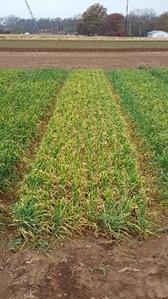
First Hollow Stem Update 2/17/17

First hollow stem (FHS) is the optimal time to remove cattle from wheat pasture (a more detailed explanation can be found by clicking here). Each year, we collect FHS measurements from the varieties in our forage variety trials. This year, we have two forage variety trial locations, Chickasha and Stillwater. Both locations were sown in mid-September. To give you a point of reference, under normal conditions approximately 50% of the varieties reach or pass FHS by March 1st at Stillwater. However, with the warmer than normal temperatures and estimates from the First Hollow Stem Advisor on the Oklahoma Mesonet, we have begun collecting our FHS measurements.


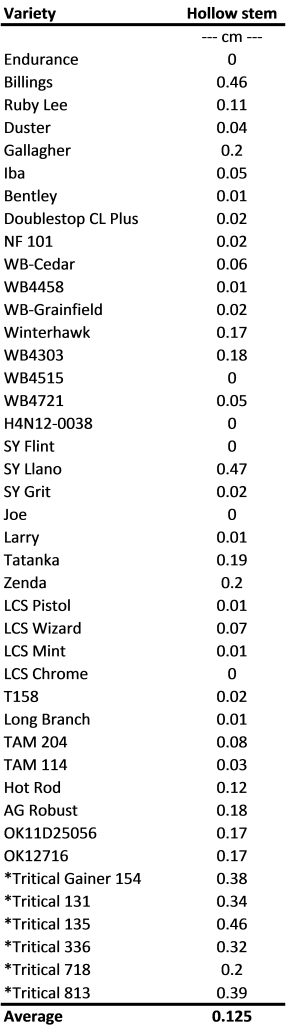
Listed below are the first set of FHS measurements from our Chickasha location (Table 1). A couple of the ‘early’ varieties are beginning to show hollow stem, but none of the varieties have reached FHS at this time. However, with the recent rainfall and warm forecasted temperatures, I suspect some of the early varieties will reach FHS very soon. I also need to provide you a word of caution with the Chickasha results. Based on how we collected our forage measurements this year, the FHS results at this location are coming from a simulated grazing situation. Grazing can delay the onset of FHS, which is why we recommend checking for FHS from a non-grazed area of the field (e.g., just outside the hot wire) to give a short buffer time for finalizing plans to remove the cattle. Because of this, there may be some varieties on this list if planted in the Chickasha area that may be closer to FHS than what is presented in the table. As always, keep in mind that wheat varieties in areas south of Chickasha may be further along, while varieties in areas further north may be a little behind yet. We are also taking measurements today from our trial at Stillwater, and I will get those results posted as soon as we get them summarized.


Table 1. First hollow stem (FHS) results by variety collected on 2/16/17 at Chickasha. Plots were sown on 9/15/16. The threshold target for FHS is 1.5 cm (approximately the diameter of a dime). The amount of hollow stem for each variety represents the average of ten measurements.

chick-fhs-2-17-17

*triticale variety

Time to start thinking about first hollow stem

First hollow stem (FHS) occurs just prior to the jointing growth stage and is the optimal time to remove cattle from wheat pasture. This is the optimal time because the added cattle weight gains associated with grazing past first hollow stem are not enough to offset the value of the reduced grain yield (1-5% loss every day past FHS). With the warmer than normal temperatures throughout the beginning of this year and the forecasted warm temperatures, it is likely we will start seeing FHS occur for some of our “early FHS” wheat varieties in Oklahoma in the next 7-14 days, especially towards the southern border.


One of the moving targets each year is determining when to start scouting for FHS. To help combat this, the First Hollow Stem Advisor was developed by researchers at Oklahoma State University. This is an online tool available on the Mesonet website, https://www.mesonet.org/index.php/agriculture/category/crop/wheat/hollow_stem_advisor. This tool uses soil temperature data to show the current probability of FHS occurrence, as well as 1-week and 2-week projections (detailed information on how this works can be found here). With this tool, producers can select their variety from a list of varieties that separates them into three FHS categories: early, middle, and late. Then, maps can be generated to provide the probability of FHS based on current conditions and the 1- and 2-week projections. Charts and tables can also be generated for individual Mesonet sites. Created maps have a color scheme to represent the probability of FHS occurrence. When using this tool, it is recommended to start scouting for FHS from a non-grazed part of the field once the 5% probability level is reached (green color). Because stem elongation will begin moving quickly as the temperature warms up, starting your scouting at the 5% level will help give you the time it takes for making the necessary preparations for removing the cattle by the time FHS occurs. Methods on how to scout for FHS are listed at the end of this post. For producers who do not scout, it is recommended to remove cattle when the 50% probability level is reached. A 50% probability level indicates that over a multi-year period (e.g., 10 years), FHS has occurred by that date in 50% of those evaluated years (e.g., 5 years). The same interpretation is used for other probability levels.


To give an example of what the tool provides and show some of the FHS conditions around OK, I have generated some statewide maps below. For producers in areas of southeastern and south central OK who planted an “early” wheat variety (e.g., Gallagher), now would be the time to go out and start scouting for FHS (Figure 1).

figure-1

Figure 1. Current FHS probabilities for “early” wheat varieties.


Looking at the 1-week projection for “early” varieties, you can see how the probabilities have increased, and producers in areas further north should begin scouting (Figure 2).

Figure 2.png

Figure 2. One-week FHS projection (i.e., through February 8) for “early” wheat varieties.


For producers who planted “middle” or “late” FHS varieties, the 1-week projections indicate producers across much of the state still have a little bit of time yet before beginning to scout. However, producers along the southern border will need to begin scouting (Figure 3).

Figure 3.png

Figure 4.png

Figure 3. One-week FHS projections (i.e., through February 8) for “middle” (top) and “late” (bottom) wheat varieties.


Methods for scouting for FHS:

  • Check for FHS in a non-grazed area of the same variety and planting date. Variety can affect FHS date by as much as three weeks, and planting date can affect it even more.
  • Dig or pull up a few plants and split the largest tiller longitudinally (lengthways), and measure the amount of hollow stem present below the developing grain head. You must dig plants because the developing grain head may still be below the soil surface at this stage.
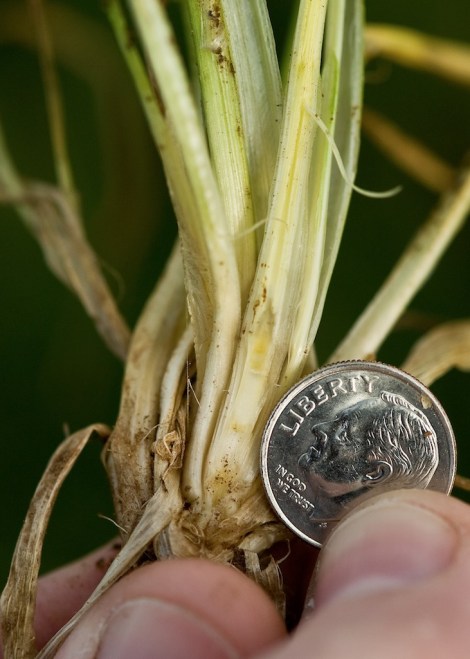
  • If there is 1.5 cm of hollow stem present (see picture below), it is time to remove cattle. 1.5 cm is about the same as the diameter of a dime.
  • More detailed information on FHS can be found at wheat.okstate.edu under ‘wheat management’ then ‘grazing’ or by clicking here.

fhs 077

The first hollow stem growth stage is reached when there is 1.5 cm of hollow stem (about the diameter of a dime) below the grain head. Photo by Dr. Jeff Edwards.


Similar to previous years, we will monitor occurrence of FHS in our wheat plots at Stillwater and Chickasha and report the findings on this blog.

Time to topdress wheat?

By David Marburger and Brian Arnall

There are few crop inputs for winter wheat that deliver as much return on investment as nitrogen fertilizer. It takes approximately two pounds of nitrogen to produce one bushel of grain. This year that will cost approximately $0.80-$1.00 to produce a bushel of grain worth about $3.25. Of course, nitrogen is not the only yield determining factor in a wheat crop, but it does represent a significant investment in a year that will have very tight margins. Also, the law of diminishing marginal returns eventually kicks in, but nitrogen fertilizer is still one of the safest bets for wheat inputs.

Topdress nitrogen fertilizer is especially important because it is applied and utilized at a time when the plant is transitioning from vegetative to reproductive growth. Several things, including the number of potential grain sites, are determined just prior to jointing, and it is imperative that the plant has the fuel it needs to complete these tasks. Jointing occurs around the end of February in southern OK and around the second week of March in northern OK. Jointing also marks the beginning of rapid nitrogen uptake by the plant which is used to build new leaves, stem, and the developing grain head. The nitrogen stored in these plant parts will be used to fill the grain later in the season, and the plant is dependent on this stored nitrogen to complete grain fill.

Early January is our normal time for beginning to topdress nitrogen fertilizer in winter wheat in Oklahoma. However, the lack of significant rainfall in many areas during November through December has presented some interesting and frustrating challenges regarding topdress nitrogen fertilizer. The biggest of these is deciding when and how much to apply. Listed below are some considerations for topdressing nitrogen this year.

When to apply

  • In order to have full benefit, nitrogen must be in the rooting zone by the time wheat is jointing, and moisture is required to move nitrogen into the rooting zone. Since precipitation is usually very limited in January and February in Oklahoma, we need the nitrogen out on the field when the precipitation hopefully arrives back.
    • If you applied nitrogen pre-plant, consider waiting until closer to jointing for a topdress application. By being patient in this situation, we are hoping for a rainfall that will not only provide soil moisture to move that topdress N down into the root zone but also provide enough N for a higher yield potential. Otherwise, if we stay dry through jointing, you will likely have enough nitrogen present to compensate for a lower yield potential.
    • If you decided not apply any nitrogen prior to planting, due to residual soil nitrogen amounts or simply did not want to invest the money into the crop at the time for example, did you happen to use a N-rich strip?

Yes I did: If you currently see a difference between the N-rich strip and the rest of the field, then now would be time to begin making applications. For those producers who are using the Sensor Based Nitrogen Recommendation (SBNRC) system, your yield predictions and nitrogen recommendations generally become more accurate as the season progresses; however, growers wishing to hedge their nitrogen bet could apply a partial topdress now and supplement with a second top dress just prior to jointing if SBNRC recommendations call for additional nitrogen. If you cannot see a difference, then wait until closer to jointing to make the call.  https://osunpk.com/2014/02/24/sensing-the-n-rich-strip-and-using-the-sbnrc/

No I did not: Now would probably be ideal to start making those applications depending on fall growth and soil moisture levels. If soil moisture is present, considering apply enough N to reach the farms break-even yield goal. At minimum, 30-40 lbs of N should be applied. The rate ultimately depends on comfortability with putting more money into this crop. Also, it is not late to apply a N-rich strip:  https://osunpk.com/2013/09/19/nitrogen-rich-strips/

  • Do not apply nitrogen to frozen ground with a layer of ice or thick snow layer. Nitrogen will move with water. If melting snow or frozen rain is moving to the ditch, so will nitrogen applied to the soil surface.
  • Consider splitting or delaying top dress nitrogen applications to sandy soils until closer to jointing, as leaching can occur.

How much to apply

  • On average it takes about 2 lbs/ac of N for every bushel of wheat yield. In addition, dual-purpose wheat requires 30 lbs/ac of N for every 100 lbs/ac of beef or 1,000 lbs/ac of forage removed. You can subtract your soil test NO3-N from these total requirements.
  • Did you soil test? It is okay to adjust topdress N plans based on your current yield potential. When you submitted your soil test, you might have stated a 50 bu/ac yield goal which would require 100 lbs/ac of nitrogen; however, it is important to take a hard look and determine if this yield goal is still realistic based on your current crop status. This does not suggest to adjust based on what you think the weather might do, but it is okay to take inventory and adjust your topdress N up or down based on current field conditions.
  • Don’t have an N-rich strip? Many more producers are trying it this year simply due the fact that producers did not want to spend much money up front on wheat inputs. An N-rich strip helps take the guess work out of adjusting your topdress N up or down based on your current crop conditions. Your county extension educator can provide more information on N-rich strips and you can find more information on the web at npk.okstate.edu

What source to use

  • The plant does not care about the nitrogen source. A pound of nitrogen is a pound of nitrogen. Focus on getting the correct amount applied at the correct time, and choose your product based on price and application uniformity.
  • Use a source that can be applied uniformly. Spinner trucks or buggies work but are generally the least uniform. Air trucks or streamers are the most uniform.
  • Streamer nozzles almost eliminate leaf burn from UAN; however, leaf burn is generally not an issue until temperatures warm and/or you are applying fairly large amounts of UAN. Stream nozzles are also not affected much by wind and deliver a uniform pattern in a variety of conditions. There are also some studies that indicate banding of UAN through the use of stream nozzles will reduce nitrogen immobilization on crop residue. Keep in mind that you cannot tank mix herbicides when using streamer nozzles.
  • One pass herbicide/topdress applications are very efficient in terms of time and input costs, but in some scenarios, it can end up costing you more money. Consider two-pass applications when dealing with no-till fields, especially when canopy coverage is below 70%. This is due to the high probability that the nitrogen will be tied up when it hits the residue and will not be available for the current wheat crop. For a more in-depth discussion on tank mixing herbicides and UAN for top-dress see
    https://osunpk.com/2016/02/07/herbicide-and-uan-tank-mixed-for-top-dress

pic1

Streamer nozzles provide uniform application of UAN in a wide variety of environmental conditions. 

pic2

Poor nitrogen application can result in a streaked field. Some of the areas in this field were over fertilized while some where under fertilized, resulting in wasted nitrogen and less than optimal crop yield. 

Hessian fly showing up in SW OK

Gary Strickland, Jackson and Greer Co. Ag Extension Educator, has indicated a number of wheat fields in that area of SW OK are showing signs of Hessian fly. Most of these fields are no-till and planted with a susceptible wheat variety such as Fuller. Plant symptoms may go unnoticed until you start to see tillers dying, a good indication of an infestation. Further investigation by removing the plant and examining the stems at the base near the crown will help identify any larvae or pupae present. Dr. Tom Royer, Extension entomologist, recently wrote a nice article depicting how and what to look for: Plan to Manage Hessian Fly.

img_6299-cropped

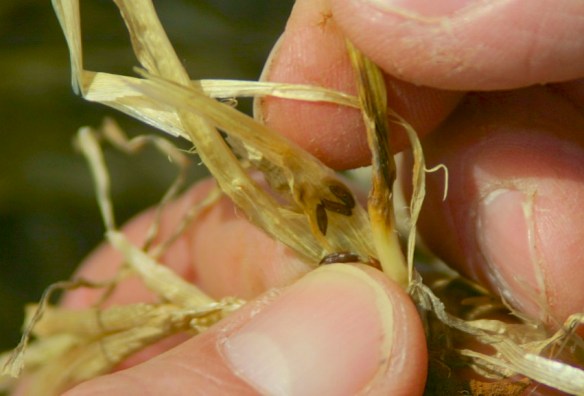
Full-grown Hessian fly larvae form rice-like puparia that are shiny and dark brown. The puparium is commonly referred to as a “flaxseed.” Photo courtesy of Dr. Jeff Edwards.

Now would be a good time to scout your fields for this pest, especially if you have fields which are planted with a non-treated susceptible wheat variety, are in a continuous wheat rotation, use no-till or minimum tillage, were planted early (September into early October), or is a conventional tilled field next or near to a no-till wheat field. If you are unsure whether your wheat variety is resistant to Hessian fly, you can use this OSU fact sheet: Wheat Variety Comparison ChartUnfortunately, not much can be done to control this insect right now. However, we can learn from this year and make some management adjustments to control this pest next year.

For more information on Hessian fly and its management, consult fact sheet EPP-7086, Hessian Fly Management in Oklahoma Winter Wheat.

Wheat Disease Update – 30-November-2016

This post was written by Dr. Bob Hunger

Extension Wheat Pathologist

Department of Entomology & Plant Pathology

Oklahoma State University

During the first week of November 2016, I reported observing fairly severe leaf rust in rows of Jagalene wheat in Dr. Brett Carver’s breeder nurseries here at Stillwater.  About that time, leaf rust also was observed in the early planted variety-demonstration nursery planted in Stillwater by Dr. David Marburger.  The early planted plots were planted 13-Sep-2016.  For this variety-demonstration, Dr. Marburger plants a duplicate, later planted (26-Oct-2016) plot of each variety immediately in front of the early-planted plot.  This variety-demonstration nursery has provided an interesting observation of the effect of planting date on leaf rust as can be seen in Figure 1.

With cooler temperatures and light frosts we finally have received over the last 7-10 days, the older leaves infected with leaf rust in the early planted plots have mostly turned yellow.  Rust pustules are evident, but chlorosis (yellowing) is the predominate symptom.  Across all the varieties (>60), there is a range from nearly all yellow except the youngest leaves, to nearly all green (there is some tip yellowing/burning from the frosts).

pic-1pic 2.jpg

figure 1.jpg

By comparison, look at the photo below (Figure 2) showing early planted plots (background) and late planted plots in the foreground.  Leaf rust is not found in the late planted plots (foreground).  If early planted wheat had been grazed, which would be more typical with a mid-September planting date, much of the rank foliage would have been removed and rust would not be nearly as severe as in this variety-demonstration.  This is a good example of how planting date can effect disease incidence and severity given an environment favorable for disease such as we have had this fall with mild temperature and occasional rain and dews.

pic 3.jpg

figure 2.jpg

There are a couple of additional points I should make with the photos above.  First, not many would plant wheat in early to mid-September for the purpose of grain only.  Hence, wheat in the early planted plots would most likely be grazed, which would remove much of the rank foliage and also the rust, and thereby the rust incidence would not be nearly as severe.  Wheat in a grain-only mode would look more like the wheat in the late planted plots (foreground plots in Figure 2).  Second, we normally would have colder weather earlier than we had this year that would have arrested rust development.  Then, newly emerging leaves would be healthy and green.  As I have said previously, I am not a proponent of spraying in the fall to control fall foliar diseases such as leaf rust because leaf rust development typically slows and stops once we get to colder temperatures in November-January (basically <60 F with frosts at night).  And remember, the primary concern with fall leaf rust is that with a mild winter and sufficient moisture, the rust will survive through the winter and inoculum will be present in fields to start the disease early in the spring.  Hence, monitoring of fields through the late winter and early next spring is recommended to see if application of a fungicide to control rust is indicated in the early spring.  For all the foliar wheat diseases (leaf rust, stripe rust, powdery mildew, tan spot, and septoria leaf blotch), control in the spring is more critical then control in the fall.  I have heard of fungicide being added in with a fall herbicide application to limit disease, but such an application would have needed to have been applied 3-4 weeks ago to prevent the situation as depicted in the photos above.  However, I can see where in a year such as this one with a fully susceptible variety that was planted early and not grazed there may be value to an early fungicide application.  BUT ESPECIALLY, watch these fields starting in late February to see if an application is merited because control of foliar diseases in the spring is much more critical than control in the fall.

Wheat Disease Update – 08-November-2016

This post is written by Dr. Bob Hunger

Extension Wheat Pathologist

Department of Entomology & Plant Pathology

Oklahoma State University

Fall 2016 has been mild/warm and relatively dry. Because of the dryness, fall foliar diseases should be relatively sparse, but some areas have received sufficient rain or had sufficient dews to favor development of wheat foliar diseases. That is the case around Stillwater as you can see in the photo below. This picture, which was taken November 5th in one of Dr. Brett Carver’s wheat breeding nurseries at Stillwater, was planted September 14th. The variety is Jagalene, which is highly susceptible to both leaf and stripe rust (I could find no stripe rust).

leaf-rust-1

Wheat foliage (‘Jagalene’) showing a highly susceptible reaction to leaf rust with an intermediate severity level. Note younger leaves show no leaf rust. This nursery is located in Stillwater, OK, and was planted 9-14-2016 with this photo taken on 11-5-2016.


I am not a proponent of spraying in the fall to control fall foliar diseases such as leaf rust because leaf rust development slows and stops once we get to winter temperatures in late November-January (basically <60 F). Typically the lower/older leaves with leaf rust pustules die, but the youngest leaves are green and healthy. Grazing helps to remove leaf rust infections, is not harmful to cattle, and also “opens” the canopy so there is increased air circulation and drying that are less favorable to development of leaf rust. Given these considerations, spraying to control leaf rust in the fall typically is not necessary.  The primary concern with fall leaf rust is that with a mild winter and sufficient moisture, the rust will survive through the winter and inoculum will be present in fields to start the disease early in the spring.  Hence, monitoring of fields through the late winter and early next spring is recommended to see if application of a fungicide to control rust is indicated in the early spring.


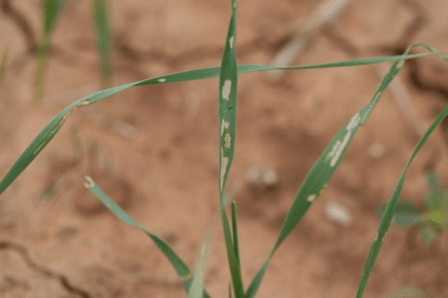
Other samples that have come to the lab for diagnosis appear to be related to abiotic conditions such as dryness or low fertility.  Some leaf spots have been observed on these samples, but they are either secondary or of low incidence and not a cause of major concern. Dr. Misha Manuchehri (OSU Weed Specialist) sent the following photo showing leaf spots she observed on plants in a trial located near Perkins, OK. Dr. Manuchehri is bringing a sample for us to isolate from, but this appears to be tan spot. Leaf spotting diseases such as tan spot and Septoria leaf blotch typically do not appear until late February or March.

leaf-spot

Leaf spots (most likely tan spot) on wheat foliage (variety not known). This nursery is located near Perkins, OK. Photo taken the first week of November 2016 by Dr. Misha Manuchehri.


For all the foliar wheat diseases (leaf rust, stripe rust, powdery mildew, tan spot, and Septoria leaf blotch), control in the spring is more critical then control in the fall. I have heard of growers adding a shot of fungicide with a fall herbicide application to limit disease present. I have no data to support the value of such an application, but there may be some value to it because plants are smaller and not growing as actively so limiting the amount of foliage loss due to a disease such as tan spot will contribute to the overall health of the wheat going into winter.  BUT ESPECIALLY, watch these fields starting in late February to see if an application is merited because control of foliar diseases is much more critical in the spring than in the fall.

**ATTENTION** New date for the herbicide symptomology clinic!

We will be having the 2nd Annual Herbicide Symptomology Clinic at the Agronomy Research Farm in Stillwater on Friday, November 4.  The flyer below includes all details, but topics covered will include herbicide demonstrations for wheat and canola as well as many winter weeds, simulated drift demonstration, and discussion on sprayer nozzle selection for specific tasks.  Please plan on attending if possible, and contact Dr. Manuchehri for an RSVP.  Thank you!

2016-herbicide-symptomology-clinic-flyer-new-date

Mark your calendars for November 2nd!

We will be having the 2nd Annual Herbicide Symptomology Clinic at the Agronomy Research Farm in Stillwater.  The flyer below includes all details, but topics covered will include herbicide demonstrations for wheat and canola as well as many winter weeds, simulated drift demonstration, and discussion on sprayer nozzle selection for specific tasks.  Please plan on attending if possible, and contact Dr. Manuchehri for an RSVP.  Thank you!

2016-herbicide-symptomology-clinic-flyer

Scout for fall armyworm!

With wheat planting beginning in some areas of the state during the last week of August into the first week of September, we have already received several calls regarding fall armyworm feeding. Dr. Tom Royer, Extension entomologist, said fall armyworms have been very active this summer, showing up early and in large numbers this growing season.

As wheat planting progresses here in September, producers need to check fields very regularly after seedling emergence. One producer had significant damage occur across an entire 1/2 section within 2 days. Dr. Royer suggests scouting for fall armyworms by examining plants in several (5 or more) locations in the field. A good place to start is along the field margin as they sometimes move in from the road ditches and weedy areas, but make sure to examine the interior of the field as well. Fall armyworms are most active in the morning or late afternoon.

armyworm1armyworm2

Fall armyworms are small (3/8-1 1/2″) and can be easily overlooked (top photo). Feeding on leaves gives a transparent (“window paned”) appearance (bottom photo). Photos courtesy of Dr. Tom Royer.

Be on the lookout for “window paned” leaves, and count all sizes of larvae. The suggested treatment threshold is 2-3 larvae per linear foot of row in wheat with active feeding. Numerous insecticides are registered for control, but they are much more susceptible when caterpillars are small. We won’t get relief from fall armyworms until we get a killing frost. So make sure to keep scouting regularly, especially with early-planted wheat!

armyworm3

Fall armyworm can cause significant damage across large areas very quickly, so scout early and scout often. Photo courtesy of B. Boeckman.

Control suggestions for fall armyworm are available in the OSU Fact Sheets CR-7194 Management of Insect and Mite Pests of Small Grains.

Wheat Disease Update – 04-Aug-2016

Considerations to Make before Planting Wheat this Fall

Dr. Bob Hunger, Extension Wheat Pathologist

Dr. Tom Royer, Extension Entomologist

Department of Entomology & Plant Pathology

Oklahoma State University

Planting dateMuch of the winter wheat in Oklahoma is sown with the intent of being used as a dual-purpose crop. In such a system, wheat is grazed by cattle during the late fall through early spring and then harvested for grain in early summer.  In a grain-only system, wheat is generally planted in October, but in a dual-purpose system wheat is planted in early to mid-September to maximize forage production.  Planting wheat early significantly increases the likelihood that diseases such as mite-transmitted viruses, the aphid/barley yellow dwarf complex, and root and foot rots will be more prevalent and more severe.  For more detailed information on planting date and seed treatment considerations on wheat, see CR-7088 (Effect of Planting Date and Seed Treatment on Diseases and Insect Pests of Wheat) at:

http://pods.dasnr.okstate.edu/docushare/dsweb/Get/Document-7836/CR-7088web2012.pdf

Mite-transmitted virus diseases.    These include wheat streak mosaic (WSM), wheat mosaic (formerly called high plains disease), and Triticum mosaic (TrM).  All are transmitted by wheat curl mite (WCMs).  WCMs and these viruses survive in crops such as wheat and corn, as well as many grassy weeds and volunteer wheat.  In the fall, WCMs spread to emerging seedling wheat, feed on that seedling wheat, and transmit virus to the young wheat plants.  In the spring of 2016, several fields of commercial wheat in north-central and northwestern OK were destroyed by WSM.  These fields were growing immediately adjacent to fields left fallow during the fall/winter of 2015-2016.  The fallow fields contained abundant volunteer wheat and grassy weeds from which WCMs carrying WSMV spread into the commercial fields.  Wheat infected in the fall is either killed by the next spring or will be severely damaged.  Hence, it is imperative to be a good neighbor and control volunteer wheat and grassy weeds in fields left fallow – especially, if they are adjacent to commercial wheat fields.

A commercial wheat field showing severe symptoms of wheat streak mosaic (left).  The commercial field was infested during the fall and winter with wheat curl mites carrying the virus from volunteer wheat and grassy weeds that were not controlled in the fallow field.  The picture on the right are typical foliar symptoms of WSM.

image1   image2

Seed treatments are not effective in controlling these mite-transmitted virus diseases.  However, planting later in the fall (after October 1 in northern OK and after October 15 in southern OK) and controlling volunteer wheat are two practices that provide some control.  It is extremely critical that volunteer wheat is completely dead for at least two weeks prior to emergence of seedling wheat because WCMs have a life span of 7-10 days.  Thus, destroying volunteer wheat at least two weeks prior to emergence of seedling wheat will greatly reduce mite numbers in the fall.  In addition to these cultural controls, two winter wheat varieties (RonL from Kansas and Mace from Nebraska) have resistance to WSM; however, their adaptation to production is limited to northwestern Oklahoma.  For more information on mite-transmitted virus diseases, see OSU Fact Sheet 7328 (Wheat Streak Mosaic, High Plains Disease and Triticum Mosaic:  Three Virus Diseases of Wheat in Oklahoma) at: http://pods.dasnr.okstate.edu/docushare/dsweb/Get/Document-8987/EPP-7328.pdf

Aphid/barley yellow dwarf (BYD) complex:  Viruses that cause BYD are transmitted by many cereal-feeding aphids.  BYD infections that occur in the fall are the most severe because virus has a longer time to damage plants as compared to infections that occur in the spring.  Several steps can be taken to help manage BYD. First, a later planting date (after October 1 in northern Oklahoma and after October 15 in southern Oklahoma) helps reduce the opportunity for fall infection.Second, some wheat varieties (e.g., Duster, Endurance, Gallagher, Iba, Doublestop CL+, Bentley, Everest, Winterhawk, Redhawk) tolerate BYD better than other varieties; however, be aware that no wheat variety has a high level of resistance to the aphid/BYD complex.  Third, control aphids that transmit the viruses that cause BYD.  This can be done by applying contact insecticides to kill aphids, or by treating seed before planting with a systemic insecticide.  Unfortunately, by the time contact insecticides are applied, aphids frequently have already transmitted the virus(es) that cause BYD.  Systemic seed-treatment insecticides including Gaucho (imidacloprid) and Cruiser (thiamethoxam) can control aphids during the fall after planting.  This may be particularly beneficial if wheat is planted early to obtain forage.  Be sure to thoroughly read the label before applying any chemical.

Spot in field (top) of barley yellow dwarf (BYD) as would be seen in March or April.  Many types of aphids (for example, greenbug; bottom) transmit the viruses that cause BYD.
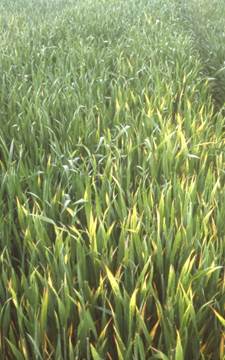
image3.jpg image4.jpg

Hessian fly:  Hessian fly infestations occur in the fall and spring.  Fall infestations arise from over-summering pupae that emerge when climate conditions become favorable.

Adult Hessian fly (left) and larvae and pupae of the Hessian fly (right)

image5.jpgimage6.jpg

Delayed planting (after October 1 in northern Oklahoma, and after October 15 in southern Oklahoma) can help reduce the threat of Hessian fly, but a specific “fly free date” does not exist for most of Oklahoma as it does in Kansas and more northern wheat-growing states.  This is because smaller, supplementary broods of adult flies emerge throughout the fall and winter.  Some wheat varieties are either resistant (e.g. Duster, Gallagher, SY-Southwind, LCS Wizard, Winterhawk) or partially resistant (e.g. Everest, Iba, Jackpot, PostRock, Ruby Lee, SY-Gold, T-153, Tam 304, WB-Stout) to Hessian fly infestations.  Hessian fly infestations can be reduced somewhat by destroying volunteer wheat in and around the field at least two weeks prior to emergence of seedling wheat.  Seed treatments that contain imidacloprid or thiamethoxam will also help reduce fly fall infestations, especially if combined with delayed planting and volunteer destruction.  For more information on Hessian fly, see OSU Fact Sheet: EPP-7086 (Hessian fly Management in Oklahoma Winter Wheat) at:

http://pods.dasnr.okstate.edu/docushare/dsweb/Get/Document-6189/EPP-7086web2015.pdf

Root and foot rots:  These include several diseases caused by fungi such as dryland (Fusarium) root rot, Rhizoctonia root rot (sharp eyespot), common root rot, take-all, and eyespot (strawbreaker).  Be aware that in the late spring of 2016, several samples of wheat were received that were diagnosed as being affected by take all and other root rots.  This could indicate a greater incidence of wheat root rots in 2017, but the incidence and severity of root rots is highly dependent on weather conditions so it is impossible to predict their incidence and severity this early.

Controlling root and foot rots is difficult.  There are no resistant varieties, and although fungicide seed treatments with activity toward the root and foot rots are available, their activity usually involves early-season control or suppression rather than control at a consistently high level throughout the season.  Often, there also are different “levels” of activity related to different treatment rates, so again, CAREFULLY read the label of any seed treatment to be sure activity against the diseases and/or insects of concern are indicated, and be certain that the seed treatment(s) is being used at the rate indicated on the label for activity against those diseases and/or insects.  Later planting (after October 1 in northern Oklahoma and after October 15 in southern Oklahoma) also can help reduce the incidence and severity of root rots, but planting later will not entirely eliminate the presence or effects of root rots.  If you have a field with a history of severe root rot, consider planting that field as late as possible or plan to use it in a “graze-out” fashion if that is consistent with your overall plan.  For some root rots, there are specific factors that contribute to disease incidence and severity.  For example, a high soil pH (>6.5) greatly favors disease development of the root rot called take-all.  OSU soil test recommendations factor in this phenomenon by reducing lime recommendations when continuous wheat is the intended crop. Another practice that can help limit take-all and some of the other root rots is the elimination of residue.  However, elimination of residue by tillage or burning does not seem to affect the incidence or severity of eyespot (strawbreaker).

White heads indicative of root rot (left); darkened roots (right) indicative of root rot (in this case, take all).

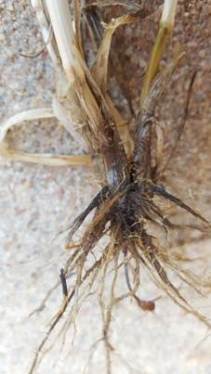
image7.jpgimage8.jpg

Seed treatmentsThere are several excellent reasons to plant seed wheat treated with an insecticide/fungicide seed treatment.  These include:

1.      Control of bunts and smuts, including common bunt (also called stinking smut) and loose smut.  The similarity of these names can be confusing.  All affect the grain of wheat, but whereas common bunt and flag smut spores carryover on seed or in the soil, loose smut carries over in the seed.  Seed treatments are highly effective in controlling all the bunts/smuts.  If common bunt (stinking smut) was observed in a field and that field is to be planted again with wheat, then planting certified wheat seed treated with a fungicide effective against common bunt is strongly recommended.  If either common bunt or loose smut was observed in a field, grain harvested from that field should not be used as seed the next year.  However, if grain harvested from such a field must be used as seed wheat, treatment of that seed at a high rate of a systemic or a systemic + contact seed treatment effective against common bunt and loose smut is strongly recommended.  For more information on common bunt & loose smut, see: http://www.entoplp.okstate.edu/ddd/hosts/wheat.htm and consult the “2016 OSU Extension Agents’ Handbook of Insect, Plant Disease, and Weed Control (OCES publication E-832),” and/or contact your County Extension Educator.

2.      Enhance seedling emergence, stand establishment and forage production by suppressing root, crown and foot rots.  This was discussed above under “Root and Foot Rots.”

3.      Early season control of the aphid/BYDV complex.  This can be achieved by using a seed treatment containing an insecticide.  Be sure that the treatment includes an insecticide labeled for control of aphids.

4.      Control fall foliar diseases including leaf rust and powdery mildew.  Seed treatments are effective in controlling foliar diseases (especially leaf rust and powdery mildew) in the fall, which may reduce the inoculum level of these diseases in the spring.  However, this control should be viewed as an added benefit and not necessarily as a sole reason to use a seed treatment.

Suppression of early emerged Hessian fly.  Research suggests that some suppression can be achieved, but an insecticide seed treatment has little residual activity past the seedling stage.