Water-based drilling mud and wheat

The recent increase in oil and gas exploration has resulted in the production of more water-base mud, (WBM), a by-product from the drilling process. The most common method of disposal for this material is land application to agricultural and grazing lands. As the name implies, water is the most common component of water base mud, but water-base mud also contains dissolved solids and sodium and a small amount on non-dissolved solids. Therefore the primary risk associated with over application of water-base mud is the soil becoming saline or sodic.

Water-base mud is mostly water, but also contains dissolved solids that, without agitation, will settle out of solution over time.

Water-base mud is mostly water, but also contains dissolved solids that, without agitation, will settle out of solution over time.

Soil salinity can be a problem for plants. Excessive salinity (approx. > 7,800 ppm for wheat) can decrease the ability of the plant to extract water from soil, even when water is plentiful. Salts can also interfere with germination. Germination reduction due to starter fertilizers with excess nitrogen or potassium, for example, are an example of how salts can inhibit germination. The solution for excess salt is typically water in the form of rainfall, as the water will move the salts deeper into the soil and out of the rooting zone. Unfortunately, rainfall in western Oklahoma is not always plentiful enough to achieve this downward movement and salts can accumulate.

OSU researchers Dr. Chad Penn and Dr. Jason Warren initiated a study at Lahoma, Oklahoma in 2012 to determine how in-season application of water-base drilling mud affected soil salinity and wheat yield. They evaluated  4,000 and 6,000 lbs/ac of total dissolved solids (6,000 lb/ac is the maximum allowed by the Oklahoma Corporation Commission) and five different timings from 16 October to 20 March. A detailed description of their findings is available in Current Report CR2272 at www.wheat.okstate.edu. 
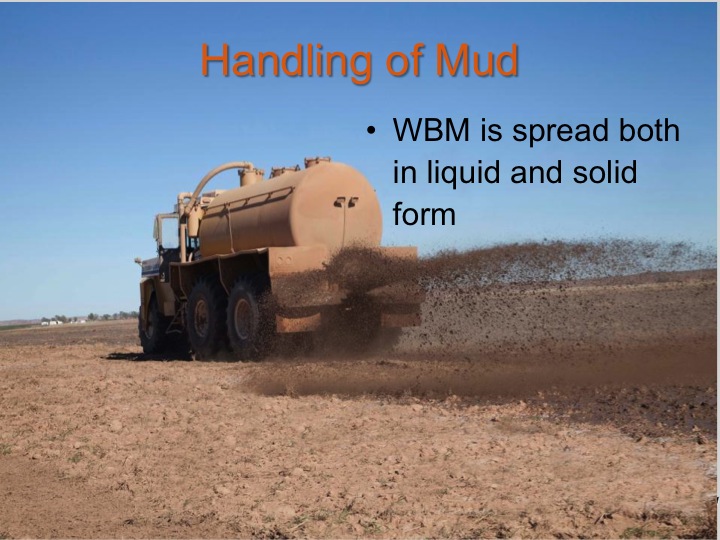
Water-base mud is spread in both liquid and solid form

Water-base mud is spread in both liquid and solid form

Drs. Penn and Warren found that the salts from the water-base mud accumulated in the top three inches of soil initially. Rainfall for the next 90 days was scarce (0.5 inches total) and the salt remained largely in the top three inches of soil. Once rainfall picked up, however, the salts started moving downward through the soil profile. As expected the 6,000 lb/ac total dissolved solids rate resulted in greater soil salinity than the 4,000 lbs/ac rate, so the less you apply per acre, the lower the chances of increasing soil salinity to toxic levels.

In this study water-base mud applied to wheat prior to approximately first hollow stem did not significantly affect wheat grain yield; however, water-base mud applied March 20 (approximately jointing) reduced wheat grain yield. Their recommendation resulting from this study was not to apply water-base mud after February 15. It is also important to consider the effects of wheel traffic and associated soil compaction from applications of water-base mud.
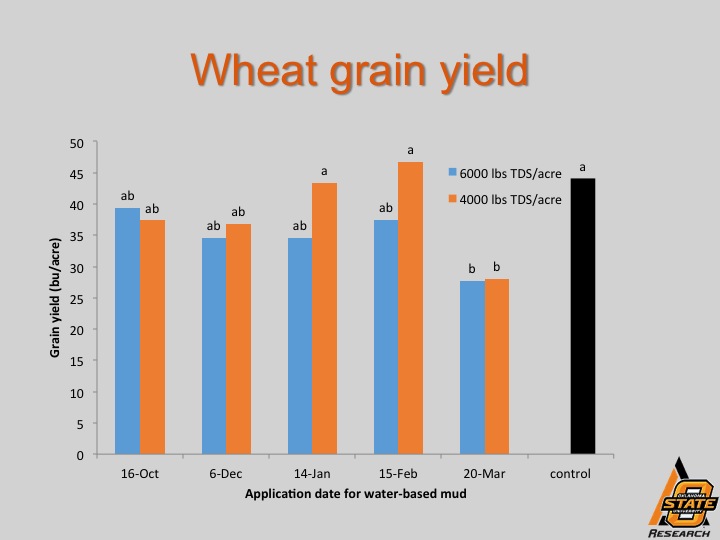
Effect of water-base mud on subsequent wheat grain yield. Source: OSU Current Report 2272

Effect of water-base mud on subsequent wheat grain yield. Source: OSU Current Report 2272

This blog entry is a summarization of OSU Current Report 2272 Application of water-base drilling mud to winter wheat: impact of application timing on yield and soil properties. You can view the entire document at http://www.wheat.okstate.edu under Wheat Management then Fertility. Dr. Chad Penn (chad.penn@okstate.edu) and Dr. Jason Warren (jason.warren@okstate.edu) are authors of the publication.
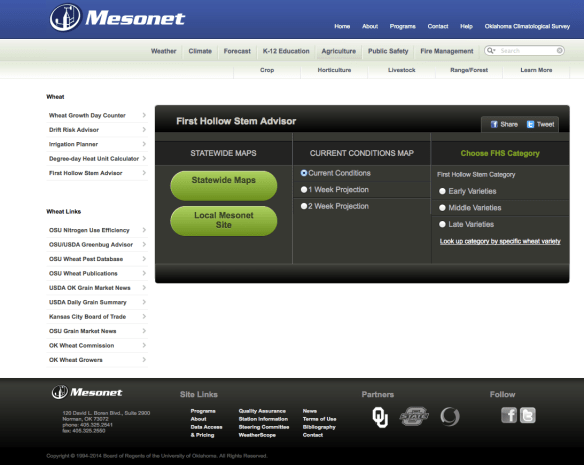
First hollow stem advisor available on Mesonet

First hollow stem occurs just prior to jointing and is the optimal time to remove cattle from wheat pasture. A new first hollow stem advisor tool available on the Oklahoma Mesonet provides Oklahoma wheat farmers a real time assessment of the current first hollow stem situation in the state and a forecast for the next two weeks. While the first hollow stem advisor is a valuable tool, it is not a substitute for scouting, as conditions in your field may vary from the estimates provided.

The advisor uses a mathematical model that predicts the probability of first hollow stem based on soil heat units and wheat first hollow stem category (early, middle, or late). The model was developed by J.D. Carlson at OSU using first hollow stem data from the wheat variety testing program, and model development was made possible through a grant from the Oklahoma Wheat Commission.

You can navigate to the first hollow stem advisor from www.mesonet.org by clicking on “Agriculture” then “Crop-Wheat”  and looking for First Hollow Stem Advisor on the lefthand menubar. Or you can click here.  

Screen Shot 2014-02-14 at 1.01.50 PM

Once you are at the first hollow stem advisor page, you will need to make a few selections. First, you have an option of viewing a statewide map or you can view data for a particular site in a table or graph. Next, you can select whether you want to view the current situation or a projection for the next one or two weeks. Finally, you will need to indicate if your variety falls into the early, middle, or late category. Click on the “look up by category” link if you are unsure where your variety falls.

hollowstem_early.current

Above is the statewide map for current conditions as of 14 February 2014. Other than a hot spot near Ardmore, there is less than 5% probability that we are at first hollow stem in Oklahoma. Note, however, that many locations are near the 576 heat unit threshold for 5% probability of first hollow stem. This is where the projection tools come in handy.

hollowstem_early.proj14day

The map above is the two-week first hollow stem projection through 28 February 2014 (i.e the map was created on 14 February 2014). These projections are based on historical weather data for the next two weeks, and do not take into account the current forecast which might be warmer or colder than the historical average. Note that almost the entire state up to I-40 is predicted be at or above the 25% probability level for first hollow stem by February 28. It is recommended that you start scouting once the advisor predicts a 5% probability of first hollow stem in your area. If you are going by the first hollow stem advisor alone (not recommended) cattle should be removed no later than when a 50% probability of first hollow stem has occurred.

First hollow stem nearing

First hollow stem occurs just prior to jointing and is the optimal time to remove cattle from wheat pasture. Given the warm forecast for the next two weeks, it is likely that we will start seeing first hollow stem in Oklahoma wheat fields. Grazing past first hollow stem can reduce wheat grain yield by as much as 5% per day and the added cattle gains are not enough to offset the value of the reduced wheat yield.

Similar to previous years, we will monitor occurrence of first hollow stem in our wheat plots at Stillwater and report the findings on this blog. There is also a new first hollow stem advisor available on the Oklahoma Mesonet that can assist in determining when to start scouting.

Checking for first hollow stem is fairly easy.

  • You must check first hollow stem in a nongrazed area of the same variety and planting date. Variety can affect date of first hollow stem by as much as three weeks and planting date can affect it even more.
  • Dig or pull up a few plants and split the largest tiller longitudinally (lengthways) and measure the amount of hollow stem present below the developing grain head. You must dig plants because at this stage the developing grain head may still be below the soil surface.
  • If there is 1.5 cm of hollow stem present (see picture below), it is time to remove cattle. 1.5 cm is about the same as the diameter of a dime.
  • Detailed information on first hollow stem can be found at www.wheat.okstate.edu under ‘wheat management’ then ‘grazing’
  • Image