Unknown's avatar

About Amanda De Oliveira Silva

I have served as an Assistant Professor and Small Grains Extension Specialist at Oklahoma State University since August 2019. I believe that close interaction with producers is vital to understand their production strategies and to establish realistic research goals. My program focuses on developing science-based information to improve the agronomic and economic viability of small grains production in Oklahoma and in the Southern Great Plains.

Sensing the N-Rich Strip and Using the SBNRC

osunpk's avatarDown and Dirty with NPK

With the significant swing in temperature over the last few weeks many are chomping at the bit to get outside.  The wheat is starting to respond to the good weather and N-Rich Strips are showing up around the state.  Over the past week I have had several calls concerning the impact of the cold weather on the N-Rich Strips.  Many of the fields either are still small due to limited days of warm weather and growth or may have a good deal of damage to the foliage.  If the field of concern has only a little or no damage and the strip is visible, the time to go is NOW, but if you cannot see the strip and your field has tissue damage or is small, similar to the first two images, then you will need to wait a week or two for sensor based recommendations.  Another situation fits…

View original post 466 more words

Plant growth regulators for wheat

Many Oklahoma wheat farmers battled lodged wheat in 2013 and are looking to plant growth regulators to help reduce lodging in 2014. Lodging occurs due to a variety of factors, and as shown in the figure below, the timing of lodging will determine the final impact on grain yield. Lodging at head emergence can cause as little as 30 or as much as 80% yield reduction. The numbers in the figure do not account for harvest losses, which can exceed losses associated with lower photosynthetic capacity shown in the figure.

Slide05

Freeze injury or disease can cause lodging due to stem failure, which is characterized by plant stems breaking near the base. I the absence of weakened stems due to freeze or disease, most lodging in wheat is caused by failure of the root anchorage system (root lodging). Root lodging occurs when the anchorage system of a top-heavy wheat plant is weakened due to moist soil and wind provides sufficient force to overcome the rotational stiffness of the root/soil complex. Research has shown that increasing the soil water content from 17 to 26% reduced the force required for anchorage failure by 33%, and as little as 0.25 inches of water plus 11 mph winds were enough to cause lodging. The thicker the wheat crop and/or the taller the wheat crop, the more force that winds exert on the root anchorage system and the greater the likelihood of lodging.
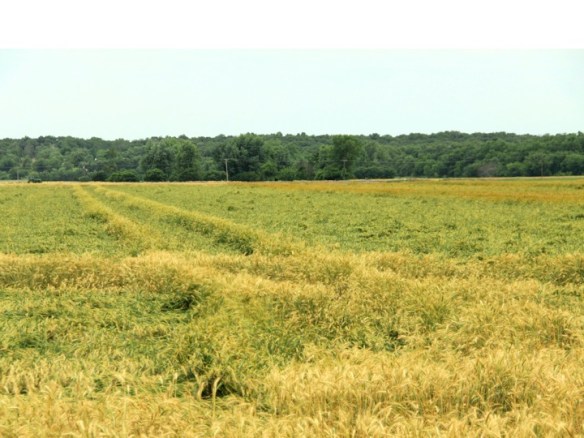
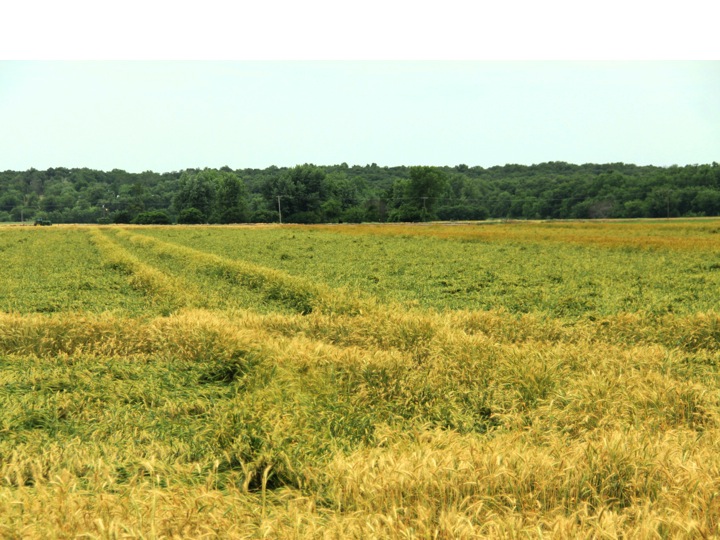
Severe lodging in an Oklahoma wheat field in 2013

In 2013 we evaluated the plant growth regulator trinexapac-ethyl, which is sold under the trade name Palisade®. Palisade is a giberellic acid inhibitor and works primarily by reducing plant height. In our study we evaluated 12 oz/ac of Palisade with and without 4 oz/ac of Tilt (propiconazole) applied at Feekes GS 7 (two nodes visible above the soil surface). We included an untreated check and ALL plots, including the check, received 10.5 oz/ac of Quilt Xcel at Feekes GS 10.5 (heading). We conducted the trial at Stillwater (Irr), Perkins (Irr), and Chickasha (Non-Irr).
Slide11

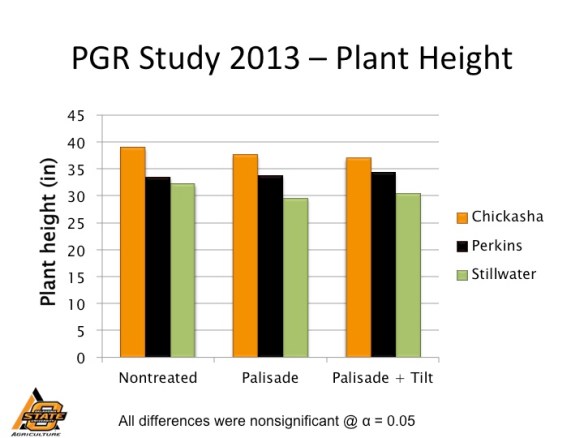
While application of Palisade resulted in numeric reductions in plant height at Chickasha and Stillwater, differences among treatments were not statistically significant.
Slide14

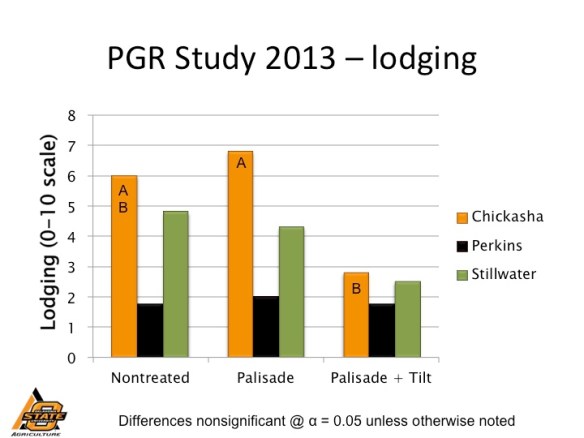
We rated plots for lodging at harvest using a 1 – 10 scale with 0 equaling no lodging and 10 equaling complete lodging.  Application of Palisade plus Tilt reduced lodging over Palisade alone at Chickasha. Application of Palidsade or Palisade plus Tilt resulted in numeric reductions in lodging scores at Stillwater, but the result were too variable to result in statistical significance. Palisade did not affect lodging at Perkins.
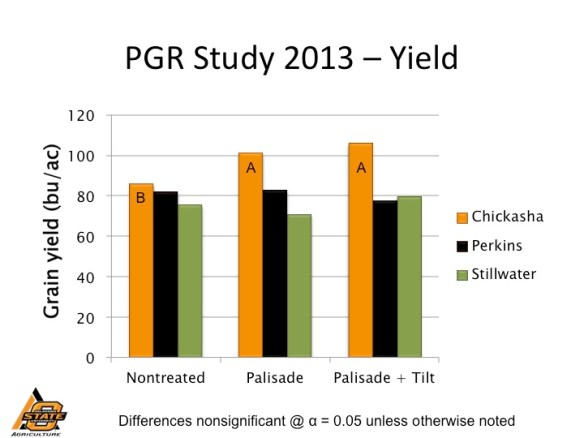
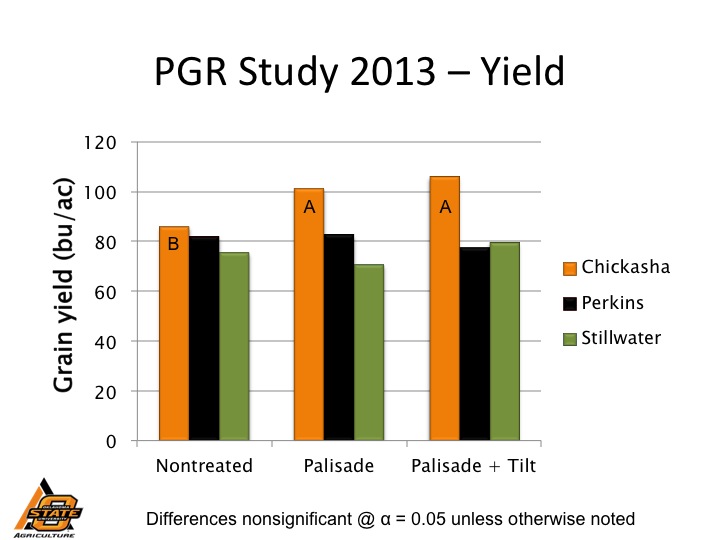
Slide18Application of Palisade or Palisade plus Tilt increased grain yield at Chickasha and had no effect on grain yield at Stillwater or Perkins. It is interesting to note that the Palisade treatment increased grain yield at Perkins even though the plots lodged at comparable levels as the non treated check. My best hypothesis is that the treated plots lodged later than the non treated plots, as all plots were standing at anthesis (see picture below).Lodging occurred at Chickasha, but occurred later in the season.

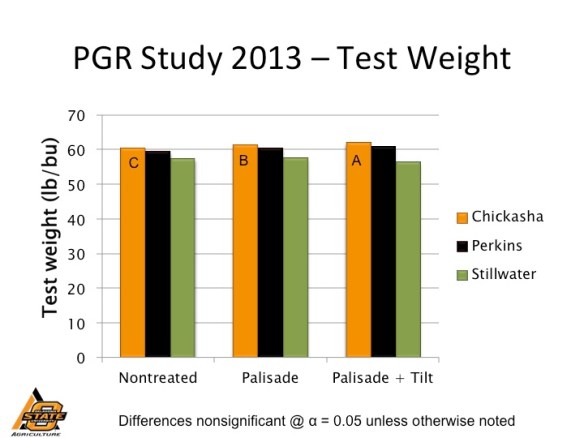
Slide19Palisade and Palisade plus Tilt increased test weight at Chickasha and had no effect on test weight at Perkins or Stillwater

To summarize this first year of work with plant growth regulators, we found a trend for one to two inch reductions in plant height when Palisade or Palisade plus Tilt were applied, but this only translated to increased grain yield at one site. Our results are consistent with other wheat plant growth regulator research, which has reported similar variation in response among sites and years.  The literature also shows that reduction in lodging is relative to the straw strength of the variety. That is, a plant growth regulator will not make a lodging prone variety stand like one with excellent straw strength, rather they will make it less prone to lodging relative to the same variety non treated.

Based on current evidence, plant growth regulators in Oklahoma are best kept on acres with high (> 80 bu/ac) yield potential that may have greater propensity for lodging due to variety or fertility.  If these high yield potential acres are being sprayed with a growth regulator at GS 7, the addition of a foliar fungicide might be prudent if it can be included at a relatively low cost. This early-season fungicide application will not, however, substitute for a fungicide application at flag leaf.

Full disclosure: Syngenta donated the product for this trial, but the only funding for the research was provided by the Oklahoma Agricultural Experiment Station and the Oklahoma Cooperative Extension Service. We are conducting the same trial in 2014 along with a separate trial evaluating Palisade in drought stress environments that is partially funded by Syngenta. The analysis and recommendations made in this blog post are preliminary and based on research findings from 2013. Recommendations may change as further research is conducted and new information is obtained.

Water-based drilling mud and wheat

The recent increase in oil and gas exploration has resulted in the production of more water-base mud, (WBM), a by-product from the drilling process. The most common method of disposal for this material is land application to agricultural and grazing lands. As the name implies, water is the most common component of water base mud, but water-base mud also contains dissolved solids and sodium and a small amount on non-dissolved solids. Therefore the primary risk associated with over application of water-base mud is the soil becoming saline or sodic.

Water-base mud is mostly water, but also contains dissolved solids that, without agitation, will settle out of solution over time.

Water-base mud is mostly water, but also contains dissolved solids that, without agitation, will settle out of solution over time.

Soil salinity can be a problem for plants. Excessive salinity (approx. > 7,800 ppm for wheat) can decrease the ability of the plant to extract water from soil, even when water is plentiful. Salts can also interfere with germination. Germination reduction due to starter fertilizers with excess nitrogen or potassium, for example, are an example of how salts can inhibit germination. The solution for excess salt is typically water in the form of rainfall, as the water will move the salts deeper into the soil and out of the rooting zone. Unfortunately, rainfall in western Oklahoma is not always plentiful enough to achieve this downward movement and salts can accumulate.

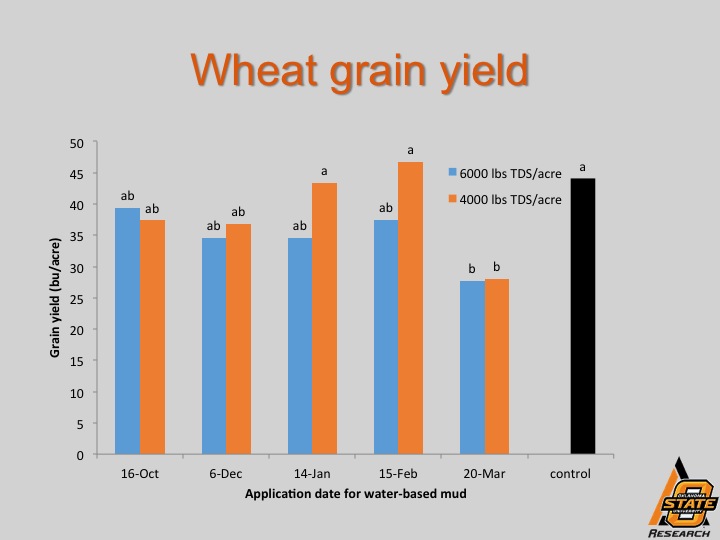
OSU researchers Dr. Chad Penn and Dr. Jason Warren initiated a study at Lahoma, Oklahoma in 2012 to determine how in-season application of water-base drilling mud affected soil salinity and wheat yield. They evaluated  4,000 and 6,000 lbs/ac of total dissolved solids (6,000 lb/ac is the maximum allowed by the Oklahoma Corporation Commission) and five different timings from 16 October to 20 March. A detailed description of their findings is available in Current Report CR2272 at www.wheat.okstate.edu. 

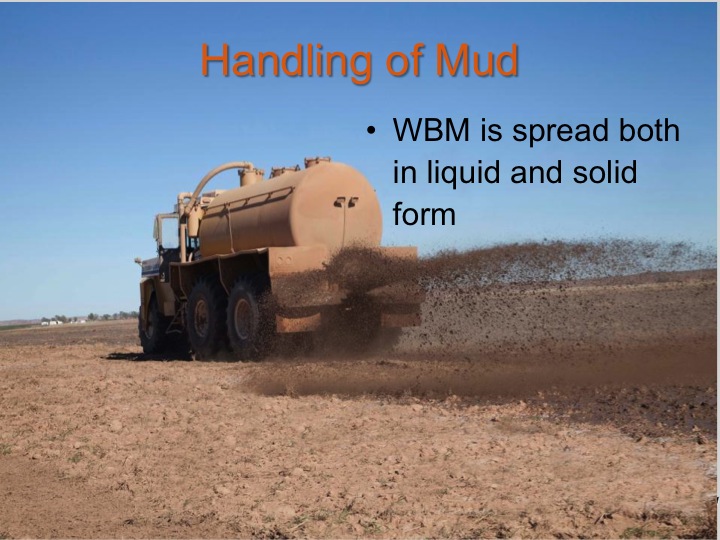
Water-base mud is spread in both liquid and solid form

Water-base mud is spread in both liquid and solid form

Drs. Penn and Warren found that the salts from the water-base mud accumulated in the top three inches of soil initially. Rainfall for the next 90 days was scarce (0.5 inches total) and the salt remained largely in the top three inches of soil. Once rainfall picked up, however, the salts started moving downward through the soil profile. As expected the 6,000 lb/ac total dissolved solids rate resulted in greater soil salinity than the 4,000 lbs/ac rate, so the less you apply per acre, the lower the chances of increasing soil salinity to toxic levels.

In this study water-base mud applied to wheat prior to approximately first hollow stem did not significantly affect wheat grain yield; however, water-base mud applied March 20 (approximately jointing) reduced wheat grain yield. Their recommendation resulting from this study was not to apply water-base mud after February 15. It is also important to consider the effects of wheel traffic and associated soil compaction from applications of water-base mud.

Effect of water-base mud on subsequent wheat grain yield. Source: OSU Current Report 2272

Effect of water-base mud on subsequent wheat grain yield. Source: OSU Current Report 2272

This blog entry is a summarization of OSU Current Report 2272 Application of water-base drilling mud to winter wheat: impact of application timing on yield and soil properties. You can view the entire document at http://www.wheat.okstate.edu under Wheat Management then Fertility. Dr. Chad Penn (chad.penn@okstate.edu) and Dr. Jason Warren (jason.warren@okstate.edu) are authors of the publication.

First hollow stem advisor available on Mesonet

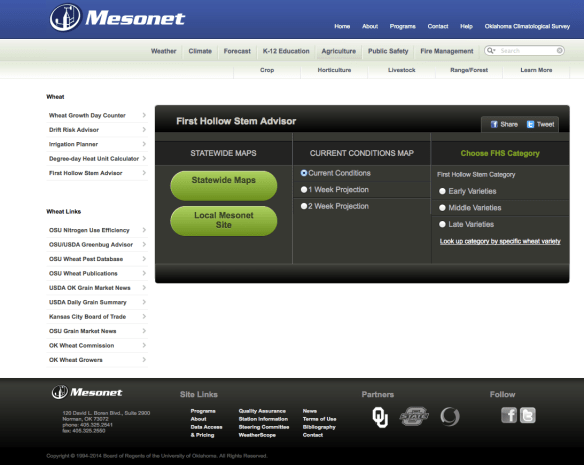
First hollow stem occurs just prior to jointing and is the optimal time to remove cattle from wheat pasture. A new first hollow stem advisor tool available on the Oklahoma Mesonet provides Oklahoma wheat farmers a real time assessment of the current first hollow stem situation in the state and a forecast for the next two weeks. While the first hollow stem advisor is a valuable tool, it is not a substitute for scouting, as conditions in your field may vary from the estimates provided.

The advisor uses a mathematical model that predicts the probability of first hollow stem based on soil heat units and wheat first hollow stem category (early, middle, or late). The model was developed by J.D. Carlson at OSU using first hollow stem data from the wheat variety testing program, and model development was made possible through a grant from the Oklahoma Wheat Commission.

You can navigate to the first hollow stem advisor from www.mesonet.org by clicking on “Agriculture” then “Crop-Wheat”  and looking for First Hollow Stem Advisor on the lefthand menubar. Or you can click here.  

Screen Shot 2014-02-14 at 1.01.50 PM

Once you are at the first hollow stem advisor page, you will need to make a few selections. First, you have an option of viewing a statewide map or you can view data for a particular site in a table or graph. Next, you can select whether you want to view the current situation or a projection for the next one or two weeks. Finally, you will need to indicate if your variety falls into the early, middle, or late category. Click on the “look up by category” link if you are unsure where your variety falls.

hollowstem_early.current

Above is the statewide map for current conditions as of 14 February 2014. Other than a hot spot near Ardmore, there is less than 5% probability that we are at first hollow stem in Oklahoma. Note, however, that many locations are near the 576 heat unit threshold for 5% probability of first hollow stem. This is where the projection tools come in handy.

hollowstem_early.proj14day

The map above is the two-week first hollow stem projection through 28 February 2014 (i.e the map was created on 14 February 2014). These projections are based on historical weather data for the next two weeks, and do not take into account the current forecast which might be warmer or colder than the historical average. Note that almost the entire state up to I-40 is predicted be at or above the 25% probability level for first hollow stem by February 28. It is recommended that you start scouting once the advisor predicts a 5% probability of first hollow stem in your area. If you are going by the first hollow stem advisor alone (not recommended) cattle should be removed no later than when a 50% probability of first hollow stem has occurred.

First hollow stem nearing

First hollow stem occurs just prior to jointing and is the optimal time to remove cattle from wheat pasture. Given the warm forecast for the next two weeks, it is likely that we will start seeing first hollow stem in Oklahoma wheat fields. Grazing past first hollow stem can reduce wheat grain yield by as much as 5% per day and the added cattle gains are not enough to offset the value of the reduced wheat yield.

Similar to previous years, we will monitor occurrence of first hollow stem in our wheat plots at Stillwater and report the findings on this blog. There is also a new first hollow stem advisor available on the Oklahoma Mesonet that can assist in determining when to start scouting.

Checking for first hollow stem is fairly easy.

  • You must check first hollow stem in a nongrazed area of the same variety and planting date. Variety can affect date of first hollow stem by as much as three weeks and planting date can affect it even more.
  • Dig or pull up a few plants and split the largest tiller longitudinally (lengthways) and measure the amount of hollow stem present below the developing grain head. You must dig plants because at this stage the developing grain head may still be below the soil surface.
  • If there is 1.5 cm of hollow stem present (see picture below), it is time to remove cattle. 1.5 cm is about the same as the diameter of a dime.
  • Detailed information on first hollow stem can be found at www.wheat.okstate.edu under ‘wheat management’ then ‘grazing’
  • Image

Time to start topdressing wheat

There are few crop inputs that deliver as much return on investment as nitrogen fertilizer. It takes approximately two pounds of nitrogen, costing approximately $1.00, to produce one bushel of grain worth about $6.00. Of course, nitrogen is not the only yield determining factor in a wheat crop. Also, the law of diminishing marginal returns eventually kicks in, but nitrogen fertilizer is still one of the safest bets in the house.

Top dress nitrogen fertilizer is especially important because it is applied and utilized at a time when the plant is transitioning from vegetative to reproductive growth. Several things, including the number of potential grain sites, are determined just prior to jointing and it is imperative that the plant has the fuel it needs to complete these tasks. Jointing also marks the beginning of rapid nitrogen uptake by the plant which is used to build new leaves, stem, and the developing grain head. The nitrogen stored in these plant parts will be used to fill the grain later in the season, and the plant is dependent on this stored nitrogen to complete grain fill.

In the bullet points below, I will hit the major points regarding top dress nitrogen for wheat.  I have also posted three slide presentations with audio regarding topdressing wheat at my YouTube channel available by clicking here or by searching YouTube for OSU Small Grains. 

When to apply

  • In order to have full benefit, nitrogen must be in the rooting zone by the time wheat is jointing. Jointing occurs around the end of February in southern OK and around the second week of March in northern OK.
  • Moisture is required to move nitrogen into the rooting zone. Since precipitation is usually very limited in January and February in Oklahoma we need the nitrogen out on the field when the precipitation arrives. This, along with the fact that we have 5.5 million acres to cover, means that we need to get started in January to get everything taken care of in a timely fashion.
  • If you are using the Sensor Based Nitrogen Recommendation system your yield predictions and nitrogen recommendations generally become more accurate as the season progresses; however, growers wishing to hedge their nitrogen bet could apply a partial top dress in January or early February and supplement with a second top dress just prior to jointing if SBNR recommendations call for additional nitrogen.
  • Do not apply nitrogen to frozen ground. Nitrogen will move with water. If melting snow or frozen rain is moving to the ditch, so will nitrogen applied to the soil surface.
  • Consider splitting or delaying top dress nitrogen applications to sandy soils until closer to jointing, as leaching can occur.

How much to apply

  • On average it takes about 2 lbs/ac of N for every bushel of wheat yield. In addition, dual-purpose wheat requires 30 lbs/ac of N for every 100 lbs/ac of beef removed. You can subtract your soil test NO3-N from these total requirements.
  • It is okay to adjust topdress N plans based on your current yield potential. When you submitted your soil test, you might have stated a 50 bu/ac yield goal which would require 100 lbs/ac of nitrogen; however, it is important to take a hard look and determine if this yield goal is still realistic based on your current crop status. I am not suggesting to adjust based on what you think the weather might do, but it is okay to take inventory and adjust your topdress N up or down based on current field conditions.
  • Don’t have an N-rich strip? It would be a lot cooler if you did. An N-rich strip would take the guess work out of adjusting your topdress N up or down based on your current crop conditions. Your county extension educator can provide more information on N-rich strips and you can find more information on the web at www.npk.okstate.edu

What source to use

  • The plant does not care about nitrogen source. A pound of nitrogen is a pound of nitrogen. Focus on getting the correct amount applied at the correct time, and choose your product based on price and application uniformity.
  • Use a source that can be applied uniformly. In my experience, spinner trucks or buggies are generally the least uniform. Air trucks or streamers are the most uniform.
  • Streamer nozzles almost eliminate leaf burn from UAN; however, leaf burn is generally not an issue until temperatures warm and/or you are applying fairly large amounts of UAN. Stream nozzles are also not affected much by wind and deliver a uniform pattern in a variety of conditions. There are also some studies that indicate banding of UAN through the use of stream nozzles will reduce nitrogen immobilization on crop residue. All in all, I am a big fan of streamer nozzles. You cannot, however, tank mix herbicides when using streamer nozzles.
    Streamer nozzles provide uniform application of UAN in a wide variety of environmental conditions.

    Streamer nozzles provide uniform application of UAN in a wide variety of environmental conditions.

    Poor nitrogen application can result in a streaked field. Some of the areas in this field were over fertilized while some were under fertilized resulting in wasted nitrogen and less than optimal crop yield.

    Poor nitrogen application can result in a streaked field. Some of the areas in this field were over fertilized while some were under fertilized resulting in wasted nitrogen and less than optimal crop yield.

Freeze injury

Freeze injured plants from Cotton County, OK. Note the green, healthy leaf coming through the desiccated leaves in the plant on the right

Freeze injured plants from Cotton County, OK. Note the green, healthy leaf coming through the desiccated leaves in the plant on the right. These plants will make a full recovery with adequate moist and fertility.

Our recent extreme shifts in temperature have resulted in moderate to severe freeze injury in some Oklahoma wheat fields. To be honest, the damage is not as widespread or severe as I thought it would be given that most of our wheat had not had an opportunity to harden off. The dry soil conditions in western and southern Oklahoma did not help the situation, as there was not sufficient soil moisture to buffer the temperature shift in the top few inches of soil.

Freeze injury at this stage of growth (tillering) rarely impacts grain yield, but, as always, there are a few exceptions. Wheat that was very small or late-sown is more susceptible to winter kill. Similarly, wheat that does not have a good root system or that was shallow sown due to crop residue is more susceptible to winter kill. It is best to wait until after a few days of favorable growing conditions to check for freeze injury. Plants with regrowth that is green and healthy should make a full recovery, and this will be the case for most Oklahoma wheat fields.

Freeze injury in late-sown wheat near Enid, OK. Some of the smaller plants might have a tough time recovering, but given favorable conditions, the wheat stand as a whole still has adequate time to "fill in" and compensate for some of the lost plants.

Freeze injury in late-sown wheat near Enid, OK. Some of the smaller plants might have a tough time recovering, but it is still too early to determine whether or not the field as a whole will adequate to produce a decent grain crop.

Winter grain mites in SW OK

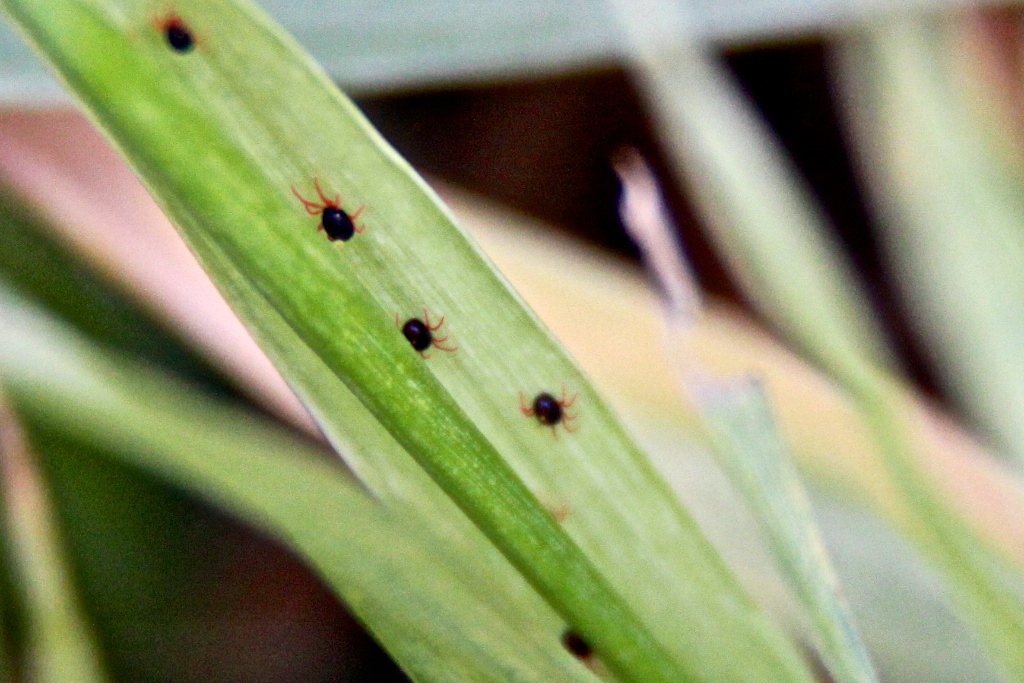
Over the past week, I have received a few reports of winter grain mite activity in southwest Oklahoma. Winter grain mites are small (about 1 mm long) with black bodies and orange-red legs. Winter grain mites complete two generations per year and the adults can live for up to 40 days. The generation we are dealing with now resulted from oversummering eggs laid last spring. The second generation peaks in March/April and results from eggs laid in January/February.

Scouting
Winter grain mites are light sensitive and prefer calm air to windy conditions; therefore, scouting early in the morning, late in the evening, or on cloudy days generally works best. Be sure to look under residue in no-till fields and under clumps of soil in conventional-till fields.

Image

Winter grain mites on wheat near Blair, Oklahoma.

Injury
Winter grain mites feed by piercing plant cells in the leaf, which results in “stippling”.  As injury continues, the leaves take on a characteristic grayish or silverish cast.  Winter grain mites are more likely to cause injury in wheat if it is already stressed due to lack of moisture or nutrients. Also be advised that freeze injury can easily be confused for winter grain mite injury.

When to spray
There are no established thresholds for winter grain mite. Healthy, well-fertilized wheat plants can generally outgrow injury, so it takes large numbers to justify control. If there is injury present AND large numbers of mites (~10 per plant) present in grain only wheat this time of year, you might consider control. If the wheat is to be grazed, I would simply monitor the situation in most cases and only spray if injury became severe.

What to spray
There are not a lot of pesticides with winter grain mite listed on the label, and most products have grazing restrictions. Malathion and methyl parathion have been shown to provide effective control in the past. Consult OSU Current Report 7194 Management of insect and mite pests in small grains for a more complete listing of available pesticides.

Hessian fly strikes back!

Back in 2006 it appeared that Hessian fly was going to be the demise of no-till wheat production in Oklahoma. Early planting, lack of crop rotation, and no-till monocrop wheat all create a favorable environment for Hessian fly, and there were several early-sown fields that were completely lost to the Hessian fly in 2006 & 2007. About that same time OSU release a variety named Duster that was an excellent grazing wheat with good yield potential. Duster also happened to be Hessian fly resistant. (If you are not a Star Wars fan, skip the next sentence) This resistance was a clear proton torpedo in the thermal exhaust port of the fully operational Hessian fly Death Star.

Mature Hessian fly larvae are brown in color and often referred to as flaxseed. Tillers with larvae will not recover and will eventually die and slough off.

Mature Hessian fly larvae are brown in color and often referred to as flaxseed. Tillers with larvae will not recover and will eventually die and slough off.

Over the past four years, I have received very few calls about Hessian fly. It seemed as thought the adoption of Duster and unfavorable environmental conditions resulted in a dramatic reduction in Hessian fly in Oklahoma, but there are some indications Hessian fly is making a return. I have received a few calls about Hessian fly this fall, most of them from southwest Oklahoma. In most cases producers had  either switched to a newer variety that was not Hessian fly resistant or changed to a nonresistant variety because they were displeased with Duster’s performance the past two years.

There are no curative treatments for Hessian fly in wheat. If you currently have a field that is infested with Hessian fly, the first step is to assess the level of infestation. If a plant with four viable tillers has one infected, then the impact on yield might not be that great, as we could have additional tillering in late winter. A field with the majority of tillers infected is likely a good candidate for graze out.

It is never too soon to be thinking of how to limit the impact of Hessian fly on next year’s crop. Planting a resistant variety still remains the most effective technique of combating the Hessian fly menace in Oklahoma for dual-purpose wheat farmers. To determine which varieties are resistant, consult a current OSU Wheat Variety Comparison Chart. Insecticide seed treatments are effective early in the season, but do not typically last long enough to provide season long control in Oklahoma. Cultural practices such as crop rotation and delaying planting until mid October will also help reduce Hessian fly infestations but might not be suitable for all operations.

Wheat disease update – 05 November 2013

Wheat disease updates are written by Dr. Bob Hunger, OSU Extension Plant Pathologist

Fall of 2013 has been quiet for wheat diseases with no wheat samples coming into the Diagnostic Lab.  Otherwise, the only report of a wheat disease in the state has been a report I received from Brian Vincent who indicated that Keith Castner (BASF) had observed leaf rust in late October on early planted ‘Duster’ near El Reno, OK.  This finding is not surprising as leaf rust often is observed in Oklahoma in the fall.

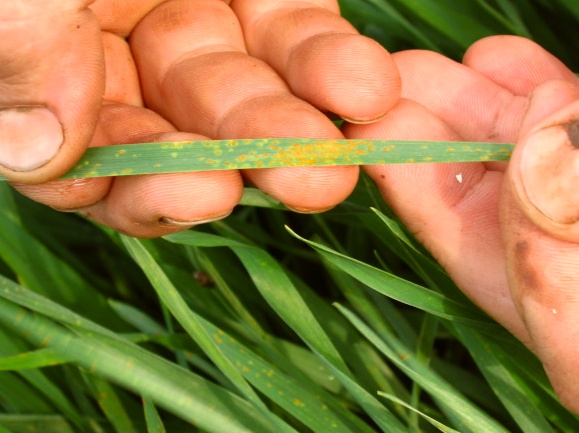
Fall leaf rust rarely warrants fungicide application. Cold weather and/or grazing help remove the rust pustules. Fall infestations should be monitored, however, and control measures might be considered if the problem remains after jointing in the spring.

Fall leaf rust rarely warrants fungicide application. Cold weather and/or grazing help remove the rust pustules. Fall infestations should be monitored, however, and control measures might be considered if the problem remains after jointing in the spring.

When leaf rust is observed in the fall, the value of spraying to control that rust is asked.  Fall-infected leaf rust plants typically have yellowed lower/older leaves with rust pustules, but the youngest 2 or 3 leaves are green and healthy.  As temperature drops through November and December, the older rust-infected leaves die and new infections are greatly slowed and inhibited.  Grazing also helps to remove these leaves and increase air circulation and drying that are conditions less favorable to spread of the disease.  Given these consideration, spraying to control leaf rust in the fall is of limited value.  The primary concern with fall infections of leaf rust is that with a mild winter and sufficient moisture, the rust will survive through the winter and inoculum will be present in fields to start the disease early in the spring.  Hence, monitoring of these fields through the winter and early next spring is recommended to see if application of a fungicide to control the rust is indicated in the early spring.

I called around to other extension specialists [northwestern OK/panhandle (Rick Kochenower; Area Research & Extension Specialist – Agronomy), south central OK (Mark Gregory Area Extension Agronomy Specialist), and southwestern OK (Gary Strickland; Extension Educator – Jackson County), and all indicated that no foliar or root diseases have been observed to date.

Recent updates from other states:
Kansas (Dr. Erick De Wolf, Extension Plant Pathologist, Kansas State University):  Leaf rust was found in research plots near Manhattan KS (Northeast Kansas) on Oct 25.  Dr. Bill Bockus reported leaf rust in research plots that were established approximately a month ago (about 2 weeks before the normal planting date), and have ample fall growth.  The leaf rust was observed in multiple foci or “hot spots” but was now present at low levels throughout the plots suggesting the disease has been there for more than 3 weeks.  The incidence was approximately 2-5% with severity of trace to 10% on any given leaf. The leaf rust was found on the wheat variety 1863. This variety is known to be susceptible to leaf rust. An older variety Newton was also infected.

It is not unusual to find leaf rust near Manhattan this time of year.  The winter conditions are often enough to keep the rust population from overwintering in KS, but finding the disease in the fall could be important if we have a mild winter.  It has been several years since leaf rust observed in the fall at this location. The absence of rust in these years was likely related to the drought that dominated the central plains in 2011-2012.  The drought conditions have lessened in recent months and leaf rust is returning to normal fall activity.  We will be monitoring this location and others to check for overwintering leaf rust.