Unknown's avatar

About Amanda De Oliveira Silva

I have served as an Assistant Professor and Small Grains Extension Specialist at Oklahoma State University since August 2019. I believe that close interaction with producers is vital to understand their production strategies and to establish realistic research goals. My program focuses on developing science-based information to improve the agronomic and economic viability of small grains production in Oklahoma and in the Southern Great Plains.

Oklahoma Wheat Harvest Continues in Southern Oklahoma Amidst Scattered Rains Across the State

Oklahoma Harvest Report by the Oklahoma Wheat Commission

Oklahoma Wheat harvest continues in Southern Oklahoma, as light rains have scattered across the state in several places since Monday afternoon.  Some places have received 2/100ths while others have received over 1 ½ inches depending on location. (It has been reported some places in Southwest Oklahoma might have received 1 and 3/10ths of moisture and on the other side of a town or county no rain was received at all.)  Despite the rain, several locations in Southern Oklahoma are still reporting good quality wheat on what is being taken in.  Heavier rains have brought test weights down some.   Most locations are still reporting averages to be 60 lbs. per bushel or higher.  Several locations down in South Central Oklahoma are reporting ranges still from 61-65 lbs. per bushel.

Moisture has been ranging from 11.5-13%. Yields on wheat being taken in as harvest progresses has been favorable to this point.  Most are reporting 30 to 40 bushels per acre depending on the location. (Several instances of 50 bushel wheat being reported where timely rains were received.)  Some high management intensive producers in rare instances have reported yields in the mid 70’s to low 80’s.  (Keep in mind the reporting on the yield is still mainly being reported on the region in the state that is predicted to a have the best wheat.)  Elevator managers have some concerns as harvest progresses further North that the test weight and quality will not be as favorable since we continue to receive larger amounts of moisture in these regions. Protein averages are being reported in a wide range from 10.5% to 13.5% depending on location.  Some have reported protein to be as high as 15.5% on few select fields.  Average for all areas being reported is 11.5% to 12.5%

The Oklahoma Wheat Commission is calling Oklahoma Wheat harvest 20% complete.

Eldorado- Test weights raining from 60 to 66 lbs. per bushel. Yields being reported from low 30’s to low 50’s depending on location.  Protein ranging from 10.5% to 14%.  This region is considered 60 to 65% complete with harvest.

Grandfield/Chattanooga- Test weights ranging from 61-64 lbs. per bushel. Moisture reported at 12.5%. Yields ranging mostly from 30 bushels to 50 bushels per acre. Grandfield region is 60% completed, Chattanooga region is 35% complete with harvest.

Devol- Yields reported from the low 30’s to mid 50’s.  Test weights ranging from 61-64 lbs. per bushel.  Moisture is 12.5%.  This region is 65% complete with harvest.

Frederick- Test weights in this region averaging 61 lbs. per bushel.  Yields being reported from low 20’s to mid 40’s depending on location. Protein ranging from 10.5% to 12%, with the average for this region at 10.9%.  This region is 65% complete with harvest.

Altus/Duke- Test weights ranging 59 lbs. to 62 lbs. per bushel. Early yields reported from the high 20’s to low 40’s depending on location.  Protein reported at 10.5-12.5%  This region is 20% harvested.

Hobart/Roosevelt- Early loads received last week had test weights reported at 59 lbs. to 62 lbs. per bushel. Yields ranging from the mid 20’s to low 40’s. Protein was reported at 12%-14%.  This region is 20% harvested.

Lone Wolf- Harvest is just getting started in this region.  Early test weights were not as high in the region and ranging from 57 lbs. to 61 lbs. per bushel.  No yields being reported.

Apache- This area continues to be plagued with rains and high humidity which has made harvesting difficult.  Only 3 loads have been reported taken in as of today in this region.  Test weight on the wheat was averaging 60 lbs. per bushel.  No yields or proteins have been reported.

Rocky/Sentinel- Early test cuttings took place last week but heavy rains have delayed harvest in both the Sentinel and Rocky areas this week.   Test weights on early cuttings ranged from 58 lbs. to 62 lbs. per bushel.  No yields have been reported.

Hinton- Wheat harvest has just started today in this region as producers missed rains that were received in other parts of the state last night.   Test weights averaged 61.4 lbs. per bushel on the first few loads taken in.  No yields reported.  Protein was averaging 13.4%.

Greenfield- Wheat harvest has started in this region and continues today as producers missed rains surrounding the majority of this area last night. Generally, wheat harvest starts 5 to 10 days later in this area than other parts in the central regions of Oklahoma, but that will not be the case this year. Test weights in this region so far are ranging from 60 lbs. to 61 lbs. per bushel.  No yields and proteins have been reported on early cuttings.

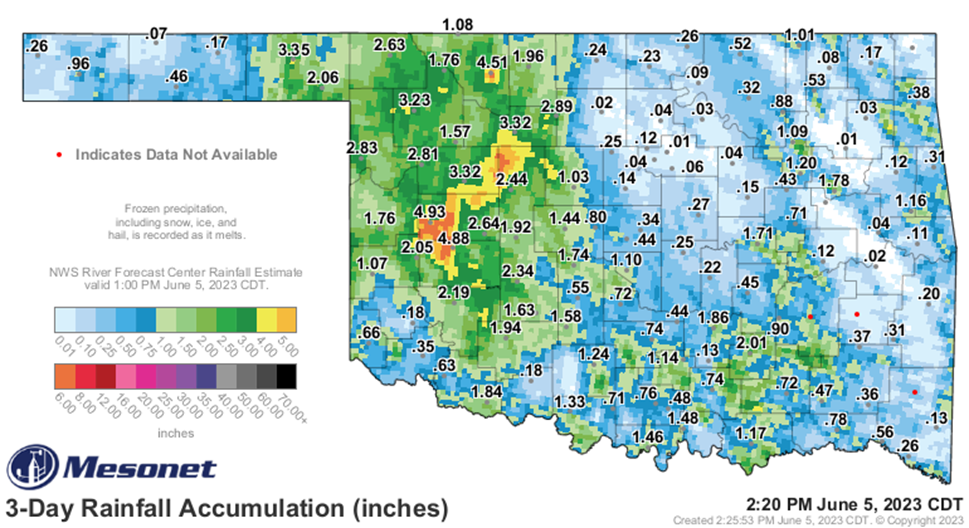
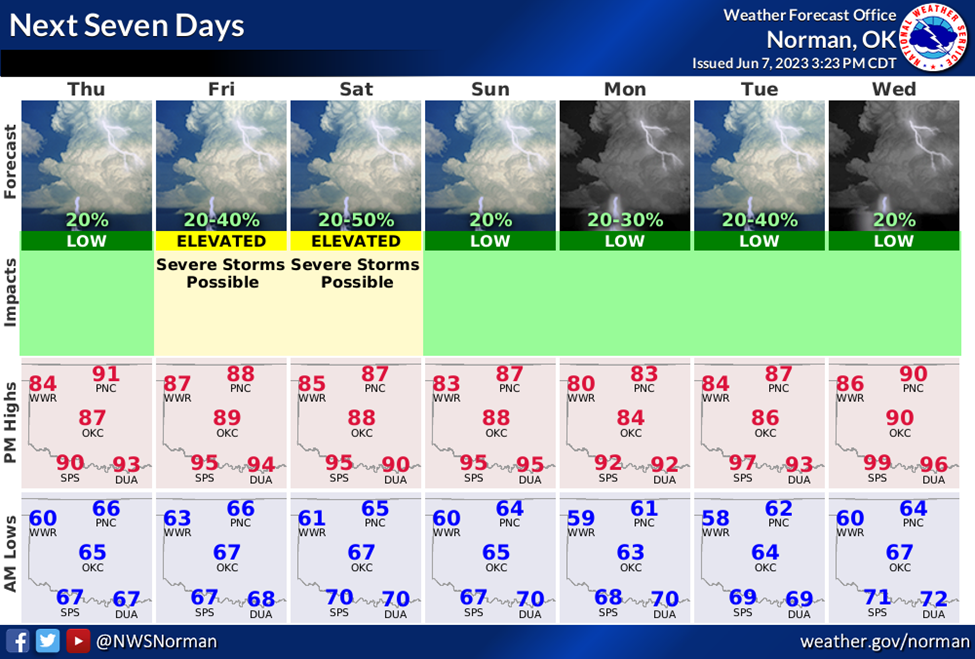
Below, see the next 7-day forecast and 3-Day Rainfall Accumulations recorded by the Oklahoma Mesonet.  The next Oklahoma Harvest Report will be published on Monday, June 12, 2023, and a regional report will be published by Plains Grain Inc. on Friday, June 9, 2023
Oklahoma Wheat Harvest Progresses in Southern Oklahoma

Oklahoma Harvest Report by the Oklahoma Wheat Commission

Oklahoma wheat harvest has moved steadily in most regions of Southern Oklahoma this past week. Rains have hindered progress in other parts of the South Central and Western regions.  The rains in Central and Northern Oklahoma this past week along with the high humidity continue to delay ripening in those places. Test weights for the most part remain favorable on what is being taken in, although some areas are reporting lower test weights where the crop has been more stressed. Several locations are reporting 60-64 lbs. per bushel. Some lower test weights are being reported in the mid to high 50’s but overall the state average is still coming in between 60-61 lbs. per bushel.

Moisture has been ranging from 12-13%, with most wheat being taken in at around 12.5%.  Early yields reported in Southern Oklahoma are ranging from the low 20’s to the mid 50’s depending on location and management practices. Some intensive management producers in rare instances have reported yields in the mid 70’s to low 80’s. (Keep in mind this is in an area that received timely moisture in the Grandfield-Devol region. This area is predicted to have the best overall crop conditions for Oklahoma this year.) Protein averages are being reported in a wide range from 10.5% to 12.5% depending on location.  Some have reported protein to be as high as 15.5% on a few select fields.

The Oklahoma Wheat Commission is calling Oklahoma wheat harvest 15% complete.

Grandfield/Chattanooga- Producers in parts of this region were rained out this weekend, but are hopeful to get back into the fields late this afternoon. Test weights ranging from 61-64 lbs. per bushel. Moisture reported at 12.5%. Yields ranging mostly from 30 bushels to 50 bushels per acre. Grandfield region is 50% completed, Chattanooga region is 20% complete with harvest.

Devol- This area has made great progress over the past week and combines continue to move.  Yields reported from the low 30’s to mid 50’s.  Test weights ranging from 61-64 lbs. per bushel.  Moisture is 12.5%.  This region is 50% complete with harvest.

Frederick- Test weights in this region averaging 61 lbs. per bushel. Yields being reported from low 20’s to mid 40’s depending on location. Protein ranging from 10.5% to 12%.  This region is 60% complete with harvest.

Tipton- This area suffered more from drought than other areas in South Central, Oklahoma. Yields are being reported from the low 20’s to low 40’s, depending on location. Test weight has been lower on some fields,  but the average for the region is 59.5 lbs. per bushel.  Moisture was reported at 12 to 12.5%.  Protein is reported at 12% to 12.5%.  This area is 65% to 70% harvested.

Altus- Harvest continued to move in this region over the weekend, some producers were delayed with light rain showers. Test weights ranging 57 lbs. to 62 lbs. per bushel. Early yields reported from the high 20’s to low 40’s, depending on location.  This region is 40% harvested.

Hobart/Gotebo-   Harvest was slowed this past week due to rains, producers are hopeful to get back into the fields late this afternoon or tomorrow.  Early loads received last week had test weights reported at 60 to 62 lbs. per bushel. Yields ranging from the mid 20’s to low 30’s. This region is 15% harvested.

Lawton-  This region has made great progress over the past week. Test weight was 60 lbs. to 62 lbs. per bushel on wheat being harvested. Yields ranging from mid 30’s to mid 50’s.  This region is 50% complete with harvest.

Rocky/Sentinel- Early test cuttings took place last week and the wheat is ready to be harvested at Sentinel but heavy rains have delayed harvest in both the Sentinel and Rocky areas this week. Test weights on early cuttings ranged from 58 lbs. to 62 lbs. per bushel.  No yields have been reported.  This area is 5% complete with harvest.

Apache- No wheat has been taken in at the location as of today. Test cuttings took place late last week, with a sample close to 13.5%.  Heavy rains over the weekend hindered producers from getting started in this region.  West of town received 2 inches and other areas East of town received ¼ inch of rain.

Below, see the next 7-day forecast and 3-Day Rainfall Accumulations recorded by the Oklahoma Mesonet.  The next Oklahoma Harvest Report will be published on Wednesday, June 7, 2023, and a regional report will be published by Plains Grain Inc. on Friday, June 9, 2023

The 2023 Oklahoma Wheat Harvest Begins

Oklahoma Harvest Report by the Oklahoma Wheat Commission

Oklahoma Wheat Harvest had test cuttings with small deliveries last Thursday evening in Eldorado, OK. Rains over the Memorial Day weekend delayed producers from getting into the fields, but machines started moving across the Southern border of Oklahoma in many locations on Monday and Tuesday this week. Light rains and high humidity in parts of Southwest Oklahoma will make a slow start today, but producers are hopeful to get rolling in these locations by late this afternoon. All locations being reported this afternoon are reporting favorable test weights in all locations with ranges from 60-64 lbs. per bushel. Several locations are reporting 62-64 lbs. per bushel.
Moisture has been ranging from 12-13.5%, with most wheat being taken in at around 12.5%. Early yields being reported in Southern Oklahoma are ranging from the mid 20’s to low 40’s depending on location and management practices. Some high management intensive producers have reported a couple locations to be making in the mid 40’s with one report coming in at 55 bushels per acre. Most yields being reported are ranging from the low 30’s to low 40’s in Southern and South Central Oklahoma. Those regions are predicted to have the best overall crop conditions for Oklahoma this year. Protein has not been reported on most early samples throughout the region, although some locations have reported proteins ranging from 12.5% to as high as 15%.

Eldorado– Test weights on early wheat ranging from 60 to 63 lbs. per bushel. No yields reported on early cuttings.
Grandfield/Devol/Chattanooga– Test weights ranging from 62-64 lbs. per bushel. Moisture reported at 12.5% to 13%. Yields ranging mostly from 30 bushels to 40 bushels per acre.
Frederick– Test weights on early cuttings ranging mainly from 60 to 62 lbs. per bushel. Moisture was reported at 12.5% to 12.7% Yields ranging from the low 30’s to low 40’s on the wheat being harvested.
Tipton– This area suffered more from drought than other areas in South Central, Oklahoma. Yields are being reported from the low 20’s to low 30’s depending on location. Test weight has been lower on some fields, but the average for the region is 60 lbs. per bushel. Moisture was ranging from 12.5% to 13%.
Altus/Duke– Harvest has started in this area with great movement yesterday afternoon. Light rains and high humidity will make the start slower this afternoon. Test weights ranging from 60 lbs. to 62 lbs. per bushel. Early yields reported from the high 20’s to low 40’s.
Hobart/Gotebo– A couple loads have just been received in these locations. Test weights reported at 60 to 62 lbs. per bushel. Yields ranging from the mid 20’s to low 30’s. Early reports indicate this area has struggled harder with drought conditions.
Lawton– A couple loads have been taken in at Lawton. Test weight was 62 lbs. per bushel, no yields reported. Moisture was 13.5%.
Rocky/Sentinel– Samples have been received at these locations but nothing has been cut, producers were hoping to start late this afternoon or tomorrow.


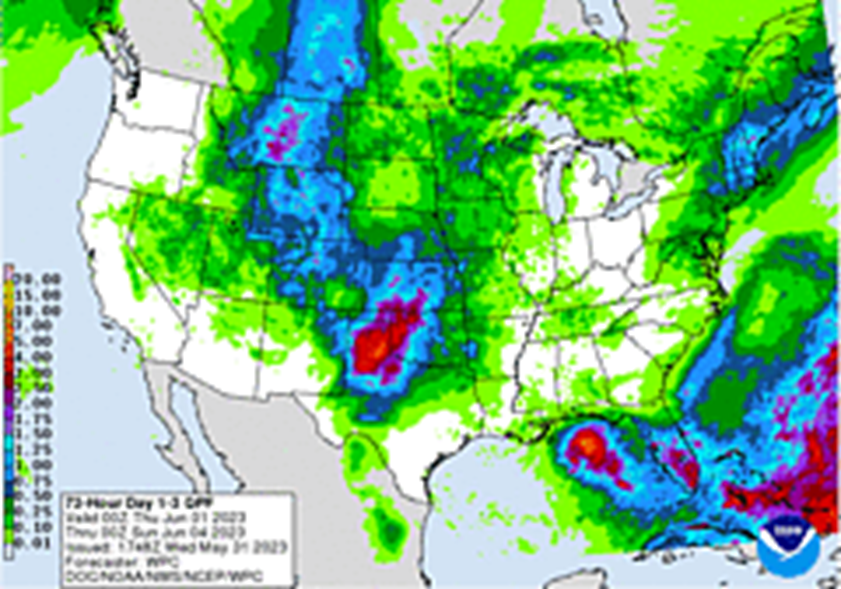
Below, see the next 1-3 day rain prediction forecast models provided by the Oklahoma Mesonet. The next Oklahoma Harvest Report will be published on Monday, June 5, 2023, and a regional report will be published by Plains Grain Inc. on Friday, June 2, 2023

2023 OSU Wheat Variety Testing Plot Tours and Wheat Status

Hello everyone, find below the complete schedule for the 2023 OSU Wheat Variety Trials plot tours and Field Days. We look forward to seeing you all there!

Note that times are subject to change due to environmental conditions. Please call your County Extension Office to confirm the date, time, and location.

Notes:
Abbreviations: DP = Dual-purpose, GO = Grain-only, IM =Intensive management, SM = Standard management
1 Meet at the Extension office
2 Meet at the plot, 1 mile north of Bill’s Corner on the east side of Hwy 177 at Knobhill.
3 Meet at fairgrounds for lunch, plot tour south of town afterwards
4 Meet at plot ¾ mile west of HWY 54 on Arapaho Road
5 Lunch at Wheeler Brothers, plot tour north of elevator afterwards
6 Meet at Ledbetter’s farm @ 9:30, field tour @ 10, lunch @ 12
7 Lunch at Wheeler Brothers, plot tour north of town afterwards
8 Meal at Brook Strader’s farm, plot tour afterwards

The plot maps for each location can be found on our website click here

Below are pictures from some of the variety trial locations from the end of March to early April. Wheat needs rain badly.

You can watch my latest interview with SUNUP TV on the following link: How is Drought Impacting the Wheat Crop?

Balko wheat variety trial on March 28, 2023. Photo: Tyler Lynch.
Hooker wheat variety trial on March 28, 2023. Photo: Tyler Lynch.
Alva wheat variety trial on April 6, 2023. Photo: Tyler Lynch.
Cherokee wheat variety trial on April 6, 2023. Photo: Tyler Lynch.
El Reno wheat variety dual-purpose trial on April 5, 2023. Photo: Tyler Lynch.

First Hollow Stem Update – 3/20/2023

Amanda de Oliveira Silva, Small Grains Extension Specialist

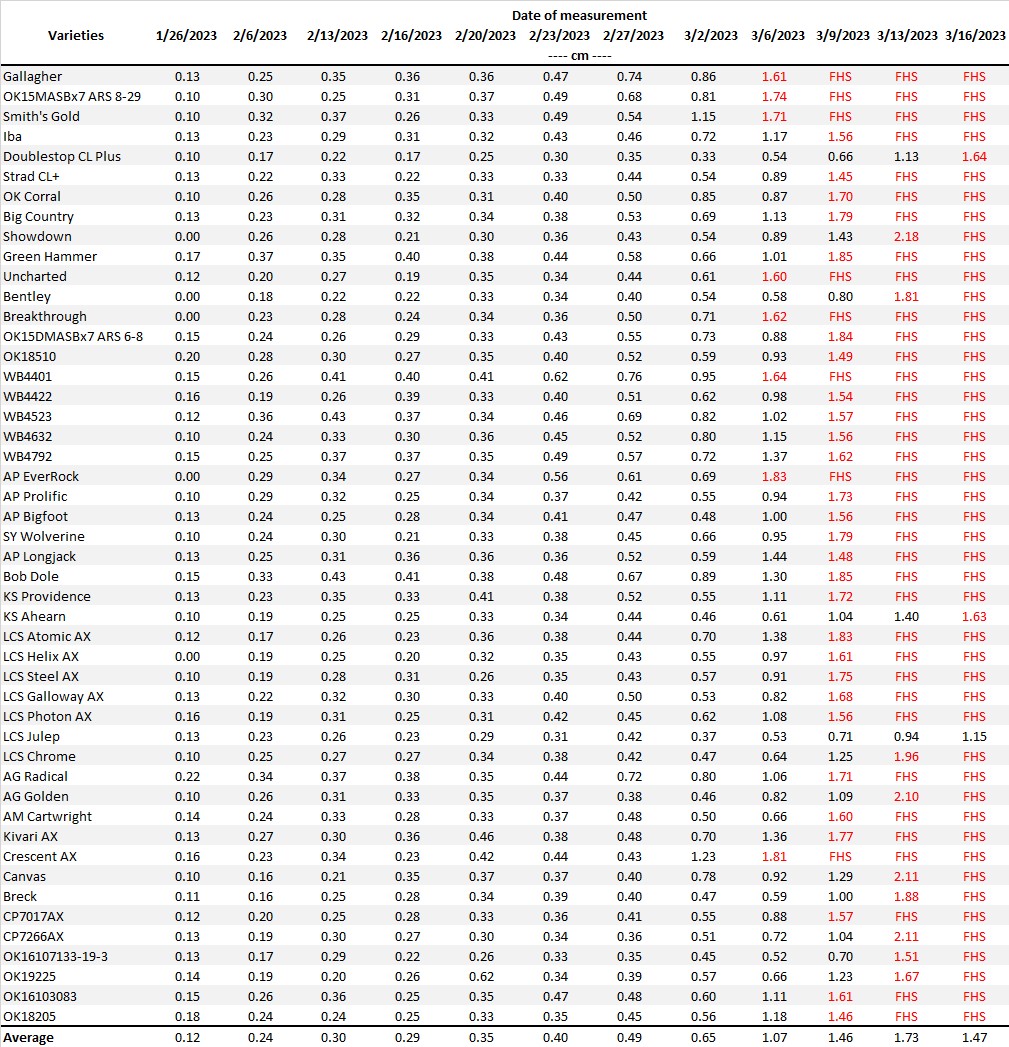
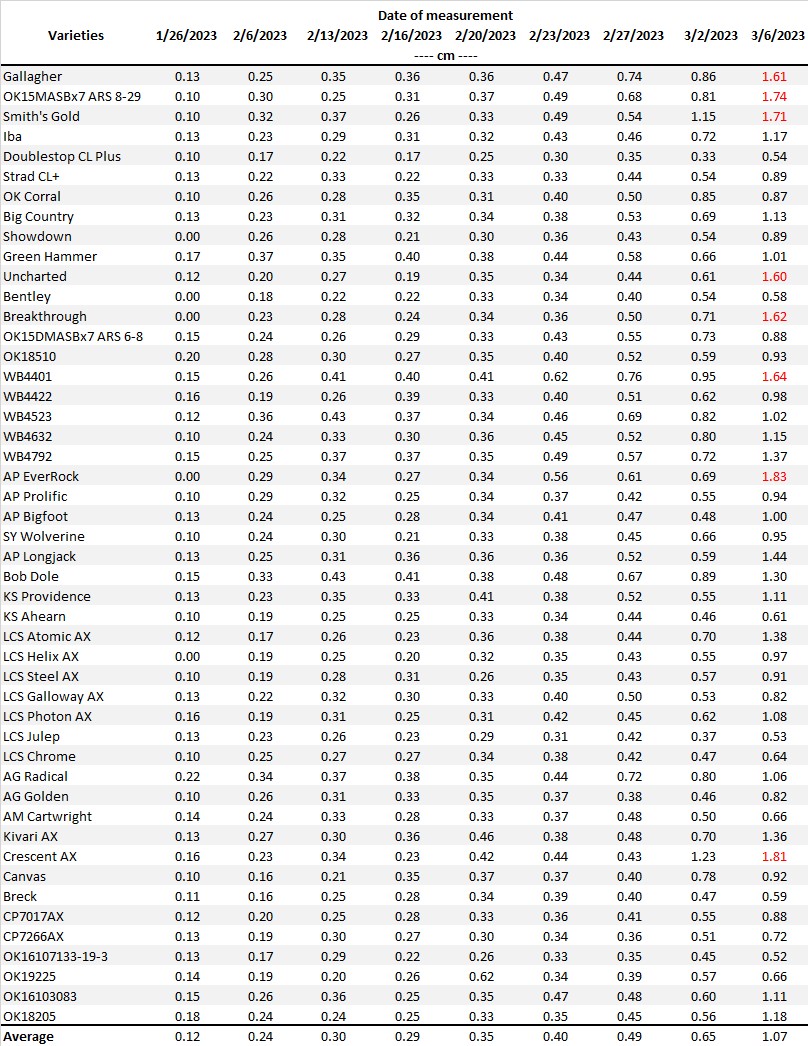
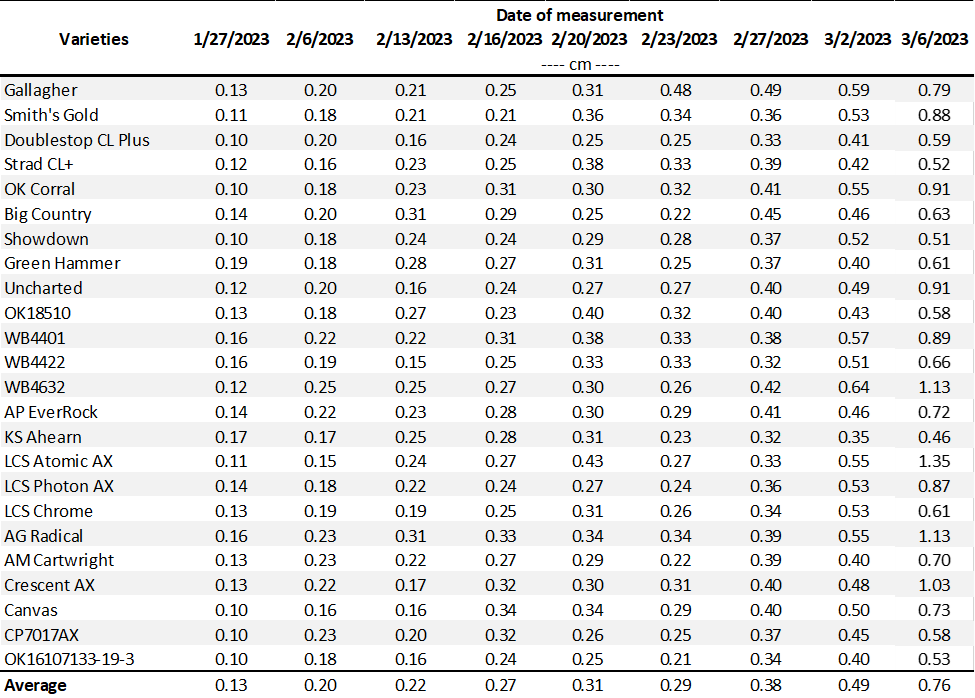
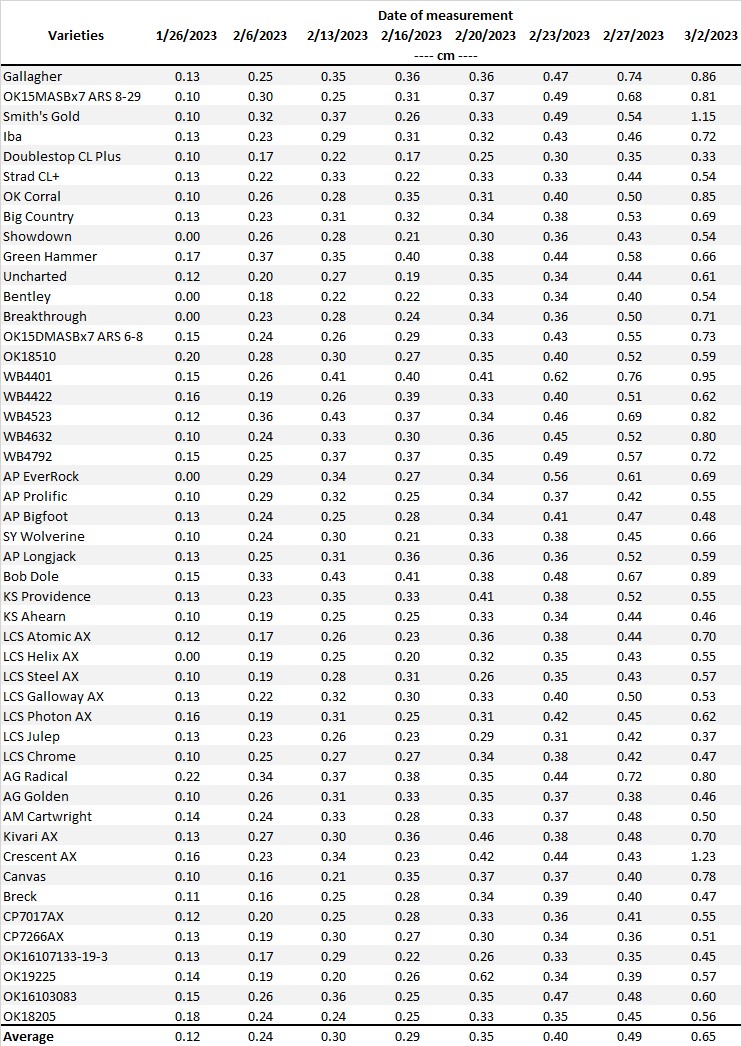
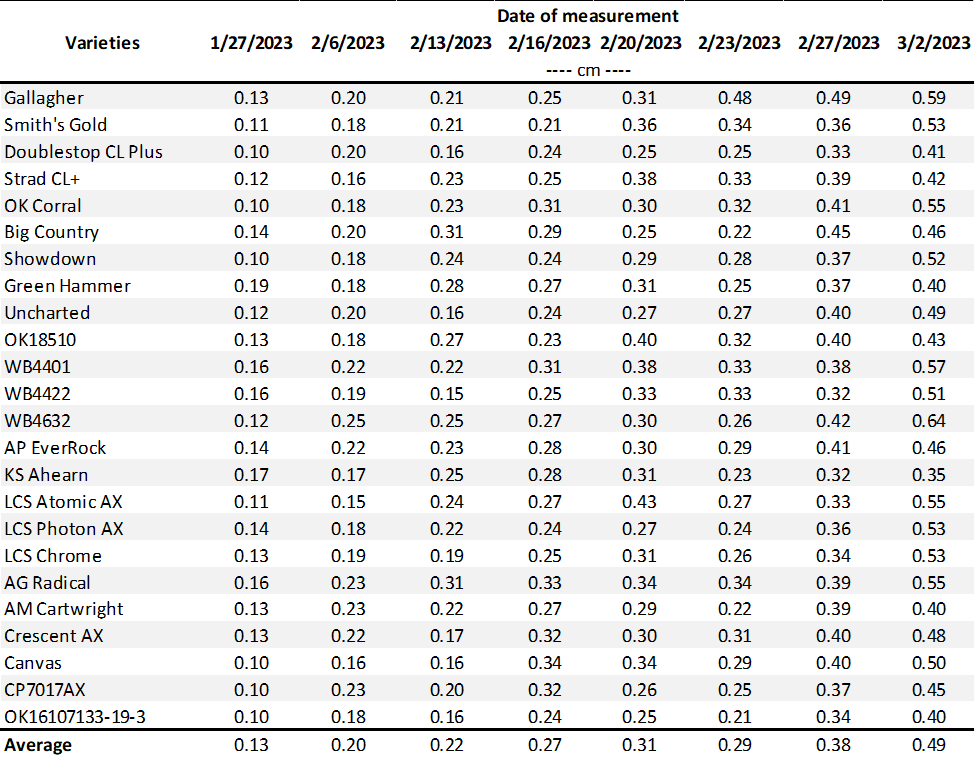
First hollow stem (FHS) is the optimal time to remove cattle from wheat pasture. This occurs when there is 1.5 cm (5/8”, or the diameter of a dime) of hollow stem below the developing grain head (see full explanation). The latest FHS results from OSU forage trials in Stillwater (Table 1) and Chickasha (Table 2) are listed below. For an additional resource and wheat update on FHS, see the Mesonet First Hollow Stem Advisor

We use an accelerated growth system to report the earliest onset of FHS stage. Trials are seeded early to simulate a grazed system, but the forage is not removed. Varieties reported here with the earliest FHS date should be the first to monitor in commercial fields. In practice, wheat that is grazed will likely reach FHS stage later than reported here, and differences between varieties will likely moderate.

Table 1. First hollow stem (FHS) results for each variety collected at Stillwater. Plots were planted on 10/06/22 but not grazed or clipped. The threshold target for FHS is 1.5 cm (5/8″ or the diameter of a dime). The value of hollow stem for each variety represents the average of ten measurements. Varieties exceeding the threshold are highlighted in red.

Table 2. First hollow stem (FHS) results for each variety collected at Chickasha. Plots were planted on 10/07/22 but not grazed or clipped. The threshold target for FHS is 1.5 cm (5/8″ or the diameter of a dime). The value of hollow stem for each variety represents the average of ten measurements. Varieties exceeding the threshold are highlighted in red.

Contact your local Extension office and us if you have questions. 

Additional resources available:

Acknowledgments: 

Tyler Lynch, Senior Agriculturalist

Israel Molina Cyrineu, Graduate Research Assistant

Samson Abiola, Graduate Research Assistant

Cassidy Stowers, Undergraduate Student

Lettie Crabtree, Undergraduate Student

First Hollow Stem Update – 3/16/2023

Amanda de Oliveira Silva, Small Grains Extension Specialist

First hollow stem (FHS) is the optimal time to remove cattle from wheat pasture. This occurs when there is 1.5 cm (5/8”, or the diameter of a dime) of hollow stem below the developing grain head (see full explanation). The latest FHS results from OSU forage trials in Stillwater (Table 1) and Chickasha (Table 2) are listed below. For an additional resource and wheat update on FHS, see the Mesonet First Hollow Stem Advisor

We use an accelerated growth system to report the earliest onset of FHS stage. Trials are seeded early to simulate a grazed system, but the forage is not removed. Varieties reported here with the earliest FHS date should be the first to monitor in commercial fields. In practice, wheat that is grazed will likely reach FHS stage later than reported here, and differences between varieties will likely moderate.

Table 1. First hollow stem (FHS) results for each variety collected at Stillwater. Plots were planted on 10/06/22 but not grazed or clipped. The threshold target for FHS is 1.5 cm (5/8″ or the diameter of a dime). The value of hollow stem for each variety represents the average of ten measurements. Varieties exceeding the threshold are highlighted in red.

Table 2. First hollow stem (FHS) results for each variety collected at Chickasha. Plots were planted on 10/07/22 but not grazed or clipped. The threshold target for FHS is 1.5 cm (5/8″ or the diameter of a dime). The value of hollow stem for each variety represents the average of ten measurements. Varieties exceeding the threshold are highlighted in red.

Contact your local Extension office and us if you have questions. 

Additional resources available:

Acknowledgments: 

Tyler Lynch, Senior Agriculturalist

Israel Molina Cyrineu, Graduate Research Assistant

Samson Abiola, Graduate Research Assistant

Cassidy Stowers, Undergraduate Student

Lettie Crabtree, Undergraduate Student

First Hollow Stem Update – 3/14/2023

Amanda de Oliveira Silva, Small Grains Extension Specialist

First hollow stem (FHS) is the optimal time to remove cattle from wheat pasture. This occurs when there is 1.5 cm (5/8”, or the diameter of a dime) of hollow stem below the developing grain head (see full explanation). The latest FHS results from OSU forage trials in Stillwater (Table 1) and Chickasha (Table 2) are listed below. For an additional resource and wheat update on FHS, see the Mesonet First Hollow Stem Advisor

We use an accelerated growth system to report the earliest onset of FHS stage. Trials are seeded early to simulate a grazed system, but the forage is not removed. Varieties reported here with the earliest FHS date should be the first to monitor in commercial fields. In practice, wheat that is grazed will likely reach FHS stage later than reported here, and differences between varieties will likely moderate.

Table 1. First hollow stem (FHS) results for each variety collected at Stillwater. Plots were planted on 10/06/22 but not grazed or clipped. The threshold target for FHS is 1.5 cm (5/8″ or the diameter of a dime). The value of hollow stem for each variety represents the average of ten measurements. Varieties exceeding the threshold are highlighted in red.

Table 2. First hollow stem (FHS) results for each variety collected at Chickasha. Plots were planted on 10/07/22 but not grazed or clipped. The threshold target for FHS is 1.5 cm (5/8″ or the diameter of a dime). The value of hollow stem for each variety represents the average of ten measurements. Varieties exceeding the threshold are highlighted in red.

Contact your local Extension office and us if you have questions. 

Additional resources available:

Acknowledgments: 

Tyler Lynch, Senior Agriculturalist

Israel Molina Cyrineu, Graduate Research Assistant

Samson Abiola, Graduate Research Assistant

Cassidy Stowers, Undergraduate Student

Lettie Crabtree, Undergraduate Student

First Hollow Stem Update – 3/10/2023

Amanda de Oliveira Silva, Small Grains Extension Specialist

First hollow stem (FHS) is the optimal time to remove cattle from wheat pasture. This occurs when there is 1.5 cm (5/8”, or the diameter of a dime) of hollow stem below the developing grain head (see full explanation). The latest FHS results from OSU forage trials in Stillwater (Table 1) and Chickasha (Table 2) are listed below. For an additional resource and wheat update on FHS, see the Mesonet First Hollow Stem Advisor

We use an accelerated growth system to report the earliest onset of FHS stage. Trials are seeded early to simulate a grazed system, but the forage is not removed. Varieties reported here with the earliest FHS date should be the first to monitor in commercial fields. In practice, wheat that is grazed will likely reach FHS stage later than reported here, and differences between varieties will likely moderate.

Table 1. First hollow stem (FHS) results for each variety collected at Stillwater. Plots were planted on 10/06/22 but not grazed or clipped. The threshold target for FHS is 1.5 cm (5/8″ or the diameter of a dime). The value of hollow stem for each variety represents the average of ten measurements. Varieties exceeding the threshold are highlighted in red.

Table 2. First hollow stem (FHS) results for each variety collected at Chickasha. Plots were planted on 10/07/22 but not grazed or clipped. The threshold target for FHS is 1.5 cm (5/8″ or the diameter of a dime). The value of hollow stem for each variety represents the average of ten measurements. Varieties exceeding the threshold are highlighted in red.

Contact your local Extension office and us if you have questions. 

Additional resources available:

Acknowledgments: 

Tyler Lynch, Senior Agriculturalist

Israel Molina Cyrineu, Graduate Research Assistant

Samson Abiola, Graduate Research Assistant

Cassidy Stowers, Undergraduate Student

Lettie Crabtree, Undergraduate Student

First Hollow Stem Update – 3/7/2023

Amanda de Oliveira Silva, Small Grains Extension Specialist

First hollow stem (FHS) is the optimal time to remove cattle from wheat pasture. This occurs when there is 1.5 cm (5/8”, or the diameter of a dime) of hollow stem below the developing grain head (see full explanation). The latest FHS results from OSU forage trials in Stillwater (Table 1) and Chickasha (Table 2) are listed below. For an additional resource and wheat update on FHS, see the Mesonet First Hollow Stem Advisor

We use an accelerated growth system to report the earliest onset of FHS stage. Trials are seeded early to simulate a grazed system, but the forage is not removed. Varieties reported here with the earliest FHS date should be the first to monitor in commercial fields. In practice, wheat that is grazed will likely reach FHS stage later than reported here, and differences between varieties will likely moderate.

Table 1. First hollow stem (FHS) results for each variety collected at Stillwater. Plots were planted on 10/06/22 but not grazed or clipped. The threshold target for FHS is 1.5 cm (5/8″ or the diameter of a dime). The value of hollow stem for each variety represents the average of ten measurements. Varieties exceeding the threshold are highlighted in red.

Table 2. First hollow stem (FHS) results for each variety collected at Chickasha. Plots were planted on 10/07/22 but not grazed or clipped. The threshold target for FHS is 1.5 cm (5/8″ or the diameter of a dime). The value of hollow stem for each variety represents the average of ten measurements. Varieties exceeding the threshold are highlighted in red.

Contact your local Extension office and us if you have questions. 

Additional resources available:

Acknowledgments: 

Tyler Lynch, Senior Agriculturalist

Israel Molina Cyrineu, Graduate Research Assistant

Samson Abiola, Graduate Research Assistant

Cassidy Stowers, Undergraduate Student

Lettie Crabtree, Undergraduate Student

First Hollow Stem Update – 3/3/2023

Amanda de Oliveira Silva, Small Grains Extension Specialist

First hollow stem (FHS) is the optimal time to remove cattle from wheat pasture. This occurs when there is 1.5 cm (5/8”, or the diameter of a dime) of hollow stem below the developing grain head (see full explanation). The latest FHS results from OSU forage trials in Stillwater (Table 1) and Chickasha (Table 2) are listed below. For an additional resource and wheat update on FHS, see the Mesonet First Hollow Stem Advisor

We use an accelerated growth system to report the earliest onset of FHS stage. Trials are seeded early to simulate a grazed system, but the forage is not removed. Varieties reported here with the earliest FHS date should be the first to monitor in commercial fields. In practice, wheat that is grazed will likely reach FHS stage later than reported here, and differences between varieties will likely moderate.

Table 1. First hollow stem (FHS) results for each variety collected at Stillwater. Plots were planted on 10/06/22 but not grazed or clipped. The threshold target for FHS is 1.5 cm (5/8″ or the diameter of a dime). The value of hollow stem for each variety represents the average of ten measurements. Varieties exceeding the threshold are highlighted in red.

Table 2. First hollow stem (FHS) results for each variety collected at Chickasha. Plots were planted on 10/07/22 but not grazed or clipped. The threshold target for FHS is 1.5 cm (5/8″ or the diameter of a dime). The value of hollow stem for each variety represents the average of ten measurements. Varieties exceeding the threshold are highlighted in red.

Contact your local Extension office and us if you have questions. 

Additional resources available:

Acknowledgments: 

Tyler Lynch, Senior Agriculturalist

Israel Molina Cyrineu, Graduate Research Assistant

Samson Abiola, Graduate Research Assistant

Cassidy Stowers, Undergraduate Student

Lettie Crabtree, Undergraduate Student