Unknown's avatar

About Amanda De Oliveira Silva

I have served as an Assistant Professor and Small Grains Extension Specialist at Oklahoma State University since August 2019. I believe that close interaction with producers is vital to understand their production strategies and to establish realistic research goals. My program focuses on developing science-based information to improve the agronomic and economic viability of small grains production in Oklahoma and in the Southern Great Plains.

Wheat Disease Update – 12 April 2022

This article was written by Dr. Meriem Aoun, Small Grains Pathologist

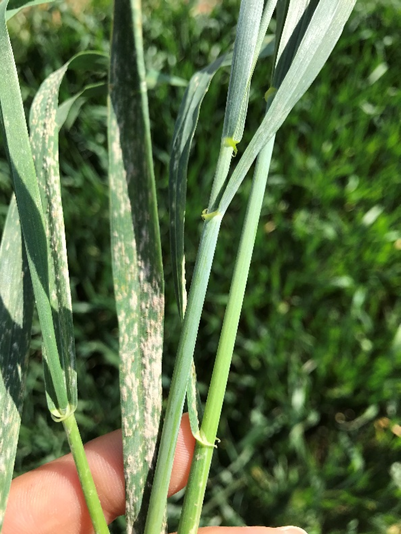
During the first and second week of April, some wheat diseases appeared in Oklahoma. For example, in the Stillwater Agronomy Research Station, I observed high powdery mildew infection on the susceptible wheat variety ‘OK Bullet’ (Figure 1). Similarly, Bradley Secraw (Extension educator at Cleveland county; March, 31, 2022) found little powdery mildew infection on the variety ‘OK Corral’ which is moderately resistant to this disease. In Stillwater and on April 11th, I observed initial stripe rust infection on OK Bullet (Figure 2). Also recall in my previous update of 25-March, I indicated seeing little stripe rust infection in Jackson county. Therefore, I encourage growers to start scouting their fields for these diseases, especially if they are growing susceptible varieties. We will continue to monitor these diseases as we approach flag leaf stage and provide recommendations.

Figure 1. Powdery mildew infection on the susceptible wheat variety ‘OK Bullet’ in Stillwater, OK (April, 11, 2022)

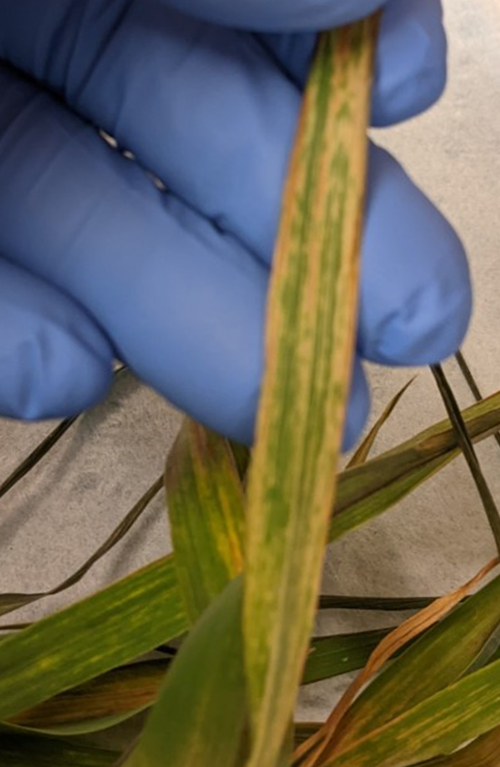
In the Stillwater Agronomy Research Station, I also observed barley yellow dwarf virus (BYD) symptoms on the susceptible wheat variety ‘Pete’. The symptoms appeared as yellow, red/purple discoloration on the leaves as shown in Figure 2. This virus is transmitted from plant to plant by cereal aphids. Enzyme linked immunosorbent assay (ELISA) on a symptomatic sample from Pete was positive for two BYD strains; BYD strain 2 (BYDV-PAV) and cereal yellow dwarf (CYDV-RPV).

Figure 2. Barley yellow dwarf virus symptoms on the susceptible variety ‘Pete’ in Stillwater, OK (April, 5, 2022).

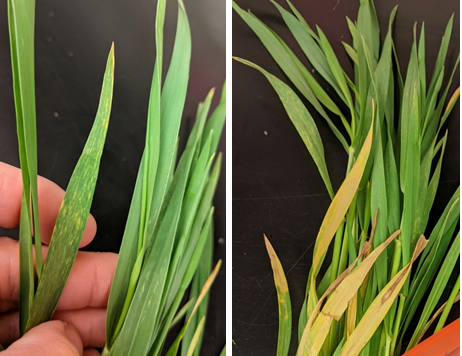
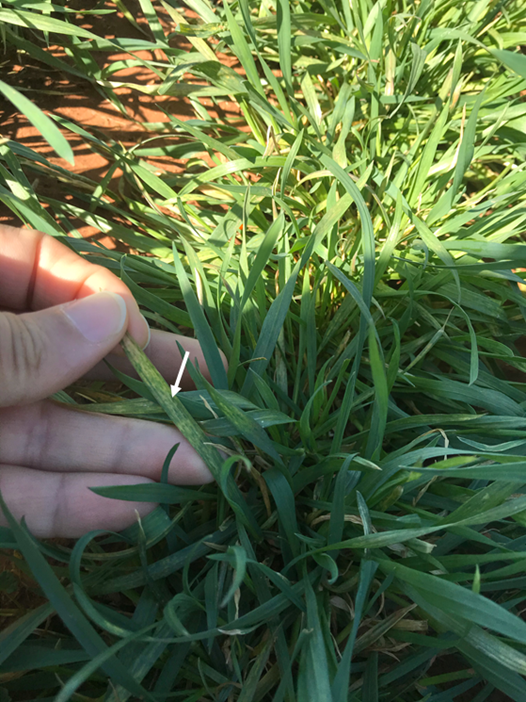
In Stillwater, I observed yellowing on the wheat variety ‘Lonerider’. Older leaves were completely chlorotic (Figure 3). Laboratory diagnosis of a sample using ELISA was positive for wheat streak mosaic virus (WSM) which is transmitted by wheat curl mite. This disease is an issue in our region as many wheat varieties growing in Oklahoma are susceptible to WSM.

Figure 3. Symptoms of wheat streak mosaic virus on the susceptible wheat variety ‘Lonerider’ in Stillwater, OK (April, 5, 2022).

Wheat Disease Update – 25 March 2022

This article was written by Meriem Aoun, Small Grains Pathologist

Based on my observations in Stillwater wheat fields and communications with multiple county educators in Oklahoma, it is relatively quiet in terms of diseases. In southwestern Texas and during the first week of March, Dr. Amir Ibrahim (Regents Professor & Small Grains Breeder/Geneticist; Texas A&M AgriLife Research) and Dr. Bryan Simoneaux (Research Associate, Texas A&M AgriLife Research) reported infections of stripe rust and leaf rust in naturally infected rust nurseries.

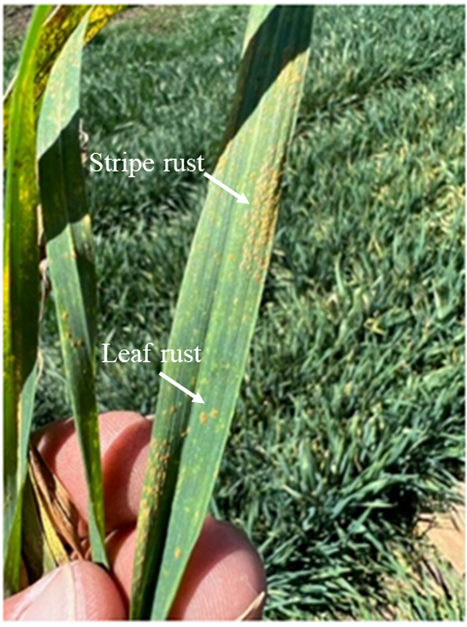
In Castroville, TX (29.3558° N, 98.8786° W) nursery, Drs. Ibrahim and Simoneaux observed a little bit of leaf rust in the lower canopy of the hard red winter wheat variety ‘Jagalene’. In the Uvalde, TX (29.2097° N, 99.7862° W) nursery, they observed some leaf rust on the lower canopy of the hard red winter wheat varieties Jagalene and ‘TAM 110’, however leaf rust infection did not spread uniformly throughout the nursery. They also found good stripe rust infection on Jagalene in Uvalde, TX (Figure 1 & 2).

Figure 1. Leaf rust and stripe rust infections on the same leaf of the susceptible wheat variety Jagalene at Uvalde, TX (Photo by Dr. Bryan Simoneaux on 3 March 2022).
Figure 2. Stripe rust infections on the susceptible wheat variety Jagalene at Uvalde, TX (Photo by Dr. Bryan Simoneaux, on 3 March 2022).

In southwestern Oklahoma and during the first week of March, Gary Strickland (Jackson County Extn Educator) reported seeing only very little tan spot on bottom leaves but nothing major (in terms of percentage infestation). He also noted a few leaves infected with stripe rust. Gary Strickland mentioned that the major issue he observed was winter grain mites.

In the Stillwater Agronomy Research Station and on 24 March 2022, I am starting to observe symptoms of the wheat soil-borne mosaic (SB)/wheat spindle streak mosaic (SS) virus complex on the susceptible hard red winter wheat variety ‘Vona’ in the SB-SS nursery (Figure 3). However, due to the use of resistant varieties, these viral diseases are not a problem in Oklahoma and the central plains.

Figure 3. Symptoms of wheat soil-borne mosaic/wheat spindle streak mosaic virus complex on the susceptible wheat variety Vona in Stillwater, OK

First Hollow Stem Update – 3/22/2022

Amanda de Oliveira Silva, Small Grains Extension Specialist

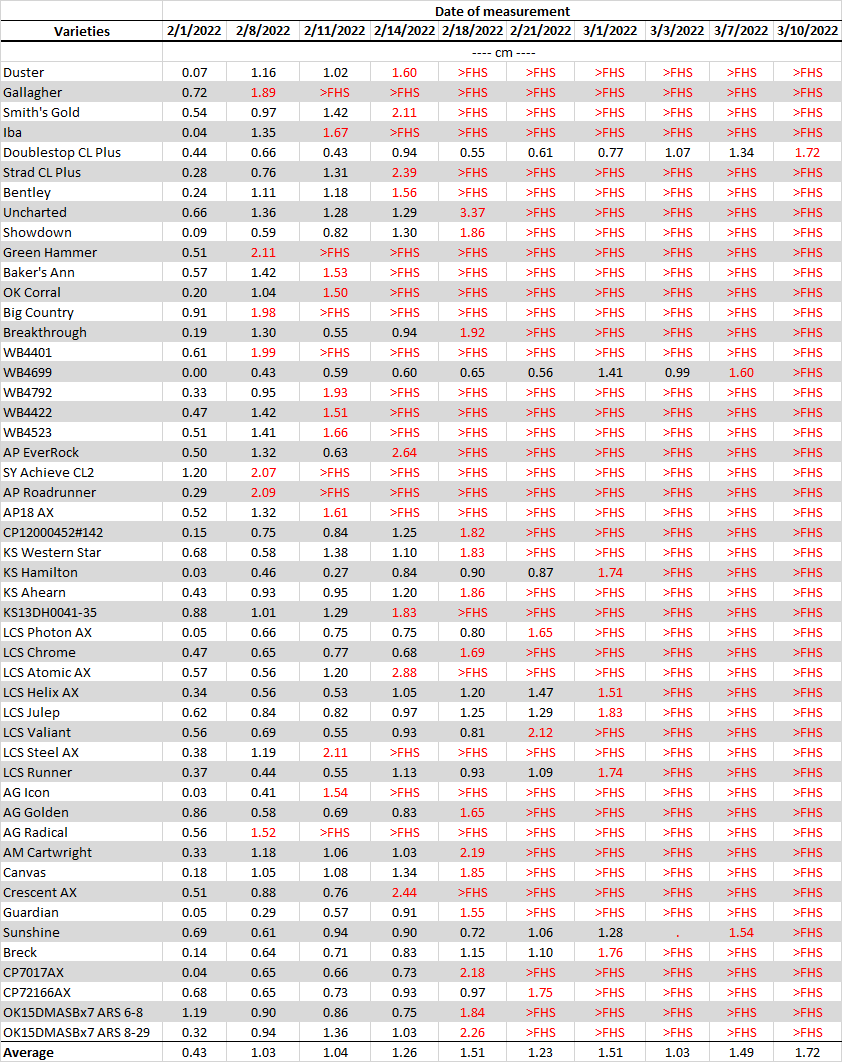
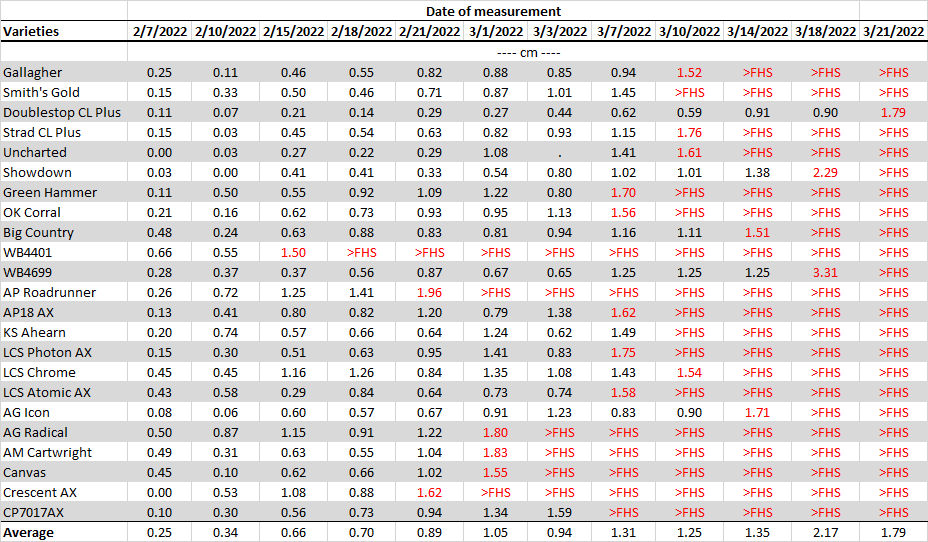
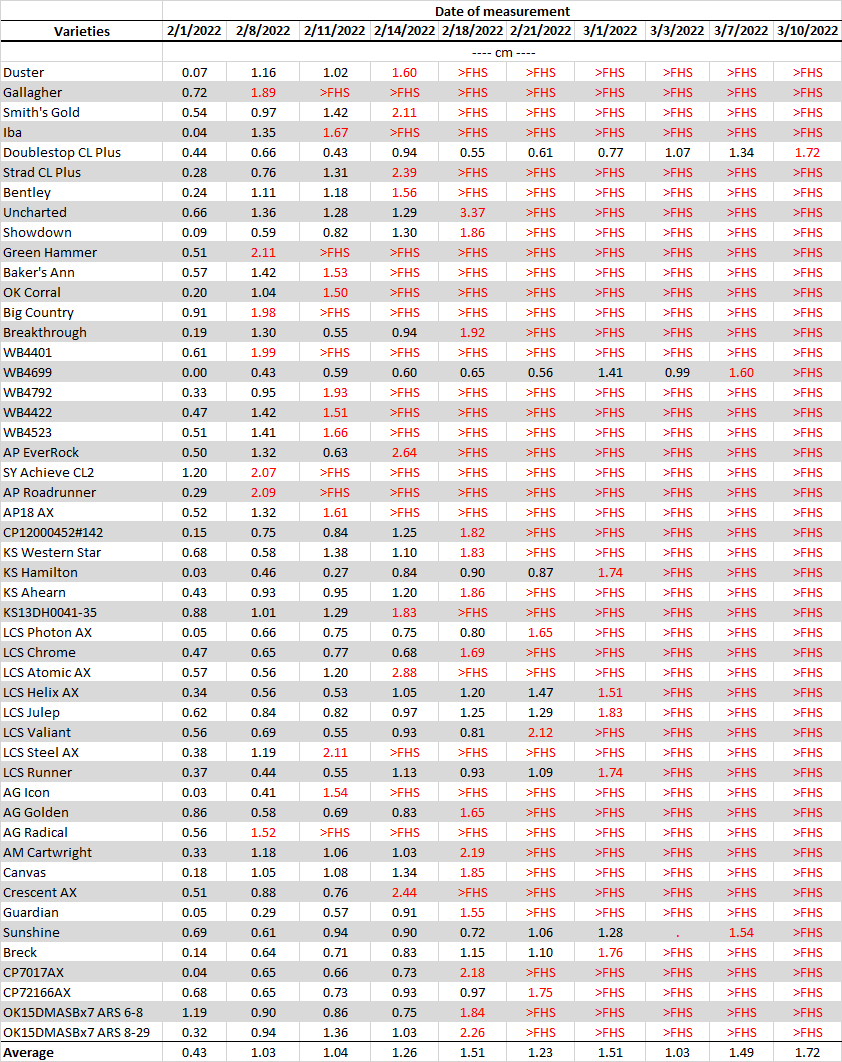
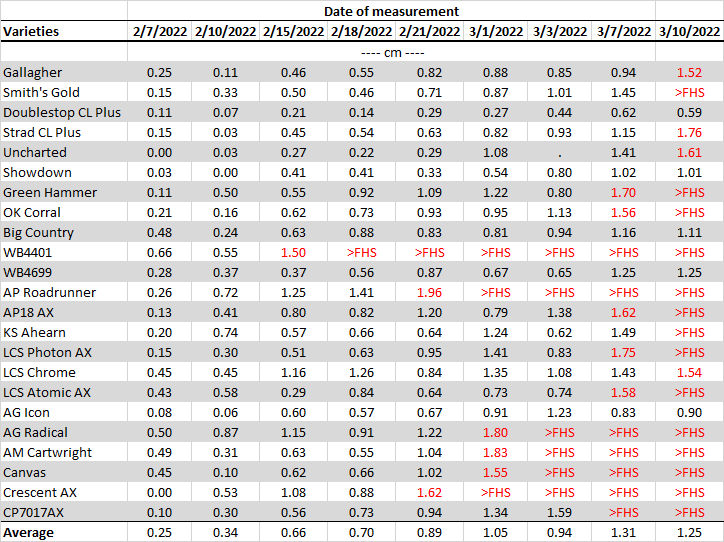
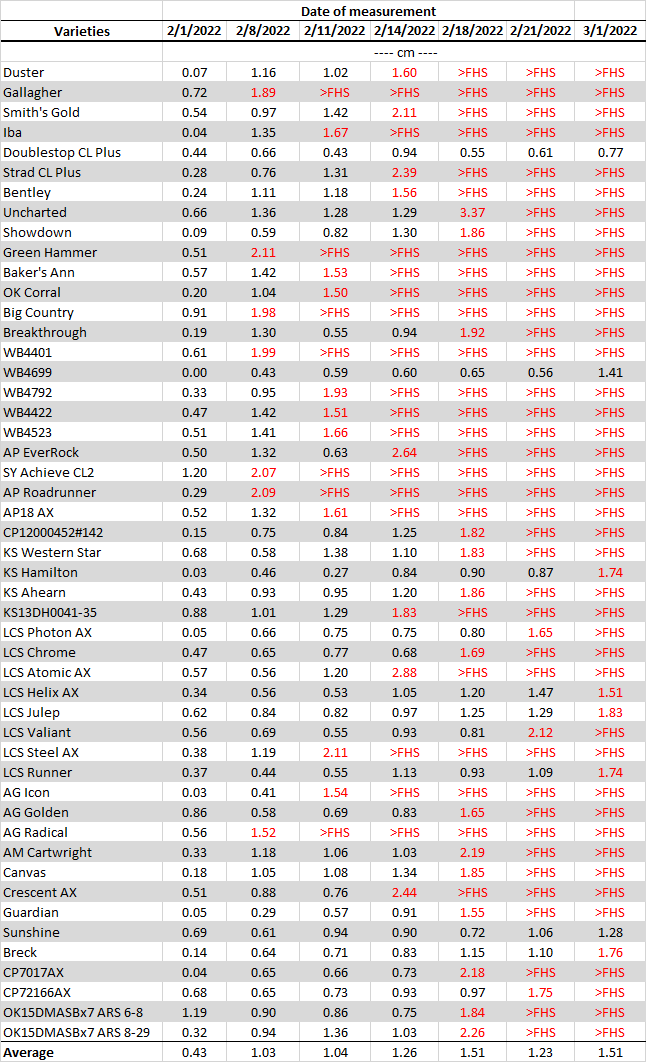
First hollow stem (FHS) is the optimal time to remove cattle from wheat pasture. This occurs when there is 1.5 cm (5/8”, or the diameter of a dime) of hollow stem below the developing grain head (see full explanation). The latest FHS results from OSU forage trials in Stillwater (Table 1) and Chickasha (Table 2) are listed below. For an additional resource, see the Mesonet First Hollow Stem Advisor.

We use an accelerated growth system to report the earliest onset of FHS stage. Trials are seeded early to simulate a grazed system, but the forage is not removed. Varieties reported here with the earliest FHS date should be the first to monitor in commercial fields. In practice, wheat that is grazed will likely reach FHS stage later than reported here, and differences between varieties will likely moderate.

Values can fluctuate from one sampling to another due to environmental variation associated with, among other factors, the winter storm on February 2-4. Additionally, varieties differed widely in their FHS response following this cold period.

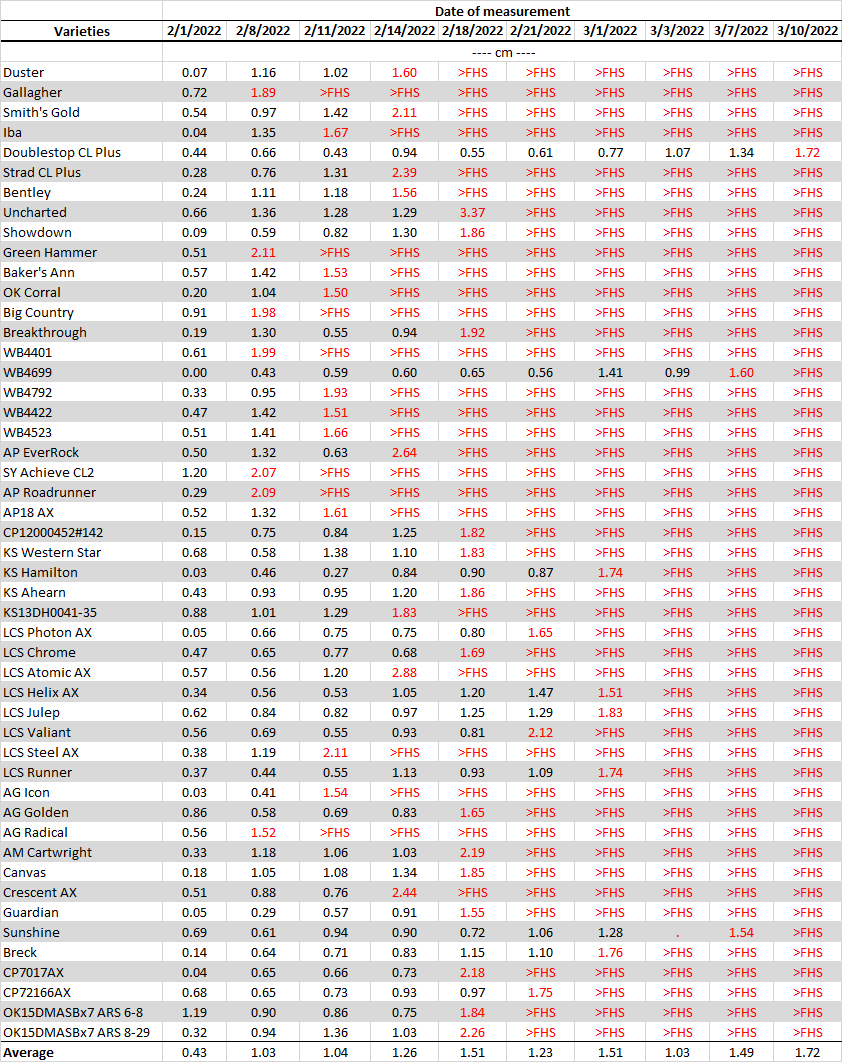
Table 1. First hollow stem (FHS) results for each variety collected at Stillwater. Plots were planted on 09/27/21 but not grazed or clipped. The threshold target for FHS is 1.5 cm (5/8″ or the diameter of a dime). The value of hollow stem for each variety represents the average of ten measurements. Varieties exceeding the threshold are highlighted in red. The overall average represents the mean FHS for the varieties measured within a date.

Table 2. First hollow stem (FHS) results for each variety collected at Chickasha. Plots were planted on 09/28/21 but not grazed or clipped. The threshold target for FHS is 1.5 cm (5/8″ or the diameter of a dime). The value of hollow stem for each variety represents the average of ten measurements. Varieties exceeding the threshold are highlighted in red. The overall average represents the mean FHS for the varieties measured within a date.

Additional resources available:

Acknowledgements

Tyler Lynch, Senior Agriculturalist

Israel Molina Cyrineu, Graduate Research Assistant

Cassidy Stowers, Undergraduate student

Ephraim Muyombo, Undergraduate student

Lettie Crabtree, Undergraduate student

Teresa Swantek, Undergraduate student

First Hollow Stem Update – 3/18/2022

Amanda de Oliveira Silva, Small Grains Extension Specialist

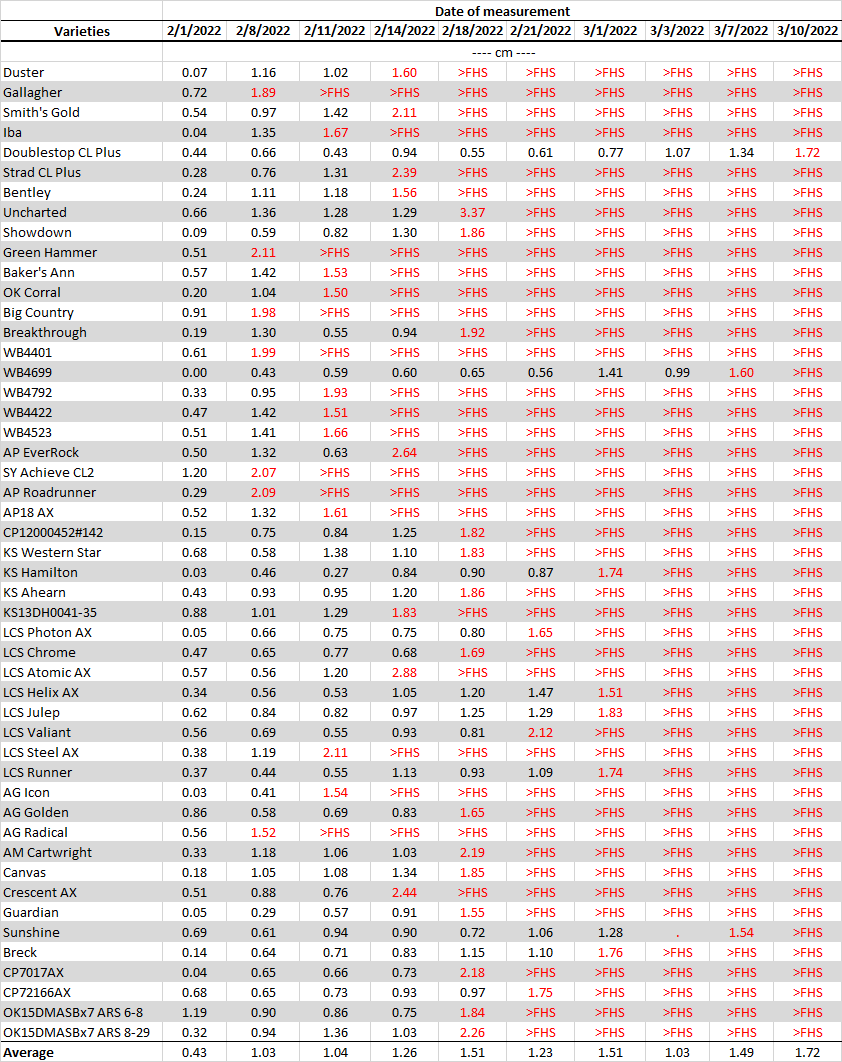
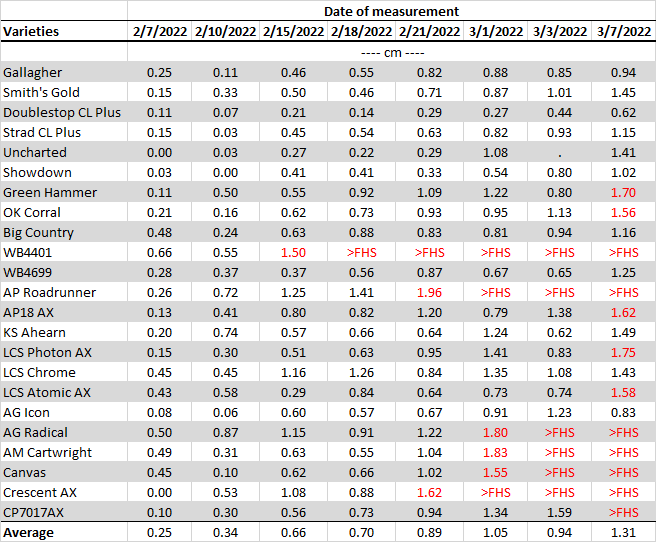
First hollow stem (FHS) is the optimal time to remove cattle from wheat pasture. This occurs when there is 1.5 cm (5/8”, or the diameter of a dime) of hollow stem below the developing grain head (see full explanation). The latest FHS results from OSU forage trials in Stillwater (Table 1) and Chickasha (Table 2) are listed below. For an additional resource, see the Mesonet First Hollow Stem Advisor.

We use an accelerated growth system to report the earliest onset of FHS stage. Trials are seeded early to simulate a grazed system, but the forage is not removed. Varieties reported here with the earliest FHS date should be the first to monitor in commercial fields. In practice, wheat that is grazed will likely reach FHS stage later than reported here, and differences between varieties will likely moderate.

Values can fluctuate from one sampling to another due to environmental variation associated with, among other factors, the winter storm on February 2-4. Additionally, varieties differed widely in their FHS response following this cold period.

Table 1. First hollow stem (FHS) results for each variety collected at Stillwater. Plots were planted on 09/27/21 but not grazed or clipped. The threshold target for FHS is 1.5 cm (5/8″ or the diameter of a dime). The value of hollow stem for each variety represents the average of ten measurements. Varieties exceeding the threshold are highlighted in red. The overall average represents the mean FHS for the varieties measured within a date.

Table 2. First hollow stem (FHS) results for each variety collected at Chickasha. Plots were planted on 09/28/21 but not grazed or clipped. The threshold target for FHS is 1.5 cm (5/8″ or the diameter of a dime). The value of hollow stem for each variety represents the average of ten measurements. Varieties exceeding the threshold are highlighted in red. The overall average represents the mean FHS for the varieties measured within a date.

Additional resources available:

Acknowledgements

Tyler Lynch, Senior Agriculturalist

Israel Molina Cyrineu, Graduate Research Assistant

Cassidy Stowers, Undergraduate student

Ephraim Muyombo, Undergraduate student

Lettie Crabtree, Undergraduate student

Teresa Swantek, Undergraduate student

First Hollow Stem Update – 3/15/2022

Amanda de Oliveira Silva, Small Grains Extension Specialist

First hollow stem (FHS) is the optimal time to remove cattle from wheat pasture. This occurs when there is 1.5 cm (5/8”, or the diameter of a dime) of hollow stem below the developing grain head (see full explanation). The latest FHS results from OSU forage trials in Stillwater (Table 1) and Chickasha (Table 2) are listed below. For an additional resource, see the Mesonet First Hollow Stem Advisor.

We use an accelerated growth system to report the earliest onset of FHS stage. Trials are seeded early to simulate a grazed system, but the forage is not removed. Varieties reported here with the earliest FHS date should be the first to monitor in commercial fields. In practice, wheat that is grazed will likely reach FHS stage later than reported here, and differences between varieties will likely moderate.

Values can fluctuate from one sampling to another due to environmental variation associated with, among other factors, the winter storm on February 2-4. Additionally, varieties differed widely in their FHS response following this cold period.

Table 1. First hollow stem (FHS) results for each variety collected at Stillwater. Plots were planted on 09/27/21 but not grazed or clipped. The threshold target for FHS is 1.5 cm (5/8″ or the diameter of a dime). The value of hollow stem for each variety represents the average of ten measurements. Varieties exceeding the threshold are highlighted in red. The overall average represents the mean FHS for the varieties measured within a date.

Table 2. First hollow stem (FHS) results for each variety collected at Chickasha. Plots were planted on 09/28/21 but not grazed or clipped. The threshold target for FHS is 1.5 cm (5/8″ or the diameter of a dime). The value of hollow stem for each variety represents the average of ten measurements. Varieties exceeding the threshold are highlighted in red. The overall average represents the mean FHS for the varieties measured within a date.

Additional resources available:

Acknowledgements:

Tyler Lynch, Senior Agriculturalist

Israel Molina Cyrineu, Graduate Research Assistant

Cassidy Stowers, Undergraduate student

Ephraim Muyombo, Undergraduate student

Lettie Crabtree, Undergraduate student

Teresa Swantek, Undergraduate student

First Hollow Stem Update – 3/10/2022

Amanda de Oliveira Silva, Small Grains Extension Specialist

First hollow stem (FHS) is the optimal time to remove cattle from wheat pasture. This occurs when there is 1.5 cm (5/8”, or the diameter of a dime) of hollow stem below the developing grain head (see full explanation). The latest FHS results from OSU forage trials in Stillwater (Table 1) and Chickasha (Table 2) are listed below. For an additional resource, see the Mesonet First Hollow Stem Advisor.

We use an accelerated growth system to report the earliest onset of FHS stage. Trials are seeded early to simulate a grazed system, but the forage is not removed. Varieties reported here with the earliest FHS date should be the first to monitor in commercial fields. In practice, wheat that is grazed will likely reach FHS stage later than reported here, and differences between varieties will likely moderate.

Values can fluctuate from one sampling to another due to environmental variation associated with, among other factors, the winter storm on February 2-4. Additionally, varieties differed widely in their FHS response following this cold period.

Table 1. First hollow stem (FHS) results for each variety collected at Stillwater. Plots were planted on 09/27/21 but not grazed or clipped. The threshold target for FHS is 1.5 cm (5/8″ or the diameter of a dime). The value of hollow stem for each variety represents the average of ten measurements. Varieties exceeding the threshold are highlighted in red. The overall average represents the mean FHS for the varieties measured within a date.

Table 2. First hollow stem (FHS) results for each variety collected at Chickasha. Plots were planted on 09/28/21 but not grazed or clipped. The threshold target for FHS is 1.5 cm (5/8″ or the diameter of a dime). The value of hollow stem for each variety represents the average of ten measurements. Varieties exceeding the threshold are highlighted in red. The overall average represents the mean FHS for the varieties measured within a date.

Additional resources available:

First Hollow Stem Update – 3/7/2022

Amanda de Oliveira Silva, Small Grains Extension Specialist

First hollow stem (FHS) is the optimal time to remove cattle from wheat pasture. This occurs when there is 1.5 cm (5/8”, or the diameter of a dime) of hollow stem below the developing grain head (see full explanation). The latest FHS results from OSU forage trials in Stillwater (Table 1) and Chickasha (Table 2) are listed below. For an additional resource, see the Mesonet First Hollow Stem Advisor.

We use an accelerated growth system to report the earliest onset of FHS stage. Trials are seeded early to simulate a grazed system, but the forage is not removed. Varieties reported here with the earliest FHS date should be the first to monitor in commercial fields. In practice, wheat that is grazed will likely reach FHS stage later than reported here, and differences between varieties will likely moderate.

Values can fluctuate from one sampling to another due to environmental variation associated with, among other factors, the winter storm on February 2-4. Additionally, varieties differed widely in their FHS response following this cold period.

Table 1. First hollow stem (FHS) results for each variety collected at Stillwater. Plots were planted on 09/27/21 but not grazed or clipped. The threshold target for FHS is 1.5 cm (5/8″ or the diameter of a dime). The value of hollow stem for each variety represents the average of ten measurements. Varieties exceeding the threshold are highlighted in red. The overall average represents the mean FHS for the varieties measured within a date.

Table 2. First hollow stem (FHS) results for each variety collected at Chickasha. Plots were planted on 09/28/21 but not grazed or clipped. The threshold target for FHS is 1.5 cm (5/8″ or the diameter of a dime). The value of hollow stem for each variety represents the average of ten measurements. Varieties exceeding the threshold are highlighted in red. The overall average represents the mean FHS for the varieties measured within a date.

Additional resources available:

First Hollow Stem Update – 3/02/2022

Amanda de Oliveira Silva, Small Grains Extension Specialist

First hollow stem (FHS) is the optimal time to remove cattle from wheat pasture. This occurs when there is 1.5 cm (5/8”, or the diameter of a dime) of hollow stem below the developing grain head (see full explanation). The latest FHS results from OSU forage trials in Stillwater (Table 1) and Chickasha (Table 2) are listed below. For an additional resource, see the Mesonet First Hollow Stem Advisor.

We use an accelerated growth system to report the earliest onset of FHS stage. Trials are seeded early to simulate a grazed system, but the forage is not removed. Varieties reported here with the earliest FHS date should be the first to monitor in commercial fields. In practice, wheat that is grazed will likely reach FHS stage later than reported here, and differences between varieties will likely moderate.

Values can fluctuate from one sampling to another due to environmental variation associated with, among other factors, the winter storm on February 2-4. Additionally, varieties differed widely in their FHS response following this cold period.

Table 1. First hollow stem (FHS) results for each variety collected at Stillwater. Plots were planted on 09/27/21 but not grazed or clipped. The threshold target for FHS is 1.5 cm (5/8″ or the diameter of a dime). The value of hollow stem for each variety represents the average of ten measurements. Varieties exceeding the threshold are highlighted in red. The overall average represents the mean FHS for the varieties measured within a date.

Table 2. First hollow stem (FHS) results for each variety collected at Chickasha. Plots were planted on 09/28/21 but not grazed or clipped. The threshold target for FHS is 1.5 cm (5/8″ or the diameter of a dime). The value of hollow stem for each variety represents the average of ten measurements. Varieties exceeding the threshold are highlighted in red. The overall average represents the mean FHS for the varieties measured within a date.

  • Additional resources available:

First Hollow Stem Update – 2/22/2022

Amanda de Oliveira Silva, Small Grains Extension Specialist

First hollow stem (FHS) is the optimal time to remove cattle from wheat pasture. This occurs when there is 1.5 cm (5/8”, or the diameter of a dime) of hollow stem below the developing grain head (see full explanation). The latest FHS results from OSU forage trials in Stillwater (Table 1) and Chickasha (Table 2) are listed below. For an additional resource, see the Mesonet First Hollow Stem Advisor.

We use an accelerated growth system to report the earliest onset of FHS stage. Trials are seeded early to simulate a grazed system, but the forage is not removed. Varieties reported here with the earliest FHS date should be the first to monitor in commercial fields. In practice, wheat that is grazed will likely reach FHS stage later than reported here, and differences between varieties will likely moderate.

Values can fluctuate from one sampling to another due to environmental variation associated with, among other factors, the winter storm on February 2-4. Additionally, varieties differed widely in their FHS response following this cold period.

Table 1. First hollow stem (FHS) results for each variety collected at Stillwater. Plots were planted on 09/27/21 but not grazed or clipped. The threshold target for FHS is 1.5 cm (5/8″ or the diameter of a dime). The value of hollow stem for each variety represents the average of ten measurements. Varieties exceeding the threshold are highlighted in red.

Table 2. First hollow stem (FHS) results for each variety collected at Chickasha. Plots were planted on 09/28/21 but not grazed or clipped. The threshold target for FHS is 1.5 cm (5/8″ or the diameter of a dime). The value of hollow stem for each variety represents the average of ten measurements. Varieties exceeding the threshold are highlighted in red.

First Hollow Stem Update – 2/18/2022

Amanda de Oliveira Silva, Small Grains Extension Specialist

First hollow stem (FHS) is the optimal time to remove cattle from wheat pasture. This occurs when there is 1.5 cm (5/8”, or the diameter of a dime) of hollow stem below the developing grain head (see full explanation). The latest FHS results from OSU forage trials in Stillwater (Table 1) and Chickasha (Table 2) are listed below. For an additional resource, see the Mesonet First Hollow Stem Advisor.

We use an accelerated growth system to report the earliest onset of FHS stage. Trials are seeded early to simulate a grazed system, but the forage is not removed. Varieties reported here with the earliest FHS date should be the first to monitor in commercial fields. In practice, wheat that is grazed will likely reach FHS stage later than reported here, and differences between varieties will likely moderate.

Values can fluctuate from one sampling to another due to environmental variation associated with, among other factors, the winter storm on February 2-4. Additionally, varieties differed widely in their FHS response following this cold period.

Table 1. First hollow stem (FHS) results for each variety collected at Stillwater. Plots were planted on 09/27/21 but not grazed or clipped. The threshold target for FHS is 1.5 cm (5/8″ or the diameter of a dime). The value of hollow stem for each variety represents the average of ten measurements. Varieties exceeding the threshold are highlighted in red.

Table 2. First hollow stem (FHS) results for each variety collected at Chickasha. Plots were planted on 09/28/21 but not grazed or clipped. The threshold target for FHS is 1.5 cm (5/8″ or the diameter of a dime). The value of hollow stem for each variety represents the average of ten measurements. Varieties exceeding the threshold are highlighted in red.

  • Additional resources available: