First Hollow Stem Update – 3/17/2025

Amanda de Oliveira Silva, Small Grains Extension Specialist

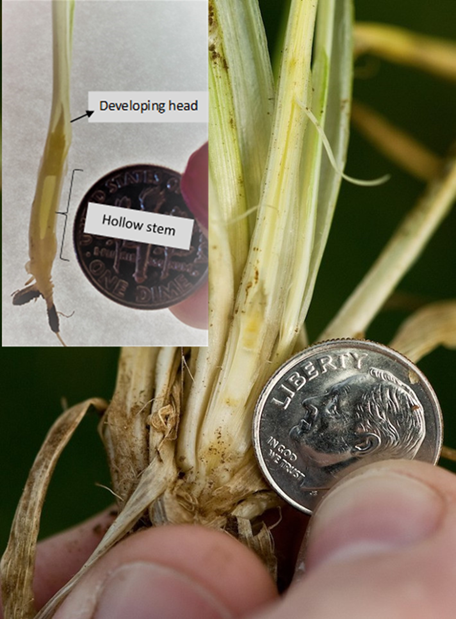
The first hollow stem stage indicates the beginning of stem elongation or just before the jointing stage. It is a good indicator of when producers should remove cattle from wheat pasture. This occurs when there is 1.5 cm (5/8”, or the diameter of a dime) of hollow stem below the developing grain head (see full explanation). 
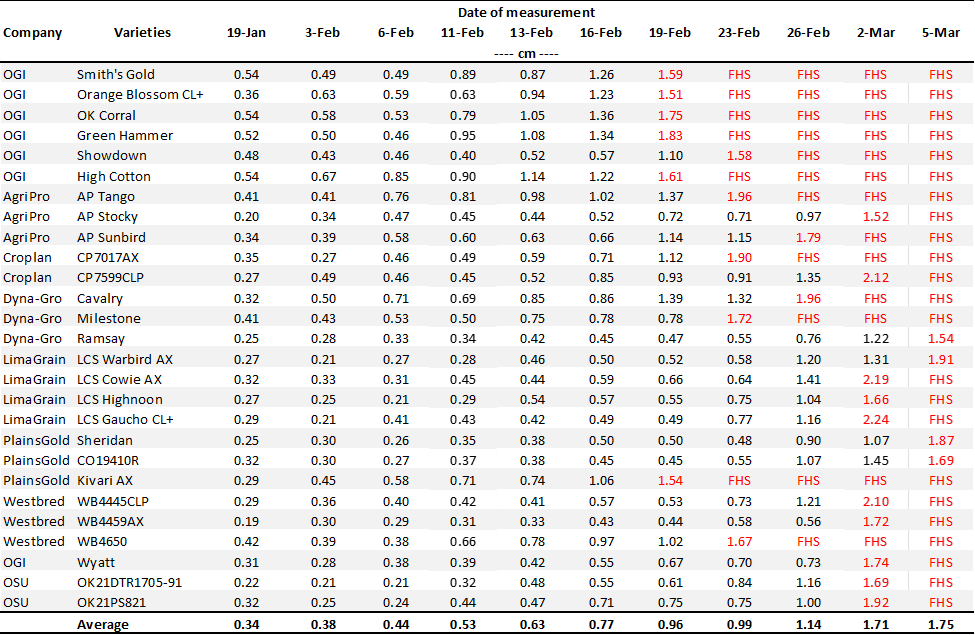
The latest FHS results from OSU forage trials in Stillwater (Table 1) and Chickasha (Table 2) are listed below. For an additional resource and wheat update on FHS, see the Mesonet First Hollow Stem Advisor

OSU Small Grains Program monitors FHS occurrence on a twice-per-week basis

As in previous years, we will continue monitoring FHS occurrence in our wheat plots at Stillwater and Chickasha and share updates on this blog. In past years, our forage trials—where FHS samples are collected—were seeded early to simulate a grazed system, though forage was not removed. This method created an accelerated growth environment, allowing us to identify the earliest onset of FHS. Varieties that reach FHS earliest in these trials should be closely monitored in commercial fields.

This year, we are introducing a new approach by simulating grazing with a mower in the forage trial in Stillwater. This will allow us to compare whether varieties reach FHS at different times when grazed versus non-grazed. We hypothesize that the simulated grazing treatment will likely delay FHS relative to the non-grazed treatment, with FHS differences among varieties becoming less pronounced. We also hypothesize that the amount of delay will vary among varieties, such that an early-FHS variety in the non-grazed environment may appear more intermediate in its FHS arrival with canopy removal. This comparison will provide insight into how canopy removal from grazing impacts the timing of reproductive development.
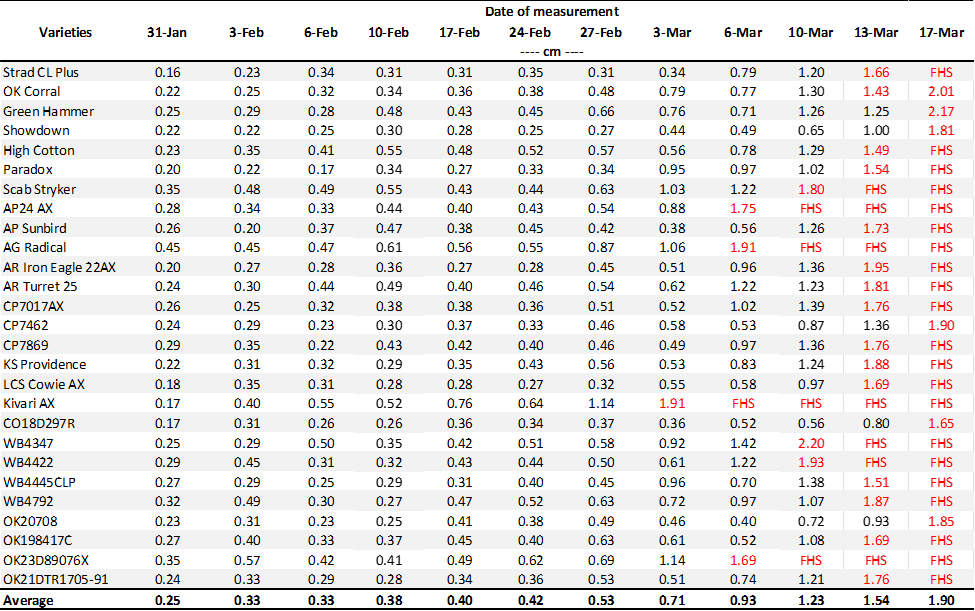
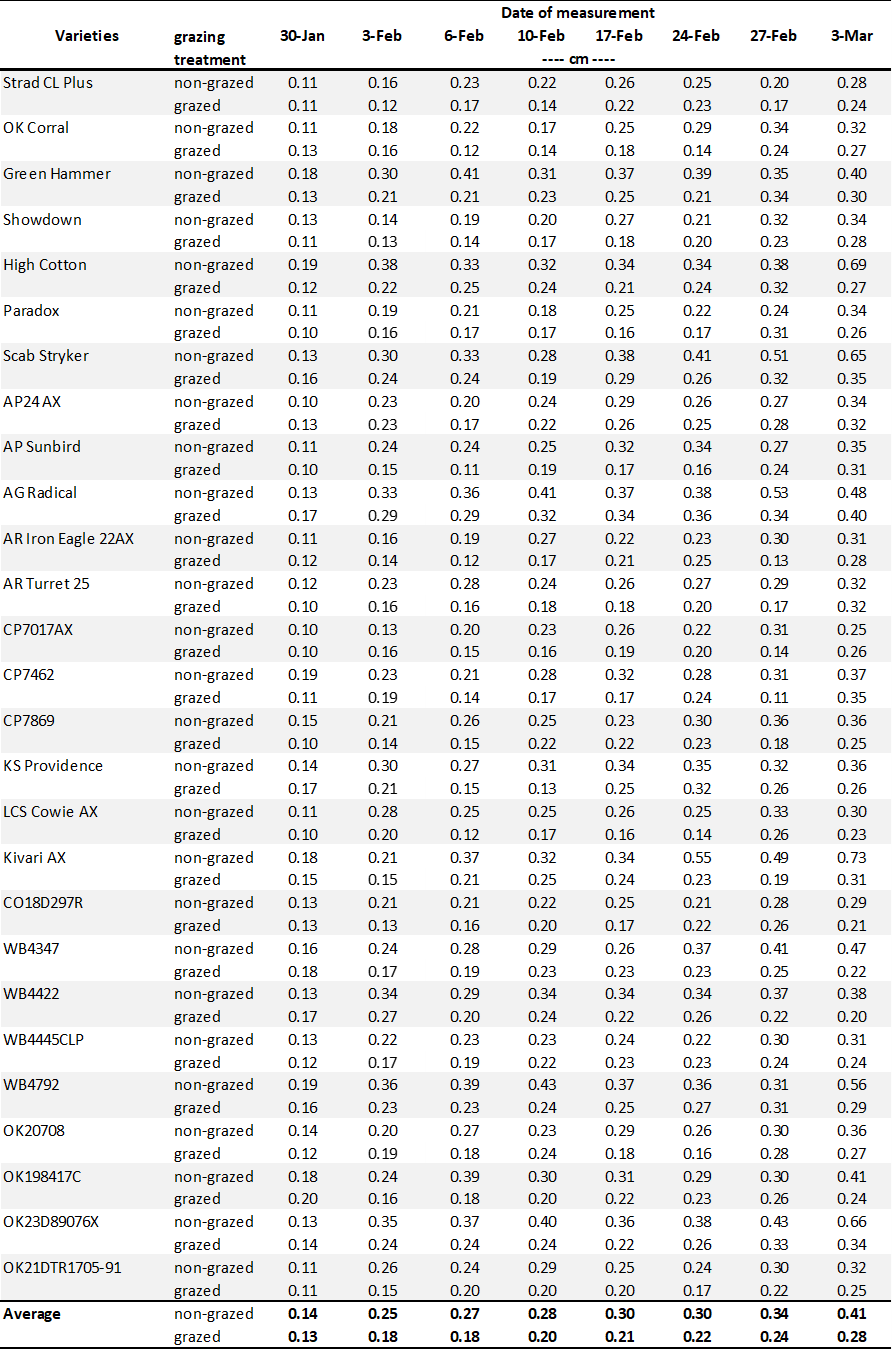
The latest FHS results for each variety planted in our forage trials at Stillwater and Chickasha are summarized below (Tables 1 and 2). All varieties have reached the FHS threshold in Chickasha.

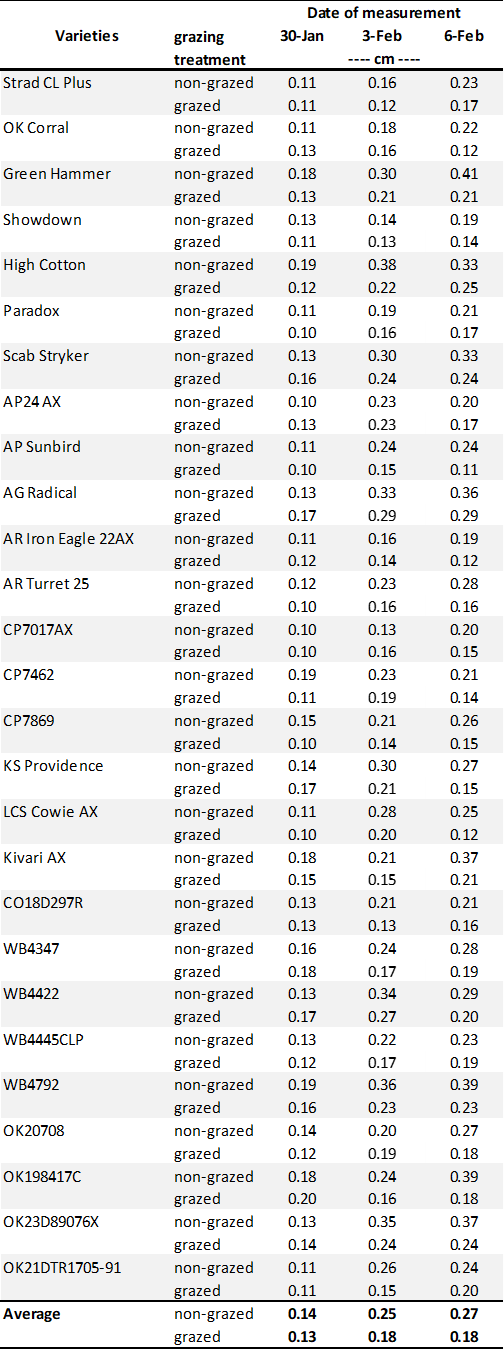
Table 1. First Hollow Stem (FHS) results for each wheat variety collected at Stillwater. Plots were planted on 10/11/24, with one section left unclipped and the other clipped to simulate grazing. The FHS threshold is 1.5 cm (5/8″ or approximately the diameter of a dime). Reported values represent the average of ten measurements per variety. Varieties that exceed the threshold are highlighted in red. For the simulated grazing, plots were mowed on January 3rd, 15th, 28th, February 10th, and March 6th at a 2.5-3” cutting height, with the frequency representing a light grazing treatment.
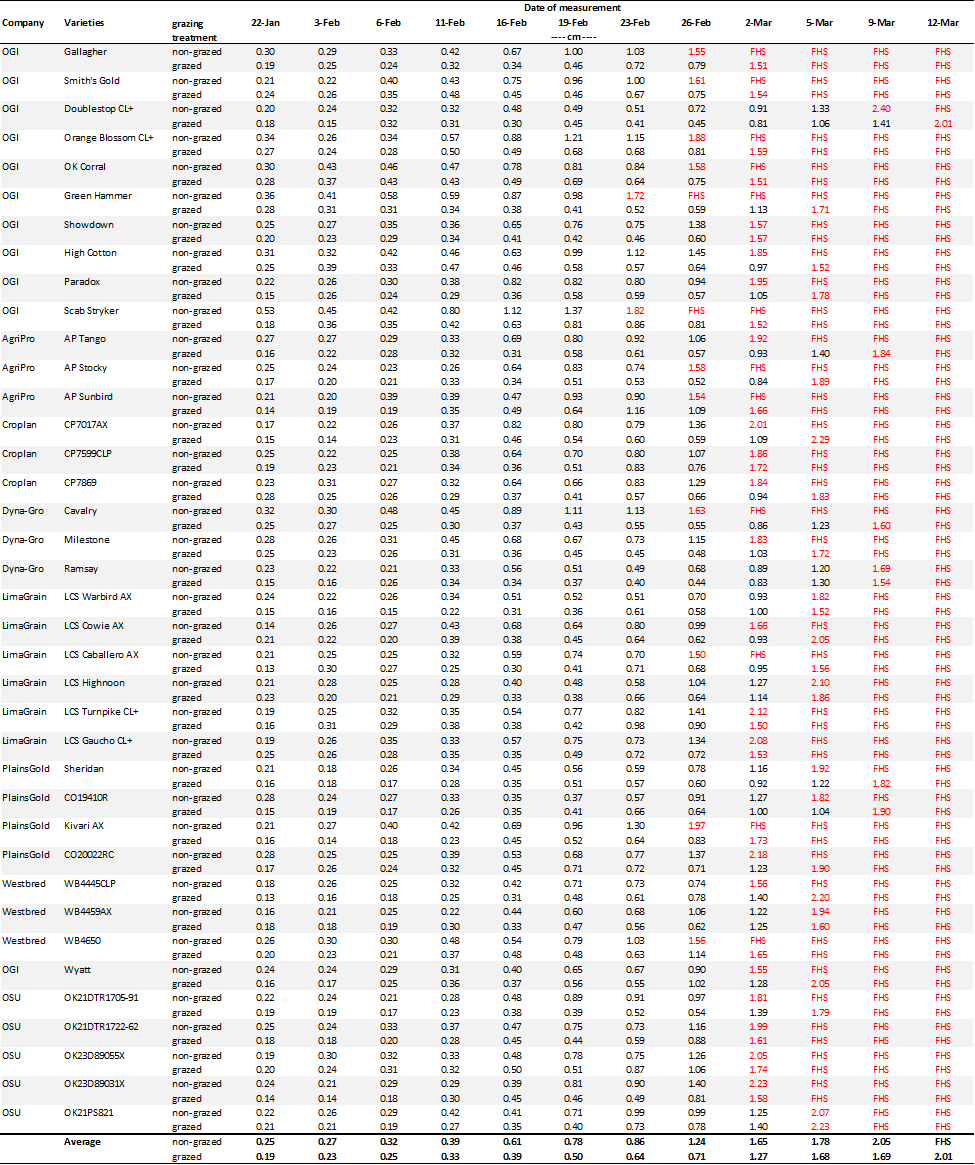
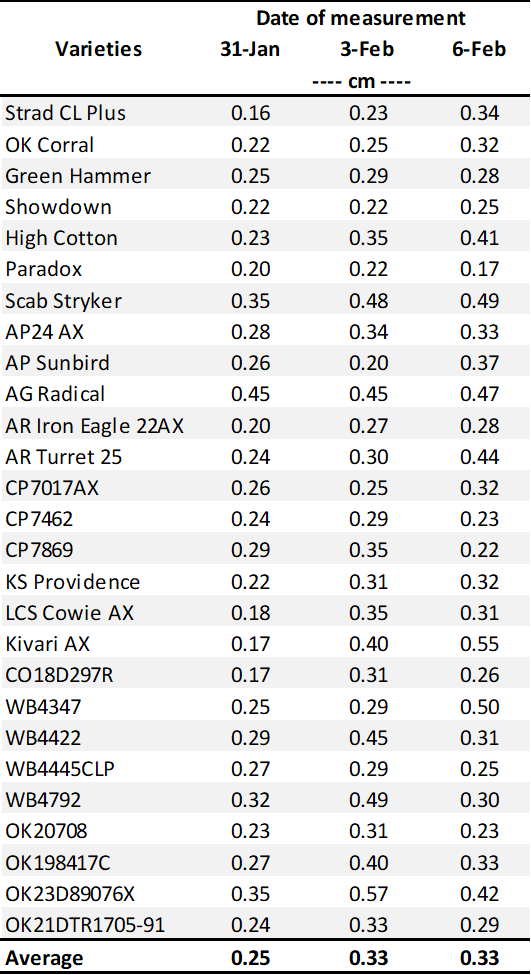
Table 2. First Hollow Stem (FHS) results for each wheat variety collected at Chickasha. Plots were planted on 10/02/24, with all sections left unclipped (i.e., not grazed). The FHS threshold is 1.5 cm (5/8″ or approximately the diameter of a dime). Reported values represent the average of ten measurements per variety. Varieties that exceed the threshold are highlighted in red.
Contact your local Extension office and us if you have questions. 

Additional resources available:

Acknowledgments: 

Tyler Lynch, Senior Agriculturalist

Israel Molina Cyrineu, Graduate Research Assistant

Gilmar Machado, Visiting scholar

Rafael Moreira, Visiting scholar

Kenderson Reis, Visiting scholar

Francisco Arana, Visiting scholar
Photo of a wheat plant with stem split lengthways showing the hollow stem and the developing wheat head

First Hollow Stem Update – 3/4/2025

Amanda de Oliveira Silva, Small Grains Extension Specialist

The first hollow stem stage indicates the beginning of stem elongation or just before the jointing stage. It is a good indicator of when producers should remove cattle from wheat pasture. This occurs when there is 1.5 cm (5/8”, or the diameter of a dime) of hollow stem below the developing grain head (see full explanation). 

The latest FHS results from OSU forage trials in Stillwater (Table 1) and Chickasha (Table 2) are listed below. For an additional resource and wheat update on FHS, see the Mesonet First Hollow Stem Advisor

OSU Small Grains Program monitors FHS occurrence on a twice-per-week basis

As in previous years, we will continue monitoring FHS occurrence in our wheat plots at Stillwater and Chickasha and share updates on this blog. In past years, our forage trials—where FHS samples are collected—were seeded early to simulate a grazed system, though forage was not removed. This method created an accelerated growth environment, allowing us to identify the earliest onset of FHS. Varieties that reach FHS earliest in these trials should be closely monitored in commercial fields.

This year, we are introducing a new approach by simulating grazing with a mower in the forage trial in Stillwater. This will allow us to compare whether varieties reach FHS at different times when grazed versus non-grazed. We hypothesize that the simulated grazing treatment will likely delay FHS relative to the non-grazed treatment, with FHS differences among varieties becoming less pronounced. We also hypothesize that the amount of delay will vary among varieties, such that an early-FHS variety in the non-grazed environment may appear more intermediate in its FHS arrival with canopy removal. This comparison will provide insight into how canopy removal from grazing impacts the timing of reproductive development.

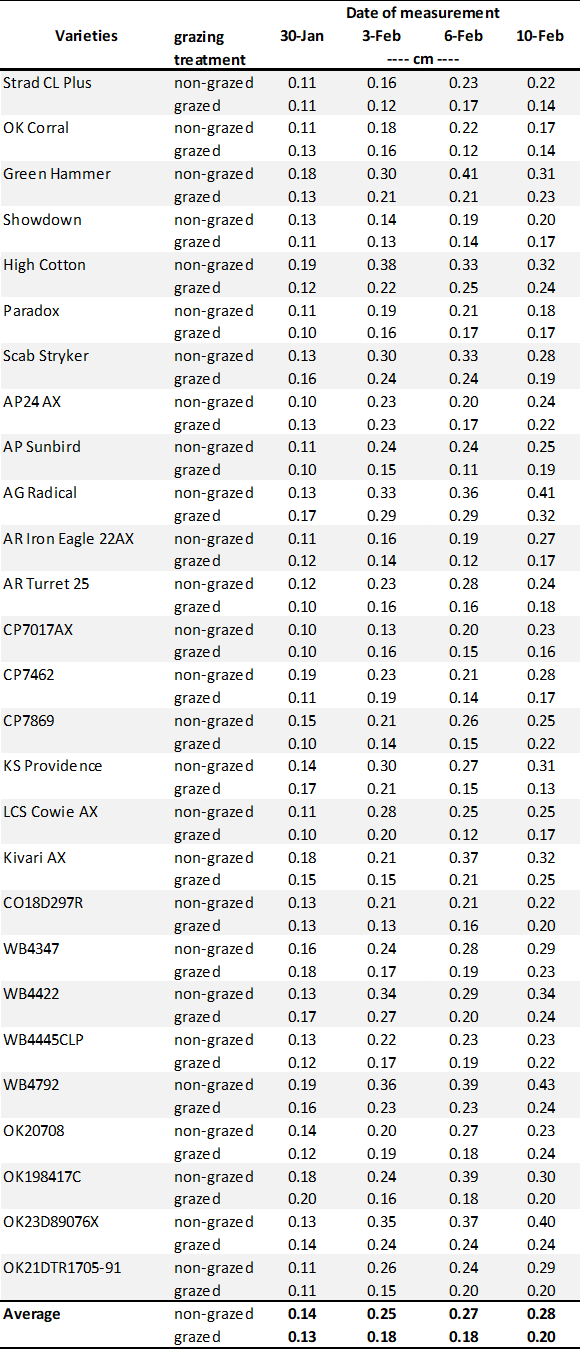
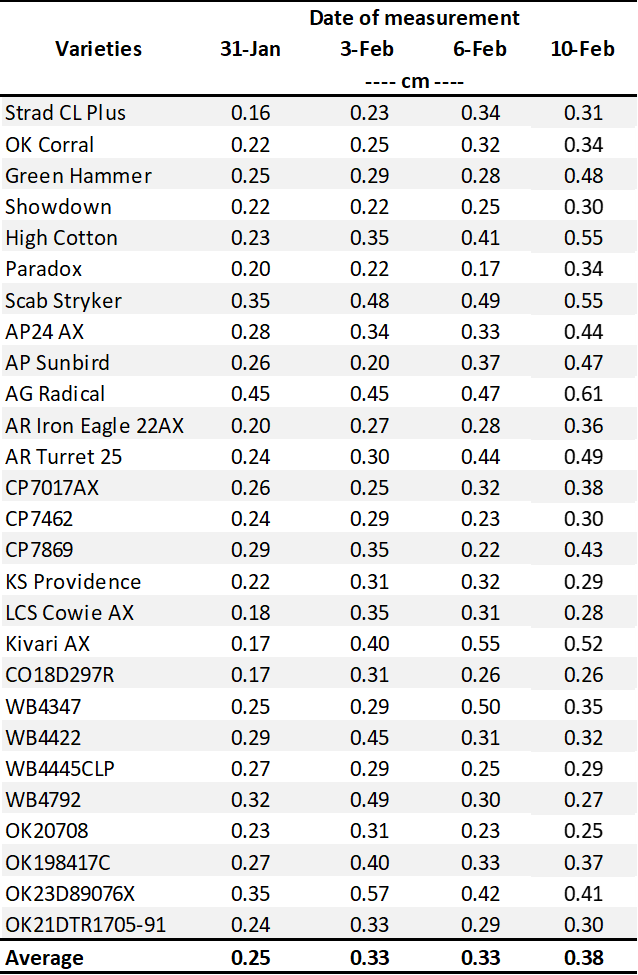
The latest FHS results for each variety planted in our forage trials at Stillwater and Chickasha are summarized below (Tables 1 and 2). Most varieties are still well below the 1.5 cm FHS threshold.

Table 1. First Hollow Stem (FHS) results for each wheat variety collected at Stillwater. Plots were planted on 10/11/24, with one section left unclipped and the other clipped to simulate grazing. The FHS threshold is 1.5 cm (5/8″ or approximately the diameter of a dime). Reported values represent the average of ten measurements per variety. Varieties that exceed the threshold are highlighted in red. For the simulated grazing, plots were mowed on January 3rd, 15th, 28th and on February 10th at a 2.5-3” cutting height, with the frequency representing a light grazing treatment.

Table 2. First Hollow Stem (FHS) results for each wheat variety collected at Chickasha. Plots were planted on 10/02/24, with all sections left unclipped (i.e., not grazed). The FHS threshold is 1.5 cm (5/8″ or approximately the diameter of a dime). Reported values represent the average of ten measurements per variety. Varieties that exceed the threshold are highlighted in red.

Contact your local Extension office and us if you have questions. 

Additional resources available:

Acknowledgments: 

Tyler Lynch, Senior Agriculturalist

Israel Molina Cyrineu, Graduate Research Assistant

Gilmar Machado, Visiting scholar

Rafael Moreira, Visiting scholar

Kenderson Reis, Visiting scholar

First Hollow Stem Update – 2/26/2025

Amanda de Oliveira Silva, Small Grains Extension Specialist

The first hollow stem stage indicates the beginning of stem elongation or just before the jointing stage. It is a good indicator of when producers should remove cattle from wheat pasture. This occurs when there is 1.5 cm (5/8”, or the diameter of a dime) of hollow stem below the developing grain head (see full explanation). 

The latest FHS results from OSU forage trials in Stillwater (Table 1) and Chickasha (Table 2) are listed below. For an additional resource and wheat update on FHS, see the Mesonet First Hollow Stem Advisor

OSU Small Grains Program monitors FHS occurrence on a twice-per-week basis

As in previous years, we will continue monitoring FHS occurrence in our wheat plots at Stillwater and Chickasha and share updates on this blog. In past years, our forage trials—where FHS samples are collected—were seeded early to simulate a grazed system, though forage was not removed. This method created an accelerated growth environment, allowing us to identify the earliest onset of FHS. Varieties that reach FHS earliest in these trials should be closely monitored in commercial fields.

This year, we are introducing a new approach by simulating grazing with a mower in the forage trial in Stillwater. This will allow us to compare whether varieties reach FHS at different times when grazed versus non-grazed. We hypothesize that the simulated grazing treatment will likely delay FHS relative to the non-grazed treatment, with FHS differences among varieties becoming less pronounced. We also hypothesize that the amount of delay will vary among varieties, such that an early-FHS variety in the non-grazed environment may appear more intermediate in its FHS arrival with canopy removal. This comparison will provide insight into how canopy removal from grazing impacts the timing of reproductive development.

The latest FHS results for each variety planted in our forage trials at Stillwater and Chickasha are summarized below (Tables 1 and 2). Most varieties are still well below the 1.5 cm FHS threshold.

Table 1. First Hollow Stem (FHS) results for each wheat variety collected at Stillwater. Plots were planted on 10/11/24, with one section left unclipped and the other clipped to simulate grazing. The FHS threshold is 1.5 cm (5/8″ or approximately the diameter of a dime). Reported values represent the average of ten measurements per variety. Varieties that exceed the threshold are highlighted in red. For the simulated grazing, plots were mowed on January 3rd, 15th, 28th and on February 10th at a 2.5-3” cutting height, with the frequency representing a light grazing treatment.

Table 2. First Hollow Stem (FHS) results for each wheat variety collected at Chickasha. Plots were planted on 10/02/24, with all sections left unclipped (i.e., not grazed). The FHS threshold is 1.5 cm (5/8″ or approximately the diameter of a dime). Reported values represent the average of ten measurements per variety. Varieties that exceed the threshold are highlighted in red.

Contact your local Extension office and us if you have questions. 

Additional resources available:

Acknowledgments: 

Tyler Lynch, Senior Agriculturalist

Israel Molina Cyrineu, Graduate Research Assistant

Gilmar Machado, Visiting scholar

Rafael Moreira, Visiting scholar

First Hollow Stem Update – 2/11/2025

Amanda de Oliveira Silva, Small Grains Extension Specialist

The first hollow stem stage indicates the beginning of stem elongation or just before the jointing stage. It is a good indicator of when producers should remove cattle from wheat pasture. This occurs when there is 1.5 cm (5/8”, or the diameter of a dime) of hollow stem below the developing grain head (see full explanation). 

OSU Small Grains Program monitors FHS occurrence on a twice-per-week basis

As in previous years, we will continue monitoring FHS occurrence in our wheat plots at Stillwater and Chickasha and share updates on this blog. In past years, our forage trials—where FHS samples are collected—were seeded early to simulate a grazed system, though forage was not removed. This method created an accelerated growth environment, allowing us to identify the earliest onset of FHS. Varieties that reach FHS earliest in these trials should be closely monitored in commercial fields.

This year, we are introducing a new approach by simulating grazing with a mower in the forage trial in Stillwater. This will allow us to compare whether varieties reach FHS at different times when grazed versus non-grazed. We hypothesize that the simulated grazing treatment will likely delay FHS relative to the non-grazed treatment, with FHS differences among varieties becoming less pronounced. We also hypothesize that the amount of delay will vary among varieties, such that an early-FHS variety in the non-grazed environment may appear more intermediate in its FHS arrival with canopy removal. This comparison will provide insight into how canopy removal from grazing impacts the timing of reproductive development.

The latest FHS results for each variety planted in our forage trials at Stillwater and Chickasha are summarized below (Tables 1 and 2). Most varieties are still well below the 1.5 cm FHS threshold.

Table 1. First Hollow Stem (FHS) results for each wheat variety collected at Stillwater. Plots were planted on 10/11/24, with one section left unclipped and the other clipped to simulate grazing. The FHS threshold is 1.5 cm (5/8″ or approximately the diameter of a dime). Reported values represent the average of ten measurements per variety. Varieties that exceed the threshold are highlighted in red. For the simulated grazing, plots were mowed on January 3rd, 15th, and 28th at a 2.5-3” cutting height, with the frequency representing a light grazing treatment.

Table 2. First Hollow Stem (FHS) results for each wheat variety collected at Chickasha. Plots were planted on 10/02/24, with all sections left unclipped (i.e., not grazed). The FHS threshold is 1.5 cm (5/8″ or approximately the diameter of a dime). Reported values represent the average of ten measurements per variety. Varieties that exceed the threshold are highlighted in red.

Contact your local Extension office and us if you have questions. 

Additional resources available:

Acknowledgments: 

Tyler Lynch, Senior Agriculturalist

Israel Molina Cyrineu, Graduate Research Assistant

Gilmar Machado, Visiting scholar

Fall Season Review and Ideal Timing for Cattle Removal from Wheat Pasture

Amanda de Oliveira Silva, Small Grains Extension Specialist

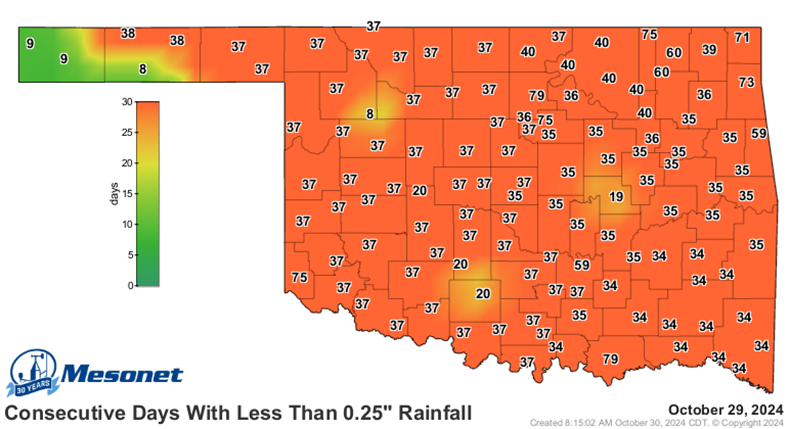
Oklahoma’s wheat planting season was heavily impacted by severe drought. The season was essentially divided into two main rain events that impacted crop growth. Dual-purpose producers who planted before September 22 established good stands in early fall. Warm temperatures promoted rapid growth, but the crop began to decline as drought conditions intensified (Figure 1).

The next significant rain event occurred about a month later, almost past the optimal wheat planting window in some areas. With rain in the forecast for late October, many farmers chose to “dust in” their wheat ahead of the rain, while others opted to wait.

In early November, wheat-growing regions across Oklahoma received between 1 and nearly 8 inches of rain, while the Panhandle saw up to 20 inches of snow from November 5–9 (Figure 2). These events quickly shifted conditions from extreme drought to flooding. Although November temperatures were above average (~53°F), seeds remained in cool, wet soils for weeks, leading to slow or failed germination. Some areas experienced standing water and soil crusting, causing plant losses. As a result, wheat stands across the state vary widely, with some fields establishing well while others remain highly uneven, contributing to overall low fall forage production.

For grain-only wheat sown in late fall, stands are just now closing in some areas. Though still small, the crop appears to be growing well.

Figure 1. Consecutive days with less than 0.25” rainfall as of October 29, 2024.
Figure 2. Four-day rainfall accumulation from November 2 to 6th, 2024.

Yield loss for grazing past first hollow

For the producers with available pasture for spring grazing, preserving some leaf tissue after grazing will be important for future grain crop. Ideally, at least 60% canopy coverage (as measured by the Canopeo app) should remain to support crop recovery after grazing (PSS-2170). Extending grazing for an additional two week past first hollow stem (FHS)—particularly under conditions unfavorable for plant regrowth and canopy recovery—could reduce wheat yield by approximately 60% of its potential (Figure 3).

Figure 3. Grazing past first hollow stem has been shown to reduce grain yield by as much as five percent per day or as little as one percent per day. This figure shows the anticipated yield loss for grazing past first hollow stem given favorable (solid line), unfavorable (dashed line) and average (dotted line) conditions for wheat regrowth following grazing termination (PSS-2147).

The first hollow stem stage as an indicator for cattle removal from wheat pasture

The first hollow stem stage indicates the beginning of stem elongation or just before the jointing stage. It is a good indicator of when producers should remove cattle from wheat pasture. This occurs when there is 1.5 cm (5/8”, or the diameter of a dime) of hollow stem below the developing grain head (Figure 4). This is the optimal period because it gives enough time for the crop to recover from grazing and rebuild the canopy. Also, the added cattle weight gains associated with grazing past the FHS are not enough to offset the value of the potential reduced grain yield (1-5% every day past FHS) (Figure 3). The wheat variety, severity of grazing, time when cattle are removed, and weather conditions after cattle removal determine how much grain yield potential might be reduced.

Figure 4. The first hollow stem growth stage is reached when there is 1.5 cm of hollow stem (about the diameter of a dime) below the grain head. 

Methods for scouting for FHS

  • Check for FHS in a non-grazed area of the same variety and planting date. Variety can affect FHS date by as much as three weeks, and planting date can affect it even more.
  • Dig or pull up a few plants, split the largest tiller longitudinally (lengthways), and measure the amount of hollow stem present below the developing grain head. Plant tissue must be removed below the soil surface, because the developing grain head may still be below the soil surface.
  • If there is 1.5 cm (~5/8″) of hollow stem present, it is time to remove cattle. 1.5 cm is about the same as the diameter of a dime (see picture below).
  • Find detailed information on FHS and grazing by clicking here.

OSU Small Grains Program monitors FHS occurrence on a twice-per-week basis

As in previous years, we will continue monitoring FHS occurrence in our wheat plots at Stillwater and Chickasha and share updates on this blog. In past years, our forage trials—where FHS samples are collected—were seeded early to simulate a grazed system, though forage was not removed. This method created an accelerated growth environment, allowing us to identify the earliest onset of FHS. Varieties that reach FHS earliest in these trials should be closely monitored in commercial fields.

This year, we are introducing a new approach by simulating grazing with a mower in the forage trial in Stillwater. This will allow us to compare whether varieties reach FHS at different times when grazed versus non-grazed. We hypothesize that the simulated grazing treatment will likely delay FHS relative to the non-grazed treatment, with FHS differences among varieties becoming less pronounced. We also hypothesize that the amount of delay will vary among varieties, such that an early-FHS variety in the non-grazed environment may appear more intermediate in its FHS arrival with canopy removal. This comparison will provide insight into how canopy removal from grazing impacts the timing of reproductive development.

The latest FHS results for each variety planted in our forage trials at Stillwater and Chickasha are summarized below (Tables 1 and 2). Most varieties are still well below the 1.5 cm FHS threshold. However, if moisture and warmer conditions develop in the coming weeks, values could increase quickly.

Table 1. First Hollow Stem (FHS) results for each wheat variety collected at Stillwater. Plots were planted on 10/11/24, with one section left unclipped and the other clipped to simulate grazing. The FHS threshold is 1.5 cm (5/8″ or approximately the diameter of a dime). Reported values represent the average of ten measurements per variety. Varieties that exceed the threshold are highlighted in red. For the simulated grazing, plots were mowed on January 3rd, 15th, and 28th at a 2.5-3” cutting height, with the frequency representing a light grazing treatment.

Table 2. First Hollow Stem (FHS) results for each wheat variety collected at Chickasha. Plots were planted on 10/02/24, with all sections left unclipped (i.e., not grazed). The FHS threshold is 1.5 cm (5/8″ or approximately the diameter of a dime). Reported values represent the average of ten measurements per variety. Varieties that exceed the threshold are highlighted in red.

Contact your local Extension office and us if you have questions. 

Acknowledgements: 

Tyler Lynch, Senior Agriculturalist

Israel Molina Cyrineu, PhD student

Gilmar Machado, Visiting Scholar

Rafael Moreira, Undergraduate Visiting Scholar

First Hollow Stem Update – 2/14/2024

Amanda de Oliveira Silva, Small Grains Extension Specialist

First hollow stem (FHS) is the optimal time to remove cattle from wheat pasture. This occurs when there is 1.5 cm (5/8”, or the diameter of a dime) of hollow stem below the developing grain head (see full explanation). The latest FHS results from OSU forage trials in Stillwater (Table 1) and Chickasha (Table 2) are listed below. For an additional resource and wheat update on FHS, see the Mesonet First Hollow Stem Advisor

We use an accelerated growth system to report the earliest onset of FHS stage. Trials are seeded early to simulate a grazed system, but the forage is not removed. Varieties reported here with the earliest FHS date should be the first to monitor in commercial fields. In practice, wheat that is grazed will likely reach FHS stage later than reported here, and differences between varieties will likely be moderate.

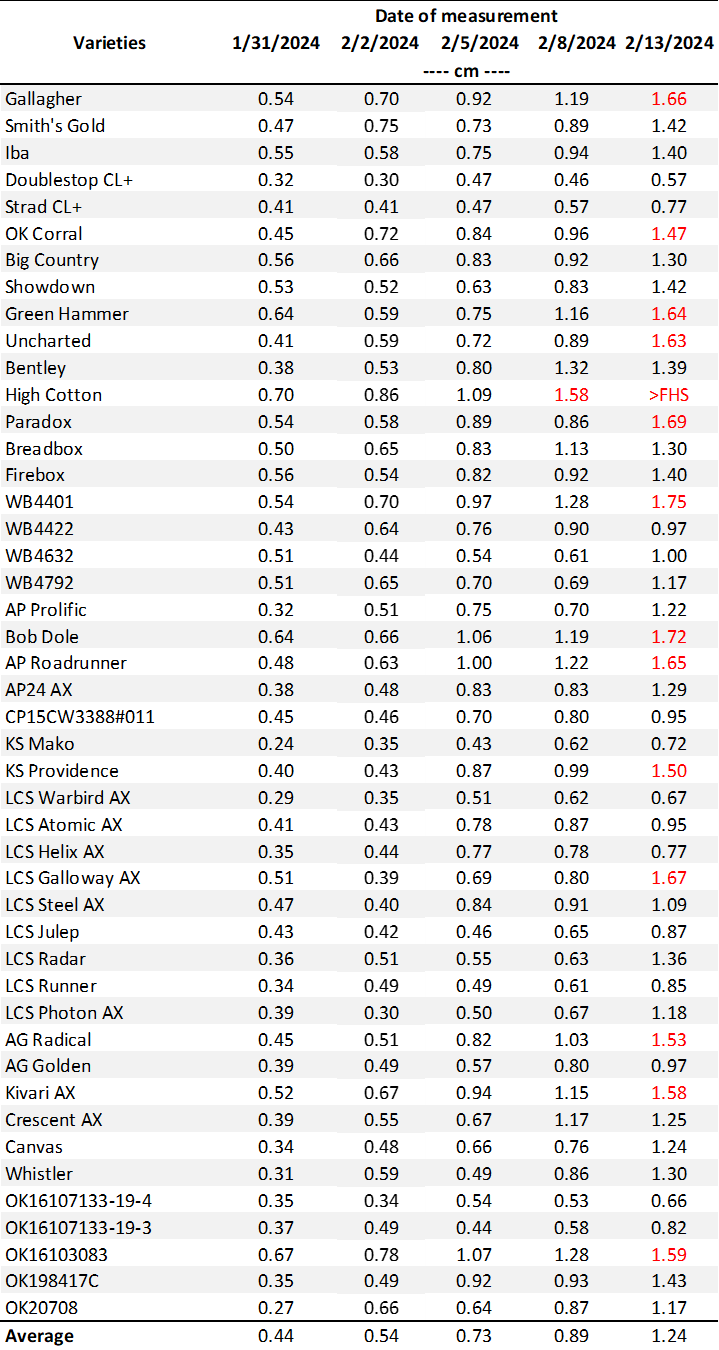
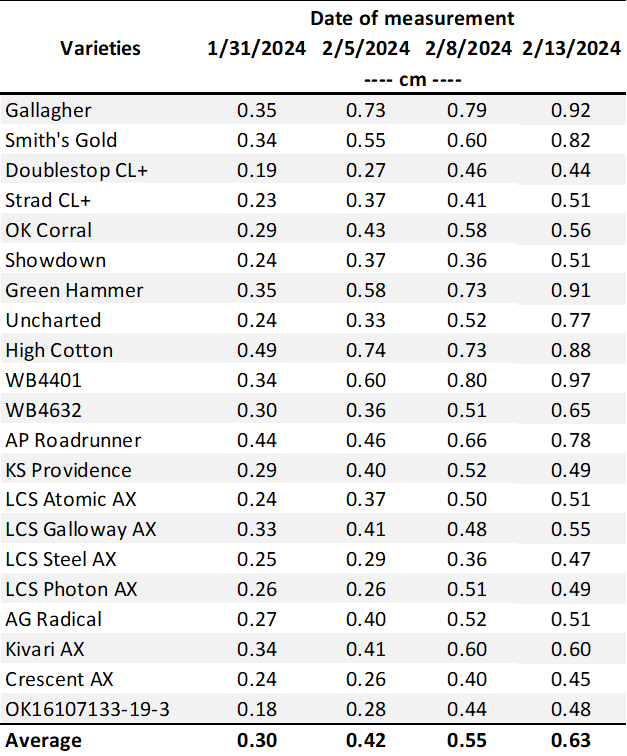
Table 1. First hollow stem (FHS) results for each variety collected at Stillwater. Plots were planted on 09/18/23 but not grazed or clipped. The threshold target for FHS is 1.5 cm (5/8″ or the diameter of a dime). The value of hollow stem for each variety represents the average of ten measurements. Varieties exceeding the threshold are highlighted in red.

Table 2. First hollow stem (FHS) results for each variety collected at Chickasha. Plots were planted on 09/21/23 but not grazed or clipped. The threshold target for FHS is 1.5 cm (5/8″ or the diameter of a dime). The value of hollow stem for each variety represents the average of ten measurements. Varieties exceeding the threshold are highlighted in red.

Contact your local Extension office and us if you have questions. 

Additional resources available:

Acknowledgments: 

Tyler Lynch, Senior Agriculturalist

Israel Molina Cyrineu, Graduate Research Assistant

Samson Abiola, Graduate Research Assistant

Lettie Crabtree, Undergraduate Student

Joao Ferro, Undergraduate Student

First Hollow Stem Update – 2/9/2024

Amanda de Oliveira Silva, Small Grains Extension Specialist

First hollow stem (FHS) is the optimal time to remove cattle from wheat pasture. This occurs when there is 1.5 cm (5/8”, or the diameter of a dime) of hollow stem below the developing grain head (see full explanation). The latest FHS results from OSU forage trials in Stillwater (Table 1) and Chickasha (Table 2) are listed below. For an additional resource and wheat update on FHS, see the Mesonet First Hollow Stem Advisor

We use an accelerated growth system to report the earliest onset of FHS stage. Trials are seeded early to simulate a grazed system, but the forage is not removed. Varieties reported here with the earliest FHS date should be the first to monitor in commercial fields. In practice, wheat that is grazed will likely reach FHS stage later than reported here, and differences between varieties will likely moderate.

Table 1. First hollow stem (FHS) results for each variety collected at Stillwater. Plots were planted on 09/18/23 but not grazed or clipped. The threshold target for FHS is 1.5 cm (5/8″ or the diameter of a dime). The value of hollow stem for each variety represents the average of ten measurements. Varieties exceeding the threshold are highlighted in red.

Table 2. First hollow stem (FHS) results for each variety collected at Chickasha. Plots were planted on 09/21/23 but not grazed or clipped. The threshold target for FHS is 1.5 cm (5/8″ or the diameter of a dime). The value of hollow stem for each variety represents the average of ten measurements. Varieties exceeding the threshold are highlighted in red.

Contact your local Extension office and us if you have questions. 

Additional resources available:

Acknowledgments: 

Tyler Lynch, Senior Agriculturalist

Israel Molina Cyrineu, Graduate Research Assistant

Samson Abiola, Graduate Research Assistant

Lettie Crabtree, Undergraduate Student

Joao Ferro, Undergraduate Student

Estimating the optimal time to remove cattle from wheat pasture – First Hollow Stem Update

Amanda de Oliveira Silva, Small Grains Extension Specialist

The first hollow stem stage (FHS) indicates the beginning of stem elongation, or just before the jointing stage. It is a good indicator for when producers should remove cattle from wheat pasture. This occurs when there is 1.5 cm (5/8”, or the diameter of a dime) of stem below the developing grain head (see full explanation). This is the optimal period because it gives enough time for the crop to recover from grazing and rebuild the canopy. Also, the added cattle weight gains associated with grazing past the FHS are not enough to offset the value of the potential reduced grain yield (1-5% every day past FHS). The wheat variety, severity of grazing, time when cattle are removed, and weather conditions after cattle removal determine how much grain yield potential might be reduced.

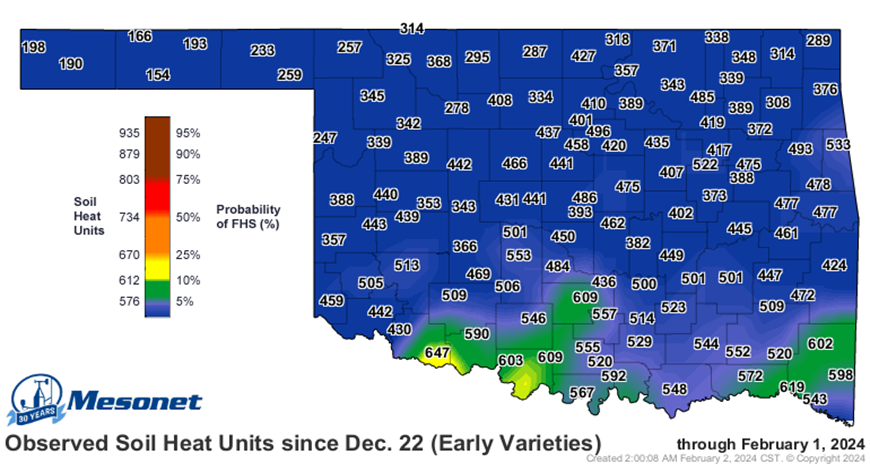
The Mesonet First Hollow Stem Advisor was developed by researchers at Oklahoma State University to help predict when FHS is nearing. This is an online tool available on the Mesonet website. This tool uses soil temperature data to show the current probability of FHS occurrence and 1-week and 2-week projections. With this tool, producers can select their variety from a list of varieties that separates them into three FHS categories: early, middle, and late. Then, maps can be generated to provide the probability of FHS based on current conditions and the 1- and 2-week projections. Charts and tables can also be generated for individual Mesonet sites. Created maps have a color scheme to represent the probability of FHS occurrence. When using this tool, it is recommended to start scouting for FHS from a non-grazed part of the field once the 5% probability is reached (green color). Because stem elongation will begin moving quickly as the air temperature rises, starting your scouting at the 5% level will help give you the time it takes for making the preparations for cattle removal by the time FHS occurs. Methods on how to scout for FHS are listed at the end of this post. For producers who do not scout, it is recommended to remove cattle when the 50% probability level is reached. A 50% probability level indicates that over an evaluated period (e.g., 10 years), FHS would have occurred by that date in 50% of those years (e.g., 5 years). The same interpretation is used for other probability levels.

To give an example of what the tool provides and show some of the FHS conditions around Oklahoma, I have generated some statewide maps below. For producers along the southern Oklahoma border who planted an “early” wheat variety (e.g., Gallagher), now would be the time to go out and start scouting for FHS (Figure 1).

Figure 1. Current FHS probabilities for “early” wheat varieties.

Remember that this tool should be used as a proxy to begin scouting for FHS. The best estimate of FHS is still to split stems from plants in each field to determine where they are developmentally. Another word of caution I want to mention when using the tool is to consider when you were finally able to get stand establishment. If this did not occur until the end of September to the beginning of October, this tool may be a little ahead of where your plants are developmentally. In this case, the tool can still give you the cue to start scouting. Checking for FHS in each field will let you know if you do have some grazing time left.

Methods for scouting for FHS:

  • Check for FHS in a non-grazed area of the same variety and planting date. Variety can affect FHS date by as much as three weeks and planting date can affect it even more.
  • Dig or pull up a few plants and split the largest tiller longitudinally (lengthways) and measure the amount of hollow stem present below the developing grain head. You must dig plants because the developing grain head may still be below the soil surface at this stage.
  • If there is 1.5 cm (~5/8″) of hollow stem present, it is time to remove cattle. 1.5 cm is about the same as the diameter of a dime (see picture below).

More detailed information on FHS can be found at wheat.okstate.edu under ‘Wheat Publications’ then ‘Grazing’ or by clicking here.

The first hollow stem growth stage is reached when there is 1.5 cm of hollow stem (about the diameter of a dime) below the grain head.

Similar to previous years, we will monitor FHS occurrence in our wheat plots at Stillwater and Chickasha and report the findings on this blog. Remember that we use an accelerated growth system to report the earliest onset of the FHS stage. Trials are seeded early to simulate a grazed system, but the forage is not removed. Varieties reported here with the earliest FHS date should be the first to monitor in commercial fields. In practice, wheat that is grazed will likely reach FHS stage later than reported here, and differences between varieties will likely moderate.

The latest FHS results for each variety planted in our forage trial at Stillwater and Chickasha are listed below (Tables 1 and 2).

Table 1. First hollow stem (FHS) results for each variety collected at Stillwater. Plots were planted on 09/18/23 but not grazed or clipped. The threshold target for FHS is 1.5 cm (5/8″ or the diameter of a dime). The value of hollow stem for each variety represents the average of ten measurements. Varieties exceeding the threshold are highlighted in red.

Table 2. First hollow stem (FHS) results for each variety collected at Chickasha. Plots were planted on 09/21/23 but not grazed or clipped. The threshold target for FHS is 1.5 cm (5/8″ or the diameter of a dime). The value of hollow stem for each variety represents the average of ten measurements. Varieties exceeding the threshold are highlighted in red.

First Hollow Stem Update – 3/20/2023

Amanda de Oliveira Silva, Small Grains Extension Specialist

First hollow stem (FHS) is the optimal time to remove cattle from wheat pasture. This occurs when there is 1.5 cm (5/8”, or the diameter of a dime) of hollow stem below the developing grain head (see full explanation). The latest FHS results from OSU forage trials in Stillwater (Table 1) and Chickasha (Table 2) are listed below. For an additional resource and wheat update on FHS, see the Mesonet First Hollow Stem Advisor

We use an accelerated growth system to report the earliest onset of FHS stage. Trials are seeded early to simulate a grazed system, but the forage is not removed. Varieties reported here with the earliest FHS date should be the first to monitor in commercial fields. In practice, wheat that is grazed will likely reach FHS stage later than reported here, and differences between varieties will likely moderate.

Table 1. First hollow stem (FHS) results for each variety collected at Stillwater. Plots were planted on 10/06/22 but not grazed or clipped. The threshold target for FHS is 1.5 cm (5/8″ or the diameter of a dime). The value of hollow stem for each variety represents the average of ten measurements. Varieties exceeding the threshold are highlighted in red.

Table 2. First hollow stem (FHS) results for each variety collected at Chickasha. Plots were planted on 10/07/22 but not grazed or clipped. The threshold target for FHS is 1.5 cm (5/8″ or the diameter of a dime). The value of hollow stem for each variety represents the average of ten measurements. Varieties exceeding the threshold are highlighted in red.

Contact your local Extension office and us if you have questions. 

Additional resources available:

Acknowledgments: 

Tyler Lynch, Senior Agriculturalist

Israel Molina Cyrineu, Graduate Research Assistant

Samson Abiola, Graduate Research Assistant

Cassidy Stowers, Undergraduate Student

Lettie Crabtree, Undergraduate Student

First Hollow Stem Update – 3/16/2023

Amanda de Oliveira Silva, Small Grains Extension Specialist

First hollow stem (FHS) is the optimal time to remove cattle from wheat pasture. This occurs when there is 1.5 cm (5/8”, or the diameter of a dime) of hollow stem below the developing grain head (see full explanation). The latest FHS results from OSU forage trials in Stillwater (Table 1) and Chickasha (Table 2) are listed below. For an additional resource and wheat update on FHS, see the Mesonet First Hollow Stem Advisor

We use an accelerated growth system to report the earliest onset of FHS stage. Trials are seeded early to simulate a grazed system, but the forage is not removed. Varieties reported here with the earliest FHS date should be the first to monitor in commercial fields. In practice, wheat that is grazed will likely reach FHS stage later than reported here, and differences between varieties will likely moderate.

Table 1. First hollow stem (FHS) results for each variety collected at Stillwater. Plots were planted on 10/06/22 but not grazed or clipped. The threshold target for FHS is 1.5 cm (5/8″ or the diameter of a dime). The value of hollow stem for each variety represents the average of ten measurements. Varieties exceeding the threshold are highlighted in red.

Table 2. First hollow stem (FHS) results for each variety collected at Chickasha. Plots were planted on 10/07/22 but not grazed or clipped. The threshold target for FHS is 1.5 cm (5/8″ or the diameter of a dime). The value of hollow stem for each variety represents the average of ten measurements. Varieties exceeding the threshold are highlighted in red.

Contact your local Extension office and us if you have questions. 

Additional resources available:

Acknowledgments: 

Tyler Lynch, Senior Agriculturalist

Israel Molina Cyrineu, Graduate Research Assistant

Samson Abiola, Graduate Research Assistant

Cassidy Stowers, Undergraduate Student

Lettie Crabtree, Undergraduate Student