Wheat streak mosaic virus showing up

Add wheat streak mosaic virus to the list of possible causes of yellowing wheat in Oklahoma. Wheat streak mosaic virus is transmitted by the wheat curl mite, which oversummers on grasses such as volunteer wheat and corn. The wheat curl mite cannot survive more than two weeks without a green host, hence the recommendation to make sure that all grass plants are dead two weeks prior to planting. You can find more information on the wheat curl mite and wheat streak mosaic in OSU Fact Sheet EPP-7328 – Three virus disease of wheat in Oklahoma

The photo below is from our wheat variety trial at Kildare. As you can see there is significant yellowing in some of the plots. Our first thoughts were that either wheat soilborne mosaic virus and/or wheat spindle streak mosaic virus were causing the symptoms; however, the yellowing was present in many varieties that are resistant to both these diseases. The Disease Doctor, Bob Hunger, collected samples for analysis in the OSU Plant Diagnostic Lab. Tests showed that wheat streak mosaic was the culprit.

Wheat streak mosaic virus is responsible for yellowing at our Kildare variety trial. All varieties are affected by the disease, but as shown in this picture the severity of the reaction differs somewhat by variety.

Wheat streak mosaic virus is responsible for yellowing at our Kildare variety trial. All varieties are affected by the disease, but as shown in this picture the severity of the reaction differs somewhat by variety.

We are facing this problem because I did not follow my own recommendations. While the plot area was mostly clean at the time of planting, there was some volunteer wheat present. We planted anyway and sprayed glyphosate right after planting. In the past wheat streak mosaic virus was primarily a northwestern Oklahoma issue and we could get by with late burndown on wheat ground in central Oklahoma. Our Kildare plots are a prime example that this is no longer the case. We have to control volunteer grasses (wheat, corn, grain sorghum, etc.) in a manner that will break the green bridge for at least two weeks prior to planting.

So, what is next for our plots at Kildare? There are some variety differences in reaction to the wheat streak mosaic virus. We will rate plots and include this information in our wheat variety comparison chart. I anticipate the plots will continue to go downhill and it is yet to be determined whether or not we will be able to harvest useable data from the location. We will certainly try again next year and apply our turndown earlier.
 

Winter grain mites in SW OK

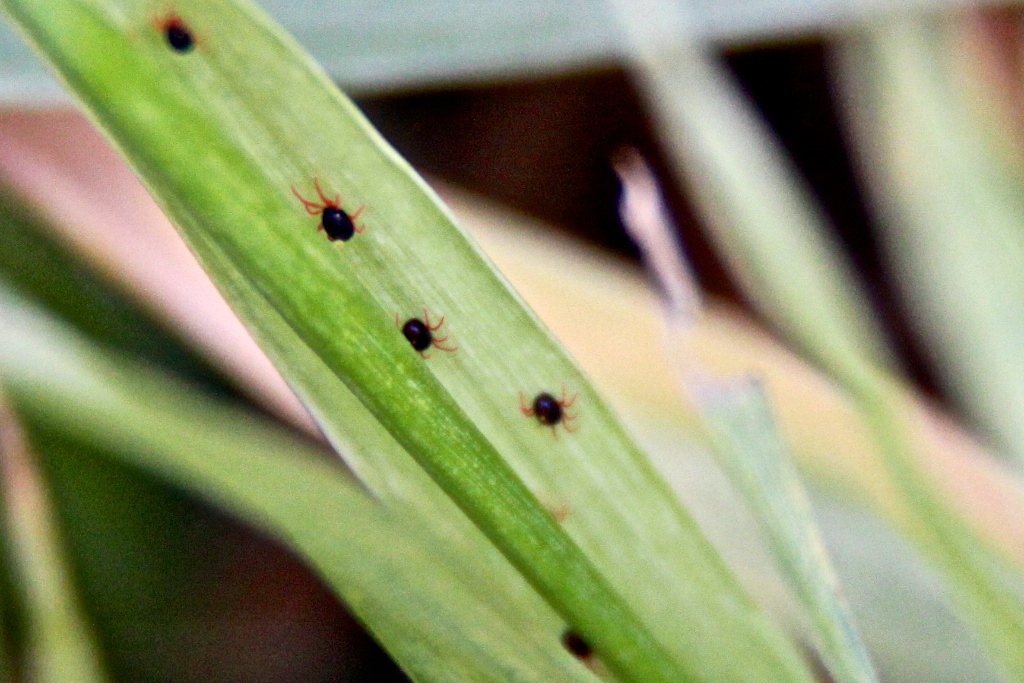
Over the past week, I have received a few reports of winter grain mite activity in southwest Oklahoma. Winter grain mites are small (about 1 mm long) with black bodies and orange-red legs. Winter grain mites complete two generations per year and the adults can live for up to 40 days. The generation we are dealing with now resulted from oversummering eggs laid last spring. The second generation peaks in March/April and results from eggs laid in January/February.

Scouting
Winter grain mites are light sensitive and prefer calm air to windy conditions; therefore, scouting early in the morning, late in the evening, or on cloudy days generally works best. Be sure to look under residue in no-till fields and under clumps of soil in conventional-till fields.

Image

Winter grain mites on wheat near Blair, Oklahoma.

Injury
Winter grain mites feed by piercing plant cells in the leaf, which results in “stippling”.  As injury continues, the leaves take on a characteristic grayish or silverish cast.  Winter grain mites are more likely to cause injury in wheat if it is already stressed due to lack of moisture or nutrients. Also be advised that freeze injury can easily be confused for winter grain mite injury.

When to spray
There are no established thresholds for winter grain mite. Healthy, well-fertilized wheat plants can generally outgrow injury, so it takes large numbers to justify control. If there is injury present AND large numbers of mites (~10 per plant) present in grain only wheat this time of year, you might consider control. If the wheat is to be grazed, I would simply monitor the situation in most cases and only spray if injury became severe.

What to spray
There are not a lot of pesticides with winter grain mite listed on the label, and most products have grazing restrictions. Malathion and methyl parathion have been shown to provide effective control in the past. Consult OSU Current Report 7194 Management of insect and mite pests in small grains for a more complete listing of available pesticides.

Hessian fly strikes back!

Back in 2006 it appeared that Hessian fly was going to be the demise of no-till wheat production in Oklahoma. Early planting, lack of crop rotation, and no-till monocrop wheat all create a favorable environment for Hessian fly, and there were several early-sown fields that were completely lost to the Hessian fly in 2006 & 2007. About that same time OSU release a variety named Duster that was an excellent grazing wheat with good yield potential. Duster also happened to be Hessian fly resistant. (If you are not a Star Wars fan, skip the next sentence) This resistance was a clear proton torpedo in the thermal exhaust port of the fully operational Hessian fly Death Star.

Mature Hessian fly larvae are brown in color and often referred to as flaxseed. Tillers with larvae will not recover and will eventually die and slough off.

Mature Hessian fly larvae are brown in color and often referred to as flaxseed. Tillers with larvae will not recover and will eventually die and slough off.

Over the past four years, I have received very few calls about Hessian fly. It seemed as thought the adoption of Duster and unfavorable environmental conditions resulted in a dramatic reduction in Hessian fly in Oklahoma, but there are some indications Hessian fly is making a return. I have received a few calls about Hessian fly this fall, most of them from southwest Oklahoma. In most cases producers had  either switched to a newer variety that was not Hessian fly resistant or changed to a nonresistant variety because they were displeased with Duster’s performance the past two years.

There are no curative treatments for Hessian fly in wheat. If you currently have a field that is infested with Hessian fly, the first step is to assess the level of infestation. If a plant with four viable tillers has one infected, then the impact on yield might not be that great, as we could have additional tillering in late winter. A field with the majority of tillers infected is likely a good candidate for graze out.

It is never too soon to be thinking of how to limit the impact of Hessian fly on next year’s crop. Planting a resistant variety still remains the most effective technique of combating the Hessian fly menace in Oklahoma for dual-purpose wheat farmers. To determine which varieties are resistant, consult a current OSU Wheat Variety Comparison Chart. Insecticide seed treatments are effective early in the season, but do not typically last long enough to provide season long control in Oklahoma. Cultural practices such as crop rotation and delaying planting until mid October will also help reduce Hessian fly infestations but might not be suitable for all operations.