OSU to open new Lahoma research station facility in honor of Raymond Sidwell on May 13

LAHOMA, Okla. – The life’s work of the late Raymond Sidwell of Goltry is continuing to provide benefits to agricultural producers across the region, thanks to a new facility that bears his name at the Oklahoma State University Division of Agricultural Sciences and Natural Resources’ North Central Research Station.
OSU to open new Lahoma research station facility in honor of Raymond Sidwell on May 13

Bambi (front), Brady (left) and Brenda Sidwell gear up for the grand opening of the Dr. Raymond Sidwell Research Facility on May 13

“We can think of nothing more suitable than to have our new Dr. Raymond Sidwell Research Facility’s grand opening be part of our May 13 Wheat Field Day, as Raymond worked diligently for decades to make the annual field day one of the premier agricultural events in the Southern Plains,” said Tom Coon, OSU vice president for agricultural programs.

Sidwell served as senior station manager for the 143-acre experiment station, located in the heart of wheat production country near Lahoma, from June of 1980 until his passing in December of 2013.

“We invite everyone to join us as we honor Dr. Sidwell and showcase the importance of crop research being conducted through our statewide Oklahoma Agricultural Experiment Station system,” Coon said. “Lahoma is situated on Highway 60 just west of Enid, for those who have never been to the experiment station. Signs will be posted.”

There is no cost to attend the 2016 Wheat Field Day, which will take place from 8:30 a.m. to approximately noon. Lunch will be provided free of charge thanks to the generosity of several sponsors.

Richard Austin, current station superintendent, said the state-of-the-art Dr. Raymond Sidwell Research Facility has a conference room, offices and restrooms compliant with the Americans with Disabilities Act, and features a large open bay design that will facilitate equipment and make possible field day events unimpeded by weather.

“There is a lot of orange integrated into the building, signifying it is an OSU facility, which everyone who knew Raymond recognizes would be important to him,” Austin said.

In addition, Sidwell was known to be fond of porches, so one was incorporated into the front of the facility.

“It’s a nice touch people can enjoy, allowing those who visit the facility to be outside but out of the sun and hopefully remember what Raymond meant to Oklahoma agricultural producers and agribusinesses,” said Randy Raper, OAES assistant director.

More than three decades of Sidwell’s meticulous management of the station allowed for major research efforts in wheat breeding and variety development, soil fertility, weed science, soybean varieties and cropping systems, grain sorghum variety trials, plant pathology and entomology.

Through station educational activities such as the annual Wheat Field Day, Sidwell hosted literally thousands of guests over the years, including agricultural producers, commodity groups, foreign dignitaries, national and state legislators and numerous other officials, representatives and individuals from the public and private sectors.

“Dr. Sidwell was an important part of our Wheat Improvement Team, working to ensure wheat growers were able to take advantage of improved crop varieties and research-based best management practices,” Coon said. “He really was one of the great ambassadors of the land-grant mission, helping Oklahomans improve the quality of life for them, their families and their communities.”

The Sidwells – Raymond, his wife Brenda and their children Bambi and Brady – have long been highly regarded members of Oklahoma’s agricultural and agribusiness communities, and are recognized by their farmer peers as very progressive and proactive production agriculturalists.

An OSU agricultural economics alumnus and president of Sidwell Seed and the newly established Enterprise Grain Company located in Kremlin, Brady Sidwell said his father implemented many science-proven practices into the family operation that were backed by cutting-edge research done at the North Central Research Station under his guidance.

“Our family is both extremely proud as well as humbled to have this opportunity to honor our father in such a way,” he said. “Research and Extension programs at land-grant institutions play a critical role in Oklahoma and American agriculture.”

Sidwell added the family is grateful to be able to do their part in further promoting the work being done by the OSU Wheat Improvement Team.

“As a longstanding certified seed wheat producer, we will continue to utilize the best-in-class seed genetics being released by OSU every year and know that the new Dr. Raymond Sidwell Research Facility will only help this already well-respected program reach new heights,” he said.

For Bambi Sidwell, she always knew how passionate her father was about agriculture, in general, and wheat improvement, in particular.

“Growing up on our family farm near Goltry, our dad had an excitement about continuously improving wheat production,” she said. “He enjoyed sharing ideas with other producers that would have a significant and positive impact on people’s lives and their farming operations. Our dad was keen on maintaining a meticulously clean operation, something we strive to continue today.”

An OSU agribusiness alumna, Bambi said the family is proud to be able to take part in honoring her father in a way that enhances research and educational programs conducted at the Lahoma experiment station. Funding for the new facility was made through the Sidwell family, the Sitlington Trust and OAES.

Spring-planted oat for forage

Spring-planted oat has been a “go to” forage crop for southern Great Plains beef producers for years. It is a good option when winter wheat was not planted in the fall due to wet conditions, or, as is the case this year, when wheat failed to emerge due to drought. Forage production potential for spring-planted oat is around 1,500 to 2,00 lb/ac, but you will need about 60 – 75 lb/ac of nitrogen to make this type of yield. Dr. Daren Redfern and I wrote a fact sheet detailing spring oat production for hay and it can be found by clicking here or going to www.wheat.okstate.edu under “wheat management” then “seeding”. I will provide the Cliff’s Notes version below.

Spring oat can provide an alternate hay or forage source in the spring

Spring oat can provide an alternate hay or forage source in the spring

Seed — Plant 80 – 100 lb/ac of good quality seed that has a germination of no less than 85%. There aren’t many options regarding varieties, so you will likely be limited to whatever seed is available in your area. The key is not to cut back on seeding rate, regardless of variety.

Seedbed — Sow oat seed at approximately 1/2 to 3/4 inches deep. Most producers will fare better with a conventionally-tilled seedbed. You are planting seed at a time of year when the ground is already marginal regarding temperature. Conventionally-tilled seedbeds warm more quickly, which should speed germination. There is one exception to the conventional till recommendation. If you are sowing into a stale seedbed or a failed wheat crop that is very thin, no-till should be okay. Just avoid situations where excessive residue will keep the soil cold.

Grazing — Oat plants should have a minimum of six inches of growth prior to grazing. Unlike fall-seeded cereals, you should not expect a large amount of tillering. A good stand of spring oat can provide a 750 lb animal approximately 60 days of grazing when stocked at 1.5 animals per acre

Hay — Oat should be cut for hay at early heading.

Don’t let armyworms waylay your wheat or canola

By Tom Royer, Extension Entomologist

Heath Sanders could not have made a more prophetic statement for this Extension Entomologist than when he said: “we learn something new about canola every year”. I have learned something new every year that I have been working with canola, and this year is starting to confirm his “prophesy” once again.

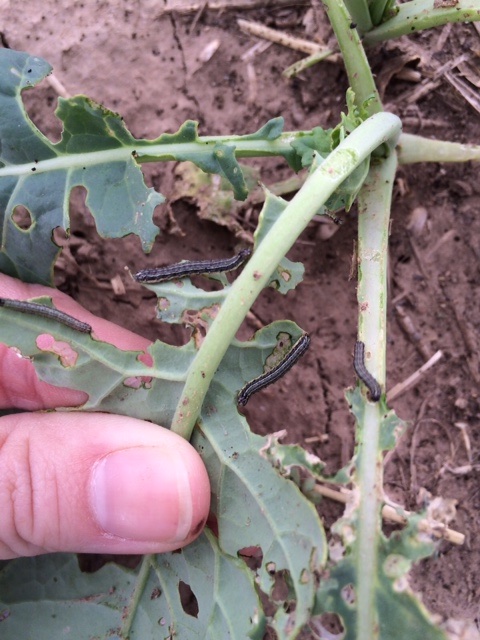
This has been a banner year for fall armyworms. They built up populations early, and migrated into Oklahoma earlier than “normal”, attacking sorghum and pasture grasses. Now, they are ready to attack wheat (once it emerges) and possibly, are marching in to graze on newly emerged canola. Dr. Angela Post, OSU Extension Weeds specialist reported that there were caterpillars that appeared to be either beet armyworm or fall armyworms attacking canola. We are getting confirmation on their identity, but regardless, producers need to be vigilant and protect their fields.

I have already discussed their management in wheat http://entoplp.okstate.edu/pddl/pddl/2015/PA14-41.pdf, but now need to alert canola producers about them attacking seedling canola and eliminating stand.

Look for “window pane” damage in young canola plants and/or cut plants. At this time, with canola so small, armyworm and cutworm caterpillars cannot be allowed the chance to reduce stand. The suggested treatment threshold is 1 or more armyworms per row-foot.

Look for window pane damage in young canola plants. Treatment threshold is one or more worms per foot of row.

Look for window pane damage in young canola plants. Treatment threshold is one or more worms per foot of row.

Consult CR-7194 Management of Insect and Mite Pests of Small Grains and CR-7667 Management of Insect and Mite Pests in Canola for specific insecticides that are registered for control. Keep in mind that beet and fall armyworms can sometimes be difficult to control, so vigilance is needed by follow-up scouting following an application to make sure control is achieved.

Disease and insect issues to consider prior to planting

Planting date:  Much of the winter wheat in Oklahoma is sown with the intent of being used as a dual-purpose crop. In this system wheat is grazed by cattle from late October to early March, and then harvested for grain in early summer.  In a grain-only system, wheat is generally planted in October, but in a dual-purpose system wheat is planted in early to mid-September to maximize forage production.  Planting wheat early significantly increases the likelihood that diseases such as mite-transmitted viruses, the aphid/barley yellow dwarf complex, and root and foot rots will be more prevalent and more severe.  For more detailed information on planting date and seed treatment considerations on wheat, see CR-7088 (Effect of Planting Date and Seed Treatment on Diseases and Insect Pests of Wheat)

Mite-transmitted virus diseases.    These include wheat streak mosaic (WSM), wheat mosaic (formerly called high plains disease), and Triticum mosaic (TrM).  All are transmitted by wheat curl mite (WCMs).  WCMs and these viruses survive in crops such as wheat and corn, as well as many grassy weeds and volunteer wheat.  In the fall, WCMs spread to emerging seedling wheat, feed on that seedling wheat, and transmit virus to the young wheat plants.  Wheat infected in the fall is either killed by the next spring or will be severely damaged.  Seed treatments are not effective in controlling these virus diseases.  However, planting later in the fall (after October 1 in northern OK and after October 15 in southern OK) and controlling volunteer wheat are two practices that provide some control.  It is critical that volunteer wheat is completely dead for at least two weeks prior to emergence of seedling wheat because WCMs have a life span of 7-10 days.  Thus, destroying volunteer wheat at least two weeks prior to emergence of seedling wheat will greatly reduce mite numbers in the fall.  In addition to these cultural controls, two winter wheat varieties (RonL from Kansas and Mace from Nebraska) have resistance to WSM; however, their adaptation to production is limited to northwestern Oklahoma.  For more information on mite-transmitted virus diseases, see OSU Fact Sheet 7328 (Wheat Streak Mosaic, High Plains Disease and Triticum Mosaic:  Three Virus Diseases of Wheat in Oklahoma)

Aphid/barley yellow dwarf (BYD) complex:  Viruses that cause BYD are transmitted by many cereal-feeding aphids.  BYD infections that occur in the fall are the most severe because virus has a longer time to damage plants as compared to infections that occur in the spring.  Several steps can be taken to help manage BYD.  First, a later planting date (after October 1 in northern Oklahoma and after October 15 in southern Oklahoma) helps reduce the opportunity for fall infection. Second, some wheat varieties (e.g., Duster, Endurance, Gallagher, Iba, Doublestop CL+, Bentley, Everest, Winterhawk, Redhawk) tolerate BYD better than other varieties; however, be aware that no wheat variety has a high level of resistance to the aphid/BYD complex.  Third, control aphids that transmit the viruses that cause BYD.  This can be done by applying contact insecticides to kill aphids, or by treating seed before planting with a systemic insecticide.  Unfortunately, by the time contact insecticides are applied, aphids frequently have already transmitted the virus(es) that cause BYD.  Systemic seed-treatment insecticides including Gaucho (imidacloprid) and Cruiser (thiamethoxam) can control aphids during the fall after planting.  This may be particularly beneficial if wheat is planted early to obtain forage.  Be sure to thoroughly read the label before applying any chemical.

Hessian fly:  Hessian fly infestations occur in the fall and spring.  Fall infestations arise from over-summering pupae that emerge when climate conditions become favorable.  Delayed planting (after October 1 in northern Oklahoma, and after October 15 in southern Oklahoma) can help reduce the threat of Hessian fly, but a specific “fly free date” does not exist for most of Oklahoma as it does in Kansas and more northern wheat-growing states.  This is because smaller, supplementary broods of adult flies emerge throughout the fall and winter.  Some wheat varieties are either resistant (e.g. Duster, Gallagher, SY-Southwind, LCS Wizard, Winterhawk) or partially resistant (e.g. Everest, Iba, Jackpot, PostRock, Ruby Lee, SY-Gold, T-153, Tam 304, WB-Stout) to Hessian fly infestations.  Hessian fly infestations can be reduced somewhat by destroying volunteer wheat in and around the field at least two weeks prior to emergence of seedling wheat.  Seed treatments that contain imidacloprid or thiamethoxam will also help reduce fly fall infestations, especially if combined with delayed planting and volunteer destruction.  For more information on Hessian fly, see OSU Fact Sheet: EPP-7086 (Hessian fly Management in Oklahoma Winter Wheat)

Root and foot rots:  These include several diseases caused by fungi such as dryland (Fusarium) root rot, Rhizoctonia root rot (sharp eyespot), common root rot, take-all, and eyespot (strawbreaker).  Controlling root and foot rots is difficult.  There are no resistant varieties, and although fungicide seed treatments with activity toward the root and foot rots are available, their activity usually involves early-season control or suppression rather than control at a consistently high level throughout the season.  Often, there also are different “levels” of activity related to different treatment rates, so again, CAREFULLY read the label of any seed treatment to be sure activity against the diseases and/or insects of concern are indicated, and be certain that the seed treatment(s) is being used at the rate indicated on the label for activity against those diseases and/or insects.  Later planting (after October 1 in northern Oklahoma and after October 15 in southern Oklahoma) also can help reduce the incidence and severity of root rots, but planting later will not entirely eliminate the presence or effects of root rots.  If you have a field with a history of severe root rot, consider planting that field as late as possible or plan to use it in a “graze-out” fashion if that is consistent with your overall plan.  For some root rots, there are specific factors that contribute to disease incidence and severity.  For example, a high soil pH (>6.5) greatly favors disease development of the root rot called take-all.  OSU soil test recommendations factor in this phenomenon by reducing lime recommendations when continuous wheat is the intended crop. Another practice that can help limit take-all and some of the other root rots is the elimination of residue.  However, elimination of residue by tillage or burning does not seem to affect the incidence or severity of eyespot (strawbreaker).

Seed treatments:  There are several excellent reasons to plant seed wheat treated with an insecticide/fungicide seed treatment.  These include:

  1. Control of bunts and smuts, including common bunt (also called stinking smut), loose smut, and flag smut (for more information on flag smut, go to end of this report).  The similarity of these names can be confusing.  All affect the grain of wheat, but whereas common bunt and flag smut spores carryover onseed or in the soil, loose smut carries over in the seed.  Seed treatments are highly effective in controlling all three of these bunts/smuts.  If common bunt (stinking smut) was observed in a field and that field is to be planted again with wheat, then planting certified wheat seed treated with a fungicide effective against common bunt is strongly recommended.  If either common bunt or loose smut was observed in a field, grain harvested from that field should not be used as seed the next year.  However, if grain harvested from such a field must be used as seed wheat, treatment of that seed at a high rate of a systemic or a systemic + contact seed treatment effective against common bunt and loose smut is strongly recommended.  For more information on common bunt & loose smut, see: http://www.entoplp.okstate.edu/ddd/hosts/wheat.htm and consult the “2015 OSU Extension Agents’ Handbook of Insect, Plant Disease, and Weed Control (OCES publication E-832),” and/or contact your County Extension Educator.
  2. Enhance seedling emergence, stand establishment and forage production by suppressing root, crown and foot rots.  This was discussed above under “Root and Foot Rots.”
  3. Early season control of the aphid/BYDV complex.  This can be achieved by using a seed treatment containing an insecticide.  Be sure that the treatment includes an insecticide labeled for control of aphids.
  4. Control fall foliar diseases including leaf rust and powdery mildew.  Seed treatments are effective in controlling foliar diseases (especially leaf rust and powdery mildew) in the fall, which may reduce the inoculum level of these diseases in the spring.  However, this control should be viewed as an added benefit and not necessarily as a sole reason to use a seed treatment.
  5. Suppression of early emerged Hessian fly.  Research suggests that some suppression can be achieved, but an insecticide seed treatment has little residual activity past the seedling stage.

A final consideration for fall 2015:  In the text above, I made reference to “flag smut,” which is a smut of wheat I have not mentioned previously.  Flag smut occurs in the U.S., in particular, the Pacific Northwest.  It also has been reported in the Plains States, being first reported in Kansas in the 1920s.  However, flag smut has not been observed in the Central Plains for many years until this past spring when it was found in around 20 counties in Kansas from April-June.  No flag smut was observed on wheat in Oklahoma in 2015, but much of the wheat in Oklahoma had been harvested when I found out about flag smut occurring in Kansas.  Flag smut is similar to common bunt (stinking smut) in terms of its disease cycle, but spores of this fungus erupt through the leaves rather than replace the wheat grain as with common bunt.  Additionally, leaves and tillers infected with flag smut often are twisted and deformed.

For more information on flag smut, please go to the following links.  The first link is to a press release made in mid-July, 2015 on the finding of flag smut in Kansas.  The second link is a KSU fact sheet on flag smut.

http://www.ksre.ksu.edu/news/story/wheat_smut071515.aspx

http://www.bookstore.ksre.ksu.edu/pubs/MF3235.pdf

By: Dr. Bob Hunger, Extension OSU Wheat Pathologist and Dr. Tom Royer, OSU Extension Entomologist

Spring-planted oat for forage

Spring-planted oat has been a “go to” forage crop for southern Great Plains beef producers for years. It is a good option when winter wheat was not planted in the fall due to wet conditions, or, as is the case this year, when wheat failed to emerge due to drought. Forage production potential for spring-planted oat is around 1,500 to 2,00 lb/ac, but you will need about 60 – 75 lb/ac of nitrogen to make this type of yield. A fact sheet detailing spring oat production for hay can be found at www.wheat.okstate.edu.  I will provide the Cliff’s Notes version below.

Seed — Plant 80 – 100 lb/ac of good quality seed that has a germination of no less than 85%. There aren’t many options regarding varieties, so you will likely be limited to whatever seed is available in your area. The key is not to cut back on seeding rate, regardless of variety.

Seedbed — Sow oat seed at approximately 1/2 to 3/4 inches deep. Most producers will fare better with a conventionally-tilled seedbed. You are planting seed at a time of year when the ground is already marginal regarding temperature. Conventionally-tilled seedbeds warm more quickly, which should speed germination. There is one exception to the conventional till recommendation. If you are sowing into a stale seedbed or a failed wheat crop that is very thin, no-till should be okay. Just avoid situations where excessive residue will keep the soil cold.

Grazing — Oat plants should have a minimum of six inches of growth prior to grazing. Unlike fall-seeded cereals, you should not expect a large amount of tillering. Dr. Redfearn indicates a good stand of spring oat can provide a 750 lb animal approximately 60 days of grazing when stocked at 1.5 animals per acre

Hay — Oat should be cut for hay at early heading.

Banding P as a Band-Aid for low-pH soils.

Great post!

osunpk's avatarDown and Dirty with NPK

In the mid-1970s Dr. Robert Westerman banded 18-46-0 with wheat at planting in a low-pH soil near Haskel Ok. The impact was immediately evident. Soon after Oklahoma State University recommended the “Banding of Phosphate in Wheat: A Temporary Alternative to Liming” Figure 1. This method was a Band-Aid solution for the significant amount Oklahoma winter wheat production area which was either too far from a reliable lime source or under a short term lease contract.

Figure 1. The cover of an extension brochure distributed in Oklahoma during the 1980s. Figure 1. The cover of an extension brochure distributed in Oklahoma during the 1980s.

Still today grain producers throughout the United States commonly farm a large percentage of land that is not their own. In the leasing process agreements can widely vary both on length of the lease and the amount of inputs that the land owner will pay. The wheat belt of Oklahoma is known for having large areas with low soil pH levels…

View original post 1,199 more words

Sensing the N-Rich Strip and Using the SBNRC

osunpk's avatarDown and Dirty with NPK

With the significant swing in temperature over the last few weeks many are chomping at the bit to get outside.  The wheat is starting to respond to the good weather and N-Rich Strips are showing up around the state.  Over the past week I have had several calls concerning the impact of the cold weather on the N-Rich Strips.  Many of the fields either are still small due to limited days of warm weather and growth or may have a good deal of damage to the foliage.  If the field of concern has only a little or no damage and the strip is visible, the time to go is NOW, but if you cannot see the strip and your field has tissue damage or is small, similar to the first two images, then you will need to wait a week or two for sensor based recommendations.  Another situation fits…

View original post 466 more words

Bacterial streak found in Oklahoma

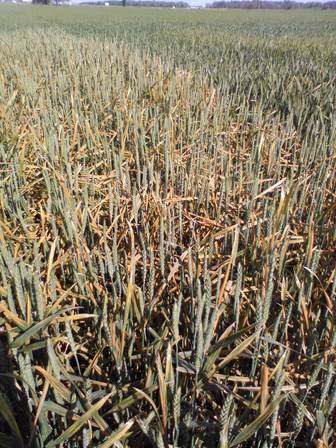
Widespread leaf spotting symptoms in wheat in the variety trial near Chickasha, OK (40 miles southeast of Oklahoma City) now is believed to be caused by bacterial streak (aka black chaff – see pictures below).  Bacterial streak/black chaff is occasionally observed in Oklahoma but typically is not widespread or severe.  This disease is more severe in warm (80 F or so) and humid climates or in wheat grown under irrigation, and often appears after an event such as a late freeze or other event that can cause wounds to facilitate entrance of bacteria into plants.  Lesions on leaves initially appear water-soaked but become elongated dead bands and streaks as time proceeds.

Bacterial streak lesions on leaves initially appear water-soaked but become elongated dead bands and streaks as time proceeds.

Bacterial streak lesions on leaves initially appear water-soaked but become elongated dead bands and streaks as time proceeds.

These dead areas tend to be more common on leaf “bends” where dew forms to enhance infection.  Symptoms on heads and on the stem immediately under the head include dark discoloration, and awns typically show a dark banding.These symptoms often can be confused with leaf spotting caused by the fungi Septoria (Septoria tritici blotch) or Stagonospora (Stagonospora nodorum blotch).

Symptoms on heads and on the stem immediately under the head include dark discoloration

Symptoms on heads and on the stem immediately under the head include dark discoloration

Bacterial streak/black chaff is seed transmitted, so grain from a badly infected field should not be kept for seed wheat.  There are no commercial seed treatments available, and although varieties vary in reaction to this disease, no resistant varieties are known in Oklahoma where bacterial streak/black chaff is not commonly widespread.  This disease may be occurring in other parts of Oklahoma this year, but will be difficult to discern from all the other factors that contribute to general browning and leaf spotting including other diseases (tan spot, septoria, etc), freeze, and drought.

Bob Hunger
Extension Plant Pathologist

Jeff Edwards
Small Grains Extension Specialist

Awns affected by bacterial streak/black chaff typically show a dark banding

Awns affected by bacterial streak/black chaff typically show a dark banding

Wheat disease update – 17 April 2013

Wheat disease updates are written by Dr. Bob Hunger, OSU Extension Wheat Plant Pathologist

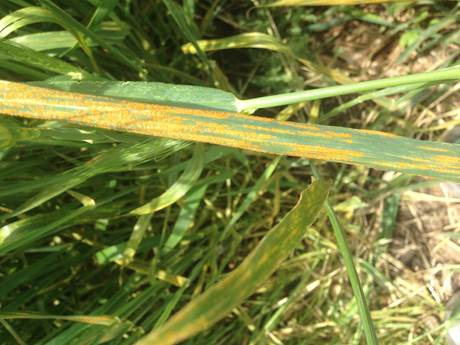
Just a few updates from this week.  First, Mark Gregory (Southwest Area Extension Agronomist) reported the first stripe rust in Oklahoma for 2013 (see photo below).  He found this stripe rust near Paul’s Valley on an Endurance/Duster mix, and “had to look hard to find it.”

Stripe rust on wheat near Pauls Valley, OK was hard to find but was present

Stripe rust on wheat near Pauls Valley, OK was hard to find but was present

David Nowlin (Caddo County Extn. Educator) sent in a wheat sample (Duster) exhibiting symptoms typical of wheat streak mosaic.  If confirmed, this would be the second sample of WSM received from south central and southwestern OK.

Dr. Art Klatt (OSU Wheat Geneticist) has been this last week in Castroville, TX (far southern TX) rating breeder plots/lines for leaf and stripe rust.  He has reported that, “In Castroville there is heavy leaf rust.  We also found a little stripe rust but not enough to take readings and it was beginning to shut down due to temps. “  In Oklahoma, Dr. Klatt has reported seeing heavy powdery mildew in plots near Perkins, OK and at Stillwater, but has not yet seen any leaf or stripe rust.

Monday, 15-Apr, I and Nathalia Grachet (OSU Graduate Student) did plot work at the variety trial near Apache, OK.  Wheat there was approaching Feekes 10.  Flags leaves were out, but for most tillers, heads had not yet moved into the boot.  Freeze damage was the most striking symptoms in this trial and surrounding fields, but tan spot/septoria/stagonospora, powdery mildew, and barley yellow dwarf symptoms also could be found – but, no leaf or stripe rust.

Today (17-Apr) I checked my trials and nurseries here at Stillwater.  Wheat was at “pre” GS 10 with flag leaves fully out but the heads not yet fully moved into the boots.  Even where the boot internode was fully expanded, the head was usually just beginning to move into the boot.  I found powdery mildew low, but no rusts at Stillwater.  Spots indicative of BYDV have appeared.

First hollow stem update 03/13/13

Most wheat varieties are now at first hollow stem. As mentioned in previous posts, the drought has wheat development in Oklahoma a good one to two weeks behind normal. If you still have cattle on wheat pasture it is past time to remove them, as there will be a significant grain yield penalty for further grazing.

CHICKASHA

                 cm of hollow stem

Variety           03/13/13

Jagger             .

Endurance       0.5

Deliver             1.5

Pete                 0.7

Ruby Lee         3.2

Garrison           2.2

Duster              1.9

Gallagher        .

Iba                   2.2

Fuller               .

Everest           .

Jackpot            .

Doans              1.6

Greer               .

CJ                    2.2

Razor               .

Armour             .

WB-Cedar        3.7

WB-Redhawk    .

T153                .

T154                .

T158                0.9

OK08328         0.8

*Average of ten hollow stem measurements in wheat sown 09/20/12 at Chickasha, OK

Stillwater

                 cm of hollow stem

Variety            03/13/13

Jagger                 3.2

Endurance          0.7

Deliver                 1.7

Pete                    0.7

OK Bullet            1.7

OK Rising            2.1

Centerfield          1.4

Ruby Lee             .

Garrison               .

Duster                  1.6

Gallgher              1.8

Iba                       0.4

Billings                2.4

Fuller                   .

Everest                .

Jackpot                4.3

Doans                  .

Greer                   1.2

CJ                        0.4

Razor                   .

Armour                3.2

WB-Cedar            2.7

WB-Redhawk       4.1

WB-Duece CL+    .

WB-Grainfield      0.8

Winterhawk          2.0

WB-4458             .

T153                   .

T154                   .

T158                   0.6

LCS Mint             0.4

LCH08-80            0.5

LCH08 – 109        0.7

T173                   0.7

Byrd                     1.8

Brawl CL+            0.5

TAM 113             1.3

OK09915C          0.9

OK09935C          0.9

OK09634             1.8

OK09125             0.4

OK09528             0.4

OK09729             0.5

OK08328             0.3

*Average of ten hollow stem measurements in wheat sown 09/18/12 at Stillwater, OK

Onset of first hollow stem was affected by severe drought stress