2015-2016 Wheat Crop Overview

This is article is authored by Dr. David Marburger, Dr. Jeff Edwards, Dr. Brett Carver, Robert Calhoun, Dr. Tracy Beedy, and Dr. Bob Hunger


As of right now, the 2015-2016 Oklahoma wheat production is estimated to be approximately 132 million bushels, which is about 34% greater than our 2015 production (Table 1) and 277% greater than production in 2014. Although the estimated harvested acres is lower than 2015, the statewide average yield is projected at 40 bu/ac, and this is a 14 bu/ac (54%) increase compared to 2015 (Table 1). Based on these projections, this would be the largest wheat production since 2012, but the average yield would be a new state record.


Table 1. Oklahoma wheat production for 2015 and 2016 as estimated by USDA NASS, July 2016
2015 2016
Harvested Acres 3.7 million 3.3 million
Yield (bu/ac) 26 40
Total bushels 98.8 million 132 million


The 2015-2016 wheat growing season was unlike most years in Oklahoma, characterized by periods of plentiful rainfall and near optimal growing conditions at critical times. Most wheat was sown into soil with adequate moisture, allowing it to emerge rapidly. The sufficient rainfall and mild temperatures allowed for good fall growth and bumper forage yields. In fact, plants in many non-grazed fields were abnormally large and phenologically advanced going into winter, and there was some concern about winter-kill. With mild temperatures continuing into the winter months, this concern proved to be largely unfounded, and most plants moved to spring green-up without injury.

Similar to 2014 and 2015, January and February were dry months for the Southern Great Plains, and the ample forage growth quickly wicked moisture from the soil. As the wheat crop was coming out of dormancy, there was much concern that the dry conditions would quickly reduce yield potential. Fortunately, rain fell during early- to mid-March as the crop was greening up. This also helped provide grazed wheat the extra boost it needed to recover from grazing injury.

As the wheat crop progressed from green-up to flowering, rain continued to fall, but warmer than normal temperatures moved the crop along quickly, and at the time, most thought harvest would come earlier than normal. As we transitioned into grain fill, temperatures stayed at more ideal levels, favoring kernel filling.

Most wheat was mature in southwestern Oklahoma and in the central part of the state by the end of the May. Widespread rainfall at the end of May delayed most producers from beginning harvest until the first week in June. Dry weather during June allowed much of the wheat crop to be harvested quickly. Unfortunately, some areas of southwestern Oklahoma were plagued by regular and heavy rainfall events that delayed harvest towards the end of the month. Overall, harvest was pretty well wrapped up in the state by the end of June.

Yields throughout Oklahoma were very good overall, with field averages of 30 to 60 bu/ac being the norm. Field averages in the 60 to 90 bu/ac range were not uncommon, and there were even isolated cases of fields averaging over 100 bu/ac. Some producers expressed they will never see their yields this high again in their lifetime, and let’s hope they are wrong! Test weights throughout harvest remained at or above 60 lb/bu for early-harvested fields and did not drop much below the upper 50’s towards the end of harvest. This was a much welcomed change from the low test weights of 2015.

Other than bird cherry oat aphids and wheat curl mites, there were few widespread insect problems in 2015-2016. Aphids were not really on the radar screen of most producers until numbers ballooned in mid-March. As a result, it was not hard to find Barley Yellow Dwarf (BYD) as flag leaves and heads started to emerge. While there was quite a bit of purpling associated with BYD, there was not as much stunting as sometimes observed with early-season transmission of the virus. Wheat Streak Mosaic (WSM) was not as wide spread as in 2015, but it was still a significant issue for many producers in 2016. The favorable growing conditions likely reduced the impact of both BYD and WSM, and yield reductions were not as severe as they might have been in a more drought stressed environment.

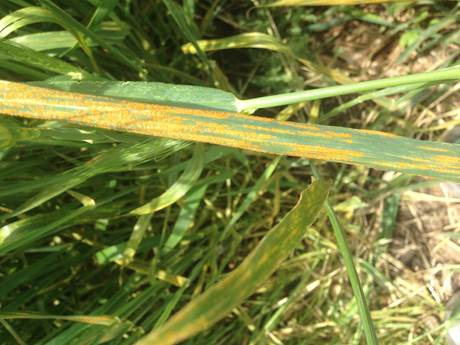
Similar to 2015, stripe rust was the major foliar disease impacting wheat production in 2016. The devastation caused by the 2015 stripe rust epidemic had many producers more open to the idea of foliar fungicide application to susceptible varieties. Many fields throughout the state received at least one fungicide application, and anecdotal evidence from agricultural retailers indicates that Oklahoma wheat acres treated with a foliar fungicide in 2016 was more than double that treated in 2015. Variety trial results from Apache, Chickasha, and Lahoma indicate that producers were well justified in spraying many of these acres. Grain yield of the popular variety Ruby Lee, for example, was increased by 68 bu/ac at Chickasha when treated twice with a foliar fungicide. Our results at Chickasha also show the power of genetic resistance to disease in varieties such as Billings which maintained an 83 bu/ac grain yield without the assistance of a foliar fungicide. In addition to stripe rust, leaf rust was present, but it was at low levels in isolated areas and was not widespread throughout the state.

For information regarding the 2015-2016 OSU Wheat Performance Trials, visit the home page of wheat.okstate.edu. Yield results from all individual locations, as well as a two-page summary of all locations, are posted. For those of you also also interested in the fall forage variety trial information, you can find that here: http://wheat.okstate.edu/variety-testing/forage-yield.
Wheat Disease Update – 08 June 2016

This article is written by Dr. Bob Hunger, Extension Wheat Pathologist.
Department of Entomology & Plant Pathology – 127 Noble Research Center
Oklahoma State University – Stillwater, OK
405-744-9958 (work) – bob.hunger@okstate.edu
 
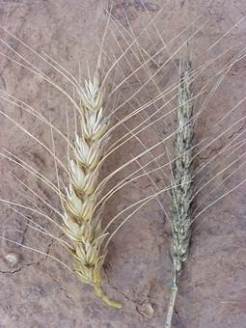
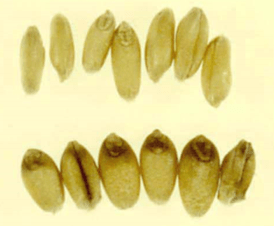
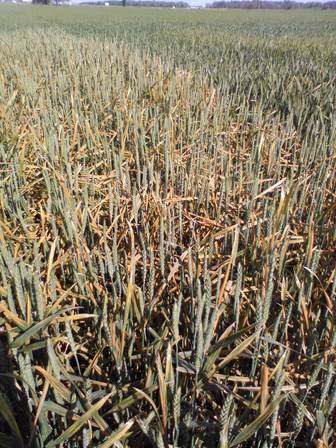
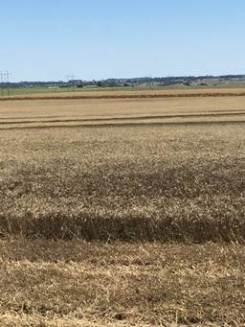
I thought last week was my final update, but over the last week I have received a couple reports of “dark” wheat appearing in wheat fields in Oklahoma such as the one below from near Cordell, OK (Washita County).  This condition, which is known as sooty mold, results from various fungal molds growing on the dead plant matter in the wheat heads.  Sooty mold typically appears when wheat that is turned cannot be cut in a timely manner.  It also seems to be more prevalent where wheat received less than optimum fertility, freeze occurred, or something else resulted in less vibrant plants.  Wet weather, high humidity, and late harvest then provide an ideal climate for secondary fungi to colonize the dead tissue causing the sooty appearance to the wheat.  Typically the sooty mold occurs in areas of a field where moisture and/or humidity is highest.  Test weight and yield can both be affected, but often the biggest problem with sooty mold is that it will result in black point of wheat kernels (photo below).  With time, sooty mold fungi colonize (typically) the germ end of the wheat kernel giving the kernel a black point.  Often such wheat grain has reduced viability, and use of heavily black-pointed wheat as seed wheat should be avoided.  Typically there are no actions to take to prevent sooty mold/black point other than to try to harvest wheat as quickly as possible once the wheat has turned.
 
Sooty mold in wheat field – Andy Evans         Wheat head with sooty mold
image001image002.jpg
Black point of wheat kernels (bottom row of wheat kernels)
image003.png

Wheat Disease Update – 28 May 2016

This article is written by Dr. Bob Hunger, Extension Wheat Pathologist.

Department of Entomology & Plant Pathology – 127 Noble Research Center

Oklahoma State University – Stillwater, OK

405-744-9958 (work) – bob.hunger@okstate.edu

This likely will be my last OK disease update for a while as diseases have mostly “run their course” in Oklahoma and harvest has started.  However, I wanted to provide a follow-up on the late season root rots we saw at several locations across northern Oklahoma.  Symptoms and a description of the setting in the field all pointed to take-all in several of the samples, and Jen Olson in the Diagnostic Lab and I did find visual signs of the take-all fungus.  With further examination, Jen found lesions indicative of Rhizoctonia root rot, and subsequently, she isolatedRhizoctonia.  In another sample with whiteheads that to me appeared to be take all, Jen isolated Parastagonospora nodorum and Fusarium (most likely acuminatum as indicated by DNA sequencing).  In a third sample in which roots appeared clean but the lower stems were discolored, Jen isolated Rhizoctonia, but also more commonly Fusarium (again most likely acuminatum), Curvularia, and Parastagonospora.  Likely some of these were secondary.  So, the exact cause of the whiteheads is somewhat uncertain with Rhizoctonia root rot, take-all, and perhaps some Fusarium-induced root rot all involved.

Reports/excerpts of reports from other states:  Just to let you know, stripe rust appears to be a major disease up through the northern Great Plains and into the mid-east as indicated below.  In many of these states, producers are facing the dilemma of needing two sprays – one to control early season stripe rust and another at flowering to help suppress Fusarium head blight (scab).  We faced a similar dilemma here in Oklahoma but with an early application to control early season stripe rust and then perhaps a later one to control later season foliar diseases and or scab (in eastern/north-eastern OK).  All with low wheat prices, but without the fungicide yield and quality (test weight) would be hurt as with what happened last year.

North Dakota:  Dr. Andrew Friskop (Ast Professor/Cereal Extn Pathologist); North Dakota State University; May 23, 2016:  “Stripe rust was confirmed in two counties in North Dakota on May 23. One sample was from a winter wheat research plot near Fargo (Cass County), and the other was from a winter wheat variety performance trial in southwest ND near Hettinger (Adams Co.). This is approximately 10 days ahead of when stripe rust was detected in North Dakota last year. Given the susceptibility in popular spring wheat and winter wheat varieties, growers will be encouraged to scout especially with rain and dew in the forecast.”

Ohio:  Dr. Pierce Paul (Aso Professor); Ohio State University; May 24, 2016:  “Stripe rust continues to spread across the state of Ohio. This is the most widespread and the earliest I have seen this disease in the state in 13 years. Several varieties in fields south of interstate 70 and west of interstate 71 are severely affected, with substantial damage to the flag leaf well before flowering in multiple hot spots in some field. As we approach flowering in more northern counties, the reports continue to come in. Several fields have already been sprayed for stripe rust, but the dilemma facing most growers is whether to spray for stripe rust or wait to spray for scab in fields not yet at anthesis.”

image001-1

Severe stripe rust in Ohio – Dr. Pierce Paul

South Dakota:  Dr. Emmanuel Byamukama (Ast Professor/Extn Spec – Plant Pathology); South Dakota State University; May 27, 2016:  “I scouted several winter wheat fields this week in East (Codington, Clark) , Central (Beadle, Hyde, Hand, Hughes) and West (Stanley, Jackson, Pennington) South Dakota and I found stripe rust in almost every field I scouted. The majority of these fields have stripe rust just starting while a few have moderate to severe stripe rust. Winter wheat is beginning to head and a few fields are at flowering. With more rain in the forecast, a fungicide may be necessary to manage stripe rust. The challenge is going to be needing another fungicide shortly for scab management. And with the wheat prices not encouraging, producers are concerned applying 2-3 fungicides in winter wheat this season.”

image002.jpg

Severe stripe rust in South Dakota – Dr. Emmanuel Byamukama

Wheat Disease Update – 19 May 2016

Article written by Dr. Bob Hunger, Extension Wheat Pathologist

Department of Entomology & Plant Pathology – 127 Noble Research Center – Oklahoma State University – Stillwater, OK

405-744-9958 (work) – bob.hunger@okstate.edu

      This past week (Monday & Tuesday) I visited the Dr. Raymond Sidwell Station near Lahoma (Major County), and the variety trials near Cherokee (Alfalfa County) and Alva (Woods County) on my way to field days in the panhandle near Balko and Hooker (Texas and Beaver Counties).  Except for in the panhandle, wheat foliage is pretty much done for in Oklahoma.  Wheat in the panhandle was mostly in the kernel forming stage.  Diseases observed on the trip to the panhandle included stripe rust (some still actively sporulating), wheat streak mosaic/high plains, and barley yellow dwarf.  Samples submitted to the Plant Disease and Insect Diagnostic Lab also have tested positive for these viruses.  As indicated in the 14-May update, take-all/root rot has been confirmed from a couple samples received from across central and northern Oklahoma.  Take-all has been confirmed, but it appears another root rot also may be involved.  Jen Olson in the PDIDL is making isolations to help resolve exactly what is involved in terms of root rot disease.  In south-central Oklahoma Aaron Henson (Tillman County Extn Educator) indicated to me that wheat is variable in maturity but he estimates that some harvesting should begin in 1.5 to 2 weeks.  Heath Sanders (Area Extn Agron Spclt located in southwestern OK) indicated much the same – especially if the cool/wet weather becomes more seasonally hot and dry.

Reports/excerpts of reports from other states:

Cereal Rust Bulletin from the Cereal Disease Lab in Minnesota; May 18, 2016:  Highlights/reports in the Cereal Rust Bulletin include:

·        Wheat stem rust was found in a nursery in south central Georgia.

·        Wheat stripe is widespread in the U.S., now reported in 24 states.

·        Oat crown rust has now been reported in Texas, Louisiana, Mississippi, Alabama and North Carolina.

The link to this report is: http://www.ars.usda.gov/SP2UserFiles/ad_hoc/36400500Cerealrustbulletins/16CRB4.pdf

Kansas:  Dr. Erick De Wolf (Extn Plant Pathologist); Kansas State University; May 18, 2016:  “Wheat in central and south central Kansas is at the grain filling stages of growth with many fields at or near the milk stages of kernel development.  Stripe rust is severe in many fields that were not treated with fungicides this year.  Fields of susceptible varieties have stripe rust severity >80% on flag leaves in demonstration plots in Pratt, Kingman, Harper, Barber counties.  The disease was also severe in Ellsworth county were a fungicide demonstration plot had nearly 100% severity of the flag leaves.   The weather this week appears highly conducive for continued disease development and the risk of severe disease appears to be high in Northwestern and West Central KS where low levels of stripe rust have been reported on the flag leaves.  Varieties with genetic resistance are performing well with disease reactions very similar to what we saw in previous years.   To date, T-158, Gallagher, WB-Grainfield, TAM 114, WB Cedar, Sy- Monument have all had moderate levels of resistance to the disease.  This suggests that the race structure of the stripe rust fungus is similar to last year.  Low levels of leaf rust were observed in Kingman, Pratt, Barber and Harper Counties.”

OSU to open new Lahoma research station facility in honor of Raymond Sidwell on May 13

LAHOMA, Okla. – The life’s work of the late Raymond Sidwell of Goltry is continuing to provide benefits to agricultural producers across the region, thanks to a new facility that bears his name at the Oklahoma State University Division of Agricultural Sciences and Natural Resources’ North Central Research Station.
OSU to open new Lahoma research station facility in honor of Raymond Sidwell on May 13

Bambi (front), Brady (left) and Brenda Sidwell gear up for the grand opening of the Dr. Raymond Sidwell Research Facility on May 13

“We can think of nothing more suitable than to have our new Dr. Raymond Sidwell Research Facility’s grand opening be part of our May 13 Wheat Field Day, as Raymond worked diligently for decades to make the annual field day one of the premier agricultural events in the Southern Plains,” said Tom Coon, OSU vice president for agricultural programs.

Sidwell served as senior station manager for the 143-acre experiment station, located in the heart of wheat production country near Lahoma, from June of 1980 until his passing in December of 2013.

“We invite everyone to join us as we honor Dr. Sidwell and showcase the importance of crop research being conducted through our statewide Oklahoma Agricultural Experiment Station system,” Coon said. “Lahoma is situated on Highway 60 just west of Enid, for those who have never been to the experiment station. Signs will be posted.”

There is no cost to attend the 2016 Wheat Field Day, which will take place from 8:30 a.m. to approximately noon. Lunch will be provided free of charge thanks to the generosity of several sponsors.

Richard Austin, current station superintendent, said the state-of-the-art Dr. Raymond Sidwell Research Facility has a conference room, offices and restrooms compliant with the Americans with Disabilities Act, and features a large open bay design that will facilitate equipment and make possible field day events unimpeded by weather.

“There is a lot of orange integrated into the building, signifying it is an OSU facility, which everyone who knew Raymond recognizes would be important to him,” Austin said.

In addition, Sidwell was known to be fond of porches, so one was incorporated into the front of the facility.

“It’s a nice touch people can enjoy, allowing those who visit the facility to be outside but out of the sun and hopefully remember what Raymond meant to Oklahoma agricultural producers and agribusinesses,” said Randy Raper, OAES assistant director.

More than three decades of Sidwell’s meticulous management of the station allowed for major research efforts in wheat breeding and variety development, soil fertility, weed science, soybean varieties and cropping systems, grain sorghum variety trials, plant pathology and entomology.

Through station educational activities such as the annual Wheat Field Day, Sidwell hosted literally thousands of guests over the years, including agricultural producers, commodity groups, foreign dignitaries, national and state legislators and numerous other officials, representatives and individuals from the public and private sectors.

“Dr. Sidwell was an important part of our Wheat Improvement Team, working to ensure wheat growers were able to take advantage of improved crop varieties and research-based best management practices,” Coon said. “He really was one of the great ambassadors of the land-grant mission, helping Oklahomans improve the quality of life for them, their families and their communities.”

The Sidwells – Raymond, his wife Brenda and their children Bambi and Brady – have long been highly regarded members of Oklahoma’s agricultural and agribusiness communities, and are recognized by their farmer peers as very progressive and proactive production agriculturalists.

An OSU agricultural economics alumnus and president of Sidwell Seed and the newly established Enterprise Grain Company located in Kremlin, Brady Sidwell said his father implemented many science-proven practices into the family operation that were backed by cutting-edge research done at the North Central Research Station under his guidance.

“Our family is both extremely proud as well as humbled to have this opportunity to honor our father in such a way,” he said. “Research and Extension programs at land-grant institutions play a critical role in Oklahoma and American agriculture.”

Sidwell added the family is grateful to be able to do their part in further promoting the work being done by the OSU Wheat Improvement Team.

“As a longstanding certified seed wheat producer, we will continue to utilize the best-in-class seed genetics being released by OSU every year and know that the new Dr. Raymond Sidwell Research Facility will only help this already well-respected program reach new heights,” he said.

For Bambi Sidwell, she always knew how passionate her father was about agriculture, in general, and wheat improvement, in particular.

“Growing up on our family farm near Goltry, our dad had an excitement about continuously improving wheat production,” she said. “He enjoyed sharing ideas with other producers that would have a significant and positive impact on people’s lives and their farming operations. Our dad was keen on maintaining a meticulously clean operation, something we strive to continue today.”

An OSU agribusiness alumna, Bambi said the family is proud to be able to take part in honoring her father in a way that enhances research and educational programs conducted at the Lahoma experiment station. Funding for the new facility was made through the Sidwell family, the Sitlington Trust and OAES.

Spring-planted oat for forage

Spring-planted oat has been a “go to” forage crop for southern Great Plains beef producers for years. It is a good option when winter wheat was not planted in the fall due to wet conditions, or, as is the case this year, when wheat failed to emerge due to drought. Forage production potential for spring-planted oat is around 1,500 to 2,00 lb/ac, but you will need about 60 – 75 lb/ac of nitrogen to make this type of yield. Dr. Daren Redfern and I wrote a fact sheet detailing spring oat production for hay and it can be found by clicking here or going to www.wheat.okstate.edu under “wheat management” then “seeding”. I will provide the Cliff’s Notes version below.

Spring oat can provide an alternate hay or forage source in the spring

Spring oat can provide an alternate hay or forage source in the spring

Seed — Plant 80 – 100 lb/ac of good quality seed that has a germination of no less than 85%. There aren’t many options regarding varieties, so you will likely be limited to whatever seed is available in your area. The key is not to cut back on seeding rate, regardless of variety.

Seedbed — Sow oat seed at approximately 1/2 to 3/4 inches deep. Most producers will fare better with a conventionally-tilled seedbed. You are planting seed at a time of year when the ground is already marginal regarding temperature. Conventionally-tilled seedbeds warm more quickly, which should speed germination. There is one exception to the conventional till recommendation. If you are sowing into a stale seedbed or a failed wheat crop that is very thin, no-till should be okay. Just avoid situations where excessive residue will keep the soil cold.

Grazing — Oat plants should have a minimum of six inches of growth prior to grazing. Unlike fall-seeded cereals, you should not expect a large amount of tillering. A good stand of spring oat can provide a 750 lb animal approximately 60 days of grazing when stocked at 1.5 animals per acre

Hay — Oat should be cut for hay at early heading.

Don’t let armyworms waylay your wheat or canola

By Tom Royer, Extension Entomologist

Heath Sanders could not have made a more prophetic statement for this Extension Entomologist than when he said: “we learn something new about canola every year”. I have learned something new every year that I have been working with canola, and this year is starting to confirm his “prophesy” once again.

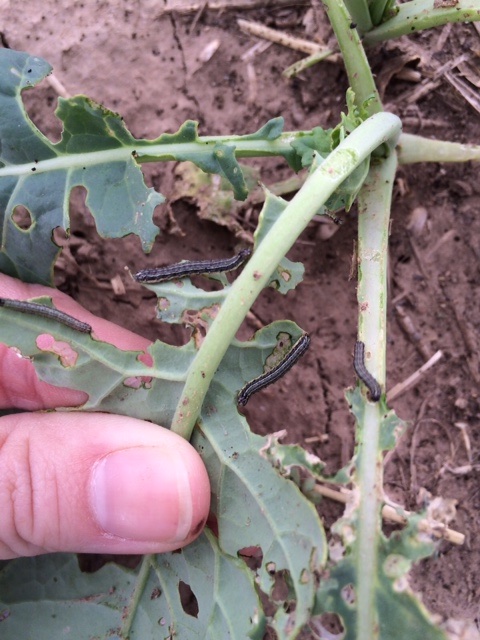
This has been a banner year for fall armyworms. They built up populations early, and migrated into Oklahoma earlier than “normal”, attacking sorghum and pasture grasses. Now, they are ready to attack wheat (once it emerges) and possibly, are marching in to graze on newly emerged canola. Dr. Angela Post, OSU Extension Weeds specialist reported that there were caterpillars that appeared to be either beet armyworm or fall armyworms attacking canola. We are getting confirmation on their identity, but regardless, producers need to be vigilant and protect their fields.

I have already discussed their management in wheat http://entoplp.okstate.edu/pddl/pddl/2015/PA14-41.pdf, but now need to alert canola producers about them attacking seedling canola and eliminating stand.

Look for “window pane” damage in young canola plants and/or cut plants. At this time, with canola so small, armyworm and cutworm caterpillars cannot be allowed the chance to reduce stand. The suggested treatment threshold is 1 or more armyworms per row-foot.

Look for window pane damage in young canola plants. Treatment threshold is one or more worms per foot of row.

Look for window pane damage in young canola plants. Treatment threshold is one or more worms per foot of row.

Consult CR-7194 Management of Insect and Mite Pests of Small Grains and CR-7667 Management of Insect and Mite Pests in Canola for specific insecticides that are registered for control. Keep in mind that beet and fall armyworms can sometimes be difficult to control, so vigilance is needed by follow-up scouting following an application to make sure control is achieved.

Disease and insect issues to consider prior to planting

Planting date:  Much of the winter wheat in Oklahoma is sown with the intent of being used as a dual-purpose crop. In this system wheat is grazed by cattle from late October to early March, and then harvested for grain in early summer.  In a grain-only system, wheat is generally planted in October, but in a dual-purpose system wheat is planted in early to mid-September to maximize forage production.  Planting wheat early significantly increases the likelihood that diseases such as mite-transmitted viruses, the aphid/barley yellow dwarf complex, and root and foot rots will be more prevalent and more severe.  For more detailed information on planting date and seed treatment considerations on wheat, see CR-7088 (Effect of Planting Date and Seed Treatment on Diseases and Insect Pests of Wheat)

Mite-transmitted virus diseases.    These include wheat streak mosaic (WSM), wheat mosaic (formerly called high plains disease), and Triticum mosaic (TrM).  All are transmitted by wheat curl mite (WCMs).  WCMs and these viruses survive in crops such as wheat and corn, as well as many grassy weeds and volunteer wheat.  In the fall, WCMs spread to emerging seedling wheat, feed on that seedling wheat, and transmit virus to the young wheat plants.  Wheat infected in the fall is either killed by the next spring or will be severely damaged.  Seed treatments are not effective in controlling these virus diseases.  However, planting later in the fall (after October 1 in northern OK and after October 15 in southern OK) and controlling volunteer wheat are two practices that provide some control.  It is critical that volunteer wheat is completely dead for at least two weeks prior to emergence of seedling wheat because WCMs have a life span of 7-10 days.  Thus, destroying volunteer wheat at least two weeks prior to emergence of seedling wheat will greatly reduce mite numbers in the fall.  In addition to these cultural controls, two winter wheat varieties (RonL from Kansas and Mace from Nebraska) have resistance to WSM; however, their adaptation to production is limited to northwestern Oklahoma.  For more information on mite-transmitted virus diseases, see OSU Fact Sheet 7328 (Wheat Streak Mosaic, High Plains Disease and Triticum Mosaic:  Three Virus Diseases of Wheat in Oklahoma)

Aphid/barley yellow dwarf (BYD) complex:  Viruses that cause BYD are transmitted by many cereal-feeding aphids.  BYD infections that occur in the fall are the most severe because virus has a longer time to damage plants as compared to infections that occur in the spring.  Several steps can be taken to help manage BYD.  First, a later planting date (after October 1 in northern Oklahoma and after October 15 in southern Oklahoma) helps reduce the opportunity for fall infection. Second, some wheat varieties (e.g., Duster, Endurance, Gallagher, Iba, Doublestop CL+, Bentley, Everest, Winterhawk, Redhawk) tolerate BYD better than other varieties; however, be aware that no wheat variety has a high level of resistance to the aphid/BYD complex.  Third, control aphids that transmit the viruses that cause BYD.  This can be done by applying contact insecticides to kill aphids, or by treating seed before planting with a systemic insecticide.  Unfortunately, by the time contact insecticides are applied, aphids frequently have already transmitted the virus(es) that cause BYD.  Systemic seed-treatment insecticides including Gaucho (imidacloprid) and Cruiser (thiamethoxam) can control aphids during the fall after planting.  This may be particularly beneficial if wheat is planted early to obtain forage.  Be sure to thoroughly read the label before applying any chemical.

Hessian fly:  Hessian fly infestations occur in the fall and spring.  Fall infestations arise from over-summering pupae that emerge when climate conditions become favorable.  Delayed planting (after October 1 in northern Oklahoma, and after October 15 in southern Oklahoma) can help reduce the threat of Hessian fly, but a specific “fly free date” does not exist for most of Oklahoma as it does in Kansas and more northern wheat-growing states.  This is because smaller, supplementary broods of adult flies emerge throughout the fall and winter.  Some wheat varieties are either resistant (e.g. Duster, Gallagher, SY-Southwind, LCS Wizard, Winterhawk) or partially resistant (e.g. Everest, Iba, Jackpot, PostRock, Ruby Lee, SY-Gold, T-153, Tam 304, WB-Stout) to Hessian fly infestations.  Hessian fly infestations can be reduced somewhat by destroying volunteer wheat in and around the field at least two weeks prior to emergence of seedling wheat.  Seed treatments that contain imidacloprid or thiamethoxam will also help reduce fly fall infestations, especially if combined with delayed planting and volunteer destruction.  For more information on Hessian fly, see OSU Fact Sheet: EPP-7086 (Hessian fly Management in Oklahoma Winter Wheat)

Root and foot rots:  These include several diseases caused by fungi such as dryland (Fusarium) root rot, Rhizoctonia root rot (sharp eyespot), common root rot, take-all, and eyespot (strawbreaker).  Controlling root and foot rots is difficult.  There are no resistant varieties, and although fungicide seed treatments with activity toward the root and foot rots are available, their activity usually involves early-season control or suppression rather than control at a consistently high level throughout the season.  Often, there also are different “levels” of activity related to different treatment rates, so again, CAREFULLY read the label of any seed treatment to be sure activity against the diseases and/or insects of concern are indicated, and be certain that the seed treatment(s) is being used at the rate indicated on the label for activity against those diseases and/or insects.  Later planting (after October 1 in northern Oklahoma and after October 15 in southern Oklahoma) also can help reduce the incidence and severity of root rots, but planting later will not entirely eliminate the presence or effects of root rots.  If you have a field with a history of severe root rot, consider planting that field as late as possible or plan to use it in a “graze-out” fashion if that is consistent with your overall plan.  For some root rots, there are specific factors that contribute to disease incidence and severity.  For example, a high soil pH (>6.5) greatly favors disease development of the root rot called take-all.  OSU soil test recommendations factor in this phenomenon by reducing lime recommendations when continuous wheat is the intended crop. Another practice that can help limit take-all and some of the other root rots is the elimination of residue.  However, elimination of residue by tillage or burning does not seem to affect the incidence or severity of eyespot (strawbreaker).

Seed treatments:  There are several excellent reasons to plant seed wheat treated with an insecticide/fungicide seed treatment.  These include:

  1. Control of bunts and smuts, including common bunt (also called stinking smut), loose smut, and flag smut (for more information on flag smut, go to end of this report).  The similarity of these names can be confusing.  All affect the grain of wheat, but whereas common bunt and flag smut spores carryover onseed or in the soil, loose smut carries over in the seed.  Seed treatments are highly effective in controlling all three of these bunts/smuts.  If common bunt (stinking smut) was observed in a field and that field is to be planted again with wheat, then planting certified wheat seed treated with a fungicide effective against common bunt is strongly recommended.  If either common bunt or loose smut was observed in a field, grain harvested from that field should not be used as seed the next year.  However, if grain harvested from such a field must be used as seed wheat, treatment of that seed at a high rate of a systemic or a systemic + contact seed treatment effective against common bunt and loose smut is strongly recommended.  For more information on common bunt & loose smut, see: http://www.entoplp.okstate.edu/ddd/hosts/wheat.htm and consult the “2015 OSU Extension Agents’ Handbook of Insect, Plant Disease, and Weed Control (OCES publication E-832),” and/or contact your County Extension Educator.
  2. Enhance seedling emergence, stand establishment and forage production by suppressing root, crown and foot rots.  This was discussed above under “Root and Foot Rots.”
  3. Early season control of the aphid/BYDV complex.  This can be achieved by using a seed treatment containing an insecticide.  Be sure that the treatment includes an insecticide labeled for control of aphids.
  4. Control fall foliar diseases including leaf rust and powdery mildew.  Seed treatments are effective in controlling foliar diseases (especially leaf rust and powdery mildew) in the fall, which may reduce the inoculum level of these diseases in the spring.  However, this control should be viewed as an added benefit and not necessarily as a sole reason to use a seed treatment.
  5. Suppression of early emerged Hessian fly.  Research suggests that some suppression can be achieved, but an insecticide seed treatment has little residual activity past the seedling stage.

A final consideration for fall 2015:  In the text above, I made reference to “flag smut,” which is a smut of wheat I have not mentioned previously.  Flag smut occurs in the U.S., in particular, the Pacific Northwest.  It also has been reported in the Plains States, being first reported in Kansas in the 1920s.  However, flag smut has not been observed in the Central Plains for many years until this past spring when it was found in around 20 counties in Kansas from April-June.  No flag smut was observed on wheat in Oklahoma in 2015, but much of the wheat in Oklahoma had been harvested when I found out about flag smut occurring in Kansas.  Flag smut is similar to common bunt (stinking smut) in terms of its disease cycle, but spores of this fungus erupt through the leaves rather than replace the wheat grain as with common bunt.  Additionally, leaves and tillers infected with flag smut often are twisted and deformed.

For more information on flag smut, please go to the following links.  The first link is to a press release made in mid-July, 2015 on the finding of flag smut in Kansas.  The second link is a KSU fact sheet on flag smut.

http://www.ksre.ksu.edu/news/story/wheat_smut071515.aspx

http://www.bookstore.ksre.ksu.edu/pubs/MF3235.pdf

By: Dr. Bob Hunger, Extension OSU Wheat Pathologist and Dr. Tom Royer, OSU Extension Entomologist

Spring-planted oat for forage

Spring-planted oat has been a “go to” forage crop for southern Great Plains beef producers for years. It is a good option when winter wheat was not planted in the fall due to wet conditions, or, as is the case this year, when wheat failed to emerge due to drought. Forage production potential for spring-planted oat is around 1,500 to 2,00 lb/ac, but you will need about 60 – 75 lb/ac of nitrogen to make this type of yield. A fact sheet detailing spring oat production for hay can be found at www.wheat.okstate.edu.  I will provide the Cliff’s Notes version below.

Seed — Plant 80 – 100 lb/ac of good quality seed that has a germination of no less than 85%. There aren’t many options regarding varieties, so you will likely be limited to whatever seed is available in your area. The key is not to cut back on seeding rate, regardless of variety.

Seedbed — Sow oat seed at approximately 1/2 to 3/4 inches deep. Most producers will fare better with a conventionally-tilled seedbed. You are planting seed at a time of year when the ground is already marginal regarding temperature. Conventionally-tilled seedbeds warm more quickly, which should speed germination. There is one exception to the conventional till recommendation. If you are sowing into a stale seedbed or a failed wheat crop that is very thin, no-till should be okay. Just avoid situations where excessive residue will keep the soil cold.

Grazing — Oat plants should have a minimum of six inches of growth prior to grazing. Unlike fall-seeded cereals, you should not expect a large amount of tillering. Dr. Redfearn indicates a good stand of spring oat can provide a 750 lb animal approximately 60 days of grazing when stocked at 1.5 animals per acre

Hay — Oat should be cut for hay at early heading.

Banding P as a Band-Aid for low-pH soils.

Great post!

osunpk's avatarDown and Dirty with NPK

In the mid-1970s Dr. Robert Westerman banded 18-46-0 with wheat at planting in a low-pH soil near Haskel Ok. The impact was immediately evident. Soon after Oklahoma State University recommended the “Banding of Phosphate in Wheat: A Temporary Alternative to Liming” Figure 1. This method was a Band-Aid solution for the significant amount Oklahoma winter wheat production area which was either too far from a reliable lime source or under a short term lease contract.

Figure 1. The cover of an extension brochure distributed in Oklahoma during the 1980s. Figure 1. The cover of an extension brochure distributed in Oklahoma during the 1980s.

Still today grain producers throughout the United States commonly farm a large percentage of land that is not their own. In the leasing process agreements can widely vary both on length of the lease and the amount of inputs that the land owner will pay. The wheat belt of Oklahoma is known for having large areas with low soil pH levels…

View original post 1,199 more words