Amanda de Oliveira Silva, Small Grains Extension Specialist
Soil moisture conditions are currently favorable for wheat planting across much of Oklahoma. Many of you may be eager to get seed in the ground, but before moving ahead, it is important to consider a few key points.
Planting date
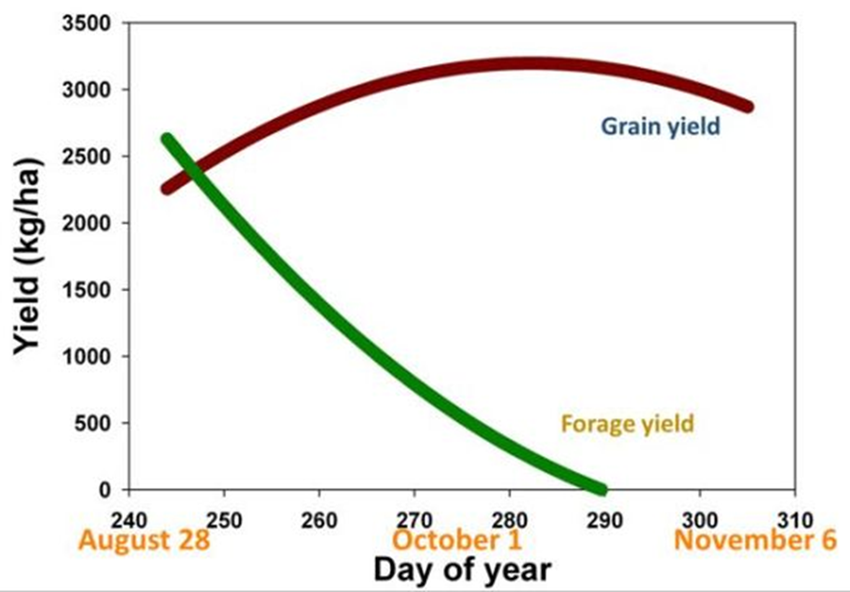
For dual-purpose wheat (grazing + grain), the optimal planting window in most of Oklahoma is mid-September (Figure 1). Planting during this period provides the best balance between fall forage production and maintaining grain yield potential.
Early planting may increase fall forage production but also raises the risk of pests and diseases. It’s usually only recommended for wheat intended for graze-out or dual-purpose.
Grain-only wheat should generally be planted about 3-4 weeks later (mid-October, Figure 1) in many parts of the state. Our recent work shows there is more flexibility than we thought, and planting a little later can still work well depending on the weather.
Figure 1. Forage and grain yield potential in relation to the day of the year. Every 1,000 kg/ha is equal to approximately 900 lb/acre or 15 bu/acre. Ideal planting dates for dual-purpose wheat in Oklahoma are mid-September (i.e., approximately day 260). Planting for grain-only should occur at least 3-4 weeks after dual-purpose planting (i.e., mid-October or approximately day 285).
Watch for Fall Armyworms
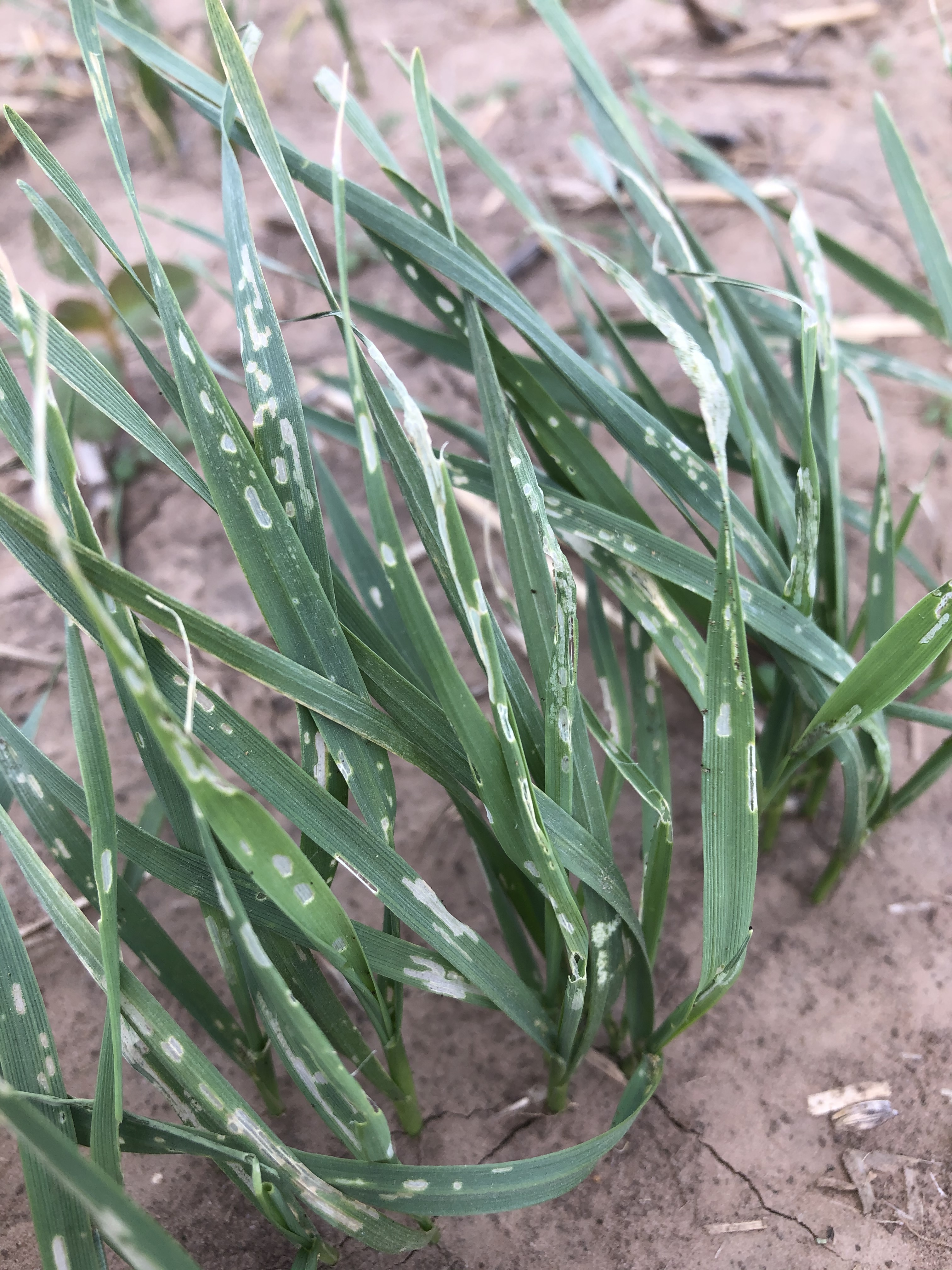
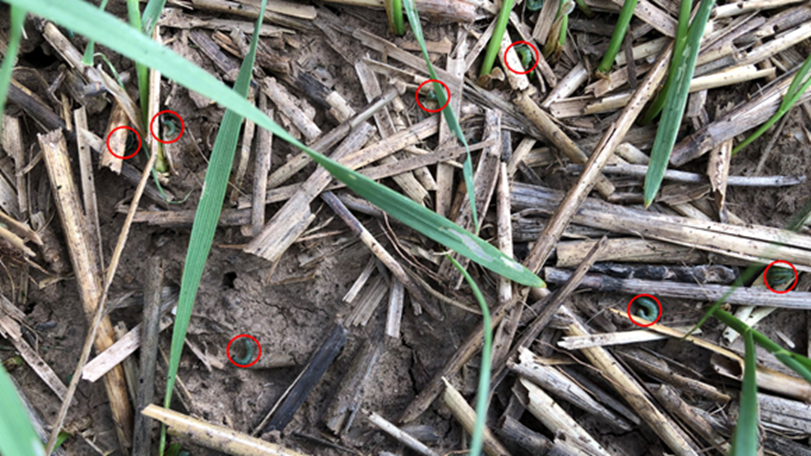
Planting too early increases the chance of fall armyworm infestations. These pests are small and easy to miss, but you might notice “window-pane” feeding on leaves (Figure 2). Check beneath crop residue as well, since they often hide there during the heat of the day (Figure 3).
Figure 2. Symptom of “window paned” leaves shows severe feeding from the fall armyworm. Photo taken on October 2, 2019, at Canadian County by Amanda Silva.
Figure 3. Fall armyworms may be found under crop residue during the day. Photo taken on October 2, 2019 at Canadian County by Amanda Silva.
Volunteer wheat and Virus Risk
Early planting also raises the risk of wheat streak mosaic and Triticum mosaic viruses, spread by the wheat curl mite. Because seed treatments do not control these viruses and few varieties have strong resistance (i.e., Breakthrough), cultural practices are critical:
Control volunteer wheat and other grassy hosts as much as possible.
Ensure volunteer wheat is completely dead for at least two weeks before planting. This breaks the “green bridge” that mites use to move into new seedlings.
Planting a little later can also help lower virus pressure.
We saw significant wheat streak mosaic issues last year, making these steps especially important in 2025.
Other Planting Considerations
Before planting:
Soil test to guide fertility needs and reduce input costs.
Use high-quality seed to promote good germination and stand establishment.
Consider fungicide and insecticide seed treatments to protect against soilborne diseases and early pest pressure such as root rots.
Need More Information?
Your county OSU Extension office is a great resource for information. You can also reach out directly to us:
Amanda de Oliveira Silva, Small Grains Extension Specialist and Ashleigh Faris, Cropping Systems Extension Entomologist
Wheat planting in Oklahoma is off to a slow start due to extremely dry conditions, with only 32% of wheat planted as of October 7 (according to the USDA Crop Progress Report).
For most of Oklahoma, the optimal time to plant dual-purpose wheat is between September 10-20 (approximately day 260 in Figure 1). This period represents a balance between achieving good forage production and minimizing the risk of grain yield loss. Planting earlier can provide more fall forage potential but is usually only recommended if wheat is intended for grazing or “grazeout.” If you are planting wheat just for grain, you could wait at least 2-3 weeks after the dual-purpose planting window, which puts the best time for planting around mid-October (approximately day 285 in Figure 1) in many parts of the state. We have been evaluating how delayed wheat planting affects wheat yields, and it appears there might be more flexibility in the planting window than previously thought. I will be sharing more details about this research in an upcoming post!
Figure 1. Forage and grain yield potential in relation to the day of the year. Every 1,000 kg/ha is equal to approximately 900 lb/acre or 15 bu/acre. Ideal planting dates for dual-purpose wheat in Oklahoma are mid-September (i.e., approximately day 260). Planting for grain-only should occur at least 2-3 weeks after dual-purpose planting (i.e., mid-October or approximately day 285).
Rainfall on September 22 helped some fields in north-central, northwest, and Panhandle areas, and wheat that was planted before then has now emerged and looks good, though more rain would certainly help (Figure 2). In the fields we planted in Panhandle and northwest, we found moisture at about 1.5 inches deep, but the drought is holding us back in other parts of the state.
Figure 2. Wheat field planted before the September 22 rain event. Photo taken on October 8, 2024, near Goltry, OK by Josh Bushong.
For fields where wheat was planted before the September rain, we are receiving reports of fall armyworms. They have been especially active in north-central Oklahoma over the past week. We recommend checking your fields daily after wheat emerges. The worms are small and hard to spot, but you may notice symptoms like “window pane” feeding on the leaves (Figure 3). Also, check under crop residue where they might be hiding from the heat (Figure 4).
Figure 3. Symptom of “window paned” leaves shows severe feeding from the fall armyworm. Photo taken on October 2, 2019, at Canadian County by Amanda Silva.
Figure 4. Fall armyworms may be found under crop residue during the day. Photo taken on October 2, 2019 at Canadian County by Amanda Silva.
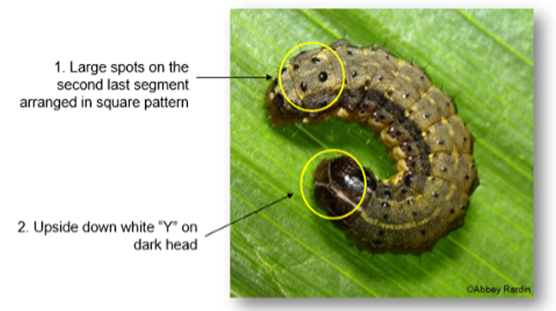
Below is some information regarding monitoring and management of fall armyworms. Typically, fall armyworm population spikes are due to increases in precipitation in summer months. Fall armyworms are identifiable due to the light colored, inverted “Y” on their head (Figure 5). They are generally light tan to light green caterpillars that have a brownish-black head (may appear orangish). For more on the biology of the insect and its identification, check out the EPP-23-21 e-Pest Alert from this past summer.
Figure 5. Image of fall armyworm with two common features used to differentiate it from other caterpillar pests. Image: Corteva Agriscience.
Fall armyworm larvae will begin to consume vegetation in the early instars (1-3) but often this damage goes unnoticed because of the small amount consumed. As fall armyworms enter the later instars (4-6) the rate of consumption increases, and damage is more noticeable. The reason for rapid crop loss at this stage is caterpillars do most of their feeding (80-90%) in the final two instars. Fall armyworms cause damage by defoliating leaves and cutting seedlings at the surface level. Small larvae, unable to completely chew through the leaf, will often feed on vegetation by scraping it, lending to a windowpane appearance (as mentioned above, Figure 3).
Recommendations
Begin scouting for fall armyworms as soon as wheat emerges, particularly in the morning hours at the edges of wheat fields that share borders with pasture or road ditches. Look closely for signs of windowpaned leaves and the fall armyworms themselves. Treat if three to four larvae are found per foot of row AND feeding damage is evident. The early instars are more susceptible to insecticides so early detection is important for providing effective chemical control. While pyrethroid-based insecticides are low-cost, they are often ineffective when populations of fall armyworms are high. Instead, consider mixing a pyrethroid with another product that has chlorantraniliprole or diflubenzuron as an active ingredient which have a longer residual. Chlorantraniliprole products offer the advantage of being rainfast as well as protection against bigger fall armyworms. Products with diflubenzuron have a long residual but do not work well on larger worms. The good news is first frost will help knockback fall armyworm populations, until then producers are encouraged to have fall armyworm scouting as part of their daily routine and to be on the ready to spray when threshold is met.
We will not get relief from fall armyworms until we get a killing frost, so keep vigilant!
Reach out to us and contact your county Extension office for more information.
Amanda de Oliveira Silva, Small Grains Extension Specialist
With severe dry conditions and high temperatures in our state, it is good to consider the possible effects of high temperature and drought on wheat germination and early growth. As of September 19, soil temperature was in the 80’s F across the state and reached 97 F in some areas (Figure 1). Wheat can germinate in soil temperatures from 40 F to 99 F, but temperatures from 54 F to 77 F are optimal.
Figure 1. Soil temperature across Oklahoma. Figure courtesy Oklahoma Mesonet.
Wheat germination and emergence in HOT soils
Is the variety I am planting high-temperature germination sensitive?
High-temperature germination sensitivity is a more elaborate way of saying that some wheat varieties do not germinate well in hot soil conditions. This is not to say that the seed will not germinate, but it may not germinate until the soil temperature has lowered. Keep in mind too that this sensitivity can vary from year to year. For example, a sensitive variety like Ruby Lee may germinate fine in 90°F soils one year and only produce a 10% stand in the same soil conditions the next. When sowing early, it is best to plant varieties first that do not have high-temperature sensitivity (e.g., Duster, Gallagher). Soil temperatures typically begin to cool by about September 20 due to lower air temperatures and/or rainfall events. However, our summer temperatures seem to be sticking around for longer this year. Waiting until at least mid-September to plant sensitive varieties can help reduce the risk of this issue. A high temperature germination sensitivity rating for wheat varieties can be found in the OSU Fact Sheet (available by clicking here). An updated version of this factsheet will be published soon.
Coleoptile Length
Hot soil conditions at sowing also reduce coleoptile length. The coleoptile is the rigid, sheath-like structure that protects the first true leaf and aids it in navigating and reaching the soil surface. Once the coleoptile breaks the soil surface, the coleoptile will stop growing, and the first true leaf will emerge. If the coleoptile fails to reach the soil surface, the first true leaf will emerge below ground and take on an accordion-like appearance (Figure 2A-B). If this happens, the plant will die.
Figure 2A and 2B. Example of two different wheat seedlings in which the coleoptile failed to break the soil surface. The first true leaf emerged below the soil surface and resulted in this accordion-like appearance.
The coleoptile length for most wheat varieties today can allow for the seed to be safely planted up to 1.5 inches deep. Under hot soil conditions though, the coleoptile length tends to be decreased. Therefore, “dusting in” early-sown wheat at ¾ to 1 inch depth and waiting on a rain event may result in more uniform emergence than trying to plant into soil moisture at a deeper depth, if soil moisture is not available in the top 1 to 1.5 inches of the soil profile. A rating for coleoptile length for wheat varieties can be found in the OSU Fact Sheet PSS-2142 Wheat Variety Comparison. We are also working on updating this.
Wheat germination and emergence in DRY soils
The most important physiological requirement for wheat to germinate and sustain the developing seedling is soil water. Therefore, planting decisions should be based on a combination of available soil moisture and expected rainfall. In addition, other factors such as adequate seeding depth, sowing date, soil fertility, seed treatment, seed quality, etc., should be considered to guarantee good crop establishment. For more information, check the materials on our website.
Wheat seed needs a minimum water content of 35 to 45% of its dry weight to initiate germination, and germination will be more complete as moisture levels increase. Dry soils can still maintain a relative humidity of 99%, which can provide enough moisture for seeds to germinate. It might just take longer than with free-moisture availability. My concern with the current situation in Oklahoma is the severe drought we are in and the lack of rain in the forecast. In some cases, we could have enough moisture to start the germination process in some regions of the state, but seedling emergence and growth could be compromised if we do not see any rain soon.
What happens if the soil completely dries out before wheat emergence?
There are three phases during the germination process: water absorption, activation when the seed coat is ruptured, and visible germination when the radicle emerges, followed by the seminal roots and coleoptile. These processes will start and stop depending on soil moisture availability. Thus, if the soil dries out before the roots and shoots are visible, the seed remains viable, and germination will be paused and continue once water is available. However, if the soil dries out after those structures are emerged (approximately 4-5 days after germination has begun), the seedling may not tolerate the lack of water, resulting in incomplete or loss of stand.
What should I do then? Choose your battle!
The optimal time for planting wheat in central Oklahoma is around mid-September for a dual-purpose system or around mid-October for a grain-only system (Figure 3). With the current forecast, we are planning to wait another 7-10 days to decide on our dual-purpose and forage trials. There are different ways we can go about it, but we must remember that there is always risk involved when planting wheat in dry and hot soil conditions.
Figure 3. Forage and grain yield potential in relation to the day of the year. Every 1,000 kg/ha is equal to approximately 900 lb/acre or 15 bu/acre. Ideal planting dates for dual-purpose wheat in Oklahoma are mid-September (i.e., approximately day 260). Planting for grain-only should occur at least 2-3 weeks after dual-purpose planting (i.e., mid-October or approximately day 285).
If you decide to dust in your wheat and wait for a rainfall event to drive germination, watch your seeding depth. The optimum seeding depth to plant wheat is about 1-1.5” deep. We typically do not have as many issues with winterkill in Oklahoma as in more northern states, so I am comfortable with dusting in at about 0.75 – 1” deep. Planting at 0.5” or less is too shallow in most circumstances. Also, there is always a chance for a pounding rainfall event and subsequent soil crusting, which makes it difficult for the coleoptile to push through the soil surface and may result in poor emergence. Fields with stubble cover may be less affected and reduce the risk of soil crusting. If we receive light rain in the following weeks, that could cause wheat to emerge, but it may not be enough for wheat to continue growing. Most of the fields do not have good subsoil moisture, either.
If subsoil moisture is available and you decide to plant deeper to reach moisture, be careful with the coleoptile length of your variety, and make sure it has a long-enough coleoptile that will allow emergence if conditions are favorable. Consider increasing seeding rate to compensate for reduced emergence, which is prone to occur in this situation.
Should we wait for rain to plant then? This is a farm-by-farm call and it depends on which source of risk you find most comfortable. Personally, I would rather plant my wheat in the optimal planting window and adequate seeding depth than waiting for a rain that may take too long to happen or missing my optimal planting window. If the latter is the case, consider bumping seeding rate to try to compensate for the reduced time for tillering (especially in a grain-only system). Planting wheat at optimal time allows for more time for root growth in seedlings, helping the crop to establish more quickly under dry conditions and possibly help the plant to scavenge for water that is available deeper in the soil profile.
Are there any specific agronomic traits that could help wheat seedling growth under water stress?
Traits that will help with seedling growth in dry conditions are coleoptile length potential, which allows to plant a little deeper in moisture and good emergence (if deep planting is the practice of your choice). There are indications that sowing wheat varieties with larger seed may help to reduce the negative effects of drought during early growth (Mian and Nafziger, 1994). In general, the greater reserves of larger seed result in faster germination and crop establishment by increasing root growth and tiller production. Keep in mind, however, there are varieties with small seed size that germinate more rapidly than larger seeded varieties, owing to their differential response to available moisture.
Kickoff of the college football season and the start of wheat planting are Labor Day traditions in the southern Great Plains. Many producers are waiting to see if rain forecasted for this weekend materializes, but it is likely that forage-based wheat farmers will start sowing wheat next week whether it rains or not. This means sowing wheat into hot soil conditions which can cause wheat germination and emergence issues. Given the potential problems, there are a few questions producers should ask themselves prior to planting into soil temperatures >90F.
If the wheat coleoptile does not break the soil surface, the germinating wheat plant will not survive.
Will you have to plant deep to reach moisture? That first structure protruding from a germinating wheat seed is actually not a leaf. It is the coleoptile. The wheat coleoptile is a rigid structure whose sole purpose is to “punch through” the soil surface so that the first true leaf emerges above the soil surface. If this does not happen, the first true leaf will try to extend below the soil surface, turn yellow, and take on an accordion-like appearance (picture above). Modern semi-dwarf wheat varieties have shorter coleoptiles than older, tall wheat varieties and coleoptile length is shortened even further by hot soil conditions. So it is important to plant a variety with a longer coleoptile length (e.g. Garrison or Doans) if planting deeply into hot soils. A rating of coleoptile lengths for wheat varieties can be found in OSU Fact Sheet 2141 OSU Wheat Variety Comparison Chart available at www.wheat.okstate.edu or at the direct link to the publication here.
Is the variety high temperature germination sensitive? High temperature germination sensitivity is a fancy way of saying that some wheat varieties simply don’t germinate well in hot soil conditions (e.g. 2174, Overley). The extent of the sensitivity varies by year, so Overley might germinate fine in 95F soils one year and produce a 10% stand in the same soil conditions the next. When sowing early, it is best to plant varieties that do not have high temperature germination sensitivity (e.g. Duster, Gallagher, or Armour). Soil conditions generally cool due to lower ambient temperatures or cooling rains by about September 20; however our summer temperatures seem to be arriving late this year, so it is best to know the level of germination sensitivity in the variety you are planting. A rating of high temperature germination sensitivity for wheat varieties can be found in the variety comparison chart linked above. A more detailed explanation of the phenomenon can be found in OSU Fact Sheet PSS 2256 Factors affecting wheat germination and stand establishment in hot soils (available by clicking here).
Partial funding for the research included in this blog post was provided by USDA Project No.2012-02355 through the National Institute for Food and Agriculture’s Agriculture and Food Research Initiative, Regional Approaches for Adaptation to and Mitigation of Climate Variability and Change
Should we plant by seeds per acre or pounds per acre? I will certainly not settle this issue in a single blog post, but I will provide ammunition for those in both camps in the discussion below. Before the discussion begins, I must come clean by acknowledging that when I came to Oklahoma ten years ago, I was solidly in the seeds per acre camp. As a crop consultant I spent most of October every year calibrating clients’ drills each time they changed varieties or field conditions changed. I was certainly not willing to entertain the notion that this could have been wasted time. After reading the published research on the subject, however, I have moved to the pounds per acre camp and will probably remain there unless seed prices increase dramatically OR seed quality improves significantly (I will elaborate below).
Why pounds per acre works The published research on wheat seed size clearly shows that larger seeds produce more vigorous plants which result in more and larger tillers per plant. Additionally, the research indicates that if you sow the same number of seed of both small and large seeds from the same variety, the large seed will have an approximate 10% better yield potential. While not expressly mentioned in the research, it is reasonable to assume that small seed will produce less fall forage as well. For more reading on this subject consult Kansas Agricultural Experiment Station, Keeping Up With Research numbers 74 (1984) and 101 (1991).
We have established that larger seeds are better on a seed vs. seed basis; however, there are 36% more seeds in a bushel of wheat with 15,000 seeds per pound as compared to a bushel of wheat with 11,000 seeds per pound. So, when sowing by pounds per acre the additional seeds compensate for the smaller seed size and generally results in the same total number of tillers . This compensation effect means that planting by pounds per acre works for a wide range of seed sizes and varieties. This should not be taken as an excuse to plant poor quality seed, as the compensatory effect is not the same if you are sowing shriveled, light, or head-scab damaged seed.
When seeds per acre is a better option If you are sowing high-quality, large seed, then seeds per acre might be a better option. To get this type of seed usually requires a favorable environment during grain fill, adequate fertility, and a foliar fungicide in-season followed by an aggressive seed cleaning process. I have heard Phil Needham say, and I agree, that 10% seed cleanout is a minimum. Most seed lots require 20 – 40% cleanout to achieve large-seed status. Including a gravity table in the cleaning process will increase seed quality further. The fact of the matter is that most of our wheat seed in the Great Plains simply does not consistently fall into this category. For this reason, if you are sowing “average” quality seed by seeds per acre, then adjust your seeding rate up accordingly to ensure you are not short on tillers.
Seeds per acre may also a better option if you are managing fertility to manipulate final tiller numbers. In this scenario, farmers will sow a set number of seeds per acre and adjust topdress rate and timing to encourage or discourage tillering to reach a desired number of heads at harvest. You can do the same thing when sowing by pounds per acre, but you will need an accurate stand count shortly after emergence. When used in combination with an accurate tiller count in February, a stand count will allow you to accurately estimate potential heads per acre and adjust accordingly.
Finally, if seed costs rise significantly in the future, a switch to seeds per acre might be justified. No one would suggest planting a $300 bag of corn or cotton seed based on pounds per acre. I don’t know what the wheat seed cost threshold is for switching to seeds per acre but would assume that if we ever reach this point seed quality will increase accordingly, making seeds per acre a better option.
As is usually the case in Oklahoma, we currently have a wide range of soil moisture conditions. Soils in central Oklahoma are generally dry on top, but there is ample soil moisture below. Soils in western Oklahoma and the Panhandle are dry all the way down. A few drills have started rolling, but most producers are waiting on a “State Fair” rain to get started (for all you non-Okies, it usually rains sometime during the State Fair in early September). While moisture availability is the primary driver of wheat planting, it is not the only consideration for producers. Hot soil conditions can affect wheat germination too, and there are a few questions producers should ask themselves prior to planting into soil temperatures >90F.
If the wheat coleoptile does not break the soil surface, the germinating wheat plant will not survive.
Will you have to plant deep to reach moisture? That first structure protruding from a germinating wheat seed is actually not a leaf. It is the coleoptile. The wheat coleoptile is a rigid structure whose sole purpose is to “punch through” the soil surface so that the first true leaf emerges above the soil surface. If this does not happen, the first true leaf will try to extend below the soil surface, turn yellow, and take on an accordion-like appearance (picture above). Modern semi-dwarf wheat varieties have shorter coleoptiles than older, tall wheat varieties and coleoptile length is shortened even further by hot soil conditions. So it is important to plant a variety with a longer coleoptile length (e.g. Garrison or Doans) if planting deeply into hot soils. A rating of coleoptile lengths for wheat varieties can be found in OSU Fact Sheet 2141 OSU Wheat Variety Comparison Chart available at www.wheat.okstate.edu or at the direct link to the publication here.
Is the variety high temperature germination sensitive? High temperature germination sensitivity is a fancy way of saying that some wheat varieties simply don’t germinate well in hot soil conditions (e.g. 2174, Overley). The extent of the sensitivity varies by year, so Overley might germinate fine in 95F soils one year and produce a 10% stand in the same soil conditions the next. When sowing early, it is best to plant varieties that do not have high temperature germination sensitivity (e.g. Duster, Gallagher, or Armour). Soil conditions generally cool due to lower ambient temperatures or cooling rains by about September 20; however our summer temperatures seem to be arriving late this year, so it is best to know the level of germination sensitivity in the variety you are planting. A rating of high temperature germination sensitivity for wheat varieties can be found in the variety comparison chart linked above. A more detailed explanation of the phenomenon can be found in OSU Fact Sheet PSS 2256 Factors affecting wheat germination and stand establishment in hot soils (available by clicking here).




 WORLD OF WHEAT