Oklahoma wheat harvest made good strides the last few days in parts of Southwest, Oklahoma. Producers as far North in the Okarche and Reeding area were also able to start earlier in the week before rains delayed progress on Wednesday morning. Samples and small cuttings were taken in at Greenfield. Cooler temperatures made for a late start in a lot of areas yesterday. High humidity, cloudy weather, with fog and mist today have hindered anything being cut this morning. Predicted rains late this afternoon/evening and over the weekend will likely stall progress over the Memorial Day weekend. Wheat being taken in at all locations show favorable yields and quality.
Devol/Grandfield/Chattanooga- This area has taken in a lot of wheat over the past 5 to 7 days, with approximately 15 percent of the crop harvested. Yields are ranging from the low 20’s to high 40’s for the most part. Heavily grazed wheat having the lower yields. It has been noted some intensively managed fields have been yielding 50, with a few yields in the lower 70’s being reported. Test weights ranging from 60lbs. to 65lbs. per bushel. Protein averages being reported from 10.5% to 12%, with the overall average being around 11.0% to 11.2%.
Frederick- Great strides have been made in this area until cooler temperatures and higher humidities yesterday. Yields being reported from as low as 25 to as high as 50 bushels per acre depending on management and whether or not it was grazed. Test weights reported from 60lbs. to 63lbs. per bushel. Protein average at 10.5%
Altus/Lone Wolf- Yields in this region mainly ranging from 35 to 40 bushels per acre. A couple of intensively managed fields making above 60 bushels per acre being reported. Test weights ranging from 60 lbs. to 64 lbs. per bushel. Harvest just getting a good start at these locations so no protein reports being made at this time. (Test cuttings and samples have been taken in at Hobart, Gotebo, Roosevelt, Sentinel, Rocky, Dill City and Cordell, but no actual reports being made until harvest starts in these regions.)
Greenfield-Early test weights being reported on one field making 58.5 lbs. per bushel. Protein was reported at 13%, no yields reported.
Okarche-Early cuttings reporting yields from 40 to 45 bushels per acre. Test weights reported at 61 lbs. to 62 lbs. per bushel. Protein reports on early cuttings coming in at 13.5%
Reeding- Early cuttings on a couple fields in this region had reports of yields making 45 to 50 bushels per acre. Test weights ranging from 60lbs. to 62lbs. per bushel. No proteins being reported on the early cuttings.
Early reports in all locations show test weights ranging from 60 to 65 lbs. per bushel. Proteins ranging from 10.5% to 13.5%, with an overall average of proteins being reported at 11.0% to 11.2%. The wheat being harvested in Southwest Oklahoma has not been stressed as much, so it is thought proteins will get higher as harvest progresses North where we have drought stress. Early yields being reported at 40 to 45 bushels per acre in most regions. Higher yields being reported on intensively managed wheat with some yields on a few fields being reported in the mid 60’s to low 70’s. The regions where this is being reported is considered the bright spot of the state for growing conditions this year. The state has received a large amount of hail damage in South Central, Southwest, and Northern, Oklahoma over the past two weeks. Producers are hoping future predicted storms for tonight and over the weekend subside. The next harvest report to be published will be Tuesday, May 28th. In honor of all the Veterans and Active Service members the Oklahoma Wheat Commission wants to wish everyone a Happy Memorial Day weekend!
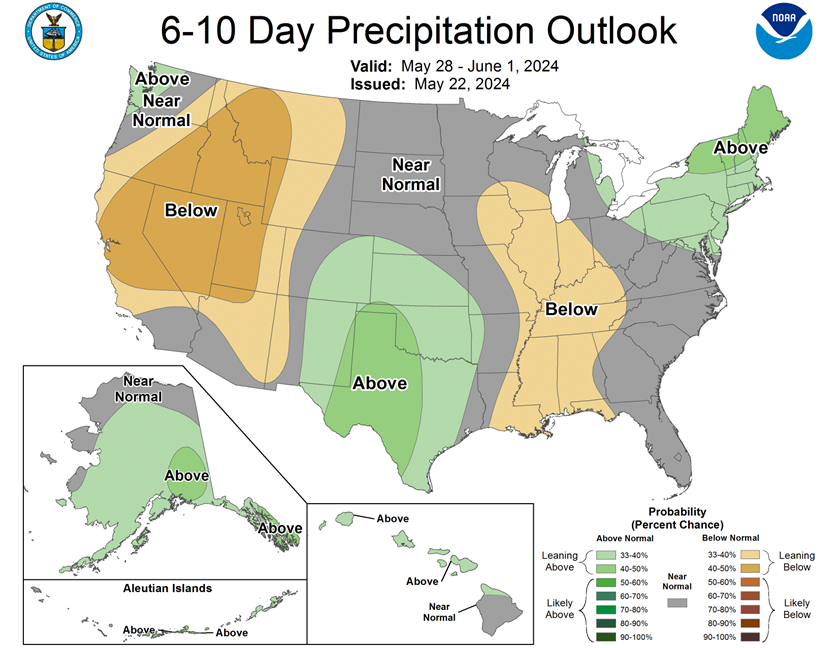
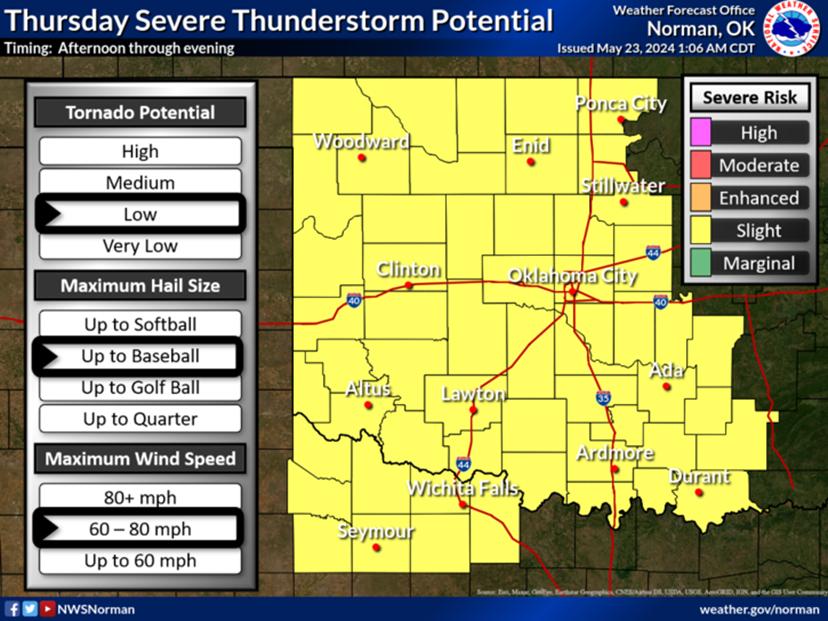
Below, see the 6-10 day precipitation and storm potential outlook provided by the Oklahoma Mesonet.
Oklahoma Harvest Report by the Oklahoma Wheat Commission
The Oklahoma Wheat Harvest made greater progress in areas over the weekend, even with continued rains in multiple regions throughout this past week.
Harvest in Southwest and South Central, Oklahoma is wrapped up for the most part although producers are still cutting in regions where they have been fighting rains. Harvest in Southwest, Oklahoma is 95% complete. In Central Oklahoma greater progress was made in most areas over the weekend. The OWC is now calling that region 60% complete in most places. In parts of Northwest Oklahoma, up by Burlington and Alva, harvest is 80% complete. As you move into North Central regions along the Hwy 81 corridor east up along I-35 around Tonkawa, Ponca City, Blackwell and Braman, that area is 35% complete. In Northeast Oklahoma in the Afton and Miami regions, that area is 85% to 95% complete depending on location.
In the Panhandle regions producers have been fighting untimely rains for wheat harvest in many places. No dryland wheat or irrigated wheat is being reported as being harvest in the Balko region. One field of irrigated wheat has been reported as being harvested south of Hooker and was making 55 bushels per acre on early cuttings, but no irrigated wheat has been reported as being taken in at elevators within that region. Some samples have been received on irrigated wheat at Hooker this morning and they were 17% moisture, so producers were hoping to get into the fields today. (No dryland wheat will be harvested in this region most likely.)
In Southern Oklahoma test weights at most locations have fallen a bit now ranging mostly at a 59 lbs. per bushel average for that region. In Central Oklahoma test weights are not as high ranging from 56 to 61 lbs. per bushel, but most coming in at 57 lbs. to 59 lbs. per bushel. Early reports from Northern Oklahoma across the state have test weights ranging from 60-62 lbs. per bushel, with a few lower test weights being reported at 58 lbs. per bushel. Quality has still been holding up on wheat in this area as the rains have not as impacted it as much as Central, Oklahoma.
In Northeast Oklahoma, the quality on both Hard Red Winter and Soft Red Winter wheat has been extremely favorable. Test weight coming in at 61 to 63 lbs. with yields on Hard Red Winter wheat being reported at 50 bushels per acre and on Soft Red Winter wheat being reported at 85 to over 100 bushels per acre in some instances.
Yields on wheat being taken in as harvest progresses in Southern Oklahoma are still favorable at this point, as the majority of the crop is now harvested in this region. Most are reporting 30 to 40 bushel per acre yields in Southern Oklahoma. In Central Oklahoma the yields are ranging from the low 20’s to mid 30’s, with some higher yields in the mid to high 40’s depending on location. Yields being reported in Northern Oklahoma locations from elevator managers as most locations are just getting good starts have many locations calling for a 35 bushel per acre average, with a few management intensive producers mentioning some higher yields, but those instances are rare. Protein has been ranging from 10.5% to 14.5% in most all locations with stronger proteins overall. State average as of today for protein is being figured at 13.2%. The Oklahoma Wheat Commission is calling harvest 57% complete.
This will be the last week Southern Oklahoma elevator regions will be reported for the 2023 harvest season as harvest in those regions for the most part is considered complete.
Southern Oklahoma
Grandfield/Chattanooga-Test weights have dropped some in this region due to rains and now are ranging from 59-61 lbs. per bushel. A large portion of this area was harvested with higher test weights so average on the area will still fall in the 60-61 lbs. per bushel range. Yields ranging mostly from 30 bushels to 50 bushels per acre. Grandfield region is 95% completed, Chattanooga region is 90% complete with harvest.
Devol- Yields reported from the low 30’s to mid 50’s. Test weights ranging from 61-64 lbs. per bushel. This region is 99% complete with harvest.
Frederick- Test weights in this region averaging 60 to 61 lbs. per bushel. Yields being reported from low 20’s to mid 40’s depending on location. Protein ranging from 10.5% to 12.5%, with the average for this region at 11.9%. This region is 99% complete with harvest.
Altus/Duke- Test weights ranging 59 lbs. to 62 lbs. per bushel. Yields reported from the high 20’s to low 40’s depending on location. Protein reported at 11.5%-12.5%. This region is 97% harvested.
Hobart/Roosevelt-Test weights reported at 58 lbs. to 60 lbs. per bushel. Yields ranging from the mid 20’s to low 40’s. Protein was reported at 12%-14%. This region is 90% harvested.
Lone Wolf- Test weights in the region are ranging from 57 lbs. to 61 lbs. per bushel. Average test weight at 59.5 lbs. per bushel. Yields being reported in the mid 20’s to low 40’s depending on location. This region is 90% harvested.
Rocky/Sentinel- Test weights are ranging from 57 lbs. to 60 lbs. per bushel, the average for the region is at 59 lbs. per bushel, as of today. Yields have been reported from low 20’s to high 30’s. This region is 90% harvested.
Central Oklahoma
Hinton- Yields in the area are being reported from the low 20’s to mid 40’s. Test weights are averaging 59 to 61 lbs. per bushel. Protein was ranging from 12.5% to 13.5%. This region is 75% harvested.
Okarche- Yields being reported in the low 20’s to high 30’s for the most part. Some management intensive producers reporting higher yields in the low 40’s. Test weights ranging from 56 lbs. to 61 lbs. per bushel. Average test weight for the region coming in at 59 lbs. per bushel. Protein is ranging from 12.5% to 13.5%. This region is 65% harvested.
Reeding/Piedmont- Test weights on what is being harvested is at 59 lbs. per bushel. Yields being reported from the mid 20’s to mid 30’s. Protein was averaging 13% on early cuttings. This region is 65% harvested.
Northern Oklahoma
Lahoma- Test weights ranging from 58 lbs. to 61 lbs. per bushel. Yields being reported in the low to mid 30’s. More progress was made in this region over the last two days. This region is 60% harvested.
Burlington- Test weights in this region mainly at 60 lbs. per bushel and above, with rains over the past few days some have been lowered now to 59 lbs. per bushel. Yields on wheat in this region being reported from 25 bushels per acre to 35 bushels per acre, with a few higher yields being reported in the low to mid 40’s but those instances are rare. Proteins coming in at a 13% average for the region. A large amount of wheat in this region has been abandoned and was cut down for hay.
Shattuck- Test weights at this location reported at 58 lbs. to 62 lbs. per bushel depending on location and management practices. Dryland wheat in this area is reported as making in the low 20’s, some irrigated wheat in this region reported to be making 60 bushels per acre. Protein is ranging from 12.5% to 14%. This region is 30% harvested.
Tonkawa/Ponca City/Blackwell/Braman- Test weight for this region have been ranging from 58.5 lbs. to 60 lbs. per bushel. Producers reporting the wheat to be making 30 to 35 bushels per acre for the most part as an average in this region. Proteins are ranging from 13% to 14%. This region is 35% harvested.
Oklahoma Panhandle
Balko/Guymon/Hooker- No wheat has been taken in at these locations. Producers have had untimely rains for wheat harvest in several regions of the Panhandle this past week. One irrigated field south of Hooker is being reported as harvested and the yields on that were reported at 55 bushels per acre. One sample was received in Hooker this morning at 17% moisture on irrigated wheat, so producers are hopeful to start harvesting late this afternoon or tomorrow. Most dryland wheat in the Panhandle will not be harvested. Some dryland wheat planned to be harvested in the Balko region.
Northeast Oklahoma
Afton- 60% of the wheat reported at this location is Soft Red Winter Wheat, and the other 40% is Hard Red Winter. Harvest on both classes has been extremely high quality with favorable yields. Test weight on all wheat has been 60 lbs. and above with the majority of the wheat coming in at 62 lbs. to 63 lbs. per bushel. Yields on the Hard Red Winter wheat being reported at 40 to 50 bushels per acre. Yields on the Soft Red Winter Wheat being reported at 80 to 95 bushels per acre. No proteins have been reported. Harvest in this region is 95-97% complete.
Miami- 95% of the wheat reported at this location is Soft Red Winter Wheat, the other 5% is Hard Red Winter wheat. Harvest on both classes has had extremely high quality with favorable yields. Test weight on all wheat has been 60 lbs. and above with the majority of the wheat coming in at 62 lbs. to 63 lbs. per bushel. Yields on the Hard Red Winter wheat being reported at 40 to 50 bushels per acre. Yields on the Soft Red Winter Wheat being reported at 80 to 95 bushels per acre. No proteins have been reported. Harvest in this region is 85% complete.
Wheat Classes and What They are Used For
Hard Red Winter-(HRW) wheat is versatile with excellent milling and baking characteristics for pan bread. Hard Red Winter wheat is also a choice for Asian noodles, hard rolls, flat breads, general purpose flour and cereal.
Soft Red Winter-(SRW) a versatile weak-gluten wheat with excellent milling and baking characteristics suited for cookies, crackers, pretzels, pastries and flat breads.
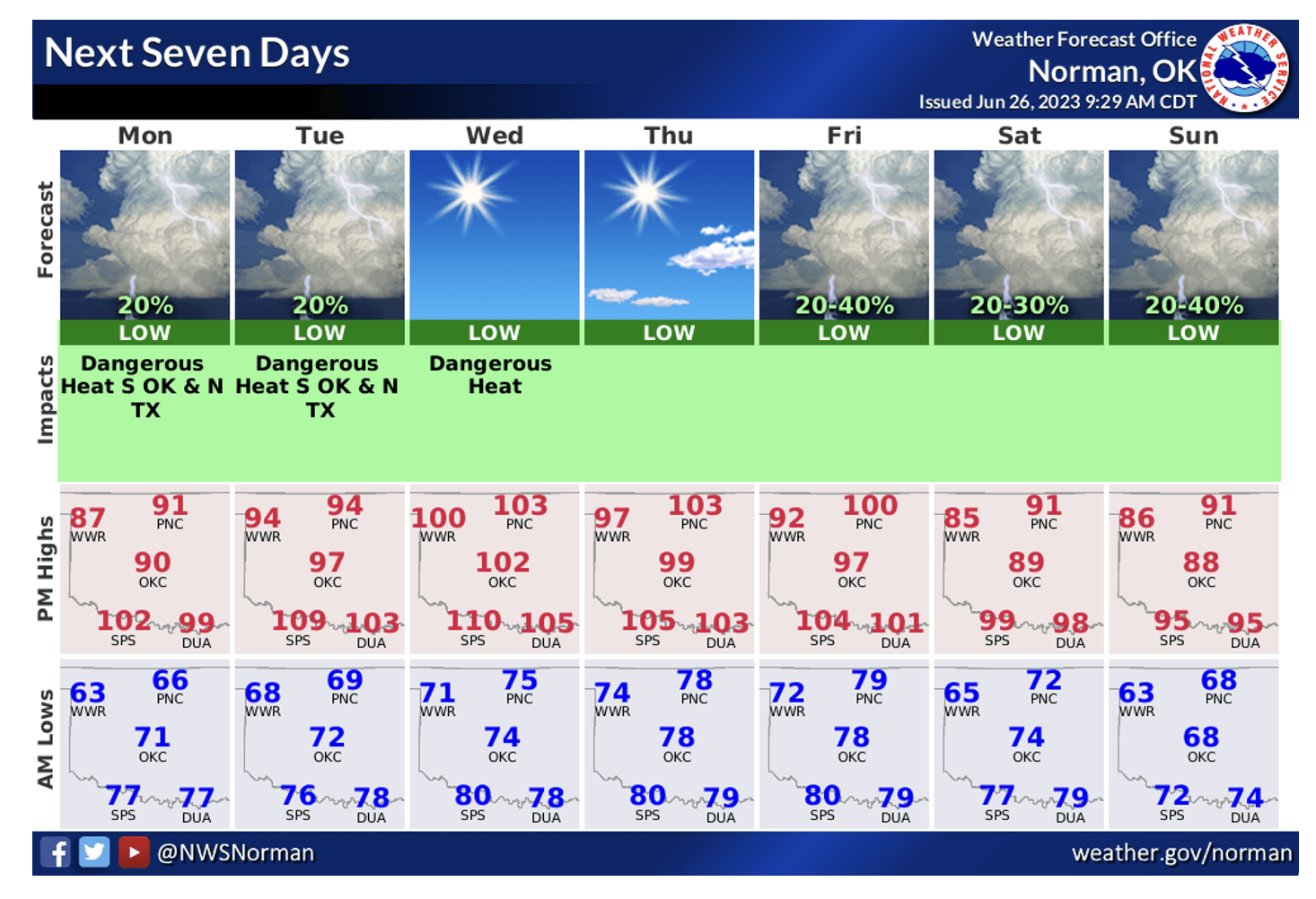
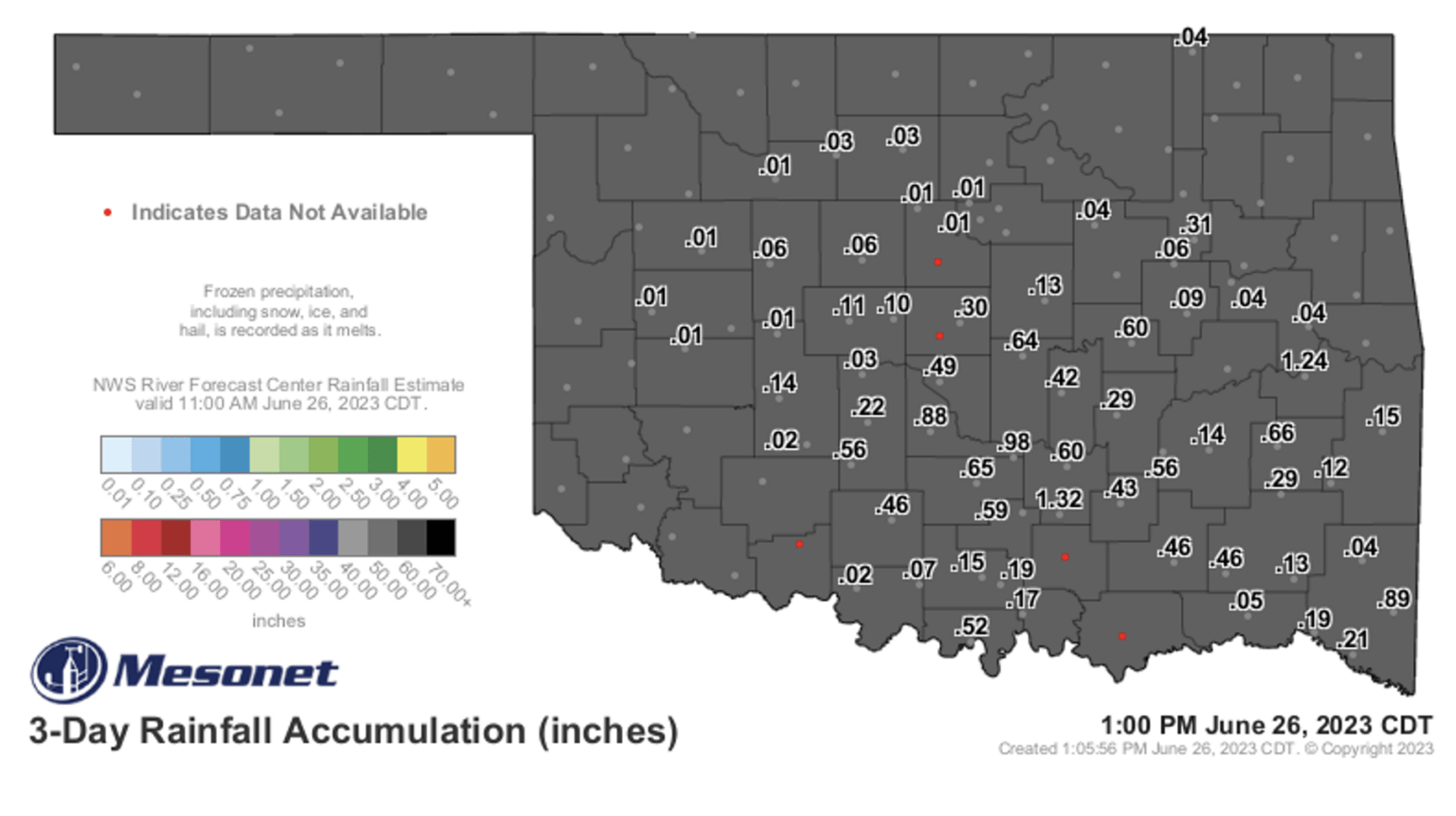
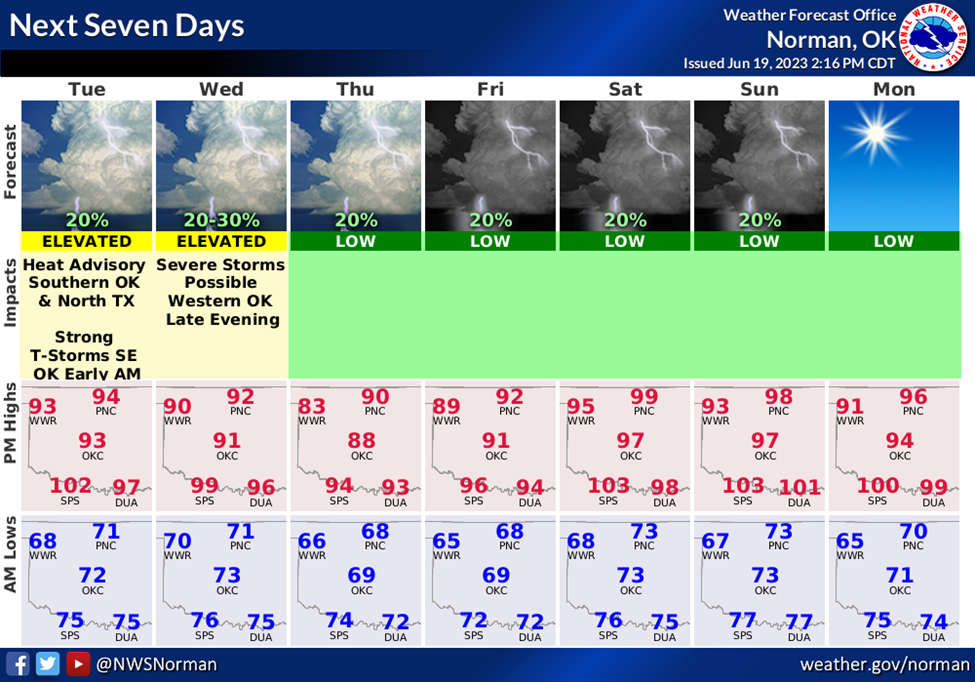
Below, see the next 7 day forecast and 3-Day Rainfall Accumulations recorded by the Oklahoma Mesonet. The next Oklahoma Harvest Report will be published on Wednesday, June 26, 2023, and a regional report will be published by Plains Grain Inc. on Friday, June 30, 2023.
Oklahoma Harvest Report by the Oklahoma Wheat Commission
Oklahoma Wheat harvest made slight progress this week as producers were in fields off and on again as rains came late last week and over the weekend. Harvest is still taking place from the Oklahoma/Texas line to the Oklahoma/ Kansas line, but heavy rains in parts of Southwest Oklahoma as well as in Central and Northern Oklahoma had everyone at a standstill yesterday, with hopes that producers will be back in the fields by this afternoon or late tomorrow depending on location. Harvest is just getting a good start in Northern Oklahoma from 81 HWY east to the I-35 corridor we are calling that region now 15% harvested. As you go further into Northwest Oklahoma around Cherokee and Alva they are calling harvest 5 to 10% complete. Shattuck just received a few loads over the weekend and no harvest is being reported in the Panhandle regions, out by Guymon or Hooker as of today. It is thought some dryland harvest might begin the end of this week in the Panhandle but the wheat in that region is further behind. (A large amount of the dryland wheat in the Panhandle has been terminated and will not be harvested due to the severe drought, and a lot of irrigated wheat has been laid down for hay.) In Southern Oklahoma test weights at most locations are still falling in the ranges of 60-62 lbs. per bushel. In Central and West Central regions, test weights are ranging from 57-60 lbs. per bushel. Early reports from Northern Oklahoma across the state have test weights ranging from 60-62 lbs. per bushel, with a few lower test weights being reported at 58 lbs. per bushel. Yields on wheat being taken in as harvest progresses in Southern Oklahoma still favorable at this point, as the majority of the crop is now harvested in this region. Most are reporting 30 to 40 bushel per acre yields in Southern Oklahoma. In Central Oklahoma the yields are ranging from the low 20’s to mid 30’s, with some higher yields in the mid to high 40’s depending on location. Yields being reported in Northern Oklahoma locations from elevator managers as most locations are just getting good starts have many locations calling for a 35 bushel per acre average, with a few management intensive producers mentioning some higher yields, but those instances are rare. Protein has been ranging from 10.5% to 14.5% in most all locations with stronger proteins overall. State average as of today for protein is being figured at 12.8%. The Oklahoma Wheat Commission is calling harvest 43% complete.
Grandfield/Chattanooga-Test weights have dropped some in this region, due to rains and now are ranging from 59-61 lbs. per bushel. A large portion of this area was harvested with higher test weights so average on the area will still fall in the 60-61 lbs. per bushel range. Yields ranging mostly from 30 bushels to 50 bushels per acre. Grandfield region is 95% completed, Chattanooga region is 75% complete with harvest.
Devol- Yields reported from the low 30’s to mid 50’s. Test weights ranging from 61-64 lbs. per bushel. This region is 99% complete with harvest.
Frederick- Test weights in this region averaging 60 to 61 lbs. per bushel. Yields being reported from low 20’s to mid 40’s depending on location. Protein ranging from 10.5% to 12.5%, with the average for this region at 11.9%. This region is 99% complete with harvest.
Altus/Duke- Test weights ranging 59 lbs. to 62 lbs. per bushel. Yields reported from the high 20’s to low 40’s depending on location. Protein reported at 11.5%-12.5%. This region is 85% harvested.
Hobart/Roosevelt-Test weights reported at 59 lbs. to 62 lbs. per bushel, this is up until the heavy rains this past weekend. Yields ranging from the mid 20’s to low 40’s. Protein was reported at 12%-14%. This region is 70% harvested.
Lone Wolf- Test weights in the region are ranging from 57 lbs. to 61 lbs. per bushel. Average test weight at 59.5 lbs. per bushel. Yields being reported in the mid 20’s to low 40’s depending on location. This region is 70% harvested.
Apache- This region has been fighting untimely rains for the entire harvest season but producers have managed to get more harvesting done before this weekend. Test weight before the rains this weekend dropped some but still are at a 60 lb. per bushel average. Yields have been ranging from 25 to 40 bushels per acre. One management intensive producer reporting higher yields ranging from 65 to 70 bushels per acre. Proteins are ranging from 11.5% to 13%. This region is 55% harvested.
Rocky/Sentinel- Rains over the weekend have stopped producers once again, but they are hopeful they will be back in the fields late this afternoon. Test weights are ranging from 58 lbs. to 60 lbs. per bushel, the average for the region is at 59.5 lbs. per bushel, as of today. Yields have been reported from low 20’s to high 30’s. This region is 75% harvested.
Hinton- Yields in the area are being reported from the low 20’s to mid 40’s. Test weights before the rains this weekend were averaging 60 to 61 lbs. per bushel. Protein was ranging from 12.5% to 13.5%. This region is 35% harvested.
Okarche- Harvest in this region made some progress late last week and some on Saturday, but rains have delayed producers from getting back into fields. Yields being reported in the low 20’s to high 30’s for the most part. Some management intensive producers reporting higher yields in the low 40’s. Test weights ranging from 58 lbs. to 59 lbs. per bushel. Protein is ranging from 12.5% to 13.5%. This region is 30% harvested.
Reeding/Piedmont- Heavy rains over the weekend are delaying producers once again in this area. Test weights on what is being harvested is at 59 lbs. per bushel. Yields being reported from the mid 20’s to mid 30’s. Protein was averaging 13% on early cuttings. This region is 20% harvested.
Lahoma- This location is just getting started with some wheat being taken in over the weekend before the rains on Saturday evening. Test weights on early cuttings are 60 lbs. per bushel and above. Early yields being reported in the low to mid 30’s. This region is 5% harvested.
Kremlin/Wakita/Renfrow- Early cuttings taken in at this location have test weights at 60 lbs. per bushel and above. Early yields for the region are being reported at a 30 to 35 bushel average, but a large amount of wheat has been abandoned due to the severe drought. Protein is ranging from 12-13%. This region is 15% harvested.
Pond Creek/Hunter/Medford- Early cuttings have been taken in at these locations and harvest is just getting a good start. Yields ranging in the low 20’s to low 40’s depending on location and management practices. Test weights reported at 60 lbs. per bushel and higher. Proteins are ranging from 12-13%. This region is 15% harvested.
Cherokee- This location just got started over the weekend before the rains on Saturday evening. Early cuttings have test weights at 60 lbs. per bushel and higher for the most part, with a few loads coming in at 58 lbs. per bushel. Yields on early cuttings reported from the mid 20’s to mid 30’s. Some higher yields are anticipated, but the majority of the crop is predicted to come in at around 30 bushels per acre. (A large amount of the wheat in this area was laid down for hay) No proteins being reported on early cuttings. This region is 5% harvested.
Shattuck- Producers were just getting started in this area over the weekend and then were hindered by rains on Saturday evening. Early cuttings coming in at 62 lbs. per bushel on test weight. No yields being reported, although a lot of wheat in the region will not be harvested due to the drought. This region is 5-10% harvested.
Guymon/Hooker- No wheat has been taken in at these locations. Elevator operators in Guymon and Hooker think some wheat might be ready for harvesting by the end of this week.
We also want to let our producers in Lawton, OK and neighbors in Perryton, TX that they are in our thoughts and prayers this week and in the days ahead!
Below, see the next 7 day forecast and 3-Day Rainfall Accumulations recorded by the Oklahoma Mesonet. The next Oklahoma Harvest Report will be published on Wednesday, June 21, 2023, and a regional report will be published by Plains Grain Inc. on Friday, June 23, 2023.
Oklahoma Harvest Report by the Oklahoma Wheat Commission
Oklahoma Wheat harvest continues to move along in different areas depending on rain amounts and when producers can get into fields. Harvest is taking place from the Oklahoma/Texas line to the Oklahoma/ Kansas line. More progress has been made along the I-35 corridor up into Kansas on early cuttings, with producers just getting started in the Goltry/Helena areas, and Burlington/Alva regions of North Central and Northwest Oklahoma. No harvest has been reported at elevator locations taking place from Shattuck up into the Panhandle regions of Balko and Hooker. It is thought some dryland harvest might begin in those Panhandle regions over the weekend or the beginning of next week. (A large amount of the dryland wheat in the Panhandle has been terminated and will not be harvested due to the severe drought.) In Southern, Oklahoma test weights at most locations are still falling in the ranges of 60-62 lbs. per bushel. In Central and West Central regions, test weights are ranging from 58-60 lbs. per bushel. Early reports from Northern Oklahoma have test weights ranging from 60-62 lbs. per bushel. Yields on wheat being taken in as harvest progresses in Southern Oklahoma are still favorable at this point. Most are reporting 30 to 40 bushel per acre yields in Southern Oklahoma. In Central Oklahoma the yields are ranging from the low 20’s to mid 30’s with better wheat being reported in the Greenfield and Hinton areas. No yields have been reported in the Northern Oklahoma locations from elevator managers as most locations are just getting good starts. Some producers are mentioning yields to be ranging in the low 20’s to low 40’s depending on location. Early reports show the wheat to be fairing better along the Northern I-35 corridor than the wheat in Northwest Oklahoma, west of 81 Hwy. (Initial reports indicated the wheat was estimated to be doing better in South Central and Southwest Oklahoma and it appears those estimates are following what has been predicted.) Protein has been ranging from 10.5% to 13.5% in most all locations with stronger proteins overall. State average as of today for protein is being figured at 12.1%.
The Oklahoma Wheat Commission is calling harvest 35% complete.
Grandfield/Chattanooga-Test weights have dropped some in this region, due to rains and now are ranging from 59-61 lbs. per bushel. A large portion of this area was harvested with higher test weights so average on the area will still fall in the 60-61 lbs. per bushel range. Yields ranging mostly from 30 bushels to 50 bushels per acre. Grandfield region is 70% completed, Chattanooga region is 55% complete with harvest.
Devol- Yields reported from the low 30’s to mid 50’s. Test weights ranging from 61-64 lbs. per bushel. Moisture is 12.5%. This region is 98% complete with harvest.
Frederick- Test weights in this region averaging 60 to 61 lbs. per bushel. Yields being reported from low 20’s to mid 40’s depending on location. Protein ranging from 10.5% to 12%, with the average for this region at 10.9%. This region is 80% complete with harvest.
Altus/Duke- Test weights ranging 59 lbs. to 62 lbs. per bushel. Early yields reported from the high 20’s to low 40’s depending on location. Protein reported at 10.5-12.5% This region is 60% harvested.
Hobart/Roosevelt-Early loads received last week had test weights reported at 59 lbs. to 62 lbs. per bushel. Yields ranging from the mid 20’s to low 40’s. Protein was reported at 12%-14%. This region is 50% harvested.
Lone Wolf- Harvest is just getting started in this region. Test weights in the region are ranging from 57 lbs. to 61 lbs. per bushel. Average test weight at 59.5 lbs. per bushel. Yields being reported in the mid 20’s to low 40’s depending on location. This region is 50% harvested.
Apache- This area continues to be plagued with rains and high humidity which has made harvesting difficult; but, producers in the region have managed to make progress. Test weight before the rains Monday and Tuesday were ranging from 60 lbs. to 62 lbs. per bushel. Yields have been ranging from 25 to 40 bushels per acre. One management intensive producer reported a couple yields ranging from 65 to 70 bushels per acre. Proteins are ranging from 11.5% to 12.5%. This region is 25% harvested.
Rocky/Sentinel- Producers have also been dealing with on and off rains all week in this region. Over the weekend great strides were made before rains on Monday and Tuesday. Test weights are ranging from 58 lbs. to 60 lbs. per bushel, the average for the region is at 59.5 lbs. per bushel, as of today. Yields have been reported from low 20’s to high 30’s. Producers have been parked in this region but are hopeful to get back into the fields today. This region is 35% harvested.
Hinton- Harvest in this region made great progress before the rains that came thru on Monday and Tuesday. Yields in the area are being reported from the low 20’s to mid 40’s. Test weights before the rains this week were averaging 62 lbs. per bushel. Protein was ranging from 11.5% to 12.5%. This region is 10% harvested.
Okarche- Harvest in this region made progress in some areas before the rains on Monday and Tuesday. Yields being reported in the low 20’s to high 30’s for the most part. Some management intensive producers reporting higher yields in the low 40’s. Test weights ranging from 58 lbs. to 59 lbs. per bushel. Protein is ranging from 11.5% to 12.5%. This region is 8% harvested.
Reeding/Piedmont- Some early test cutting has begun in this region. Test weights on early cuttings averaging 59 lbs. per bushel. No yields have been reported. Protein was averaging 12.9% on early cuttings. This region is 1% harvested.
Kingfisher/Omega- Harvest has just begun in this region, test weights ranging from 57 lbs. to 60 lbs. per bushel, with average on early cuttings in the region at 59 lbs. per bushel. Yields ranging from the mid 20’s to low 40’s depending on management practices and location. Proteins ranging from 12.5% to 13.5%. This region is 1% harvested.
Goltry/Helena- These locations have taken in some grain and are just getting started, but producers got rained out yesterday and are hopeful to get back into the fields late this afternoon. A lot of the wheat in this region will never be harvested due to issues from the drought. On the wheat being harvested early reports of yields are ranging from low 20’s to low 30’s. Test weights are ranging from 60.5 lbs. to 62 lbs. per bushel. Early proteins reported at 12% to 14%.
Kremlin/Wakita/Renfrow- Locations have not accepted anything that have been harvested at the time of this report. Producers are hopeful to start trying late this afternoon in these locations.
Pond Creek/Hunter/Medford- Early cuttings have been taken in at these locations and harvest is just getting a good start. Yields ranging in the low 20’s to low 40’s depending on location and management practices. Test weights reported at 60 lbs. per bushel and higher. No proteins have been reported for this region.
Burlington- This location took in two loads yesterday and producers are hopeful to get a good start in this region today as custom harvesting crews are starting to arrive.
Alva- Some test cuttings are going on in this region. Early test weights reported at 60 to 61 lbs. per bushel. No yields are being reported, early protein reports at 13%.
Shattuck- No wheat has been taken in at this location, producers are hoping to get started this weekend or the beginning of next week, if they can miss the predicted rains over the weekend.
Perryton, TX/Balko/Hooker- No wheat has been taken in at these locations. Elevator operators in Perryton and Balko are hoping to start taking in dryland wheat in some locations over the weekend or next week.
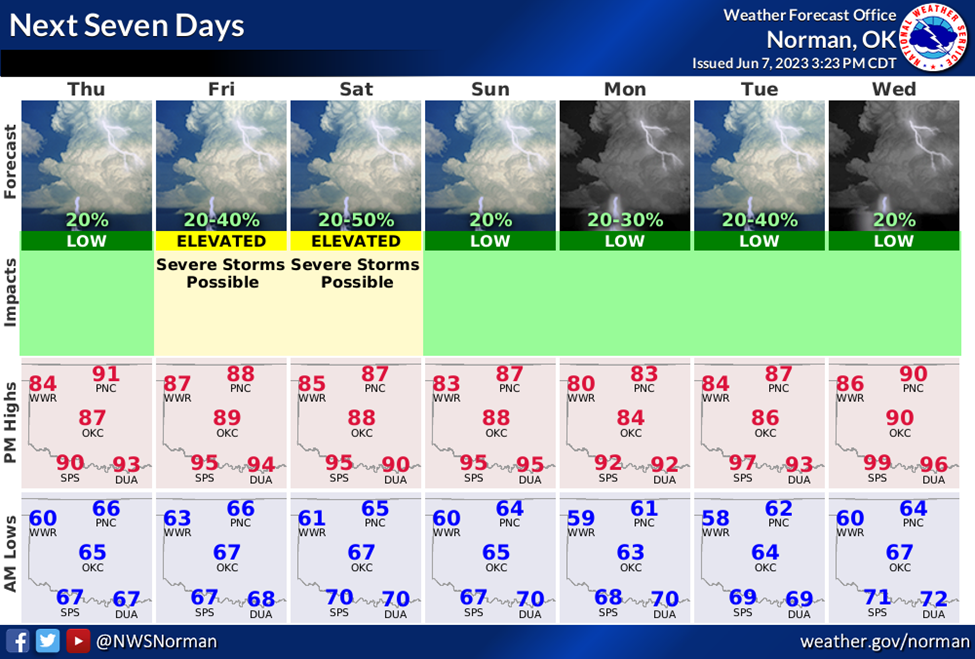
Below, see the next 7 day forecast and 3-Day Rainfall Accumulations recorded by the Oklahoma Mesonet. The next Oklahoma Harvest Report will be published on Monday, June 19, 2023, and a regional report will be published by Plains Grain Inc. on Friday, June 16, 2023
Oklahoma Harvest Report by the Oklahoma Wheat Commission
Oklahoma Wheat harvest continues in Southern Oklahoma, as light rains have scattered across the state in several places since Monday afternoon. Some places have received 2/100thswhile others have received over 1 ½ inches depending on location. (It has been reported some places in Southwest Oklahoma might have received 1 and 3/10ths of moisture and on the other side of a town or county no rain was received at all.) Despite the rain, several locations in Southern Oklahoma are still reporting good quality wheat on what is being taken in. Heavier rains have brought test weights down some. Most locations are still reporting averages to be 60 lbs. per bushel or higher. Several locations down in South Central Oklahoma are reporting ranges still from 61-65 lbs. per bushel.
Moisture has been ranging from 11.5-13%. Yields on wheat being taken in as harvest progresses has been favorable to this point. Most are reporting 30 to 40 bushels per acre depending on the location. (Several instances of 50 bushel wheat being reported where timely rains were received.) Some high management intensive producers in rare instances have reported yields in the mid 70’s to low 80’s. (Keep in mind the reporting on the yield is still mainly being reported on the region in the state that is predicted to a have the best wheat.) Elevator managers have some concerns as harvest progresses further North that the test weight and quality will not be as favorable since we continue to receive larger amounts of moisture in these regions. Protein averages are being reported in a wide range from 10.5% to 13.5% depending on location. Some have reported protein to be as high as 15.5% on few select fields. Average for all areas being reported is 11.5% to 12.5%
The Oklahoma Wheat Commission is calling Oklahoma Wheat harvest 20% complete.
Eldorado-Test weights raining from 60 to 66 lbs. per bushel. Yields being reported from low 30’s to low 50’s depending on location. Protein ranging from 10.5% to 14%. This region is considered 60 to 65% complete with harvest.
Grandfield/Chattanooga-Test weights ranging from 61-64 lbs. per bushel. Moisture reported at 12.5%. Yields ranging mostly from 30 bushels to 50 bushels per acre. Grandfield region is 60% completed, Chattanooga region is 35% complete with harvest.
Devol- Yields reported from the low 30’s to mid 50’s. Test weights ranging from 61-64 lbs. per bushel. Moisture is 12.5%. This region is 65% complete with harvest.
Frederick- Test weights in this region averaging 61 lbs. per bushel. Yields being reported from low 20’s to mid 40’s depending on location. Protein ranging from 10.5% to 12%, with the average for this region at 10.9%. This region is 65% complete with harvest.
Altus/Duke- Test weights ranging 59 lbs. to 62 lbs. per bushel. Early yields reported from the high 20’s to low 40’s depending on location. Protein reported at 10.5-12.5% This region is 20% harvested.
Hobart/Roosevelt-Early loads received last week had test weights reported at 59 lbs. to 62 lbs. per bushel. Yields ranging from the mid 20’s to low 40’s. Protein was reported at 12%-14%. This region is 20% harvested.
Lone Wolf- Harvest is just getting started in this region. Early test weights were not as high in the region and ranging from 57 lbs. to 61 lbs. per bushel. No yields being reported.
Apache- This area continues to be plagued with rains and high humidity which has made harvesting difficult. Only 3 loads have been reported taken in as of today in this region. Test weight on the wheat was averaging 60 lbs. per bushel. No yields or proteins have been reported.
Rocky/Sentinel- Early test cuttings took place last week but heavy rains have delayed harvest in both the Sentinel and Rocky areas this week. Test weights on early cuttings ranged from 58 lbs. to 62 lbs. per bushel. No yields have been reported.
Hinton- Wheat harvest has just started today in this region as producers missed rains that were received in other parts of the state last night. Test weights averaged 61.4 lbs. per bushel on the first few loads taken in. No yields reported. Protein was averaging 13.4%.
Greenfield- Wheat harvest has started in this region and continues today as producers missed rains surrounding the majority of this area last night. Generally, wheat harvest starts 5 to 10 days later in this area than other parts in the central regions of Oklahoma, but that will not be the case this year. Test weights in this region so far are ranging from 60 lbs. to 61 lbs. per bushel. No yields and proteins have been reported on early cuttings.
Below, see the next 7-day forecast and 3-Day Rainfall Accumulations recorded by the Oklahoma Mesonet. The next Oklahoma Harvest Report will be published on Monday, June 12, 2023, and a regional report will be published by Plains Grain Inc. on Friday, June 9, 2023
Hello everyone, find below the complete schedule for the 2023 OSU Wheat Variety Trials plot tours and Field Days. We look forward to seeing you all there!
Note that times are subject to change due to environmental conditions. Please call your County Extension Office to confirm the date, time, and location.
Notes: Abbreviations: DP = Dual-purpose, GO = Grain-only, IM =Intensive management, SM = Standard management 1 Meet at the Extension office 2 Meet at the plot, 1 mile north of Bill’s Corner on the east side of Hwy 177 at Knobhill. 3 Meet at fairgrounds for lunch, plot tour south of town afterwards 4 Meet at plot ¾ mile west of HWY 54 on Arapaho Road 5 Lunch at Wheeler Brothers, plot tour north of elevator afterwards 6 Meet at Ledbetter’s farm @ 9:30, field tour @ 10, lunch @ 12 7 Lunch at Wheeler Brothers, plot tour north of town afterwards 8 Meal at Brook Strader’s farm, plot tour afterwards
The plot maps for each location can be found on our websiteclick here
Below are pictures from some of the variety trial locations from the end of March to early April. Wheat needs rain badly.
Amanda de Oliveira Silva, Small Grains Extension Specialist
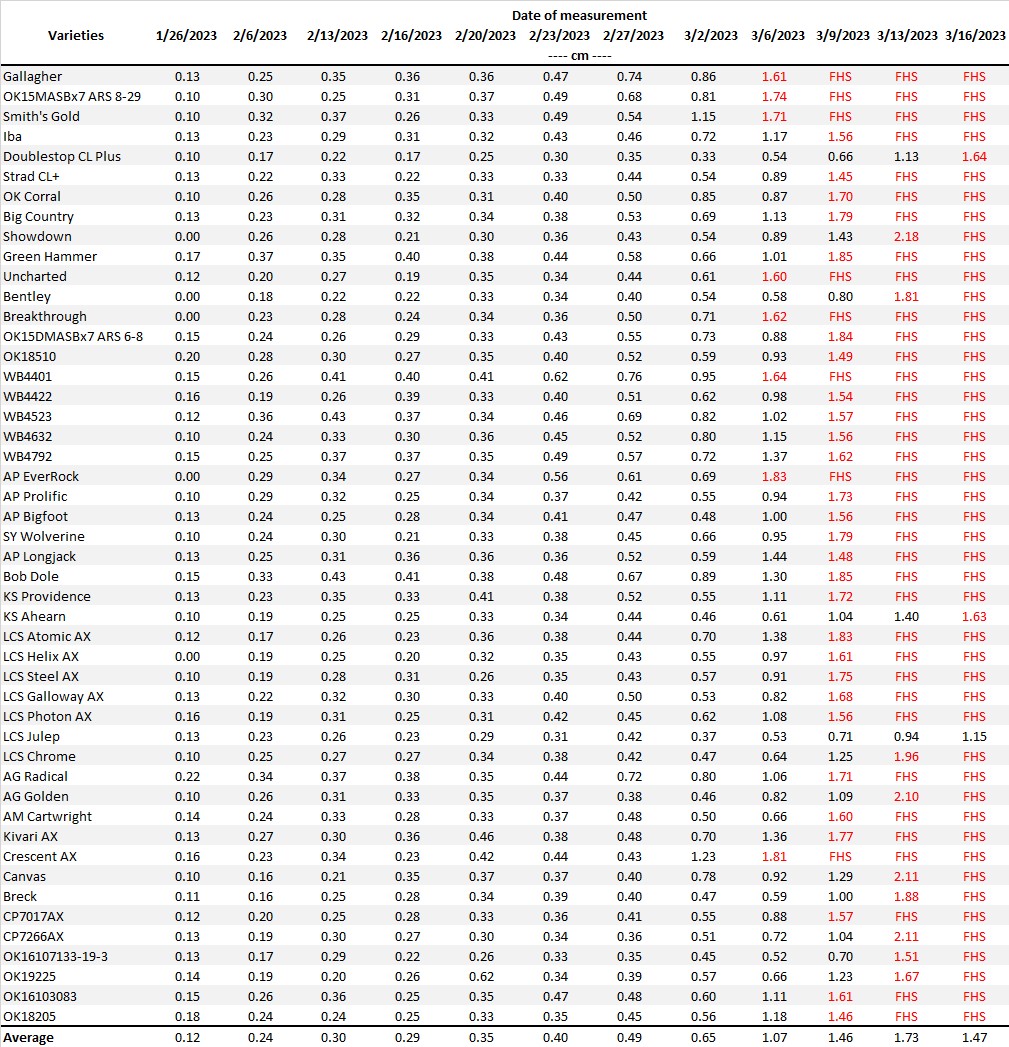
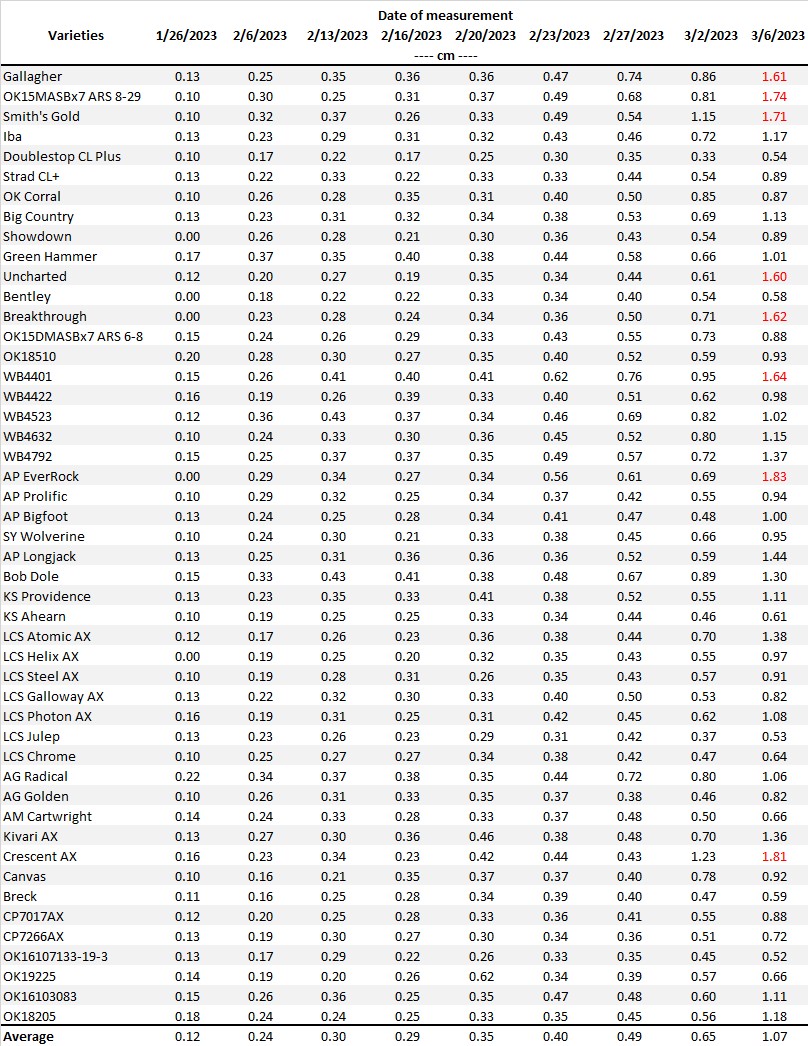
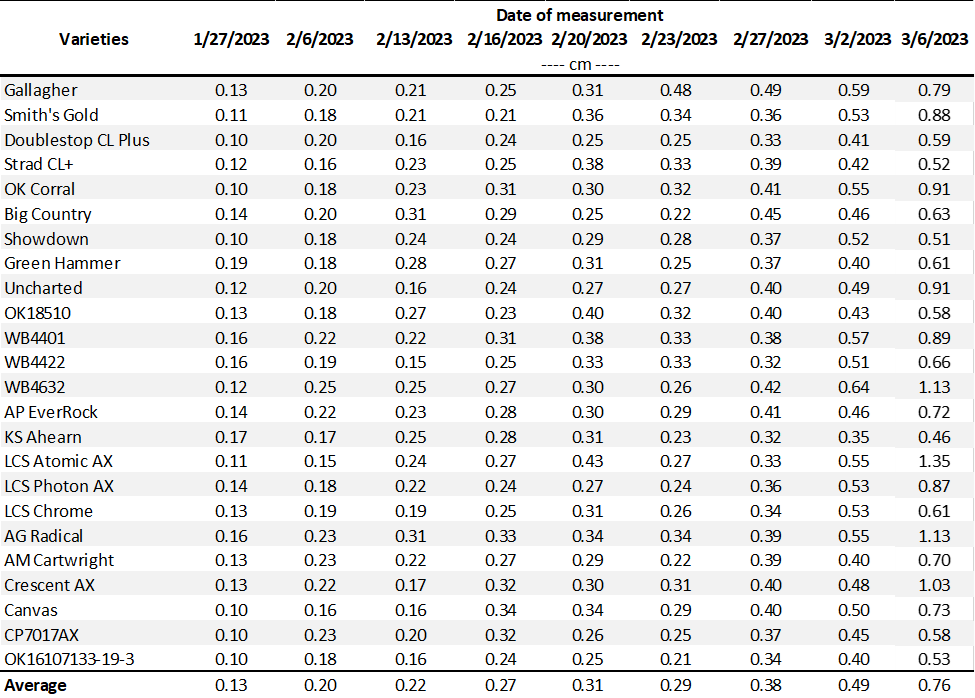
First hollow stem (FHS) is the optimal time to remove cattle from wheat pasture. This occurs when there is 1.5 cm (5/8”, or the diameter of a dime) of hollow stem below the developing grain head (see full explanation). The latest FHS results from OSU forage trials in Stillwater (Table 1) and Chickasha (Table 2) are listed below. For an additional resource and wheat update on FHS, see the Mesonet First Hollow Stem Advisor.
We use an accelerated growth system to report the earliest onset of FHS stage. Trials are seeded early to simulate a grazed system, but the forage is not removed. Varieties reported here with the earliest FHS date should be the first to monitor in commercial fields. In practice, wheat that is grazed will likely reach FHS stage later than reported here, and differences between varieties will likely moderate.
Table 1. First hollow stem (FHS) results for each variety collected at Stillwater. Plots were planted on 10/06/22 but not grazed or clipped. The threshold target for FHS is 1.5 cm (5/8″ or the diameter of a dime). The value of hollow stem for each variety represents the average of ten measurements. Varieties exceeding the threshold are highlighted in red.
Table 2. First hollow stem (FHS) results for each variety collected at Chickasha. Plots were planted on 10/07/22 but not grazed or clipped. The threshold target for FHS is 1.5 cm (5/8″ or the diameter of a dime). The value of hollow stem for each variety represents the average of ten measurements. Varieties exceeding the threshold are highlighted in red.
Contact your local Extension office and us if you have questions.
Amanda de Oliveira Silva, Small Grains Extension Specialist
First hollow stem (FHS) is the optimal time to remove cattle from wheat pasture. This occurs when there is 1.5 cm (5/8”, or the diameter of a dime) of hollow stem below the developing grain head (see full explanation). The latest FHS results from OSU forage trials in Stillwater (Table 1) and Chickasha (Table 2) are listed below. For an additional resource and wheat update on FHS, see the Mesonet First Hollow Stem Advisor.
We use an accelerated growth system to report the earliest onset of FHS stage. Trials are seeded early to simulate a grazed system, but the forage is not removed. Varieties reported here with the earliest FHS date should be the first to monitor in commercial fields. In practice, wheat that is grazed will likely reach FHS stage later than reported here, and differences between varieties will likely moderate.
Table 1. First hollow stem (FHS) results for each variety collected at Stillwater. Plots were planted on 10/06/22 but not grazed or clipped. The threshold target for FHS is 1.5 cm (5/8″ or the diameter of a dime). The value of hollow stem for each variety represents the average of ten measurements. Varieties exceeding the threshold are highlighted in red.
Table 2. First hollow stem (FHS) results for each variety collected at Chickasha. Plots were planted on 10/07/22 but not grazed or clipped. The threshold target for FHS is 1.5 cm (5/8″ or the diameter of a dime). The value of hollow stem for each variety represents the average of ten measurements. Varieties exceeding the threshold are highlighted in red.
Contact your local Extension office and us if you have questions.
Amanda de Oliveira Silva, Small Grains Extension Specialist
First hollow stem (FHS) is the optimal time to remove cattle from wheat pasture. This occurs when there is 1.5 cm (5/8”, or the diameter of a dime) of hollow stem below the developing grain head (see full explanation). The latest FHS results from OSU forage trials in Stillwater (Table 1) and Chickasha (Table 2) are listed below. For an additional resource and wheat update on FHS, see the Mesonet First Hollow Stem Advisor.
We use an accelerated growth system to report the earliest onset of FHS stage. Trials are seeded early to simulate a grazed system, but the forage is not removed. Varieties reported here with the earliest FHS date should be the first to monitor in commercial fields. In practice, wheat that is grazed will likely reach FHS stage later than reported here, and differences between varieties will likely moderate.
Table 1. First hollow stem (FHS) results for each variety collected at Stillwater. Plots were planted on 10/06/22 but not grazed or clipped. The threshold target for FHS is 1.5 cm (5/8″ or the diameter of a dime). The value of hollow stem for each variety represents the average of ten measurements. Varieties exceeding the threshold are highlighted in red.
Table 2. First hollow stem (FHS) results for each variety collected at Chickasha. Plots were planted on 10/07/22 but not grazed or clipped. The threshold target for FHS is 1.5 cm (5/8″ or the diameter of a dime). The value of hollow stem for each variety represents the average of ten measurements. Varieties exceeding the threshold are highlighted in red.
Contact your local Extension office and us if you have questions.
Amanda de Oliveira Silva, Small Grains Extension Specialist
First hollow stem (FHS) is the optimal time to remove cattle from wheat pasture. This occurs when there is 1.5 cm (5/8”, or the diameter of a dime) of hollow stem below the developing grain head (see full explanation). The latest FHS results from OSU forage trials in Stillwater (Table 1) and Chickasha (Table 2) are listed below. For an additional resource and wheat update on FHS, see the Mesonet First Hollow Stem Advisor.
We use an accelerated growth system to report the earliest onset of FHS stage. Trials are seeded early to simulate a grazed system, but the forage is not removed. Varieties reported here with the earliest FHS date should be the first to monitor in commercial fields. In practice, wheat that is grazed will likely reach FHS stage later than reported here, and differences between varieties will likely moderate.
Table 1. First hollow stem (FHS) results for each variety collected at Stillwater. Plots were planted on 10/06/22 but not grazed or clipped. The threshold target for FHS is 1.5 cm (5/8″ or the diameter of a dime). The value of hollow stem for each variety represents the average of ten measurements. Varieties exceeding the threshold are highlighted in red.
Table 2. First hollow stem (FHS) results for each variety collected at Chickasha. Plots were planted on 10/07/22 but not grazed or clipped. The threshold target for FHS is 1.5 cm (5/8″ or the diameter of a dime). The value of hollow stem for each variety represents the average of ten measurements. Varieties exceeding the threshold are highlighted in red.
Contact your local Extension office and us if you have questions.











 WORLD OF WHEAT