I have served as an Assistant Professor and Small Grains Extension Specialist at Oklahoma State University since August 2019. I believe that close interaction with producers is vital to understand their production strategies and to establish realistic research goals. My program focuses on developing science-based information to improve the agronomic and economic viability of small grains production in Oklahoma and in the Southern Great Plains.
Amanda de Oliveira Silva, Small Grains Extension Specialist
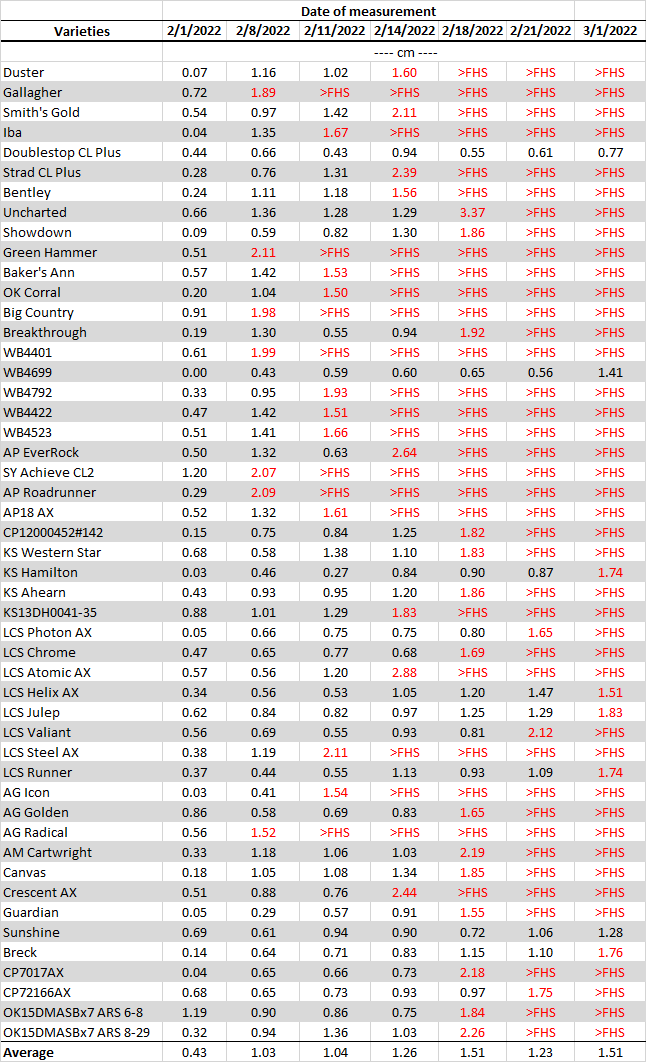
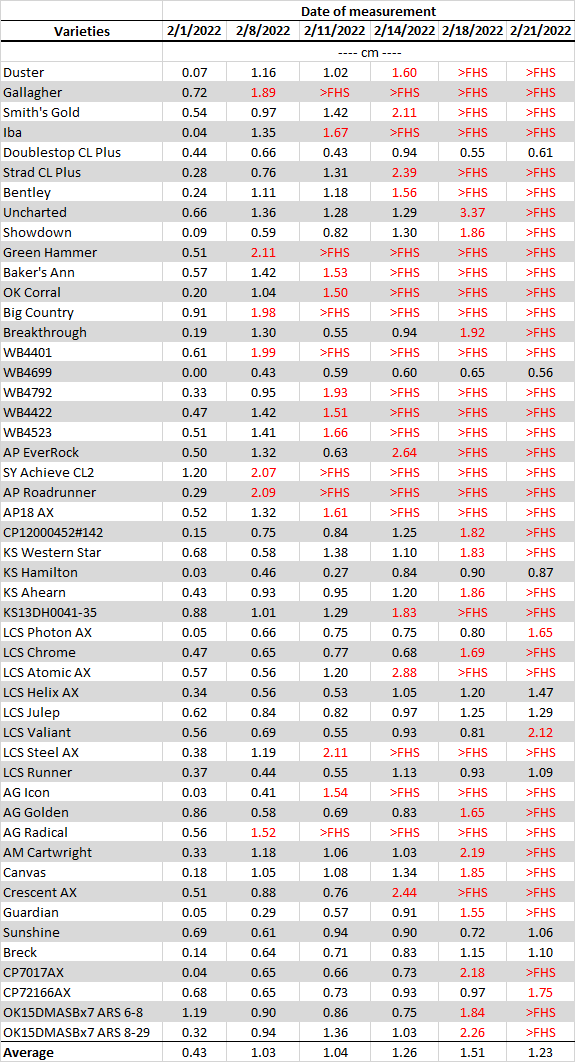
First hollow stem (FHS) is the optimal time to remove cattle from wheat pasture. This occurs when there is 1.5 cm (5/8”, or the diameter of a dime) of hollow stem below the developing grain head (see full explanation). The latest FHS results from OSU forage trials in Stillwater (Table 1) and Chickasha (Table 2) are listed below. For an additional resource, see the Mesonet First Hollow Stem Advisor.
We use an accelerated growth system to report the earliest onset of FHS stage. Trials are seeded early to simulate a grazed system, but the forage is not removed. Varieties reported here with the earliest FHS date should be the first to monitor in commercial fields. In practice, wheat that is grazed will likely reach FHS stage later than reported here, and differences between varieties will likely moderate.
Values can fluctuate from one sampling to another due to environmental variation associated with, among other factors, the winter storm on February 2-4. Additionally, varieties differed widely in their FHS response following this cold period.
Table 1. First hollow stem (FHS) results for each variety collected at Stillwater. Plots were planted on 09/27/21 but not grazed or clipped. The threshold target for FHS is 1.5 cm (5/8″ or the diameter of a dime). The value of hollow stem for each variety represents the average of ten measurements. Varieties exceeding the threshold are highlighted in red. The overall average represents the mean FHS for the varieties measured within a date.
Table 2. First hollow stem (FHS) results for each variety collected at Chickasha. Plots were planted on 09/28/21 but not grazed or clipped. The threshold target for FHS is 1.5 cm (5/8″ or the diameter of a dime). The value of hollow stem for each variety represents the average of ten measurements. Varieties exceeding the threshold are highlighted in red. The overall average represents the mean FHS for the varieties measured within a date.
Amanda de Oliveira Silva, Small Grains Extension Specialist
First hollow stem (FHS) is the optimal time to remove cattle from wheat pasture. This occurs when there is 1.5 cm (5/8”, or the diameter of a dime) of hollow stem below the developing grain head (see full explanation). The latest FHS results from OSU forage trials in Stillwater (Table 1) and Chickasha (Table 2) are listed below. For an additional resource, see the Mesonet First Hollow Stem Advisor.
We use an accelerated growth system to report the earliest onset of FHS stage. Trials are seeded early to simulate a grazed system, but the forage is not removed. Varieties reported here with the earliest FHS date should be the first to monitor in commercial fields. In practice, wheat that is grazed will likely reach FHS stage later than reported here, and differences between varieties will likely moderate.
Values can fluctuate from one sampling to another due to environmental variation associated with, among other factors, the winter storm on February 2-4. Additionally, varieties differed widely in their FHS response following this cold period.
Table 1. First hollow stem (FHS) results for each variety collected at Stillwater. Plots were planted on 09/27/21 but not grazed or clipped. The threshold target for FHS is 1.5 cm (5/8″ or the diameter of a dime). The value of hollow stem for each variety represents the average of ten measurements. Varieties exceeding the threshold are highlighted in red.
Table 2. First hollow stem (FHS) results for each variety collected at Chickasha. Plots were planted on 09/28/21 but not grazed or clipped. The threshold target for FHS is 1.5 cm (5/8″ or the diameter of a dime). The value of hollow stem for each variety represents the average of ten measurements. Varieties exceeding the threshold are highlighted in red.
Amanda de Oliveira Silva, Small Grains Extension Specialist
First hollow stem (FHS) is the optimal time to remove cattle from wheat pasture. This occurs when there is 1.5 cm (5/8”, or the diameter of a dime) of hollow stem below the developing grain head (see full explanation). The latest FHS results from OSU forage trials in Stillwater (Table 1) and Chickasha (Table 2) are listed below. For an additional resource, see the Mesonet First Hollow Stem Advisor.
We use an accelerated growth system to report the earliest onset of FHS stage. Trials are seeded early to simulate a grazed system, but the forage is not removed. Varieties reported here with the earliest FHS date should be the first to monitor in commercial fields. In practice, wheat that is grazed will likely reach FHS stage later than reported here, and differences between varieties will likely moderate.
Values can fluctuate from one sampling to another due to environmental variation associated with, among other factors, the winter storm on February 2-4. Additionally, varieties differed widely in their FHS response following this cold period.
Table 1. First hollow stem (FHS) results for each variety collected at Stillwater. Plots were planted on 09/27/21 but not grazed or clipped. The threshold target for FHS is 1.5 cm (5/8″ or the diameter of a dime). The value of hollow stem for each variety represents the average of ten measurements. Varieties exceeding the threshold are highlighted in red.
Table 2. First hollow stem (FHS) results for each variety collected at Chickasha. Plots were planted on 09/28/21 but not grazed or clipped. The threshold target for FHS is 1.5 cm (5/8″ or the diameter of a dime). The value of hollow stem for each variety represents the average of ten measurements. Varieties exceeding the threshold are highlighted in red.
Amanda de Oliveira Silva, Small Grains Extension Specialist
First hollow stem (FHS) is the optimal time to remove cattle from wheat pasture. This occurs when there is 1.5 cm (5/8”, or the diameter of a dime) of hollow stem below the developing grain head (see full explanation). The latest FHS results from OSU forage trials in Stillwater (Table 1) and Chickasha (Table 2) are listed below. For an additional resource, see the Mesonet First Hollow Stem Advisor.
We use an accelerated growth system to report the earliest onset of FHS stage. Trials are seeded early to simulate a grazed system, but the forage is not removed. Varieties reported here with the earliest FHS date should be the first to monitor in commercial fields. In practice, wheat that is grazed will likely reach FHS stage later than reported here, and differences between varieties will likely moderate.
Values can fluctuate from one sampling to another due to environmental variation associated with, among other factors, the winter storm on February 2-4. Additionally, varieties differed widely in their FHS response following this cold period.
Table 1. First hollow stem (FHS) results for each variety collected at Stillwater. Plots were planted on 09/27/21 but not grazed or clipped. The threshold target for FHS is 1.5 cm (5/8″ or the diameter of a dime). The value of hollow stem for each variety represents the average of ten measurements. Varieties exceeding the threshold are highlighted in red.
Table 2. First hollow stem (FHS) results for each variety collected at Chickasha. Plots were planted on 09/28/21 but not grazed or clipped. The threshold target for FHS is 1.5 cm (5/8″ or the diameter of a dime). The value of hollow stem for each variety represents the average of ten measurements. Varieties exceeding the threshold are highlighted in red.
Amanda de Oliveira Silva, Small Grains Extension Specialist
First hollow stem (FHS) is the optimal time to remove cattle from wheat pasture. This occurs when there is 1.5 cm (5/8”, or the diameter of a dime) of hollow stem below the developing grain head (see full explanation). The latest FHS results from OSU forage trials in Stillwater(Table 1) and Chickasha (Table 2) are listed below. For an additional resource, see the Mesonet First Hollow Stem Advisor.
We use an accelerated growth system to report the earliest onset of FHS stage. Trials are seeded early to simulate a grazed system, but the forage is not removed. Varieties reported here with the earliest FHS date should be the first to monitor in commercial fields. In practice, wheat that is grazed will likely reach FHS stage later than reported here, and differences between varieties will likely moderate.
Table 1. First hollow stem (FHS) results for each variety collected at Stillwater. Plots were planted on 09/27/21 but not grazed or clipped. The threshold target for FHS is 1.5 cm (5/8″ or the diameter of a dime). The value of hollow stem for each variety represents the average of ten measurements. Varieties exceeding the threshold are highlighted in red.
Table 2. First hollow stem (FHS) results for each variety collected at Chickasha. Plots were planted on 09/28/21 but not grazed or clipped. The threshold target for FHS is 1.5 cm (5/8″ or the diameter of a dime). The value of hollow stem for each variety represents the average of ten measurements. Varieties exceeding the threshold are highlighted in red.
Amanda de Oliveira Silva, Small Grains Extension Specialist
The wheat growing season up to this point has been extremely tough, to say the least. The forage situation has been a kick-in-the-knees. It was challenging to get a stand established and wheat pasture with limited rainfall since planting. By January 30, most of Oklahoma had not seen any significant precipitation for more than 90 days (Figure 1). Last week’s winter storm helped improve conditions in some areas, but western OK continues to be dry (Figure 2). As a result, many producers have already grazed as much as possible and removed their cattle, or they have not even had the chance to graze. For the few producers who still have pasture to graze, leaving some leaf tissue after grazing will be important for having any chance of a decent grain crop. Ideally, there should be a minimum of 60% canopy coverage (measured from the Canopeo app) left to allow the crop to recover from grazing (PSS-2170).
Figure 1. Consecutive days with less than 0.25 inches of rainfall on January 30, 2022.
Figure 2. Consecutive days with less than 0.25 inches of rainfall after the winter storm (top figure) and plant available water in the soil (bottom figure) on February 6, 2022.
The first hollow stem stage (FHS) indicates the beginning of stem elongation, or just before the jointing stage. It is a good indicator for when producers should remove cattle from wheat pasture. This occurs when there is 1.5 cm (5/8”, or the diameter of a dime) of stem below the developing grain head (see full explanation). This is the optimal period because it gives enough time for the crop to recover from grazing and rebuild the canopy. Also, the added cattle weight gains associated with grazing past the FHS are not enough to offset the value of the potential reduced grain yield (1-5% every day past FHS). The wheat variety, severity of grazing, time when cattle are removed, and weather conditions after cattle removal determine how much grain yield potential might be reduced.
The Mesonet First Hollow Stem Advisor was developed by researchers at Oklahoma State University to help predict when FHS is nearing. This is an online tool available on the Mesonet website. This tool uses soil temperature data to show the current probability of FHS occurrence and 1-week and 2-week projections. With this tool, producers can select their variety from a list of varieties that separates them into three FHS categories: early, middle, and late. Then, maps can be generated to provide the probability of FHS based on current conditions and the 1- and 2-week projections. Charts and tables can also be generated for individual Mesonet sites. Created maps have a color scheme to represent the probability of FHS occurrence. When using this tool, it is recommended to start scouting for FHS from a non-grazed part of the field once the 5% probability is reached (green color). Because stem elongation will begin moving quickly as the air temperature rises, starting your scouting at the 5% level will help give you the time it takes for making the preparations for cattle removal by the time FHS occurs. Methods on how to scout for FHS are listed at the end of this post. For producers who do not scout, it is recommended to remove cattle when the 50% probability level is reached. A 50% probability level indicates that over an evaluated period (e.g., 10 years), FHS would have occurred by that date in 50% of those years (e.g., 5 years). The same interpretation is used for other probability levels.
To give an example of what the tool provides and show some of the FHS conditions around Oklahoma, I have generated some statewide maps below. For producers along the southern Oklahoma border who planted an “early” wheat variety (e.g., Gallagher), now would be the time to go out and start scouting for FHS (Figure 3).
Figure 3. Current FHS probabilities for “early” wheat varieties.
Looking at the 1-week projection for early maturing FHS varieties, you can see how the probabilities have increased, and areas further north should begin scouting (Figure 4).
Figure 4. One-week FHS projection (i.e., through February 14) for “early” wheat varieties.
For producers who planted late-maturing FHS varieties (e.g., LCS Chrome), the 1-week projections indicate producers across much of the state still have a little bit of time before beginning to scout (Figure 5).
Figure 5. One-week FHS projections (i.e., through February 14) for “late” (bottom) wheat varieties.
Remember that this tool should be used as a proxy to begin scouting for FHS. The best estimate of FHS is still to split stems from plants in each field to determine where they are developmentally. Another word of caution I want to mention when using the tool for this year especially is to consider when you were finally able to get stand establishment. If this did not occur until the end of September to the beginning of October, this tool may be a little ahead of where your plants are developmentally. In this case, the tool can still give you the cue to start scouting. Checking for FHS in each field will let you know if you do have some grazing time left.
Methods for scouting for FHS:
Check for FHS in a non-grazed area of the same variety and planting date. Variety can affect FHS date by as much as three weeks and planting date can affect it even more.
Dig or pull up a few plants and split the largest tiller longitudinally (lengthways), and measure the amount of hollow stem present below the developing grain head. You must dig plants because the developing grain head may still be below the soil surface at this stage.
If there is 1.5 cm (~5/8″) of hollow stem present, it is time to remove cattle. 1.5 cm is about the same as the diameter of a dime (see picture below).
More detailed information on FHS can be found at wheat.okstate.edu under ‘Wheat Management’ then ‘Grazing’ or by clicking here.
The first hollow stem growth stage is reached when there is 1.5 cm of hollow stem (about the diameter of a dime) below the grain head.
Similar to previous years, we will monitor FHS occurrence in our wheat plots at Stillwater and Chickasha and report the findings on this blog. Remember that we use an accelerated growth system to report the earliest onset of the FHS stage. Trials are seeded early to simulate a grazed system, but the forage is not removed. Varieties reported here with the earliest FHS date should be the first to monitor in commercial fields. In practice, wheat that is grazed will likely reach FHS stage later than reported here, and differences between varieties will likely moderate.
The latest FHS results for each variety planted in our forage trial at Stillwater are listed below (Table 1). A few varieties were near FHS (values at or above 1.5 cm) before the winter storm last week, and values are likely to move quickly with warmer conditions in Oklahoma.
Table 1. First hollow stem (FHS) results for each variety collected at Stillwater. Plots were planted on 09/27/21 but not grazed or clipped. The threshold target for FHS is 1.5 cm (5/8″ or the diameter of a dime). The value of hollow stem for each variety represents the average of ten measurements. Varieties exceeding the threshold are highlighted in red.
Amanda de Oliveira Silva, Small Grains Extension Specialist
Dual-purpose producers were not able to plant wheat in timely fashion (mid-September) due to drought conditions in much of the state. Most of the wheat intended for dual-purpose was “dusted in” and emergence was delayed, but plants established well. Oklahoma received good rainfall in October, which helped the dual-purpose wheat to emerge and grow and enabled grain-only producers to plant in good soil moisture. Although dual-purpose wheat was planted later than desired, the October moisture enabled moderate fall forage production. Oklahoma has not received 0.25” of rainfall for almost two months in some parts of the state and the wheat is showing signs of drought stress. There are also several fields showing symptoms of nitrogen deficiency.
The last several weeks have been warmer than usual. December is on track to be one of the warmest on record. The issue with current temperature fluctuations and abnormally warm temperatures is that the wheat crop is not able to fully acclimate and “cold-harden” before the winter. On December 15, soil temperatures in OK ranged from 47 to 62 F and air temperature in one location changed by 13 degrees (from 67 to 80F) in a matter of hours.
Soil temperature at the crown level will influence wheat vernalization and tolerance to cold temperatures. Wheat needs soil temperatures at the crown level to be below about 50F to initiate the physiological process of cold acclimation. Once below this threshold, cooler temperatures generally mean more rapid acclimation.
If wheat is not well acclimated, severe drops in temperature could cause winterkill or injury, and a reduction in tillering and crop growth in the spring, but we won’t know for certain until later. In addition, dry soils can experience wider oscillation in temperature than moist soils, creating more crop risk if temperatures drop well below freezing before significant rainfall.
In all, the effect of this hot and dry weather on Oklahoma’s wheat crop will depend on several factors, especially how abrupt temperatures decrease and how much rainfall is received soon. Our crop is showing signs of drought stress and could benefit from additional moisture going into the winter.
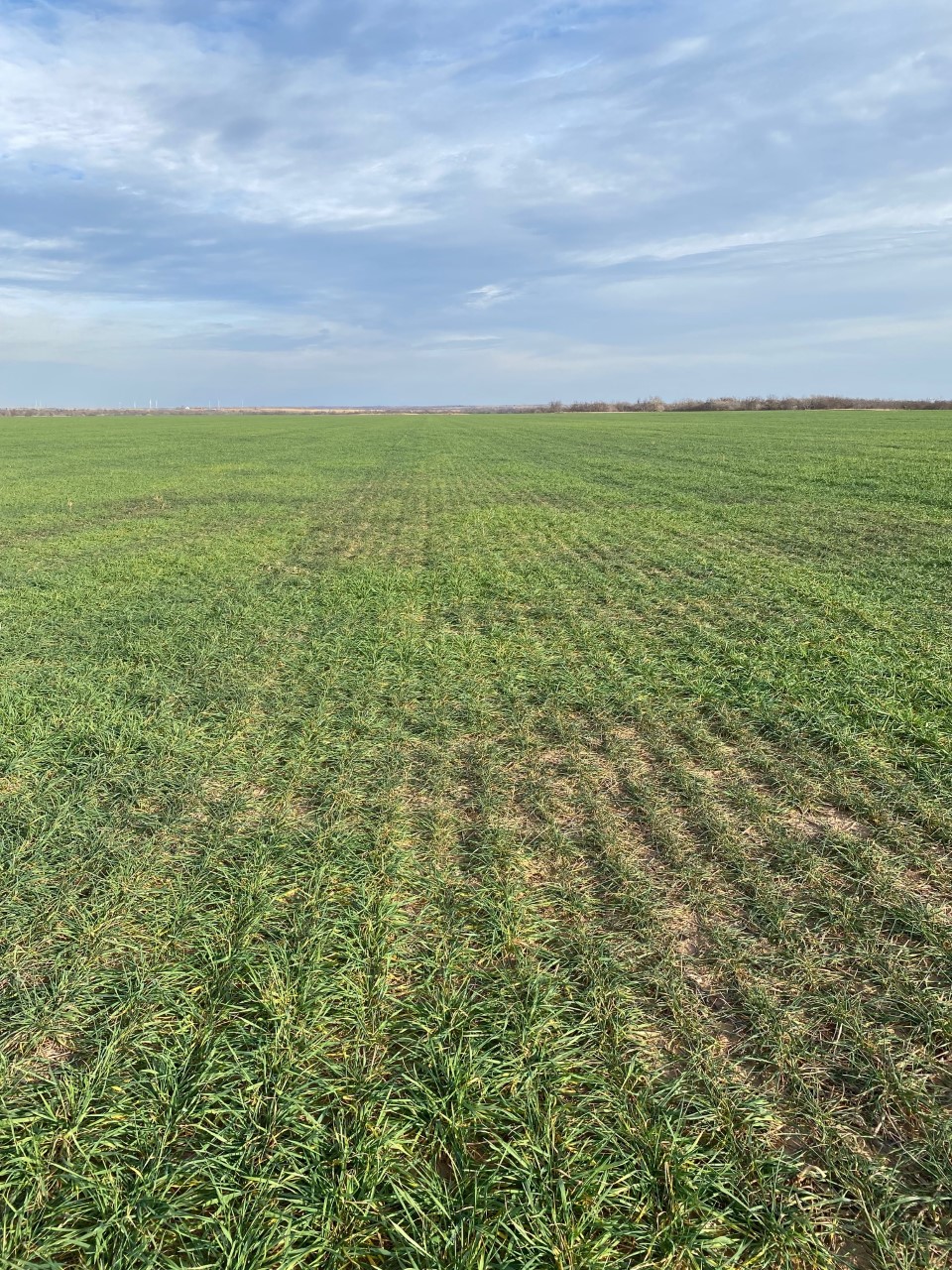
Wheat field showing signs of drought stress at Caddo County. Photo taken on Dec 7, 2021.
Amanda de Oliveira Silva, Small Grains Extension Specialist and Tom Royer, Extension Entomologist
Planting date: Much of the winter wheat sown in Oklahoma is used as a dual-purpose crop. In such a system, wheat is grazed by cattle from late fall through late winter/early spring and then harvested for grain in early summer. In a grain-only system, wheat is generally planted in October, but in a dual-purpose system wheat is planted in early to mid-September to maximize forage production. Planting wheat early significantly increases the likelihood that diseases and insect pests such as mite-transmitted viruses, the aphid/barley yellow dwarf complex, root and foot rots, and Hessian fly will be more prevalent and severe. For more detailed information on planting date and seed treatment considerations on wheat, see CR-7088 (Effect of Planting Date and Seed Treatment on Diseases and Insect Pests of Wheat).
Mite-transmitted virus diseases: These virus diseases are transmitted by wheat curl mites (WCMs) (Figure 1), and include wheat streak mosaic (WSM), high plains disease (HPD), and Triticum mosaic (TrM). Of these, WSM is the most common. WCMs and these viruses survive in crops such as wheat, corn, and sorghum as well as many grassy weeds and volunteer wheat. In the fall and spring, WCMs spread to emerging seedling wheat, feed on that seedling wheat, and transmit virus to the young wheat plants. Given this disease cycle, it is easy to see several factors that determine the incidence and severity of these diseases. First, controlling volunteer wheat and other grassy weeds that serve as alternative hosts for the mite and the viruses is imperative to help limit these diseases. Often an infected field of commercial wheat is growing immediately adjacent to a field left fallow during the fall and winter (Figure 2). The fallow field contained abundant volunteer wheat and grassy weeds from which WCMs carrying Wheat streak mosaic virus (WSMV) spread into the commercial field. Wheat infected in the fall will be severely damaged the next spring. Wheat infected in the spring also is damaged, but not as severely as wheat infected in the fall. Hence, it is imperative to do yourself and your neighbors a favor by controlling volunteer wheat and grassy weeds in fields left fallow – especially, if they are adjacent to commercial wheat fields. A second factor linked to the severity of these mite-transmitted virus diseases is planting date. Early planting dates associated with grazing provides for a much longer time period in the fall for mites to spread to and infect seedling wheat. Planting later in the fall (after October 1 in northern OK and after October 15 in southern OK) and controlling volunteer wheat are the two practices that can be employed to help manage these diseases. It is extremely critical that volunteer wheat is completely dead for at least two weeks prior to planting wheat because WCMs have a life span of 7-10 days. Thus, completely killing or destroying volunteer wheat for a period of at least two weeks prior planting will greatly reduce mite numbers in the fall. The incidence and severity of these mite-transmitted virus diseases as affected by planting date can be illustrated by the number of samples that tested positive for WSMV and HPV during each of the last three years. In 2017, which was the last year mite-transmitted virus diseases were prevalent in Oklahoma, 103 wheat samples were tested by the Plant Disease and Insect Diagnostic Lab at OSU for presence of mite-transmitted viruses. Of these 103 samples, 69 (67%) tested positive for WSMV and 22 (21%) tested positive for HPV. In 2018, only 12 of 126 (10%) samples tested positive for one or both of these viruses. In 2019, only 21 samples were submitted for testing with 7 samples (33%) testing positive for WSMV (no positives for HPV). In 2020, few samples (less than 5) tested positive for any of these viruses. This lower number of positive samples in 2019 and 2020 likely was the result of an overall later planting date of wheat in the fall of 2018 due to wet conditions and in fall 2020 due to extremely dry conditions. I believethis later planting date in conjunction with more awareness and action in limiting the green bridge helped to lower the incidence and severity of the mite-transmitted viruses in Oklahoma in both 2019 and 2020. Finally, seed treatments and insecticides are NOT effective in controlling the mites or these mite-transmitted virus diseases. Regarding resistant varieties, there are several winter wheat varieties that have resistance to either WSM or the curl mites, but the adaptation of these varieties to Oklahoma is limited, and the resistance is not typically an absolute resistance to the disease. Hence, severe and continuous disease pressure especially at higher temperature (greater than about 75 F) can overcome the resistance. For more information on mite-transmitted virus diseases, see OSU Fact Sheet EPP-7328 (Wheat Streak Mosaic, High Plains Disease and Triticum Mosaic: Three Virus Diseases of Wheat in Oklahoma).
Figure 1. Wheat curl mites and symptoms of wheat streak mosaic.
Figure 2. A commercial wheat field (right) growing adjacent to a field (left) in which volunteer wheat and grassy weeds were not controlled until the spring. The commercial field begin to show WSM symptoms in late March and the disease became severe as the spring progressed.
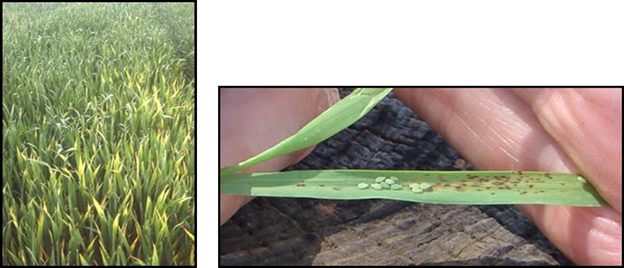
Aphid/barley yellow dwarf (BYD) complex: Viruses that cause BYD are transmitted by many cereal-feeding aphids (Figure 3). BYD infections that occur in the fall are the most severe because virus has a longer time to damage plants as compared to infections that occur in the spring.
Several steps can be taken to help manage BYD. First, a later planting date (after October 1 in northern Oklahoma and after October 15 in southern Oklahoma) helps reduce the opportunity for fall infection. Second, some wheat varieties tolerate BYD better than other varieties; however, be aware that no wheat variety has a high level of resistance to the aphid/BYD complex.For a listing of reaction of wheat varieties to BYD, other diseases and insect pests, and agronomic traits there are several sources available including variety comparison charts from Oklahoma State University (www.wheat.okstate.edu) and Kansas State University (https://bookstore.ksre.ksu.edu/pubs/MF991.pdf), and the annual wheat variety publication titled, “Wheat Varieties for Kansas and the Great Plains by Layton Ehmke (34 Star Publishing Inc.; layton@34starpublising.com; https://thewheatfarmer.com; 1-844-643-0170). Third, control aphids that transmit the viruses that cause BYD. This can be done by applying contact insecticides to kill aphids, or by treating seed before planting with a systemic insecticide. Unfortunately, by the time contact insecticides are applied, aphids frequently have already transmitted the viruses that cause BYD. Systemic seed-treatment insecticides containing imidacloprid or thiamethoxam can control aphids during the fall after planting. This may be particularly beneficial if wheat is planted early to obtain forage. Be sure to thoroughly read the label before applying any chemical.
Figure 3. Spot in field (left) of barley yellow dwarf (BYD) as would be seen in March or April. Many types of aphids (for example, greenbug; right) transmit the viruses that cause BYD.
Hessian fly: Hessian fly (Figure 4) infestations can occur in the fall and spring. Fall infestations arise from over-summering pupae that emerge when climate conditions become favorable. In states north of Oklahoma, a “Hessian fly free” planting date often is used to help limit fall infestations by Hessian fly. However, such a planting date does not apply in Oklahoma because Hessian fly can emerge in Oklahoma as late as December (Figure 5).
Delayed planting (after October 1 in northern Oklahoma, and after October 15 in southern Oklahoma) can help reduce the threat of Hessian fly, but a specific “fly free date” does not exist for most of Oklahoma as it does in Kansas and more northern wheat-growing states. This is because smaller, supplementary broods of adult flies emerge throughout the fall and winter. A number of varieties are resistant to Hessian fly; for a listing of reaction of wheat varieties to Hessian fly, other diseases and insect pests, and agronomic traits there are several sources available including variety comparison charts from Oklahoma State University (www.wheat.okstate.edu) and Kansas State University (https://bookstore.ksre.ksu.edu/pubs/MF991.pdf), and the annual wheat variety publication titled, “Wheat Varieties for Kansas and the Great Plains by Layton Ehmke (34 Star Publishing Inc.; layton@34starpublising.com; https://thewheatfarmer.com; 1-844-643-0170). Hessian fly infestations can be reduced somewhat by destroying volunteer wheat in and around the field at least two weeks prior to emergence of seedling wheat. Seed treatments that contain imidacloprid or thiamethoxam will also help reduce fall infestations of seedling wheat, especially if combined with delayed planting and volunteer destruction. For more information on Hessian fly, see OSU Fact Sheet: EPP-7086 (Hessian fly Management in Oklahoma Winter Wheat).
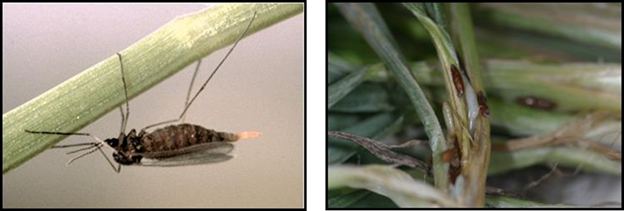
Figure 4. Adult Hessian fly (left) and larvae and pupae of the Hessian fly (right).
Figure 5. Emergence of Hessian fly in Oklahoma by month from 2011-2013.
Root and foot rots: These are caused by fungi and include several diseases such as dryland (Fusarium) root rot, Rhizoctonia root rot (sharp eyespot), common root rot, take-all, and eyespot (strawbreaker). Every year samples are received in the lab that are diagnosed with root rot. Typically wheat affected by seedling/root rots are either submitted in the fall when wheat is in the seedling stage or in later May and early June as plants are maturing. Germinating seeds and seedlings have small root systems that if infected impacts seed germination and seedling emergence (Figure 6). Later in the season (late May/early June), root rots again become apparent as maturing plants are unable to obtain sufficient moisture to finish grain development especially if drought conditions are present. In mature plants, white heads often indicates the presence of root rot (Figure 7).
In 2017-2018, the incidence and severity of root rots across Oklahoma dramatically increased compared to the 2016-2017 season. This increase likely resulted from weather conditions that favored the root rots along with heat and drought in May/June of 2018 that promoted white heads to develop. Dryland (Fusarium) root rot was the most common root rot observed in 2018, and caused significant damage to wheat in southwestern, western, northwestern OK as well as the panhandle. In 2018-2019, dryland (Fusarium) root rot again became prevalent across much of Oklahoma, but was not as damaging as the previous year likely because ample moisture and cool temperatures meant that water stress on plants was much less than in 2017-2018. Root rots were only sparsely observed in 2019-2020 and only at low severity.
Controlling root and foot rots is difficult. There are no resistant varieties, and fungicide seed treatments with activity toward the root and foot rots are effective in protecting germinating seed and emerging seedlings, their activity usually involves early-season control or suppression rather than control at a consistently high level throughout the season. Often, there also are different “levels” of activity related to different treatment rates, so again, CAREFULLY read the label of any seed treatment to be sure activity against the diseases and/or insects of concern are indicated, and be certain that the seed treatment(s) is being used at the rate indicated on the label for activity against those diseases and/or insects. Later planting (after October 1 in northern Oklahoma and after October 15 in southern Oklahoma) also can help reduce the incidence and severity of root rots, but planting later will not entirely eliminate the presence or effects of root rots. If you have a field with a history of severe root rot, consider planting that field as late as possible or plan to use it in a “graze-out” fashion if that is consistent with your overall plan.
For some root rots, there are specific factors that contribute to disease incidence and severity. For example, a high soil pH (>6.5) greatly favors disease development of the root rot called take-all. OSU soil test recommendations factor in this phenomenon by reducing lime recommendations when continuous wheat is the intended crop. Another practice that can help limit take-all and some of the other root rots is the elimination of residue. However, elimination of residue by tillage or burning does not seem to affect the incidence or severity of eyespot (strawbreaker).
Figure 6. A healthy plot of wheat in the fall as a result of using a seed treatment (left); a poor stand of wheat in the fall in a non-treated plot; a healthy seedling (left) compared to two seedlings (center and right) showing symptoms of common root rot. Notice the darkened sub-crown internode on the seedlings in the center and on the right as well as the reduced top growth compared to the healthy seedling on the left.
Figure 7. White heads indicative of root rot (left); darkened roots indicative of take all root rot (center); wheat killed by dryland root rot split open to show the pinkish growth of the causal fungus, Fusarium (right).
Seed treatments: There are several excellent reasons to plant seed wheat treated with an insecticide/fungicide seed treatment. These include:
1. Control of bunts and smuts, including common bunt (also called stinking smut) and loose smut. The similarity of these names can be confusing. All affect the grain of wheat, but whereas common bunt spores carryover on seed or in the soil, loose smut carries over in the seed. Seed treatments labeled to control bunts and smuts are highly effective. If common bunt (stinking smut) was observed in a field and that field is to be planted again with wheat, then planting certified wheat seed treated with a fungicide effective against common bunt (stinking smut) is strongly recommended. If either common bunt (stinking smut) or loose smut was observed in a field, grain harvested from that field should not be used as seed the next year. However, if grain harvested from such a field must be used as seed wheat, treatment of that seed at a high rate of a systemic or a systemic + contact seed treatment effective against common bunt (stinking smut) and loose smut is strongly recommended. In 2020, loose smut in fields and common bunt in harvested grain was observed at higher incidence and severity than for several years, so I strongly recommend planting certified wheat seed that was been treated with a fungicide labeled for control of bunt and smut. For more information on common bunt (stinking smut) & loose smut, see: http://www.entoplp.okstate.edu/ddd/hosts/wheat.htm and consult the “2020 OSU Extension Agents’ Handbook of Insect, Plant Disease, and Weed Control (OCES publication E-832),” and/or contact your County Extension Educator.
2.Enhance seedling emergence, stand establishment, and forage production by suppressing root, crown and foot rots. This was discussed above under “Root and Foot Rots.”
3.Early season control of the aphid/BYDV complex. This can be achieved by using a seed treatment containing an insecticide. Be sure that the treatment includes an insecticide labeled for control of aphids.
4. Control fall foliar diseases including leaf rust and powdery mildew. Seed treatments are effective in controlling foliar diseases (especially leaf rust and powdery mildew) in the fall, which may reduce the inoculum level of these diseases in the spring. However, this control should be viewed as an added benefit and not necessarily as a sole reason to use a seed treatment.
5. Suppression of early emerged Hessian fly. Research suggests that some suppression can be achieved, but an insecticide seed treatment has little residual activity past the seedling stage and Hessian fly often infests wheat after the seedling stage.
Fall Armyworm Potential: We have seen a severe outbreak of fall armyworms infesting bermudagrass and fescues lawns this past month. The strain that is infesting these lawns is known as the “rice” strain, and it overwinters in the Florida Gulf Coast and parts of the Caribbean. We typically see the “corn” strain which typically overwinters in the Texas Gulf Coast and Mexico. The rice strain prefers rice, and grasses, and the corn strain prefers corn and sorghum and as we have seen in the past, winter wheat. This year, Oklahoma is experiencing a “double whammy” of both strains, and unfortunately, they both like wheat. So, our advice is to carefully watch your fields after they emerge and deal with any fall armyworm infestations before they take your stand.
Lanie Hale, from Wheeler Brothers sent a picture of “window paned” wheat from a field that he had scouted in 2017. He counted 3 fall armyworms per row foot from his visual count (which is treatment threshold) but when he looked closely at his photo on his computer, he saw 15 worms in an area the size of his hand (they were very tiny, and probably newly hatched). It is easy to miss some of these little worms in the field because they hide in residue and are very tiny.
Symptoms like “window pane” in the leaves indicate feeding from fall armyworm.
Look very closely for “window paned” leaves and count all sizes of larvae. Examine plants along the field margin as well as in the interior, because they sometimes move in from road ditches and weedy areas. The suggested treatment threshold is 2-3 larvae per linear foot of row in wheat with active feeding. Numerous insecticides are registered for control, but they are much more susceptible when caterpillars are small. We won’t get relief from fall armyworms until we get a killing frost, so keep vigilant!
Amanda de Oliveira Silva, Small Grains Extension Specialist
Today I would like to dedicate a post to Dr. Bob Hunger, who has served as the OSU Wheat Extension Pathologist for 39 years and is officially retiring today!
Bob, I am grateful to have had the chance to work with you during our time at OSU. Thanks for being a mentor, colleague, and a friend. I know you have many fun plans, but I hope you won’t forget us.
I had so much fun traveling with you to field days this year. I learned many things with you, including a few American sayings like “bright-eyed and bushy-tailed” on our early morning trips and how to use a printed road map to get to our sites instead of using a GPS. However, I am not sure I will follow you on this last one lol.
Bob, I hope you know the great contributions you have made to the OK wheat industry and how much we appreciate you. See a few pictures below 🙂
My first (in person) field day season and Bob’s last field day season. Cotton County, 2021.
Bob about to dig in at Eischen’s, the oldest bar in OK. This was after our field day at Kingfisher.
Bob giving an update on wheat diseases at the field day at Cherokee.
The field day in the Panhandle would not be complete if we didn’t stop for a blizzard on a hot day in Woodward. Drs. Edwards and Manuchehri will relate to that.
Brett Carver, me, and Bob celebrating Bob’s retirement with a lunch and walk around OSU campus.
The Oklahoma Wheat Commission recognized Bob for his 39 years of dedicated service during the Lahoma Field Day.
Thank you, Bob!
Feel free to leave a message to Bob here below. I am sure he will be glad to read it.
Oklahoma Wheat harvest continues to move forward with producers facing challenges from Mother Nature, with continued rains in North Central and Panhandle regions of Oklahoma. Since our last report, producers were fighting mud within fields from rains received last Wednesday and Thursday. Combines got moving again in parts of North Central Oklahoma and the Panhandle yesterday; but, have been hindered by rains again late last night in the Panhandle regions out by Hooker and Guymon, and now late this afternoon in North Central Oklahoma. Since last week Oklahoma completion towards harvest has made slight progress moving from 85% complete to now 92% complete. In the Northern regions, producers in Garfield, Major, Alfalfa, Woodward, Woods, Ellis, counties are mostly finished, with the majority of wheat that is left to cut being in Grant, Kay and Noble counties. In the Panhandle regions producers are pretty well finished in Harper, Beaver and Cimmaron counties. Approximately 25% to 30% of the crop mostly now being irrigated wheat, is still in the field in Texas county around Goodwell, Guymon and Hooker. We have now seen a decline on test weights within the crop on the last remaining 15% to be harvested across the state. Test weights on wheat being taken in this past week now is ranging from 54 lbs./bu. to 60 lbs./bu., mainly in the northern regions of Oklahoma. In the Panhandle we have had slight declines on test weight but they are maintaining a better position on irrigated wheat still coming in at mostly 60 lbs./bu. or slightly above. While test weights have declined on the last of what is remaining in Oklahoma wheat fields, most likely this will have little impact on overall statewide test weight averages. Oklahoma had exceptionally high-test weights for most of this season so the Oklahoma crop average statewide will still come in at 60 lbs./bu. or above. Yields are still being reported as favorable ranging from the mid 40’s to mid 60’s for the most part across Northern Oklahoma. Producers with intensive management plans reporting yields in the mid 70’s to mid 80’s. In the Panhandle yields on the dryland wheat ranging from 15 to 50 bushels per acre depending on management and location. On the irrigated wheat in the Panhandle yields are reported from 70 bushels to 110 bushels per acre. Protein reports are varying across the state with higher protein averages noted overall in Southwest, Oklahoma, ranging from 11.0% to 11.4%. In Central Oklahoma, protein averages are ranging from 10.5% to 11.1%. Protein reports across Northern, Oklahoma are ranging across the board from 10.1% to 11.9%. In the Panhandle region, proteins are being reported higher including the irrigated wheat with a 12.5% average. Currently we are calling the statewide average in Oklahoma for protein at 11.1%.
We have been hearing reports of sprout damage now also occurring in some fields in northern Oklahoma on what is remaining in the field and what has been harvested this past week. Sprout damage has ranged from 5% to 80% depending on field location, moisture levels and variety. While this is becoming more of an issue for producers now in Northern Oklahoma, still the amount of wheat with sprout damage being reported will be minimal for our region based on the yields and test weights that have been reported from this harvest. In many instances producers harvesting sprout damaged wheat will now be utilizing markets that will be moving this product into feed grains or will choose to turn it in for crop insurance purposes depending on producer plans.
Below are regions where wheat was taken in prior to Wednesday July 7, at 5:00 p.m. CST.
Southern Oklahoma locations reporting to be 99% complete.
Central Oklahoma locations reporting to be 98% complete.
Northern Oklahoma locations reporting to be 92% complete.
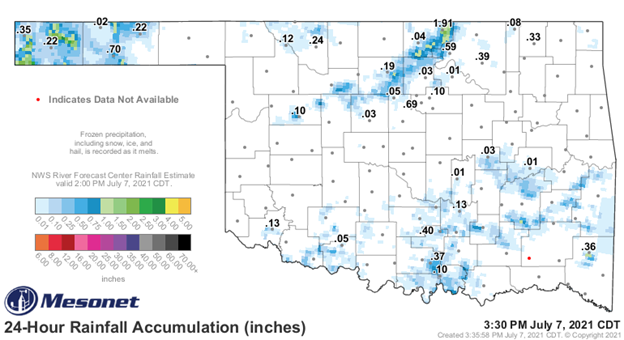
Enclosed, see the 1 hour, 24-Hour and 7-day rainfall accumulation maps with the 7-day weather forecast for Oklahoma.
The Oklahoma Wheat Commission will put a final crop report out with the date on that to be determined once the wheat harvest has been finally completed for our region.















 WORLD OF WHEAT