Unknown's avatar

About Amanda De Oliveira Silva

I have served as an Assistant Professor and Small Grains Extension Specialist at Oklahoma State University since August 2019. I believe that close interaction with producers is vital to understand their production strategies and to establish realistic research goals. My program focuses on developing science-based information to improve the agronomic and economic viability of small grains production in Oklahoma and in the Southern Great Plains.

Oklahoma Wheat Harvest Continues to Move Full Speed Ahead

Courtesy Oklahoma Wheat Commission

Wheat harvest continues to make great progress in Southern and Central Oklahoma. Producers along the 412 Hwy corridor, in Northern Oklahoma, are just getting a good start.  Custom harvesting crews are trying to finalize cuttings in Southern and Central Oklahoma and this has impacted some producers getting fields harvested in Northern regions, but with the open weather that most likely is going to change in the next couple days.  Overall crop quality continues to be favorable with test weight and yield reports. Statewide nothing has been reported below 60 lbs./bu., until today and we are seeing some lower test weights being reported east of Enid and in regions North of Blackwell and Braman on the I-35 corridor.  Yields in most all regions have been favorable ranging from the mid 30’s to mid 60’s depending on variety, location and management plans.  Some producers with intensive management programs are reporting yields in the mid 70’s to mid 80’s in parts of Northern, Oklahoma.  Protein reports across the state are varying, with wide ranges, in Southwest, Oklahoma.  For the most part we are hearing regional averages of 11.2% to 11.6%, although some lower numbers have been reported in Tillman County to be in the 10% range.  In Central, Oklahoma we are seeing slightly lower proteins in the 10.5% to 11.1% range.  Early reports on protein in Northern, Oklahoma, are ranging across the board with higher numbers being reported around the Ringwood, Cherokee & Burlington regions. Averages along this corridor coming in at 11.1% to 11.2%.  East of Enid and North we are seeing protein numbers vary across the board from 10.1% to 11.8%.  Some numbers as high as 14% have been reported although that is few and far between. Currently we are calling the statewide average in Oklahoma for protein at 11.2%.

Below are regions where wheat has been taken in prior to Wednesday June 16, at 3:00  CST.

Southwest Oklahoma Locations Reporting

Grandfield/Devol/Lawton- Test weights have still been holding up even though light rains have occurred, prior to producers getting back into fields.  This region has a 62 lbs./bu average.  Yields currently being reported in the mid 30’s to mid 40’s, some fields with intensive management have been reported in the mid 50’s.  This area is being reported at 65% to 70% completed.

Altus- Harvest was slowed due to rains late last week and over the weekend. Test weights to this point still ranging from 60 lbs./bu. to 62 lbs./bu. with yields being reported in the mid 30’s to mid 40’s.  Some fields with intensive management have been reported making in the mid 60’s to mid 70’s.  Harvest is 55% complete.

Frederick/Chattanooga- Test weights are still holding up in Tillman County even with the later rains received last week that have hindered harvest.  Test weights are ranging from 60 lbs./bu. to 61 lbs./bu.  Yields in this area making in the low to mid 40’s for the most part. Harvest just a little over 50% complete.

Lone Wolf/Hobart- Wheat harvest continues in this region. Test weights averaging 61 lbs./bu. to 63 lbs./bu. Yields being reported from the mid 30’s to mid 50’s depending on location and management. Yields have been better around the Hobart area, due to more moisture received in this region throughout the growing season.  Harvest in this region is 75% complete.

Apache- Yields across the board in this region being reported in the mid 40’s.  The test weight average for this location is 62.5 lbs./bu.  Protein average for this location is 11.5%. Harvest in this region is 25% to 30% complete.

Sentinel/Rocky- Harvest has made great progress in this region over the past few days.  Yields are being reported as favorable making in the upper 30’s to mid 40’s.  Fields with more intense management in both locations have been reported in the mid 60’s. Test weight on the wheat is ranging from 60 lbs./bu. to 64 lbs./bu.  Harvest in this region is 50% complete.

Central Oklahoma Locations Reporting

Reeding/Kingfisher/Omega/Greenfield- Yields in this region have been favorable up to this point. Harvest has been moving forward in this area for the past week, but it has been slower with the scattered showers and high humidity.  Yields for the most part are ranging from the mid to low 40’s.   Test weights have been ranging from 60 lbs./bu. to 64 lbs./bu. Harvest in the Eastern part of this region is 55% to 60% complete. Harvest in the Western part of this region is 40% complete.

Northern Oklahoma Locations Reporting

Blackwell/Braman- Harvest is just getting started. Yields have varied from the mid 30’s to the mid 50’s for the most part on early cuttings.  Lower test weights in this region along the I-35 corridor have been ranging from 56 lbs./bu. to 60 lbs./bu.  Harvest in this region is 5% to 7% complete.

Deer Creek/ Renfrow/ Medford/ Pond Creek- Harvest is just getting started in this region of Grant County.  Test weights have been averaging 60 lbs./bu. or above.  Yields ranging from the mid 30’s to mid 50’s, depending on management. Some highly intensive managed fields reported at making 70+.  Protein in this region is ranging from 10% to 13%.  Harvest in this region is 10% complete.

Kremlin- Yields for the most part have been favorable in the mid 40’s to mid 50’s depending on management.  Some yields have been noted at 70+.  Test weights are ranging from 61 lbs./bu. to 64 lbs./bu.  Protein is 11.8% for this area.  Harvest in this region is 10% complete.

Cherokee- Harvest is moving along in this region. Test weights have averaged 63 lbs./bu. to 65 lbs./bu. Yields are being reported in the mid 40’s with some higher yields being reported on fields with intensive management making 70+.  Protein average for this region is coming in at 11.2%.  Harvest in this region is 20% to 25% complete.

Burlington- Producers continue to make progress in this area with yields ranging from the mid 30’s to the mid 40’s. Some higher yields have been noted in the mid 50’s.  The test weight average has been from 60.5 lbs./bu. to 61.5 lbs./bu.  No protein was reported.  Harvest in this area is 35% completed.

Alva/Selman/Buffalo- Harvest is starting to move along in this region, but has been slower around the Buffalo area.  Yields are ranging in the mid 30’s to mid 50’s depending on management practices. Harvest is less than 10% complete for this area.

Shattuck/Fort Supply- Harvest has started picking up in the Shattuck region and is just getting started in the Fort Supply area.  Early yields are reported in the mid 30’s to mid 40’s, although yields seem to be lower South of Shattuck due to less moisture.   Test weights are ranging from 62lbs./bu. to 63lbs./bu.  Harvest in Shattuck is 10% complete and is 5% complete around the Fort Supply area.

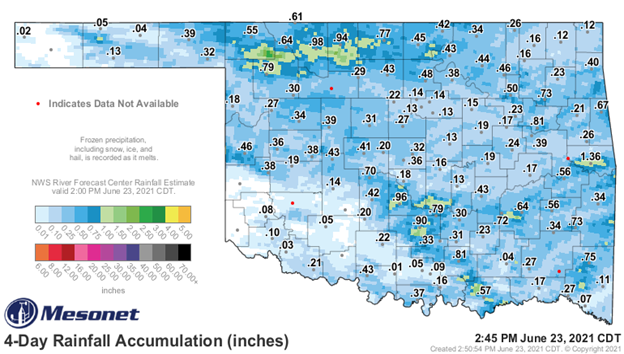
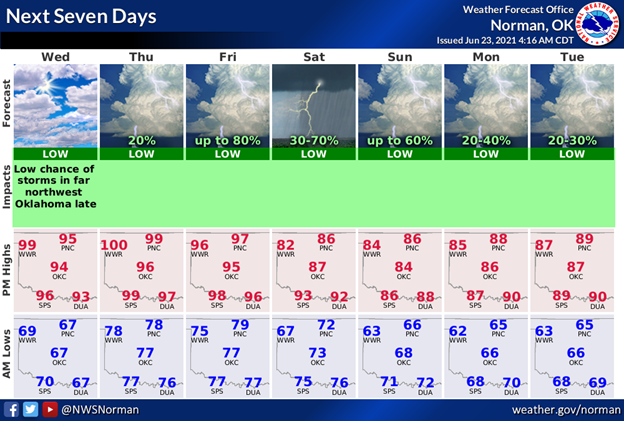
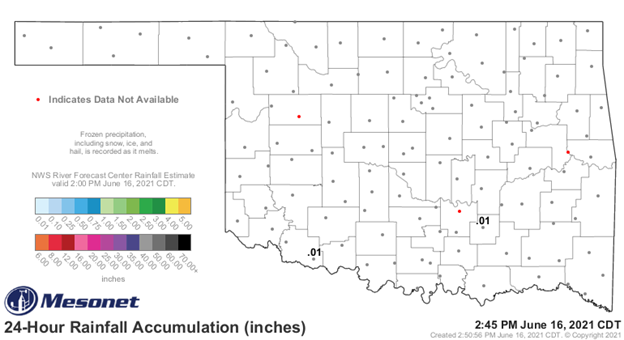
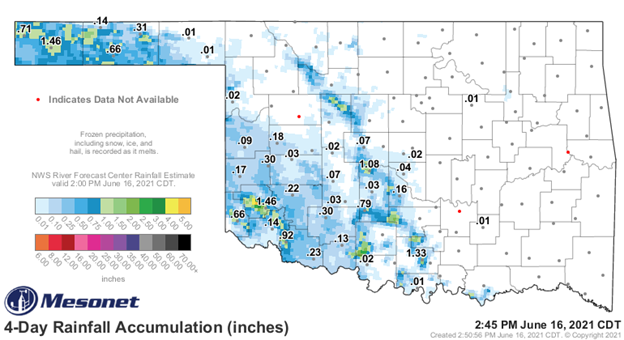
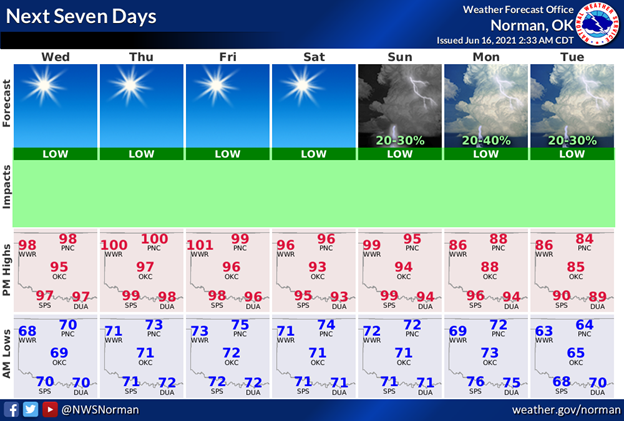
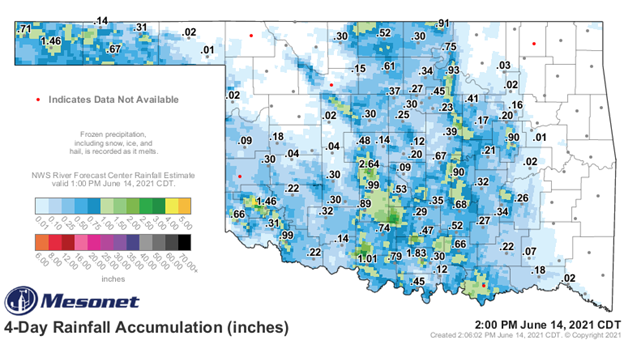
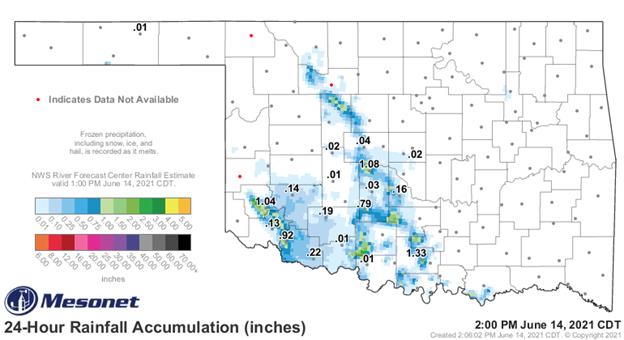
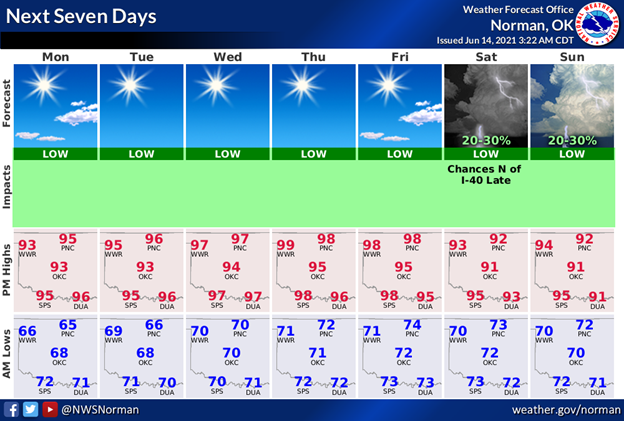
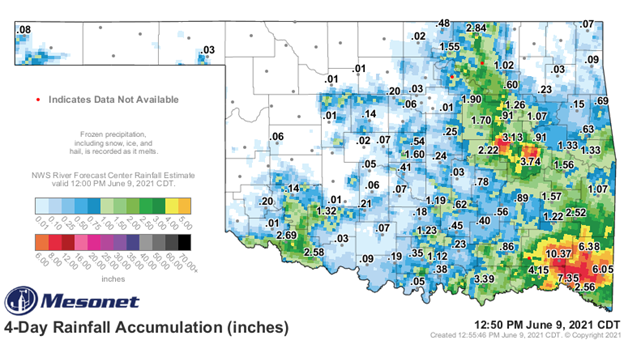
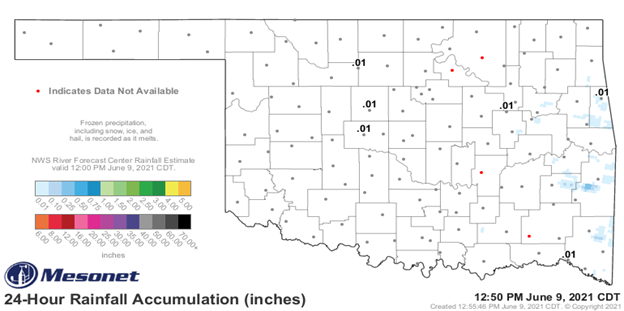
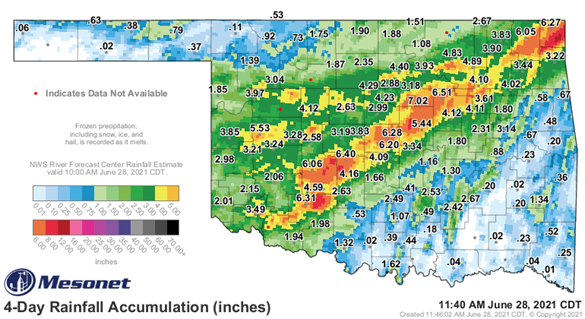
Enclosed, see the 4 day and 24-Hour rainfall accumulation maps with the 7-day weather forecast for Oklahoma.
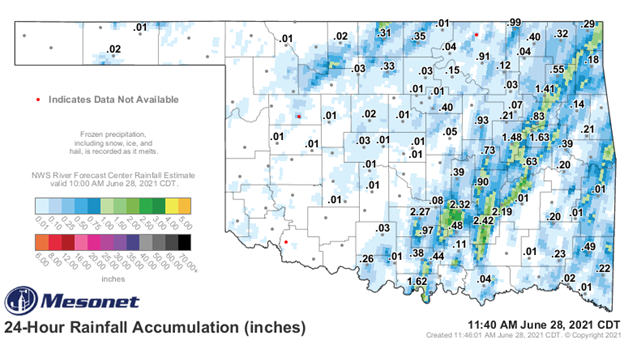
The next harvest report by the Oklahoma Wheat Commission will be published Monday, June 21, 2021.  A regional harvest report and crop update will be made available and published on Friday, June 18, 2021.

Oklahoma Wheat Harvest Taking Place from Oklahoma/Texas Border to Oklahoma/Kansas State Line

Courtesy Oklahoma Wheat Commission

Southwest & Central Oklahoma

Wheat harvest continues to roll along in week 2. While great progress has been made in regions of Southwest, Oklahoma, some areas have had light rains over the weekend which has put harvest on hold.  In the Altus region heavier rains were reported and will delay producers from getting back into the fields for the next couple days.  Other parts of Southwest, Oklahoma have had light showers, while producers have not had to fight mud in most places, the light rains and high humidity levels have created delays with late starts on most days.  In South Central Oklahoma, around Minco/Tuttle, and in North Central Oklahoma around Goltry producers over the weekend had light rains which have delayed harvest progress from really getting started in those regions.  Overall crop quality continues to be favorable with test weight and yield reports. Statewide nothing has been reported below 60 lbs./bu. Yields in most all regions have been favorable ranging from the mid 30’s to mid 60’s depending on variety, location and management plans.  A lot of yields across the state are reported in the low 40’s. We are seeing lower yields once you get west of Lone Wolf and Cordell, due to more intense drought situations that producers have been dealing with in that region all year. In the Southwest region proteins being reported are still in a favorable range of 11.5 percent.  Harvest in many parts of this region are 50% to 60% completed, while in other parts some locations are reporting 20% to 30% completed.

Northern Oklahoma

The regions North of 412 Hwy from the Helena to Garber area, harvest is just getting started as several producers were able to start with test cutting over the weekend.  Early indications from this region North in most places it is estimated that yields will be decent and mirror much of what we saw last year, with ranges from the mid 40’s to mid 60’s; although in some places lack of moisture during this spring seem to have impacted the crop especially around the Cherokee, Burlington and Alva regions.  It is too early to report an accurate protein number on the crop that is being harvest in Central and Northern, Oklahoma, it looks like this also is going to mirror what we saw last year, with high pocket regions, and some areas that will be lower.

Below are regions where wheat has been taken in prior to Monday June 14, at 12:00 noon CST.

Southwest Oklahoma Locations Reporting

Duke- Harvest is progressing in this region. Yields have been ranging in the mid 30’s to mid 40’s. Test weights averaging 62 lbs./bu. to 63 lbs./bu. per bushel.  Harvest in this region is 60% complete.

Altus- Harvest was successful in this region prior to heavy rains received over the weekend.  This region received 1.4 to 1.9 inches of moisture over the weekend and harvest will be at a standstill most likely the next couple days.   Test weights to this point ranging from 61 lbs./bu. to 63 lbs./bu. with yields being reported in the mid 30’s to mid 40’s for the most part.  Harvest 50% to 60% complete.

Lone Wolf/Hobart- Wheat harvest continues in this region. Test weights averaging 61 lbs./bu. to 63 lbs./bu. Yields being reported from the mid 30’s to mid 50’s depending on location and management.   Yields have been better around the Hobart area, due to more moisture received in this region throughout the growing season.  Harvest in this region is 55% complete.

Roosevelt- Harvest in this region has been slower this year due to several untimely rains and high humidity days.  Yields on the wheat in this region have been more favorable than other areas of Southwest, Oklahoma, due to more moisture throughout the growing season.  Yields are being reported in the high 30’s to low 50’s.  Test weights are being reported at 61 lbs./bu. to 62 lbs./bu. per bushel.  Harvest in this region is 30% complete.

Sentinel/Rocky- Light rain showers and high humidity throughout the week have hindered harvest from getting into full swing.  Custom cutters have been slower to arrive in the region due to harvest still going on in the Central/Northern Texas regions and other parts of Southwest, Oklahoma.  Yields are being reported as favorable making in the upper 30’s to mid 40’s on early cuttings. Test weight on the wheat is ranging from 62lbs./bu. to 64 lbs./bu.  Harvest in this region is 20% complete.

Central Oklahoma Locations Reporting

Reeding/Kingfisher/Omega- Yields in this region have been favorable up to this point in time. Harvest has been moving forward in this area for the past week, but it has been slower going with the scattered showers and high humidity.  Yields for the most part are ranging from the mid to low 40’s. One yield was reported to make above 75 bushels per acre on a field with intensive management North of Kingfisher. Test weights have been ranging from 60 lbs./bu. to 64 lbs./bu. Harvest in this region will have a more accurate field count on Wednesday, but right now we are calling the area 35% to 40% harvested.

Northern Oklahoma Locations Reporting

Perry/Tonkawa/Blackwell/Braman- These four locations took in a few truck loads each over the weekend.  No yields for the region have been reported, but test weights are ranging from 61 lbs. to 62 lbs. per bushel.  No protein has been reported on early cuttings.  Yields are expected to be favorable.

Goltry/Helena- Only a couple of loads were taken in at these locations over the weekend, as the crop was not fully ripe and light rains also hindered progress.   Producers were hopeful to get into the field around Goltry and Helena later today.  Early loads indicate strong test weights and decent yields.

Cherokee- Harvest started on Friday and has been picking up over the weekend. Test weights have ranged from 60 lbs./bu. to 65lbs./bu.  Yields are being reported in the mid 40’s with some higher yields being reported on fields with intensive management.  Proteins have ranged from all over the board in this region from 10% to 12.8%.  This location is hoping for an 11% to 11.5% average.

Burlington- Harvest started on Friday and they are hopeful the region will make great progress over this coming week.  Early reports showing a lot of yields ranging from the mid 30’s to the mid 40’s.  The test weight average has been from 60.5 lbs./bu. to 61.5 lbs./bu.  No protein was reported.

Alva/Selman/Buffalo- Harvest is just getting ready to start in this region.  A little wheat was taken in at Selman and Alva over the weekend, with one truck reported at Buffalo. Test weights and yields look to be favorable but nothing was reported on early cuttings.

Shattuck- Harvest is just getting started in this region.  No yields have been reported, however on the two truck loads of wheat harvested over the weekend, the test weight was 64 lbs./bu.

Enclosed, see the 4 day and 24-Hour rainfall accumulation maps with the 7-day weather forecast for Oklahoma.
The next harvest report by the Oklahoma Wheat Commission will be published Wednesday, June 16, 2021. 

Oklahoma Wheat Harvest Moving Forward in Most Parts of Southern Oklahoma, Producers in Central Regions Hoping to Start Soon

Courtesy Oklahoma Wheat Commission

The 2021 wheat harvest is on the move in most areas of Southwest, Oklahoma.  Some places around the Frederick region have been slowed due to heavier rains, but producers are hopeful they will start getting back in fields later tonight or tomorrow.  A large portion of Tillman County received ½ to 3 ½ inches of rain late Sunday evening and early Monday morning.  In other parts of Comanche and Cotton counties where harvest has resumed, test weights have dropped slightly but are still favorable coming in at 60 lbs./bu. or higher.  Other regions in Kiowa, Washita, and Caddo counties are also reporting extremely favorable test weights ranging from 62 to 63 lbs/bu. for the most part with a few being reported as high as 65.5 lbs./bu. Yields in most regions where harvest is being reported are coming in favorable across Southwest Oklahoma.  They are ranging from the mid 30’s to the mid 60’s depending on climate, rainfall and management systems.  We have had a report of one load of wheat being taken in at Clinton and harvest has also started with wheat being taken in at Sentinel, Rocky, Cordell and Apache. Producers have been test cutting East of Okarche and South of Kingfisher where harvest usually leap frogs over Grady and Canadian counties, but as of today, moisture ranges on test cuttings have been reported at 15.5% to 17.4% in the Kingfisher/Canadian county region.  With the predicted forecast of warmer temperatures, producers are hoping they will get into the fields in this area late this afternoon.  Proteins being reported in Southwest, Oklahoma are varying depending on locations, environment and producer management. Regional averages from Southern Oklahoma are currently holding steady at 11.3% to 11.6% based off early reports.

Below are regions where wheat has been taken in prior to Wednesday, June 9, at 12:00 noon CST.

Grandfield/Devol- Harvest was successful this past weekend and combines have started back up in these locations after the rains earlier in the week.  Test weights have dropped from earlier reports last weekend but still are coming in at 60 to 61 lbs./bu.  Yields being reported in the mid 30’s to the mid 50’s.

Frederick/Chattanooga- Harvest was successful this past weekend until heavy rains on Sunday and Monday morning took place.  Producers are hopeful they will get back into the fields around Chattanooga later this afternoon.  The Frederick region, is hopeful harvest will get moving at full speed tomorrow.  Test weights in this region before the rains were being reported at 60 to 62 lbs./bu., with more data available on the next report.  Yields were being reported as favorable in the mid 30’s to mid 40’s for the most part, with some higher yields in the mid 50’s noted.

Altus/Duke- Harvest was successful in this region over the weekend, while light moisture and humidity slowed harvest around Altus.  Producers around Duke have been able to continue cutting and harvest in the Altus area now is moving full speed ahead.  Test weights are coming in higher than some of the earlier harvested wheat, with reports now showing 62 to 64 lbs./bu.  Yields being reported from high 30’s to mid 60’s depending on management systems.

Lone Wolf/Hobart-Wheat harvest continues in this region, as the lighter rains did not delay progress much this week.  Test weights averaging 61 to 63 lbs./bu. Yields being reported from the mid 30’s to mid 50’s depending on location and management.

Roosevelt- Some wheat was taken in over the weekend at this location, but harvest has been at a standstill due to the heavier rains they received earlier in the week.  Early test weights were favorable at 61 to 63 lbs./bu., no yields were reported. Producers are hopeful they will get back into the fields tomorrow.

Sentinel/Rocky/Cordell-Test weights being reported around Sentinel on early cuttings are ranging from 60 to 62 lbs./bu.  Test weights on early cuttings around the Rocky and Cordell regions are ranging from 62 to 65 lbs./bu.  Yields are being reported in the mid 30’s to mid 60’s depending on management and if the wheat was grazed.

Apache- Apache received three loads this morning on first cuttings, test weights on each load were reported at 60lbs./bu. or higher.  No yields were yet reported from this region.

Enclosed, see the 4 day and 24-Hour rainfall accumulation maps with the 7-day weather forecast for Oklahoma.

The next harvest report by the Oklahoma Wheat Commission will be published Monday, June 14, 2021.  A regional harvest report and crop update will be made available and published on Friday, June 11, 2021.

Wheat Disease Update – 9 June 2021

This article was written by Bob Hunger, Extension Wheat Pathologist

      During the last two days there have been a couple reports of dark wheat heads being observed in fields.  This is a condition call sooty mold (aka black head mold) (Figure 1). These dark heads are the result of saprophytic (living of dead tissue) or weakly pathogenic fungi growing on the dead tissue in wheat heads.  Reports of this have come from Greg Highfill (Alfalfa County Extension Educator in north central OK) and from Brad Secraw (Cleveland County Extension Educator in central OK).  Additionally, I have observed severe sooty mold in some of the trials around Stillwater.

      Sooty mold occurs when wheat has turned but cannot be harvested in a timely manner.  Wet/humid conditions during a delayed harvest will then promote the fungal growth on wheat heads.  Often wheat that has been subjected to a stress such as freeze, root rot, or drought shows a greater severity of sooty mold than if the wheat had been healthy and not stressed.  This is the case in the top photo in Figure 1.  The darker strips of wheat with sooty mold are the variety Pete, which was hit hard by the late freeze in April.  The lighter, more golden colored heads with much less sooty mold are lines in one of Dr. Carver’s nurseries.  These breeder lines were not nearly as affected by the freeze as was the Pete.  Although grain yield from wheat with sooty mold often is reduced, the sooty mold itself is not the primary cause of that reduce yield.  Rather, it was the stress such as a freeze or root rot that was the primary cause of the reduced yield. 

Figure 1. A field view of sooty mold (black head mold) on wheat at Stillwater, OK on June 9, 2021 (top photo). Note the darker appearance of the wheat heads in the alternating long, solid strips of wheat compared to lighter, more golden colored heads in the middle strip. The bottom two photos show wheat heads with sooty mold. [Photo credits bottom two photos – Left photo; Greg Highfill (Extn Educator, Alfalfa County); photo on right; Brad Secraw (Extn Educator, Cleveland County)].

One additional point to be made is that grain harvested from wheat with severe sooty mold may show a condition known as black point (Figure 2).  Black point is a discoloration of the seed (typically the germ end of the seed) resulting either from infection by various fungi that typically are saprophytic but can occasionally parasitize living tissue, or from a combination of abiotic (environmental) conditions that promote the discoloration without the presence of an organism.  Like sooty mold, black point often is observed when freeze damage has occurred or when harvest was delayed and dead tissue in the heads was heavily colonized by fungi that resulted in sooty mold.  Black point in wheat grain can be a grading factor as the discoloration can result in black flecks in flour milled from such grain.  Additionally, if used as seed wheat, kernels with black point can have reduce germination resulting in lower seedling emergence.  Hence, if wheat showing black point is to be used as seed wheat, it is imperative to check the germination of that seed and to use a seed treatment that controls seed and seedling rots.

Figure 2. Wheat kernels with black point. The wheat kernels to the left and right show typical black point. The kernel in the middle is healthy. Ignore the reddish-pink color in the outer kernels as this is from an applied seed treatment.

FINALLY – This likely will be my (Dr. Bob Hunger) last Wheat Disease update as my last day of work is July 9th.  It has truly been a pleasure to send these updates!! I hope all of you have a great harvest this year and even better ones in the future!!!

Oklahoma Wheat Harvest Begins for the 2021 Season, Amid Cooler Temperatures and Heavy Moisture

Courtesy Oklahoma Wheat Commission

The 2021 wheat harvest has begun with several locations in Southwest, Oklahoma, reporting a successful weekend for grain being received.  The following counties that received grain in elevator locations were Harmon, Jackson, Tillman, Cotton, Comanche, Kiowa and Greer.  A few reports of sample loads being accepted in Frederick on Saturday, May 29th. Rain showers across Southwestern, Oklahoma, over the Memorial Day weekend hindered producers from making any progress over this past week until Saturday, June 5th.  During this period, cooler temperatures, cloud cover and high moisture levels on the grain have slowed progress on harvesting the crop.   Traditionally combines are rolling in Southwest, Oklahoma Memorial Day weekend or before, but unseasonable cool temperatures and rain has delayed the crop maturing.  High quality and favorable test weights have been noted so far.   Rains across Southwest, Oklahoma, late last night and early this morning have put harvest on standstill again in several regions, while in other areas producers hope to get rolling again later this afternoon, west of Tillman and Kiowa counties.  In a large area of Tillman county, producers are reporting 3 to 5 inch rains last night, which will delay harvest another 4 to 5 days.  Regions of Cotton and Comanche county locations received 1/10th to 2.5 inches of moisture depending on location.

Overall early wheat that has been harvested in Southwest, Oklahoma, indicates strong quality and decent yields. Yields reported varied depending on locations and producer management.  Test weights are averaging 60 lbs./bu. or higher.  While it is premature to report on protein, early numbers are ranging between 11 and 12 percent.

Grandfield/Devol- Harvest started over the weekend, although moisture last night will make it a late start today. More moisture was reported around Grandfield with less rain in the Devol area where combines will likely start up again.   Test weights for this region being reported at 60 +.  Yields around Grandfield and Devol have been favorable ranging from 40 to 50 bushels per acre.   One field has been reported at 70 bushels per acre.

Frederick/Chattanooga- The past two days have been successful for harvest in this region, but heavy rains last night across Tillman County is going to hinder harvest most likely another 4 to 5 days depending on the location.  Three to five inch rains from elevator managers in this region being reported today.  Areas of heavy rain did not report on Mesonet due to the nature of pop- up storms. Test weights ranging from 60 to 61 lbs./bu. Yields in this region not being reported as favorable as Comanche County but still ranging from the high 30’s on heavily grazed wheat to the mid 40’s on early cuttings.

Altus/Duke- Harvest was successful in this region over the weekend, while light moisture and humidity will most likely hinder harvest in Altus.  Little rain was received out at Duke so producers are hopeful combines in this area as well as in Harmon and Greer Counties will move later today. Note: much of the wheat in Harmon and Greer counties was cut for hay due to the excessive ongoing drought in this region.  Test weights in this area being reported at 61 to 62 lbs./bu.  Yields being reported from high 30’s to mid 60’s on fields with extremely progressive management systems.

Lone Wolf/Hobart-Producers also had success with harvesting in this region over the past two days.  Light rains and higher humidity will likely hinder an early start to harvest today in most places, certain regions may be delayed longer from getting into the fields in Kiowa county.  Test weights in this region averaging 62.4 lbs./bu. Yields being reported from the mid 30’s to mid 50’s depending on location and management.

Sentinel/Rocky- While it was close to starting this weekend at these locations, light rains today will most likely hinder harvest another couple days in this area.  No wheat was reported as taken in at these locations over the weekend.

Enclosed, see the 14-Day and 12-Hour rainfall accumulation maps with the 7-day weather forecast for Oklahoma.

The next harvest report by the Oklahoma Wheat Commission will be published Wednesday, June 9, 2021.

Wheat Disease Update – 21 May 2021

This article was written by Bob Hunger, Extension Wheat Pathologist

Wheat tours over the last ten days included Kingfisher (Kingfisher County; south central OK), Cherokee (Alfalfa County; north central OK), Alva (Woods County; northwestern OK), Lahoma (Garfield County; north central OK), Morris (Okmulgee County; eastern OK), El Reno (Canadian County; central OK); and Buffalo (Harper County; northwestern OK).  Wheat in these areas is pretty much done with flowering and kernels ranged from just forming to fully formed.  Some varieties in some areas were in the milk stage with some approaching soft dough.

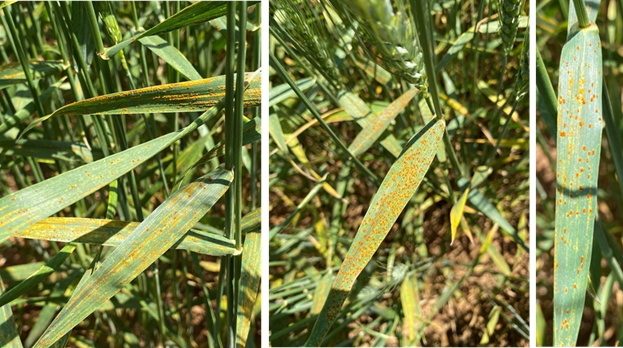
      Diseases at these locations varied considerably but overall, a wider range of diseases was observed.  Some locations such as Cherokee, Alva and Buffalo had relatively light foliar disease incidence with some leaves indicating barley yellow dwarf and wheat streak mosaic (and/or other mite transmitted viruses).  Around Stillwater and at Lahoma, although stripe rust was still prevalent leaf rust is making an appearance (Figure 1).  At others such as Kingfisher, Morris and El Reno, leaf rust could be found but stripe rust seemed to still be more prevalent.  Leaf spot diseases also were observed at most of these locations, but these foliar diseases were not as prevalent as the rusts.

Figure 1. Stripe and leaf rust both observed on wheat at Lahoma on May 13/14. A mixture of stripe and leaf rust (photo on left) compared to mostly all leaf rust (middle and right photos). [Photo credits – Dr. Amanda de Oliveira Silva; OSU Small Grains Agronomist].

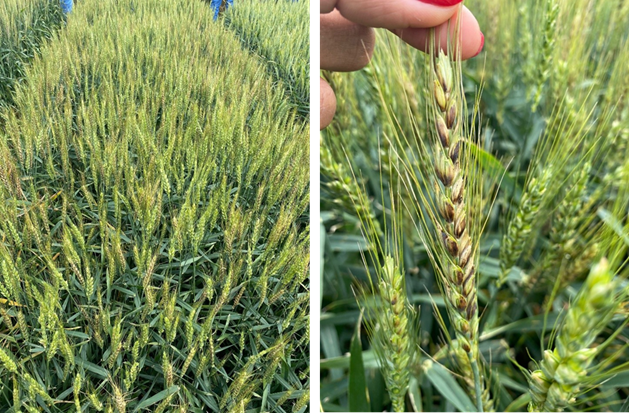
Darkened heads were observed at several locations but were most prominent and prevalent at Morris in eastern OK (Figure 2).  Darkened heads like this can result from several causes.  If Septoria and/or Stagonospora are present on lower leaves, these fungi can move up onto the heads and cause a glume blotch that has this appearance.  Another possibility is a bacterial disease called black chaff or bacterial streak (Figure 3).  Black chaff will occur on leaves (Figure 3; photo on left), but also can move onto heads (Figure 3; center photo).  Note on this center photo how the stem (peduncle) immediately beneath the head shows darkened lesions like those on the head.  Finally, awns of heads infected with black chaff often show an alternating pattern of dark and white (Figure 3; photo on right).  Another possible cause of these dark heads is presence of a gene that confers resistance to wheat stem rust.  In this case, the result is not a disease, but rather an association with the presence of that gene.  Regarding the darkened heads observed in the trial near Morris, Dr. Silva and I agree it is most likely the majority of the darkened heads observed likely resulted from freeze damage as many of these heads also were totally or partially sterile (see Dr. Silva’s blog at https://osuwheat.com/2021/05/18/freeze-damage-update/).  However, Septoria/Stagonospora and black chaff also contributed as symptoms of these diseases were observed in the field.

Figure 2. Darkened heads observed on wheat heads in a trial located in eastern Oklahoma near Morris. These darkened heads were caused by Septoria/Stagonospora, black chaff and/or freeze. [Photo credits – Dr. Amanda de Oliveira Silva; OSU Small Grains Agronomist].
Figure 3. Black chaff (bacterial streak) on wheat at Chickasha in 2013. Photo on the left is of a leaf infection; center photo shows darkening of the head and the stem just beneath the head; photo on the right shows the alternating dark and light pattern often seen on awns of wheat heads infected with the bacterium that causes black chaff. [Photo credits: Dr. Jeff Edwards; Oklahoma State University]

A final disease observed this past week was indicated by the sporadic occurrence of white heads in some parts of the field.  Examination of plants/tillers associated with these white/yellowing heads revealed symptoms typical of take all root rot (Figure 4).  However, I am not yet certain that these tillers had take all as symptoms of other root rots also were present.  Hence, samples were brought back to the lab for isolation and identification.  Look for an update on this in my next report but be aware there likely will be root rot showing up in some areas of the state.

Figure 4. Symptoms of take all root rot. White heads (photo on left) as the plants mature often indicate presence of a root rot. Lower, blackened stems and crowns of tillers with white heads resulting from take all root rot (photo on the right).

This next week marks the end of the wheat field days in Oklahoma with four coming next Thursday and Friday in the Oklahoma panhandle.  A complete schedule of the remaining field days can be viewed at: http://wheat.okstate.edu/virtual-plot-tour/2021OSUWheatFieldTours.pdf

Freeze damage update

Amanda de Oliveira Silva, Small Grains Extension Specialist

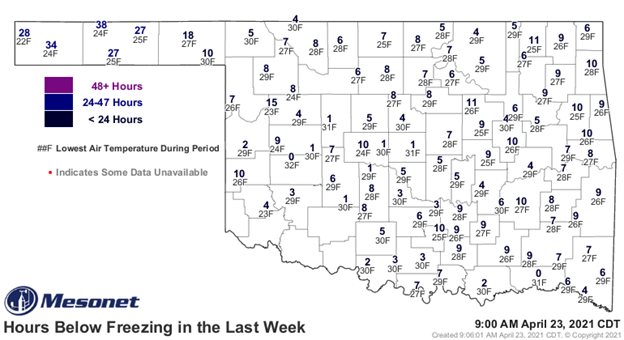
It has been almost one month since the freeze event on April 21, and we are now obtaining a better picture of potential freeze damage on wheat fields across Oklahoma. As I have indicated, the extent of the freeze damage will depend on several factors, including the growth stage of the plants, how low the temperature will get, and how long it stays at those cold temperatures. Wheat growth stage ranged from flag leaf emergence to heads starting to or fully emerged when the freeze occurred, and number of hours and temperature varied across the state (Figure 1).

Figure 1. Hour below freezing two days after the freeze event.

Traveling around the state for plot tours these past weeks, I have seen and heard about damage ranging from minimal to quite severe. Some fields seem to be fine with only scattered damaged heads and the grain appears to be filling as expected. Other fields however, show much more significant damage with discolored and sterile heads.

At the plot tour at Chickasha on April 30, there was a mix of freeze and hail damage with several abnormally growing heads (due to head trapping). Anthers seemed to be fine at that point (Figure 2).

Figure 2. Abnormally growing wheat heads at the Chickasha variety trial on April 30.

On May 7, I checked some wheat fields around Sentinel with Gary Strickland (Jackson County Extension Educator and SW Regional Agronomist) and we observed almost no freeze damage with a few heads in the field showing a pale color and partial sterility (Figure 3). I have observed this symptom commonly in fields I have visited, and many producers have described this to me as well.  Although common, it typically has been found at a low incidence.

Figure 3. Freeze damaged heads with partial sterility and pale color near Sentinel, OK on May 7.

We observed a few spots with freeze damage while at Alva on May 12, especially in low spots of the field and on the tops of terraces. Again, relatively few spots in the field showed damage. The wheat was looking good at Alva, but really needing a rain (Figure 4).

Figure 4. Freeze damage on wheat in low spots of the field at Alva, May 12.

The most severe freeze damage that I have seen so far was yesterday near Morris in eastern OK. The heads were green but there was no grain present (i.e. sterile). Damaged heads had glumes with a chocolate discoloration, which is similar to the discoloration caused by the bacterial disease called black chaff. In some cases, Dr. Hunger and I felt these discolored heads were the result of this bacterial disease but that the majority of the heads showing these symptoms were the result of freeze damage (Figure 5).

Figure 5. Freeze damaged heads without grains inside and showing a chocolate color on the outside (top photos). Heads showing no freeze damage and black chaff bacterial disease (bottom photos).

At the plot tour at El Reno today, we also observed a few varieties with pale colored and “empty” heads due to the freeze (Figure 6). We observed more freeze damage on wheat that was planted earlier and grazed as compared to the grain-only (ungrazed) wheat in that same field. Another noteworthy item is related to my earlier observation that the February freeze hurt some of the varieties in the dual-purpose plots by severely reducing tillering that would cause a loss of stand. That observation in those varieties was confirmed as the stand loss was quite evident today.

Figure 6. Wheat at El Reno. Same variety under grain-only (left) and dual-purpose (right) systems.

In conclusion, the freeze damage I am seeing is variable within and across fields, but overall I would say is minimal in most of the state. However, continue to keep scouting as it will now be easier to identify freeze damage.

Please let me know what you are seeing out there! My email is silvaa@okstate.edu.

Also, contact your County Extension office for more information.

Lahoma Field Day is this Friday – May 14!

Are you planning to attend the in-person event?

Please pre-register here: http://wheat.okstate.edu/plot-tours/21EXT_Lahoma_eFlyer_altFINAL.pdf

The program will start a little earlier at around 8:45am and the presentations will start at 9:15am. 

Are you planning to watch it online? 

Please see below the livestream link for each presentation. All you need to do is to click on the link at the time of each talk.

9:15 am – Wheat Varieties – Amanda Silva, Small Grains Extension Specialist

10:00 am – Integrated Weed Management – Misha Manuchehri, Weed Science Extension Specialist

10:45 am – Wheat Breeding and Disease Update – Brett Carver, Wheat Breeder and Bob Hunger, Extension Wheat Pathologist

All of these will be available live at www.youtube.com/sunuptv

For more information go here: http://wheat.okstate.edu/plot-tours/21EXT_Lahoma_eFlyer_altFINAL.pdf

Looking forward to seeing you there!

Wheat Disease Update – 10 May 2021

This article was written by Bob Hunger, Extension Wheat Pathologist

Wheat tours last week included Homestead (Blaine County; west-central OK), Afton (Ottawa County; northeastern OK), Sentinel and Tipton (Washita and Tillman Counties, respectively; southwestern OK) and Kildare and Lamont (Kay and Grant Counties, respectively; north-central OK).  At Homestead, Dr. Amanda Silva (OSU Small Grains Agronomist) saw primarily tan spot (Figure 1) as this trial was planted in a field of wheat after wheat.  Sentinel was fairly free of foliar diseases, but the trial at Tipton was severely infected with stripe rust.  The incidence and severity of stripe rust at Tipton also was observed by Dr. Brett Carver (OSU Wheat Breeder/Geneticist) who indicated that he saw severe stripe rust in his trials at Tipton as well.  Near Chattanooga OK, also in SW OK, there was a report of stripe rust occurring in wheat heads (Figure 1, center photo and photo to the right).  Over the years, I have occasionally observed this in Oklahoma, and it typically is a signal that stripe rust has been severe.  As far as I know, the grain is not infected, but rather it is the plant tissue surrounding the grain.  These reports of severe stripe rust contrast with what Dr. Silva and I observed at Afton, Kildare, and Lamont where little foliar disease of any type was observed.  We did however see symptoms indicative of barley yellow dwarf at all locations and some indicative of the mite-transmitted virus diseases such as wheat streak mosaic and high plains disease.

Figure 1. Tan spot (photo on left) observed on May 3rd by Dr. Amanda Silva (OSU Small Grains Agronomist) in the variety trial at Homestead, OK in west-central OK. Center and photo to the right show stripe rust that has infected and is sporulating in a wheat head. The photo credit for these two photos goes to Leon Fisher and came to me via Jerry Goodson and Mike Schulz (Station Supt, Altus).

This week will be spent at wheat field days in central, north central, and northwestern OK including trials near Cherokee, Kingfisher, Thomas, Alva, and Lahoma. A complete schedule of the remaining field days can be viewed at: http://wheat.okstate.edu/virtual-plot-tour/2021OSUWheatFieldTours.pdf

Wheat Disease Update – 4 May 2021

This article was written by Bob Hunger, Extension Wheat Pathologist

Wheat tours last week to Walters (Cotton County) in south-central OK, Altus (Jackson County) in southwestern OK, and Apache and Chickasha (both in Caddo County) in central OK showed wheat in these areas to be either quickly approaching flowering, at flowering, or just past flowering.  In all locations except Altus, stripe rust was by far the most prevalent foliar disease.  At Altus, there simply has not been sufficient moisture for any foliar disease to develop.  At the other locations, stripe rust was light at Walters, light to moderate at Apache, and moderate to severe at Chickasha.  Stripe rust in trials around Stillwater also has increased significantly as shown in Figure 1.  Although some leaf spotting and powdery mildew occasionally was observed on lower leaves, these diseases were at a low incidence and severity.

Figure 1. Severe stripe rust in a susceptible wheat line at Stillwater, OK on 5-1-2021.

Other diseases observed included barley yellow dwarf, which was present at all locations but did not seem to occur over large areas.  Another disease observed at a low incidence was loose smut (Figure 2; left photo; credit Mike Schulte).  If you recall, last year there was a higher than typical occurrence of loose smut across Oklahoma and although present again this year, loose smut seems to be more sporadic and at a lower incidence compared to 2020.  Another disease that we did not see at these southern OK field days was wheat streak mosaic virus (Figure 2; right photo).  However, we continue to receive a steady number of samples that are testing positive for Wheat streak mosaic virusHigh plains virus, or both.  These samples are coming from northern to northwestern OK and the panhandle, and it appears that mite transmitted virus diseases such as wheat streak mosaic and high plains virus will be a significant factor in certain fields in 2021.

Figure 2. A loose smutted head observed in southern Oklahoma the last week of April 2021 (left photo; photo credit: Mike Schulte) and wheat showing symptoms from a co-infection of Wheat streak mosaic virus plus High plains virus (right photo; photo credit Dr. Charlie Rush, Texas A&M University).

Finally, this week will be spent at wheat field days in northeastern OK (Afton) and in north-central OK (Kildare and Lamont). A complete schedule of those field days can be viewed at: http://wheat.okstate.edu/virtual-plot-tour/2021OSUWheatFieldTours.pdf