Bacterial streak found in Oklahoma

Widespread leaf spotting symptoms in wheat in the variety trial near Chickasha, OK (40 miles southeast of Oklahoma City) now is believed to be caused by bacterial streak (aka black chaff – see pictures below).  Bacterial streak/black chaff is occasionally observed in Oklahoma but typically is not widespread or severe.  This disease is more severe in warm (80 F or so) and humid climates or in wheat grown under irrigation, and often appears after an event such as a late freeze or other event that can cause wounds to facilitate entrance of bacteria into plants.  Lesions on leaves initially appear water-soaked but become elongated dead bands and streaks as time proceeds.

Bacterial streak lesions on leaves initially appear water-soaked but become elongated dead bands and streaks as time proceeds.

Bacterial streak lesions on leaves initially appear water-soaked but become elongated dead bands and streaks as time proceeds.

These dead areas tend to be more common on leaf “bends” where dew forms to enhance infection.  Symptoms on heads and on the stem immediately under the head include dark discoloration, and awns typically show a dark banding.These symptoms often can be confused with leaf spotting caused by the fungi Septoria (Septoria tritici blotch) or Stagonospora (Stagonospora nodorum blotch).

Symptoms on heads and on the stem immediately under the head include dark discoloration

Symptoms on heads and on the stem immediately under the head include dark discoloration

Bacterial streak/black chaff is seed transmitted, so grain from a badly infected field should not be kept for seed wheat.  There are no commercial seed treatments available, and although varieties vary in reaction to this disease, no resistant varieties are known in Oklahoma where bacterial streak/black chaff is not commonly widespread.  This disease may be occurring in other parts of Oklahoma this year, but will be difficult to discern from all the other factors that contribute to general browning and leaf spotting including other diseases (tan spot, septoria, etc), freeze, and drought.

Bob Hunger
Extension Plant Pathologist

Jeff Edwards
Small Grains Extension Specialist

Awns affected by bacterial streak/black chaff typically show a dark banding

Awns affected by bacterial streak/black chaff typically show a dark banding

Wheat disease update 18 May 2013

Wheat disease updates are written by Dr. Bob Hunger, OSU Extension Plant Pathologist

Oklahoma:

Wheat in southern/southwestern Oklahoma is maturing and will speed up with the warmer (>90 F) over the last couple of days.  In central Oklahoma, around Stillwater and to the north, wheat is just finishing or has just past flowering and kernel development is starting.  As you head to northwest Oklahoma, wheat also is in late flowering or has just finished flowering.  I’m not sure about out toward the panhandle but know there is not much wheat that will be harvested as you move west of Woodward and Buffalo.  I’ll be taking a trip to the panhandle the end of the coming week and will report more after that trip.

Disease-wise, not a lot changed over the past week in Oklahoma.  Leaf rust remained practically absent although infections in the 15-40S range were observed in Jagalene (or Jagger) guard rows in breeder plots at Stillwater.  However, little to no leaf rust was found elsewhere around Stillwater and no reports were observed or reported from north-central and northwestern Oklahoma.  Stripe rust is slight more prevalent.  Several “hot spots” were noted around trials at Stillwater and occasional “stripes” (but not hot spots) were noted at field days west of Enid, north of Ponca City, and north of Stillwater.  Leaf spotting diseases, barley yellow dwarf, and wheat streak mosaic (WSM) are the most commonly observed diseases in samples seen at field days and submitted to the Plant Disease and Insect Diagnostic Clinic.  This past week a few samples also tested positive for High plains virus.  Several reports from ag educators, consultants, and growers have indicated that WSM has devastated wheat in fields in northern and western Oklahoma.  In all cases where I talked to the person, there was an indication that volunteer wheat was involved either in the field or adjacent to it.

Reports/excerpts of reports from other states:

Arkansas – Dr. Gene Milus, (Professor/Small Grains Pathologist, Univ of Arkansas, Fayetteville, AR) 17-May-2013:  Visited plots at Kibler near Fort Smith today. Wheat is in soft dough. Stripe rust is still active. Leaf rust was present at mostly low levels. Also Septoria, bacterial streak, powdery mildew, and Stagonospora on flag leaves depending on the line. Most lines in the variety test had resistance to most or all of the above diseases. Weather is hot and humid. Plenty of soil moisture.

Kansas – Dr. Erick De Wolf (Professor/Small Grains Extension Pathologist, Kansas State Univ, Manhattan, KS) 17-May-2013:  Stripe rust continues to be reported at low levels in Kansas this week with new finds in Sedgwick, Kingman, Sumner, and Pratt counties. The wheat in this area of the state is still heading or flowering. Generally, only trace levels could be found in these fields.  Tom Maxwell, Central Kansas District agent, reported finding low levels of stripe rust in Saline County on May 17. The wheat there is generally in the early heading stages.  I have found a few fields and a demonstration plot in Pratt County where the disease is at high enough levels to justify a fungicide application. This area of the state has received more rain than others in recent weeks and some fields in Pratt County have good yield potential. The affected varieties included Everest and Armour, which were found to be susceptible in 2012. A lot of wheat in this area of the state is struggling with continued dry weather.

I encourage farmers to carefully check fields for symptoms of disease. Fields where stripe rust can be readily found on the flag leaf (one lesion every 2-3 feet) will likely benefit from a fungicide application. The wild card on this decision is the weather.  Low temperatures in the upper 60’s are generally thought to be suppressive to stripe rust development. High temperatures in the upper 80’s or above for several days in a row also tend to suppress stripe rust. But if temperatures in that range last only last a few days or so, followed by cooler weather, stripe rust can resume activity.

Wheat disease update 11 May 2013

Wheat disease updates are written by Dr. Bob Hunger, OSU Extension Plant Pathologist

Oklahoma:  As you move from southern to northern/northwestern Oklahoma, wheat ranges from past flowering to flowering to heads emerging/approaching flowering (depending on variety and planting/emergence date).  It is highly variable.  Weather continues to be cool and moist except in southern, western and northwestern Oklahoma where it continues to be dry.

There were no reports of leaf rust over the last week in Oklahoma, but reports of stripe rust increased.  However, none of these stripe rust sightings indicated a widespread, severe outbreak anywhere in the state.  Bryan Vincent (Crop Consultant – northern Oklahoma) reported seeing strip rust on Everest wheat just west of Orienta, OK (about 40 miles west of Enid).  Dr. Brett Carver (OSU Wheat Breeder) reported in his visit early in the week to his breeder nursery at Lahoma (north central OK – 10 miles west of Enid), that, “35 swipes, just one 1″ sporulating Yr lesion at Lahoma, f-3. Otherwise nothing. Will keep looking.”  On Friday (10-May) at the Lahoma field day in the variety trial, I found an occasional active stripe in expected varieties (Pete, Garrison, Iba, Everest, and Armour), but these stripes were rare – only one or two per plot.  However, our weather over the last couple weeks and the near forecast is for weather favorable for stripe and leaf rust, so we may begin to see more of these rust diseases.  Powdery mildew continues to be found but I have not seen it yet on flag leaves or even F-1 leaves.  Leaf spotting diseases (tan spot, septoria, stagonospora) are more severe in Oklahoma than typical but vary by location.  For example, Dr. Jeff Edwards (OSU Smalll Grains Extension Agronomist) indicated that at his variety trial at Chickasha, leaf spotting was widespread, severe, and was on the flag leaves of specific varieties in the trial.

Regarding viruses – barley yellow dwarf is commonly observed at all locations, but is not associated with severe stunting indicating a later infection.  Numerous reports have been received and many samples have now tested positive for wheat streak mosaic virus from many areas of Oklahoma.  None of these samples have tested positive for either High plains virus or Triticum mosaic virus.

Reports/excerpts of reports from other states:

Arkansas – Dr. Gene Milus, (Professor/Small Grains Pathologist, Univ of Arkansas, Fayetteville, AR) 10-May-2013:  Most wheat has flowered or is flowering now. I found a low level of leaf rust at Rohwer in the southeast corner, and this is the first confirmed leaf rust here. Stripe rust is still active. Bacterial streak showed up on several varieties in the variety test. Leaf blotch is moving up the plants. There is abundant soil moisture across most of the state.

Kansas – Dr. Erick De Wolf (Professor/Small Grains Extension Pathologist, Kansas State Univ, Manhattan, KS) 11-May-2013:  The wheat is heading and flowering in southeastern and south central Kansas this week.  Wheat in central Kansas is mostly in the boot stages of development with the most advanced fields beginning to head this weekend. The wheat in southwestern KS continues to struggle with drought and freeze damage and growth stage varies widely among fields.

Disease scouting this week suggests the risk of severe rust epidemics remains low in Kansas this year.  I had a few more reports of trace levels of stripe rust in southeastern KS where the wheat is flowering. The levels of stripe rust are very low at this time.  Temperatures are forecast to reach the upper 80’s early next week with low temps at or above 60 F. Temperatures in this range often slow the development of stripe rust but farmers in this areas should monitor the disease carefully.

I was able to find a single pustule of leaf rust in Stafford county Kansas this week, but the wheat at this location was thin from recent dry conditions.  I suspect the leaf rust will not increase rapidly at this location.  Other fields that I checked in southwest KS (Finney and Kiowa counties) show significant drought stress and no sign of rust.  In south central and central Kansas (Pratt, Reno, and McPherson counties), the wheat is in better condition with thick canopies and good moisture recently.  I found no leaf rust, stripe rust or stem rust in these areas; however, several fields had moderate levels of powdery mildew. Symptoms of barley yellow dwarf remain low or absent in all fields I have check to date.

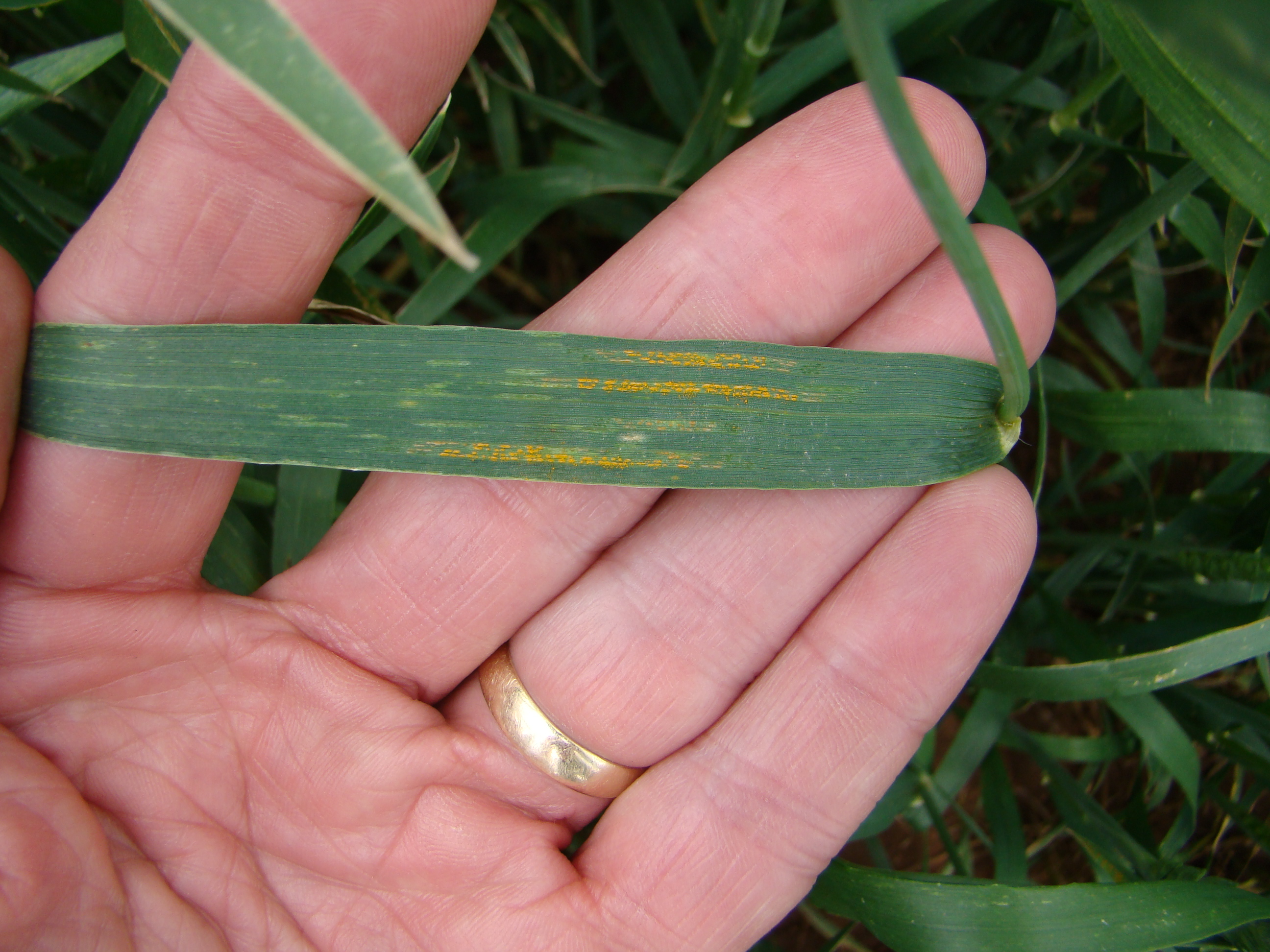
Stripe rust on wheat at Lahoma

Stripe rust on wheat at Lahoma

Wheat disease update 04 May 2013

Wheat disease updates are written by Dr. Bob Hunger, OSU Extension Wheat Pathologist

Oklahoma:  Over the last week I, Nathalia Grachet (OSU graduate student), and Brian Olson (OSU A&P) extensively looked at wheat around Stillwater, and in central (Minco, Apache), southwestern (Granite), and north central (Lahoma) Oklahoma.  Additionally, OSU Wheat Breeder Brett Carver examined his plots at numerous locations in central, southwestern OK as well as at Stillwater, and Dr. Art Klatt (OSU Wheat Geneticist) examined trials around Stillwater and Perkins.  Wheat in southwestern Oklahoma was damaged from drought and freeze, and little disease was discernible.  Wheat in southwestern Oklahoma (where it was possible) appeared to be at various states of head emergence, and in a few cases was just starting to flower.  In central OK, wheat was in various stages of heading.  Around Stillwater, wheat was just starting head emergence, while at Lahoma wheat was mostly just approaching GS 10 (boot stage).  However, there seems to be quite a bit of variability regarding stage of maturity depending on variety and planting date.

No leaf rust was observed at any location.  The “hot spot” of stripe rust we found at Minco is still active, but my previous update incorrectly identified ‘Duster’ as the variety with the most severe stripe rust.  Actually that was ‘Garrison’.  Stripe rust also was on Duster but not to the same severity nor was significant stripe rust on the flag leaves of Duster.  This is the only location where we observed significant stripe rust.  We also observed powdery mildew and leaf spotting on lower to mid leaves at many locations.  Primarily the leaf spotting appeared to be septoria/stagonospora with some tan spot mixed in, and as expected is usually somewhat more severe in no- or low-till fields.

Barley yellow dwarf was commonly observed at many locations with variable severity, but it was often difficult to differentiate damage between BYD, freeze, and drought.  Wheat streak mosaic also was observed across the areas examined (see photo below).  An increasing number of samples from around western OK have kept Jen Olson (Plant Disease Diagnostician) busy.  Most of these samples have tested positive for BYDV, WSMV, or both, but no high plains virus or Triticum mosaic virus has been detected.  This includes the Stillwater area where I have never before (since 1982) observed WSM.  Another interesting find here at Stillwater included occurrence of Russian Wheat Aphid, which was confirmed by Dr. Rick Grantham (Director of the Plant Disease and Insect Diagnostic Lab –  photos below taken by Rick).

Wheat showing symtoms of Wheat Streak Mosiac Virus. There are no curative sprays for this virus, but it can be avoided by ensuring volunteer wheat and other grasses are dead at least two weeks prior to planting

Wheat showing symtoms of Wheat Streak Mosiac Virus. There are no curative sprays for this virus, but it can be avoided by ensuring volunteer wheat and other grasses are dead at least two weeks prior to planting

Symptoms of Russian wheat aphid feeding

Symptoms of Russian wheat aphid feeding

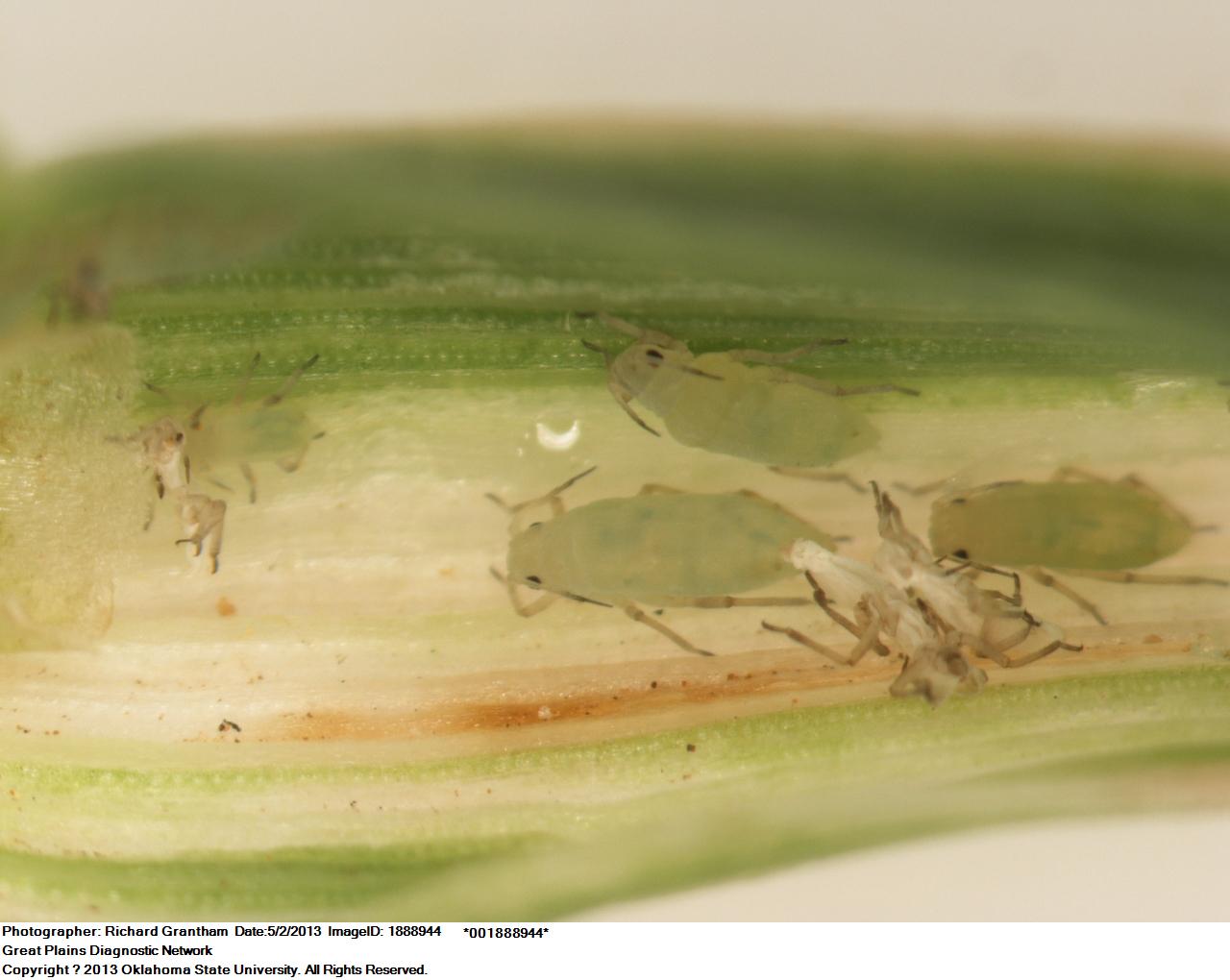
Russian wheat aphids on wheat

Russian wheat aphids on wheat

Wheat disease update 26 April 2013

Wheat disease updates are written by Dr. Bob Hunger, OSU Extension Wheat Pathologist

Oklahoma:  Reports of stripe rust were more common from Oklahoma this past week.  Yesterday (25-Apr) I and Nathalia Grachet (OSU graduate student) looked at wheat in central Oklahoma to the southwest, west, and northwest of Oklahoma City (OKC).  Wheat in this area was variable, but mostly around GS 10 (boot stage) to heads just emerging.  Fields where freeze damage occurred showed a wide range of tiller maturity.

Fields around Apache, OK (about 75 miles southwest of OKC) including the variety trial showed light powdery mildew and leaf spotting (tan spot/septoria/stagonospora) with stripe rust found in one field located about 10 miles west of Apache – not severe but the incidence was spread across the field (variety unknown).  On our return trip to Stillwater, we found stripe rust on lower to mid leaves in the variety demo at Minco (about 25 miles southwest of OKC) with the most severe rust on Duster (photo below).  Powdery mildew was severe on lower leaves of the wheat in the field surrounding the variety demo.  No rust was observed at the variety trial at Kingfisher (about 30 miles northwest of OKC), and no leaf rust was found at any stop.  Although not severe, stripe rust also was observed this past week around Stillwater/Perkins by Dr. Art Klatt (OSU wheat geneticist/breeder) and by Mark Gregory (OSU Southwest Extension Agronomist) in the variety trial near Chickasha (30 miles southwest of OKC).   Dr. Klatt also reported severe powdery mildew in his plots near Perkins.  Symptoms indicative of barley yellow dwarf are common around Stillwater and on the trip yesterday, however, freeze damage symptoms make it difficult to comfortably identify BYD without confirmation in the lab.

Stripe rust on Duster near Apache OK on 25 April 2013

Stripe rust on Duster near Apache OK on 25 April 2013

Watch season-long restrictions when split applying fungicides

By Dr. Bob Hunger, OSU Extension Plant Pathologist

My counterpart in Arkansas, Dr. Gene Milus (University of Arkansas), just sent out an important message about being careful to not exceed the maximum amount of a fungicide applied to a crop in a single year.  Such a consideration could be an issue where more than one fungicide application is made.  This is especially true if a generic of tebuconazole is applied, as this chemical also is in Prosaro;  however, multiple applications of the same fungicide may also exceed the maximum amount of chemical that can be applied in a single year.  Reading the label is the best place to determine the maximum amount of a chemical that can be applied in a single season and the exact amount of a chemical(s) that is in a fungicide.  A quick reference to what chemicals are in the typical fungicides used on wheat in Oklahoma is the OSU Current Report (CR-7668) that Dr. Jeff Edwards and I recently updated (available at www.wheat.okstate.edu)

In Arkansas and many states through the mid-western region of the U.S., two or even three fungicide applications on wheat are more common, with the last application typically targeted toward Fusarium head blight (scab).  In Oklahoma, where scab usually is not a concern, deciding to apply one fungicide application typically has been the only consideration.  However, in recent years making two fungicide applications have become more common because of higher wheat prices, lower cost of fungicides, and increased no-till wheat acres that favor early diseases such as powdery mildew, tan spot, and septoria/stagonospora.  It is in these situations that care must be taken to insure label compliance.  The following message from Dr. Milus addresses this point.  The report below is also at http://www.arkansas-crops.com/ along with other ag news from Arkansas.

Given the early onset of stripe rust and the cool rainy weather in recent weeks, some wheat growers are considering two or three fungicide applications. This is a new phenomenon for Arkansas growers and requires some planning to stay within the legal limits for total amounts of particular fungicides that can be applied to wheat fields. The fungicide label lists to total amount of each active ingredient that can be applied per acre per year. These amounts usually are given in pounds of active ingredient (lb ai) which require some math to translate into fluid ounces (fl oz) of particular products. The total amounts and usual application rates below are for fungicides most likely to be used in Arkansas.

Tebuconazole: total amount = 0.11 lb ai/A = 4 fl oz/A.
Products containing only tebuconazole include Folicur (no longer being sold), Orius, Tebucon, Tebustar, Tebuzol, Tegrol, and Toledo.

Prosaro: total amount = 8.2 fl oz /A = 0.11 lb ai each of prothioconazole and tebuconazole.
(Note that no Prosaro can be applied if 4 fl oz of a tebuconazole product was applied earlier because Prosaro is half tebuconazole.)

Propiconazole: total amount = 0.22 lb ai/A = 8 fl oz/A.
4 fl oz/A = 0.11 lb propiconazole.
Products containing propiconazole include Tilt, Bumper, Fitness, Propiconazole E-AG, and PropiMax

Quilt Excel: total amount = 28 fl oz/A = 0.22 lb propiconazole + 0.26 lb azoxystrobin
14 fl oz Quilt Excel = 0.11 lb propiconazole + 0.13 lb azoxystrobin.
(Therefore 4 fl oz of a propiconazole product + 14 fl oz of Quilt Excel can be legally applied.)

Pyraclostrobin (Headline): total amount = 18 fl oz/A = 0.29 lb ai/A
9 fl oz = 0.147 lb Pyraclostrobin (Note the slight discrepancy between the total amounts expressed as fl oz/A and lb ai/A.)

Metconazole (Caramba): total amount = 34 fl oz/A = 0.20 lb ai/A
17 fl oz = 0.10 lb Metconazole

Twinline: total amount = 18 fl oz/A = 0.10 lb metconazole + 0.15 lb pyraclostrobin
9 fl oz/A = 0.05 lb metconazole + 0.076 lb pyraclostrobin
(Note the discrepancies for total amounts metconazole and pyraclostrobin depending on which products are used.)

Wheat disease update 04/10/13

Wheat disease updates are written by OSU Extension Plant Pathologist Dr. Bob Hunger and posted on the World of Wheat blog.

Oklahoma:  A couple of “firsts” occurred this week.  Mark Gregory (Southwest Area Extension Agronomist) reported the first leaf rust in Oklahoma for 2013 (see photo below).  It was on Overley near Devol, OK, which is near the Red River north of Wichita Falls, TX.  The wheat was at GS 10-10.1 (boot to heads just emerging), and was in a field with quite a bit of damage from the freeze.  From Mark’s description, the prevalence was fairly low as he indicated he had to look around quite a bit to find rust pustules.  Along these lines, Dr. Jeff Edwards and I recently updated “Foliar Fungicides and Wheat Production in Oklahoma – April, 2013” (OSU Current Report CR-7668).  This publication provides answers to many of the common questions typically asked about wheat foliar fungicides and provides a table listing the most common fungicides available to control wheat foliar diseases. You can find the publication at http://www.wheat.okstate.edu or by clicking here.

We also had our first confirmed sample of wheat streak mosaic in Fuller wheat from southwestern OK (near Sentinel) in Washita County.  This was in a field that had been sprayed for volunteer wheat last fall.  Perhaps sufficient time was not allowed to elapse between the spraying of the volunteer and the planting of the wheat in the fall – remember, two weeks should be allowed between the complete death (not the spraying) of volunteer wheat and the emergence of seedling wheat in order to kill the wheat curl mites that transmit Wheat streak mosaic virus.

Next week I’ll be looking around more of the state for diseases – thankfully it is too rainy today!!!!

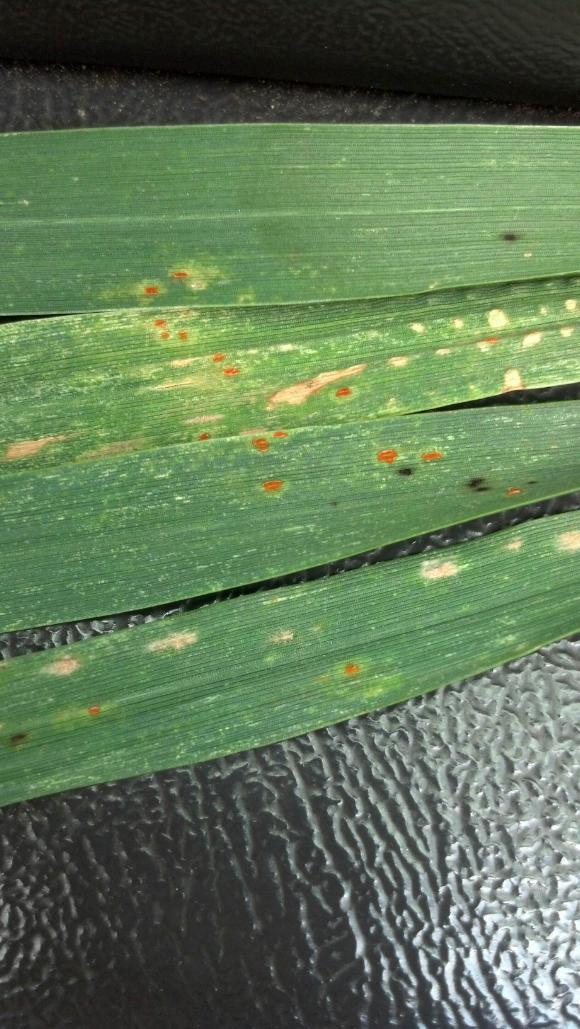
Leaf rust and powdery mildew on Overley at Devol, Oklahoma 04/08/2013

Leaf rust and powdery mildew on Overley at Devol, Oklahoma 04/08/2013