First hollow stem is here

First hollow stem occurs just prior to jointing and is the optimal time to remove cattle from wheat pasture. Grazing past first hollow stem can reduce wheat grain yield by as much as 5% per day and the added cattle gains are not enough to offset the value of the reduced wheat yield. Checking for first hollow stem is fairly easy.

  • You must check first hollow stem in a nongrazed area of the same variety and planting date. Variety can affect date of first hollow stem by as much as three weeks and planting date can affect it even more.
  • Dig or pull up a few plants and split the largest tiller longitudinally (lengthways) and measure the amount of hollow stem present below the developing grain head. You must dig plants because at this stage the developing grain head may still be below the soil surface.
  • If there is 1.5 cm of hollow stem present (see picture below), it is time to remove cattle. 1.5 cm is about the same as the diameter of a dime.
  • Detailed information on first hollow stem can be found at www.wheat.okstate.edu under ‘wheat management’ then ‘grazing’


  • Image

We check for first hollow stem in our forage trials each year. These can be used as rules of thumb, but you will still need to check your own fields. Our Chickasha plots were sown September 20, 2012 and have had fair growing conditions. First hollow stem was measured on February 18, 2013 and the results are presented in the table below. Gallagher and Everest are just past first hollow stem and Razor is not far behind. I predict that most varieties will be past first hollow stem by March 1.

Variety Hollow stem* 02/18/13
—cm—
Jagger 0.9
Endurance 0.4
Deliver 0.3
Pete 0.0
Ruby Lee 0.7
Garrison 0.5
Duster 0.4
Gallagher 1.7
Iba 0.3
Fuller 0.5
Everest 2.1
Jackpot 0.6
Doans 0.1
Greer 0.4
CJ 0.2
Razor 1.4
Armour 0.5
WB-Cedar 0.5
WB-Redhawk 0.6
T153 0.9
T154 0.4
T158 0.0
OK08328 0.0
*Average of ten hollow stem measurements in wheat sown 09/20/12 at Chickasha, OK

Spring-planted oat for forage

Spring-planted oat has been a “go to” forage crop for southern Great Plains beef producers for years. It is a good option when winter wheat was not planted in the fall due to wet conditions, or, as is the case this year, when wheat failed to emerge due to drought. Forage production potential for spring-planted oat is around 1,500 to 2,00 lb/ac, but you will need about 60 – 75 lb/ac of nitrogen to make this type of yield. Dr. Daren Redfearn has written a fact sheet detailing spring oat production for hay and it can be found at www.wheat.okstate.edu under “wheat management” then “seeding”. I will provide the Cliff’s Notes version below.

Seed — Plant 80 – 100 lb/ac of good quality seed that has a germination of no less than 85%. There aren’t many options regarding varieties, so you will likely be limited to whatever seed is available in your area. The key is not to cut back on seeding rate, regardless of variety.

Seedbed — Sow oat seed at approximately 1/2 to 3/4 inches deep. Most producers will fare better with a conventionally-tilled seedbed. You are planting seed at a time of year when the ground is already marginal regarding temperature. Conventionally-tilled seedbeds warm more quickly, which should speed germination. There is one exception to the conventional till recommendation. If you are sowing into a stale seedbed or a failed wheat crop that is very thin, no-till should be okay. Just avoid situations where excessive residue will keep the soil cold.

Grazing — Oat plants should have a minimum of six inches of growth prior to grazing. Unlike fall-seeded cereals, you should not expect a large amount of tillering. Dr. Redfearn indicates a good stand of spring oat can provide a 750 lb animal approximately 60 days of grazing when stocked at 1.5 animals per acre

Hay — Oat should be cut for hay at early heading.

Time to topdress, but be realistic

Normally, I would be sounding the wheat topdress alarm in early January. When you have 5.5 million acres to cover, it is important to start early. However, this year we have mostly kept the topdress rigs in neutral with a wait and see approach due to the drought. The recent rain brought life to portions of the Oklahoma wheat belt and it is time to make a decision regarding topdress nitrogen. I have posted three slide presentations with audio regarding topdressing wheat at my YouTube channel available by clicking here or by searching YouTube for OSU Small Grains. I have listed some additional facts and items to consider below.

  • In order to have full benefit, nitrogen must be in the rooting zone by the time wheat is jointing. Jointing occurs around the first of March in southern OK and around the second week of March in northern OK.

  • On average it takes about 2 lbs/ac of N for every bushel of wheat yield. In addition, dual-purpose wheat requires 30 lbs/ac of N for every 100 lbs/ac of beef removed. You can subtract your soil test NO3-N from these total requirements.

  • It is okay to adjust topdress N plans based on your current yield potential. When you submitted your soil test, you might have stated a 50 bu/ac yield goal which would require 100 lbs/ac of nitrogen; however, it is important to take a hard look and determine if this yield goal is still realistic based on your current crop status. I am not suggesting to adjust based on what you think the weather might do, but it is okay to take inventory and adjust your topdress N up or down based on current field conditions.

  • Don’t have an N-rich strip? It would be a lot cooler if you did. An N-rich strip would take the guess work out of adjusting your topdress N up or down based on your current crop conditions. Your county extension educator can provide more information on N-rich strips and you can find more information on the web at www.npk.okstate.edu

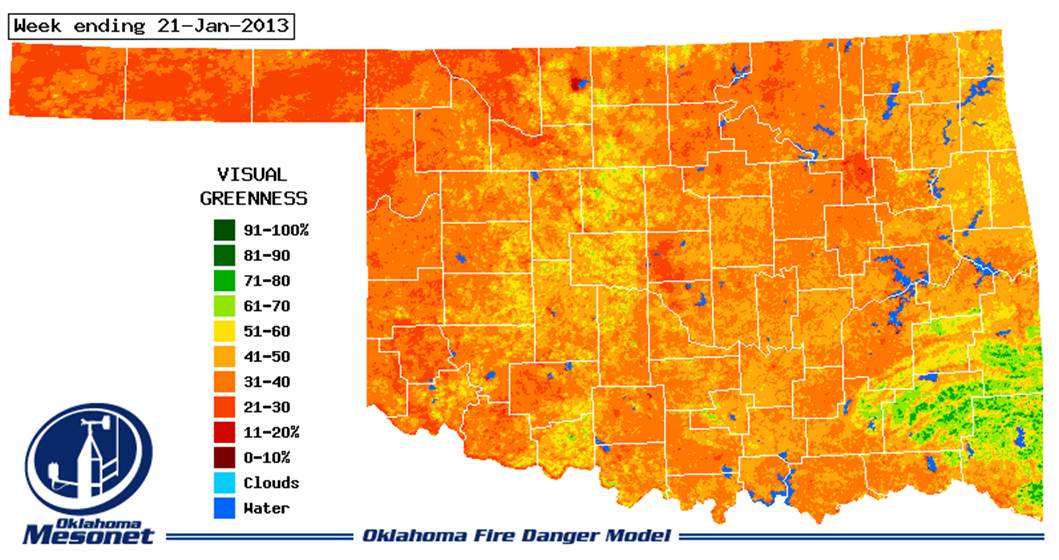
2012 versus 2013 greenness maps

I thought I would share a couple of visual greenness maps sent to me by JD Carlson in Biosystems and Ag Engineering. These are from the Oklahoma Mesonet fire danger model site and provide a visual estimate of green vegetation for mid January 2012 (top) and 2013 (bottom). Note the stark contrast in greenness throughout the wheat belt of western Oklahoma. As indicated in the 2013 map, there are some small pockets of wheat with ample stands and average yield potential, but these are not large enough to make up for all of the red.ImageImage

Check with crop insurance provider prior to drilling mud application

There are more questions than answers when it comes to application of drilling mud to agricultural land. The list of questions expands when the drilling mud is being applied to an established annual crop, such as wheat. We simply do not have enough information to know how a growing crop will respond to drilling mud application from different sources and at different application timings.

If current conditions continue it is highly likely that many Oklahoma wheat farmers will rely on crop insurance to cash flow through 2013. Therefore, wheat farmers should check with their crop insurance provider prior to applying drilling mud to established wheat to see how application of these materials will affect their coverage. Tenants should discuss application of drilling mud with landowners and it is a good idea to address these issue in writing in the lease agreement.

It’s all about tillers and tiller survival

In order to maximize grain yield, we need between 500 and 900 heads/sq. yd. at harvest.  Wheat sown at 1 bu/ac will generally result in about 175 seeds/sq. yd. meaning that we will need at least three tillers per seed that go on to make a wheat head. Not just any tiller will suffice. If a tiller does not have three large, unfolded leaves by jointing, there is a good shot that it will not make a head.

One of my primary concerns right now is  tillering in many Oklahoma wheat fields will be insufficient to reach the critical 500 heads/sq. yd. number. Even though most of our wheat was sown in October, a lot of it will have a November or December (if we are lucky) germination date. A K-State study from 1995 showed that wheat emerging on November 30th produced an average of only 1.8 viable heads per plant at harvest. If we had known that our emergence date would be in November or December, we would have compensated by doubling or tripling our seeding rate.

September-sown wheat that got a good start but is now backpedaling due to a lack of moisture is a different issue. In the same study mentioned above, wheat emerging October 12 produced 1,850 tillers per plant on average. Only 476 (26%) of these tillers made it to harvest, so it is normal for early-sown wheat to slough off several tillers. This has an energy cost to the plant and is one reason early-sown wheat generally yields less than October sown wheat. We have enough tillers present in our early-sown wheat but are losing them quickly. Rain is needed quickly to stop the losses.

Agronomists are second only to lawyers in including disclaimers and qualifying statements, and there is a lot of wiggle room in the numbers I have provided. A variety that typically produces larger heads (e.g. Billings) can be on the lower end of the 500 – 900 head range and a variety with smaller heads (e.g. Duster) will need to be on the upper end.With a warm winter and rainfall, we could still hit these targets. However, to borrow some terminology from Vegas, I think there are fairly low odds that our wheat will cover the spread when it comes to tillering this year.