Amanda de Oliveira Silva, Small Grains Extension Specialist
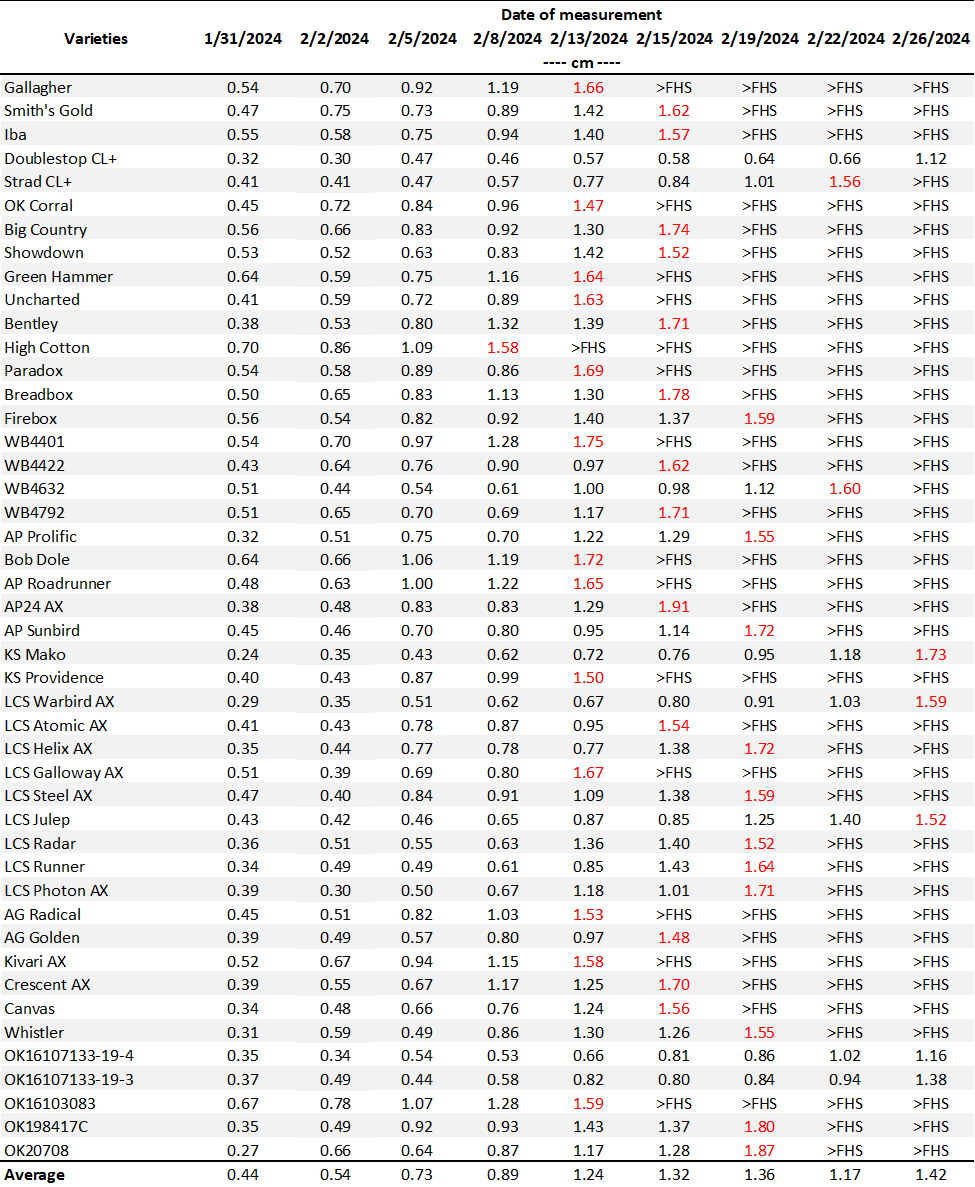
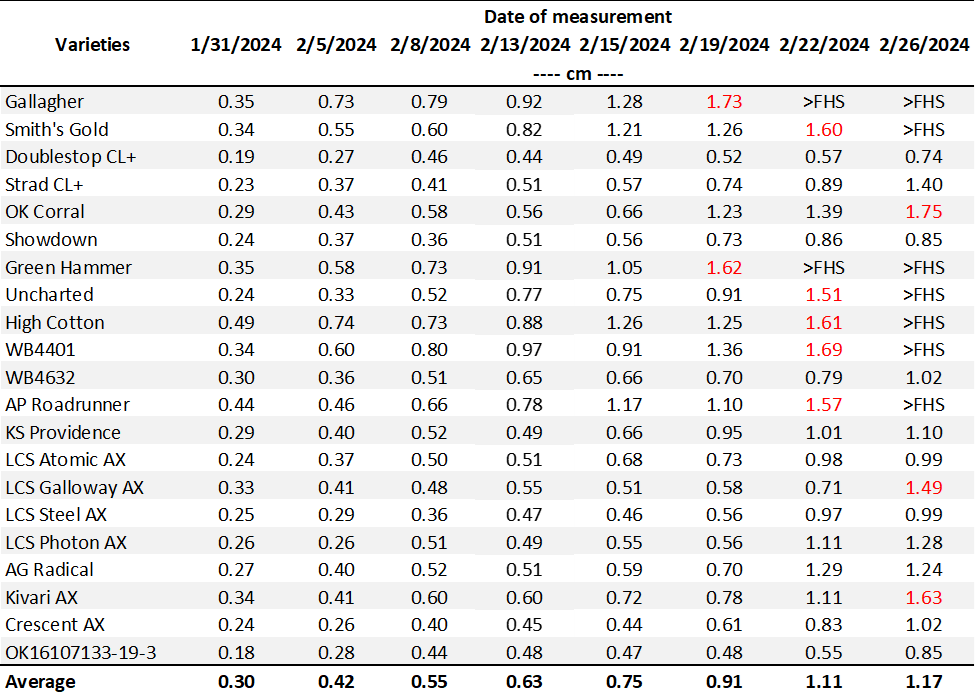
First hollow stem (FHS) is the optimal time to remove cattle from wheat pasture. This occurs when there is 1.5 cm (5/8”, or the diameter of a dime) of hollow stem below the developing grain head (see full explanation). The latest FHS results from OSU forage trials in Stillwater (Table 1) and Chickasha (Table 2) are listed below. For an additional resource and wheat update on FHS, see the Mesonet First Hollow Stem Advisor.
We use an accelerated growth system to report the earliest onset of FHS stage. Trials are seeded early to simulate a grazed system, but the forage is not removed. Varieties reported here with the earliest FHS date should be the first to monitor in commercial fields. In practice, wheat that is grazed will likely reach FHS stage later than reported here, and differences between varieties will likely be moderate.
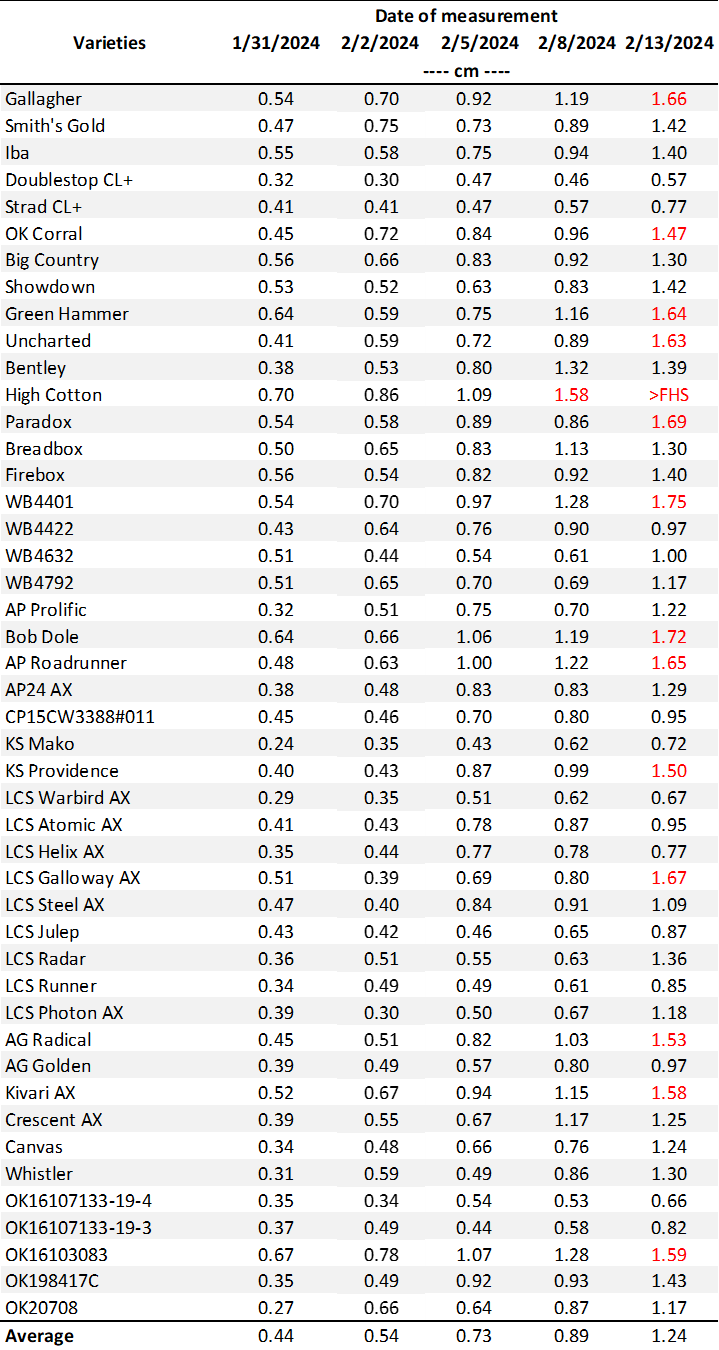
Table 1. First hollow stem (FHS) results for each variety collected at Stillwater. Plots were planted on 09/18/23 but not grazed or clipped. The threshold target for FHS is 1.5 cm (5/8″ or the diameter of a dime). The value of hollow stem for each variety represents the average of ten measurements. Varieties exceeding the threshold are highlighted in red.
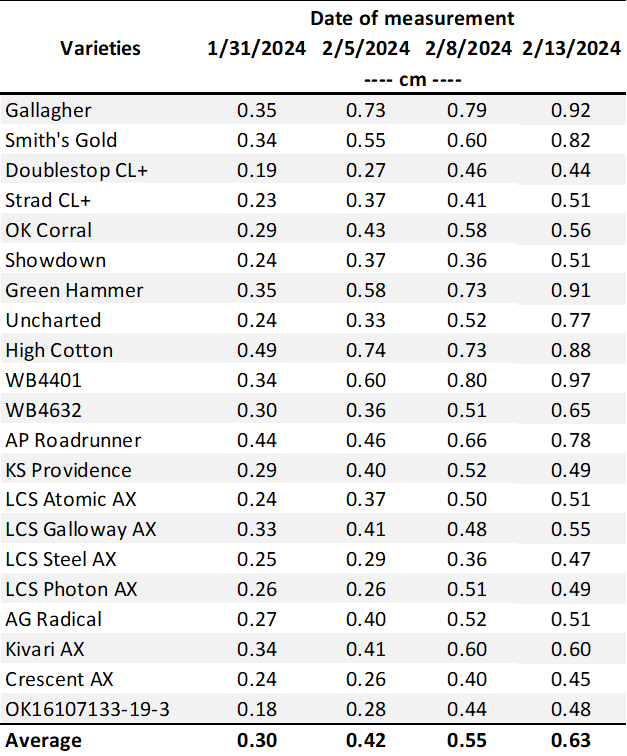
Table 2. First hollow stem (FHS) results for each variety collected at Chickasha. Plots were planted on 09/21/23 but not grazed or clipped. The threshold target for FHS is 1.5 cm (5/8″ or the diameter of a dime). The value of hollow stem for each variety represents the average of ten measurements. Varieties exceeding the threshold are highlighted in red.
Contact your local Extension office and us if you have questions.
Amanda de Oliveira Silva, Small Grains Extension Specialist
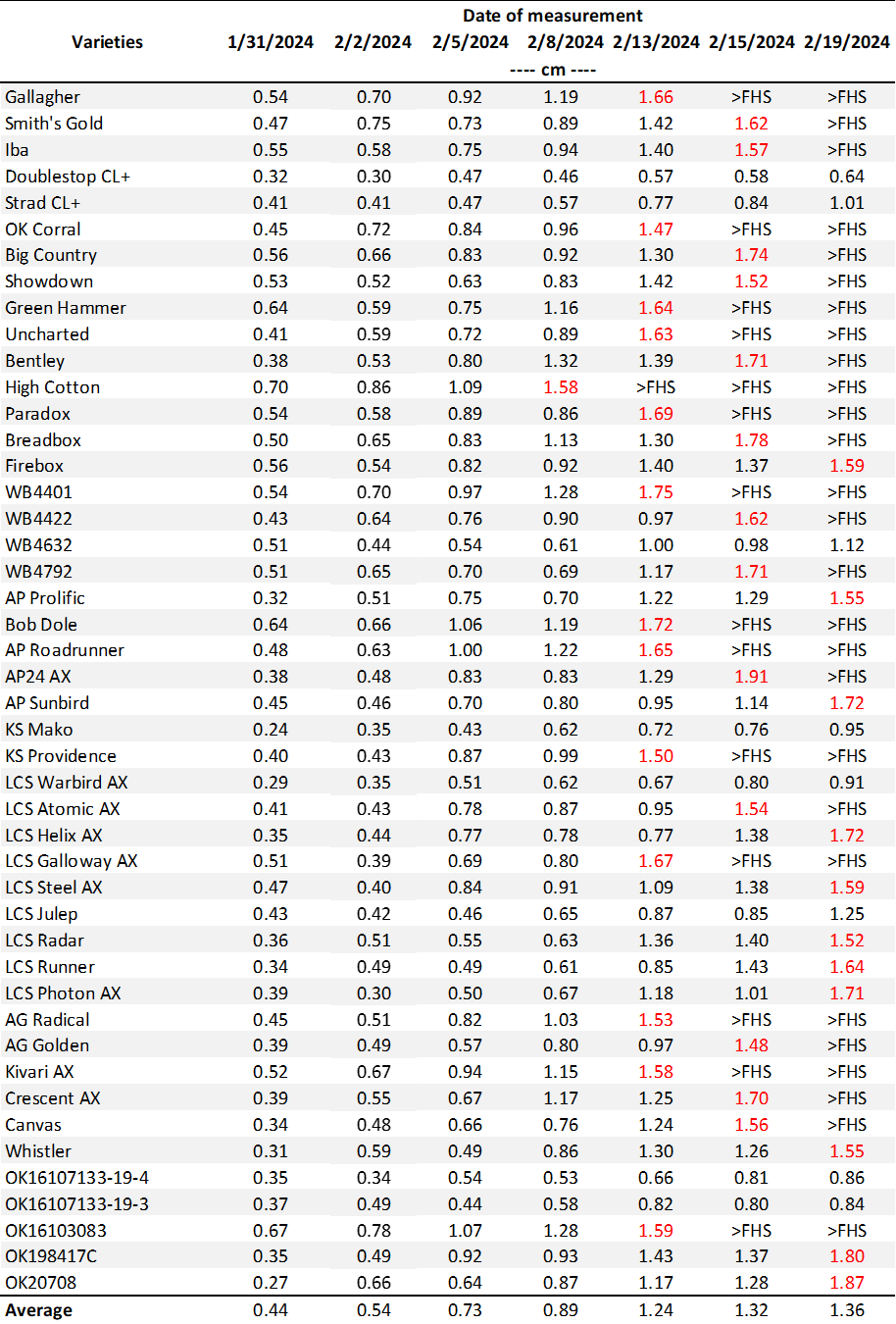
First hollow stem (FHS) is the optimal time to remove cattle from wheat pasture. This occurs when there is 1.5 cm (5/8”, or the diameter of a dime) of hollow stem below the developing grain head (see full explanation). The latest FHS results from OSU forage trials in Stillwater (Table 1) and Chickasha (Table 2) are listed below. For an additional resource and wheat update on FHS, see the Mesonet First Hollow Stem Advisor.
We use an accelerated growth system to report the earliest onset of FHS stage. Trials are seeded early to simulate a grazed system, but the forage is not removed. Varieties reported here with the earliest FHS date should be the first to monitor in commercial fields. In practice, wheat that is grazed will likely reach FHS stage later than reported here, and differences between varieties will likely be moderate.
Table 1. First hollow stem (FHS) results for each variety collected at Stillwater. Plots were planted on 09/18/23 but not grazed or clipped. The threshold target for FHS is 1.5 cm (5/8″ or the diameter of a dime). The value of hollow stem for each variety represents the average of ten measurements. Varieties exceeding the threshold are highlighted in red.
Table 2. First hollow stem (FHS) results for each variety collected at Chickasha. Plots were planted on 09/21/23 but not grazed or clipped. The threshold target for FHS is 1.5 cm (5/8″ or the diameter of a dime). The value of hollow stem for each variety represents the average of ten measurements. Varieties exceeding the threshold are highlighted in red.
Contact your local Extension office and us if you have questions.
Amanda de Oliveira Silva, Small Grains Extension Specialist
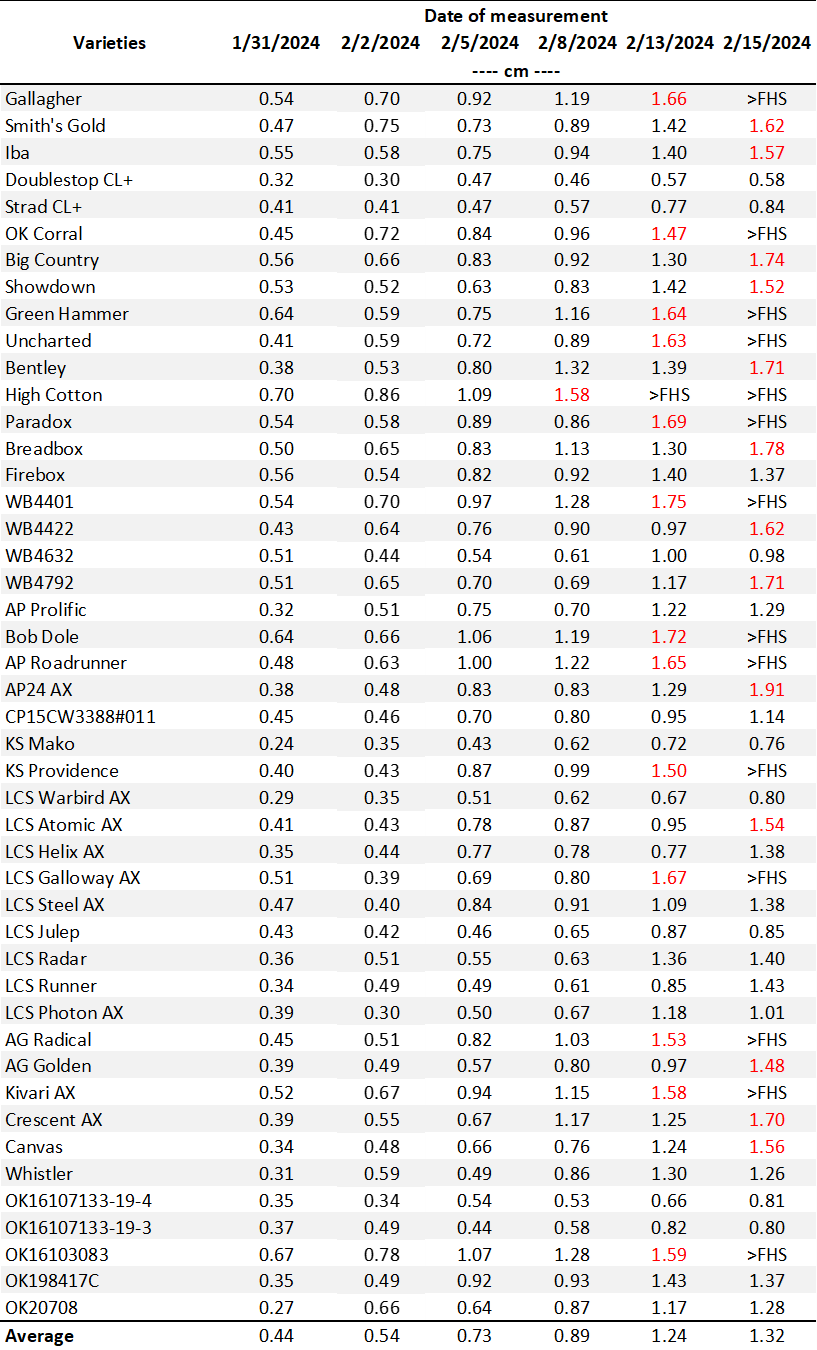
First hollow stem (FHS) is the optimal time to remove cattle from wheat pasture. This occurs when there is 1.5 cm (5/8”, or the diameter of a dime) of hollow stem below the developing grain head (see full explanation). The latest FHS results from OSU forage trials in Stillwater (Table 1) and Chickasha (Table 2) are listed below. For an additional resource and wheat update on FHS, see the Mesonet First Hollow Stem Advisor.
We use an accelerated growth system to report the earliest onset of FHS stage. Trials are seeded early to simulate a grazed system, but the forage is not removed. Varieties reported here with the earliest FHS date should be the first to monitor in commercial fields. In practice, wheat that is grazed will likely reach FHS stage later than reported here, and differences between varieties will likely be moderate.
Table 1. First hollow stem (FHS) results for each variety collected at Stillwater. Plots were planted on 09/18/23 but not grazed or clipped. The threshold target for FHS is 1.5 cm (5/8″ or the diameter of a dime). The value of hollow stem for each variety represents the average of ten measurements. Varieties exceeding the threshold are highlighted in red.
Table 2. First hollow stem (FHS) results for each variety collected at Chickasha. Plots were planted on 09/21/23 but not grazed or clipped. The threshold target for FHS is 1.5 cm (5/8″ or the diameter of a dime). The value of hollow stem for each variety represents the average of ten measurements. Varieties exceeding the threshold are highlighted in red.
Contact your local Extension office and us if you have questions.
Amanda de Oliveira Silva, Small Grains Extension Specialist
First hollow stem (FHS) is the optimal time to remove cattle from wheat pasture. This occurs when there is 1.5 cm (5/8”, or the diameter of a dime) of hollow stem below the developing grain head (see full explanation). The latest FHS results from OSU forage trials in Stillwater (Table 1) and Chickasha (Table 2) are listed below. For an additional resource and wheat update on FHS, see the Mesonet First Hollow Stem Advisor.
We use an accelerated growth system to report the earliest onset of FHS stage. Trials are seeded early to simulate a grazed system, but the forage is not removed. Varieties reported here with the earliest FHS date should be the first to monitor in commercial fields. In practice, wheat that is grazed will likely reach FHS stage later than reported here, and differences between varieties will likely be moderate.
Table 1. First hollow stem (FHS) results for each variety collected at Stillwater. Plots were planted on 09/18/23 but not grazed or clipped. The threshold target for FHS is 1.5 cm (5/8″ or the diameter of a dime). The value of hollow stem for each variety represents the average of ten measurements. Varieties exceeding the threshold are highlighted in red.
Table 2. First hollow stem (FHS) results for each variety collected at Chickasha. Plots were planted on 09/21/23 but not grazed or clipped. The threshold target for FHS is 1.5 cm (5/8″ or the diameter of a dime). The value of hollow stem for each variety represents the average of ten measurements. Varieties exceeding the threshold are highlighted in red.
Contact your local Extension office and us if you have questions.
Amanda de Oliveira Silva, Small Grains Extension Specialist
First hollow stem (FHS) is the optimal time to remove cattle from wheat pasture. This occurs when there is 1.5 cm (5/8”, or the diameter of a dime) of hollow stem below the developing grain head (see full explanation). The latest FHS results from OSU forage trials in Stillwater (Table 1) and Chickasha (Table 2) are listed below. For an additional resource and wheat update on FHS, see the Mesonet First Hollow Stem Advisor.
We use an accelerated growth system to report the earliest onset of FHS stage. Trials are seeded early to simulate a grazed system, but the forage is not removed. Varieties reported here with the earliest FHS date should be the first to monitor in commercial fields. In practice, wheat that is grazed will likely reach FHS stage later than reported here, and differences between varieties will likely moderate.
Table 1. First hollow stem (FHS) results for each variety collected at Stillwater. Plots were planted on 09/18/23 but not grazed or clipped. The threshold target for FHS is 1.5 cm (5/8″ or the diameter of a dime). The value of hollow stem for each variety represents the average of ten measurements. Varieties exceeding the threshold are highlighted in red.
Table 2. First hollow stem (FHS) results for each variety collected at Chickasha. Plots were planted on 09/21/23 but not grazed or clipped. The threshold target for FHS is 1.5 cm (5/8″ or the diameter of a dime). The value of hollow stem for each variety represents the average of ten measurements. Varieties exceeding the threshold are highlighted in red.
Contact your local Extension office and us if you have questions.
Amanda de Oliveira Silva, Small Grains Extension Specialist
The first hollow stem stage (FHS) indicates the beginning of stem elongation, or just before the jointing stage. It is a good indicator for when producers should remove cattle from wheat pasture. This occurs when there is 1.5 cm (5/8”, or the diameter of a dime) of stem below the developing grain head (see full explanation). This is the optimal period because it gives enough time for the crop to recover from grazing and rebuild the canopy. Also, the added cattle weight gains associated with grazing past the FHS are not enough to offset the value of the potential reduced grain yield (1-5% every day past FHS). The wheat variety, severity of grazing, time when cattle are removed, and weather conditions after cattle removal determine how much grain yield potential might be reduced.
The Mesonet First Hollow Stem Advisor was developed by researchers at Oklahoma State University to help predict when FHS is nearing. This is an online tool available on the Mesonet website. This tool uses soil temperature data to show the current probability of FHS occurrence and 1-week and 2-week projections. With this tool, producers can select their variety from a list of varieties that separates them into three FHS categories: early, middle, and late. Then, maps can be generated to provide the probability of FHS based on current conditions and the 1- and 2-week projections. Charts and tables can also be generated for individual Mesonet sites. Created maps have a color scheme to represent the probability of FHS occurrence. When using this tool, it is recommended to start scouting for FHS from a non-grazed part of the field once the 5% probability is reached (green color). Because stem elongation will begin moving quickly as the air temperature rises, starting your scouting at the 5% level will help give you the time it takes for making the preparations for cattle removal by the time FHS occurs. Methods on how to scout for FHS are listed at the end of this post. For producers who do not scout, it is recommended to remove cattle when the 50% probability level is reached. A 50% probability level indicates that over an evaluated period (e.g., 10 years), FHS would have occurred by that date in 50% of those years (e.g., 5 years). The same interpretation is used for other probability levels.
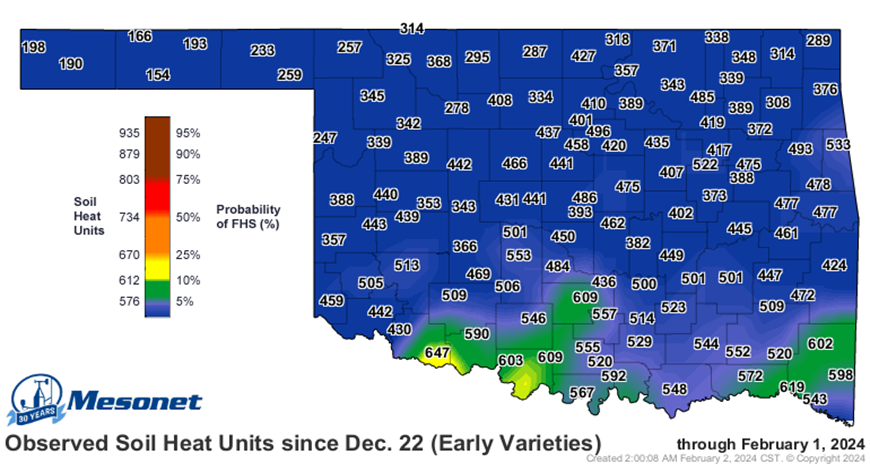
To give an example of what the tool provides and show some of the FHS conditions around Oklahoma, I have generated some statewide maps below. For producers along the southern Oklahoma border who planted an “early” wheat variety (e.g., Gallagher), now would be the time to go out and start scouting for FHS (Figure 1).
Figure 1. Current FHS probabilities for “early” wheat varieties.
Remember that this tool should be used as a proxy to begin scouting for FHS. The best estimate of FHS is still to split stems from plants in each field to determine where they are developmentally. Another word of caution I want to mention when using the tool is to consider when you were finally able to get stand establishment. If this did not occur until the end of September to the beginning of October, this tool may be a little ahead of where your plants are developmentally. In this case, the tool can still give you the cue to start scouting. Checking for FHS in each field will let you know if you do have some grazing time left.
Methods for scouting for FHS:
Check for FHS in a non-grazed area of the same variety and planting date. Variety can affect FHS date by as much as three weeks and planting date can affect it even more.
Dig or pull up a few plants and split the largest tiller longitudinally (lengthways) and measure the amount of hollow stem present below the developing grain head. You must dig plants because the developing grain head may still be below the soil surface at this stage.
If there is 1.5 cm (~5/8″) of hollow stem present, it is time to remove cattle. 1.5 cm is about the same as the diameter of a dime (see picture below).
More detailed information on FHS can be found at wheat.okstate.edu under ‘Wheat Publications’ then ‘Grazing’ or by clicking here.
The first hollow stem growth stage is reached when there is 1.5 cm of hollow stem (about the diameter of a dime) below the grain head.
Similar to previous years, we will monitor FHS occurrence in our wheat plots at Stillwater and Chickasha and report the findings on this blog. Remember that we use an accelerated growth system to report the earliest onset of the FHS stage. Trials are seeded early to simulate a grazed system, but the forage is not removed. Varieties reported here with the earliest FHS date should be the first to monitor in commercial fields. In practice, wheat that is grazed will likely reach FHS stage later than reported here, and differences between varieties will likely moderate.
The latest FHS results for each variety planted in our forage trial at Stillwater and Chickasha are listed below (Tables 1 and 2).
Table 1. First hollow stem (FHS) results for each variety collected at Stillwater. Plots were planted on 09/18/23 but not grazed or clipped. The threshold target for FHS is 1.5 cm (5/8″ or the diameter of a dime). The value of hollow stem for each variety represents the average of ten measurements. Varieties exceeding the threshold are highlighted in red.
Table 2. First hollow stem (FHS) results for each variety collected at Chickasha. Plots were planted on 09/21/23 but not grazed or clipped. The threshold target for FHS is 1.5 cm (5/8″ or the diameter of a dime). The value of hollow stem for each variety represents the average of ten measurements. Varieties exceeding the threshold are highlighted in red.
Oklahoma Harvest Report by the Oklahoma Wheat Commission
Oklahoma Wheat Harvest had test cuttings with small deliveries last Thursday evening in Eldorado, OK. Rains over the Memorial Day weekend delayed producers from getting into the fields, but machines started moving across the Southern border of Oklahoma in many locations on Monday and Tuesday this week. Light rains and high humidity in parts of Southwest Oklahoma will make a slow start today, but producers are hopeful to get rolling in these locations by late this afternoon. All locations being reported this afternoon are reporting favorable test weights in all locations with ranges from 60-64 lbs. per bushel. Several locations are reporting 62-64 lbs. per bushel. Moisture has been ranging from 12-13.5%, with most wheat being taken in at around 12.5%. Early yields being reported in Southern Oklahoma are ranging from the mid 20’s to low 40’s depending on location and management practices. Some high management intensive producers have reported a couple locations to be making in the mid 40’s with one report coming in at 55 bushels per acre. Most yields being reported are ranging from the low 30’s to low 40’s in Southern and South Central Oklahoma. Those regions are predicted to have the best overall crop conditions for Oklahoma this year. Protein has not been reported on most early samples throughout the region, although some locations have reported proteins ranging from 12.5% to as high as 15%.
Eldorado– Test weights on early wheat ranging from 60 to 63 lbs. per bushel. No yields reported on early cuttings. Grandfield/Devol/Chattanooga– Test weights ranging from 62-64 lbs. per bushel. Moisture reported at 12.5% to 13%. Yields ranging mostly from 30 bushels to 40 bushels per acre. Frederick– Test weights on early cuttings ranging mainly from 60 to 62 lbs. per bushel. Moisture was reported at 12.5% to 12.7% Yields ranging from the low 30’s to low 40’s on the wheat being harvested. Tipton– This area suffered more from drought than other areas in South Central, Oklahoma. Yields are being reported from the low 20’s to low 30’s depending on location. Test weight has been lower on some fields, but the average for the region is 60 lbs. per bushel. Moisture was ranging from 12.5% to 13%. Altus/Duke– Harvest has started in this area with great movement yesterday afternoon. Light rains and high humidity will make the start slower this afternoon. Test weights ranging from 60 lbs. to 62 lbs. per bushel. Early yields reported from the high 20’s to low 40’s. Hobart/Gotebo– A couple loads have just been received in these locations. Test weights reported at 60 to 62 lbs. per bushel. Yields ranging from the mid 20’s to low 30’s. Early reports indicate this area has struggled harder with drought conditions. Lawton– A couple loads have been taken in at Lawton. Test weight was 62 lbs. per bushel, no yields reported. Moisture was 13.5%. Rocky/Sentinel– Samples have been received at these locations but nothing has been cut, producers were hoping to start late this afternoon or tomorrow.
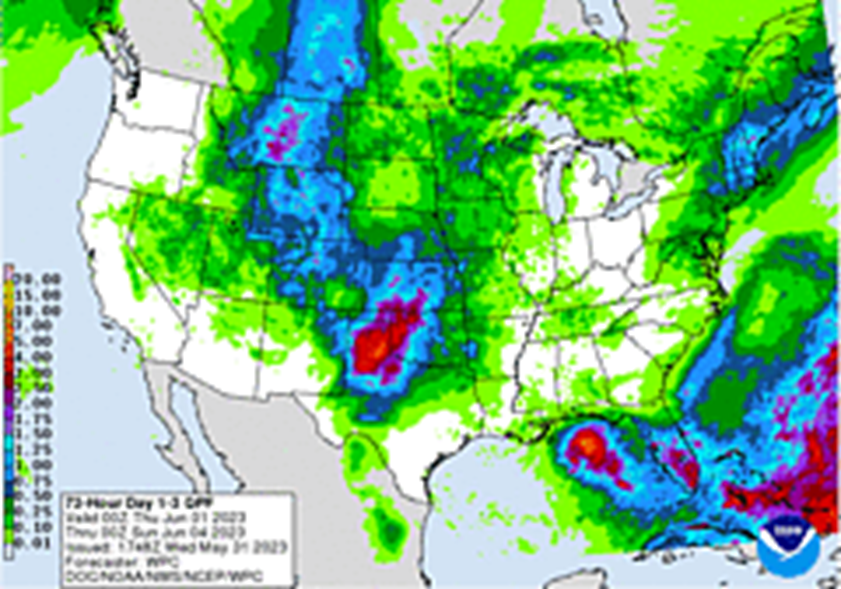
Below, see the next 1-3 day rain prediction forecast models provided by the Oklahoma Mesonet. The next Oklahoma Harvest Report will be published on Monday, June 5, 2023, and a regional report will be published by Plains Grain Inc. on Friday, June 2, 2023
Hello everyone, find below the complete schedule for the 2023 OSU Wheat Variety Trials plot tours and Field Days. We look forward to seeing you all there!
Note that times are subject to change due to environmental conditions. Please call your County Extension Office to confirm the date, time, and location.
Notes: Abbreviations: DP = Dual-purpose, GO = Grain-only, IM =Intensive management, SM = Standard management 1 Meet at the Extension office 2 Meet at the plot, 1 mile north of Bill’s Corner on the east side of Hwy 177 at Knobhill. 3 Meet at fairgrounds for lunch, plot tour south of town afterwards 4 Meet at plot ¾ mile west of HWY 54 on Arapaho Road 5 Lunch at Wheeler Brothers, plot tour north of elevator afterwards 6 Meet at Ledbetter’s farm @ 9:30, field tour @ 10, lunch @ 12 7 Lunch at Wheeler Brothers, plot tour north of town afterwards 8 Meal at Brook Strader’s farm, plot tour afterwards
The plot maps for each location can be found on our websiteclick here
Below are pictures from some of the variety trial locations from the end of March to early April. Wheat needs rain badly.
Amanda de Oliveira Silva, Small Grains Extension Specialist
Areas of Oklahoma with dry conditions have begun to see some visible wheat injury due to brown wheat mite (Figure 1) and winter grain mite (Figure 2). Last week, Josh Bushong, OSU Northcentral Area Extension Agronomist, reported seeing fields with injury due to brown wheat mites in Alfalfa and Kingfisher counties (Figure 3). Later that week Tyler Lynch, the Senior Agriculturalist in the Small Grains Program also reported seeing wheat grain mites in our wheat plots at Alfalfa and Woods Counties.
Two common mites can injure wheat, the brown wheat mite and the winter grain mite. Producers need to remain alert so that they don’t mistake damaged wheat from small grains mites for drought or virus disease.
Figure 1. Brown wheat mite with oversummering egg
Brown wheat mite is small (about the size of this period.) with a metallic brown to black body and four pairs of yellowish legs (Figure 1). The forelegs are distinctly longer than the other three pairs. Brown wheat mites can complete a cycle in as little as 10-14 days. Oklahoma experiences multiple generations of brown wheat mites that usually peak in spring, and the last generation occurs in April. At that time, females produce a whitish egg that will over summer.
Figure 2. Winter grain mite with a kidney-shaped egg
Winter grain mite is small (about 1 mm long) with a dark blue to black body and four pairs of orange-red legs, and a small reddish spot on the top of its abdomen that can be seen under magnification (Figure 2). Winter grain mite eggs are kidney-shaped, and change from clear, to yellow to reddish-orange after several days. They are laid on leaf blades and stems or the roots near the crown. Besides wheat, many grasses serve as host plants, including barley, oats, ryegrass, and fescue. We typically experience two generations each year, a fall generation and a winter generation that cycles out in March.
Figure 3. Field infested with brown wheat mite. Photos taken by Josh Bushong at Kingfisher County on February 21, 2023.
Figure 4. Leaf stippling from brown wheat mite (left) and grain wheat mite (right) feeding. Photo on the right taken by Tyler Lynch at Alfalfa county on April 24, 2023.
Figure 5. Field infested with winter grain mite
Both mites feed by piercing plant cells in the leaf, which results in “stippling” (Figures 4 and 5). The leaves take on a characteristic brown-grayish or cast and could be mistaken for injury due to herbicide. These mites are more likely to cause injury in wheat stressed from lack of moisture or nutrients.
Figure 6. Winter grain mite hiding in residue
Threshold
Brown wheat mites are not light sensitive but are vulnerable to driving rains of more than 0.25 inches, which tend to reduce populations. Winter grain mites are more tolerant of rainfall but are very light sensitive and tend to avoid bright, sunny days and windy days, so adjust your scouting accordingly. It is best to scout for winter grain mites on still, cloudy days or early morning/late evening. On sunny or windy days, they hide under the soil surface (up to a couple of inches) or congregate under dirt clods (Figure 6). Both mites are associated with continuous wheat production. Research suggests that brown wheat mite can be economically treated when there are 25-50 mites per leaf in wheat that is 6-9 inches tall. An alternative estimation is “several hundred” per foot of a row. The best recommendation for winter grain mite is to treat when plants show visible injury, and there are still mites present.
Chemical control
Only a few insecticides include either mite species on their label. Work conducted by Dr. Gerald Wilde at Kansas State evaluated several insecticides for the control of winter grain mites. Of those registered for winter grain mites, the insecticide dimethoate (Dimethoate and other generics) is effective. Other pyrethroid insecticides, lambda-cyhalothrin (Karate, Warrior II, and its generics), gamma-cyhalothrin (Declare) and beta-cyfluthrin (Baythroid and its generics) are also effective for both mites, even if they are not specifically listed on the label.
Additional resources
Contact your County Extension office
For more information on these mites, consult fact sheet EPP-7093 Mites in Small Grains by clicking here. If you find active mite infestations in your field, consult fact sheet CR-7194 Management of Insect and Mite Pests in Small Grainsfor registered insecticides, application rates, and grazing/harvest waiting periods by clicking here.
Amanda de Oliveira Silva, Small Grains Extension Specialist and Brett Carver, Wheat Breeder
Oklahoma farmers plant on average 4 million acres of winter wheat each year, making wheat the largest cash crop in the state. Depending on market conditions approximately 30-60% of Oklahoma wheat acres is grazed by stocker cattle during the winter months. Therefore, wheat plays a crucial role in the cattle industry as it is the primary source of cool-season forage to fall-weaned calves.
Producers intending to use wheat for grazing purposes begin planting wheat around early to mid-September. The optimal time for planting wheat in a dual-purpose system (i.e., wheat used for both grazing and grain production) in central Oklahoma is around mid-September. This maximizes forage production while minimizing yield losses from an earlier planting date. However, with the current dry conditions and lack of soil moisture to drive germination, the likelihood of having forage this year is severely reduced to non-existent.
The current drought conditions result in the loss of a grazing opportunity, which leads to a significant loss of income to OK and OK wheat farmers in the US Beef Industry.
Cattle on wheat pasture near Apache, OK December 2021.
If this drought is extended later into the fall, as weather predictions indicate, it will threaten OK wheat intended for grain production. What does that mean?
Oklahoma is the 2nd largest producer and an important source of high quality hard red winter wheat (HRWW) in the US (USDA-NASS, 2022). HRWW is the main source of wheat used to make almost all types of bread consumed in the US and abroad (e.g., Mexico). Therefore, a drought that prolongs in October and November will again deprive OK wheat farmers from that source of income (i.e., grain) and the country’s access to a key source of bread wheat.
Research efforts have been made from OSU to test and develop resilient varieties and management practices adapted to changing climate. A history about this was shown on FOX 25 News yesterday morning (link below). A drought of this magnitude uniquely and negatively impacts Oklahoma’s farm economy in two commodities, wheat and beef. We will continue to pray for rain!









 WORLD OF WHEAT