First Hollow Stem Update – 3/02/2022

Amanda de Oliveira Silva, Small Grains Extension Specialist

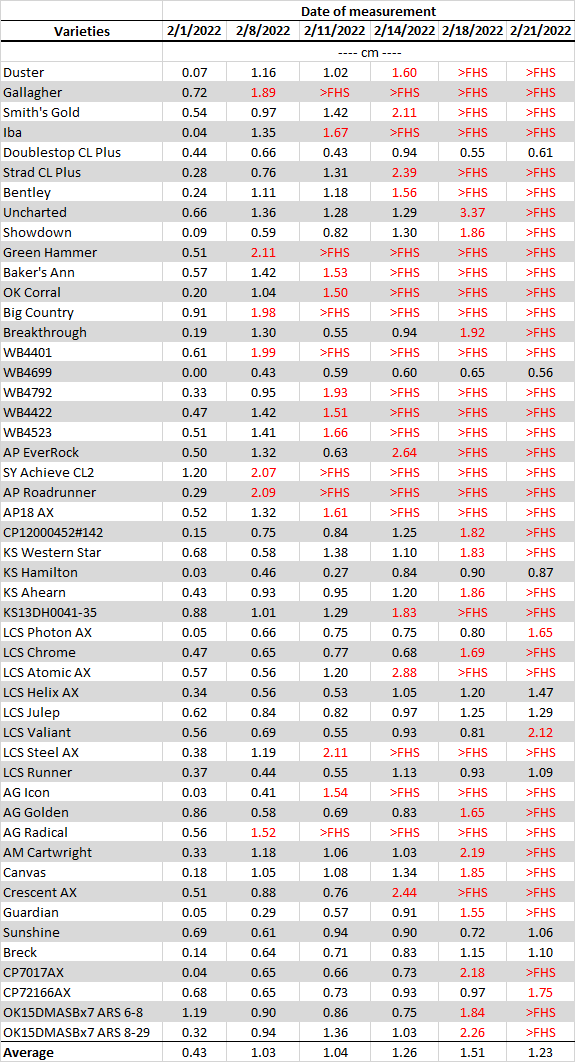
First hollow stem (FHS) is the optimal time to remove cattle from wheat pasture. This occurs when there is 1.5 cm (5/8”, or the diameter of a dime) of hollow stem below the developing grain head (see full explanation). The latest FHS results from OSU forage trials in Stillwater (Table 1) and Chickasha (Table 2) are listed below. For an additional resource, see the Mesonet First Hollow Stem Advisor.

We use an accelerated growth system to report the earliest onset of FHS stage. Trials are seeded early to simulate a grazed system, but the forage is not removed. Varieties reported here with the earliest FHS date should be the first to monitor in commercial fields. In practice, wheat that is grazed will likely reach FHS stage later than reported here, and differences between varieties will likely moderate.

Values can fluctuate from one sampling to another due to environmental variation associated with, among other factors, the winter storm on February 2-4. Additionally, varieties differed widely in their FHS response following this cold period.

Table 1. First hollow stem (FHS) results for each variety collected at Stillwater. Plots were planted on 09/27/21 but not grazed or clipped. The threshold target for FHS is 1.5 cm (5/8″ or the diameter of a dime). The value of hollow stem for each variety represents the average of ten measurements. Varieties exceeding the threshold are highlighted in red. The overall average represents the mean FHS for the varieties measured within a date.
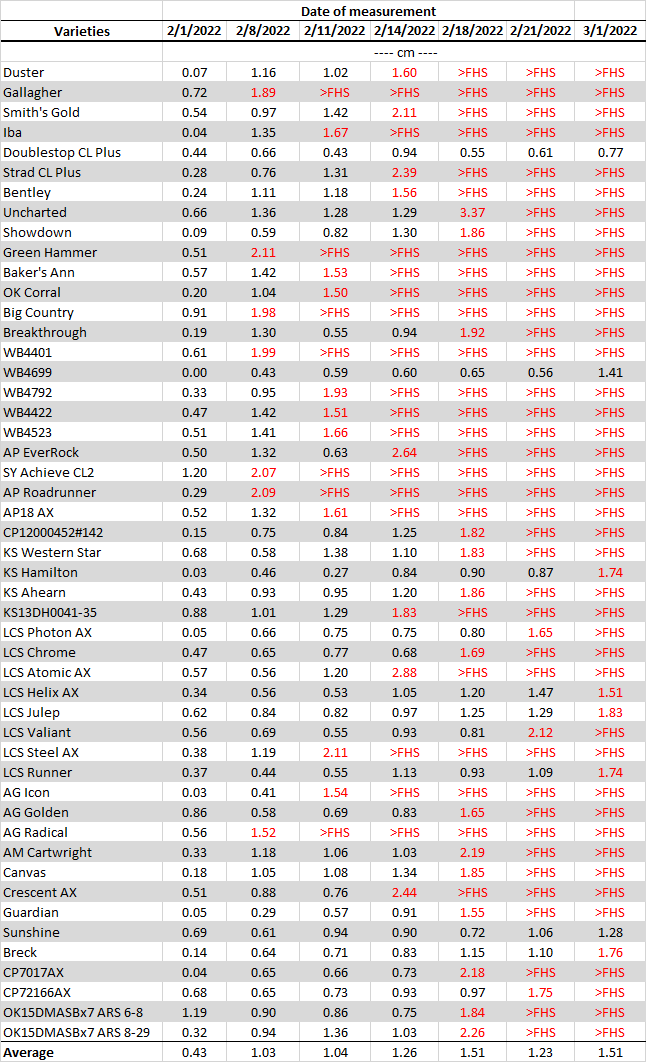
Table 2. First hollow stem (FHS) results for each variety collected at Chickasha. Plots were planted on 09/28/21 but not grazed or clipped. The threshold target for FHS is 1.5 cm (5/8″ or the diameter of a dime). The value of hollow stem for each variety represents the average of ten measurements. Varieties exceeding the threshold are highlighted in red. The overall average represents the mean FHS for the varieties measured within a date.

  • Additional resources available:

First Hollow Stem Update – 2/22/2022

Amanda de Oliveira Silva, Small Grains Extension Specialist

First hollow stem (FHS) is the optimal time to remove cattle from wheat pasture. This occurs when there is 1.5 cm (5/8”, or the diameter of a dime) of hollow stem below the developing grain head (see full explanation). The latest FHS results from OSU forage trials in Stillwater (Table 1) and Chickasha (Table 2) are listed below. For an additional resource, see the Mesonet First Hollow Stem Advisor.

We use an accelerated growth system to report the earliest onset of FHS stage. Trials are seeded early to simulate a grazed system, but the forage is not removed. Varieties reported here with the earliest FHS date should be the first to monitor in commercial fields. In practice, wheat that is grazed will likely reach FHS stage later than reported here, and differences between varieties will likely moderate.

Values can fluctuate from one sampling to another due to environmental variation associated with, among other factors, the winter storm on February 2-4. Additionally, varieties differed widely in their FHS response following this cold period.

Table 1. First hollow stem (FHS) results for each variety collected at Stillwater. Plots were planted on 09/27/21 but not grazed or clipped. The threshold target for FHS is 1.5 cm (5/8″ or the diameter of a dime). The value of hollow stem for each variety represents the average of ten measurements. Varieties exceeding the threshold are highlighted in red.

Table 2. First hollow stem (FHS) results for each variety collected at Chickasha. Plots were planted on 09/28/21 but not grazed or clipped. The threshold target for FHS is 1.5 cm (5/8″ or the diameter of a dime). The value of hollow stem for each variety represents the average of ten measurements. Varieties exceeding the threshold are highlighted in red.

First Hollow Stem Update – 2/15/2022

Amanda de Oliveira Silva, Small Grains Extension Specialist

First hollow stem (FHS) is the optimal time to remove cattle from wheat pasture. This occurs when there is 1.5 cm (5/8”, or the diameter of a dime) of hollow stem below the developing grain head (see full explanation). The latest FHS results from OSU forage trials in Stillwater (Table 1) and Chickasha (Table 2) are listed below. For an additional resource, see the Mesonet First Hollow Stem Advisor.

We use an accelerated growth system to report the earliest onset of FHS stage. Trials are seeded early to simulate a grazed system, but the forage is not removed. Varieties reported here with the earliest FHS date should be the first to monitor in commercial fields. In practice, wheat that is grazed will likely reach FHS stage later than reported here, and differences between varieties will likely moderate.

Values can fluctuate from one sampling to another due to environmental variation associated with, among other factors, the winter storm on February 2-4. Additionally, varieties differed widely in their FHS response following this cold period.

Table 1. First hollow stem (FHS) results for each variety collected at Stillwater. Plots were planted on 09/27/21 but not grazed or clipped. The threshold target for FHS is 1.5 cm (5/8″ or the diameter of a dime). The value of hollow stem for each variety represents the average of ten measurements. Varieties exceeding the threshold are highlighted in red.

Table 2. First hollow stem (FHS) results for each variety collected at Chickasha. Plots were planted on 09/28/21 but not grazed or clipped. The threshold target for FHS is 1.5 cm (5/8″ or the diameter of a dime). The value of hollow stem for each variety represents the average of ten measurements. Varieties exceeding the threshold are highlighted in red.

  • Additional resources available:

First Hollow Stem Update – 2/10/2022

Amanda de Oliveira Silva, Small Grains Extension Specialist

First hollow stem (FHS) is the optimal time to remove cattle from wheat pasture. This occurs when there is 1.5 cm (5/8”, or the diameter of a dime) of hollow stem below the developing grain head (see full explanation). The latest FHS results from OSU forage trials in Stillwater(Table 1) and Chickasha (Table 2) are listed below. For an additional resource, see the Mesonet First Hollow Stem Advisor.

We use an accelerated growth system to report the earliest onset of FHS stage. Trials are seeded early to simulate a grazed system, but the forage is not removed. Varieties reported here with the earliest FHS date should be the first to monitor in commercial fields. In practice, wheat that is grazed will likely reach FHS stage later than reported here, and differences between varieties will likely moderate.

Table 1. First hollow stem (FHS) results for each variety collected at Stillwater. Plots were planted on 09/27/21 but not grazed or clipped. The threshold target for FHS is 1.5 cm (5/8″ or the diameter of a dime). The value of hollow stem for each variety represents the average of ten measurements. Varieties exceeding the threshold are highlighted in red.

Table 2. First hollow stem (FHS) results for each variety collected at Chickasha. Plots were planted on 09/28/21 but not grazed or clipped. The threshold target for FHS is 1.5 cm (5/8″ or the diameter of a dime). The value of hollow stem for each variety represents the average of ten measurements. Varieties exceeding the threshold are highlighted in red.

  • Additional resources available:

Join me in congratulating Dr. Bob Hunger for his retirement after 39 years of service!

Amanda de Oliveira Silva, Small Grains Extension Specialist

Today I would like to dedicate a post to Dr. Bob Hunger, who has served as the OSU Wheat Extension Pathologist for 39 years and is officially retiring today!

Bob, I am grateful to have had the chance to work with you during our time at OSU. Thanks for being a mentor, colleague, and a friend. I know you have many fun plans, but I hope you won’t forget us.

I had so much fun traveling with you to field days this year. I learned many things with you, including a few American sayings like “bright-eyed and bushy-tailed” on our early morning trips and how to use a printed road map to get to our sites instead of using a GPS. However, I am not sure I will follow you on this last one lol.

Bob, I hope you know the great contributions you have made to the OK wheat industry and how much we appreciate you. See a few pictures below 🙂

My first (in person) field day season and Bob’s last field day season. Cotton County, 2021.
Bob about to dig in at Eischen’s, the oldest bar in OK. This was after our field day at Kingfisher.
Bob giving an update on wheat diseases at the field day at Cherokee.
The field day in the Panhandle would not be complete if we didn’t stop for a blizzard on a hot day in Woodward. Drs. Edwards and Manuchehri will relate to that.
Brett Carver, me, and Bob celebrating Bob’s retirement with a lunch and walk around OSU campus.
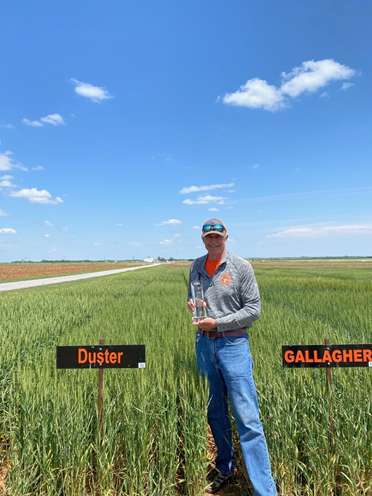
The Oklahoma Wheat Commission recognized Bob for his 39 years of dedicated service during the Lahoma Field Day.

Thank you, Bob!

Feel free to leave a message to Bob here below. I am sure he will be glad to read it.

Wheat Disease Update – 21 May 2021

This article was written by Bob Hunger, Extension Wheat Pathologist

Wheat tours over the last ten days included Kingfisher (Kingfisher County; south central OK), Cherokee (Alfalfa County; north central OK), Alva (Woods County; northwestern OK), Lahoma (Garfield County; north central OK), Morris (Okmulgee County; eastern OK), El Reno (Canadian County; central OK); and Buffalo (Harper County; northwestern OK).  Wheat in these areas is pretty much done with flowering and kernels ranged from just forming to fully formed.  Some varieties in some areas were in the milk stage with some approaching soft dough.

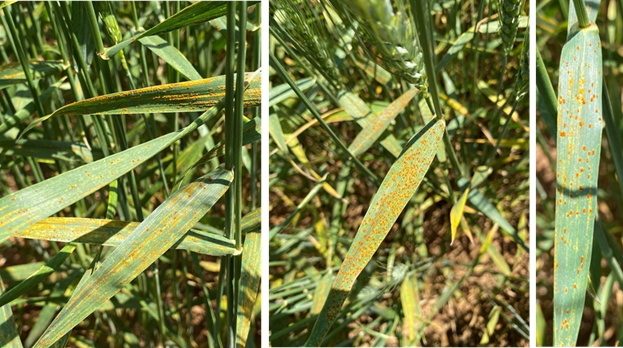
      Diseases at these locations varied considerably but overall, a wider range of diseases was observed.  Some locations such as Cherokee, Alva and Buffalo had relatively light foliar disease incidence with some leaves indicating barley yellow dwarf and wheat streak mosaic (and/or other mite transmitted viruses).  Around Stillwater and at Lahoma, although stripe rust was still prevalent leaf rust is making an appearance (Figure 1).  At others such as Kingfisher, Morris and El Reno, leaf rust could be found but stripe rust seemed to still be more prevalent.  Leaf spot diseases also were observed at most of these locations, but these foliar diseases were not as prevalent as the rusts.

Figure 1. Stripe and leaf rust both observed on wheat at Lahoma on May 13/14. A mixture of stripe and leaf rust (photo on left) compared to mostly all leaf rust (middle and right photos). [Photo credits – Dr. Amanda de Oliveira Silva; OSU Small Grains Agronomist].

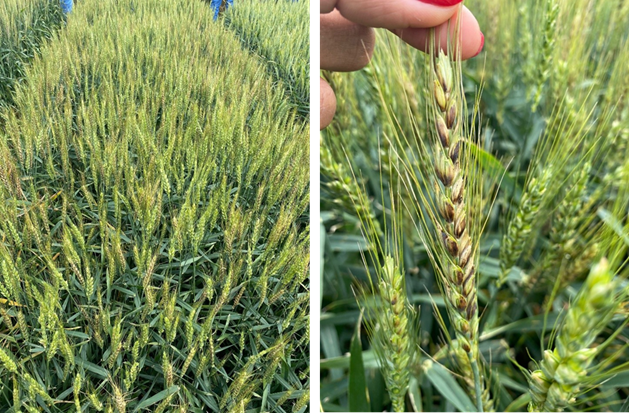
Darkened heads were observed at several locations but were most prominent and prevalent at Morris in eastern OK (Figure 2).  Darkened heads like this can result from several causes.  If Septoria and/or Stagonospora are present on lower leaves, these fungi can move up onto the heads and cause a glume blotch that has this appearance.  Another possibility is a bacterial disease called black chaff or bacterial streak (Figure 3).  Black chaff will occur on leaves (Figure 3; photo on left), but also can move onto heads (Figure 3; center photo).  Note on this center photo how the stem (peduncle) immediately beneath the head shows darkened lesions like those on the head.  Finally, awns of heads infected with black chaff often show an alternating pattern of dark and white (Figure 3; photo on right).  Another possible cause of these dark heads is presence of a gene that confers resistance to wheat stem rust.  In this case, the result is not a disease, but rather an association with the presence of that gene.  Regarding the darkened heads observed in the trial near Morris, Dr. Silva and I agree it is most likely the majority of the darkened heads observed likely resulted from freeze damage as many of these heads also were totally or partially sterile (see Dr. Silva’s blog at https://osuwheat.com/2021/05/18/freeze-damage-update/).  However, Septoria/Stagonospora and black chaff also contributed as symptoms of these diseases were observed in the field.

Figure 2. Darkened heads observed on wheat heads in a trial located in eastern Oklahoma near Morris. These darkened heads were caused by Septoria/Stagonospora, black chaff and/or freeze. [Photo credits – Dr. Amanda de Oliveira Silva; OSU Small Grains Agronomist].
Figure 3. Black chaff (bacterial streak) on wheat at Chickasha in 2013. Photo on the left is of a leaf infection; center photo shows darkening of the head and the stem just beneath the head; photo on the right shows the alternating dark and light pattern often seen on awns of wheat heads infected with the bacterium that causes black chaff. [Photo credits: Dr. Jeff Edwards; Oklahoma State University]

A final disease observed this past week was indicated by the sporadic occurrence of white heads in some parts of the field.  Examination of plants/tillers associated with these white/yellowing heads revealed symptoms typical of take all root rot (Figure 4).  However, I am not yet certain that these tillers had take all as symptoms of other root rots also were present.  Hence, samples were brought back to the lab for isolation and identification.  Look for an update on this in my next report but be aware there likely will be root rot showing up in some areas of the state.

Figure 4. Symptoms of take all root rot. White heads (photo on left) as the plants mature often indicate presence of a root rot. Lower, blackened stems and crowns of tillers with white heads resulting from take all root rot (photo on the right).

This next week marks the end of the wheat field days in Oklahoma with four coming next Thursday and Friday in the Oklahoma panhandle.  A complete schedule of the remaining field days can be viewed at: http://wheat.okstate.edu/virtual-plot-tour/2021OSUWheatFieldTours.pdf

Freeze damage update

Amanda de Oliveira Silva, Small Grains Extension Specialist

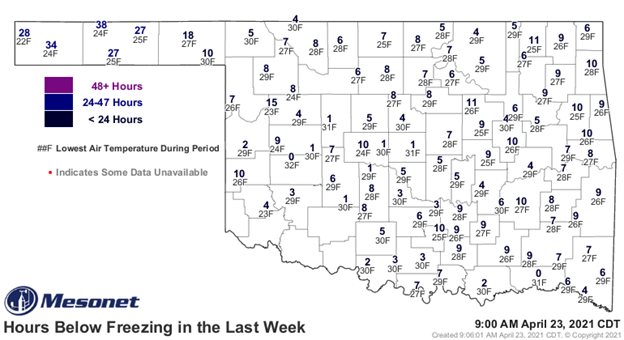
It has been almost one month since the freeze event on April 21, and we are now obtaining a better picture of potential freeze damage on wheat fields across Oklahoma. As I have indicated, the extent of the freeze damage will depend on several factors, including the growth stage of the plants, how low the temperature will get, and how long it stays at those cold temperatures. Wheat growth stage ranged from flag leaf emergence to heads starting to or fully emerged when the freeze occurred, and number of hours and temperature varied across the state (Figure 1).

Figure 1. Hour below freezing two days after the freeze event.

Traveling around the state for plot tours these past weeks, I have seen and heard about damage ranging from minimal to quite severe. Some fields seem to be fine with only scattered damaged heads and the grain appears to be filling as expected. Other fields however, show much more significant damage with discolored and sterile heads.

At the plot tour at Chickasha on April 30, there was a mix of freeze and hail damage with several abnormally growing heads (due to head trapping). Anthers seemed to be fine at that point (Figure 2).

Figure 2. Abnormally growing wheat heads at the Chickasha variety trial on April 30.

On May 7, I checked some wheat fields around Sentinel with Gary Strickland (Jackson County Extension Educator and SW Regional Agronomist) and we observed almost no freeze damage with a few heads in the field showing a pale color and partial sterility (Figure 3). I have observed this symptom commonly in fields I have visited, and many producers have described this to me as well.  Although common, it typically has been found at a low incidence.

Figure 3. Freeze damaged heads with partial sterility and pale color near Sentinel, OK on May 7.

We observed a few spots with freeze damage while at Alva on May 12, especially in low spots of the field and on the tops of terraces. Again, relatively few spots in the field showed damage. The wheat was looking good at Alva, but really needing a rain (Figure 4).

Figure 4. Freeze damage on wheat in low spots of the field at Alva, May 12.

The most severe freeze damage that I have seen so far was yesterday near Morris in eastern OK. The heads were green but there was no grain present (i.e. sterile). Damaged heads had glumes with a chocolate discoloration, which is similar to the discoloration caused by the bacterial disease called black chaff. In some cases, Dr. Hunger and I felt these discolored heads were the result of this bacterial disease but that the majority of the heads showing these symptoms were the result of freeze damage (Figure 5).

Figure 5. Freeze damaged heads without grains inside and showing a chocolate color on the outside (top photos). Heads showing no freeze damage and black chaff bacterial disease (bottom photos).

At the plot tour at El Reno today, we also observed a few varieties with pale colored and “empty” heads due to the freeze (Figure 6). We observed more freeze damage on wheat that was planted earlier and grazed as compared to the grain-only (ungrazed) wheat in that same field. Another noteworthy item is related to my earlier observation that the February freeze hurt some of the varieties in the dual-purpose plots by severely reducing tillering that would cause a loss of stand. That observation in those varieties was confirmed as the stand loss was quite evident today.

Figure 6. Wheat at El Reno. Same variety under grain-only (left) and dual-purpose (right) systems.

In conclusion, the freeze damage I am seeing is variable within and across fields, but overall I would say is minimal in most of the state. However, continue to keep scouting as it will now be easier to identify freeze damage.

Please let me know what you are seeing out there! My email is silvaa@okstate.edu.

Also, contact your County Extension office for more information.

Lahoma Field Day is this Friday – May 14!

Are you planning to attend the in-person event?

Please pre-register here: http://wheat.okstate.edu/plot-tours/21EXT_Lahoma_eFlyer_altFINAL.pdf

The program will start a little earlier at around 8:45am and the presentations will start at 9:15am. 

Are you planning to watch it online? 

Please see below the livestream link for each presentation. All you need to do is to click on the link at the time of each talk.

9:15 am – Wheat Varieties – Amanda Silva, Small Grains Extension Specialist

10:00 am – Integrated Weed Management – Misha Manuchehri, Weed Science Extension Specialist

10:45 am – Wheat Breeding and Disease Update – Brett Carver, Wheat Breeder and Bob Hunger, Extension Wheat Pathologist

All of these will be available live at www.youtube.com/sunuptv

For more information go here: http://wheat.okstate.edu/plot-tours/21EXT_Lahoma_eFlyer_altFINAL.pdf

Looking forward to seeing you there!

Wheat Disease Update – 10 May 2021

This article was written by Bob Hunger, Extension Wheat Pathologist

Wheat tours last week included Homestead (Blaine County; west-central OK), Afton (Ottawa County; northeastern OK), Sentinel and Tipton (Washita and Tillman Counties, respectively; southwestern OK) and Kildare and Lamont (Kay and Grant Counties, respectively; north-central OK).  At Homestead, Dr. Amanda Silva (OSU Small Grains Agronomist) saw primarily tan spot (Figure 1) as this trial was planted in a field of wheat after wheat.  Sentinel was fairly free of foliar diseases, but the trial at Tipton was severely infected with stripe rust.  The incidence and severity of stripe rust at Tipton also was observed by Dr. Brett Carver (OSU Wheat Breeder/Geneticist) who indicated that he saw severe stripe rust in his trials at Tipton as well.  Near Chattanooga OK, also in SW OK, there was a report of stripe rust occurring in wheat heads (Figure 1, center photo and photo to the right).  Over the years, I have occasionally observed this in Oklahoma, and it typically is a signal that stripe rust has been severe.  As far as I know, the grain is not infected, but rather it is the plant tissue surrounding the grain.  These reports of severe stripe rust contrast with what Dr. Silva and I observed at Afton, Kildare, and Lamont where little foliar disease of any type was observed.  We did however see symptoms indicative of barley yellow dwarf at all locations and some indicative of the mite-transmitted virus diseases such as wheat streak mosaic and high plains disease.

Figure 1. Tan spot (photo on left) observed on May 3rd by Dr. Amanda Silva (OSU Small Grains Agronomist) in the variety trial at Homestead, OK in west-central OK. Center and photo to the right show stripe rust that has infected and is sporulating in a wheat head. The photo credit for these two photos goes to Leon Fisher and came to me via Jerry Goodson and Mike Schulz (Station Supt, Altus).

This week will be spent at wheat field days in central, north central, and northwestern OK including trials near Cherokee, Kingfisher, Thomas, Alva, and Lahoma. A complete schedule of the remaining field days can be viewed at: http://wheat.okstate.edu/virtual-plot-tour/2021OSUWheatFieldTours.pdf

Wheat Disease Update – 4 May 2021

This article was written by Bob Hunger, Extension Wheat Pathologist

Wheat tours last week to Walters (Cotton County) in south-central OK, Altus (Jackson County) in southwestern OK, and Apache and Chickasha (both in Caddo County) in central OK showed wheat in these areas to be either quickly approaching flowering, at flowering, or just past flowering.  In all locations except Altus, stripe rust was by far the most prevalent foliar disease.  At Altus, there simply has not been sufficient moisture for any foliar disease to develop.  At the other locations, stripe rust was light at Walters, light to moderate at Apache, and moderate to severe at Chickasha.  Stripe rust in trials around Stillwater also has increased significantly as shown in Figure 1.  Although some leaf spotting and powdery mildew occasionally was observed on lower leaves, these diseases were at a low incidence and severity.

Figure 1. Severe stripe rust in a susceptible wheat line at Stillwater, OK on 5-1-2021.

Other diseases observed included barley yellow dwarf, which was present at all locations but did not seem to occur over large areas.  Another disease observed at a low incidence was loose smut (Figure 2; left photo; credit Mike Schulte).  If you recall, last year there was a higher than typical occurrence of loose smut across Oklahoma and although present again this year, loose smut seems to be more sporadic and at a lower incidence compared to 2020.  Another disease that we did not see at these southern OK field days was wheat streak mosaic virus (Figure 2; right photo).  However, we continue to receive a steady number of samples that are testing positive for Wheat streak mosaic virusHigh plains virus, or both.  These samples are coming from northern to northwestern OK and the panhandle, and it appears that mite transmitted virus diseases such as wheat streak mosaic and high plains virus will be a significant factor in certain fields in 2021.

Figure 2. A loose smutted head observed in southern Oklahoma the last week of April 2021 (left photo; photo credit: Mike Schulte) and wheat showing symptoms from a co-infection of Wheat streak mosaic virus plus High plains virus (right photo; photo credit Dr. Charlie Rush, Texas A&M University).

Finally, this week will be spent at wheat field days in northeastern OK (Afton) and in north-central OK (Kildare and Lamont). A complete schedule of those field days can be viewed at: http://wheat.okstate.edu/virtual-plot-tour/2021OSUWheatFieldTours.pdf