Wheat disease update – 21 March 2014

Wheat disease updates are written by Dr. Bob Hunger, OSU Extension Plant Pathologist

Oklahoma:  Diseases are still quiet across Oklahoma.  Gary Strickland (Extension Educator – southwest Oklahoma) indicated he has “seen one leaf rut pustule.”  Also, wheat just has not grown in his area and is just starting to get to the point of tillering but there is so little growth he doesn’t feel there is sufficient growth to support much tillering.  He did indicate he has seen and has a lot of reports of brown wheat mites.

Around Stillwater, the wheat soilborne/spindle streak mosaic is the only disease of prominence.  I did find some small pustules of powdery mildew in the extreme low leaves of ‘Pete’ wheat that was in the range of Feekes 6.  Wheat around Stillwater is in much better condition than in western Oklahoma where drought has been severe.  I also have seen quite a few lady beetles in my trials and plots, but have yet to see any aphids.

Reports/excerpts of reports from other states:

Arkansas  Dr. Gene Milus (Professor/Wheat Pathologist, Univ of Arkansas) 20-Mar-2014:  Jason Kelley, Extension wheat agronomist, found fresh leaf rust pustules on volunteer wheat at the Cotton Branch Experiment Station near Marianna on March 20.

Louisiana Dr. Stephen Harrison (Professor/Wheat Breeder, LSU AgCenter) 18-Mar-2014:  I found leaf rust at the Ben Hur Research Farm in Baton Rouge yesterday.  This was in an early-planted field for Hessian Fly where I found a few pustules around Christmas.  The cold and very wet winter put the rust on hold until recently but it is active and should ‘take off’ now.  I have not received any other rust reports from around the state but will check nurseries in north Louisiana tomorrow.

The wheat crop is a little later than normal and has a much tighter range of heading dates due to the cold winter.  The variety trial probably averages second node but is very rapidly developing.
First hollow stem update 03/18/2014

Most wheat varieties are now at first hollow stem in our plots at Stillwater. I have posted the measurements from 18 March 2014 below.

Variety cm of hollow stem 03/18/2014
Endurance 1.5
Deliver 1.5
Pete 1.7
OK Bullet 3.2
OK Rising 3.0
Billings 2.2
Ruby Lee 1.2
Garrison 1.9
Duster 2.0
Gallagher 3.1
Iba 1.1
Everest 3.6
Jackpot 4.6
Doans 1.9
Greer 1.7
CJ 2.6
SY Southwind 3.6
Sy Llano .
Armour 2.4
WB-Cedar .
WB-Redhawk 2.7
WB-Grainfield 1.3
Winterhawk 1.8
WB4458 1.7
T153 3.0
T154 2.1
T158 1.0
LCS Mint 0.2
LCS Wizard 1.5
LCH11-109 2.0
LCH11-1117 2.4
LCH11-1130 2.3
TAM 112 3.8
TAM 113 3.5
Byrd 2.0
Brawl CL Plus 1.0
Centerfield 0.9
Doublestop CL Plus 0.9
OK09125 1.3
OK09520 1.6
OK10126 0.6
OK08707W-19C13 1.3
OK10805W 1.2
OK10728W 3.3
OK11754WF .
Sample Average 2.1

Wheat disease update – 14 March 2014

Wheat disease updates are written by Dr. Bob Hunger, OSU Extension Plant Pathologist

Oklahoma:  No foliar diseases of significance to report in Oklahoma.  Wheat is mostly just coming out of dormancy, and cold/dry conditions have not favored initiation of foliar diseases.  My soilborne/spindle streak nursery is starting to show symptoms of these virus diseases.  The wheat is just starting to “green-up,” so symptoms of this virus complex will become evident over the next couple weeks if a susceptible variety was planted in areas where these diseases are present.

Reports/excerpts of reports from other states:

Texas Dr. Amir Ibrahim (Prof, Small Grains Breeding and Genetics, Texas A&M University) 07-Mar-2014:  Our rust evaluation nursery was planted at Castroville, TX, about 12 miles west of San Antonio.  The wheat crop is now at Feeks stage 7‐9.  There is a mild buildup of leaf rust (Puccinia triticina) in the lower canopy of the spreader rows throughout the field. At this time last year, leaf rust was already 50S on ‘TAM 110’. The unusually cold weather that we have encountered this year did not favor rapid spread, but the disease seems ready to move if the weather starts to warm up.  Stripe rust (Puccinia striiformis) has been detected on some plots located in the middle of the field, and is mostly limited to a 600 ft2 area. Night temperatures for next week will range from 39 – 48 F, which will favor new infections by urediniospores and pick up in sporulation.

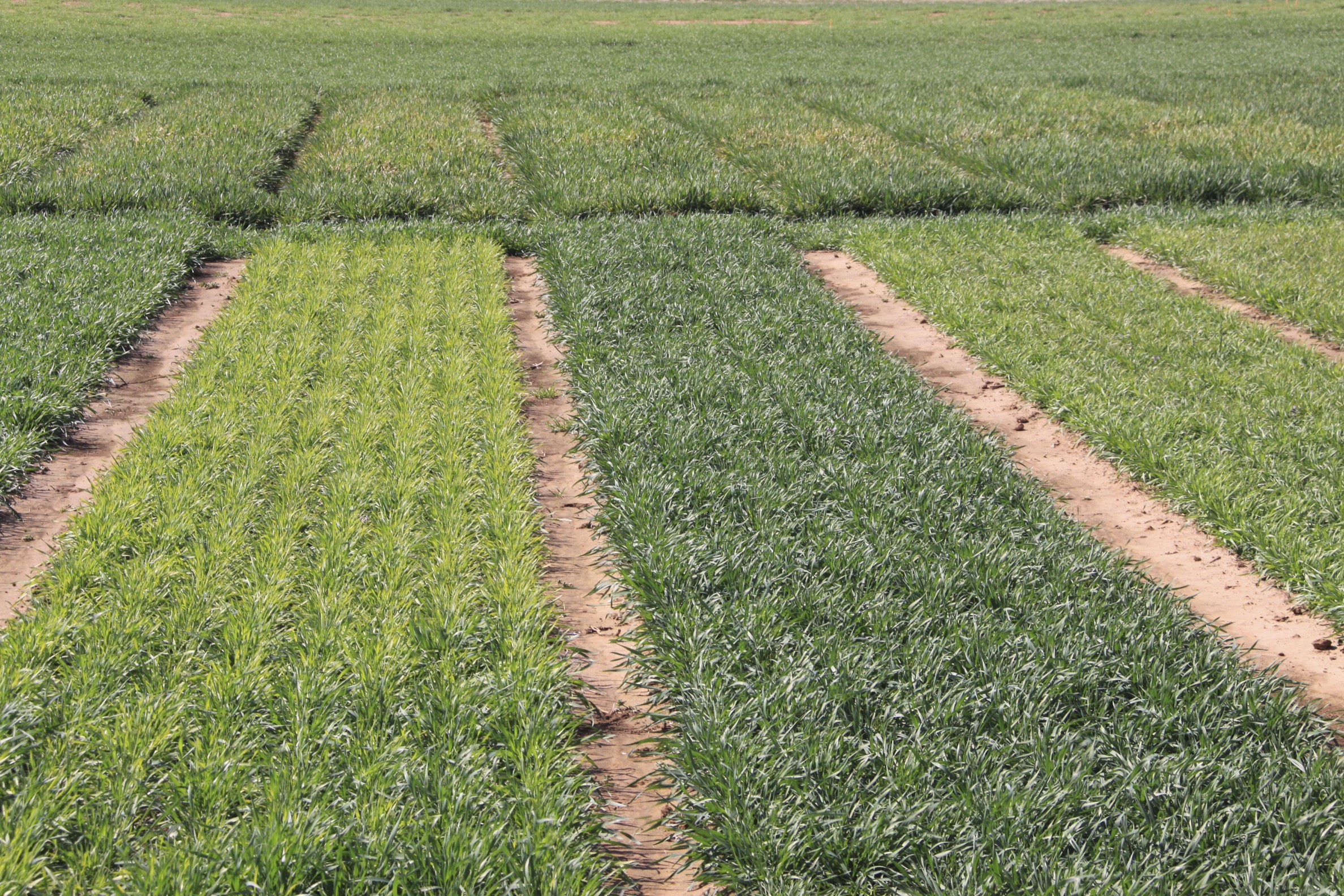
Wheat soilborne mosaic virus can cause yellowing in the spring in susceptible varieties such as the one on the left.

Wheat soilborne mosaic virus can cause yellowing in the spring in susceptible varieties such as the one on the left.

First hollow stem update 03/14/2014

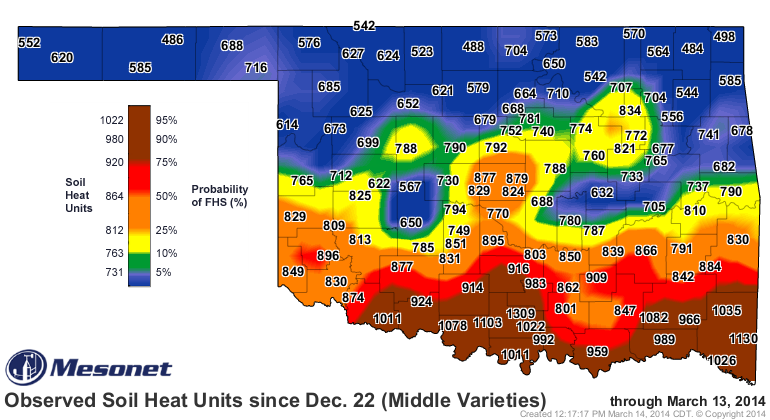
WB-Cedar and Sy Llano reached first hollow stem this week, and there are several additional early-maturing varieties that are near first hollow stem. The results from a March 13 sampling of plots are posted below, and we will post results from another sample early next week. I have also posted the map from the Oklahoma Mesonet’s First Hollow Stem Advisor for medium maturity varieties. As indicated in the map, most wheat south of I-40 is likely at or past first hollow stem.

Probability of first hollow stem for medium maturity wheat varieties on 03/14/14

Probability of first hollow stem for medium maturity wheat varieties on 03/14/14


First hollow stem works as a pull off date for cattle on wheat pasture because it allows the plant a small amount of time prior to jointing to recover some of the green leaf area lost to grazing. As evidenced by the results posted on this blog, first hollow stem is running a good 1.5 to 2 weeks later than normal. Given the situation, it is advisable to consider removing cattle from wheat pasture sooner rather than later. In many cases this would be before the occurrence of first hollow stem. I make this recommendation because once our temperatures start to warm, it is likely that that wheat phenological development will proceed in rapid fashion. We could easily encounter a situation where there are only a few days separating first hollow stem and jointing. Pulling cattle from wheat pasture a little early will allow extra time for recovery, which might be needed this year.

Variety cm of hollow stem 03/13/2014
Endurance 0.5
Deliver 0.7
Pete 1.4
OK Bullet 0.4
OK Rising 0.5
Billings 1.1
Ruby Lee 0.4
Garrison 0.6
Duster 0.1
Gallagher 0.8
Iba 0.3
Everest 1.0
Jackpot 1.1
Doans 0.8
Greer 0.4
CJ 1.1
SY Southwind 1.0
Sy Llano 1.5
Armour 1.0
WB-Cedar 1.7
WB-Redhawk 0.7
WB-Grainfield 0.1
Winterhawk 0.7
WB4458 0.8
T153 0.8
T154 0.9
T158 0.5
LCS Mint 0.2
LCS Wizard 0.4
LCH11-109 0.3
LCH11-1117 0.8
LCH11-1130 0.6
TAM 112 1.3
TAM 113 1.4
Byrd 0.4
Brawl CL Plus 0.6
Centerfield 0.1
Doublestop CL Plus 0.4
OK09125 0.5
OK09520 0.3
OK10126 0.0
OK08707W-19C13 1.4
OK10805W 0.3
OK10728W 1.2
OK11754WF .
Average 0.7

First hollow stem update 03/11/2014

With the exception of one experimental line, there are still no varieties at the first hollow stem stage of growth at Stillwater. The results from a March 10 sampling of plots are posted below, and we will post results from another sample later this week. First hollow stem works as a pull off date for cattle on wheat pasture because it allows the plant a small amount of time prior to jointing to recover some of the green leaf area lost to grazing. As evidenced by the results posted on this blog, first hollow stem is running a good 1.5 to 2 weeks later than normal.

Given the situation, it is advisable to consider removing cattle from wheat pasture sooner rather than later. In many cases this would be before the occurrence of first hollow stem. I make this recommendation because once our temperatures start to warm, it is likely that that wheat phenological development will proceed in rapid fashion. We could easily encounter a situation where there are only a few days separating first hollow stem and jointing. Pulling cattle from wheat pasture a little early will allow extra time for recovery, which might be needed this year.

Variety cm of hollow stem 03/10/2014
Endurance 0.16
Deliver 0.00
Pete 0.32
OK Bullet 0.15
OK Rising 0.15
Billings 0.60
Ruby Lee 0.13
Garrison 0.20
Duster 0.02
Gallagher 0.84
Iba 0.17
Everest 0.60
Jackpot 1.09
Doans 0.04
Greer 0.33
CJ 0.07
SY Southwind 0.57
Exp F14 0.86
Armour 1.00
WB-Cedar 0.97
WB-Redhawk 1.08
WB-Grainfield 0.09
Winterhawk 0.35
WB4458 0.40
T153 0.64
T154 0.37
T158 0.07
LCS Mint 0.29
LCS Wizard 0.00
LCH11-109 0.00
LCH11-1117 0.12
LCH11-1130 0.88
TAM 112 1.03
TAM 113 0.84
Byrd 0.62
Brawl CL Plus 0.00
Centerfield 0.00
Doublestop CL Plus 0.00
OK09125 0.08
OK09520 0.05
OK10126 0.00
OK08707W-19C13 0.55
OK10805W 0.00
OK10728W 0.24
OK11754WF 1.61
Average 0.40

First hollow stem advisor available on Mesonet

First hollow stem occurs just prior to jointing and is the optimal time to remove cattle from wheat pasture. A new first hollow stem advisor tool available on the Oklahoma Mesonet provides Oklahoma wheat farmers a real time assessment of the current first hollow stem situation in the state and a forecast for the next two weeks. While the first hollow stem advisor is a valuable tool, it is not a substitute for scouting, as conditions in your field may vary from the estimates provided.

The advisor uses a mathematical model that predicts the probability of first hollow stem based on soil heat units and wheat first hollow stem category (early, middle, or late). The model was developed by J.D. Carlson at OSU using first hollow stem data from the wheat variety testing program, and model development was made possible through a grant from the Oklahoma Wheat Commission.

You can navigate to the first hollow stem advisor from www.mesonet.org by clicking on “Agriculture” then “Crop-Wheat”  and looking for First Hollow Stem Advisor on the lefthand menubar. Or you can click here.  

Screen Shot 2014-02-14 at 1.01.50 PM

Once you are at the first hollow stem advisor page, you will need to make a few selections. First, you have an option of viewing a statewide map or you can view data for a particular site in a table or graph. Next, you can select whether you want to view the current situation or a projection for the next one or two weeks. Finally, you will need to indicate if your variety falls into the early, middle, or late category. Click on the “look up by category” link if you are unsure where your variety falls.

hollowstem_early.current

Above is the statewide map for current conditions as of 14 February 2014. Other than a hot spot near Ardmore, there is less than 5% probability that we are at first hollow stem in Oklahoma. Note, however, that many locations are near the 576 heat unit threshold for 5% probability of first hollow stem. This is where the projection tools come in handy.

hollowstem_early.proj14day

The map above is the two-week first hollow stem projection through 28 February 2014 (i.e the map was created on 14 February 2014). These projections are based on historical weather data for the next two weeks, and do not take into account the current forecast which might be warmer or colder than the historical average. Note that almost the entire state up to I-40 is predicted be at or above the 25% probability level for first hollow stem by February 28. It is recommended that you start scouting once the advisor predicts a 5% probability of first hollow stem in your area. If you are going by the first hollow stem advisor alone (not recommended) cattle should be removed no later than when a 50% probability of first hollow stem has occurred.