Freeze injury update 21 March 2016

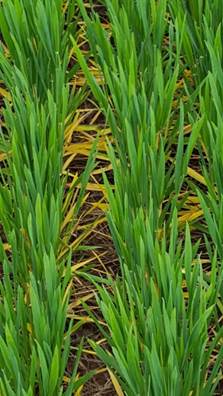
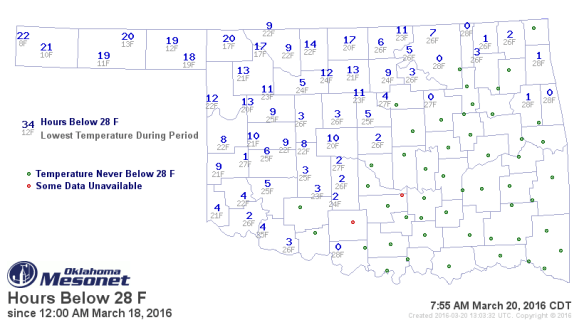
Temperatures over the weekend were cold enough to cause injury to the Oklahoma wheat crop. As shown in the figure below from the Oklahoma Mesonet many areas of Oklahoma spent several hours below 28F. While temperatures in the wheat canopy might have remained slightly higher than reported air temperatures, they were still probably low enough to result in significant injury to wheat.


Hours spent below 28F March 18 - 20

Hours spent below 28F March 18 – 20


A few points I would encourage everyone to consider:

Every freeze event is unique – the temperatures and time durations we use regarding freeze injury are rules of thumb and are not exact. I have seen instances where conventional wisdom would indicate complete crop loss and we skate through with minimal damage.
It will take a few days to see how bad things are – Symptoms may start to appear later this week and will likely be clearly identifiable by the end of this week. Healthy wheat heads will remain turgid with a green color. Damaged wheat heads will be bleached, yellow, or brown and will easily break when pushed against. I anticipate that we will not have any partial “blanking” of wheat heads and that most wheat heads will either be okay or a complete loss. This post from last year has some pictures showing tell tale signs of freeze injury. The linked post also serves as a reminder that while freeze is the concern of the day, the potential worsening of drought conditions in NW Oklahoma has the potential to do far more damage.

% damaged heads might not = % yield loss –  It is still relatively early in the growing season and there is still opportunity for smaller (two nodes or less) wheat to produce additional tillers and/or retain secondary tillers. Whether or not these tillers are able to compensate for larger tillers that were lost due to freeze will depend on moisture and weather. IF (and that is a big if) weather conditions remain favorable, late emerging tillers in central and northern Oklahoma might still have a shot at producing grain. It will be tougher for more advanced wheat in southern Oklahoma to make this type of recovery.


Wheat disease update – 04 March 2016

Wheat disease updates are written by Dr. Bob Hunger, OSU Extension Plant Pathologist

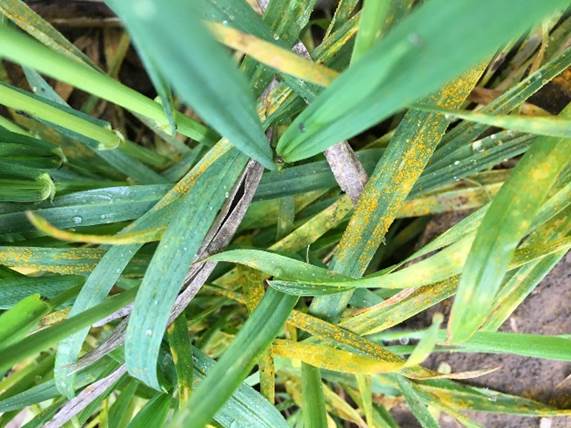
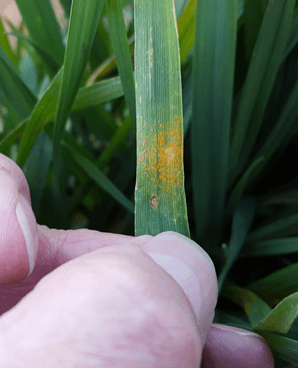
Oklahoma –  Foliar diseases are becoming active in Oklahoma.  Around Stillwater I have found both leaf and stripe rust, powdery mildew, and septoria.  Incidence/ severity of all these foliar diseases is relatively light, but I am especially watching what happens to the leaf and stripe rust.  The leaf rust pustules are small and on lower/older leaves indicating that leaf rust likely overwintered in Central OK.  The stripe rust pustules were on the upper leaves of ‘Pete’ wheat (see photo) indicating the spores causing these initial infections likely blew up from the south.  With rain and cool wet weather in the forecast, I definitely expect for there to be an increase in foliar diseases.  Around Stillwater, I also have seen quite a few aphids (mostly bird cherry-oat but also a few greenbug) and many lady beetles.  However, no symptoms yet of barley yellow dwarf.


Stripe rust on Pete 03/04/2016

Stripe rust on Pete 03/04/2016

Gary Strickland (SWREC Dryland Cropping Systems Spclt – Jackson Cnty) relayed to me that in SW OK he has seen leaf rust in fairly high levels on lower leaves of Endurance and other wheats, and has heard reports of stripe rust but has not seen any himself.

Yesterday I traveled to north-central OK (Alva).  On the way there and while there I visited several fields and found a few very small leaf rust pustules.  Overall the wheat from I-35 over to Alva (Hwy 11) looked good and was greening-up nicely.  Also while in Alva, numerous producers, etc. relayed reports of mostly leaf rust showing up across central OK, such as leaf rust around Geary, OK, etc.

Regarding rust incidence/severity in Texas, I talked to a wheat breeder in Texas last week and he indicated that wheat in southern Texas was showing both leaf and stripe rust but had not yet reached a severe level.  Early next week I’ll be at a meeting of wheat pathologists and should be able to find out more about diseases in Texas.

All these reports indicate the potential for significant foliar disease on the current wheat crop.  Genetic resistance in some of wheat varieties helps protect against the foliar diseases, but fungicides also provide an excellent management tool to protect not only yield, but also quality (test weight).  To help with deciding if and when to apply a fungicide, Dr. Jeff Edwards and I earlier this week updated and revised CR 7668 (Foliar Fungicides and Wheat Production in Oklahoma – March 2016).  It can be found at www.wheat.okstate.edu.  This Current Report discusses the significant aspects related to using fungicides to manage wheat foliar diseases.

One point I want to be sure to emphasize when using fungicides is the importance to not exceed the maximum amount of a fungicide applied to a crop in a single year.  Such a consideration couldespecially be an issue when more than one fungicide application is made.  In many states through the southeastern region of the U.S., two fungicide applications on wheat are more common, with the last application typically targeted toward Fusarium head blight (scab).  In Oklahoma, where scab usually is not a concern, deciding when to make a single fungicide application typically is the only consideration.  However, if you have early disease pressure from stripe rust or have early season powdery mildew, tan spot, or Septoria leaf blotch in no-till fields, more than one application may be needed to adequately manage these diseases.  In these situations, care must be taken to insure label compliance.  For example, if an early application of a generic form of tebuconazole is applied at 4 oz/ac, a subsequent application of any fungicide containing tebuconazole around heading would put you over the 4 oz limit for the crop season.  Thus, be sure to read the label to determine the maximum amount of a chemical that can be applied in a single season and the exact amount of a chemical(s) that is in a fungicide.

South Texas – Amir Ibrahim TAMU Wheat Breeder – The wheat crop in our trials at Castroville and Uvalde, TX is at Feekes stages 5‐10, ranging from the latest winter to the earliest spring types. Growth is very lush and there is no winter kill or frost injury in either winter and spring types. Stripe rust is at 70S, in the medium to upper canopy, on our  ‘Patton’ spreader passes across the field. Stripe rust is about 60S on ‘TAM 110’. ‘Coronado’ is hammered with yellow rust at Castroville.  Stripe rust is more progressed at Uvalde. We have been getting natural and uniform stripe rust infection at Uvalde every year for the last few years. The Texas A&M AgriLife Center at Uvalde sits at the bottom of a valley with constant morning dew that favors infection. Stripe rust has also been found at low levels in the wheat breeding trials near Chillicothe in the Rolling Plains of Texas.

Texas – Dr. John Fenderson – WestBred.  “I saw rampant Stripe in Central TX on Ruby Lee.  I also saw it on sensitive lines from I-20 south anywhere it has rained.  Some spraying has occurred in the Austin area.  I also pulled wheat in the Red River corridor both sides with a lot of stripe on older leaves.  It is just waiting on the right conditions to explode.  I was all the way down in S. TX this week and I did not see stripe on the spring wheat but there was some on Winter wheat around San Angelo etc.”

First hollow stem update 03/04/2016

First hollow stem is the optimal time to remove cattle from wheat pasture (full explanation). This will be the last of the 2016 first hollow stem updates, as the vast majority of varieties are at or well past first hollow stem.

Keep in mind that the numbers reported from Stillwater are likely behind those being observed in southern Oklahoma and ahead of those observed in northern Oklahoma. The First Hollow Stem Advisor can provide an estimate of first hollow stem progress in your neck of the woods.

First hollow stem measured in wheat sown 09/15/2015 at Stillwater, OK. Varieties with ‘-‘ reached first hollow stem on a previous measurement date
Variety cm of hollow stem 03/04/16
Endurance 1.5
OK Rising
Billings
Ruby Lee
Duster
Gallagher
Iba
Bentley
Doublestop CL Plus 1.57
NF 101
WB-Cedar
WB4458
WB-Grainfield
Winterhawk
WB4515
WB4721
WB4303
SY Monument 1.5
SY Flint
SY Llano
SY Drifter
SY Wolf
SY Razor
SY Grit
Everest
1863
KanMark
Oakley CL 1.74
Larry 1.8
Zenda
Tatanka 1.81
Joe 1.1
LCS Pistol 1.68
LCS Wizard 1.43
LCS Mint 2.08
LCS Chrome 1.84
T158 1.5
Long Branch 1.73
TAM 112
TAM 204
TAM 114
AG Robust
Byrd
Brawl CL Plus 1.26
Avery 1.97
OK1059060-3 1.91
OK10126 1.41
OK11D25056 1.55
OK12621 2.18
Stardust 2.24
OK12716R/W 1.16
OK11231 1.26
OK09915C-1 1.32
OK12912C 1.17
OK12DP22002-042
OK118036R/W

First hollow stem update 02/29/2016

First hollow stem is the optimal time to remove cattle from wheat pasture (full explanation). We measure first hollow in our September-sown wheat forage plots at Stillwater each year, and normally have approximately 50% of varieties at or past first hollow stem by March 1st. I have posted first hollow stem measurements from samples taken from these plots on 02/29/16 in a table at the end of this blog. Most wheat varieties are now at or well past first hollow stem.

Keep in mind that the numbers reported from Stillwater are likely behind those being observed in southern Oklahoma and ahead of those observed in northern Oklahoma. The First Hollow Stem Advisor can provide an estimate of first hollow stem progress in your neck of the woods.

First hollow stem measured in wheat sown 09/15/2015 at Stillwater, OK. Varieties with ‘-‘ reached first hollow stem on a previous measurement date
Variety cm of hollow stem 02/29/2016
Endurance 1.0
OK Rising 1.5
Billings
Ruby Lee 2.0
Duster 2.0
Gallagher
Iba
Bentley
Doublestop CL Plus 1.4
NF 101
WB-Cedar
WB4458
WB-Grainfield
Winterhawk
WB4515
WB4721
WB4303
SY Monument 1.0
SY Flint
SY Llano
SY Drifter
SY Wolf 2.7
SY Razor
SY Grit
Everest
1863
KanMark 1.5
Oakley CL 1.3
Larry 0.9
Zenda
Tatanka 1.1
Joe 0.8
LCS Pistol 1.1
LCS Wizard 1.3
LCS Mint 1.4
LCS Chrome 1.2
T158 1.1
Long Branch 1.2
TAM 112 1.6
TAM 204 1.7
TAM 114 1.6
AG Robust
Byrd 1.7
Brawl CL Plus 1.1
Avery 1.1
OK1059060-3 1.4
OK10126 0.8
OK11D25056 1.1
OK12621 1.1
Stardust 1.0
OK12716R/W 1.1
OK11231 1.0
OK09915C-1 0.8
OK12912C 1.1
OK12DP22002-042 1.6
OK118036R/W

First hollow stem update 02/26/2016

First hollow stem is the optimal time to remove cattle from wheat pasture (full explanation). We measure first hollow in our September-sown wheat forage plots at Stillwater each year, and normally have approximately 50% of varieties at or past first hollow stem by March 1st. I have posted first hollow stem measurements from these plots in a table at the end of this blog. WB-Grainfield and AG Robust have reached first hollow stem since our last update.

Keep in mind that the numbers reported from Stillwater are likely behind those being observed in southern Oklahoma and ahead of those observed in northern Oklahoma. The First Hollow Stem Advisor can provide an estimate of first hollow stem progress in your neck of the woods.

First hollow stem measured in wheat sown 09/15/2015 at Stillwater, OK. Varieties with no hollow stem value reached first hollow stem on a previous measurement date
Variety cm of hollow stem 02/26/16
Endurance 0.9
OK Rising 1.3
Billings
Ruby Lee 1.3
Duster 1.2
Gallagher
Iba
Bentley
Doublestop CL Plus 1.3
NF 101
WB-Cedar
WB4458
WB-Grainfield 1.6
Winterhawk
WB4515
WB4721
WB4303
SY Monument 0.9
SY Flint
SY Llano
SY Drifter
SY Wolf 1.1
SY Razor
SY Grit
Everest
1863
KanMark 1.4
Oakley CL 1.3
Larry 0.8
Zenda
Tatanka 1.0
Joe 0.7
LCS Pistol 0.9
LCS Wizard 1.2
LCS Mint 0.9
LCS Chrome 1.0
T158 1.0
Long Branch 1.1
TAM 112 1.2
TAM 204 1.3
TAM 114 1.3
AG Robust 1.6
Byrd 1.2
Brawl CL Plus 0.6
Avery 0.7
OK1059060-3 1.3
OK10126 0.7
OK11D25056 0.8
OK12621 0.8
OK10728W 0.8
OK12716R/W 0.6
OK11231 0.8
OK09915C-1 0.6
OK12912C 1.0
OK12DP22002-042 1.2
OK118036R/W  
Average 1.0

First hollow stem update 02/23/2016

First hollow stem is the optimal time to remove cattle from wheat pasture (full explanation). We measure first hollow in our September-sown wheat forage plots at Stillwater each year, and normally have approximately 50% of varieties at or past first hollow stem by March 1st. I have posted first hollow stem measurements from these plots in a table at the end of this blog. As of Monday the varieties, Billings, Gallagher, Iba, Bentley, NF101, WB-Cedar, WB4458, Winterhawk, WB4515, WB4721, WB4303, SY Flint, Sy Llano, SY Drifter, SY Razor, SY Grit, Everest, and Zenda were all at or past first hollow stem at Stillwater. Please note that WB4515 was incorrectly labeled as WB4455 in the past couple of posts. Also note that experimental line OK0728W has been released as Stardust hard white winter wheat. We will take another set of measurements at the end of this week and report the results on this blog.

Keep in mind that the numbers reported from Stillwater are likely behind those being observed in southern Oklahoma and ahead of those observed in northern Oklahoma. The First Hollow Stem Advisor on the Oklahoma Mesonet can provide an indication of where varieties are regarding first hollow stem in your area.

First hollow stem measured in wheat sown 09/15/2015 at Stillwater, OK.
Variety cm of hollow stem 02/22/2016
Endurance 0.8
OK Rising 1.3
Billings 2.1
Ruby Lee 1.2
Duster 1.1
Gallagher 2.0
Iba 1.9
Bentley 1.8
Doublestop CL Plus 1.2
NF 101 2.5
WB-Cedar 1.5
WB4458 1.9
WB-Grainfield 1.3
Winterhawk 1.5
WB4515 1.6
WB4721 1.5
WB4303 2.1
SY Monument 0.8
SY Flint 1.5
SY Llano 2.8
SY Drifter 1.5
SY Wolf 1.0
SY Razor 2.9
SY Grit 1.7
Everest 1.5
1863 2.1
KanMark 1.4
Oakley CL 1.0
Larry 0.7
Zenda 1.6
Tatanka 0.9
Joe 0.7
LCS Pistol 0.8
LCS Wizard 1.2
LCS Mint 0.8
LCS Chrome 0.8
T158 0.8
Long Branch 1.0
TAM 112 0.9
TAM 204 1.2
TAM 114 0.7
AG Robust 1.0
Byrd 0.6
Brawl CL Plus 0.6
Avery 0.5
OK1059060-3 1.3
OK10126 0.6
OK11D25056 0.6
OK12621 0.7
Stardust 0.7
OK12716R/W 0.5
OK11231 0.6
OK09915C-1 0.5
OK12912C 0.9
OK12DP22002-042 0.9
OK118036R/W 2.0
Average 1.2


First hollow stem update 02/19/2016

First hollow stem is the optimal time to remove cattle from wheat pasture (full explanation). We measure first hollow in our September-sown wheat forage plots at Stillwater each year, and normally have approximately 50% of varieties at or past first hollow stem by March 1st. I have posted first hollow stem measurements from these plots in a table at the end of this blog. No varieties are currently at first hollow stem at Stillwater, but given the warm conditions and the estimates from the first hollow stem advisor on the Mesonet, I anticipate we will have some varieties past first hollow stem by next week. Note that while no varieties are currently at first hollow stem, the overall average first hollow stem measurement increased as compared to 02/16/15.  Dillon Butchee reported early sown Gallagher in the Altus area was at first hollow stem.

Keep in mind that the numbers reported from Stillwater are likely behind those being observed in southern Oklahoma and ahead of those observed in northern Oklahoma. The First Hollow Stem Advisor on the Oklahoma Mesonet indicates that  early varieties in southern Oklahoma are likely past first hollow stem and that early varieties in central Oklahoma will reach this point within a week. Jim Johnson with the Noble Foundation reported that the estimates on the first hollow stem advisor were matching closely with his observations in the field around the Ardmore area. My advice is to start looking for a home for cattle on wheat pasture.


First hollow stem measured in wheat sown 09/15/2015 at Stillwater, OK.
Variety cm of hollow stem 02/19/16
Endurance 0.6
OK Rising 0.5
Billings 1.3
Ruby Lee 1.2
Duster 1.1
Gallagher 1.4
Iba 1.1
Bentley 0.7
Doublestop CL Plus 0.6
NF 101 1.1
WB-Cedar 0.7
WB4458 0.8
WB-Grainfield 1.0
Winterhawk 0.9
WB4455 0.6
WB4721 1.3
WB4303 1.2
SY Monument 0.6
SY Flint 1.3
SY Llano 1.0
SY Drifter 0.8
SY Wolf 0.4
SY Razor 1.4
SY Grit 1.3
Everest 0.6
1863 0.9
KanMark 0.7
Oakley CL 0.7
Larry 0.4
Zenda 1.1
Tatanka 0.4
Joe 0.6
LCS Pistol 0.6
LCS Wizard 0.6
LCS Mint 0.7
LCS Chrome 0.6
T158 0.7
Long Branch 0.9
TAM 112 0.7
TAM 204 0.6
TAM 114 0.4
AG Robust 0.7
Byrd 0.6
Brawl CL Plus 0.5
Avery 0.4
OK1059060-3 0.5
OK10126 0.3
OK11D25056 0.5
OK12621 0.4
OK10728W 0.6
OK12716R/W 0.4
OK11231 0.4
OK09915C-1 0.4
OK12912C 0.7
OK12DP22002-042 0.8
OK118036R/W 1.1
Average 0.7


First hollow stem update 02/16/2016

First hollow stem is the optimal time to remove cattle from wheat pasture (full explanation). We measure first hollow in our September-sown wheat forage plots at Stillwater each year, and normally have approximately 50% of varieties at or past first hollow stem by March 1st. I have posted first hollow stem measurements from these plots in a table at the end of this blog. No varieties are currently at first hollow stem at Stillwater, but given the warm conditions and the estimates from the first hollow stem advisor on the Mesonet, I anticipate we will have some varieties past first hollow stem by the end of the week. We will take another set of measurements at the end of this week and report the results on this blog.

Keep in mind that the numbers reported from Stillwater are likely behind those being observed in southern Oklahoma and ahead of those observed in northern Oklahoma. The First Hollow Stem Advisor on the Oklahoma Mesonet indicates that  early varieties in southern Oklahoma are likely past first hollow stem and that early varieties in central Oklahoma will reach this point within a week. Jim Johnson with the Noble Foundation reported that the estimates on the first hollow stem advisor were matching closely with his observations in the field around the Ardmore area. My advice is to start looking for a home for cattle on wheat pasture.

Current first hollow stem estimates for early maturity wheat varieties

Current first hollow stem estimates for early maturity wheat varieties

One week projection of first hollow stem for early maturity wheat varieties

One week projection of first hollow stem for early maturity wheat varieties

Two week projection of first hollow stem for early maturity wheat varieties

Two week projection of first hollow stem for early maturity wheat varieties


First hollow stem measured in wheat sown 09/15/2015 at Stillwater, OK.
Variety cm of hollow stem 02/15/16
Endurance 0.0
OK Rising 0.1
Billings 0.4
Ruby Lee 0.3
Duster 0.1
Gallagher 0.7
Iba 0.8
Bentley 0.6
Doublestop CL Plus 0.3
NF 101 0.4
WB-Cedar 0.4
WB4458 0.7
WB-Grainfield 0.0
Winterhawk 0.0
WB4455 0.1
WB4721 0.3
WB4303 1.2
SY Monument 0.0
SY Flint 0.7
SY Llano 1.0
SY Drifter 0.1
SY Wolf 0.2
SY Razor 1.4
SY Grit 0.4
Everest 0.2
1863 0.8
KanMark 0.0
Oakley CL 0.2
Larry 0.0
Zenda 0.8
Tatanka 0.0
Joe 0.0
LCS Pistol 0.0
LCS Wizard 0.2
LCS Mint 0.1
LCS Chrome 0.1
T158 0.3
Long Branch 0.2
TAM 112 0.3
TAM 204 0.4
TAM 114 0.0
AG Robust 0.2
Byrd 0.1
Brawl CL Plus 0.1
Avery 0.2
OK1059060-3 0.0
OK10126 0.1
OK11D25056 0.1
OK12621 0.0
OK10728W 0.2
OK12716R/W 0.4
OK11231 0.0
OK09915C-1 0.0
OK12912C 0.4
OK12DP22002-042 0.1
OK118036R/W 0.3
Average 0.3

First hollow stem nearing

First hollow stem occurs just prior to jointing and is the optimal time to remove cattle from wheat pasture. Given the warm forecast for the next two weeks, it is likely that we will start seeing first hollow stem in Oklahoma wheat fields. Grazing past first hollow stem can reduce wheat grain yield by as much as 5% per day and the added cattle gains are not enough to offset the value of the reduced wheat yield.

Similar to previous years, we will monitor occurrence of first hollow stem in our wheat plots at Stillwater and report the findings on this blog. There is also a first hollow stem advisor available on the Oklahoma Mesonet that can assist in determining when to start scouting.

Checking for first hollow stem is fairly easy.

  • You must check first hollow stem in a nongrazed area of the same variety and planting date. Variety can affect date of first hollow stem by as much as three weeks and planting date can affect it even more.
  • Dig or pull up a few plants and split the largest tiller longitudinally (lengthways) and measure the amount of hollow stem present below the developing grain head. You must dig plants because at this stage the developing grain head may still be below the soil surface.
  • If there is 1.5 cm of hollow stem present (see picture below), it is time to remove cattle. 1.5 cm is about the same as the diameter of a dime.
  • Detailed information on first hollow stem can be found at www.wheat.okstate.edu under ‘wheat management’ then ‘grazing’
  • Image

Wheat disease update – 10 February 2016

Wheat disease updates are written by Dr. Bob Hunger, OSU Extension Plant Pathologist

Since my last report, I don’t believe a lot has changed with the disease situation.  Similar to what I indicated in mid-December, I have continued to find small pustules of powdery mildew and a few scattered leaf rust pustules in rank wheat around Stillwater.  The temperature and weather has been such that these two foliar diseases (powdery mildew and leaf rust) have been able to persist but have not increased in the wheat around Stillwater.  This seems to be the case for southwestern and south central OK as well.

Gary Strickland (Extn Educator & SWREC Dry-land Cropping Systems Specialist; Jackson/Greer Cnty in SW OK) indicated wheat in SW OK is quite a ways behind the rest of the state and mostly is just now establishing a solid root system.  He had sent us a sample last week in which he expected a root rot to be involved, but we were not able to confirm any root rot pathogens.  Gary also indicated that he has confirmed Hessian fly at damaging levels in at least a few fields in Jackson Cnty.  He is going out in the next few days to scout additional fields.  Aaron Henson (Extn Educator; Tillman Cnty in southern OK) indicated wheat in his area varies from quite small to well-established with the majority of the wheat not yet jointing.  He is aware of the earlier reports of scattered stripe rust showing in south-central OK, but has not heard anything to indicate increase in incidence or severity.  For additional information regarding early season foliar wheat diseases and possible control with an early fungicide application please see:

Also around Stillwater, I am beginning to see symptoms indicative of wheat soil-borne mosaic/wheat spindle streak mosaic in areas such as my WSBM/WSSM screening nursery.  At this point, it is somewhat difficult to differentiate between symptoms of WSBM/WSSM and discoloration resulting from cold.  The photo below shows the contrast between a variety susceptible to WSBM/WSSM and a resistant variety, but was taken about 2-3 weeks later than today.  Thus, over the next month as temperature rises and wheat greens up, symptoms will become more striking.  However, nearly 100% of varieties planted across Oklahoma are resistant to both these viruses, so this disease complex has not caused a problem to wheat in Oklahoma (or other states) for many years.  For more information on the WSBM/WSSM complex, go to: https://www.youtube.com/user/OSUWheat/videos and watch the video on “Wheat Soilborne Mosaic Virus and Wheat Spindle Streak Mosaic Virus.”

Wheat soilborne mosaic virus can cause yellowing in the spring in susceptible varieties such as the one on the left.

Wheat soilborne mosaic virus can cause yellowing in the spring in susceptible varieties such as the one on the left.

Powdery mildew

Powdery mildew

Wheat stripe rust

Wheat stripe rust

Wheat leaf rust

Wheat leaf rust

Mature Hessian fly larvae are brown in color and often referred to as flaxseed. Tillers with larvae will not recover and will eventually die and slough off.

Mature Hessian fly larvae are brown in color and often referred to as flaxseed. Tillers with larvae will not recover and will eventually die and slough off.