Amanda de Oliveira Silva, Small Grains Extension Specialist
First hollow stem (FHS) is the optimal time to remove cattle from wheat pasture. This occurs when there is 1.5 cm (5/8”, or the diameter of a dime) of hollow stem below the developing grain head (see full explanation). The latest FHS results from OSU forage trials in Stillwater (Table 1) and Chickasha (Table 2) are listed below. For an additional resource and wheat update on FHS, see the Mesonet First Hollow Stem Advisor.
We use an accelerated growth system to report the earliest onset of FHS stage. Trials are seeded early to simulate a grazed system, but the forage is not removed. Varieties reported here with the earliest FHS date should be the first to monitor in commercial fields. In practice, wheat that is grazed will likely reach FHS stage later than reported here, and differences between varieties will likely moderate.
Table 1. First hollow stem (FHS) results for each variety collected at Stillwater. Plots were planted on 10/06/22 but not grazed or clipped. The threshold target for FHS is 1.5 cm (5/8″ or the diameter of a dime). The value of hollow stem for each variety represents the average of ten measurements. Varieties exceeding the threshold are highlighted in red.
Table 2. First hollow stem (FHS) results for each variety collected at Chickasha. Plots were planted on 10/07/22 but not grazed or clipped. The threshold target for FHS is 1.5 cm (5/8″ or the diameter of a dime). The value of hollow stem for each variety represents the average of ten measurements. Varieties exceeding the threshold are highlighted in red.
Contact your local Extension office and us if you have questions.
Amanda de Oliveira Silva, Small Grains Extension Specialist
Areas of Oklahoma with dry conditions have begun to see some visible wheat injury due to brown wheat mite (Figure 1) and winter grain mite (Figure 2). Last week, Josh Bushong, OSU Northcentral Area Extension Agronomist, reported seeing fields with injury due to brown wheat mites in Alfalfa and Kingfisher counties (Figure 3). Later that week Tyler Lynch, the Senior Agriculturalist in the Small Grains Program also reported seeing wheat grain mites in our wheat plots at Alfalfa and Woods Counties.
Two common mites can injure wheat, the brown wheat mite and the winter grain mite. Producers need to remain alert so that they don’t mistake damaged wheat from small grains mites for drought or virus disease.
Figure 1. Brown wheat mite with oversummering egg
Brown wheat mite is small (about the size of this period.) with a metallic brown to black body and four pairs of yellowish legs (Figure 1). The forelegs are distinctly longer than the other three pairs. Brown wheat mites can complete a cycle in as little as 10-14 days. Oklahoma experiences multiple generations of brown wheat mites that usually peak in spring, and the last generation occurs in April. At that time, females produce a whitish egg that will over summer.
Figure 2. Winter grain mite with a kidney-shaped egg
Winter grain mite is small (about 1 mm long) with a dark blue to black body and four pairs of orange-red legs, and a small reddish spot on the top of its abdomen that can be seen under magnification (Figure 2). Winter grain mite eggs are kidney-shaped, and change from clear, to yellow to reddish-orange after several days. They are laid on leaf blades and stems or the roots near the crown. Besides wheat, many grasses serve as host plants, including barley, oats, ryegrass, and fescue. We typically experience two generations each year, a fall generation and a winter generation that cycles out in March.
Figure 3. Field infested with brown wheat mite. Photos taken by Josh Bushong at Kingfisher County on February 21, 2023.
Figure 4. Leaf stippling from brown wheat mite (left) and grain wheat mite (right) feeding. Photo on the right taken by Tyler Lynch at Alfalfa county on April 24, 2023.
Figure 5. Field infested with winter grain mite
Both mites feed by piercing plant cells in the leaf, which results in “stippling” (Figures 4 and 5). The leaves take on a characteristic brown-grayish or cast and could be mistaken for injury due to herbicide. These mites are more likely to cause injury in wheat stressed from lack of moisture or nutrients.
Figure 6. Winter grain mite hiding in residue
Threshold
Brown wheat mites are not light sensitive but are vulnerable to driving rains of more than 0.25 inches, which tend to reduce populations. Winter grain mites are more tolerant of rainfall but are very light sensitive and tend to avoid bright, sunny days and windy days, so adjust your scouting accordingly. It is best to scout for winter grain mites on still, cloudy days or early morning/late evening. On sunny or windy days, they hide under the soil surface (up to a couple of inches) or congregate under dirt clods (Figure 6). Both mites are associated with continuous wheat production. Research suggests that brown wheat mite can be economically treated when there are 25-50 mites per leaf in wheat that is 6-9 inches tall. An alternative estimation is “several hundred” per foot of a row. The best recommendation for winter grain mite is to treat when plants show visible injury, and there are still mites present.
Chemical control
Only a few insecticides include either mite species on their label. Work conducted by Dr. Gerald Wilde at Kansas State evaluated several insecticides for the control of winter grain mites. Of those registered for winter grain mites, the insecticide dimethoate (Dimethoate and other generics) is effective. Other pyrethroid insecticides, lambda-cyhalothrin (Karate, Warrior II, and its generics), gamma-cyhalothrin (Declare) and beta-cyfluthrin (Baythroid and its generics) are also effective for both mites, even if they are not specifically listed on the label.
Additional resources
Contact your County Extension office
For more information on these mites, consult fact sheet EPP-7093 Mites in Small Grains by clicking here. If you find active mite infestations in your field, consult fact sheet CR-7194 Management of Insect and Mite Pests in Small Grainsfor registered insecticides, application rates, and grazing/harvest waiting periods by clicking here.
Amanda de Oliveira Silva, Small Grains Extension Specialist
First hollow stem (FHS) is the optimal time to remove cattle from wheat pasture. This occurs when there is 1.5 cm (5/8”, or the diameter of a dime) of hollow stem below the developing grain head (see full explanation). The latest FHS results from OSU forage trials in Stillwater (Table 1) and Chickasha (Table 2) are listed below. For an additional resource and wheat update on FHS, see the Mesonet First Hollow Stem Advisor and the latest interview with SUNUP TV.
We use an accelerated growth system to report the earliest onset of FHS stage. Trials are seeded early to simulate a grazed system, but the forage is not removed. Varieties reported here with the earliest FHS date should be the first to monitor in commercial fields. In practice, wheat that is grazed will likely reach FHS stage later than reported here, and differences between varieties will likely moderate.
Table 1. First hollow stem (FHS) results for each variety collected at Stillwater. Plots were planted on 10/06/22 but not grazed or clipped. The threshold target for FHS is 1.5 cm (5/8″ or the diameter of a dime). The value of hollow stem for each variety represents the average of ten measurements. Varieties exceeding the threshold are highlighted in red.
Table 2. First hollow stem (FHS) results for each variety collected at Chickasha. Plots were planted on 10/07/22 but not grazed or clipped. The threshold target for FHS is 1.5 cm (5/8″ or the diameter of a dime). The value of hollow stem for each variety represents the average of ten measurements. Varieties exceeding the threshold are highlighted in red.
Contact your local Extension office and us if you have questions.
Amanda de Oliveira Silva, Small Grains Extension Specialist
First hollow stem (FHS) is the optimal time to remove cattle from wheat pasture. This occurs when there is 1.5 cm (5/8”, or the diameter of a dime) of hollow stem below the developing grain head (see full explanation). The latest FHS results from OSU forage trials in Stillwater (Table 1) and Chickasha (Table 2) are listed below. For an additional resource, see the Mesonet First Hollow Stem Advisor.
We use an accelerated growth system to report the earliest onset of FHS stage. Trials are seeded early to simulate a grazed system, but the forage is not removed. Varieties reported here with the earliest FHS date should be the first to monitor in commercial fields. In practice, wheat that is grazed will likely reach FHS stage later than reported here, and differences between varieties will likely moderate.
Table 1. First hollow stem (FHS) results for each variety collected at Stillwater. Plots were planted on 10/06/22 but not grazed or clipped. The threshold target for FHS is 1.5 cm (5/8″ or the diameter of a dime). The value of hollow stem for each variety represents the average of ten measurements. Varieties exceeding the threshold are highlighted in red.
Table 2. First hollow stem (FHS) results for each variety collected at Chickasha. Plots were planted on 10/07/22 but not grazed or clipped. The threshold target for FHS is 1.5 cm (5/8″ or the diameter of a dime). The value of hollow stem for each variety represents the average of ten measurements. Varieties exceeding the threshold are highlighted in red.
Contact your local Extension office and us if you have questions.
Amanda de Oliveira Silva, Small Grains Extension Specialist
First hollow stem (FHS) is the optimal time to remove cattle from wheat pasture. This occurs when there is 1.5 cm (5/8”, or the diameter of a dime) of hollow stem below the developing grain head (see full explanation). The latest FHS results from OSU forage trials in Stillwater (Table 1) and Chickasha (Table 2) are listed below. For an additional resource, see the Mesonet First Hollow Stem Advisor.
We use an accelerated growth system to report the earliest onset of FHS stage. Trials are seeded early to simulate a grazed system, but the forage is not removed. Varieties reported here with the earliest FHS date should be the first to monitor in commercial fields. In practice, wheat that is grazed will likely reach FHS stage later than reported here, and differences between varieties will likely moderate.
Table 1. First hollow stem (FHS) results for each variety collected at Stillwater. Plots were planted on 10/06/22 but not grazed or clipped. The threshold target for FHS is 1.5 cm (5/8″ or the diameter of a dime). The value of hollow stem for each variety represents the average of ten measurements. Varieties exceeding the threshold are highlighted in red.
Table 2. First hollow stem (FHS) results for each variety collected at Chickasha. Plots were planted on 10/07/22 but not grazed or clipped. The threshold target for FHS is 1.5 cm (5/8″ or the diameter of a dime). The value of hollow stem for each variety represents the average of ten measurements. Varieties exceeding the threshold are highlighted in red.
Contact your local Extension office and us if you have questions.
Amanda de Oliveira Silva, Small Grains Extension Specialist
First hollow stem (FHS) is the optimal time to remove cattle from wheat pasture. This occurs when there is 1.5 cm (5/8”, or the diameter of a dime) of hollow stem below the developing grain head (see full explanation). The latest FHS results from OSU forage trials in Stillwater (Table 1) and Chickasha (Table 2) are listed below. For an additional resource, see the Mesonet First Hollow Stem Advisor.
We use an accelerated growth system to report the earliest onset of FHS stage. Trials are seeded early to simulate a grazed system, but the forage is not removed. Varieties reported here with the earliest FHS date should be the first to monitor in commercial fields. In practice, wheat that is grazed will likely reach FHS stage later than reported here, and differences between varieties will likely moderate.
Table 1. First hollow stem (FHS) results for each variety collected at Stillwater. Plots were planted on 10/06/22 but not grazed or clipped. The threshold target for FHS is 1.5 cm (5/8″ or the diameter of a dime). The value of hollow stem for each variety represents the average of ten measurements. Varieties exceeding the threshold are highlighted in red.
Table 2. First hollow stem (FHS) results for each variety collected at Chickasha. Plots were planted on 10/07/22 but not grazed or clipped. The threshold target for FHS is 1.5 cm (5/8″ or the diameter of a dime). The value of hollow stem for each variety represents the average of ten measurements. Varieties exceeding the threshold are highlighted in red.
Contact your local Extension office and us if you have questions.
Amanda de Oliveira Silva, Small Grains Extension Specialist
The wheat growing season up to this point has been extremely tough. The forage situation has been a kick-in-the-knees again this year. Wheat “dusted in” emerged at least one month later than the ideal time to promote fall forage production. It was challenging to get a stand established with a cool November and limited rainfall since planting. As a result, many producers did not have the chance to graze or are grazing at a lower stocking rate.
If the predicted shower events occur, it could help to improve conditions in some areas. Still, most of Oklahoma, especially western OK, is under an extreme drought and needs significant rain. For the producers who have pasture to graze, leaving some leaf tissue after grazing will be important for having any chance of a decent grain crop. Ideally, there should be a minimum of 60% canopy coverage (measured from the Canopeo app) left to allow the crop to recover from grazing (PSS-2170). An additional two weeks of grazing past first hollow stem, when conditions are not ideal for plant regrowth and canopy recovery, could reduce wheat yield by approximately 60% relative to its potential (Figure 1).
Figure 1. Grazing past first hollow stem has been shown to reduce grain yield by as much as five percent per day or as little as one percent per day. Factors such as variety, grazing intensity, and environmental conditions will determine the actual yield penalty for grazing past first hollow stem. This figure shows the anticipated yield loss for grazing past first hollow stem given favorable (solid line), unfavorable (dashed line) and average (dotted line) conditions for wheat regrowth following grazing termination (PSS-2147).
The first hollow stem stage (FHS) indicates the beginning of stem elongation or just before the jointing stage. It is a good indicator of when producers should remove cattle from wheat pasture. This occurs when there is 1.5 cm (5/8”, or the diameter of a dime) of hollow stem below the developing grain head (Figure 2). This is the optimal period because it gives enough time for the crop to recover from grazing and rebuild the canopy. Also, the added cattle weight gains associated with grazing past the FHS are not enough to offset the value of the potential reduced grain yield (1-5% every day past FHS) (Figure 1). The wheat variety, severity of grazing, time when cattle are removed, and weather conditions after cattle removal determine how much grain yield potential might be reduced.
Figure 2. The first hollow stem growth stage is reached when there is 1.5 cm of hollow stem (about the diameter of a dime) below the grain head.
Mesonet First Hollow Stem Advisor
Researchers at Oklahoma State University developed the Mesonet First Hollow Stem Advisor to help predict when FHS is nearing. This online tool uses soil temperature data to show the current probability of FHS occurrence and 1-week and 2-week projections. With this tool, producers can select their variety from a list of varieties that separates them into three FHS categories: early, middle, and late. Then, maps can be generated to provide the probability of FHS based on current conditions and the 1- and 2-week projections. Charts and tables can also be generated for individual Mesonet sites. Created maps have a color scheme to represent the probability of FHS occurrence. When using this tool, it is recommended to start scouting for FHS from a non-grazed part of the field once the 5% probability is reached (green color). Because stem elongation will begin moving quickly as the air temperature rises, starting your scouting at the 5% level will help give you the time it takes to make the cattle removal preparations by the time FHS occurs. We listed methods for scouting for FHS at the end of this post. For producers who do not want to scout, it is recommended to remove cattle when the 50% probability level is reached. A 50% probability level indicates that over an evaluated period (e.g., 10 years), FHS would have occurred by that date in 50% of those years (e.g., 5 years). The same interpretation is used for other probability levels.
I have generated some statewide maps below to give an example of what the tool provides and show some of the FHS conditions around Oklahoma. For producers along the southern Oklahoma border who planted an “early” wheat variety (e.g., Gallagher), now would be past the time to remove cattle from the field (Figure 3).
Figure 3. Current FHS probabilities for “early” wheat varieties.Figure 4. One-week FHS projection (i.e., through February 14) for “early” wheat varieties.
Remember that this tool should be used as a proxy to begin scouting for FHS. The best estimate of FHS is still to split stems from plants in each field to determine how developed they are. Another word of caution I want to mention when using the tool for this year is to consider when you finally got stand establishment. If this did not occur until the end of September to the beginning of October (which are most of the cases in Oklahoma this year), this tool might be ahead of where your plants are developmentally. In this case, the tool can still cue you to start scouting. Checking for FHS in each field will let you know if you do have some grazing time left.
Methods for scouting for FHS
Check for FHS in a non-grazed area of the same variety and planting date. Variety can affect FHS date by as much as three weeks, and planting date can affect it even more.
Dig or pull up a few plants, split the largest tiller longitudinally (lengthways), and measure the amount of hollow stem present below the developing grain head. You must dig plants because the developing grain head may still be below the soil surface.
If there is 1.5 cm (~5/8″) of hollow stem present, it is time to remove cattle. 1.5 cm is about the same as the diameter of a dime (see picture below).
Find detailed information on FHS and grazing by clicking here.
OSU Small Grains Program is monitoring FHS occurrence on a twice-per-week basis
Similar to previous years, we will monitor FHS occurrence in our wheat plots at Stillwater and Chickasha and report the findings on this blog. Remember that we use an accelerated growth system to report the earliest onset of the FHS stage. Trials are seeded early to simulate a grazed system, but the forage is not removed. Varieties reported here with the earliest FHS date should be the first to monitor in commercial fields. In practice, grazed wheat will likely reach FHS stage later than reported here, and differences between varieties will likely moderate.
The latest FHS results for each variety planted in our forage trial at Stillwater and Chickasha are listed below (Tables 1 and 2). Most varieties are not near FHS (values well below 1.5 cm). However, values will likely move quickly with a bit of moisture and warmer conditions in the coming weeks in Oklahoma.
Table 1. First hollow stem (FHS) results for each variety collected at Stillwater. Plots were planted on 10/06/22 but not grazed or clipped. The threshold target for FHS is 1.5 cm (5/8″ or the diameter of a dime). The value of hollow stem for each variety represents the average of ten measurements. Varieties exceeding the threshold are highlighted in red.
Table 2. First hollow stem (FHS) results for each variety collected at Chickasha. Plots were planted on 10/07/22 but not grazed or clipped. The threshold target for FHS is 1.5 cm (5/8″ or the diameter of a dime). The value of hollow stem for each variety represents the average of ten measurements. Varieties exceeding the threshold are highlighted in red.
Contact your local Extension office and us if you have questions.
Acknowledgments:
Tyler Lynch, Senior Agriculturalist
Israel Molina Cyrineu, Graduate Research Assistant
Amanda de Oliveira Silva, Small Grains Extension Specialist
With severe dry conditions and high temperatures in our state, it is good to consider the possible effects of high temperature and drought on wheat germination and early growth. As of September 19, soil temperature was in the 80’s F across the state and reached 97 F in some areas (Figure 1). Wheat can germinate in soil temperatures from 40 F to 99 F, but temperatures from 54 F to 77 F are optimal.
Figure 1. Soil temperature across Oklahoma. Figure courtesy Oklahoma Mesonet.
Wheat germination and emergence in HOT soils
Is the variety I am planting high-temperature germination sensitive?
High-temperature germination sensitivity is a more elaborate way of saying that some wheat varieties do not germinate well in hot soil conditions. This is not to say that the seed will not germinate, but it may not germinate until the soil temperature has lowered. Keep in mind too that this sensitivity can vary from year to year. For example, a sensitive variety like Ruby Lee may germinate fine in 90°F soils one year and only produce a 10% stand in the same soil conditions the next. When sowing early, it is best to plant varieties first that do not have high-temperature sensitivity (e.g., Duster, Gallagher). Soil temperatures typically begin to cool by about September 20 due to lower air temperatures and/or rainfall events. However, our summer temperatures seem to be sticking around for longer this year. Waiting until at least mid-September to plant sensitive varieties can help reduce the risk of this issue. A high temperature germination sensitivity rating for wheat varieties can be found in the OSU Fact Sheet (available by clicking here). An updated version of this factsheet will be published soon.
Coleoptile Length
Hot soil conditions at sowing also reduce coleoptile length. The coleoptile is the rigid, sheath-like structure that protects the first true leaf and aids it in navigating and reaching the soil surface. Once the coleoptile breaks the soil surface, the coleoptile will stop growing, and the first true leaf will emerge. If the coleoptile fails to reach the soil surface, the first true leaf will emerge below ground and take on an accordion-like appearance (Figure 2A-B). If this happens, the plant will die.
Figure 2A and 2B. Example of two different wheat seedlings in which the coleoptile failed to break the soil surface. The first true leaf emerged below the soil surface and resulted in this accordion-like appearance.
The coleoptile length for most wheat varieties today can allow for the seed to be safely planted up to 1.5 inches deep. Under hot soil conditions though, the coleoptile length tends to be decreased. Therefore, “dusting in” early-sown wheat at ¾ to 1 inch depth and waiting on a rain event may result in more uniform emergence than trying to plant into soil moisture at a deeper depth, if soil moisture is not available in the top 1 to 1.5 inches of the soil profile. A rating for coleoptile length for wheat varieties can be found in the OSU Fact Sheet PSS-2142 Wheat Variety Comparison. We are also working on updating this.
Wheat germination and emergence in DRY soils
The most important physiological requirement for wheat to germinate and sustain the developing seedling is soil water. Therefore, planting decisions should be based on a combination of available soil moisture and expected rainfall. In addition, other factors such as adequate seeding depth, sowing date, soil fertility, seed treatment, seed quality, etc., should be considered to guarantee good crop establishment. For more information, check the materials on our website.
Wheat seed needs a minimum water content of 35 to 45% of its dry weight to initiate germination, and germination will be more complete as moisture levels increase. Dry soils can still maintain a relative humidity of 99%, which can provide enough moisture for seeds to germinate. It might just take longer than with free-moisture availability. My concern with the current situation in Oklahoma is the severe drought we are in and the lack of rain in the forecast. In some cases, we could have enough moisture to start the germination process in some regions of the state, but seedling emergence and growth could be compromised if we do not see any rain soon.
What happens if the soil completely dries out before wheat emergence?
There are three phases during the germination process: water absorption, activation when the seed coat is ruptured, and visible germination when the radicle emerges, followed by the seminal roots and coleoptile. These processes will start and stop depending on soil moisture availability. Thus, if the soil dries out before the roots and shoots are visible, the seed remains viable, and germination will be paused and continue once water is available. However, if the soil dries out after those structures are emerged (approximately 4-5 days after germination has begun), the seedling may not tolerate the lack of water, resulting in incomplete or loss of stand.
What should I do then? Choose your battle!
The optimal time for planting wheat in central Oklahoma is around mid-September for a dual-purpose system or around mid-October for a grain-only system (Figure 3). With the current forecast, we are planning to wait another 7-10 days to decide on our dual-purpose and forage trials. There are different ways we can go about it, but we must remember that there is always risk involved when planting wheat in dry and hot soil conditions.
Figure 3. Forage and grain yield potential in relation to the day of the year. Every 1,000 kg/ha is equal to approximately 900 lb/acre or 15 bu/acre. Ideal planting dates for dual-purpose wheat in Oklahoma are mid-September (i.e., approximately day 260). Planting for grain-only should occur at least 2-3 weeks after dual-purpose planting (i.e., mid-October or approximately day 285).
If you decide to dust in your wheat and wait for a rainfall event to drive germination, watch your seeding depth. The optimum seeding depth to plant wheat is about 1-1.5” deep. We typically do not have as many issues with winterkill in Oklahoma as in more northern states, so I am comfortable with dusting in at about 0.75 – 1” deep. Planting at 0.5” or less is too shallow in most circumstances. Also, there is always a chance for a pounding rainfall event and subsequent soil crusting, which makes it difficult for the coleoptile to push through the soil surface and may result in poor emergence. Fields with stubble cover may be less affected and reduce the risk of soil crusting. If we receive light rain in the following weeks, that could cause wheat to emerge, but it may not be enough for wheat to continue growing. Most of the fields do not have good subsoil moisture, either.
If subsoil moisture is available and you decide to plant deeper to reach moisture, be careful with the coleoptile length of your variety, and make sure it has a long-enough coleoptile that will allow emergence if conditions are favorable. Consider increasing seeding rate to compensate for reduced emergence, which is prone to occur in this situation.
Should we wait for rain to plant then? This is a farm-by-farm call and it depends on which source of risk you find most comfortable. Personally, I would rather plant my wheat in the optimal planting window and adequate seeding depth than waiting for a rain that may take too long to happen or missing my optimal planting window. If the latter is the case, consider bumping seeding rate to try to compensate for the reduced time for tillering (especially in a grain-only system). Planting wheat at optimal time allows for more time for root growth in seedlings, helping the crop to establish more quickly under dry conditions and possibly help the plant to scavenge for water that is available deeper in the soil profile.
Are there any specific agronomic traits that could help wheat seedling growth under water stress?
Traits that will help with seedling growth in dry conditions are coleoptile length potential, which allows to plant a little deeper in moisture and good emergence (if deep planting is the practice of your choice). There are indications that sowing wheat varieties with larger seed may help to reduce the negative effects of drought during early growth (Mian and Nafziger, 1994). In general, the greater reserves of larger seed result in faster germination and crop establishment by increasing root growth and tiller production. Keep in mind, however, there are varieties with small seed size that germinate more rapidly than larger seeded varieties, owing to their differential response to available moisture.
Oklahoma Wheat harvest is moving forward in all locations across the state with producers making great strides statewide. Things are finally moving better in South Central, Oklahoma, North of El Reno and down by Chickasha as fields are drying up. Elevators are still reporting sprout damage across the state in the Southwest, South Central and Central regions due to excessive moisture in places. The sprout damage has also been variety specific in many instances (Note: Percentages in comparison to non- sprouted wheat has not changed since Monday’s report). In Southwest Oklahoma, some fields have as much at 10 to 30% damage, this would be in 10 percent of the crop from this region. In South Central, fields reported to be having 10% to 18% sprout damage on 20% of the loads being taken in. In Central Oklahoma sprout damage is estimated from 2% to 15%. The majority of sprout damage in these regions is falling in the 0 to 2% category, with 5 to 7% of the crop having as much as 15% damage. In Northern Oklahoma not much sprout damage is being reported. Proteins across the state are favorable with averages coming in between 12 to 13% in most places. Yields are ranging all over the board low teens to mid-20’s in Southwest, Oklahoma. In South Central Oklahoma, yields being reported from 10 bushels per acre to the mid 30’s. (Yields on areas where harvest is just picking up after the heavy rains last week are doing much better than expected even though sprout damage on some varieties is being reported in this region.) Yields in South Central, from Hinton to El Reno and then South to Chickasha are ranging in the mid 20’s to mid-30’s, which is remarkable given what the crop went thru. It should be noted some areas did have heavy hail damage and we are hearing reports of 20 to 40% losses where hail did occur. Yields in central and Northern Oklahoma are being reported as higher ranging from 15 bushels per acre to as high as 65 bushels per acre. In the Northern tier of the state where yields are better, regions are still looking at averages in the high 20’s to mid-30’s. It is also important to note several areas in Northwest Oklahoma up by Cherokee and Burlington had severe drought and large portions of that region will not be harvested, which will also have major impact on statewide bushels that are taken in. Test weights have been lowered from Southern Oklahoma to Central Oklahoma, but based on earlier cuttings with higher test weights most locations are still hoping for a 58 bushel per pound average. Test weights being reported from Enid North up around Jefferson, Medford, Lamont, Renfrow, Perry, Tonkawa, Ponca City, and Blackwell ranging from 58-61 pounds. Harvest is just getting started in NE Oklahoma around the Afton and Miami and not enough wheat was taken in to make a report. Harvest is also moving now on the dryland wheat in the Panhandle. The Oklahoma Wheat Commission is now calling Oklahoma wheat harvest 55% completed.
Southwest
Grandfield/Devol/Chattanooga/Lawton- Grandfield is 95% complete, Devol is 99% complete, Chattanooga is 85% complete, Lawton is reported 95% completed. Test weights in this region ranging from 58-60 pounds per bushel. Yields ranging in the low teens to mid-20’s. Proteins ranging from the 11.5% to 12.5%. No sprout damage reported from these locations.
Frederick-Harvest in this region is 99% complete. Test weights ranging from 60 to 61 pounds/bushel. Proteins ranging from 12 to 12.5% range. Yields being reported from low teens to high twenties, averaging in the low 20’s.
Altus/Duke/Carter- Harvest in this region reported as 95% done. Test weights have dropped some over the past week with the heavy rains and are now trending 56-58 pounds per bushel compared to earlier cuttings making 59 to 60 pounds per bushel. Yields reported from 5 bushel an acre to mid-20’s. Proteins ranging from 13% to 16%.
Lone Wolf/Hobart-Harvest in these regions is reported at 75% complete. Test weights have dropped slightly and now being reported from 55 to 58 pounds per bushel. Yields ranging from low teens to mid-20’s. Proteins reported making from 13% to 16%.
South Central
Apache- Wheat harvest is moving along in this region and is considered 45% complete. Test weights have been ranging from 57 pounds to 58 pounds per bushel for the most part. On the intensive management wheat they are seeing some 60 pound test weights. Yields for the most part are ranging from 10 to 35 bushels per acre depending on location, management and variety.
Chickasha- Harvest in this region has really moved forward over the past couple of days once producers have been able to get into fields. Harvest in this region 45% to 50% complete. Yields are doing much better than expected based on all the heavy rains, high winds and hail damage that occurred. Test weights ranging from 58 to 59 pounds per bushel. Yields making in the mid 20’s to mid-30’s. Some minor sprout damage is being reported but not as bad as expected. Some producers have had 20 to 40% hail damage losses.
Western Oklahoma
Sentinel/Rocky-Harvest has made great progress over the weekend and is reported at 95% complete. Test weights reported in the 56 to 60 pound per bushel range. Yields being reported from 14 to 28 bushels per acre. Proteins ranging from 13% to 17% depending on variety and management practices.
Hinton- Harvest in this area has progressed extremely fast over the last few days. This region is reported at 75% complete. Yields are doing better than expected after all the storms that hit prior to last week. Yields ranging in the mid 30’s, test weights averaging 60.5 pounds. Proteins ranging from 10% to 17% with a 13.5% average.
Central Oklahoma
El Reno- Harvest has been rolling North of El Reno, and is finally getting started South of El Reno although producers are still fighting mud from last week. They are reporting 40% harvested in this region. Yields are being reported from the low 20’s to the low 40’s depending on variety and management. Test weights ranging from 57 to 59.5 pounds per bushel. Protein ranging from 11% to 14.5%
Kingfisher/Omega– Harvest in this region reported to be 80% complete. Test weights have dropped with ranges reported from 57 to 60 pounds per bushel. Yields averaging in the high 20’s to low 30’s. Proteins have ranged from 10% to 15%, seeing a lot in the 11.5% to 12.5% range.
Reeding- Harvest in this region reported 40% complete. Test weights have dropped with ranges from 57 to 59 pounds per bushel being reported. Yields averaging mid-teens to low 30’s depending on variety and management. Proteins ranging from 11% to 12%.
Loyal-Harvest in this regions reported at 40% complete. Test weights averaging 57 to 59 pounds per bushel. Yields on early harvested wheat making in the low 20’s to low 40’s. Protein ranging from 11.5% to 12.5% on early samples.
Northwest OK
Shattuck/Fort Supply-This region being reported at 30% complete. Test weights ranging from 57 to 62 pounds per bushel depending on variety and management. Yields ranging from 5 bushels to 25 bushels per acre. Proteins are ranging from 12% to 14%.
Burlington- Harvest in this region reported at 40% complete. A large area in this region much of the crop will not be harvested due to the severe drought. On the crop that will be harvested test weight for this region averaging 58 pounds per bushel. Yields making in the mid 20’s to mid-40’s on the wheat that will be harvested depending on where moisture was received in a timely manner and management practices. Proteins ranging from 12% to 13%.
Helena/Goltry- Harvest in this region has been moving full speed ahead, this region being reported as 60% harvested. Yields reported from the mid-teens to low 30’s for the most part. Test weights ranging from 58 to 60 pounds per bushel. Proteins are averaging 13%.
Northern Oklahoma
Pond Creek/Lamont-This area reported to be 30% complete. Test weights ranging from 58 to 60 pounds per bushel. Yields being reported in the low 30’s to mid-40’s. Proteins ranging from 12% to 16%.
Medford/Deer Creek- Producers in this region are moving forward and harvest is reported 20% complete. Test weights on early cuttings ranging from 58 to 60 pounds per bushel. Yields in this region have been reported to be making better because of timely rains. The yields are ranging from low 30’s to mid-40’s. Some reports on management intensive wheat to be making in the high 60’s. Proteins have been ranging from 11% to 16%.
Perry/Tonkawa/Ponca City/Blackwell–Producers in this region just getting started over the past few days. Harvest reported at 20% complete. Test weights ranging from 58 to 61 pounds per bushel. Protein averages around 12 to 13%. Yields making in the mid 20’s to mid-40’s with some areas reporting higher yields on management intensive wheat.
Northeast Oklahoma
Early reports of a couple loads being taken in at Miami, and this was on Hard Red Winter (HRW) wheat. A more detailed report with actual results will be published on Monday of next week once harvest gets rolling, we will also be reporting on the Soft Red Winter (SRW) wheat in this region. No SRW has been taken in at this time.
Panhandle
Hooker- Harvest on dryland wheat has just started over the past couple of days. Test weights ranging from 58 to 63 pounds per bushel. On the dryland wheat that is being harvested reports showing it is averaging around 20 bushels per acre on early cuttings. Proteins averaging 12%.
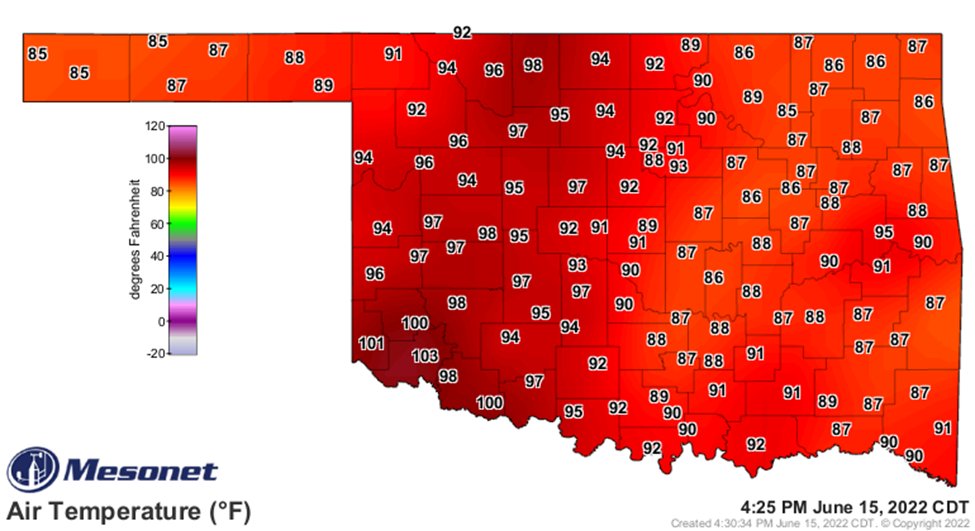
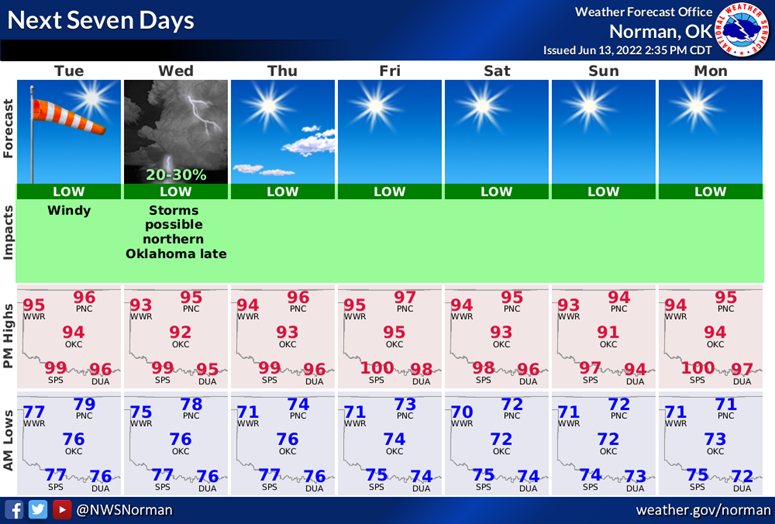
Below see the Heat Maximum and Air Temperatures for Wednesday June 15th. Also please see the 7-day forecast provided by the Oklahoma Mesonet. The next harvest report will be scheduled for Monday, June 20, 2022.
Oklahoma Wheat harvest is moving forward in all locations across the state with producers making great strides in the hot dry temperatures. A large majority of the crop in the region from Clinton, Weatherford, Carnegie, south to Pocasset and Chickasha received major hail damage and heavy rains last week and still fighting mud which will impact overall statewide numbers along with severe drought during the growing season in areas West of I-35. Elevators are reporting more sprout damage across the state in the Southwest, South Central and Central regions due to excessive moisture in places.
Yields are ranging all over the board. Low teens to mid-20’s in Southwest, Oklahoma. In South Central Oklahoma, yields are being reported from 10 bushels per acre to the mid 30’s. Yields in central and Northern Oklahoma are ranging higher from 15 bushels to as high as 65 bushels per acre. Most regions are still looking at averages in the high 20’s to mid-30’s for the most part. It is also important to note several areas in Northwest Oklahoma by Cherokee and Burlington experienced severe drought and large portions of that region will not be harvested.
Test weights have been lowered in Southern Oklahoma to Central Oklahoma, but based on earlier cuttings with higher test weights, most locations are still hoping for a 58 bushel per pound average. Test weights are being reported higher in NW Oklahoma in the Enid area and fields further north and east towards Jefferson, Medford, Lamont and Renfrow with many weights coming in at 60 pounds per bushel or higher.
Proteins have ranged across the state between 10% and as high as 17% with averages coming in between 12 to 13% in most places.
Sprout Damage – Elevators are reporting more sprout damage across the state in the Southwest, South Central and Central regions due to excessive moisture in places. The sprout damage has also been wheat variety specific in many instances. In Southwest Oklahoma, there may be as much as 10 to 30% sprout damage in 10% of the crop. In South Central, some fields are reported to having 10% to 18% sprout damage on 20% of the loads being taken in. In Central Oklahoma, sprout damage is anywhere from 2% to 15% with most of the damage in this region falling in the 0 to 2% category, with 5 to 7% of the crop having as much as 15% damage.
The Oklahoma Wheat Commission is now calling Oklahoma wheat harvest 45% completed.
Southwest
Frederick-Harvest in this region is 95-97% complete. Test weights ranging from 60 to 61 pounds/bushel. Proteins ranging from 12 to 12.5%. Yields being reported from low teens to high twenties, averaging in the low 20’s.
Altus/ Duke/ Carter- Harvest in this region reported as 90% done. Test weights have dropped some over the past week with the heavy rains and are now trending 56-58 pounds per bushel compared to earlier cuttings making 59 to 60 pounds per bushel. Yields reported from 5 bushel an acre to mid-20’s. Proteins ranging from 13% to 16%
Lone Wolf/Hobart-Harvest in these regions is reported at 60% complete. Test weights have dropped slightly and now being reported from 55 to 58 pounds per bushel. Yields ranging from low teens to mid-20’s. Proteins reported making from 13% to 16%.
South Central
Apache- Wheat harvest is just getting a good start in this region as producers have been fighting mud from the heavy rains that they received last week. Test weights have been ranging from 57 pounds to 58 pounds per bushel for the most part. On the intensive management wheat, they are seeing some 60-pound test weights. Yields for the most part are ranging from 10 to 35 bushels per acre depending on location, management and variety. This region 25% harvested.
Western Oklahoma
Sentinel/Rocky-Harvest has made great progress over the weekend and is reported at 80% complete. Test weights reported in the 56 to 60 pound per bushel range. Yields being reported from 14 to 28 bushels per acre. Proteins ranging from 13% to 17% depending on variety and management practices.
Central Oklahoma
El Reno- Harvest has been rolling North of El Reno, but South of El Reno, it is still be reported at a standstill as producers are fighting with mud from the heavy rains last week. They are reporting 20% harvested in this region. Yields are being reported from the low 20’s to the low 40’s depending on variety and management. Test weights ranging from 57 to 59.5 pounds per bushel. Protein ranging from 11% to 14.5%.
Kingfisher/Omega– Harvest in this region reported to be 60% complete. Test weights have dropped with ranges reported from 57 to 60 pounds per bushel. Yields averaging in the high 20’s to low 30’s. Proteins have ranged from 10% to 15%, seeing a lot in the 11.5% to 12.5% range.
Reeding- Harvest in this region reported 25% complete. Test weights have dropped with ranges from 57 to 59 pounds per bushel being reported. Yields averaging mid-teens to low 30’s depending on variety and management. Proteins ranging from 11% to 12%.
Loyal-Harvest in this region reported at 20% complete. Test weights averaging 57 to 59 pounds per bushel. Yields on early harvested wheat making in the low 20’s to low 40’s. Protein is ranging from 11.5% to 12.5% on early samples.
Northwest OK
Shattuck/Fort Supply-This region being reported at 15% complete. Test weights ranging from 57 to 62 pounds per bushel depending on variety and management. Yields ranging from 5 bushels to 25 bushels per acre. Proteins are ranging from 12% to 14%.
Burlington- Harvest in this region reported at 20% complete. A large area in this region will not be harvested due to the severe drought. On the crop that will be harvested, test weights for this region is averaging 58 pounds per bushel. Yields making in the mid 20’s to mid-40’s on the wheat that will be harvested depending on where moisture was received in a timely manner and management practices. Proteins ranging from 12% to 13%.
Helena/Goltry- Harvest in this region has been moving full speed ahead, this region being reported as 50% harvested. Yields reported from the mid-teens to low 30’s for the most part. Test weights ranging from 58 to 60 pounds per bushel. Proteins are averaging 13%.
Northern Oklahoma
Pond Creek/Lamont- Producers got a good start over the weekend in this region. This area reported to be 10% complete.Test weights ranging from 58 to 60 pounds per bushel. Yields being reported in the low 30’s to mid-40’s. Proteins ranging from 12% to 16%.
Medford/Deer Creek- Producers in this region are just getting started, as more moisture was received in this area last week. Test weights on early cuttings ranging from 58 to 60 pounds per bushel. Yields in this region have been reported to be making better because of timely rains. The yields are ranging from low 30’s to mid-40’s. Some reports on management intensive wheat to be making in the high 60’s. Proteins have been ranging from 11% to 16%.
Panhandle- At the time of this report, no harvest was reported as taking place in the Panhandle although we have heard early reports of harvest starting around Baker, Oklahoma. We plan to have a more in-depth report in this region on Wednesday, June 15th.
Below see the Heat Maximum and Air Temperatures for Monday June 13th. Also please see the 7-day forecast provided by the Oklahoma Mesonet. The next harvest report will be scheduled for Wednesday, June 15, 2022.




 WORLD OF WHEAT