Plant growth regulators for wheat

Many Oklahoma wheat farmers battled lodged wheat in 2013 and are looking to plant growth regulators to help reduce lodging in 2014. Lodging occurs due to a variety of factors, and as shown in the figure below, the timing of lodging will determine the final impact on grain yield. Lodging at head emergence can cause as little as 30 or as much as 80% yield reduction. The numbers in the figure do not account for harvest losses, which can exceed losses associated with lower photosynthetic capacity shown in the figure.

Slide05

Freeze injury or disease can cause lodging due to stem failure, which is characterized by plant stems breaking near the base. I the absence of weakened stems due to freeze or disease, most lodging in wheat is caused by failure of the root anchorage system (root lodging). Root lodging occurs when the anchorage system of a top-heavy wheat plant is weakened due to moist soil and wind provides sufficient force to overcome the rotational stiffness of the root/soil complex. Research has shown that increasing the soil water content from 17 to 26% reduced the force required for anchorage failure by 33%, and as little as 0.25 inches of water plus 11 mph winds were enough to cause lodging. The thicker the wheat crop and/or the taller the wheat crop, the more force that winds exert on the root anchorage system and the greater the likelihood of lodging.
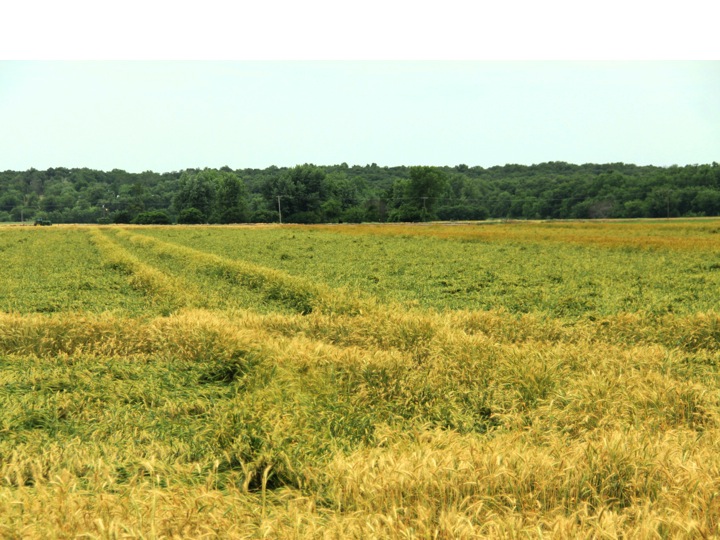
Severe lodging in an Oklahoma wheat field in 2013

In 2013 we evaluated the plant growth regulator trinexapac-ethyl, which is sold under the trade name Palisade®. Palisade is a giberellic acid inhibitor and works primarily by reducing plant height. In our study we evaluated 12 oz/ac of Palisade with and without 4 oz/ac of Tilt (propiconazole) applied at Feekes GS 7 (two nodes visible above the soil surface). We included an untreated check and ALL plots, including the check, received 10.5 oz/ac of Quilt Xcel at Feekes GS 10.5 (heading). We conducted the trial at Stillwater (Irr), Perkins (Irr), and Chickasha (Non-Irr).

Slide11

While application of Palisade resulted in numeric reductions in plant height at Chickasha and Stillwater, differences among treatments were not statistically significant.

Slide14

We rated plots for lodging at harvest using a 1 – 10 scale with 0 equaling no lodging and 10 equaling complete lodging.  Application of Palisade plus Tilt reduced lodging over Palisade alone at Chickasha. Application of Palidsade or Palisade plus Tilt resulted in numeric reductions in lodging scores at Stillwater, but the result were too variable to result in statistical significance. Palisade did not affect lodging at Perkins.
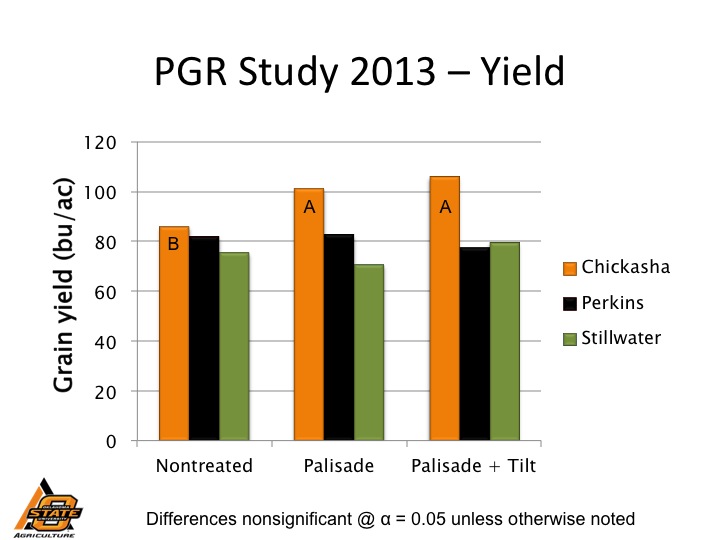
Slide18Application of Palisade or Palisade plus Tilt increased grain yield at Chickasha and had no effect on grain yield at Stillwater or Perkins. It is interesting to note that the Palisade treatment increased grain yield at Perkins even though the plots lodged at comparable levels as the non treated check. My best hypothesis is that the treated plots lodged later than the non treated plots, as all plots were standing at anthesis (see picture below).Lodging occurred at Chickasha, but occurred later in the season.

Slide19Palisade and Palisade plus Tilt increased test weight at Chickasha and had no effect on test weight at Perkins or Stillwater

To summarize this first year of work with plant growth regulators, we found a trend for one to two inch reductions in plant height when Palisade or Palisade plus Tilt were applied, but this only translated to increased grain yield at one site. Our results are consistent with other wheat plant growth regulator research, which has reported similar variation in response among sites and years.  The literature also shows that reduction in lodging is relative to the straw strength of the variety. That is, a plant growth regulator will not make a lodging prone variety stand like one with excellent straw strength, rather they will make it less prone to lodging relative to the same variety non treated.

Based on current evidence, plant growth regulators in Oklahoma are best kept on acres with high (> 80 bu/ac) yield potential that may have greater propensity for lodging due to variety or fertility.  If these high yield potential acres are being sprayed with a growth regulator at GS 7, the addition of a foliar fungicide might be prudent if it can be included at a relatively low cost. This early-season fungicide application will not, however, substitute for a fungicide application at flag leaf.

Full disclosure: Syngenta donated the product for this trial, but the only funding for the research was provided by the Oklahoma Agricultural Experiment Station and the Oklahoma Cooperative Extension Service. We are conducting the same trial in 2014 along with a separate trial evaluating Palisade in drought stress environments that is partially funded by Syngenta. The analysis and recommendations made in this blog post are preliminary and based on research findings from 2013. Recommendations may change as further research is conducted and new information is obtained.

First hollow stem advisor available on Mesonet

First hollow stem occurs just prior to jointing and is the optimal time to remove cattle from wheat pasture. A new first hollow stem advisor tool available on the Oklahoma Mesonet provides Oklahoma wheat farmers a real time assessment of the current first hollow stem situation in the state and a forecast for the next two weeks. While the first hollow stem advisor is a valuable tool, it is not a substitute for scouting, as conditions in your field may vary from the estimates provided.

The advisor uses a mathematical model that predicts the probability of first hollow stem based on soil heat units and wheat first hollow stem category (early, middle, or late). The model was developed by J.D. Carlson at OSU using first hollow stem data from the wheat variety testing program, and model development was made possible through a grant from the Oklahoma Wheat Commission.

You can navigate to the first hollow stem advisor from www.mesonet.org by clicking on “Agriculture” then “Crop-Wheat”  and looking for First Hollow Stem Advisor on the lefthand menubar. Or you can click here.  

Screen Shot 2014-02-14 at 1.01.50 PM

Once you are at the first hollow stem advisor page, you will need to make a few selections. First, you have an option of viewing a statewide map or you can view data for a particular site in a table or graph. Next, you can select whether you want to view the current situation or a projection for the next one or two weeks. Finally, you will need to indicate if your variety falls into the early, middle, or late category. Click on the “look up by category” link if you are unsure where your variety falls.

hollowstem_early.current

Above is the statewide map for current conditions as of 14 February 2014. Other than a hot spot near Ardmore, there is less than 5% probability that we are at first hollow stem in Oklahoma. Note, however, that many locations are near the 576 heat unit threshold for 5% probability of first hollow stem. This is where the projection tools come in handy.

hollowstem_early.proj14day

The map above is the two-week first hollow stem projection through 28 February 2014 (i.e the map was created on 14 February 2014). These projections are based on historical weather data for the next two weeks, and do not take into account the current forecast which might be warmer or colder than the historical average. Note that almost the entire state up to I-40 is predicted be at or above the 25% probability level for first hollow stem by February 28. It is recommended that you start scouting once the advisor predicts a 5% probability of first hollow stem in your area. If you are going by the first hollow stem advisor alone (not recommended) cattle should be removed no later than when a 50% probability of first hollow stem has occurred.

First hollow stem nearing

First hollow stem occurs just prior to jointing and is the optimal time to remove cattle from wheat pasture. Given the warm forecast for the next two weeks, it is likely that we will start seeing first hollow stem in Oklahoma wheat fields. Grazing past first hollow stem can reduce wheat grain yield by as much as 5% per day and the added cattle gains are not enough to offset the value of the reduced wheat yield.

Similar to previous years, we will monitor occurrence of first hollow stem in our wheat plots at Stillwater and report the findings on this blog. There is also a new first hollow stem advisor available on the Oklahoma Mesonet that can assist in determining when to start scouting.

Checking for first hollow stem is fairly easy.

  • You must check first hollow stem in a nongrazed area of the same variety and planting date. Variety can affect date of first hollow stem by as much as three weeks and planting date can affect it even more.
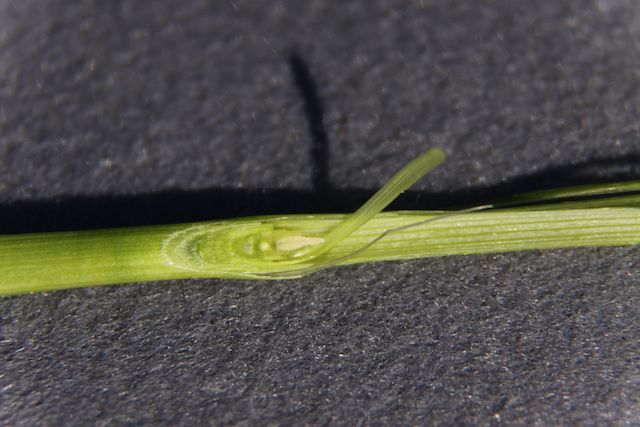
  • Dig or pull up a few plants and split the largest tiller longitudinally (lengthways) and measure the amount of hollow stem present below the developing grain head. You must dig plants because at this stage the developing grain head may still be below the soil surface.
  • If there is 1.5 cm of hollow stem present (see picture below), it is time to remove cattle. 1.5 cm is about the same as the diameter of a dime.
  • Detailed information on first hollow stem can be found at www.wheat.okstate.edu under ‘wheat management’ then ‘grazing’
  • Image

Freeze injury

Freeze injured plants from Cotton County, OK. Note the green, healthy leaf coming through the desiccated leaves in the plant on the right

Freeze injured plants from Cotton County, OK. Note the green, healthy leaf coming through the desiccated leaves in the plant on the right. These plants will make a full recovery with adequate moist and fertility.

Our recent extreme shifts in temperature have resulted in moderate to severe freeze injury in some Oklahoma wheat fields. To be honest, the damage is not as widespread or severe as I thought it would be given that most of our wheat had not had an opportunity to harden off. The dry soil conditions in western and southern Oklahoma did not help the situation, as there was not sufficient soil moisture to buffer the temperature shift in the top few inches of soil.

Freeze injury at this stage of growth (tillering) rarely impacts grain yield, but, as always, there are a few exceptions. Wheat that was very small or late-sown is more susceptible to winter kill. Similarly, wheat that does not have a good root system or that was shallow sown due to crop residue is more susceptible to winter kill. It is best to wait until after a few days of favorable growing conditions to check for freeze injury. Plants with regrowth that is green and healthy should make a full recovery, and this will be the case for most Oklahoma wheat fields.

Freeze injury in late-sown wheat near Enid, OK. Some of the smaller plants might have a tough time recovering, but given favorable conditions, the wheat stand as a whole still has adequate time to "fill in" and compensate for some of the lost plants.

Freeze injury in late-sown wheat near Enid, OK. Some of the smaller plants might have a tough time recovering, but it is still too early to determine whether or not the field as a whole will adequate to produce a decent grain crop.

Grazing considerations: crown roots and first hollow stem

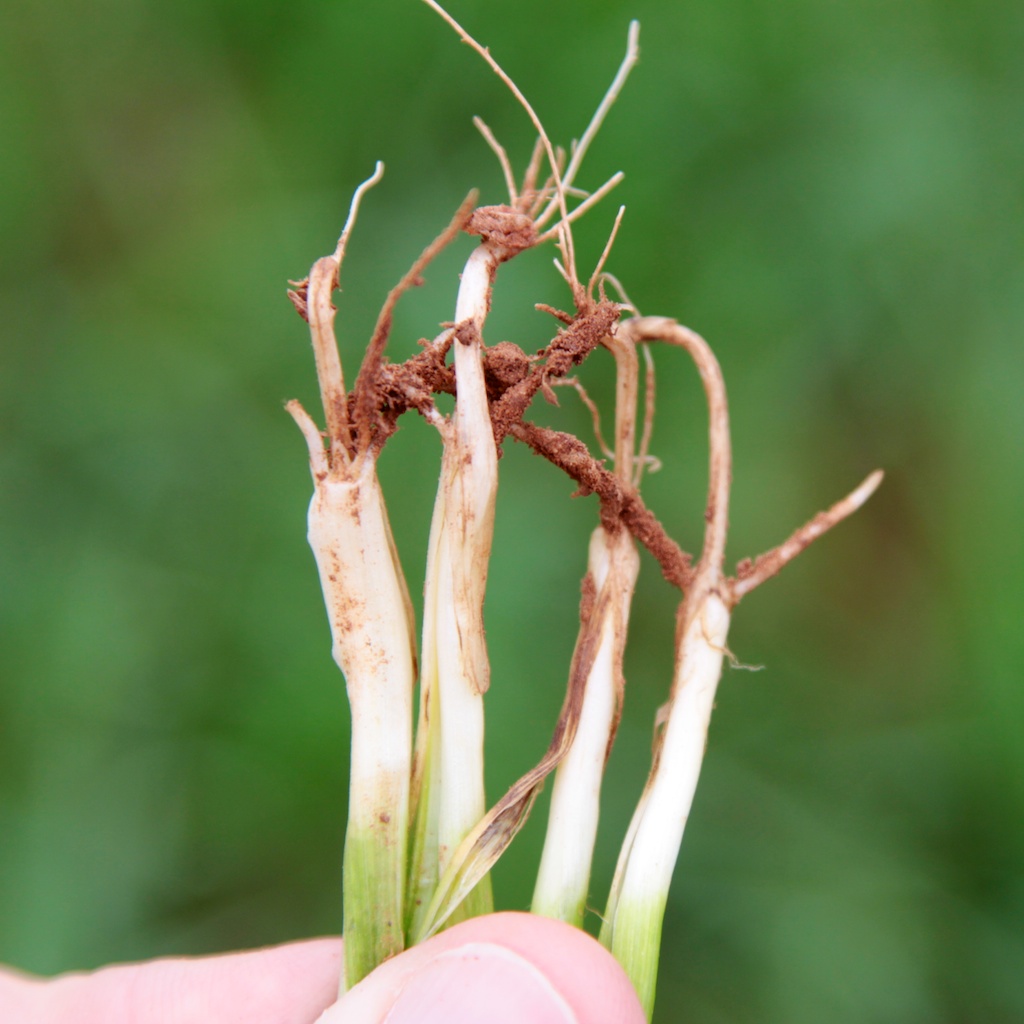
There are a few cattle already on wheat pasture in Oklahoma and more that will be turned out in the coming weeks. An adequate crown root system is required to anchor wheat in place prior to grazing.

Wheat should not be grazed until enough crown roots are present to anchor the plant in the soil

Wheat should not be grazed until enough crown roots are present to anchor the plant in the soil

Without these roots, wheat can be pulled from the soil during grazing, thinning final stands. Aboveground appearances can be deceiving, so it is important to pull plants from the soil to ensure the crown roots are there even if the plants appear large enough for grazing.

It is also important to make preparations for measuring first hollow stem prior to turning cattle out on wheat pasture. Grazing delays plant development; therefore, first hollow stem has to be checked in a nongrazed area. The nongrazed area does not have to be large and can be achieved through a panel exclosure or by simply moving one of the posts for an electric fence in a few feet. The key is to plan for the nongrazed area now so you can measure first hollow stem in February.

Watch season-long restrictions when split applying fungicides

By Dr. Bob Hunger, OSU Extension Plant Pathologist

My counterpart in Arkansas, Dr. Gene Milus (University of Arkansas), just sent out an important message about being careful to not exceed the maximum amount of a fungicide applied to a crop in a single year.  Such a consideration could be an issue where more than one fungicide application is made.  This is especially true if a generic of tebuconazole is applied, as this chemical also is in Prosaro;  however, multiple applications of the same fungicide may also exceed the maximum amount of chemical that can be applied in a single year.  Reading the label is the best place to determine the maximum amount of a chemical that can be applied in a single season and the exact amount of a chemical(s) that is in a fungicide.  A quick reference to what chemicals are in the typical fungicides used on wheat in Oklahoma is the OSU Current Report (CR-7668) that Dr. Jeff Edwards and I recently updated (available at www.wheat.okstate.edu)

In Arkansas and many states through the mid-western region of the U.S., two or even three fungicide applications on wheat are more common, with the last application typically targeted toward Fusarium head blight (scab).  In Oklahoma, where scab usually is not a concern, deciding to apply one fungicide application typically has been the only consideration.  However, in recent years making two fungicide applications have become more common because of higher wheat prices, lower cost of fungicides, and increased no-till wheat acres that favor early diseases such as powdery mildew, tan spot, and septoria/stagonospora.  It is in these situations that care must be taken to insure label compliance.  The following message from Dr. Milus addresses this point.  The report below is also at http://www.arkansas-crops.com/ along with other ag news from Arkansas.

Given the early onset of stripe rust and the cool rainy weather in recent weeks, some wheat growers are considering two or three fungicide applications. This is a new phenomenon for Arkansas growers and requires some planning to stay within the legal limits for total amounts of particular fungicides that can be applied to wheat fields. The fungicide label lists to total amount of each active ingredient that can be applied per acre per year. These amounts usually are given in pounds of active ingredient (lb ai) which require some math to translate into fluid ounces (fl oz) of particular products. The total amounts and usual application rates below are for fungicides most likely to be used in Arkansas.

Tebuconazole: total amount = 0.11 lb ai/A = 4 fl oz/A.
Products containing only tebuconazole include Folicur (no longer being sold), Orius, Tebucon, Tebustar, Tebuzol, Tegrol, and Toledo.

Prosaro: total amount = 8.2 fl oz /A = 0.11 lb ai each of prothioconazole and tebuconazole.
(Note that no Prosaro can be applied if 4 fl oz of a tebuconazole product was applied earlier because Prosaro is half tebuconazole.)

Propiconazole: total amount = 0.22 lb ai/A = 8 fl oz/A.
4 fl oz/A = 0.11 lb propiconazole.
Products containing propiconazole include Tilt, Bumper, Fitness, Propiconazole E-AG, and PropiMax

Quilt Excel: total amount = 28 fl oz/A = 0.22 lb propiconazole + 0.26 lb azoxystrobin
14 fl oz Quilt Excel = 0.11 lb propiconazole + 0.13 lb azoxystrobin.
(Therefore 4 fl oz of a propiconazole product + 14 fl oz of Quilt Excel can be legally applied.)

Pyraclostrobin (Headline): total amount = 18 fl oz/A = 0.29 lb ai/A
9 fl oz = 0.147 lb Pyraclostrobin (Note the slight discrepancy between the total amounts expressed as fl oz/A and lb ai/A.)

Metconazole (Caramba): total amount = 34 fl oz/A = 0.20 lb ai/A
17 fl oz = 0.10 lb Metconazole

Twinline: total amount = 18 fl oz/A = 0.10 lb metconazole + 0.15 lb pyraclostrobin
9 fl oz/A = 0.05 lb metconazole + 0.076 lb pyraclostrobin
(Note the discrepancies for total amounts metconazole and pyraclostrobin depending on which products are used.)

Spring freeze part deux

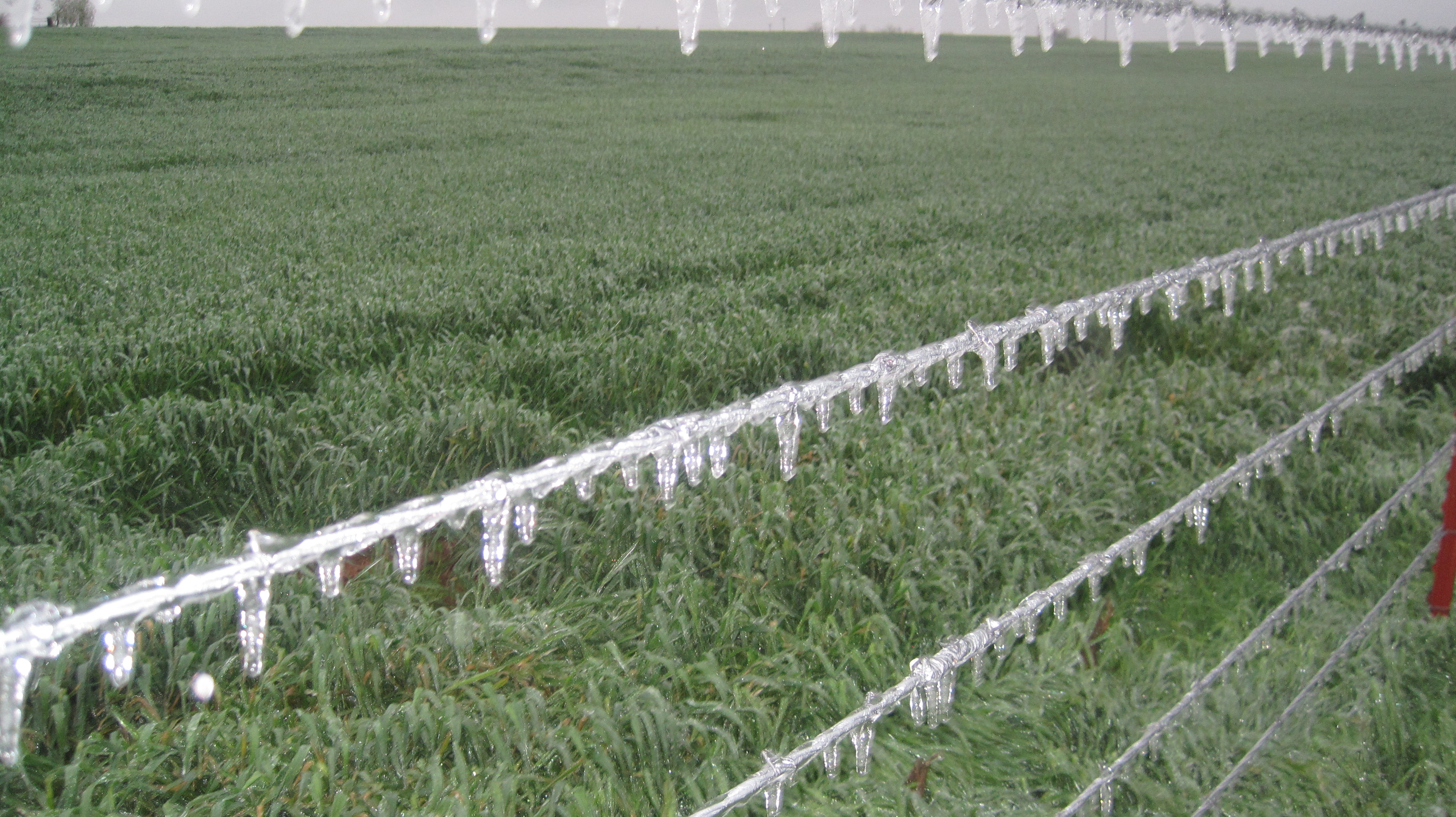
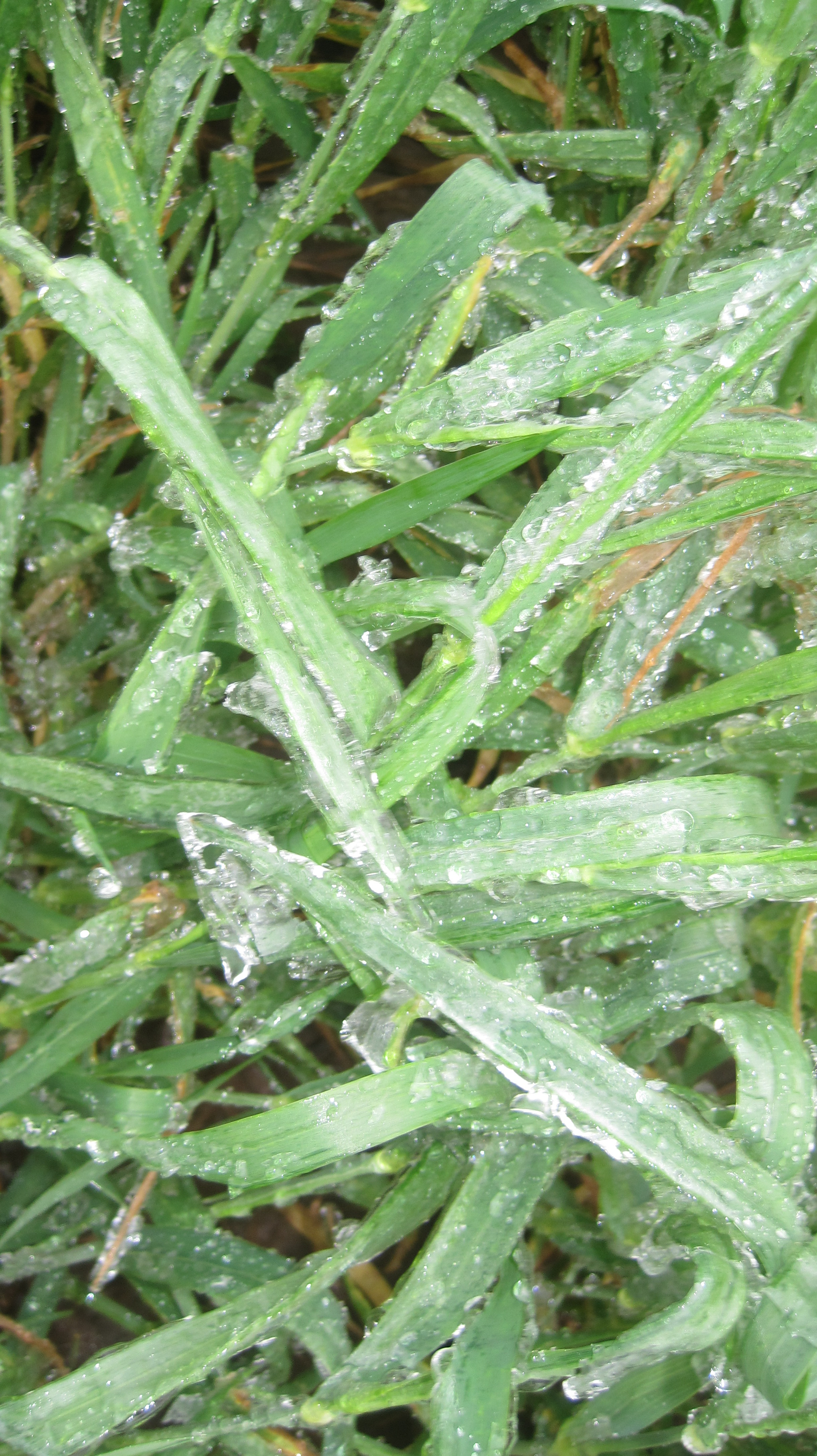
Large amounts of freezing rain, sleet, hail, etc. hit the Oklahoma wheat belt on April 10, 2013 and temperatures are expected to drop to the mid to upper 20’s this evening (I posted a couple of pictures below). Wheat development ranges from early heading in southern Oklahoma to just past jointing in northern Oklahoma and the Oklahoma Panhandle. If forecasts are correct, wheat tillers in southwest Oklahoma that escaped the first freeze have a good chance of being taken out by this freeze.  Central and northcentral Oklahoma has quite a bit of ice-covered wheat. Ice-covered wheat will remain at approximately 32F and this might be just warm enough to escape severe injury. If the ice melts, however, and temps drop into the 20’s even wheat that is just past the jointing stage can be injured. At this stage it is certain that we will have some freeze injury to the majority of the Oklahoma wheat crop, but it will be a good 7 – 10 days before we can accurately assess the level of injury.

I have been asked if there is a 1:1 relationship between % freeze injury and % grain yield loss. Generally, the answer is no. DISCLAIMER — the values I am about to discuss are approximations and have huge margins of error —  An otherwise healthy wheat crop that sustains 10% freeze injury prior to boot would probably suffer yield losses in the order of 0 to 5%. This is because the plant will divert resources to the remaining wheat heads. If damage is sufficient to reduce the final head count below a critical mass (around 400 heads per square yard) the relationship between % freeze injury and % yield loss will be much closer. So a 60% freeze injury might result in a 40 – 50% loss in grain yield. Again, these numbers are rough estimations and environmental conditions following the freeze will greatly impact the plant’s ability to compensate after freeze.

Advanced wheat partially covered by ice at Okarche, OK. Photo courtesy Mike Schulte, Oklahoma Wheat Commission

Advanced wheat partially covered by ice at Okarche, OK. Photo courtesy Mike Schulte, Oklahoma Wheat Commission

Mixture of ice and rain on wheat at Banner Rd. and I 40. Photo courtesy Mike Schulte, Oklahoma Wheat Commission

Mixture of ice and rain on wheat at Banner Rd. and I 40. Photo courtesy Mike Schulte, Oklahoma Wheat Commission

Ice covered wheat in the Alva area. Photo courtesy Woods County Extension Educator, Greg Highfill

Ice covered wheat in the Alva area. Photo courtesy Woods County Extension Educator, Greg Highfill

Freeze injury update – worse than we thought

On April 4th I toured southwest Oklahoma and surveyed freeze injury to wheat. In my experience, most freeze events are overhyped; however, this one was the real deal Holyfield.  I traveled a route from Faxon to Chattanooga to Altus to Blair and ended up at Apache. Damage was similar at all sites, with injury ranging from 50 to 80%.

The best looking wheat was the hardest hit. Particularly troubling are some fields in the Altus area that easily had 80 bushel potential prior to the freeze. In most of these fields we are too far past the tillering stage to have yield compensation from secondary tillers. Late-emerging fields that were jointing or smaller escaped the freeze with little injury. Fields that had been heavily grazed and/or under-fertilized also escaped with relatively minor injury.  Conditions improved slightly when I checked wheat in the Chickasha area and injury was more in the 10 – 30% range.

I am frequently asked if the injured wheat head will go ahead and “push through” as the season progresses, and the answer is no. So, if you see heads emerging out of the boot in a few weeks, they are likely not damaged and a head count at this stage will be a reasonable estimate of fertile heads. Since there will not be additional stem elongation in freeze injured wheat, it will not accumulate as much tonnage as in a ‘normal’ year.

I have posted a few pictures below showing freeze injury symptoms. Freeze injury can vary greatly among fields and even within a field. So, it is important to check several sites within a field and split several stems when determining the percent injury. Check early maturing varieties such as Jackpot, Billings, and Everest first, as they are most likely to have injury.

Image

Endurance wheat collected from plots at Chattanooga, OK. The two top heads are freeze damaged and will not recover. Note the shriveled, white appearance of the wheat head. The bottom head was not injured and is healthy green.

A healthy head of Endurance  from Apache, OK.

A healthy head of Endurance from Apache, OK.

Even though this wheat was just past jointing, it was injured by the freeze and the head was lost.

Even though this wheat was just past jointing, it was injured by the freeze and the head was lost.

Freeze injured Billings from the Altus research station

Freeze injured Billings from the Altus research station

A sign of the drought. Wheat seed still easy to find on a sample from near Altus, OK April 4.

A sign of the drought. Wheat seed still easy to find on a sample from near Altus, OK April 4.

Freeze injury to wheat

Temperatures across Oklahoma dipped into the teens and 20’s March 25 and 26 (see maps below). The rule of thumb is temperatures below 24F will damage wheat at or past the jointing stage, so it was certainly cold enough to injure wheat that was not delayed due to drought stress, grazing, or late emergence.  ImageImage

Freeze injury is not an exact science, and it remains to be seen whether or not we actually have widespread wheat freeze injury in the 2013 wheat crop.  My best guess is that we will have some injury and might lose our primary tillers in more advanced fields. Wheat that is at Feekes growth stage 6 – 7 generally has the ability to compensate for primary tiller loss by keeping secondary tillers that would otherwise be sloughed off in April. In this scenario, the effect on final grain yield would be minimal. Wheat that has already aborted secondary tillers does not have this flex ability and will not recover from freeze injury.  This is why March freezes are generally yield reducing and April freezes are yield eliminating. I will check fields late next week and post the results on this blog.

Freeze injury is not clearly identifiable until 7 – 10 days after the freeze event. So, the best advice for a wheat farmer after a freeze event is to find something else to do for a week or two and then check your crop. I have provided some pictures below with typical injury symptoms and rules of thumb regarding the extent of the injury. Fields should be checked at several random locations by splitting 10 – 20 stems at each location and looking for injury. Don’t focus solely on the large stems. Split a random sampling and determine the percent damage. A good reference for evaluating freeze injury to wheat is K-State Extension Publication C-646 Spring Freeze Injury to Kansas Wheat (access online by clicking here).

This is a healthy wheat head at approximately growth stage 6 - 7. Note the light green color and healthy, turgid appearance.

This is a healthy wheat head at approximately growth stage 6 – 7. Note the light green color and healthy, turgid appearance.

Freeze injury just after jointing. Note the pale, milky color of the head.

Freeze injury just after jointing. Note the pale, milky color of the head. Freeze injury to wheat heads at this growth stage is all or none, so this head is a complete loss.

Leaf tip burn from freeze injury will have no impact on final grain yield

Leaf tip burn from freeze injury will have no impact on final grain yield

Yellowing is a common reaction to light freeze injury. Wheat will recover quickly from this injury.

Yellowing is a common reaction to light freeze injury. Wheat will recover quickly from this injury.

Severe freeze injury at or just after jointing can turn the entire plant brown and fields can exude an odor similar to fermenting silage. If conditions are favorable, the plant can produce new tillers (as shown here) and make a partial recovery. It will take a few weeks after a freeze event to determine if the plant will recover from this type of injury

Severe freeze injury at or just after jointing can turn the entire plant brown and fields can exude an odor similar to fermenting silage. If conditions are favorable, the plant can produce new tillers (as shown here) and make a partial recovery. It will take a few weeks after a freeze event to determine if the plant will recover from this type of injury

It is common for sub-lethal freeze injury to result in bent or weak lower nodes. These plants might look fine, but will lodge during grain fill.

It is common for sub-lethal freeze injury to result in bent or weak lower nodes. These plants might look fine, but will lodge during grain fill.