Grazing considerations: crown roots and first hollow stem

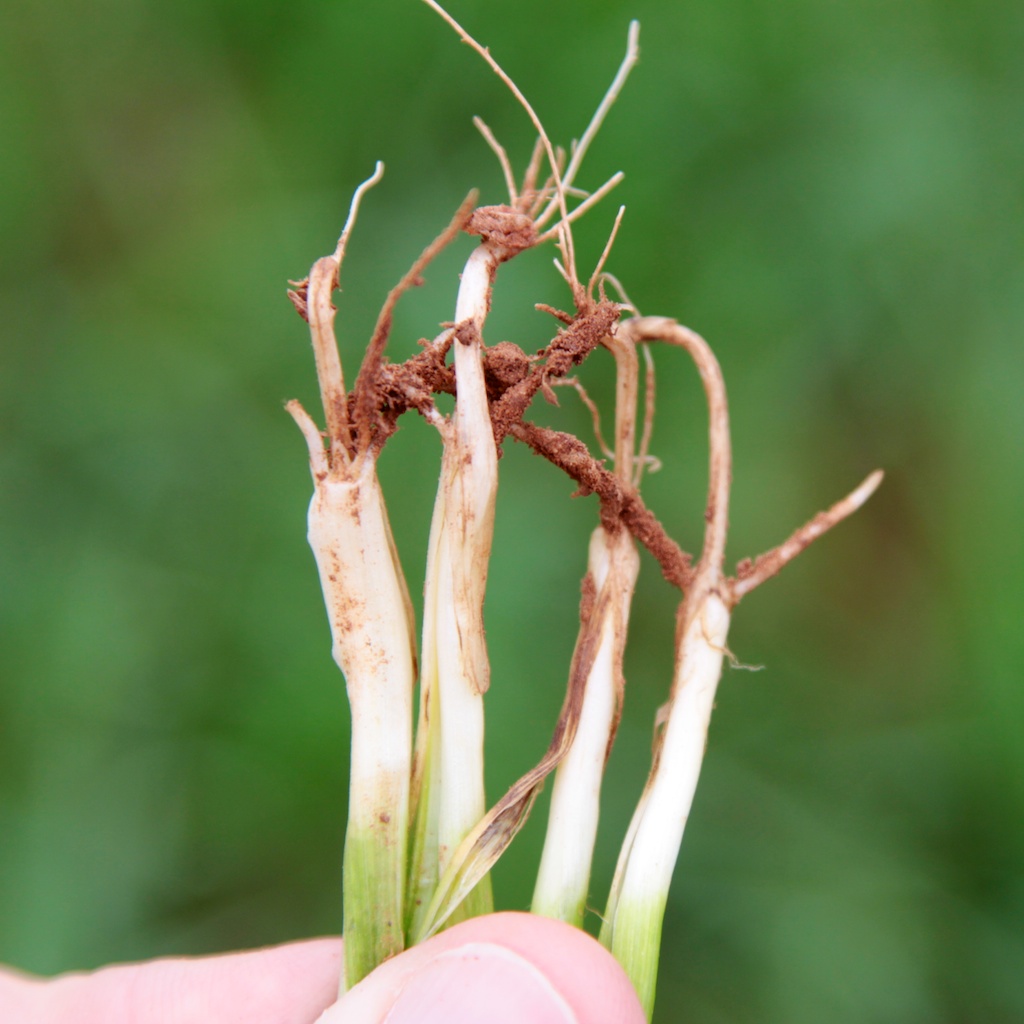
There are a few cattle already on wheat pasture in Oklahoma and more that will be turned out in the coming weeks. An adequate crown root system is required to anchor wheat in place prior to grazing.

Wheat should not be grazed until enough crown roots are present to anchor the plant in the soil

Wheat should not be grazed until enough crown roots are present to anchor the plant in the soil

Without these roots, wheat can be pulled from the soil during grazing, thinning final stands. Aboveground appearances can be deceiving, so it is important to pull plants from the soil to ensure the crown roots are there even if the plants appear large enough for grazing.

It is also important to make preparations for measuring first hollow stem prior to turning cattle out on wheat pasture. Grazing delays plant development; therefore, first hollow stem has to be checked in a nongrazed area. The nongrazed area does not have to be large and can be achieved through a panel exclosure or by simply moving one of the posts for an electric fence in a few feet. The key is to plan for the nongrazed area now so you can measure first hollow stem in February.

Get to know the OSU Wheat Variety Testing Program

It occurred to me the other day that although I have publicized the forage, grain, and quality results from the OSU Wheat Variety Testing Program, I have never really given much effort to publicizing the day to day activities required to produce these results. So, over the next year I hope to write a few blogs to provide a little more insight into the workings of the system.

Location, location, location
Our program will have replicated trials at 23 sites in 2013/2014. These sites cover the state from Afton to Altus and McLoud to Keyes and some sites (e.g. Apache, Lahoma, Chickasha, Goodwell) have multiple trials. The location of trials are decided upon by throwing darts at a map (just kidding). We pick trial locations according to many factors including: visibility, uniformity, production history, local support, and cooperator involvement. Some locations (e.g. Lamont) have been in the system from the start, and others (e.g. McLoud) are fairly new additions. Given the miles between locations and a finite number of planting and harvest days, 23 locations is about the maximum we can handle and still complete operations in a timely fashion.

In addition to the small, replicated plots we organize and distribute ten-pound demonstration bags for County Educators. We typically have about 40 sets of 15 varieties for these ten pound “demo sets”.

OSU wheat variety testing locations cover Oklahoma from Afton to Altus and McLoud to Keyes. The Kingfisher location shown in this picture, also includes Dr. Carver's elite nursery of advanced experimental lines

OSU wheat variety testing locations cover Oklahoma from Afton to Altus and McLoud to Keyes. The Kingfisher location shown in this picture, also includes Dr. Carver’s elite nursery of advanced experimental lines

Who pays for all this?
The bulk of the expense of running the program comes in the form of salary, facilities, and miscellaneous overhead expenses and is largely covered by OSU through state appropriations (i.e. Oklahoma taxpayers). The bulk of the day to day operating expenses, such as seed, fuel, and mileage expenses, are covered through grants from the Oklahoma Wheat Commission and Oklahoma Wheat Research Foundation (i.e. Oklahoma wheat farmers). These two organizations also help with large equipment purchases such as tractors and combines. A relatively new area of support for the program is an entry fee system. The $500 per variety fee helps offset increasing expenses and is generally enough to assist with student labor for the project. We typically employ one or two graduate students and one or two undergraduate workers. Yes, we charge licensees for testing released OSU varieties but do not charge for OSU experimental lines.

Little packets of seed
Once we have determined which varieties will go at each location, we will send seed requests to participating companies. If everything goes well, we will receive seed in late August. We request one bag of most varieties and eight bags of varieties that will be included in the county demonstration packets.

Depending on the location, there are 25 to 45 varieties replicated four to eight times at each site. Each one of these plots starts with an envelope with either 60 (grain only) or 120 (dual purpose) grams of seed (120 grams is approximately 1/4 pound). This creates a total of about 4,000 envelopes that are weighed and packaged by hand each year. Envelopes are sorted according to a plot plan which randomly assigns varieties to locations within the field at each site. The plots plans are all created one at a time in Excel.

Planting five feet at a time
We have two planters. Our conventional planter sows eight six-inch rows and our no-till planter sows seven 7.5-inch rows. Seed is dropped into the distribution cone and released in the five foot alley between replications/blocks. A gear box is used to adjust the length of row over which the seed will be distributed. We work the ground with a small field cultivator at some locations and the producer or station manager works the ground for us at others.

Robert Calhoun and Matt Knori sow the 2013/2014 wheat variety test plots at Alva, OK. Robert is dropping a 60 gram envelope of seed into the cone that will evenly distribute the seed across eight six-inch rows over a distance of 25 ft. The red boxes on the back are for 18-46-0 (DAP). We apply 50 lbs of DAP in furrow at all locations. Photo courtesy Woods County Educator Greg Highfill

Robert Calhoun and Matt Knori sow the 2013/2014 wheat variety test plots at Alva, OK. Robert is dropping a 60 gram envelope of seed into the cone that will evenly distribute the seed across eight six-inch rows over a distance of 25 ft.
The red boxes on the back are for 18-46-0 (DAP). We apply 50 lbs of DAP in furrow at all locations.
Photo courtesy Woods County Educator Greg Highfill


Planting by seeds per acre versus pounds per acre

Should we plant by seeds per acre or pounds per acre? I will certainly not settle this issue in a single blog post, but I will provide ammunition for those in both camps in the discussion below. Before the discussion begins, I must come clean by acknowledging that when I came to Oklahoma ten years ago, I was solidly in the seeds per acre camp. As a crop consultant I spent most of October every year calibrating clients’ drills each time they changed varieties or field conditions changed. I was certainly not willing to entertain the notion that this could have been wasted time. After reading the published research on the subject, however, I have moved to the pounds per acre camp and will probably remain there unless seed prices increase dramatically OR seed quality improves significantly (I will elaborate below).

Why pounds per acre works
The published research on wheat seed size clearly shows that larger seeds produce more vigorous plants which result in more and larger tillers per plant. Additionally, the research indicates that if you sow the same number of seed of both small and large seeds from  the same variety, the large seed will have an approximate 10% better yield potential. While not expressly mentioned in the research, it is reasonable to assume that small seed will produce less fall forage as well. For more reading on this subject consult Kansas Agricultural Experiment Station, Keeping Up With Research numbers 74 (1984) and 101 (1991).

We have established that larger seeds are better on a seed vs. seed basis; however, there are 36% more seeds in a bushel of wheat with 15,000 seeds per pound as compared to a bushel of wheat with 11,000 seeds per pound. So, when sowing by pounds per acre the additional seeds compensate for the smaller seed size and generally results in the same total number of tillers . This compensation effect means that planting by pounds per acre works for a wide range of seed sizes and varieties. This should not be taken as an excuse to plant poor quality seed, as the compensatory effect is not the same if you are sowing shriveled, light, or head-scab damaged seed.

When seeds per acre is a better option
If you are sowing high-quality, large seed, then seeds per acre might be a better option. To get this type of seed usually requires a favorable environment during grain fill, adequate fertility, and a foliar fungicide in-season followed by an aggressive seed cleaning process. I have heard Phil Needham say, and I agree, that 10% seed cleanout is a minimum. Most seed lots require 20 – 40% cleanout to achieve large-seed status. Including a gravity table in the cleaning process will increase seed quality further. The fact of the matter is that most of our wheat seed in the Great Plains simply does not consistently fall into this category. For this reason, if you are sowing  “average” quality seed by seeds per acre, then adjust your seeding rate up accordingly to ensure you are not short on tillers.

Seeds per acre may also a better option if you are managing fertility to manipulate final tiller numbers. In this scenario, farmers will sow a set number of seeds per acre and adjust topdress rate and timing to encourage or discourage tillering to reach a desired number of heads at harvest. You can do the same thing when sowing by pounds per acre, but you will need an accurate stand count shortly after emergence. When used in combination with an accurate tiller count in February, a stand count will allow you to accurately estimate potential heads per acre and adjust accordingly.

Finally, if seed costs rise significantly in the future, a switch to seeds per acre might be justified. No one would suggest planting a $300 bag of corn or cotton seed based on pounds per acre. I don’t know what the wheat seed cost threshold is for switching to seeds per acre but would assume that if we ever reach this point seed quality will increase accordingly, making seeds per acre a better option.

Planting wheat in hot soils

As is usually the case in Oklahoma, we currently have a wide range of soil moisture conditions. Soils in central Oklahoma are generally dry on top, but there is ample soil moisture below. Soils in western Oklahoma and the Panhandle are dry all the way down. A few drills have started rolling, but most producers are waiting on a “State Fair” rain to get started (for all you non-Okies, it usually rains sometime during the State Fair in early September). While moisture availability is the primary driver of wheat planting, it is not the only consideration for producers. Hot soil conditions can affect wheat germination too, and there are a few questions producers should ask themselves prior to planting into soil temperatures >90F.

coleoptile length

If the wheat coleoptile does not break the soil surface, the germinating wheat plant will not survive.

Will you have to plant deep to reach moisture? That first structure protruding from a germinating wheat seed is actually not a leaf. It is the coleoptile. The wheat coleoptile is a rigid structure whose sole purpose is to “punch through” the soil surface so that the first true leaf emerges above the soil surface. If this does not happen, the first true leaf will try to extend below the soil surface, turn yellow, and take on an accordion-like appearance (picture above). Modern semi-dwarf wheat varieties have shorter coleoptiles than older, tall wheat varieties and coleoptile length is shortened even further by hot soil conditions. So it is important to plant a variety with a longer coleoptile length (e.g. Garrison or Doans) if planting deeply into hot soils. A rating of coleoptile lengths for wheat varieties can be found in OSU Fact Sheet 2141 OSU Wheat Variety Comparison Chart available at www.wheat.okstate.edu or at the direct link to the publication here.

Is the variety high temperature germination sensitive? High temperature germination sensitivity is a fancy way of saying that some wheat varieties simply don’t germinate well in hot soil conditions (e.g. 2174, Overley). The extent of the sensitivity varies by year, so Overley might germinate fine in 95F soils one year and produce a 10% stand in the same soil conditions the next. When sowing early, it is best to plant varieties that do not have high temperature germination sensitivity (e.g. Duster, Gallagher, or Armour). Soil conditions generally cool due to lower ambient temperatures or cooling rains by about September 20; however our summer temperatures seem to be arriving late this year, so it is best to know the level of germination sensitivity in the variety you are planting. A rating of high temperature germination sensitivity for wheat varieties can be found in the variety comparison chart linked above. A more detailed explanation of the phenomenon can be found in OSU Fact Sheet PSS 2256 Factors affecting wheat germination and stand establishment in hot soils (available by clicking here).

2013 Wheat variety performance test results posted

All Oklahoma wheat variety test sites are now harvested and the results are posted at www.wheat.okstate.edu. I have posted a brief summary of the 2013 crop below. Over the next several weeks, I will be posting additional trial results on this blog along with opinion and analysis of results.


2013 WHEAT CROP OVERVIEW

At the time of writing this report, 2013 Oklahoma wheat production is estimated to be approximately 114 million bushels, which is roughly 26% less than 2012 production (Table 1).  The production decrease was due to the combination of lower yields and fewer harvested acres. Given the challenges faced in the 2012-2013 wheat production year, however, most would consider the average yield and total production to be much better than expected.


Table 1. Oklahoma wheat production for 2012 and 2013 as estimated by OK NASS, June 2013
 

2012

2013

Harvested Acres

4.3 million

3.8 million

Yield (bu/ac)

36

30

Total bushels

154.8 million

114 million


We have had several dry starts for wheat planting in Oklahoma, but the fall of 2012 might go down as the driest of the dry. A few timely rains in late August and early September allowed early and mid-September sown wheat to emerge and get a rapid start on forage production. This was the last substantial rain that most of western Oklahoma received until early 2013. As a result, much of our October-sown crop remained partially emerged in dry soil until after the first of the year.


Wheat that had emerged in September had consumed available water by early November and turned brown by December. Many fields were assumed dead, as there was no green tissue remaining above the soil surface (e.g. Marshall Dual-Purpose trial). This left little to no grazing potential for many dual-purpose wheat producers. Our Stillwater forage trial, for example, had less than 500 lb/ac (estimated) of available forage in early December, which is our normal forage measurement timing.


Rain was not plentiful in early 2013, but there was enough to allow the wheat crop to rebound. Wheat seed that had been lying in the soil germinated and early-emerging fields that had turned brown from drought were resuscitated and brought back to life. Wheat in southwestern OK and the Panhandle remained on life support throughout the season, surviving but never really thriving. Given these extreme circumstances, the grain yield at our Chattanooga, Altus, and Hooker sites are nothing short of amazing. Although wheat finally emerged at our Alva, Balko, Buffalo, Cherokee, Gage, Keyes, and Lamont sites, the stands were far too variable for use in comparing the yield potential of wheat varieties.


Drought was not the only weather-related issue Oklahoma wheat producers dealt with in 2013. There were multiple rounds of freeze events in late March and early April. Wheat in southwest Oklahoma and the Panhandle was affected by different freeze events but both sustained 30 to 80% tiller loss and were largely written off in the weeks following the freezes. Outside of far southwestern OK, cooler than normal conditions and some replenishment of soil moisture allowed regeneration of tillers. This, along with extended grainfill duration, allowed many wheat fields to recover and produce greater than expected grain yields (e.g. Apache variety trial). The cooler than normal spring temperatures were beneficial for wheat grainfill, but also delayed harvest by about one month as compared to 2012 and about two weeks as compared to the long term average.


It was a fairly quiet year regarding foliar disease. Pockets of the state suffered from heavy powdery mildew infestation in March and April, and some wheat producers chose to split-apply fungicides to combat this disease. There were also areas affected by glume blotch, tan spot, and septoria, but there was not much leaf or stripe rust present.


Yellow and purple leaves were tell tale signs that a late spring flush of aphids had transmitted barley yellow dwarf virus to several Oklahoma wheat fields. Armyworms were present late in the season, but generally did not reach threshold levels prior to maturity and few fields were sprayed. Winter grain mites took advantage of slow-growing, drought-stressed wheat and were a frequently reported problem in southwest OK, but the wheat curl mite takes top billing among mite pests in 2013. The wheat curl mite transmits wheat streak mosaic and high plains viruses. These two diseases are fairly common in the Panhandle but do not typically affect wheat in central OK. In 2013 fields as far east as Kingfisher tested positive for wheat streak mosaic and several central OK fields were affected. Growers affected by wheat streak mosaic should take care to ensure that any volunteer wheat or corn is dead at least two weeks prior to planting to reduce the risk of this disease in 2013-2014.


Wheat better than expected at Chattanooga, Kingfisher, and Chickasha

Chattanooga, Kingfisher, and Chickasha wheat variety trial results are posted at www.wheat.okstate.edu.  Grain yields at Chattanooga ranged from 12 to 36 bushels per acre. It is truly amazing that wheat somehow managed to produce these yields this in the presence of severe drought and three major freezes. Kingfisher wheat grain yields ranged from 32 to 47 bushels per acre and were more or less on par with expectations. This site had less than ideal moisture conditions, but adequate moisture to keep the wheat from turning brown as it did in many locations.

The Chickasha wheat variety trial had some problems. A late March freeze killed up to 58% of viable tillers in some varieties and lodging at harvest was moderate to severe. While leaf rust and stripe rust were not major factors, we did have a variety of leaf spotting diseases (e.g. tan spot, septoria, glum blotch) and severe, widespread bacterial blight/black chaff throughout the plot. In spite of these challenges, average yield at this site was 69 bushels per acre with yields ranging from 50 to 83 bushels per acre. While these yields are outstanding given the challenges of the year, they are not the best at the Chickasha research station. Approximately 200 feet from the variety trial was a growth regulator study planted to Iba that produced 98 to 102 bushels per acre. I have this same trial at two additional locations and will summarize results later in the year.

Both small plot combines running at Chickasha

Both small plot combines running at Chickasha

Wheat disease update 18 May 2013

Wheat disease updates are written by Dr. Bob Hunger, OSU Extension Plant Pathologist

Oklahoma:

Wheat in southern/southwestern Oklahoma is maturing and will speed up with the warmer (>90 F) over the last couple of days.  In central Oklahoma, around Stillwater and to the north, wheat is just finishing or has just past flowering and kernel development is starting.  As you head to northwest Oklahoma, wheat also is in late flowering or has just finished flowering.  I’m not sure about out toward the panhandle but know there is not much wheat that will be harvested as you move west of Woodward and Buffalo.  I’ll be taking a trip to the panhandle the end of the coming week and will report more after that trip.

Disease-wise, not a lot changed over the past week in Oklahoma.  Leaf rust remained practically absent although infections in the 15-40S range were observed in Jagalene (or Jagger) guard rows in breeder plots at Stillwater.  However, little to no leaf rust was found elsewhere around Stillwater and no reports were observed or reported from north-central and northwestern Oklahoma.  Stripe rust is slight more prevalent.  Several “hot spots” were noted around trials at Stillwater and occasional “stripes” (but not hot spots) were noted at field days west of Enid, north of Ponca City, and north of Stillwater.  Leaf spotting diseases, barley yellow dwarf, and wheat streak mosaic (WSM) are the most commonly observed diseases in samples seen at field days and submitted to the Plant Disease and Insect Diagnostic Clinic.  This past week a few samples also tested positive for High plains virus.  Several reports from ag educators, consultants, and growers have indicated that WSM has devastated wheat in fields in northern and western Oklahoma.  In all cases where I talked to the person, there was an indication that volunteer wheat was involved either in the field or adjacent to it.

Reports/excerpts of reports from other states:

Arkansas – Dr. Gene Milus, (Professor/Small Grains Pathologist, Univ of Arkansas, Fayetteville, AR) 17-May-2013:  Visited plots at Kibler near Fort Smith today. Wheat is in soft dough. Stripe rust is still active. Leaf rust was present at mostly low levels. Also Septoria, bacterial streak, powdery mildew, and Stagonospora on flag leaves depending on the line. Most lines in the variety test had resistance to most or all of the above diseases. Weather is hot and humid. Plenty of soil moisture.

Kansas – Dr. Erick De Wolf (Professor/Small Grains Extension Pathologist, Kansas State Univ, Manhattan, KS) 17-May-2013:  Stripe rust continues to be reported at low levels in Kansas this week with new finds in Sedgwick, Kingman, Sumner, and Pratt counties. The wheat in this area of the state is still heading or flowering. Generally, only trace levels could be found in these fields.  Tom Maxwell, Central Kansas District agent, reported finding low levels of stripe rust in Saline County on May 17. The wheat there is generally in the early heading stages.  I have found a few fields and a demonstration plot in Pratt County where the disease is at high enough levels to justify a fungicide application. This area of the state has received more rain than others in recent weeks and some fields in Pratt County have good yield potential. The affected varieties included Everest and Armour, which were found to be susceptible in 2012. A lot of wheat in this area of the state is struggling with continued dry weather.

I encourage farmers to carefully check fields for symptoms of disease. Fields where stripe rust can be readily found on the flag leaf (one lesion every 2-3 feet) will likely benefit from a fungicide application. The wild card on this decision is the weather.  Low temperatures in the upper 60’s are generally thought to be suppressive to stripe rust development. High temperatures in the upper 80’s or above for several days in a row also tend to suppress stripe rust. But if temperatures in that range last only last a few days or so, followed by cooler weather, stripe rust can resume activity.

Wheat disease update 11 May 2013

Wheat disease updates are written by Dr. Bob Hunger, OSU Extension Plant Pathologist

Oklahoma:  As you move from southern to northern/northwestern Oklahoma, wheat ranges from past flowering to flowering to heads emerging/approaching flowering (depending on variety and planting/emergence date).  It is highly variable.  Weather continues to be cool and moist except in southern, western and northwestern Oklahoma where it continues to be dry.

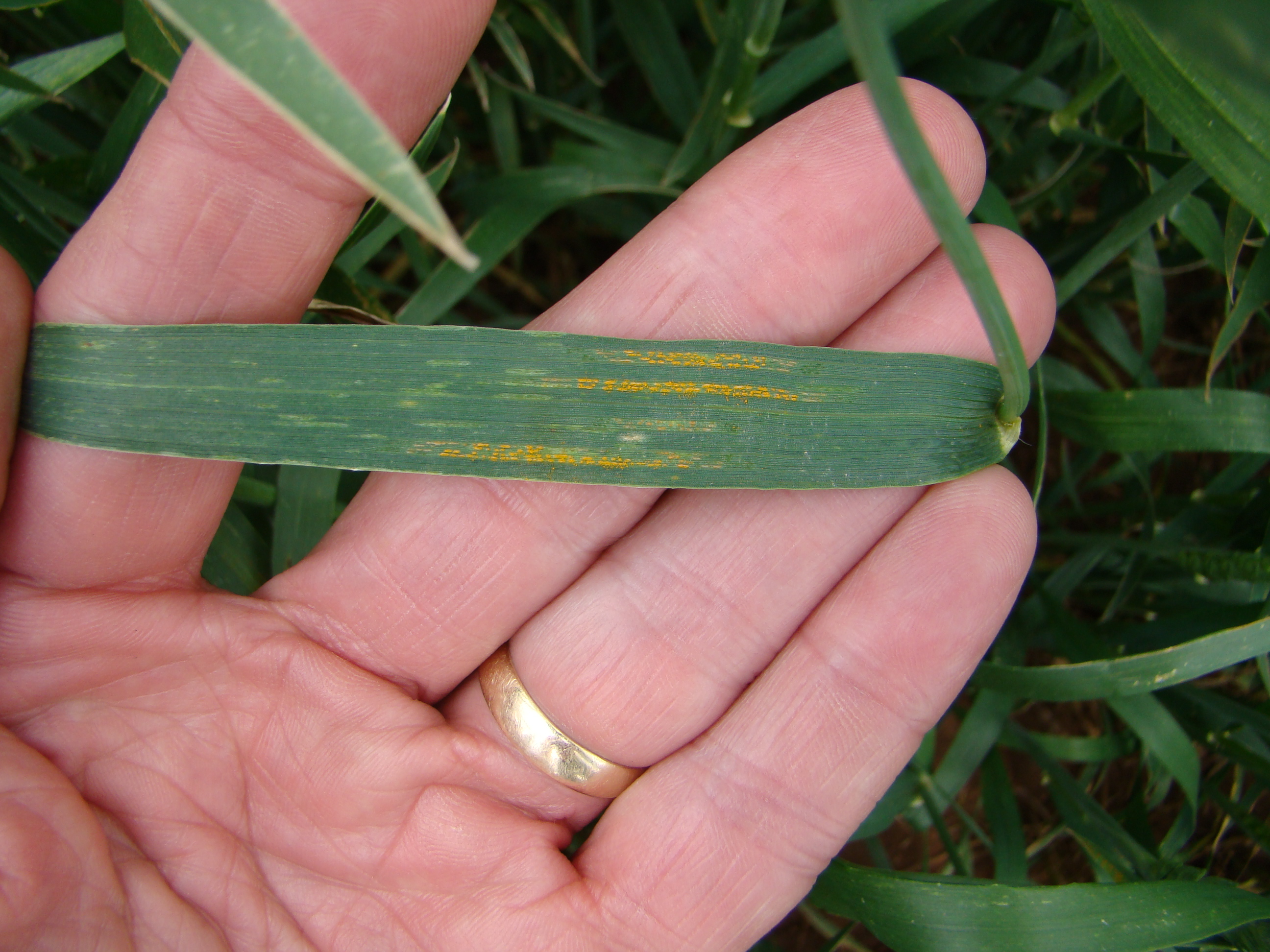
There were no reports of leaf rust over the last week in Oklahoma, but reports of stripe rust increased.  However, none of these stripe rust sightings indicated a widespread, severe outbreak anywhere in the state.  Bryan Vincent (Crop Consultant – northern Oklahoma) reported seeing strip rust on Everest wheat just west of Orienta, OK (about 40 miles west of Enid).  Dr. Brett Carver (OSU Wheat Breeder) reported in his visit early in the week to his breeder nursery at Lahoma (north central OK – 10 miles west of Enid), that, “35 swipes, just one 1″ sporulating Yr lesion at Lahoma, f-3. Otherwise nothing. Will keep looking.”  On Friday (10-May) at the Lahoma field day in the variety trial, I found an occasional active stripe in expected varieties (Pete, Garrison, Iba, Everest, and Armour), but these stripes were rare – only one or two per plot.  However, our weather over the last couple weeks and the near forecast is for weather favorable for stripe and leaf rust, so we may begin to see more of these rust diseases.  Powdery mildew continues to be found but I have not seen it yet on flag leaves or even F-1 leaves.  Leaf spotting diseases (tan spot, septoria, stagonospora) are more severe in Oklahoma than typical but vary by location.  For example, Dr. Jeff Edwards (OSU Smalll Grains Extension Agronomist) indicated that at his variety trial at Chickasha, leaf spotting was widespread, severe, and was on the flag leaves of specific varieties in the trial.

Regarding viruses – barley yellow dwarf is commonly observed at all locations, but is not associated with severe stunting indicating a later infection.  Numerous reports have been received and many samples have now tested positive for wheat streak mosaic virus from many areas of Oklahoma.  None of these samples have tested positive for either High plains virus or Triticum mosaic virus.

Reports/excerpts of reports from other states:

Arkansas – Dr. Gene Milus, (Professor/Small Grains Pathologist, Univ of Arkansas, Fayetteville, AR) 10-May-2013:  Most wheat has flowered or is flowering now. I found a low level of leaf rust at Rohwer in the southeast corner, and this is the first confirmed leaf rust here. Stripe rust is still active. Bacterial streak showed up on several varieties in the variety test. Leaf blotch is moving up the plants. There is abundant soil moisture across most of the state.

Kansas – Dr. Erick De Wolf (Professor/Small Grains Extension Pathologist, Kansas State Univ, Manhattan, KS) 11-May-2013:  The wheat is heading and flowering in southeastern and south central Kansas this week.  Wheat in central Kansas is mostly in the boot stages of development with the most advanced fields beginning to head this weekend. The wheat in southwestern KS continues to struggle with drought and freeze damage and growth stage varies widely among fields.

Disease scouting this week suggests the risk of severe rust epidemics remains low in Kansas this year.  I had a few more reports of trace levels of stripe rust in southeastern KS where the wheat is flowering. The levels of stripe rust are very low at this time.  Temperatures are forecast to reach the upper 80’s early next week with low temps at or above 60 F. Temperatures in this range often slow the development of stripe rust but farmers in this areas should monitor the disease carefully.

I was able to find a single pustule of leaf rust in Stafford county Kansas this week, but the wheat at this location was thin from recent dry conditions.  I suspect the leaf rust will not increase rapidly at this location.  Other fields that I checked in southwest KS (Finney and Kiowa counties) show significant drought stress and no sign of rust.  In south central and central Kansas (Pratt, Reno, and McPherson counties), the wheat is in better condition with thick canopies and good moisture recently.  I found no leaf rust, stripe rust or stem rust in these areas; however, several fields had moderate levels of powdery mildew. Symptoms of barley yellow dwarf remain low or absent in all fields I have check to date.

Stripe rust on wheat at Lahoma
Stripe rust on wheat at Lahoma

Wheat disease update 26 April 2013

Wheat disease updates are written by Dr. Bob Hunger, OSU Extension Wheat Pathologist

Oklahoma:  Reports of stripe rust were more common from Oklahoma this past week.  Yesterday (25-Apr) I and Nathalia Grachet (OSU graduate student) looked at wheat in central Oklahoma to the southwest, west, and northwest of Oklahoma City (OKC).  Wheat in this area was variable, but mostly around GS 10 (boot stage) to heads just emerging.  Fields where freeze damage occurred showed a wide range of tiller maturity.

Fields around Apache, OK (about 75 miles southwest of OKC) including the variety trial showed light powdery mildew and leaf spotting (tan spot/septoria/stagonospora) with stripe rust found in one field located about 10 miles west of Apache – not severe but the incidence was spread across the field (variety unknown).  On our return trip to Stillwater, we found stripe rust on lower to mid leaves in the variety demo at Minco (about 25 miles southwest of OKC) with the most severe rust on Duster (photo below).  Powdery mildew was severe on lower leaves of the wheat in the field surrounding the variety demo.  No rust was observed at the variety trial at Kingfisher (about 30 miles northwest of OKC), and no leaf rust was found at any stop.  Although not severe, stripe rust also was observed this past week around Stillwater/Perkins by Dr. Art Klatt (OSU wheat geneticist/breeder) and by Mark Gregory (OSU Southwest Extension Agronomist) in the variety trial near Chickasha (30 miles southwest of OKC).   Dr. Klatt also reported severe powdery mildew in his plots near Perkins.  Symptoms indicative of barley yellow dwarf are common around Stillwater and on the trip yesterday, however, freeze damage symptoms make it difficult to comfortably identify BYD without confirmation in the lab.

Stripe rust on Duster near Apache OK on 25 April 2013

Stripe rust on Duster near Apache OK on 25 April 2013

Insecticide-resistant greenbugs in TX Panhandle

By Tom Royer, OSU Extension Entomologist

I received some troubling news from the Texas Panhandle.  Dr. Ed Bynum, Extension Entomologist from Amarillo, reported finding some greenbug populations that were shown to be resistant to chlorpyrifos, the active ingredient in Lorsban 4E, and other generic products (Govern 4E, Hatchet, Nufos, Vulcan, Warhawk, Whirlwind).   You can read the full article by clicking on this url: http://texashighplainsinsects.net/april-12th-special-edition/  The bottom line:  he tested some suspect greenbug populations using a diagnostic test that he developed for testing greenbugs in sorghum in the 1990’s, and found that they were resistant to chlorpyrifos at labeled rates.

Greenbugs on wheat

Greenbugs on wheat

This should not raise panic among growers in Oklahoma for two reasons.  The first is that I have not heard of or received reports of any control failures for greenbugs in Oklahoma, in fact, generally greenbugs have been pretty scarce this winter.

The second reason is that it is late enough in the growing season to expect that the primary natural control of greenbugs, a tiny wasp called Lysiphlebus testaceipes (see picture to right), keeping greenbug numbers from becoming an outbreak.

Natural predators can keep greenbug infestations below economic thresholds

Natural predators can keep greenbug infestations below economic thresholds

The best course of action is to sample winter wheat fields with the Glance ‘n Go system.

Start by going to the Cereal Aphids Decision Support Tool on your computer http://entoplp.okstate.edu/gbweb/index3.htm and selecting the Greenbug Calculator.

By answering a few simple questions, you can determine an economic threshold for controlling greenbugs.  This threshold is based on the estimated cost of treating the field and the estimated price of wheat.  Once a threshold is calculated, you can print a Glance ‘n Go scouting form, take it to a field and record your sampling results.  The form will help you to decide if the field needs to be treatment for greenbugs.  There are several things that make Glance ‘n Go a good way to make such a decision. You only have to “Glance” at a tiller to see if it has greenbugs (no counting greenbug numbers).  You can make a decision to treat “on the Go” because you stop sampling once a decision is reached (no set number of samples).  Finally, you can account for the activity of the greenbug’s most important natural enemy, Lysiphlebus testaceipes.

Aphid Mummies (below)

When scouting with the Glance ‘n Go system, keep a running count of tillers that have aphid mummies and a running count of tillers that are infested with one or more greenbugs.  After each set of 5 stops, the Glance ‘n Go form directs you to look at your total number of infested tillers and tillers with mummies.  If there is enough parasitoid (mummy) activity, you will be directed to stop sampling and DON’T TREAT, even if you have exceeded the treatment threshold for greenbugs!  Why? Because research showed that at that level of parasitism, almost all of the healthy-looking greenbugs have been “sentenced to death” and will be ghosts within 3-5 days.  If they have received their “sentence” you can save the cost of an unnecessary insecticide application.

Treatment thresholds will probably fall around 2-4 greenbugs per tiller, but make sure you are using the Spring (January-May) form, not the Fall (Sept-December) form.  If a field needs to be treated, check with Current Report CR-7194, “Management of Insect and Mite Pests in Small Grains”.  If you treat for greenbugs and have a failure, please contact our Department and we will investigate further to determine