Bacterial streak found in Oklahoma

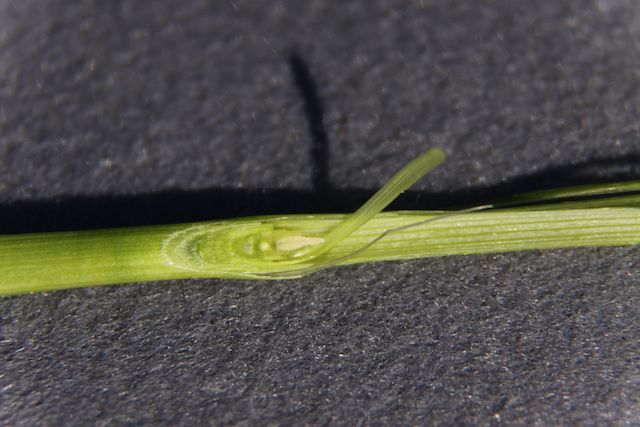
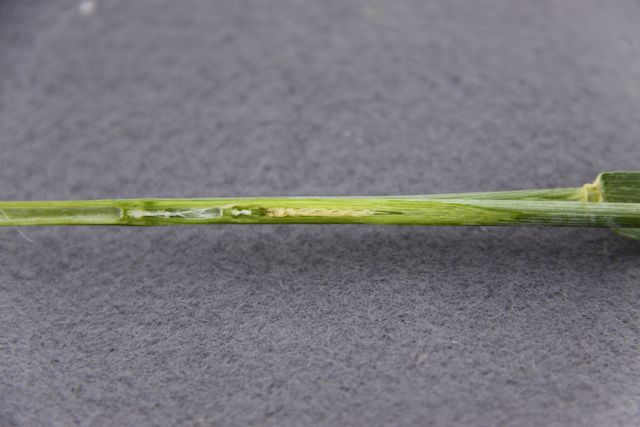
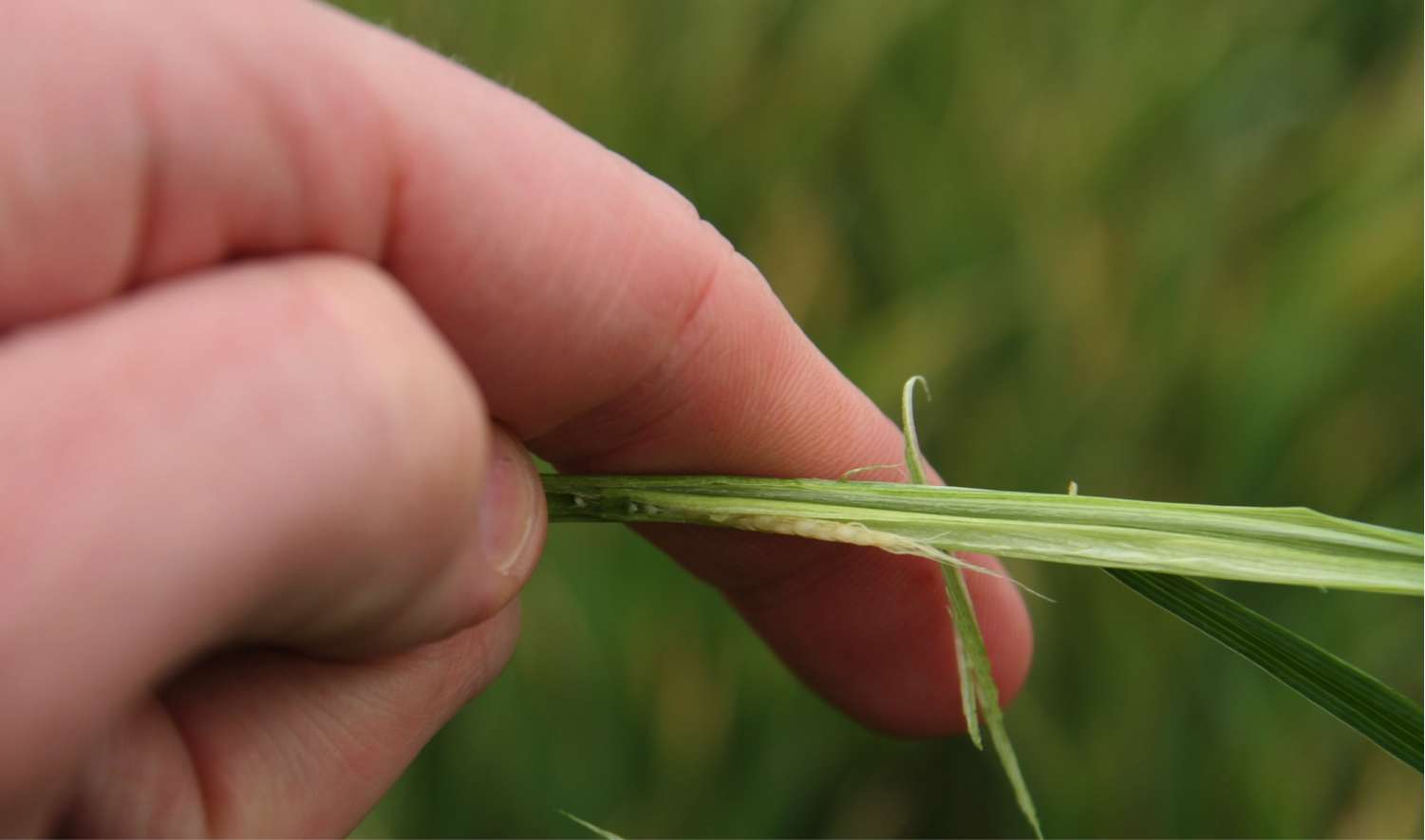
Widespread leaf spotting symptoms in wheat in the variety trial near Chickasha, OK (40 miles southeast of Oklahoma City) now is believed to be caused by bacterial streak (aka black chaff – see pictures below).  Bacterial streak/black chaff is occasionally observed in Oklahoma but typically is not widespread or severe.  This disease is more severe in warm (80 F or so) and humid climates or in wheat grown under irrigation, and often appears after an event such as a late freeze or other event that can cause wounds to facilitate entrance of bacteria into plants.  Lesions on leaves initially appear water-soaked but become elongated dead bands and streaks as time proceeds.

Bacterial streak lesions on leaves initially appear water-soaked but become elongated dead bands and streaks as time proceeds.

Bacterial streak lesions on leaves initially appear water-soaked but become elongated dead bands and streaks as time proceeds.

These dead areas tend to be more common on leaf “bends” where dew forms to enhance infection.  Symptoms on heads and on the stem immediately under the head include dark discoloration, and awns typically show a dark banding.These symptoms often can be confused with leaf spotting caused by the fungi Septoria (Septoria tritici blotch) or Stagonospora (Stagonospora nodorum blotch).

Symptoms on heads and on the stem immediately under the head include dark discoloration

Symptoms on heads and on the stem immediately under the head include dark discoloration

Bacterial streak/black chaff is seed transmitted, so grain from a badly infected field should not be kept for seed wheat.  There are no commercial seed treatments available, and although varieties vary in reaction to this disease, no resistant varieties are known in Oklahoma where bacterial streak/black chaff is not commonly widespread.  This disease may be occurring in other parts of Oklahoma this year, but will be difficult to discern from all the other factors that contribute to general browning and leaf spotting including other diseases (tan spot, septoria, etc), freeze, and drought.

Bob Hunger
Extension Plant Pathologist

Jeff Edwards
Small Grains Extension Specialist

Awns affected by bacterial streak/black chaff typically show a dark banding

Awns affected by bacterial streak/black chaff typically show a dark banding

Wheat disease update 18 May 2013

Wheat disease updates are written by Dr. Bob Hunger, OSU Extension Plant Pathologist

Oklahoma:

Wheat in southern/southwestern Oklahoma is maturing and will speed up with the warmer (>90 F) over the last couple of days.  In central Oklahoma, around Stillwater and to the north, wheat is just finishing or has just past flowering and kernel development is starting.  As you head to northwest Oklahoma, wheat also is in late flowering or has just finished flowering.  I’m not sure about out toward the panhandle but know there is not much wheat that will be harvested as you move west of Woodward and Buffalo.  I’ll be taking a trip to the panhandle the end of the coming week and will report more after that trip.

Disease-wise, not a lot changed over the past week in Oklahoma.  Leaf rust remained practically absent although infections in the 15-40S range were observed in Jagalene (or Jagger) guard rows in breeder plots at Stillwater.  However, little to no leaf rust was found elsewhere around Stillwater and no reports were observed or reported from north-central and northwestern Oklahoma.  Stripe rust is slight more prevalent.  Several “hot spots” were noted around trials at Stillwater and occasional “stripes” (but not hot spots) were noted at field days west of Enid, north of Ponca City, and north of Stillwater.  Leaf spotting diseases, barley yellow dwarf, and wheat streak mosaic (WSM) are the most commonly observed diseases in samples seen at field days and submitted to the Plant Disease and Insect Diagnostic Clinic.  This past week a few samples also tested positive for High plains virus.  Several reports from ag educators, consultants, and growers have indicated that WSM has devastated wheat in fields in northern and western Oklahoma.  In all cases where I talked to the person, there was an indication that volunteer wheat was involved either in the field or adjacent to it.

Reports/excerpts of reports from other states:

Arkansas – Dr. Gene Milus, (Professor/Small Grains Pathologist, Univ of Arkansas, Fayetteville, AR) 17-May-2013:  Visited plots at Kibler near Fort Smith today. Wheat is in soft dough. Stripe rust is still active. Leaf rust was present at mostly low levels. Also Septoria, bacterial streak, powdery mildew, and Stagonospora on flag leaves depending on the line. Most lines in the variety test had resistance to most or all of the above diseases. Weather is hot and humid. Plenty of soil moisture.

Kansas – Dr. Erick De Wolf (Professor/Small Grains Extension Pathologist, Kansas State Univ, Manhattan, KS) 17-May-2013:  Stripe rust continues to be reported at low levels in Kansas this week with new finds in Sedgwick, Kingman, Sumner, and Pratt counties. The wheat in this area of the state is still heading or flowering. Generally, only trace levels could be found in these fields.  Tom Maxwell, Central Kansas District agent, reported finding low levels of stripe rust in Saline County on May 17. The wheat there is generally in the early heading stages.  I have found a few fields and a demonstration plot in Pratt County where the disease is at high enough levels to justify a fungicide application. This area of the state has received more rain than others in recent weeks and some fields in Pratt County have good yield potential. The affected varieties included Everest and Armour, which were found to be susceptible in 2012. A lot of wheat in this area of the state is struggling with continued dry weather.

I encourage farmers to carefully check fields for symptoms of disease. Fields where stripe rust can be readily found on the flag leaf (one lesion every 2-3 feet) will likely benefit from a fungicide application. The wild card on this decision is the weather.  Low temperatures in the upper 60’s are generally thought to be suppressive to stripe rust development. High temperatures in the upper 80’s or above for several days in a row also tend to suppress stripe rust. But if temperatures in that range last only last a few days or so, followed by cooler weather, stripe rust can resume activity.

Wheat disease update 26 April 2013

Wheat disease updates are written by Dr. Bob Hunger, OSU Extension Wheat Pathologist

Oklahoma:  Reports of stripe rust were more common from Oklahoma this past week.  Yesterday (25-Apr) I and Nathalia Grachet (OSU graduate student) looked at wheat in central Oklahoma to the southwest, west, and northwest of Oklahoma City (OKC).  Wheat in this area was variable, but mostly around GS 10 (boot stage) to heads just emerging.  Fields where freeze damage occurred showed a wide range of tiller maturity.

Fields around Apache, OK (about 75 miles southwest of OKC) including the variety trial showed light powdery mildew and leaf spotting (tan spot/septoria/stagonospora) with stripe rust found in one field located about 10 miles west of Apache – not severe but the incidence was spread across the field (variety unknown).  On our return trip to Stillwater, we found stripe rust on lower to mid leaves in the variety demo at Minco (about 25 miles southwest of OKC) with the most severe rust on Duster (photo below).  Powdery mildew was severe on lower leaves of the wheat in the field surrounding the variety demo.  No rust was observed at the variety trial at Kingfisher (about 30 miles northwest of OKC), and no leaf rust was found at any stop.  Although not severe, stripe rust also was observed this past week around Stillwater/Perkins by Dr. Art Klatt (OSU wheat geneticist/breeder) and by Mark Gregory (OSU Southwest Extension Agronomist) in the variety trial near Chickasha (30 miles southwest of OKC).   Dr. Klatt also reported severe powdery mildew in his plots near Perkins.  Symptoms indicative of barley yellow dwarf are common around Stillwater and on the trip yesterday, however, freeze damage symptoms make it difficult to comfortably identify BYD without confirmation in the lab.

Stripe rust on Duster near Apache OK on 25 April 2013

Stripe rust on Duster near Apache OK on 25 April 2013

Freeze injury update – worse than we thought

On April 4th I toured southwest Oklahoma and surveyed freeze injury to wheat. In my experience, most freeze events are overhyped; however, this one was the real deal Holyfield.  I traveled a route from Faxon to Chattanooga to Altus to Blair and ended up at Apache. Damage was similar at all sites, with injury ranging from 50 to 80%.

The best looking wheat was the hardest hit. Particularly troubling are some fields in the Altus area that easily had 80 bushel potential prior to the freeze. In most of these fields we are too far past the tillering stage to have yield compensation from secondary tillers. Late-emerging fields that were jointing or smaller escaped the freeze with little injury. Fields that had been heavily grazed and/or under-fertilized also escaped with relatively minor injury.  Conditions improved slightly when I checked wheat in the Chickasha area and injury was more in the 10 – 30% range.

I am frequently asked if the injured wheat head will go ahead and “push through” as the season progresses, and the answer is no. So, if you see heads emerging out of the boot in a few weeks, they are likely not damaged and a head count at this stage will be a reasonable estimate of fertile heads. Since there will not be additional stem elongation in freeze injured wheat, it will not accumulate as much tonnage as in a ‘normal’ year.

I have posted a few pictures below showing freeze injury symptoms. Freeze injury can vary greatly among fields and even within a field. So, it is important to check several sites within a field and split several stems when determining the percent injury. Check early maturing varieties such as Jackpot, Billings, and Everest first, as they are most likely to have injury.

Image

Endurance wheat collected from plots at Chattanooga, OK. The two top heads are freeze damaged and will not recover. Note the shriveled, white appearance of the wheat head. The bottom head was not injured and is healthy green.

A healthy head of Endurance  from Apache, OK.

A healthy head of Endurance from Apache, OK.

Even though this wheat was just past jointing, it was injured by the freeze and the head was lost.

Even though this wheat was just past jointing, it was injured by the freeze and the head was lost.

Freeze injured Billings from the Altus research station

Freeze injured Billings from the Altus research station

A sign of the drought. Wheat seed still easy to find on a sample from near Altus, OK April 4.

A sign of the drought. Wheat seed still easy to find on a sample from near Altus, OK April 4.

Freeze injury to wheat

Temperatures across Oklahoma dipped into the teens and 20’s March 25 and 26 (see maps below). The rule of thumb is temperatures below 24F will damage wheat at or past the jointing stage, so it was certainly cold enough to injure wheat that was not delayed due to drought stress, grazing, or late emergence.  ImageImage

Freeze injury is not an exact science, and it remains to be seen whether or not we actually have widespread wheat freeze injury in the 2013 wheat crop.  My best guess is that we will have some injury and might lose our primary tillers in more advanced fields. Wheat that is at Feekes growth stage 6 – 7 generally has the ability to compensate for primary tiller loss by keeping secondary tillers that would otherwise be sloughed off in April. In this scenario, the effect on final grain yield would be minimal. Wheat that has already aborted secondary tillers does not have this flex ability and will not recover from freeze injury.  This is why March freezes are generally yield reducing and April freezes are yield eliminating. I will check fields late next week and post the results on this blog.

Freeze injury is not clearly identifiable until 7 – 10 days after the freeze event. So, the best advice for a wheat farmer after a freeze event is to find something else to do for a week or two and then check your crop. I have provided some pictures below with typical injury symptoms and rules of thumb regarding the extent of the injury. Fields should be checked at several random locations by splitting 10 – 20 stems at each location and looking for injury. Don’t focus solely on the large stems. Split a random sampling and determine the percent damage. A good reference for evaluating freeze injury to wheat is K-State Extension Publication C-646 Spring Freeze Injury to Kansas Wheat (access online by clicking here).

This is a healthy wheat head at approximately growth stage 6 - 7. Note the light green color and healthy, turgid appearance.

This is a healthy wheat head at approximately growth stage 6 – 7. Note the light green color and healthy, turgid appearance.

Freeze injury just after jointing. Note the pale, milky color of the head.

Freeze injury just after jointing. Note the pale, milky color of the head. Freeze injury to wheat heads at this growth stage is all or none, so this head is a complete loss.

Leaf tip burn from freeze injury will have no impact on final grain yield

Leaf tip burn from freeze injury will have no impact on final grain yield

Yellowing is a common reaction to light freeze injury. Wheat will recover quickly from this injury.

Yellowing is a common reaction to light freeze injury. Wheat will recover quickly from this injury.

Severe freeze injury at or just after jointing can turn the entire plant brown and fields can exude an odor similar to fermenting silage. If conditions are favorable, the plant can produce new tillers (as shown here) and make a partial recovery. It will take a few weeks after a freeze event to determine if the plant will recover from this type of injury

Severe freeze injury at or just after jointing can turn the entire plant brown and fields can exude an odor similar to fermenting silage. If conditions are favorable, the plant can produce new tillers (as shown here) and make a partial recovery. It will take a few weeks after a freeze event to determine if the plant will recover from this type of injury

It is common for sub-lethal freeze injury to result in bent or weak lower nodes. These plants might look fine, but will lodge during grain fill.

It is common for sub-lethal freeze injury to result in bent or weak lower nodes. These plants might look fine, but will lodge during grain fill.

Spring-planted oat for forage

Spring-planted oat has been a “go to” forage crop for southern Great Plains beef producers for years. It is a good option when winter wheat was not planted in the fall due to wet conditions, or, as is the case this year, when wheat failed to emerge due to drought. Forage production potential for spring-planted oat is around 1,500 to 2,00 lb/ac, but you will need about 60 – 75 lb/ac of nitrogen to make this type of yield. Dr. Daren Redfearn has written a fact sheet detailing spring oat production for hay and it can be found at www.wheat.okstate.edu under “wheat management” then “seeding”. I will provide the Cliff’s Notes version below.

Seed — Plant 80 – 100 lb/ac of good quality seed that has a germination of no less than 85%. There aren’t many options regarding varieties, so you will likely be limited to whatever seed is available in your area. The key is not to cut back on seeding rate, regardless of variety.

Seedbed — Sow oat seed at approximately 1/2 to 3/4 inches deep. Most producers will fare better with a conventionally-tilled seedbed. You are planting seed at a time of year when the ground is already marginal regarding temperature. Conventionally-tilled seedbeds warm more quickly, which should speed germination. There is one exception to the conventional till recommendation. If you are sowing into a stale seedbed or a failed wheat crop that is very thin, no-till should be okay. Just avoid situations where excessive residue will keep the soil cold.

Grazing — Oat plants should have a minimum of six inches of growth prior to grazing. Unlike fall-seeded cereals, you should not expect a large amount of tillering. Dr. Redfearn indicates a good stand of spring oat can provide a 750 lb animal approximately 60 days of grazing when stocked at 1.5 animals per acre

Hay — Oat should be cut for hay at early heading.

Too little, too late?

It finally rained! Rainfall totals in western Oklahoma (0.1 to 0.3 inches) will not put a dent in the drought, but were probably enough to induce germination of seed resting in dry soil. Oklahoma weather is extremely variable, and who knows when temperatures will warm enough to spur along the germination process. If we retain the recent moisture and have something close to a “normal” year, it is likely that we will see wheat popping through the soil in mid February. I compared February sown winter wheat to spring wheat in a trial at Newkirk, OK a few years ago. The winter wheat made about 15 bu/ac and the spring wheat made about 20 bu/ac. This was in a favorable year that was not plagued by drought. Given current weather trends, a best case scenario for February emerging winter wheat is 50% of normal yield. A worst case scenario is 0 – 10% of normal yield. If I were wagering, I would place my money on 20 – 30% of normal yield potential.

The rainfall might be enough to help emerged wheat west of I-35 survive, but that is about it. Soil moisture is still insufficient to produce a recovery and I would still proceed cautiously regarding inputs on these acres. The rain might have indeed been too little, too late for these acres. IF soil moisture gets recharged by mid February and IF we have a mild spring these acres could have some secondary tillering and make a moderate recovery; however, the odds are against this scenario.rainrfc.48hr

How dry is it?

It was too nice of a day to stay in the office yesterday, so I checked on our wheat variety plots. I started at McLoud, moved west to Kingfisher, and ended up at Marshall. As indicated by the pictures and captions below, neither the wheat nor my mood improved as I traveled west. I am sure if I had traveled farther west, this would have gotten worse. The bottom line is that we are in desperate need of moisture in Oklahoma. Early-sown wheat is backpedaling quickly and cannot hold on too much longer. Much of the later sown wheat has yet to emerge. We are certainly not on our way to a record year, but everything could still turn out okay……..if it rains.