Wheat disease update – 10 February 2016

Wheat disease updates are written by Dr. Bob Hunger, OSU Extension Plant Pathologist

Since my last report, I don’t believe a lot has changed with the disease situation.  Similar to what I indicated in mid-December, I have continued to find small pustules of powdery mildew and a few scattered leaf rust pustules in rank wheat around Stillwater.  The temperature and weather has been such that these two foliar diseases (powdery mildew and leaf rust) have been able to persist but have not increased in the wheat around Stillwater.  This seems to be the case for southwestern and south central OK as well.

Gary Strickland (Extn Educator & SWREC Dry-land Cropping Systems Specialist; Jackson/Greer Cnty in SW OK) indicated wheat in SW OK is quite a ways behind the rest of the state and mostly is just now establishing a solid root system.  He had sent us a sample last week in which he expected a root rot to be involved, but we were not able to confirm any root rot pathogens.  Gary also indicated that he has confirmed Hessian fly at damaging levels in at least a few fields in Jackson Cnty.  He is going out in the next few days to scout additional fields.  Aaron Henson (Extn Educator; Tillman Cnty in southern OK) indicated wheat in his area varies from quite small to well-established with the majority of the wheat not yet jointing.  He is aware of the earlier reports of scattered stripe rust showing in south-central OK, but has not heard anything to indicate increase in incidence or severity.  For additional information regarding early season foliar wheat diseases and possible control with an early fungicide application please see:

Also around Stillwater, I am beginning to see symptoms indicative of wheat soil-borne mosaic/wheat spindle streak mosaic in areas such as my WSBM/WSSM screening nursery.  At this point, it is somewhat difficult to differentiate between symptoms of WSBM/WSSM and discoloration resulting from cold.  The photo below shows the contrast between a variety susceptible to WSBM/WSSM and a resistant variety, but was taken about 2-3 weeks later than today.  Thus, over the next month as temperature rises and wheat greens up, symptoms will become more striking.  However, nearly 100% of varieties planted across Oklahoma are resistant to both these viruses, so this disease complex has not caused a problem to wheat in Oklahoma (or other states) for many years.  For more information on the WSBM/WSSM complex, go to: https://www.youtube.com/user/OSUWheat/videos and watch the video on “Wheat Soilborne Mosaic Virus and Wheat Spindle Streak Mosaic Virus.”

Wheat soilborne mosaic virus can cause yellowing in the spring in susceptible varieties such as the one on the left.

Wheat soilborne mosaic virus can cause yellowing in the spring in susceptible varieties such as the one on the left.

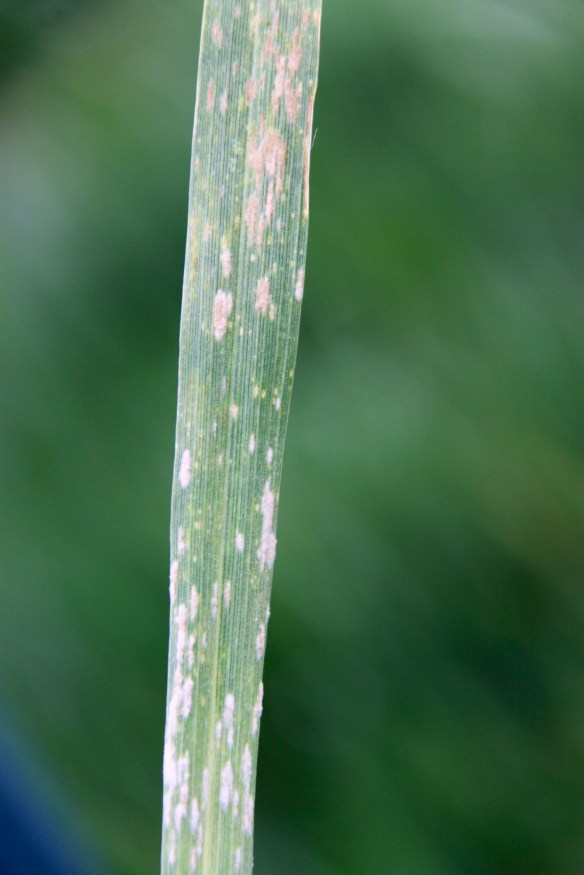
Powdery mildew

Powdery mildew

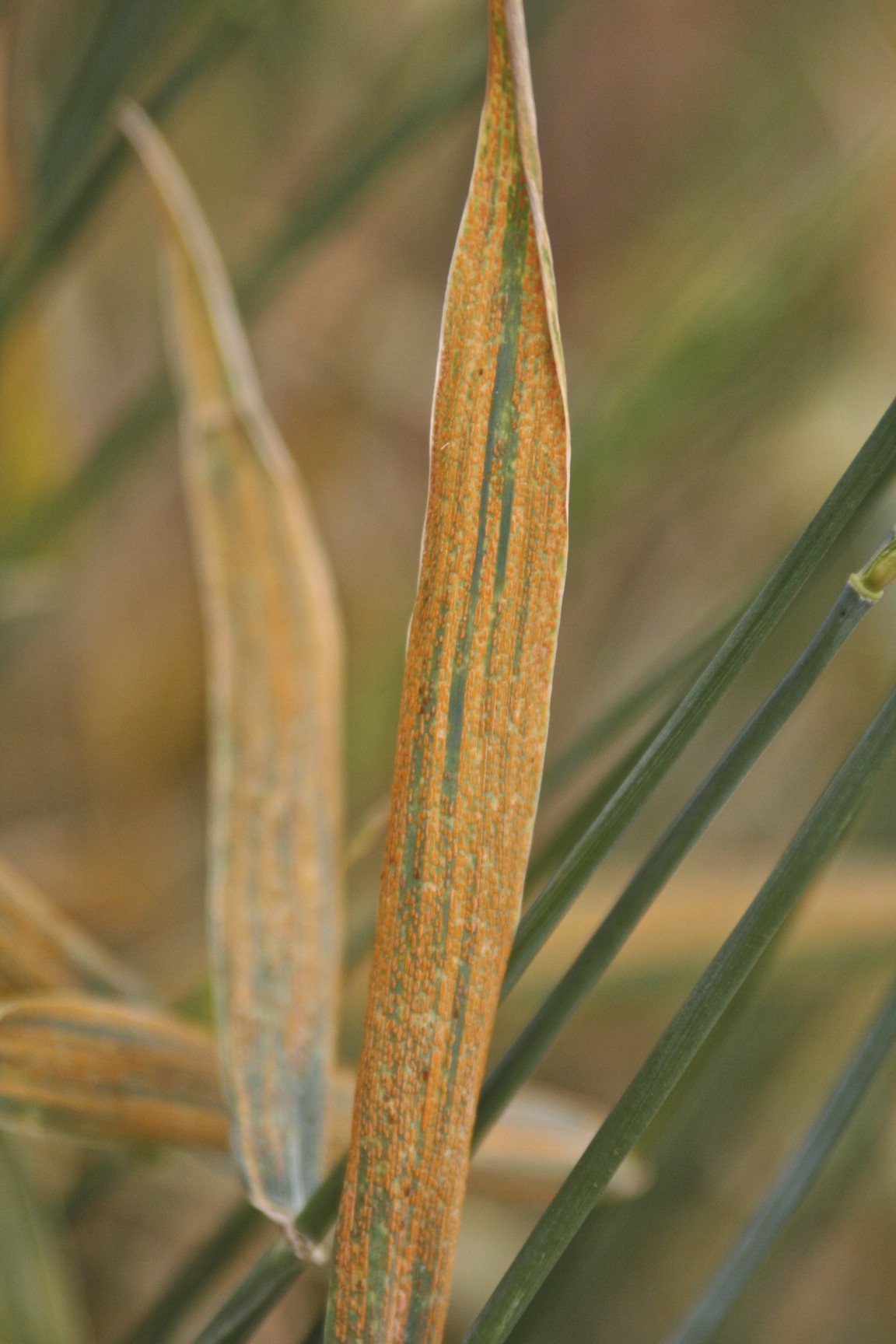
Wheat stripe rust

Wheat stripe rust

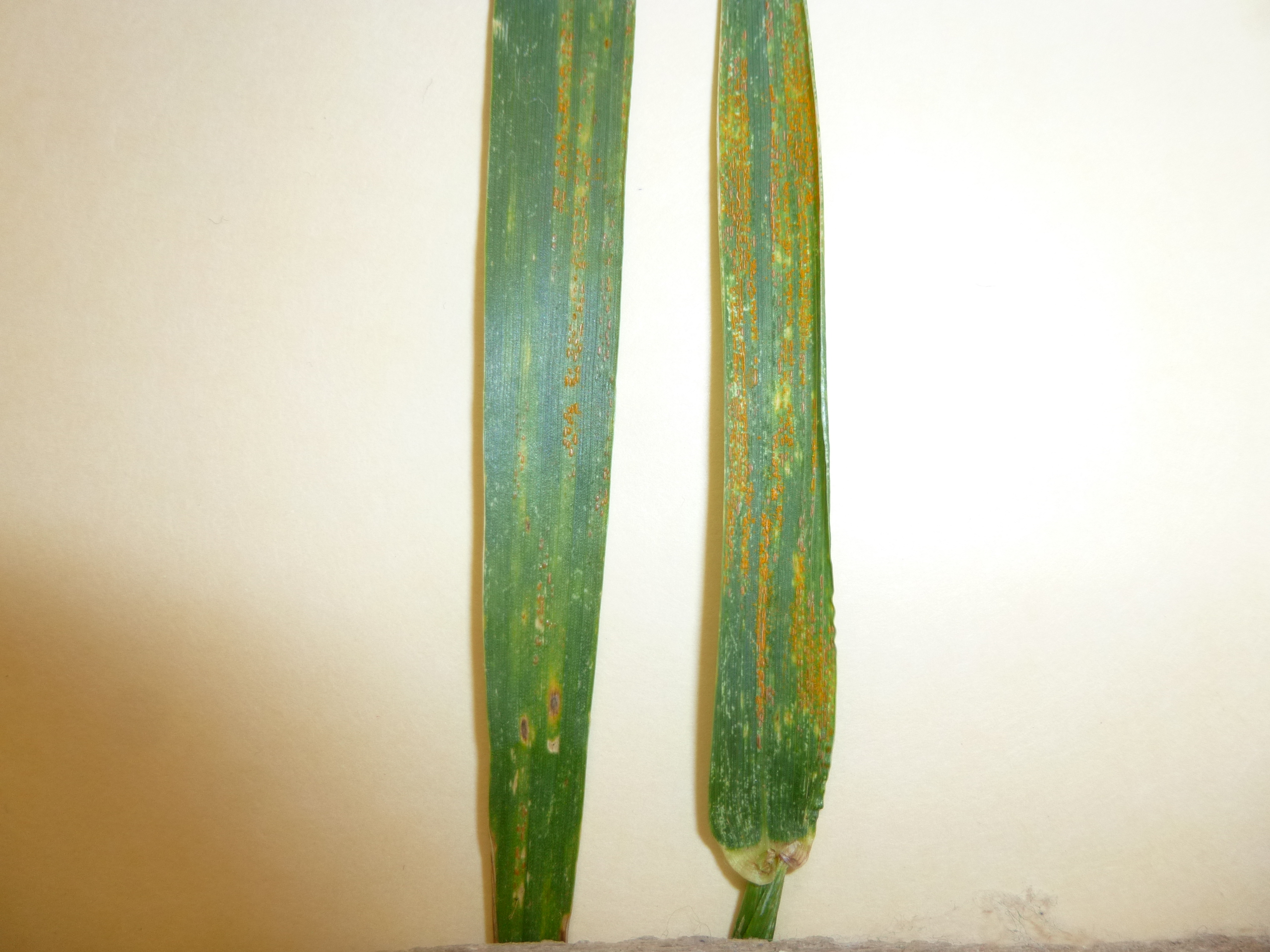
Wheat leaf rust

Wheat leaf rust

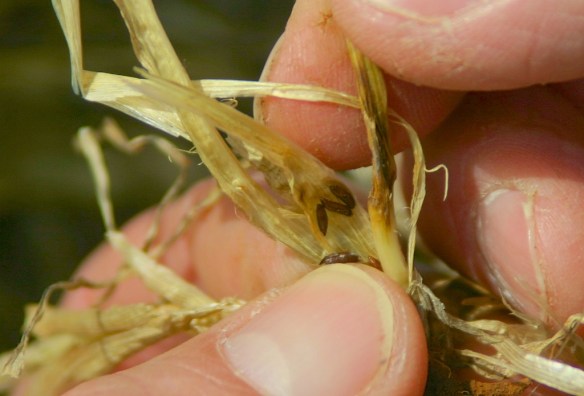
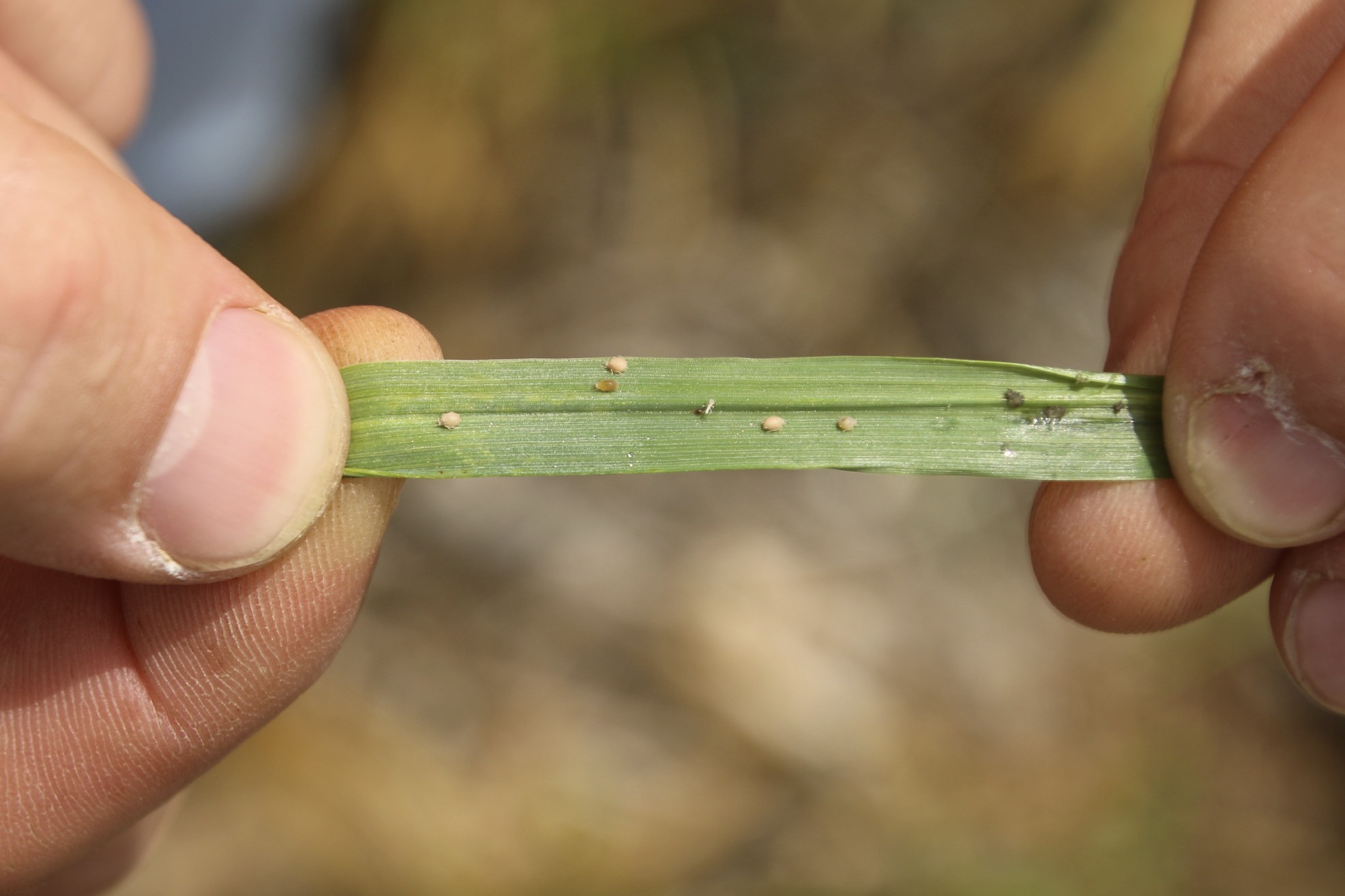
Mature Hessian fly larvae are brown in color and often referred to as flaxseed. Tillers with larvae will not recover and will eventually die and slough off.

Mature Hessian fly larvae are brown in color and often referred to as flaxseed. Tillers with larvae will not recover and will eventually die and slough off.

Spring-planted oat for forage

Spring-planted oat has been a “go to” forage crop for southern Great Plains beef producers for years. It is a good option when winter wheat was not planted in the fall due to wet conditions, or, as is the case this year, when wheat failed to emerge due to drought. Forage production potential for spring-planted oat is around 1,500 to 2,00 lb/ac, but you will need about 60 – 75 lb/ac of nitrogen to make this type of yield. Dr. Daren Redfern and I wrote a fact sheet detailing spring oat production for hay and it can be found by clicking here or going to www.wheat.okstate.edu under “wheat management” then “seeding”. I will provide the Cliff’s Notes version below.

Spring oat can provide an alternate hay or forage source in the spring

Spring oat can provide an alternate hay or forage source in the spring

Seed — Plant 80 – 100 lb/ac of good quality seed that has a germination of no less than 85%. There aren’t many options regarding varieties, so you will likely be limited to whatever seed is available in your area. The key is not to cut back on seeding rate, regardless of variety.

Seedbed — Sow oat seed at approximately 1/2 to 3/4 inches deep. Most producers will fare better with a conventionally-tilled seedbed. You are planting seed at a time of year when the ground is already marginal regarding temperature. Conventionally-tilled seedbeds warm more quickly, which should speed germination. There is one exception to the conventional till recommendation. If you are sowing into a stale seedbed or a failed wheat crop that is very thin, no-till should be okay. Just avoid situations where excessive residue will keep the soil cold.

Grazing — Oat plants should have a minimum of six inches of growth prior to grazing. Unlike fall-seeded cereals, you should not expect a large amount of tillering. A good stand of spring oat can provide a 750 lb animal approximately 60 days of grazing when stocked at 1.5 animals per acre

Hay — Oat should be cut for hay at early heading.

How to make $100,000 in a day

No, this blog post is not about a get rich quick scheme, but there is a way for the average wheat farmer in the southern Great Plains to add $50,000 to $100,000 to the bottom line in a single day. Many soil tests I have pulled have shown as much as 50 to 90 lb/ac of NO3-N in the top 18 inches of soil. Ninety pounds of N equates to about $45 of N fertilizer, and this knowledge could save a 2,500 acre wheat farmer in excess of $100,000 in fertilizer cost. Soil testing is laborious, but the potential economic returns for spending a day or two soil sampling are outstanding.

There is still time to soil sample. Soil samples only take a few days to process once they are in the OSU lab. It is not unusual for transit time to the lab to the slowest part of the process, so if you need a fast turnaround a trip to drop samples in the Ag Hall basement in Stillwater will help (plus you have probably been wanting cheese fries). If you have already applied pre-plant fertilizer or sown wheat, there is still time to assess soil N availability and uptake via the N-Rich Strip. In its simplest form, the N-rich strip is an area where N is not limiting. Either by visual assessment or with the assistance of an optical sensor, you can use the N-rich strip to determine your top dress N requirement, but you must create the N-rich strip this fall.

Soil testing is not always easy, but it is time well spent. My high school shop teacher would have labeled me a "Primitive Pete" for this photo.

Soil testing is not always easy, but it is time well spent. My high school shop teacher would have labeled me a “Primitive Pete” for this photo.

The bottom line is that a day of soil testing or putting out N-rich strips is well worth your time investment. On another note, how would you like to make money and improve your health at the same time? I have a multi-level marketing opportunity that I can get you in on the ground floor, but don’t tell anyone else. I can only make this deal for you and only today. There will be a small “buy in” fee that you will need to pay cash up front, though.

Partial funding for the research included in this blog post was provided by USDA Project No.2012-02355 through the National Institute for Food and Agriculture’s Agriculture and Food Research Initiative, Regional Approaches for Adaptation to and Mitigation of Climate Variability and Change

Wheat disease update – 15 May 2015

Wheat disease updates are written by Dr. Bob Hunger, OSU Extension Plant Pathologist

Oklahoma:  Early this week I spent time around Stillwater, Lahoma (10 miles west of Enid), and Cherokee and Alva (north-central OK not far from the Kansas border).  Wheat ranged from soft dough around Stillwater to milk at Alva (but quickly approaching dough).  There is a big difference between the wheat in these areas; obviously wheat around Alva suffered more drought stress than Cherokee, which is worse than Lahoma or Stillwater.  However, lots of moisture and cool temperatures are allowing wheat to fill and mature.

As expected, leaf rust has exploded around Stillwater, with susceptible varieties such as OK Bullet at 80-90S.  Leaves are gone on varieties that were highly susceptible to stripe rust, but varieties with stripe rust resistance that are susceptible to leaf rust (e.g., Jackpot, Greer) are now hit hard with leaf rust.

Weather since the middle of April has been reminiscent of the weather in April and May of 2007.  As a result, wheat diseases favored by cool and wet weather are starting to occur with increasing frequency and severity.  These diseases are causing head discoloration, which can be caused by fungi or bacteria.  Around Stillwater and Lahoma, head discoloration due to a bacterium (Xanthomonas) has been observed.  l have had reports of similar symptoms on wheat in southwestern OK, where more rain has fallen then around Stillwater.  This bacterial disease is called black chaff when on the heads and is called bacterial streak when symptoms are expressed on leaves.  The fungi Septoria and Stagonospora also can cause head discoloration, and we have isolated Septoria from several samples during the last week or so.  For a full discussion of the various causes of head discoloration along with pictures, clicking on the following link will take you to the e-Pest Alert sent out in June, 2007.

http://entoplp.okstate.edu/pddl/pddl/2007/PDIA6-17.pdf

Barley yellow dwarf also was observed this past week, but it was not extensive and little to no stunting was associated with the BYD spots indicating infection most likely occurred in the spring.

Purple / yellow leaves associated with barley yellow dwarf

Purple / yellow leaves associated with barley yellow dwarf


I have had reports of Fusarium head blight (scab) from southeastern KS, from Arkansas, and from eastern/northeastern OK, but have had no reports from anywhere else in Oklahoma.

Fusarium head blight (head scab) can partially or completely infect wheat heads

Fusarium head blight (head scab) can partially or completely infect wheat heads

Fusarium head blight (head scab)

Fusarium head blight (head scab)

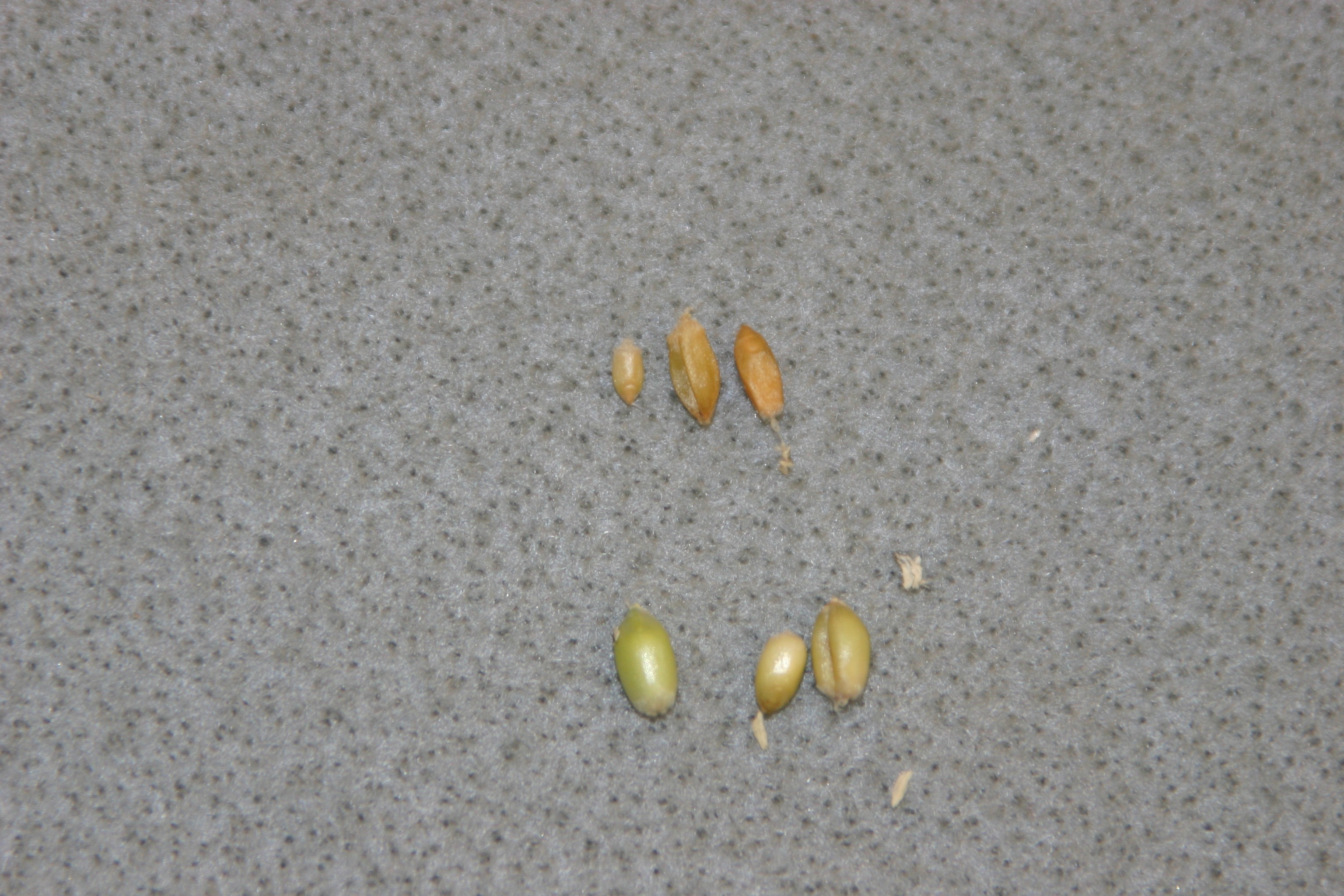
Fusarium head blight infected (top) vs. normal wheat kernels

Fusarium head blight infected (top) vs. normal wheat kernels


The diagnostic lab continued to receive multiple samples that tested positive for Wheat streak mosaic virus, with several also testing positive for High plains virus (Wheat mosaic virus) and Barley yellow dwarf virus.  For information on mite-transmitted diseases, I refer you to EPP-7328 (Wheat Streak Mosaic, High Plains Disease, and Triticum Mosaic:  Three Virus Diseases of Wheat in Oklahoma) also available at http://osufacts.okstate.edu.


Reports/excerpts of reports from other states: 

Colorado:  Dr. Scott Haley (Wheat Breeder); Colorado State Univ, 13-May-2015:  “Stripe rust continues to develop in CO. Cool wet weather will likely favor continued development. Wheat is about at the heading growth stage.”

Wheat disease update – 08 May 2015

Wheat disease updates are written by Dr. Bob Hunger, OSU Extension Plant Pathologist

Oklahoma:

In addition to looking at wheat around Stillwater this past week, I also was at field meetings near Kingfisher (30 miles northwest of OKC), Kildare (10 miles north of Ponca City), and Lahoma (10 miles west of Enid).  Wheat was at full berry to borderline milk.

Stripe rust, leaf rust, and powdery mildew were present at all locations, with stripe rust by far the most prevalent.  Where a fungicide had been sprayed (e.g., in Dr. Jeff Edwards variety trial), the effect was striking in terms of green leaf tissue.  Difference in variety susceptibility to stripe rust was obvious, with Ruby Lee, Garrision, Pete, and Everest being some of the more common highly susceptible varieties.  There also seems to be varieties with high levels of resistance (e.g., Gallagher, Jackpot, etc), and intermediate resistance; however, I’ll wait until I have all ratings in to evaluate this in more detail.
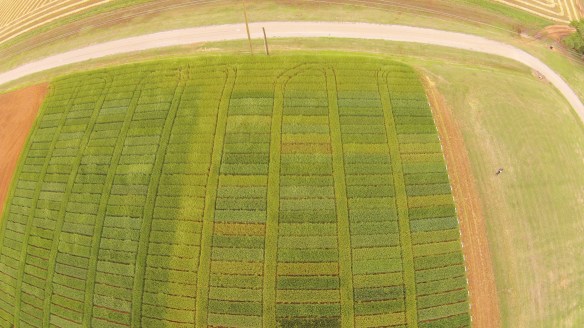
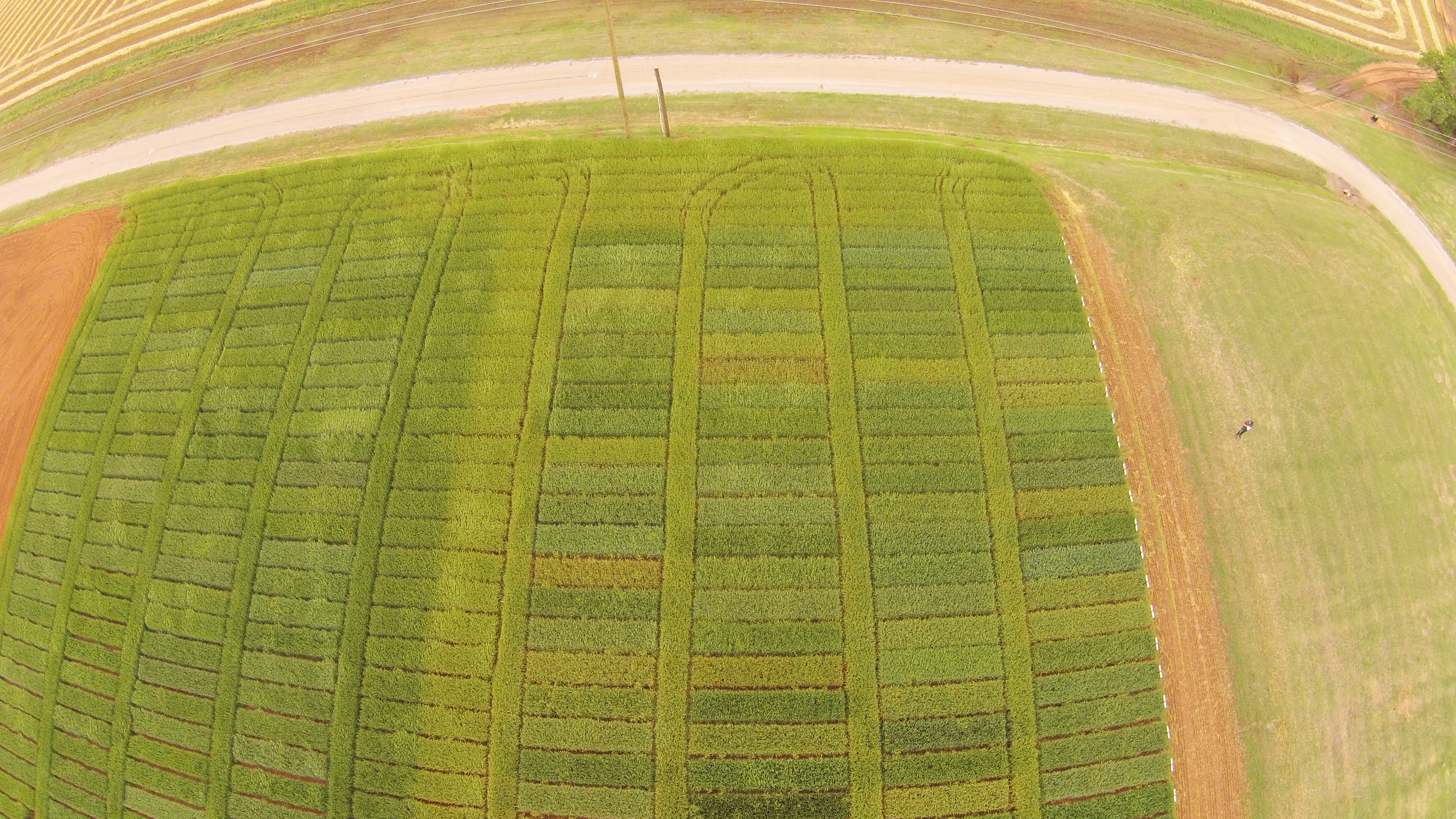
This overhead shot of the Chickasha intensive and standard wheat variety trials illustrates the severity of stripe rust in the region. The intensively managed trials on the left was treated with a fungicide just prior to heading. The standard trial on the right has the exact same varieties but no fungicide. The "middle" replication between the two studies is a border of Ruby Lee that is 1/2 treated 1/2 non treated. Photo courtesy Brian Arnall.

This overhead shot of the Chickasha intensive and standard wheat variety trials illustrates the severity of stripe rust in the region. The intensively managed trials on the left was treated with a fungicide just prior to heading. The standard trial on the right has the exact same varieties but no fungicide. The “middle” replication between the two studies is a border of Ruby Lee that is 1/2 treated 1/2 non treated. Photo courtesy Brian Arnall.

Leaf rust can be found in some varieties at severe levels, but has not increased to a level comparable to stripe rust.  Most commonly, I am seeing it on leaves of varieties that are resistant to stripe rust, but susceptible to leaf rust (e.g., Jackpot).

Barley yellow dwarf also was observed at all locations, but little to no stunting was associated with the BYD, so infection most likely occurred in the spring.

Powdery mildew also was observed at every location, but only rarely was on the flag leaf or heads.

I have not seen any Fusarium head blight, but have had a few reports of it from eastern/northeastern OK.

The diagnostic lab continued to receive samples testing positive for Wheat streak mosaic virus, with several also testing positive for High plains virus (Wheat mosaic virus)  For information on mite-transmitted diseases, I refer you to EPP-7328 (Wheat Streak Mosaic, High Plains Disease, and Triticum Mosaic:  Three Virus Diseases of Wheat in Oklahoma) also available at www.wheat.okstate.edu 


Reports/excerpts of reports from other states: 

Kansas Dr. Erick De Wolf (Extension Plant Pathologist); Kansas State Univ, 4-May-2015:  “The past week continued to bring more finds and reports of rust diseases in Kansas. Stripe rust is the primary concern many growers and the disease is now established in many areas of the state.  The disease has moved onto the upper leaves in many fields in the southeastern and south central regions of the state.  The wheat in these areas of the state was at or near the heading and flowering stages of growth this past week. Infections on the upper leaves at these stages of growth places the crop at risk for severe yield losses.  Stripe rust was found at low levels in many counties in the central and north central regions.  The disease was also reported at low levels in western Kansas.  At this point the stripe rust was primarily low to moderate incidence (1-5%) and mostly restricted to the lower leaves of many fields in the central and western regions.  However, the weather this past week was very conducive for stripe rust and the disease may soon increase to damaging levels in more areas.

The risk of yield loss in these areas depends heavily on weather over the next 2 weeks.  Stripe rust is favored by temperatures in the 40-60’s, frequent rain or heavy dew deposition. The progress of stripe rust often slows when nighttime temperatures exceed 60 degrees F.  The weather outlook for the central region indicates that rain is likely this week but also suggests low temperatures may slow further disease development. Temperatures in north central and western Kansas may be more conducive for stripe rust.  So far the stripe rust is most severe on varieties known to be susceptible to the disease but there are some early indications of unusual disease reactions on varieties previously thought to be resistant.  I will gather more information and come back with reports soon.

Leaf rust has also been detected at trace or low levels at many of the same locations as stripe rust (Crawford, Clay, Ness, Riley, Saline, and Sumner counties).  These reports are significant because the presence of leaf rust increases the risk of disease related yield loss in the state. Many of the popular varieties grown in the state are susceptible to leaf rust and finding the disease prior to flowering indicates the leaf rust may also cause problems in some areas.  To date the leaf rust appears to be most common on varieties with the Lr39/41 resistance gene (Fuller and WB 4458 for example).


TEXAS:  Dr. Clark Neely (Small Grains & Oilseed Extn Specialist; Texas A&M AgriLife; College Station; 7-May-2015:  “I spent the past several days attending wheat field days in northeast Texas. Stem rust was found in susceptible soft wheat varieties in Ellis County. After fading away for the most part from warmer temperatues, stripe rust was re-establishing itself on flag leaves of susceptible varieties in due to the cooler, wet weather affecting the region. Most wheat in the region is in the milk-soft dough stage. Leaf rust was moderate to severe on susceptible lines at Howe, TX including TV 8861, however, leaf rust was much lighter at Leonard and Farmersville, TX locations.”


Georgia:  Alfredo Martinez, John Youmans, James Buck; University of Georgia; 6-May-2015:  “Leaf rust infections have been observed in commercial wheat fields in Southwest Georgia (Seminole Co. Mitchel Co. Taylor Co.). The incidence of leaf rust seems to be localized and the severity was low. Stripe rust was confirmed in northwest GA (Floyd Co.). The incidence and severity was minor. Commercial fields surveyed near UGA College of Agricultural and Environmental Sciences Research Station in Plains, GA and around the UGA CAES Bledsoe Farm near Griffin GA yielded no stripe, leaf rust or stem rust infections.  Low rust and powdery mildew on wheat in GA was probably due to the use of resistant varieties and /or timely applied fungicides. However, for a second year in row, Fusarium Head Blight (FHB/Scab) incidences were numerous (albeit not as prevalent as in 2014), in some fields the severity was high. Surveyed fields in Sumter Co. had severity of 50%-60%. Environmental conditions at the time of wheat flowering provided conducive conditions for FHB infections especially in the southernmost part of the state. Stagonospora spot blotch and tan spot were observed throughout the state and seemed more prevalent than previous years.”

Wheat leaf rust

Wheat leaf rust

Wheat stripe rust

Wheat stripe rust

Wheat disease update – 01 May 2015

Wheat disease updates are written by Dr. Bob Hunger, OSU Extension Plant Pathologist

Oklahoma:  This past week I spent in fields/nurseries around Stillwater and also attended field days in central OK (Caddo Cnty) and southwestern OK (Jackson Cnty).  Most of the wheat I saw was at ¼ to nearly full berry.  Foliar diseases have definitely increased.

Around Stillwater, powdery mildew is evident on the lower leaves in my fungicide trial (approx. 25% severity).  In the variety demo strips at Stillwater, I can find severities >65% on lower leaves.  However, stripe rust is still the most evident foliar disease with mid-canopy leaves of susceptible varieties often completely or nearly completely infected.  Flag leaves of susceptible varieties around Stillwater are beginning to show stripe rust pustules, but that is still not uniform in all fields/locations.  Also this past week I started to see leaf rust pustules developing on lower leaves; I only occasionally saw pustules on flag leaves with the exception of ‘Jagalene’, which was at 90% or so.

In central OK I saw mostly the same thing.  At the variety trial near Kingfisher (Kingfisher Cnty), disease was surprisingly light with stripe rust the most evident.  Near Apache OK (southern Caddo Cnty), disease was more prevalent with stripe rust the most severe.  Varieties resistant to stripe rust but susceptible to leaf rust (e.g., ‘Jackpot’ were beginning to show more leaf rust pustules).  Tan spot also was evident at this variety trial as it is a no-till field.

This overhead shot of the Chickasha intensive and standard wheat variety trials illustrates the severity of stripe rust in the region. The intensively managed trials on the left was treated with a fungicide just prior to heading. The standard trial on the right has the exact same varieties but no fungicide. The "middle" replication between the two studies is a border of Ruby Lee that is 1/2 treated 1/2 non treated. Photo courtesy Brian Arnall.

This overhead shot of the Chickasha intensive and standard wheat variety trials illustrates the severity of stripe rust in the region. The intensively managed trials on the left was treated with a fungicide just prior to heading. The standard trial on the right has the exact same varieties but no fungicide. The “middle” replication between the two studies is a border of Ruby Lee that is 1/2 treated 1/2 non treated. Photo courtesy Brian Arnall.

In southwestern OK (near Altus, OK), stripe rust was severe (90% or so) on the flag leaves of susceptible varieties such as ‘Ruby Lee’, ‘Everest’, and ‘Garrison’.  Varieties with resistance to stripe rust such as ‘Gallagher’ and ‘Billings’ showed little sporulation but loss of some green tissue due to the hypersensitive reaction (HR).  ‘Greer’ showed no stripe rust and no dead tissue due to the HR.  Here again, a variety like Jackpot showed no stripe rust, but leaf rust was at a moderate level.  An interesting observation was made by Dillon Butchee (Helena Chemical Rep), who noticed stripe rust sporulating inside the glumes of susceptible varieties, which I have seen only occasionally in Oklahoma.

In more northern OK, Greg Highfill (Extension Educator, Woods Cnty – near Alva, OK) indicated he has seen small amounts of stripe rust in the border of the test plot near Alva.  Although temperature is increasing, the forecast for next week is highs only in the low to mid 80s with Tuesday-Thursday being rainy again.  These temps will be lower in northern and northwestern OK.  Hopefully the rain will continue, but these conditions will favor continued spread and increase of particularly leaf rust.  For most of Oklahoma, I believe wheat is past or quickly approaching the point where a fungicide can no longer be applied.  For a discussion of this, see “CR-7668 Foliar Fungicides and Wheat Production in Oklahoma – April, 2015,” which is available at www.wheat.okstate.edu.

Stripe rust at Alva, Oklahoma. Photo courtesy Greg Highfill

Stripe rust at Alva, Oklahoma. Photo courtesy Greg Highfill


Finally, the diagnostic lab continues to receive samples testing positive for Wheat streak mosaic virus.  For information on mite-transmitted diseases, I refer you to EPP-7328 (Wheat Streak Mosaic, High Plains Disease, and Triticum Mosaic:  Three Virus Diseases of Wheat in Oklahoma) also available at www.wheat.okstate.edu

Reports/excerpts of reports from other states: 

Nebraska:  Dr. Stephen Wegulo (Extension Plant Pathologist); Univ of Nebraska, 28-Apr-2015:  “Yesterday I surveyed wheat fields in south central and southeast Nebraska.  Stripe rust was widespread (prevalence of >70%) in the southernmost tier of counties.  Incidence ranged from about 15% to > 80% in some fields.  Severity was mostly trace to low (< 10%), although a few isolated leaves had >50% severity (see attachment).  Growth stage was mostly Feekes 6; in a few fields it was Feekes 6 to 8, and in two irrigated fields wheat was in the boot stage.  These two irrigated fields apparently had been sprayed and there was no stripe rust in them, but I was able to find some leaves on which stripe rust development was stopped by the fungicide spray.  There was severe winter kill in some fields to the extent that the wheat was sprayed with herbicide and another crop will be planted.

Last week (Thursday and Friday) I surveyed wheat fields in the southern and northern Panhandle of Nebraska (the far northwest of the state) and in southwest and west central Nebraska.  I found no foliar diseases, but there was root rot in one field that also had some winter kill in the northern Panhandle.  In the west central part of the state, there was severe winter kill in some fields (see slide #3 in the attachment).  Growth stage ranged from Feekes 5 in the Panhandle to Feekes 5 to 6 in the southwest and west central parts of the state.”

Wheat disease update – 23 April 2015

Wheat disease updates are written by Dr. Bob Hunger, OSU Extension Plant Pathologist

Oklahoma:  Again, a cool and moist week in Oklahoma with rain and cool temperatures in the forecast through the weekend.  Wheat is mostly at flowering around Stillwater but by early next week will likely be past flowering.  From what I hear across the state, wheat is quickly approaching, at, or will be quickly past flowering (depending on what part of the state, when planted, and how much drought stress was endured).

Around Stillwater there has been an increase in stripe rust and powdery mildew (especially stripe rust).  Leaf rust also has increased, but not to the same extent (incidence or severity) as stripe rust.  Dr. Brett Carver (OSU Wheat Breeder) indicated he saw significant stripe rust in his nurseries at Lahoma (north-central OK).  Gary Strickland (Jackson County Extn Educator) also has observed an increase in stripe rust (and to a lesser extent, leaf rust) in far southwestern Oklahoma.  My impression is that stripe rust has activated again with the cool and wet weather, and continues to spread across Oklahoma.  This Thursday and Friday there will be field days in central Oklahoma, so look for a more extensive report next week.

To the south of us in Texas (far southern Texas), Dr. Amir Ibrahim (Professor, Small Grains Breeder/Geneticist; Texas A&M AgriLife Research; College Station, TX) has indicated in breeder nurseries near Castroville, TX, that there is a mixture of stripe rust, leaf rust, bacterial leaf streak and some septoria.  This has occurred because of back-and-forth switching between cool and warm temperatures mixed in with lots of rain.  To some extent, this also has occurred across Oklahoma during April.

Mite-transmitted viruses also are prevalent in Oklahoma this year.  Yesterday when in nurseries here at Stillwater I noticed occasional trapped heads scattered throughout the field.  In observing these in the lab using a dissecting scope, I found wheat curl mites associated with these trapped heads.  Although only sporadic around Stillwater, the Diagnostic Lab has received multiple samples that they confirmed for presence of Wheat streak mosaic virusWheat mosaic virus (High plains virus), and/or Barley yellow dwarf virus.  This includes samples from Grady, Noble, Grant, Texas and Woods Counties.  I would refer you to EPP-7328 (Wheat Streak Mosaic, High Plains Disease, and Triticum Mosaic:  Three Virus Diseases of Wheat in Oklahoma) available at http://osufacts.okstate.edu for more information on these mite-transmitted viruses.


Reports/excerpts of reports from other states: 

Kansas Doug Shoup (SE Area Crops/Soil Specialist) & Erick DeWolf (Extn Plant Pathologist), Kansas State University, 22-Apr-2015:  “Stripe rust has been found in several fields of wheat in southeast , south central, and north central Kansas. Given the forecast of cool and relatively wet conditions for the next seven days, this is a potentially significant situation for fields anywhere in Kansas planted to varieties susceptible to stripe rust. Intensive scouting of fields should begin now.”  [This was the first paragraph of their report, which can be found at:

https://webapp.agron.ksu.edu/agr_social/eu_article.throck?article_id=532

Brown wheat mite showing up in winter wheat

By Tom Royer, OSU Extension Entomologist

Our Plant Disease and Insect Diagnostic lab received samples of wheat that were damaged by brown wheat mites. Producers need to remain alert so that they don’t mistake damaged wheat from brown wheat mite for drought or virus disease.

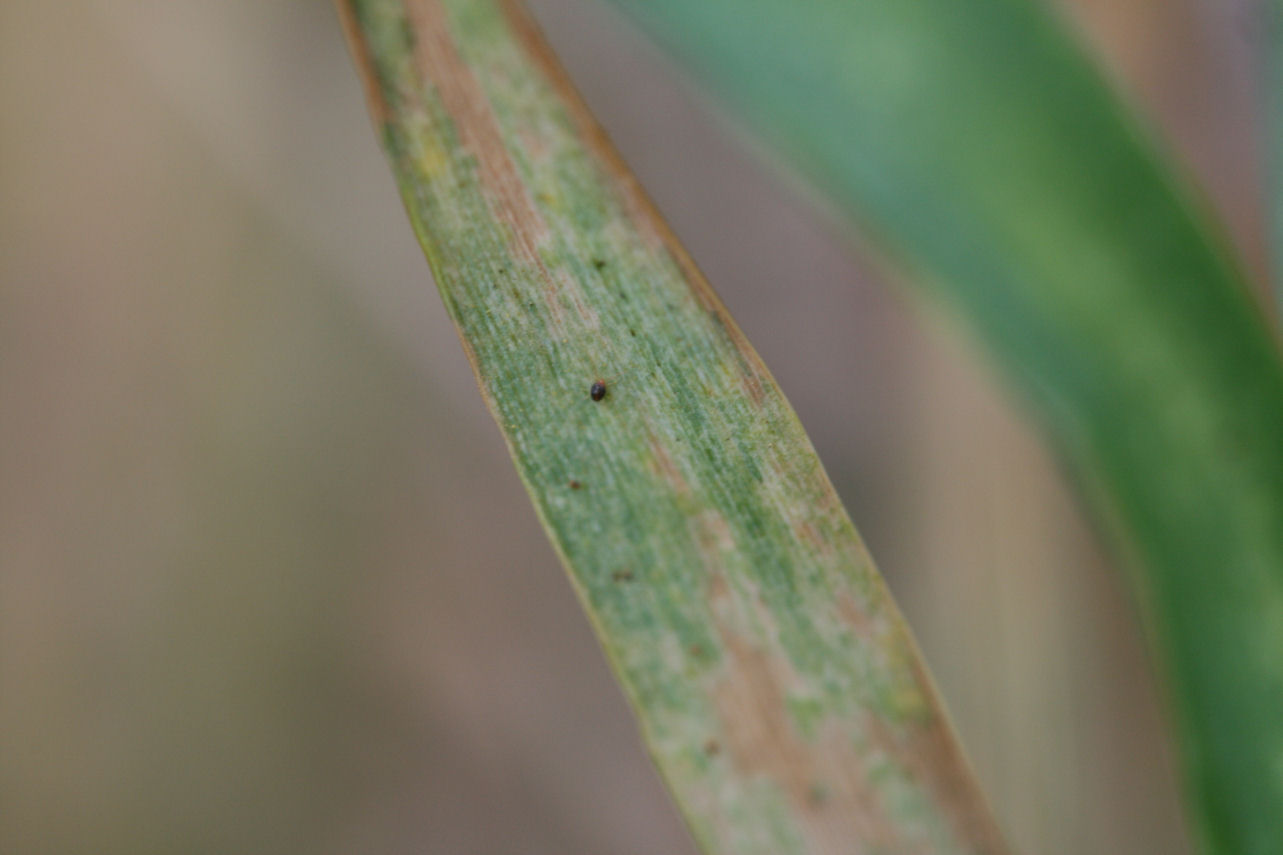
Brown wheat mite is small (about the size of this period.) with a metallic brown to black body and 4 pair of yellowish legs. The forelegs are distinctly longer that the other three pair. Brown wheat mites can complete a cycle in as little as 10-14 days. Brown wheat mite causes problems in wheat that is stressed from lack of moisture. They feed by piercing plant cells in the leaf, which results in “stippling”. As injury continues the plants become yellow, then dry out and die. They are very susceptible to hard, driving rains which many areas have now experienced, but until then they can cause yield loss when present in large numbers.

A closeup of a brown wheat mite. Photo courtesy Franklin Peairs, CSU.

A closeup of a brown wheat mite. Photo courtesy Franklin Peairs, CSU.

Brown what mite can severely damage wheat that is already stressed due to drought or other adverse environmental conditions.

Brown what mite can severely damage wheat that is already stressed due to drought or other adverse environmental conditions.

Brown wheat mites are about the size of a period at the end of a sentence and can be difficult to see with the naked eye.

Brown wheat mites are about the size of a period at the end of a sentence and can be difficult to see with the naked eye.

We typically experience 3 generations per year. However, in this sample, the mites had already caused considerable damage and had laid significant numbers of diapausing white eggs that tell us they have completed their last generation of the growing season and these eggs will oversummer.

Brown wheat mite eggs in soil.

Brown wheat mite eggs in soil.

Research suggests that a treatment threshold of 25-50 brown wheat mites per leaf in wheat that is 6-9 inches tall is economically warranted. An alternative estimation is “several hundred” per foot of row. If you find active brown wheat mites in your field, check CR-7194, Management of Insect and Mite Pests in Small Grains for registered insecticides, application rates, and grazing/harvest waiting periods. It can be obtained from any County Extension Office, or found at www.wheat.okstate.edu

Wheat disease update – 17 April 2015

Wheat disease updates are written by Dr. Bob Hunger, OSU Extension Plant Pathologist

Oklahoma:  This past week has been wet and cool across most of Oklahoma, which has greatly helped the wheat but also should lead to more foliar diseases – especially stripe and leaf rust.  Around Stillwater, we have not seen a big increase in stripe rust yet, but can find many leaves beneath the flag leaf on which there are actively sporulating pustules.  There also are leaves on which the black spore structure stage of stripe rust has appeared (called the telial stage – see photo – note actively sporulating pustules towards the base of the leaf).  Typically this indicates the disease is “shutting down,” which it was prior to this week.  However, with the cool and wet weather since Monday, there likely will be a “reactivation” of stripe rust – especially given that cool and wet weather is forecast for the next 5-10 days as well!
The black spore structure stage (telial stage) of stripe rust. Note actively sporulating pustules towards the base of the leaf.

The black spore structure stage (telial stage) of stripe rust. Note actively sporulating pustules towards the base of the leaf.

I get the impression from talking to Aaron Henson (County Educator; Tillman County) as well as other growers and consultants around the state that this is similar to what they are seeing.  Wheat seems to range from boot to heads emerging, so if you are contemplating applying a fungicide to protect a promising wheat yield, I suggest it be done soon.  Remember, GS 10.5 (heads fully emerged but not yet flowering) is the cut-off for applying fungicides for wheat foliar diseases.  That point likely is not far away for much of southern and central Oklahoma.  It likely is a bit farther away for northern and northwestern Oklahoma, but it is much better to apply a fungicide a little early rather than after the flag leaf is infected.

Most of the samples that came into the Diagnostic lab last week tested positive for wheat streak mosaic (WSM), including three from the panhandle.  However, there is nothing that can be done about WSM at this point.  I would refer you to EPP-7328 (Wheat Streak Mosaic, High Plains Disease, and Triticum Mosaic:  Three Virus Diseases of Wheat in Oklahoma) available at www.wheat.okstate.edu for more information on these mite-transmitted viruses.

Reports/excerpts of reports from other states:

Colorado  Dr. Scott Haley (Professor & Wheat Breeder, Colorado State University) 16-Apr-2015:  “FYI, stripe rust was confirmed for a field site near the Denver International Airport in Colorado this week. Infection was moderate but cool wet weather we are experiencing now could cause this to increase. This is pretty early for stripe rust sightings in eastern Colorado.”

Northwestern / north central Oklahoma wheat update – drought, greenbugs, and freeze

Dr. Hunger traveled southwest Oklahoma this week, so I made a trip out Hwy. 60 yesterday to evaluate freeze injury and assess the overall condition of the wheat crop in northwestern and north central Oklahoma. Last week’s warm temperatures and wind have taken their toll on wheat in Kay, Grant, and eastern Garfield Counties. It is not too late for rain to save a partial wheat crop in these areas, but the “full yield potential” ship sailed long ago. Wheat sown behind summer crops is the hardest hit, and wheat in these fields could best be described as yellow and thin. If the weather turned and we received rain in the next week, I would predict that yield potential in these fields would still only be around the 15 bushel mark. Without rain, subtract around 15 bushels. Wheat planted behind summer fallow has held on a little longer, but is clearly showing the signs of extreme drought stress. If we receive rain in the next week (and continue to see rain) these fields could still make 20 – 30 bushels per acre. In the absence of rain in the near future, they will be 10 bushels per acre or less.

Wheat in the Lamont test plot was approximately GS 7 - 8. Flag leaves were rolled and plants were starting to abort tillers.

Wheat in the Lamont test plot was approximately GS 7 – 8. Flag leaves were rolled and plants were starting to abort tillers.


In addition to drought stress, we found freeze injury and greenbugs at Lamont. I was a little surprised to find freeze injury and even more surprised to find the greatest injury in the later-maturing varieties. We split several stems of early varieties such as Ruby Lee and Gallagher and did not find any injury. These varieties would have likely been at approximately GS 7 – 8 when the freeze occurred. We found significant injury in later-maturing varieties such as Endurance, but these varieties were likely only GS 6 – 7 when the freeze occurred. Conventional wisdom regarding freeze injury is that the more advanced the variety, the greater the likelihood of freeze injury. After seeing the same phenomenon last year (i.e. the greatest injury in later maturing varieties) I am changing my thinking on freeze injury and now say that all bets are off when it comes to freeze injury in drought stressed wheat.

Freeze injury was greatest in late-maturing varieties at Lamont.

Freeze injury was greatest in late-maturing varieties at Lamont.


Overall wheat condition started to improve around Nash and Jet, I would say that much of the wheat in this area is CURRENTLY in fair to good condition. I emphasize the currently in the previous sentence, as the only difference between wheat in the Cherokee area and wheat to the east was about one week’s worth of moisture. Some terrace ridges had already started turning blue and moisture was starting to run out. Without rain wheat in this area will rapidly deteriorate from good to poor. One consistent theme throughout the day was greenbugs. Many sites had evidence of parasitic wasp activity (i.e. aphid mummies), but the presence or absence of parasitic wasp activity varied field by field. Dr. Royer has indicated that greenbugs still need to be controlled in drought stressed wheat. If parasitic wasps are active, the best decision is to let them do the aphid killing for you. If no mummies are present, then insecticide control could be justified. The only sure way to make this determination is to use the glance-n-go sampling system.


Greenbugs were alive and well at Lamont

Greenbugs were alive and well at Lamont

Parasitic wasps were keeping greenbug populations under control in this field

Parasitic wasps were keeping greenbug populations under control in this field

Active and parasitized greenbugs on the same plant

Active and parasitized greenbugs on the same plant


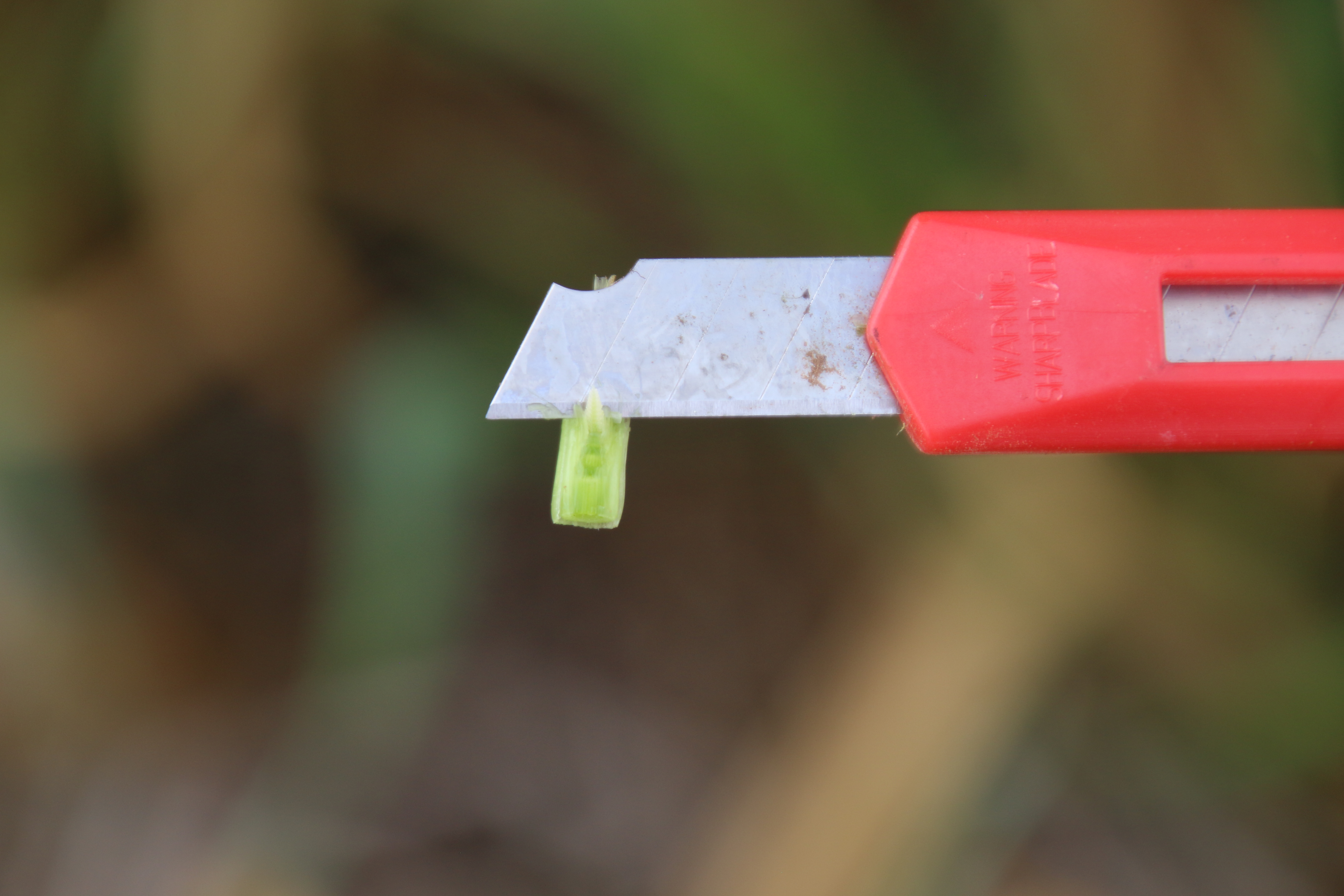
Similar to Lamont, we found freeze injury in the Cherokee and Helena areas. Many of the worst looking fields (extensive leaf burn) had only superficial injury and should recover if moisture allows. Conversely, some plants that showed no outward signs of freeze injury had injured heads within.  Most fields I surveyed had less than 10% injury, but one field was a complete loss. On the surface the 10% injury field and 100% loss field looked the same, so I cannot over stress the importance of splitting stems. I have received a few additional reports of freeze injury from Kay County this morning, so it is important for producers throughout northern Oklahoma to evaluate their wheat on a field by field basis.


Plants that look healthy on the exterior could contain damaged wheat heads

Plants that look healthy on the exterior could contain damaged wheat heads

A closeup of the damaged wheat head from the picture above

A closeup of the damaged wheat head from the picture above

Although freeze injury to plant tissue in this field was severe, the wheat heads were mostly left unscathed

Although freeze injury to plant tissue in this field was severe, the wheat heads were mostly left unscathed

A closeup of a head from the freeze-injured wheat shown above. Although tissue damage is severe, the growing point and wheat head are still viable

A closeup of a head from the freeze-injured wheat shown above. Although tissue damage is severe, the growing point and wheat head are still viable

A final note on freeze injury. Freeze injury appeared to be worst in no-till fields and in areas where residue was heaviest. Based on my observations, this was not due to winterkill or poor seed to soil contact. My best explanation is that the lack of soil cover in conventional till fields allowed stored heat to radiate from the soil surface and slightly warm the crop canopy. The insulating effect of residue in no-till fields did not allow radiant heating to occur. Given the pattern of freeze injury in fields with varying degrees of residue across the field, I feel pretty confident in this analysis of what occurred.

Please use the comment section to share pictures or descriptions of wheat in your area.