Wheat disease update – 21 March 2014

Wheat disease updates are written by Dr. Bob Hunger, OSU Extension Plant Pathologist

Oklahoma:  Diseases are still quiet across Oklahoma.  Gary Strickland (Extension Educator – southwest Oklahoma) indicated he has “seen one leaf rut pustule.”  Also, wheat just has not grown in his area and is just starting to get to the point of tillering but there is so little growth he doesn’t feel there is sufficient growth to support much tillering.  He did indicate he has seen and has a lot of reports of brown wheat mites.

Around Stillwater, the wheat soilborne/spindle streak mosaic is the only disease of prominence.  I did find some small pustules of powdery mildew in the extreme low leaves of ‘Pete’ wheat that was in the range of Feekes 6.  Wheat around Stillwater is in much better condition than in western Oklahoma where drought has been severe.  I also have seen quite a few lady beetles in my trials and plots, but have yet to see any aphids.

Reports/excerpts of reports from other states:

Arkansas  Dr. Gene Milus (Professor/Wheat Pathologist, Univ of Arkansas) 20-Mar-2014:  Jason Kelley, Extension wheat agronomist, found fresh leaf rust pustules on volunteer wheat at the Cotton Branch Experiment Station near Marianna on March 20.

Louisiana Dr. Stephen Harrison (Professor/Wheat Breeder, LSU AgCenter) 18-Mar-2014:  I found leaf rust at the Ben Hur Research Farm in Baton Rouge yesterday.  This was in an early-planted field for Hessian Fly where I found a few pustules around Christmas.  The cold and very wet winter put the rust on hold until recently but it is active and should ‘take off’ now.  I have not received any other rust reports from around the state but will check nurseries in north Louisiana tomorrow.

The wheat crop is a little later than normal and has a much tighter range of heading dates due to the cold winter.  The variety trial probably averages second node but is very rapidly developing.

First hollow stem update 03/18/2014

Most wheat varieties are now at first hollow stem in our plots at Stillwater. I have posted the measurements from 18 March 2014 below.

Variety cm of hollow stem 03/18/2014
Endurance 1.5
Deliver 1.5
Pete 1.7
OK Bullet 3.2
OK Rising 3.0
Billings 2.2
Ruby Lee 1.2
Garrison 1.9
Duster 2.0
Gallagher 3.1
Iba 1.1
Everest 3.6
Jackpot 4.6
Doans 1.9
Greer 1.7
CJ 2.6
SY Southwind 3.6
Sy Llano .
Armour 2.4
WB-Cedar .
WB-Redhawk 2.7
WB-Grainfield 1.3
Winterhawk 1.8
WB4458 1.7
T153 3.0
T154 2.1
T158 1.0
LCS Mint 0.2
LCS Wizard 1.5
LCH11-109 2.0
LCH11-1117 2.4
LCH11-1130 2.3
TAM 112 3.8
TAM 113 3.5
Byrd 2.0
Brawl CL Plus 1.0
Centerfield 0.9
Doublestop CL Plus 0.9
OK09125 1.3
OK09520 1.6
OK10126 0.6
OK08707W-19C13 1.3
OK10805W 1.2
OK10728W 3.3
OK11754WF .
Sample Average 2.1

Wheat disease update – 14 March 2014

Wheat disease updates are written by Dr. Bob Hunger, OSU Extension Plant Pathologist

Oklahoma:  No foliar diseases of significance to report in Oklahoma.  Wheat is mostly just coming out of dormancy, and cold/dry conditions have not favored initiation of foliar diseases.  My soilborne/spindle streak nursery is starting to show symptoms of these virus diseases.  The wheat is just starting to “green-up,” so symptoms of this virus complex will become evident over the next couple weeks if a susceptible variety was planted in areas where these diseases are present.

Reports/excerpts of reports from other states:

Texas Dr. Amir Ibrahim (Prof, Small Grains Breeding and Genetics, Texas A&M University) 07-Mar-2014:  Our rust evaluation nursery was planted at Castroville, TX, about 12 miles west of San Antonio.  The wheat crop is now at Feeks stage 7‐9.  There is a mild buildup of leaf rust (Puccinia triticina) in the lower canopy of the spreader rows throughout the field. At this time last year, leaf rust was already 50S on ‘TAM 110’. The unusually cold weather that we have encountered this year did not favor rapid spread, but the disease seems ready to move if the weather starts to warm up.  Stripe rust (Puccinia striiformis) has been detected on some plots located in the middle of the field, and is mostly limited to a 600 ft2 area. Night temperatures for next week will range from 39 – 48 F, which will favor new infections by urediniospores and pick up in sporulation.

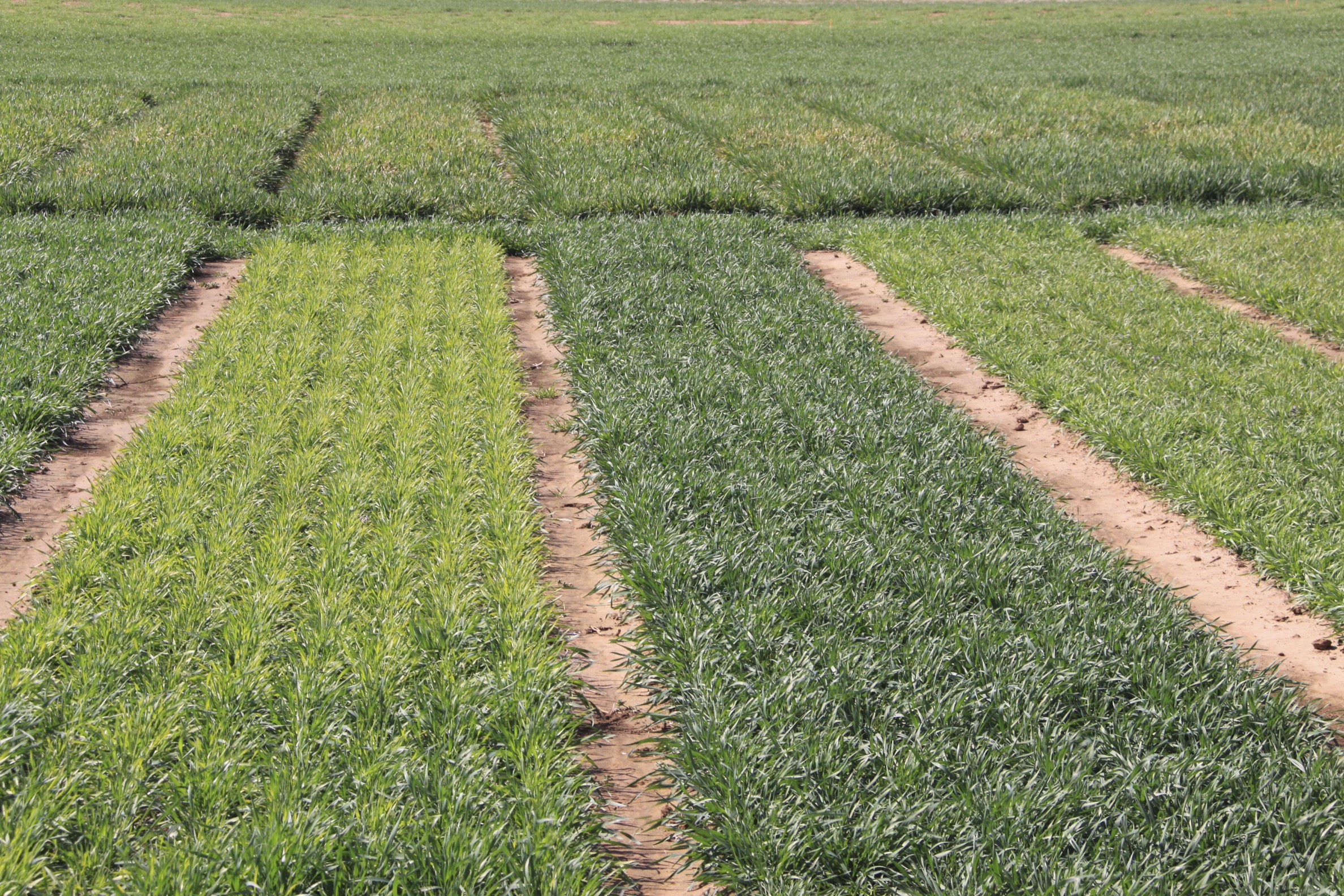
Wheat soilborne mosaic virus can cause yellowing in the spring in susceptible varieties such as the one on the left.

Wheat soilborne mosaic virus can cause yellowing in the spring in susceptible varieties such as the one on the left.

First hollow stem update 03/14/2014

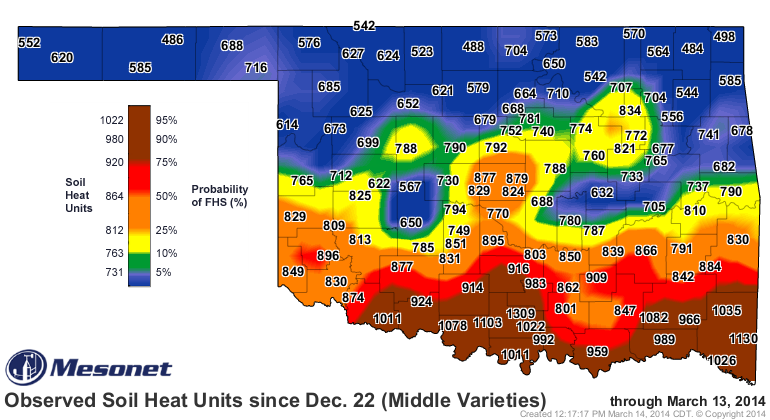
WB-Cedar and Sy Llano reached first hollow stem this week, and there are several additional early-maturing varieties that are near first hollow stem. The results from a March 13 sampling of plots are posted below, and we will post results from another sample early next week. I have also posted the map from the Oklahoma Mesonet’s First Hollow Stem Advisor for medium maturity varieties. As indicated in the map, most wheat south of I-40 is likely at or past first hollow stem.

Probability of first hollow stem for medium maturity wheat varieties on 03/14/14

Probability of first hollow stem for medium maturity wheat varieties on 03/14/14


First hollow stem works as a pull off date for cattle on wheat pasture because it allows the plant a small amount of time prior to jointing to recover some of the green leaf area lost to grazing. As evidenced by the results posted on this blog, first hollow stem is running a good 1.5 to 2 weeks later than normal. Given the situation, it is advisable to consider removing cattle from wheat pasture sooner rather than later. In many cases this would be before the occurrence of first hollow stem. I make this recommendation because once our temperatures start to warm, it is likely that that wheat phenological development will proceed in rapid fashion. We could easily encounter a situation where there are only a few days separating first hollow stem and jointing. Pulling cattle from wheat pasture a little early will allow extra time for recovery, which might be needed this year.

Variety cm of hollow stem 03/13/2014
Endurance 0.5
Deliver 0.7
Pete 1.4
OK Bullet 0.4
OK Rising 0.5
Billings 1.1
Ruby Lee 0.4
Garrison 0.6
Duster 0.1
Gallagher 0.8
Iba 0.3
Everest 1.0
Jackpot 1.1
Doans 0.8
Greer 0.4
CJ 1.1
SY Southwind 1.0
Sy Llano 1.5
Armour 1.0
WB-Cedar 1.7
WB-Redhawk 0.7
WB-Grainfield 0.1
Winterhawk 0.7
WB4458 0.8
T153 0.8
T154 0.9
T158 0.5
LCS Mint 0.2
LCS Wizard 0.4
LCH11-109 0.3
LCH11-1117 0.8
LCH11-1130 0.6
TAM 112 1.3
TAM 113 1.4
Byrd 0.4
Brawl CL Plus 0.6
Centerfield 0.1
Doublestop CL Plus 0.4
OK09125 0.5
OK09520 0.3
OK10126 0.0
OK08707W-19C13 1.4
OK10805W 0.3
OK10728W 1.2
OK11754WF .
Average 0.7

First hollow stem update 03/11/2014

With the exception of one experimental line, there are still no varieties at the first hollow stem stage of growth at Stillwater. The results from a March 10 sampling of plots are posted below, and we will post results from another sample later this week. First hollow stem works as a pull off date for cattle on wheat pasture because it allows the plant a small amount of time prior to jointing to recover some of the green leaf area lost to grazing. As evidenced by the results posted on this blog, first hollow stem is running a good 1.5 to 2 weeks later than normal.

Given the situation, it is advisable to consider removing cattle from wheat pasture sooner rather than later. In many cases this would be before the occurrence of first hollow stem. I make this recommendation because once our temperatures start to warm, it is likely that that wheat phenological development will proceed in rapid fashion. We could easily encounter a situation where there are only a few days separating first hollow stem and jointing. Pulling cattle from wheat pasture a little early will allow extra time for recovery, which might be needed this year.

Variety cm of hollow stem 03/10/2014
Endurance 0.16
Deliver 0.00
Pete 0.32
OK Bullet 0.15
OK Rising 0.15
Billings 0.60
Ruby Lee 0.13
Garrison 0.20
Duster 0.02
Gallagher 0.84
Iba 0.17
Everest 0.60
Jackpot 1.09
Doans 0.04
Greer 0.33
CJ 0.07
SY Southwind 0.57
Exp F14 0.86
Armour 1.00
WB-Cedar 0.97
WB-Redhawk 1.08
WB-Grainfield 0.09
Winterhawk 0.35
WB4458 0.40
T153 0.64
T154 0.37
T158 0.07
LCS Mint 0.29
LCS Wizard 0.00
LCH11-109 0.00
LCH11-1117 0.12
LCH11-1130 0.88
TAM 112 1.03
TAM 113 0.84
Byrd 0.62
Brawl CL Plus 0.00
Centerfield 0.00
Doublestop CL Plus 0.00
OK09125 0.08
OK09520 0.05
OK10126 0.00
OK08707W-19C13 0.55
OK10805W 0.00
OK10728W 0.24
OK11754WF 1.61
Average 0.40

First hollow stem update 03/05/2014

First hollow stem is the optimal time to remove cattle from wheat pasture (full explanation). We measure first hollow in our September-sown wheat forage plots at Stillwater each year, and normally have approximately 50% of varieties at or past first hollow stem by March 1st. I have posted first hollow stem measurements from these plots in a table at the end of this blog. No varieties are currently at first hollow stem at Stillwater, but I anticipate the small amount of moisture gained from recent snow and warming temperatures will spur onset of first hollow stem over the next week or so. We will take another set of measurements on March 10 and report the results on this blog.

Keep in mind that the numbers reported from Stillwater are likely behind those being observed in southern Oklahoma and ahead of those observed in northern Oklahoma. Dillon Butchee in the Altus area reported finding first hollow stem in Jagger last week. The First Hollow Stem Advisor on the Oklahoma Mesonet indicates that  early varieties in southern Oklahoma are likely past first hollow stem and that early varieties in central Oklahoma will reach this point within a week. Keep in mind the one week projection uses historical weather conditions which exceed our current forecast. Cooler than normal conditions will not last forever, though, and my advice is to move cattle off of wheat pasture in southern Oklahoma yesterday, start moving them off of wheat pasture in central Oklahoma today, and move cattle off wheat pasture in northern Oklahoma next week.

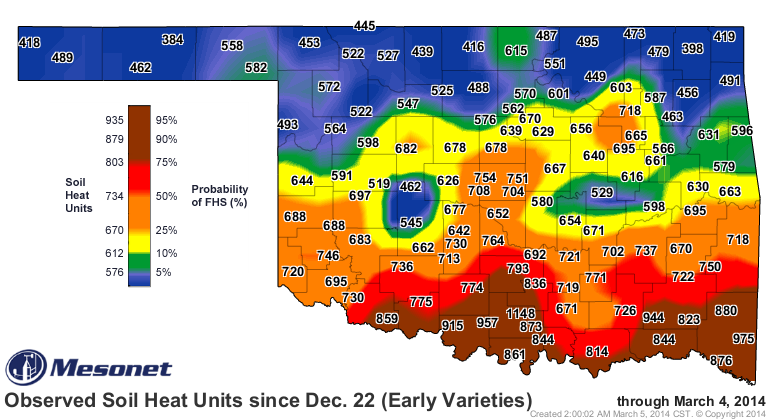
Probability of first hollow stem for early varieties 03/05/2014

Probability of first hollow stem for early varieties 03/05/2014

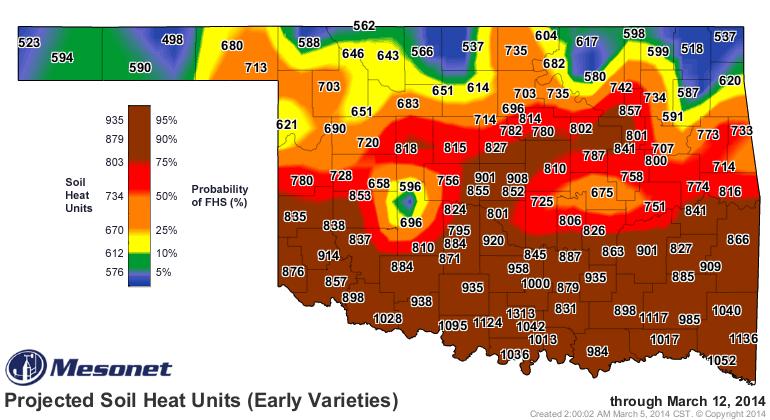
One week projected probability of first hollow stem for early varieties 03/05/2014

One week projected probability of first hollow stem for early varieties 03/05/2014

Variety cm of hollow stem 03/05/2014
Endurance 0.00
Deliver 0.00
Pete 0.24
OK Bullet 0.00
OK Rising 0.00
Billings 0.62
Ruby Lee 0.04
Garrison 0.22
Duster 0.00
Gallagher 0.39
Iba 0.00
Everest 0.29
Jackpot 0.12
Doans 0.00
Greer 0.31
CJ 0.02
SY Southwind 0.11
Exp F14 0.03
Armour 0.22
WB-Cedar 0.51
WB-Redhawk 0.66
WB-Grainfield 0.10
Winterhawk 0.09
WB4458 0.00
T153 0.00
T154 0.23
T158 0.02
LCS Mint 0.02
LCS Wizard 0.02
LCH11-109 0.11
LCH11-1117 0.10
LCH11-1130 0.16
TAM 112 0.14
TAM 113 0.77
Byrd 0.12
Brawl CL Plus 0.00
Centerfield 0.00
Doublestop CL Plus 0.03
OK09125 0.00
OK09520 0.03
OK10126 0.00
OK08707W-19C13 0.02
OK10805W 0.02
OK10728W 0.02
OK11754WF 0.77
Average 0.15

Plant growth regulators for wheat

Many Oklahoma wheat farmers battled lodged wheat in 2013 and are looking to plant growth regulators to help reduce lodging in 2014. Lodging occurs due to a variety of factors, and as shown in the figure below, the timing of lodging will determine the final impact on grain yield. Lodging at head emergence can cause as little as 30 or as much as 80% yield reduction. The numbers in the figure do not account for harvest losses, which can exceed losses associated with lower photosynthetic capacity shown in the figure.

Slide05

Freeze injury or disease can cause lodging due to stem failure, which is characterized by plant stems breaking near the base. I the absence of weakened stems due to freeze or disease, most lodging in wheat is caused by failure of the root anchorage system (root lodging). Root lodging occurs when the anchorage system of a top-heavy wheat plant is weakened due to moist soil and wind provides sufficient force to overcome the rotational stiffness of the root/soil complex. Research has shown that increasing the soil water content from 17 to 26% reduced the force required for anchorage failure by 33%, and as little as 0.25 inches of water plus 11 mph winds were enough to cause lodging. The thicker the wheat crop and/or the taller the wheat crop, the more force that winds exert on the root anchorage system and the greater the likelihood of lodging.
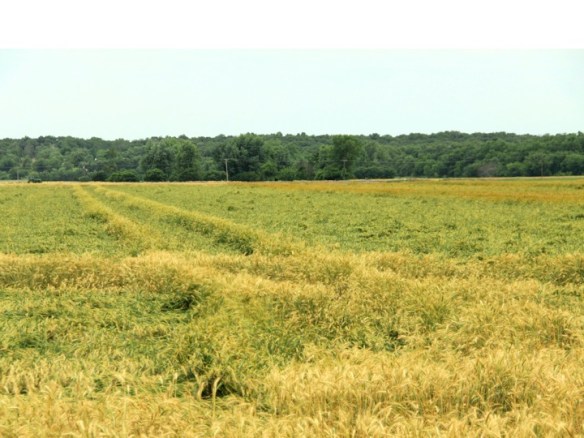
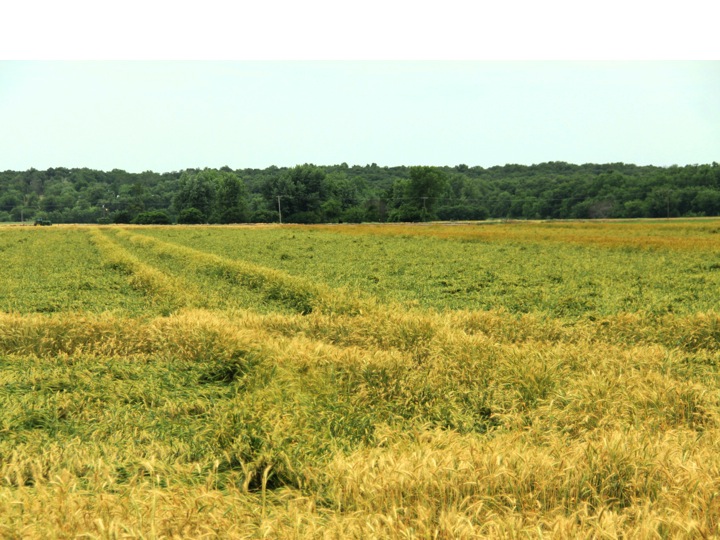
Severe lodging in an Oklahoma wheat field in 2013

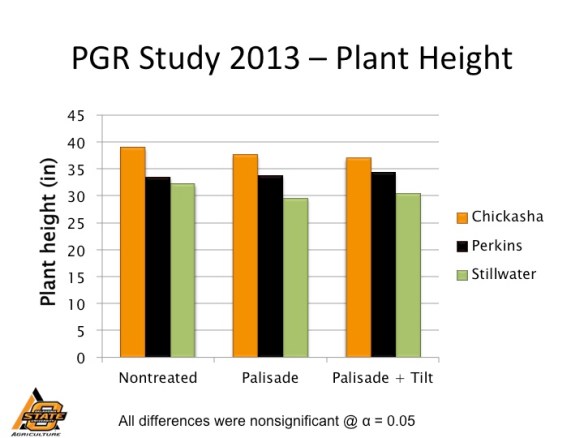
In 2013 we evaluated the plant growth regulator trinexapac-ethyl, which is sold under the trade name Palisade®. Palisade is a giberellic acid inhibitor and works primarily by reducing plant height. In our study we evaluated 12 oz/ac of Palisade with and without 4 oz/ac of Tilt (propiconazole) applied at Feekes GS 7 (two nodes visible above the soil surface). We included an untreated check and ALL plots, including the check, received 10.5 oz/ac of Quilt Xcel at Feekes GS 10.5 (heading). We conducted the trial at Stillwater (Irr), Perkins (Irr), and Chickasha (Non-Irr).
Slide11

While application of Palisade resulted in numeric reductions in plant height at Chickasha and Stillwater, differences among treatments were not statistically significant.
Slide14

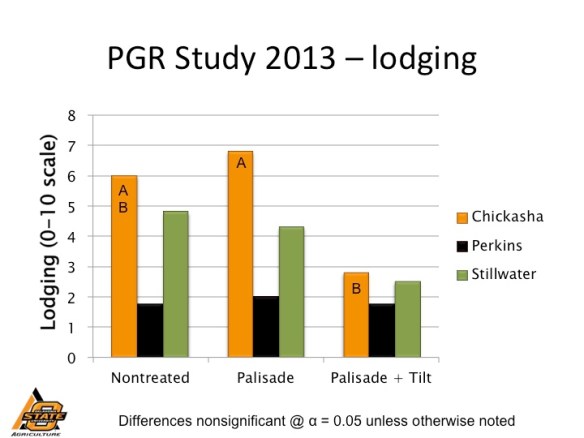
We rated plots for lodging at harvest using a 1 – 10 scale with 0 equaling no lodging and 10 equaling complete lodging.  Application of Palisade plus Tilt reduced lodging over Palisade alone at Chickasha. Application of Palidsade or Palisade plus Tilt resulted in numeric reductions in lodging scores at Stillwater, but the result were too variable to result in statistical significance. Palisade did not affect lodging at Perkins.
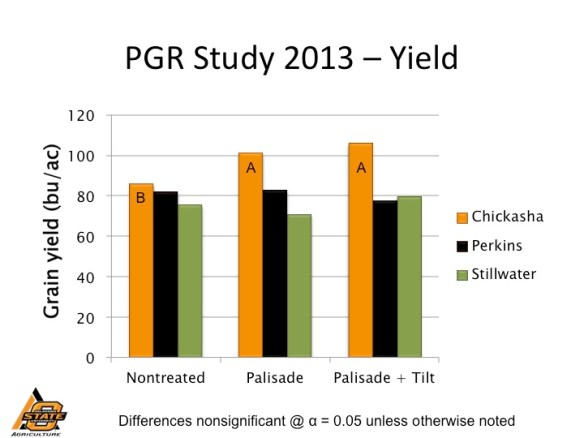
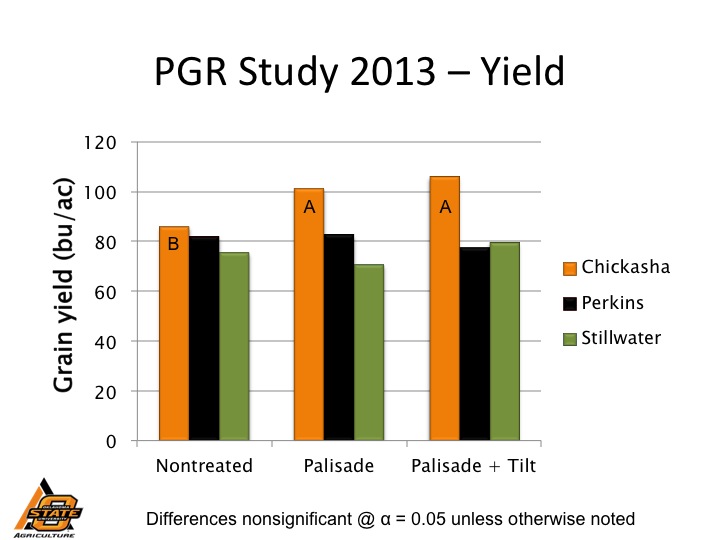
Slide18Application of Palisade or Palisade plus Tilt increased grain yield at Chickasha and had no effect on grain yield at Stillwater or Perkins. It is interesting to note that the Palisade treatment increased grain yield at Perkins even though the plots lodged at comparable levels as the non treated check. My best hypothesis is that the treated plots lodged later than the non treated plots, as all plots were standing at anthesis (see picture below).Lodging occurred at Chickasha, but occurred later in the season.

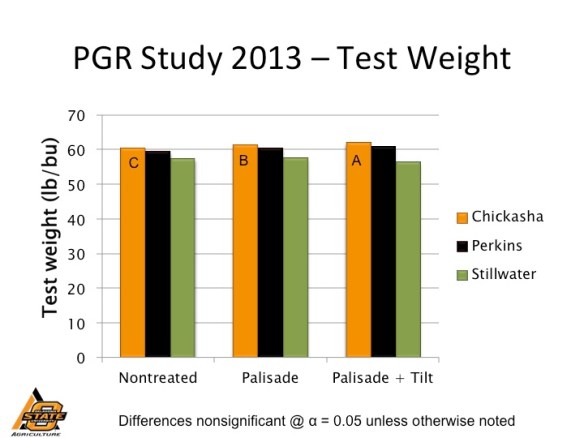
Slide19Palisade and Palisade plus Tilt increased test weight at Chickasha and had no effect on test weight at Perkins or Stillwater

To summarize this first year of work with plant growth regulators, we found a trend for one to two inch reductions in plant height when Palisade or Palisade plus Tilt were applied, but this only translated to increased grain yield at one site. Our results are consistent with other wheat plant growth regulator research, which has reported similar variation in response among sites and years.  The literature also shows that reduction in lodging is relative to the straw strength of the variety. That is, a plant growth regulator will not make a lodging prone variety stand like one with excellent straw strength, rather they will make it less prone to lodging relative to the same variety non treated.

Based on current evidence, plant growth regulators in Oklahoma are best kept on acres with high (> 80 bu/ac) yield potential that may have greater propensity for lodging due to variety or fertility.  If these high yield potential acres are being sprayed with a growth regulator at GS 7, the addition of a foliar fungicide might be prudent if it can be included at a relatively low cost. This early-season fungicide application will not, however, substitute for a fungicide application at flag leaf.

Full disclosure: Syngenta donated the product for this trial, but the only funding for the research was provided by the Oklahoma Agricultural Experiment Station and the Oklahoma Cooperative Extension Service. We are conducting the same trial in 2014 along with a separate trial evaluating Palisade in drought stress environments that is partially funded by Syngenta. The analysis and recommendations made in this blog post are preliminary and based on research findings from 2013. Recommendations may change as further research is conducted and new information is obtained.
Water-based drilling mud and wheat

The recent increase in oil and gas exploration has resulted in the production of more water-base mud, (WBM), a by-product from the drilling process. The most common method of disposal for this material is land application to agricultural and grazing lands. As the name implies, water is the most common component of water base mud, but water-base mud also contains dissolved solids and sodium and a small amount on non-dissolved solids. Therefore the primary risk associated with over application of water-base mud is the soil becoming saline or sodic.

Water-base mud is mostly water, but also contains dissolved solids that, without agitation, will settle out of solution over time.

Water-base mud is mostly water, but also contains dissolved solids that, without agitation, will settle out of solution over time.

Soil salinity can be a problem for plants. Excessive salinity (approx. > 7,800 ppm for wheat) can decrease the ability of the plant to extract water from soil, even when water is plentiful. Salts can also interfere with germination. Germination reduction due to starter fertilizers with excess nitrogen or potassium, for example, are an example of how salts can inhibit germination. The solution for excess salt is typically water in the form of rainfall, as the water will move the salts deeper into the soil and out of the rooting zone. Unfortunately, rainfall in western Oklahoma is not always plentiful enough to achieve this downward movement and salts can accumulate.

OSU researchers Dr. Chad Penn and Dr. Jason Warren initiated a study at Lahoma, Oklahoma in 2012 to determine how in-season application of water-base drilling mud affected soil salinity and wheat yield. They evaluated  4,000 and 6,000 lbs/ac of total dissolved solids (6,000 lb/ac is the maximum allowed by the Oklahoma Corporation Commission) and five different timings from 16 October to 20 March. A detailed description of their findings is available in Current Report CR2272 at www.wheat.okstate.edu. 

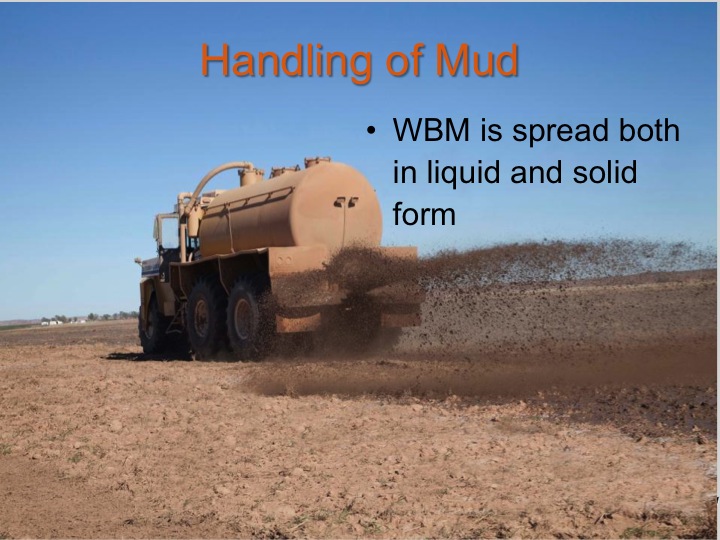
Water-base mud is spread in both liquid and solid form

Water-base mud is spread in both liquid and solid form

Drs. Penn and Warren found that the salts from the water-base mud accumulated in the top three inches of soil initially. Rainfall for the next 90 days was scarce (0.5 inches total) and the salt remained largely in the top three inches of soil. Once rainfall picked up, however, the salts started moving downward through the soil profile. As expected the 6,000 lb/ac total dissolved solids rate resulted in greater soil salinity than the 4,000 lbs/ac rate, so the less you apply per acre, the lower the chances of increasing soil salinity to toxic levels.

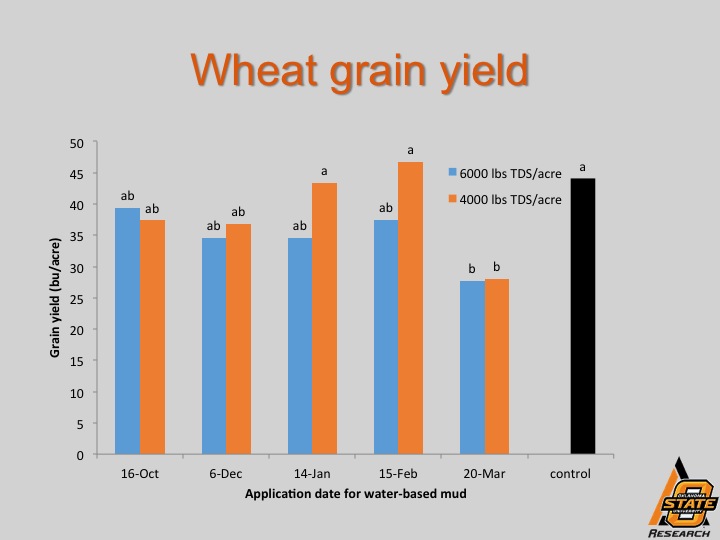
In this study water-base mud applied to wheat prior to approximately first hollow stem did not significantly affect wheat grain yield; however, water-base mud applied March 20 (approximately jointing) reduced wheat grain yield. Their recommendation resulting from this study was not to apply water-base mud after February 15. It is also important to consider the effects of wheel traffic and associated soil compaction from applications of water-base mud.

Effect of water-base mud on subsequent wheat grain yield. Source: OSU Current Report 2272

Effect of water-base mud on subsequent wheat grain yield. Source: OSU Current Report 2272

This blog entry is a summarization of OSU Current Report 2272 Application of water-base drilling mud to winter wheat: impact of application timing on yield and soil properties. You can view the entire document at http://www.wheat.okstate.edu under Wheat Management then Fertility. Dr. Chad Penn (chad.penn@okstate.edu) and Dr. Jason Warren (jason.warren@okstate.edu) are authors of the publication.

First hollow stem advisor available on Mesonet

First hollow stem occurs just prior to jointing and is the optimal time to remove cattle from wheat pasture. A new first hollow stem advisor tool available on the Oklahoma Mesonet provides Oklahoma wheat farmers a real time assessment of the current first hollow stem situation in the state and a forecast for the next two weeks. While the first hollow stem advisor is a valuable tool, it is not a substitute for scouting, as conditions in your field may vary from the estimates provided.

The advisor uses a mathematical model that predicts the probability of first hollow stem based on soil heat units and wheat first hollow stem category (early, middle, or late). The model was developed by J.D. Carlson at OSU using first hollow stem data from the wheat variety testing program, and model development was made possible through a grant from the Oklahoma Wheat Commission.

You can navigate to the first hollow stem advisor from www.mesonet.org by clicking on “Agriculture” then “Crop-Wheat”  and looking for First Hollow Stem Advisor on the lefthand menubar. Or you can click here.  

Screen Shot 2014-02-14 at 1.01.50 PM

Once you are at the first hollow stem advisor page, you will need to make a few selections. First, you have an option of viewing a statewide map or you can view data for a particular site in a table or graph. Next, you can select whether you want to view the current situation or a projection for the next one or two weeks. Finally, you will need to indicate if your variety falls into the early, middle, or late category. Click on the “look up by category” link if you are unsure where your variety falls.

hollowstem_early.current

Above is the statewide map for current conditions as of 14 February 2014. Other than a hot spot near Ardmore, there is less than 5% probability that we are at first hollow stem in Oklahoma. Note, however, that many locations are near the 576 heat unit threshold for 5% probability of first hollow stem. This is where the projection tools come in handy.

hollowstem_early.proj14day

The map above is the two-week first hollow stem projection through 28 February 2014 (i.e the map was created on 14 February 2014). These projections are based on historical weather data for the next two weeks, and do not take into account the current forecast which might be warmer or colder than the historical average. Note that almost the entire state up to I-40 is predicted be at or above the 25% probability level for first hollow stem by February 28. It is recommended that you start scouting once the advisor predicts a 5% probability of first hollow stem in your area. If you are going by the first hollow stem advisor alone (not recommended) cattle should be removed no later than when a 50% probability of first hollow stem has occurred.

First hollow stem nearing

First hollow stem occurs just prior to jointing and is the optimal time to remove cattle from wheat pasture. Given the warm forecast for the next two weeks, it is likely that we will start seeing first hollow stem in Oklahoma wheat fields. Grazing past first hollow stem can reduce wheat grain yield by as much as 5% per day and the added cattle gains are not enough to offset the value of the reduced wheat yield.

Similar to previous years, we will monitor occurrence of first hollow stem in our wheat plots at Stillwater and report the findings on this blog. There is also a new first hollow stem advisor available on the Oklahoma Mesonet that can assist in determining when to start scouting.

Checking for first hollow stem is fairly easy.

  • You must check first hollow stem in a nongrazed area of the same variety and planting date. Variety can affect date of first hollow stem by as much as three weeks and planting date can affect it even more.
  • Dig or pull up a few plants and split the largest tiller longitudinally (lengthways) and measure the amount of hollow stem present below the developing grain head. You must dig plants because at this stage the developing grain head may still be below the soil surface.
  • If there is 1.5 cm of hollow stem present (see picture below), it is time to remove cattle. 1.5 cm is about the same as the diameter of a dime.
  • Detailed information on first hollow stem can be found at www.wheat.okstate.edu under ‘wheat management’ then ‘grazing’
  • Image