Time to start topdressing wheat

There are few crop inputs that deliver as much return on investment as nitrogen fertilizer. It takes approximately two pounds of nitrogen, costing approximately $1.00, to produce one bushel of grain worth about $6.00. Of course, nitrogen is not the only yield determining factor in a wheat crop. Also, the law of diminishing marginal returns eventually kicks in, but nitrogen fertilizer is still one of the safest bets in the house.

Top dress nitrogen fertilizer is especially important because it is applied and utilized at a time when the plant is transitioning from vegetative to reproductive growth. Several things, including the number of potential grain sites, are determined just prior to jointing and it is imperative that the plant has the fuel it needs to complete these tasks. Jointing also marks the beginning of rapid nitrogen uptake by the plant which is used to build new leaves, stem, and the developing grain head. The nitrogen stored in these plant parts will be used to fill the grain later in the season, and the plant is dependent on this stored nitrogen to complete grain fill.

In the bullet points below, I will hit the major points regarding top dress nitrogen for wheat.  I have also posted three slide presentations with audio regarding topdressing wheat at my YouTube channel available by clicking here or by searching YouTube for OSU Small Grains. 

When to apply

  • In order to have full benefit, nitrogen must be in the rooting zone by the time wheat is jointing. Jointing occurs around the end of February in southern OK and around the second week of March in northern OK.
  • Moisture is required to move nitrogen into the rooting zone. Since precipitation is usually very limited in January and February in Oklahoma we need the nitrogen out on the field when the precipitation arrives. This, along with the fact that we have 5.5 million acres to cover, means that we need to get started in January to get everything taken care of in a timely fashion.
  • If you are using the Sensor Based Nitrogen Recommendation system your yield predictions and nitrogen recommendations generally become more accurate as the season progresses; however, growers wishing to hedge their nitrogen bet could apply a partial top dress in January or early February and supplement with a second top dress just prior to jointing if SBNR recommendations call for additional nitrogen.
  • Do not apply nitrogen to frozen ground. Nitrogen will move with water. If melting snow or frozen rain is moving to the ditch, so will nitrogen applied to the soil surface.
  • Consider splitting or delaying top dress nitrogen applications to sandy soils until closer to jointing, as leaching can occur.

How much to apply

  • On average it takes about 2 lbs/ac of N for every bushel of wheat yield. In addition, dual-purpose wheat requires 30 lbs/ac of N for every 100 lbs/ac of beef removed. You can subtract your soil test NO3-N from these total requirements.
  • It is okay to adjust topdress N plans based on your current yield potential. When you submitted your soil test, you might have stated a 50 bu/ac yield goal which would require 100 lbs/ac of nitrogen; however, it is important to take a hard look and determine if this yield goal is still realistic based on your current crop status. I am not suggesting to adjust based on what you think the weather might do, but it is okay to take inventory and adjust your topdress N up or down based on current field conditions.
  • Don’t have an N-rich strip? It would be a lot cooler if you did. An N-rich strip would take the guess work out of adjusting your topdress N up or down based on your current crop conditions. Your county extension educator can provide more information on N-rich strips and you can find more information on the web at www.npk.okstate.edu

What source to use

  • The plant does not care about nitrogen source. A pound of nitrogen is a pound of nitrogen. Focus on getting the correct amount applied at the correct time, and choose your product based on price and application uniformity.
  • Use a source that can be applied uniformly. In my experience, spinner trucks or buggies are generally the least uniform. Air trucks or streamers are the most uniform.
  • Streamer nozzles almost eliminate leaf burn from UAN; however, leaf burn is generally not an issue until temperatures warm and/or you are applying fairly large amounts of UAN. Stream nozzles are also not affected much by wind and deliver a uniform pattern in a variety of conditions. There are also some studies that indicate banding of UAN through the use of stream nozzles will reduce nitrogen immobilization on crop residue. All in all, I am a big fan of streamer nozzles. You cannot, however, tank mix herbicides when using streamer nozzles.
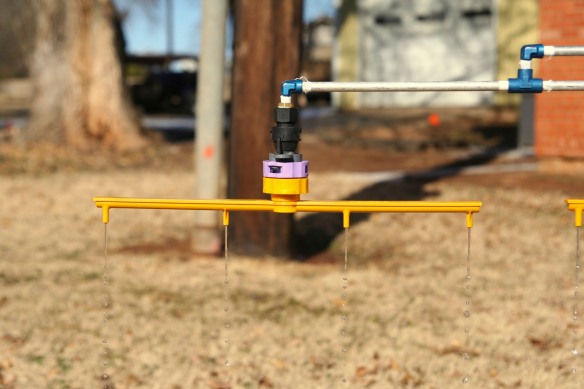
    Streamer nozzles provide uniform application of UAN in a wide variety of environmental conditions.
    Streamer nozzles provide uniform application of UAN in a wide variety of environmental conditions.

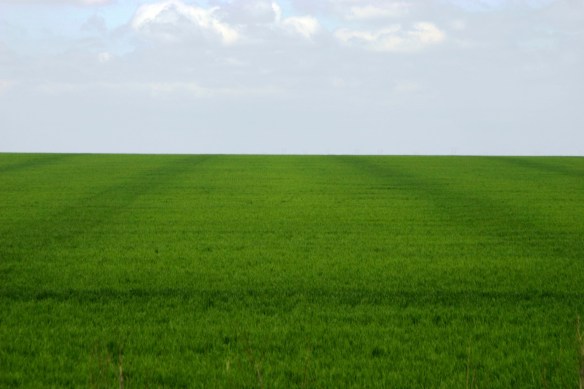
    Poor nitrogen application can result in a streaked field. Some of the areas in this field were over fertilized while some were under fertilized resulting in wasted nitrogen and less than optimal crop yield.

    Poor nitrogen application can result in a streaked field. Some of the areas in this field were over fertilized while some were under fertilized resulting in wasted nitrogen and less than optimal crop yield.

Freeze injury

Freeze injured plants from Cotton County, OK. Note the green, healthy leaf coming through the desiccated leaves in the plant on the right

Freeze injured plants from Cotton County, OK. Note the green, healthy leaf coming through the desiccated leaves in the plant on the right. These plants will make a full recovery with adequate moist and fertility.

Our recent extreme shifts in temperature have resulted in moderate to severe freeze injury in some Oklahoma wheat fields. To be honest, the damage is not as widespread or severe as I thought it would be given that most of our wheat had not had an opportunity to harden off. The dry soil conditions in western and southern Oklahoma did not help the situation, as there was not sufficient soil moisture to buffer the temperature shift in the top few inches of soil.

Freeze injury at this stage of growth (tillering) rarely impacts grain yield, but, as always, there are a few exceptions. Wheat that was very small or late-sown is more susceptible to winter kill. Similarly, wheat that does not have a good root system or that was shallow sown due to crop residue is more susceptible to winter kill. It is best to wait until after a few days of favorable growing conditions to check for freeze injury. Plants with regrowth that is green and healthy should make a full recovery, and this will be the case for most Oklahoma wheat fields.

Freeze injury in late-sown wheat near Enid, OK. Some of the smaller plants might have a tough time recovering, but given favorable conditions, the wheat stand as a whole still has adequate time to "fill in" and compensate for some of the lost plants.

Freeze injury in late-sown wheat near Enid, OK. Some of the smaller plants might have a tough time recovering, but it is still too early to determine whether or not the field as a whole will adequate to produce a decent grain crop.

Winter grain mites in SW OK

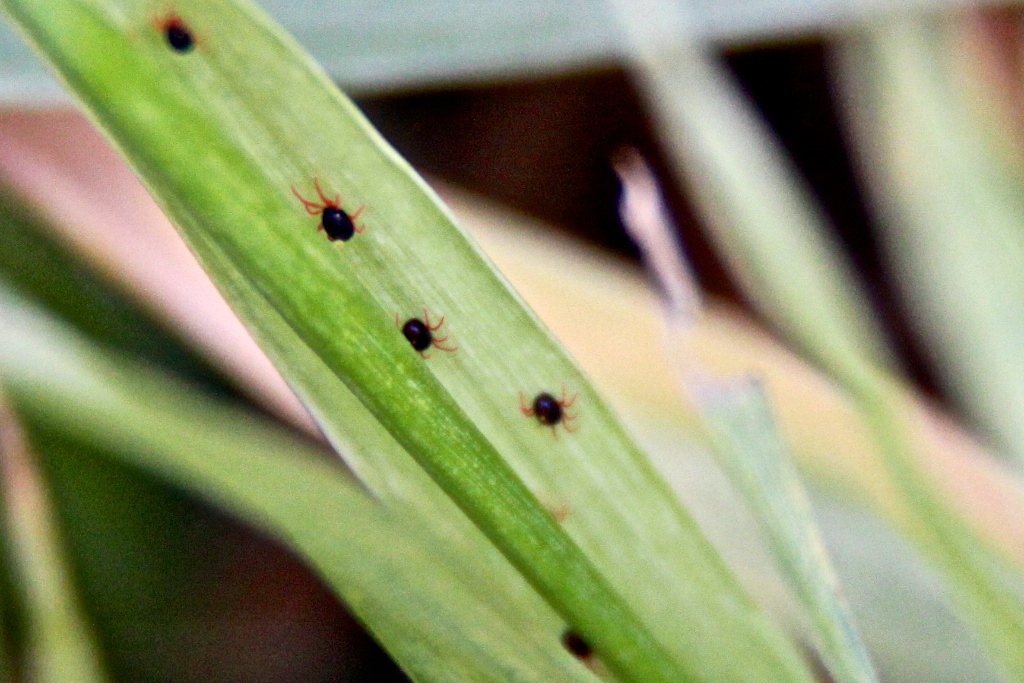
Over the past week, I have received a few reports of winter grain mite activity in southwest Oklahoma. Winter grain mites are small (about 1 mm long) with black bodies and orange-red legs. Winter grain mites complete two generations per year and the adults can live for up to 40 days. The generation we are dealing with now resulted from oversummering eggs laid last spring. The second generation peaks in March/April and results from eggs laid in January/February.

Scouting
Winter grain mites are light sensitive and prefer calm air to windy conditions; therefore, scouting early in the morning, late in the evening, or on cloudy days generally works best. Be sure to look under residue in no-till fields and under clumps of soil in conventional-till fields.

Image

Winter grain mites on wheat near Blair, Oklahoma.

Injury
Winter grain mites feed by piercing plant cells in the leaf, which results in “stippling”.  As injury continues, the leaves take on a characteristic grayish or silverish cast.  Winter grain mites are more likely to cause injury in wheat if it is already stressed due to lack of moisture or nutrients. Also be advised that freeze injury can easily be confused for winter grain mite injury.

When to spray
There are no established thresholds for winter grain mite. Healthy, well-fertilized wheat plants can generally outgrow injury, so it takes large numbers to justify control. If there is injury present AND large numbers of mites (~10 per plant) present in grain only wheat this time of year, you might consider control. If the wheat is to be grazed, I would simply monitor the situation in most cases and only spray if injury became severe.

What to spray
There are not a lot of pesticides with winter grain mite listed on the label, and most products have grazing restrictions. Malathion and methyl parathion have been shown to provide effective control in the past. Consult OSU Current Report 7194 Management of insect and mite pests in small grains for a more complete listing of available pesticides.

Hessian fly strikes back!

Back in 2006 it appeared that Hessian fly was going to be the demise of no-till wheat production in Oklahoma. Early planting, lack of crop rotation, and no-till monocrop wheat all create a favorable environment for Hessian fly, and there were several early-sown fields that were completely lost to the Hessian fly in 2006 & 2007. About that same time OSU release a variety named Duster that was an excellent grazing wheat with good yield potential. Duster also happened to be Hessian fly resistant. (If you are not a Star Wars fan, skip the next sentence) This resistance was a clear proton torpedo in the thermal exhaust port of the fully operational Hessian fly Death Star.

Mature Hessian fly larvae are brown in color and often referred to as flaxseed. Tillers with larvae will not recover and will eventually die and slough off.

Mature Hessian fly larvae are brown in color and often referred to as flaxseed. Tillers with larvae will not recover and will eventually die and slough off.

Over the past four years, I have received very few calls about Hessian fly. It seemed as thought the adoption of Duster and unfavorable environmental conditions resulted in a dramatic reduction in Hessian fly in Oklahoma, but there are some indications Hessian fly is making a return. I have received a few calls about Hessian fly this fall, most of them from southwest Oklahoma. In most cases producers had  either switched to a newer variety that was not Hessian fly resistant or changed to a nonresistant variety because they were displeased with Duster’s performance the past two years.

There are no curative treatments for Hessian fly in wheat. If you currently have a field that is infested with Hessian fly, the first step is to assess the level of infestation. If a plant with four viable tillers has one infected, then the impact on yield might not be that great, as we could have additional tillering in late winter. A field with the majority of tillers infected is likely a good candidate for graze out.

It is never too soon to be thinking of how to limit the impact of Hessian fly on next year’s crop. Planting a resistant variety still remains the most effective technique of combating the Hessian fly menace in Oklahoma for dual-purpose wheat farmers. To determine which varieties are resistant, consult a current OSU Wheat Variety Comparison Chart. Insecticide seed treatments are effective early in the season, but do not typically last long enough to provide season long control in Oklahoma. Cultural practices such as crop rotation and delaying planting until mid October will also help reduce Hessian fly infestations but might not be suitable for all operations.

Planting wheat in hot soils

As is usually the case in Oklahoma, we currently have a wide range of soil moisture conditions. Soils in central Oklahoma are generally dry on top, but there is ample soil moisture below. Soils in western Oklahoma and the Panhandle are dry all the way down. A few drills have started rolling, but most producers are waiting on a “State Fair” rain to get started (for all you non-Okies, it usually rains sometime during the State Fair in early September). While moisture availability is the primary driver of wheat planting, it is not the only consideration for producers. Hot soil conditions can affect wheat germination too, and there are a few questions producers should ask themselves prior to planting into soil temperatures >90F.

coleoptile length

If the wheat coleoptile does not break the soil surface, the germinating wheat plant will not survive.

Will you have to plant deep to reach moisture? That first structure protruding from a germinating wheat seed is actually not a leaf. It is the coleoptile. The wheat coleoptile is a rigid structure whose sole purpose is to “punch through” the soil surface so that the first true leaf emerges above the soil surface. If this does not happen, the first true leaf will try to extend below the soil surface, turn yellow, and take on an accordion-like appearance (picture above). Modern semi-dwarf wheat varieties have shorter coleoptiles than older, tall wheat varieties and coleoptile length is shortened even further by hot soil conditions. So it is important to plant a variety with a longer coleoptile length (e.g. Garrison or Doans) if planting deeply into hot soils. A rating of coleoptile lengths for wheat varieties can be found in OSU Fact Sheet 2141 OSU Wheat Variety Comparison Chart available at www.wheat.okstate.edu or at the direct link to the publication here.

Is the variety high temperature germination sensitive? High temperature germination sensitivity is a fancy way of saying that some wheat varieties simply don’t germinate well in hot soil conditions (e.g. 2174, Overley). The extent of the sensitivity varies by year, so Overley might germinate fine in 95F soils one year and produce a 10% stand in the same soil conditions the next. When sowing early, it is best to plant varieties that do not have high temperature germination sensitivity (e.g. Duster, Gallagher, or Armour). Soil conditions generally cool due to lower ambient temperatures or cooling rains by about September 20; however our summer temperatures seem to be arriving late this year, so it is best to know the level of germination sensitivity in the variety you are planting. A rating of high temperature germination sensitivity for wheat varieties can be found in the variety comparison chart linked above. A more detailed explanation of the phenomenon can be found in OSU Fact Sheet PSS 2256 Factors affecting wheat germination and stand establishment in hot soils (available by clicking here).

2013 Wheat variety performance test results posted

All Oklahoma wheat variety test sites are now harvested and the results are posted at www.wheat.okstate.edu. I have posted a brief summary of the 2013 crop below. Over the next several weeks, I will be posting additional trial results on this blog along with opinion and analysis of results.


2013 WHEAT CROP OVERVIEW

At the time of writing this report, 2013 Oklahoma wheat production is estimated to be approximately 114 million bushels, which is roughly 26% less than 2012 production (Table 1).  The production decrease was due to the combination of lower yields and fewer harvested acres. Given the challenges faced in the 2012-2013 wheat production year, however, most would consider the average yield and total production to be much better than expected.


Table 1. Oklahoma wheat production for 2012 and 2013 as estimated by OK NASS, June 2013
 

2012

2013

Harvested Acres

4.3 million

3.8 million

Yield (bu/ac)

36

30

Total bushels

154.8 million

114 million


We have had several dry starts for wheat planting in Oklahoma, but the fall of 2012 might go down as the driest of the dry. A few timely rains in late August and early September allowed early and mid-September sown wheat to emerge and get a rapid start on forage production. This was the last substantial rain that most of western Oklahoma received until early 2013. As a result, much of our October-sown crop remained partially emerged in dry soil until after the first of the year.


Wheat that had emerged in September had consumed available water by early November and turned brown by December. Many fields were assumed dead, as there was no green tissue remaining above the soil surface (e.g. Marshall Dual-Purpose trial). This left little to no grazing potential for many dual-purpose wheat producers. Our Stillwater forage trial, for example, had less than 500 lb/ac (estimated) of available forage in early December, which is our normal forage measurement timing.


Rain was not plentiful in early 2013, but there was enough to allow the wheat crop to rebound. Wheat seed that had been lying in the soil germinated and early-emerging fields that had turned brown from drought were resuscitated and brought back to life. Wheat in southwestern OK and the Panhandle remained on life support throughout the season, surviving but never really thriving. Given these extreme circumstances, the grain yield at our Chattanooga, Altus, and Hooker sites are nothing short of amazing. Although wheat finally emerged at our Alva, Balko, Buffalo, Cherokee, Gage, Keyes, and Lamont sites, the stands were far too variable for use in comparing the yield potential of wheat varieties.


Drought was not the only weather-related issue Oklahoma wheat producers dealt with in 2013. There were multiple rounds of freeze events in late March and early April. Wheat in southwest Oklahoma and the Panhandle was affected by different freeze events but both sustained 30 to 80% tiller loss and were largely written off in the weeks following the freezes. Outside of far southwestern OK, cooler than normal conditions and some replenishment of soil moisture allowed regeneration of tillers. This, along with extended grainfill duration, allowed many wheat fields to recover and produce greater than expected grain yields (e.g. Apache variety trial). The cooler than normal spring temperatures were beneficial for wheat grainfill, but also delayed harvest by about one month as compared to 2012 and about two weeks as compared to the long term average.


It was a fairly quiet year regarding foliar disease. Pockets of the state suffered from heavy powdery mildew infestation in March and April, and some wheat producers chose to split-apply fungicides to combat this disease. There were also areas affected by glume blotch, tan spot, and septoria, but there was not much leaf or stripe rust present.


Yellow and purple leaves were tell tale signs that a late spring flush of aphids had transmitted barley yellow dwarf virus to several Oklahoma wheat fields. Armyworms were present late in the season, but generally did not reach threshold levels prior to maturity and few fields were sprayed. Winter grain mites took advantage of slow-growing, drought-stressed wheat and were a frequently reported problem in southwest OK, but the wheat curl mite takes top billing among mite pests in 2013. The wheat curl mite transmits wheat streak mosaic and high plains viruses. These two diseases are fairly common in the Panhandle but do not typically affect wheat in central OK. In 2013 fields as far east as Kingfisher tested positive for wheat streak mosaic and several central OK fields were affected. Growers affected by wheat streak mosaic should take care to ensure that any volunteer wheat or corn is dead at least two weeks prior to planting to reduce the risk of this disease in 2013-2014.


Wheat better than expected at Chattanooga, Kingfisher, and Chickasha

Chattanooga, Kingfisher, and Chickasha wheat variety trial results are posted at www.wheat.okstate.edu.  Grain yields at Chattanooga ranged from 12 to 36 bushels per acre. It is truly amazing that wheat somehow managed to produce these yields this in the presence of severe drought and three major freezes. Kingfisher wheat grain yields ranged from 32 to 47 bushels per acre and were more or less on par with expectations. This site had less than ideal moisture conditions, but adequate moisture to keep the wheat from turning brown as it did in many locations.

The Chickasha wheat variety trial had some problems. A late March freeze killed up to 58% of viable tillers in some varieties and lodging at harvest was moderate to severe. While leaf rust and stripe rust were not major factors, we did have a variety of leaf spotting diseases (e.g. tan spot, septoria, glum blotch) and severe, widespread bacterial blight/black chaff throughout the plot. In spite of these challenges, average yield at this site was 69 bushels per acre with yields ranging from 50 to 83 bushels per acre. While these yields are outstanding given the challenges of the year, they are not the best at the Chickasha research station. Approximately 200 feet from the variety trial was a growth regulator study planted to Iba that produced 98 to 102 bushels per acre. I have this same trial at two additional locations and will summarize results later in the year.

Both small plot combines running at Chickasha

Both small plot combines running at Chickasha

Altus wheat variety trial results

It was a rough year to farm wheat in Altus, OK. Our plots were sown into extremely dry soil on October 8, 2012 and received a total of 1.08 inches of rain by December 31. Total rainfall for the entire season was only 7.9 inches. Under these conditions it is amazing that wheat survived, but we somehow entered March with approximately 30 bu/ac yield potential. Some production fields in the area had 50 bu/ac potential and needed nothing more than a few rains to maintain this yield potential. The rains never came and Mother Nature dealt an additional card from the bottom of the deck with major freeze events in late March, late April, and early May.

Altus wheat variety trial results are posted at www.wheat.okstate.edu. Top varieties this year were Doublestop CL Plus (25 bu/ac), WB-Grainfield (22bu/ac), and the OSU experimental lines OK08328 (23 bu/ac) and OK09125 (22 bu/ac). Eleven out of 39 varieties made less than 10 bu/ac, and it is hard to say if drought or freeze had the larger effect on wheat yield. Based on the maturity rating of the top yielding varieties (ie late maturing) one could make the argument that freeze had the larger effect, but some relatively early and medium maturing varieties performed relatively well in the presence of the freeze (e.g. Duster and OK Bullet). The interactions are complicated and not easily explained.

Additional variety trial results will be posted as locations are harvested. To keep up with the latest results, follow me on Twitter @OSU_smallgrains


Wheat disease update 05 June 2013

Wheat disease updates are written by Dr. Bob Hunger, OSU Extension Plant Pathologist

Oklahoma:

Not a lot to add since the last report and this is likely the last one from Oklahoma unless something out of the ordinary occurs.  Wheat is being harvested in southwestern OK.  I’ve heard reports that ranged from “about 180 bu from 50 some acres” up to around 30 bu/acre.  Wheat around Stillwater is typically at medium dough with very little green leaf tissue left in the leaves.  Stems are still mostly green but also beginning to fade.  All of the wheat I looked at on Monday had 3 plump kernels/mesh.

A field day last Thursday (30-May) in Pawnee County (30 miles northwest of Stillwater) revealed a trial and surrounding field with severe leaf spot.  Isolations from 3 varieties all yielded Pyrenophora (tan spot) and Septoria/Stagonospora with tan spo (Pyrenophora) more common than the other two.  The wheat was approaching dough, so I don’t think there will be a huge yield hit – especially given the moisture and cool spell we have been having.  I have only rarely seen tan spot and the leaf spot diseases in general this severe in Oklahoma.

Dr. Ned Tisserat (wheat Pathologist at Colorado State University) confirmed our suspected diagnosis of bacterial streak/black chaff in the variety trial at Chickasha (about 40 miles southwest of Oklahoma City).  Symptoms were widespread and quite severe across all varieties, but similar symptoms due to leaf spots, drought, and freeze also contributed to the overall burnt appearance to the trial.

Finally, Bryan Vincent (crop consultant – north central OK) sent in photos of isolated spots in a wheat field in Kay County (just south of Kansas in north central OK).  Although no sample was submitted, the photos and description of the situation definitely indicated this to be take all.

Reports/excerpts of reports from other states:

KansasDr. Erick De Wolf (Professor/Small Grains Extension Pathologist, Kansas State Univ, Manhattan, KS) 03-Jun-2013: Fields in Central Kansas are maturing rapidly now and many fields were at the milk stages of development last week.  The levels of stripe rust and leaf rust remain low in Kansas this year despite some earlier reports of stripe rust when the wheat was heading.  It appears higher temps have slowed the development of stripe rust.  Only trace levels of stripe rust can be found in most plots and commercial fields I visited May 27-31in Republic, Smith and Phillips counties (North central).  Rust was absent from plots and fields I checked in Eills, Rush, Ness, and Lane counties (west central KS) this year and drought remains a serious issue for these growers.

I observed low to moderate levels of leaf rust in a variety testing location in Reno county (south central KS) on May 31.  The incidence was near 80% but severity was still very low (generally less than 2%) of the flag leaves of susceptible varieties such as Overley, Jagger and Jagalene.  The wheat in this plot was at the milk stages of kernel development so I do not expect any significant yield loss at this location.


NebraskaDr. Stephen Wegulo (Small Grains Extension Pathologist, Univ of Nebraska, Lincoln, NE) 30-May-2013:  This afternoon I looked at breeding nursery plots in Lincoln (Lancaster County, southeast Nebraska).  I found trace levels of stripe rust.  The predominant disease was powdery mildew in the lower canopy, followed by leaf spots, mainly Septoria.  There was a low incidence of Fusarium head blight (FHB) at low severity (one spikelet bleached on wheat, more on barley and in one case an entire barley head bleached).  I suspect FHB is going to be a problem in the eastern part of the state.  The timing of heavy, continuous rainfall coinciding with heading and flowering couldn’t be better for FHB development in the eastern part of the state.  We have had these conditions over the last week or so and even before.  Dr. P. Stephen Baenziger, UNL small grains breeder, happened to be at the nursery when I arrived.  He told me his team saw stripe rust at higher than trace levels in a breeding nursery at Mead (about 30 miles north of Lincoln).  Conditions are perfect for rapid development and/or spread of just any fungal or bacterial disease in eastern Nebraska.  I also saw low levels of barley yellow dwarf virus in lines that appeared to be susceptible.  A sample with virus symptoms I brought back from Saline County (also in southeast Nebraska) last week has tested positive for wheat streak mosaic.

Wheat disease update 25 May 2013

Wheat disease updates are written by Dr. Bob Hunger, Extension Plant Pathologist

I and Nathalia Grachet (OSU Graduate Student) returned Friday from a trip and field days in the panhandle of Oklahoma.  Wheat at Lahoma (25 miles west of Enid) ranged from full berry (watery) to the milk stage.  Driving further to the northwest after about Alva was depressing as the condition of the wheat and the landscape in general deteriorated with what seemed like each passing mile.  The field days we attended were at Balko (40 miles east of Guymon) and Hooker (20 miles northeast of Guymon).  Wheat in these trials ranged from flowering to full berry (watery).  Rick Kochenower (Panhandle Area Specialist – Agronomy) related the story that demonstrates the resilience of wheat.  The Balko area was hit hard by the last freeze in April such that he felt there would be no wheat there.  However, a mild May with just a little moisture allowed secondary tillers to come back, and if some rainfall and mild temperatures occurs for the next couple of weeks, some wheat will be harvested in the area.  This is not the scenario over the entire panhandle.  According to Rick, wheat in Cimarron County (far western county in the panhandle) is all but gone primarily due to drought whereas in Texas and Beaver County freeze and drought have both played a role in severely impacting wheat production.

Leaf and stripe rust were found this past week around Stillwater but not at a typical incidence or severity; leaf rust is especially lacking.  Dr. Art Klatt reported being able to easily find leaf rust in his plots near Perkins, OK (15 miles south of Stillwater) in the range of 5-20S, which is lighter than typical.  At Lahoma, Nathalia and I found both leaf and stripe rust but at low incidence and severity (especially leaf rust).  Leaf spotting was more common, but it was difficult to determine if this was Septoria, Stagonospora, tan spot and/or physiological.

Signs of wheat streak mosaic and barley yellow dwarf can still be observed, especially around Lahoma where flag leaves are still mostly green.  In the panhandle and northwestern OK it is difficult to discern virus damage from freeze and drought.


Reports/excerpts of reports from other states:

Nebraska – Dr. Stephen Wegulo (Small Grains Extension Pathologist, Univ of Nebraska, Lincoln, NE) 24-May-2013:  Wheat in Nebraska is mostly in the boot to heading growth stages.  There have been no new reports or observations of rust diseases since the observation of stripe rust at Mead on May 7.  On May 21 and 22, I surveyed wheat fields in Lancaster, Saline, and Saunders Counties in southeast Nebraska.  I did not find any rust diseases.  The stripe rust that was observed at Mead on May 7 stopped activity following the high temperatures we had during the week of May 13 (including 100+ deg F on May 14), and never spread, similar to Carl Bradley’s observation in Champaign County, IL.