Fall armyworm on the march!

by: Tom Royer, OSU Extension Entomologist

Fall armyworms are active this fall. I checked a field of wheat this past weekend with significant damage from fall armyworms that averaged 6-7 fall armyworms per square foot. Scout for fall armyworms by examining plants in several (5 or more) locations in the field. Fall armyworms are most active in the morning or late afternoon. Look for “window paned” leaves and count all sizes of larvae.

Fall armyworm damage is characterized by window panning on wheat leaves. Injury can sometimes be greater in field margins as armyworms sometimes move in from adjacent road ditches or weedy areas.

Fall armyworm damage is characterized by window panning on wheat leaves. Injury can sometimes be greater in field margins as armyworms sometimes move in from adjacent road ditches or weedy areas.

Fall armyworms are generally most active early in the morning or late in the evening. Spray when 2-3 armyworms per linear foot of row are present.

Fall armyworms are generally most active early in the morning or late in the evening. Spray when 2-3 armyworms per linear foot of row are present.

Examine plants along the field margin as well as in the interior, because they sometimes move in from road ditches and weedy areas. The caterpillars were widely distributed in the field that I checked, suggesting that they were the result of a large egg lay from a recent adult moth flight. The suggested treatment threshold is 2-3 larvae per linear foot of row in wheat with active feeding. We won’t get relief from fall armyworms until we get a killing frost, since they do not overwinter in Oklahoma.

Consult the newly updated OSU Fact Sheet CR-7194 Management of Insect and Mite Pests of Small Grains for control suggestions.

Wheat protein report – 2014

This blog post contains information from OSU Current Report 2135 Protein Content of Winter Wheat Varieties in Oklahoma. A complete pdf version of the report with a brief explanation of sampling procedures can be found at www.wheat.okstate.edu.

The grass always seems to be greener on the other side when it comes to wheat protein. In a low protein year, everyone is scrambling to find higher protein wheat to blend. In a high protein year, such as this one, the same low protein wheat that was considered marginally acceptable the year before might command a slight premium. While wheat protein is important to end users, wheat protein is just one of many attributes which determine end-use quality and marketability of winter wheat. In fact, some millers and bakers would argue that functionality of wheat protein is more important than the quantity of protein. While varietal differences commonly exist, differences in wheat protein among environments are generally much larger than differences among varieties. Factors such as nitrogen fertility and drought stress, for example, can sharply impact final protein content of the grain, and most producers are better served focusing on good agronomic practices than slight genetic differences in wheat protein content.

To reflect environmental impacts on wheat grain protein content, 2014 wheat variety test data are reported by variety and location in Table 1. The 18.5% average wheat grain protein for the Thomas location is a good example of how fertility and environment can impact protein content. Soil tests at the time of sowing revealed 141 lb/acre of residual nitrogen available, which should be enough to produce a 70 bu/acre wheat crop. Due to extreme drought, however, average grain yield at Thomas was 13 bu/acre. Under these circumstances, wheat plants were able to pull large amounts of nitrogen from the soil and move this nitrogen to the developing grain. Grain size was reduced and grains were shriveled due to drought, thus resulting in abnormally high wheat protein. A similar situation was reported for Altus in 2013.

In Table 2 we reported the wheat grain protein content as a deviation from location mean for each variety, as this provides easier comparison of wheat grain protein among varieties across locations. Billings, for example, is a variety with solidly positive deviation from location means, indicating it has a tendency for above-average grain protein content. Iba, on the other hand, has negative deviations from location means, indicating a tendency for lower than average grain protein content. Adequate nitrogen fertility as recommended by a recent soil test or sensor-based nitrogen management program can help ensure that varieties such as Iba produce grain protein within the acceptable range for end-use customers. Iba is also a prime example of how protein data can sometimes be misused, as the functionality of the protein in Iba is above average, which can offset lower absolute grain protein content.

First hollow stem update 03/05/2014

First hollow stem is the optimal time to remove cattle from wheat pasture (full explanation). We measure first hollow in our September-sown wheat forage plots at Stillwater each year, and normally have approximately 50% of varieties at or past first hollow stem by March 1st. I have posted first hollow stem measurements from these plots in a table at the end of this blog. No varieties are currently at first hollow stem at Stillwater, but I anticipate the small amount of moisture gained from recent snow and warming temperatures will spur onset of first hollow stem over the next week or so. We will take another set of measurements on March 10 and report the results on this blog.

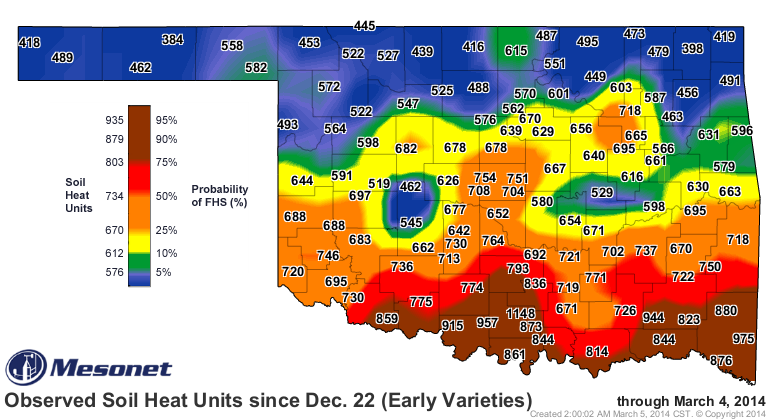
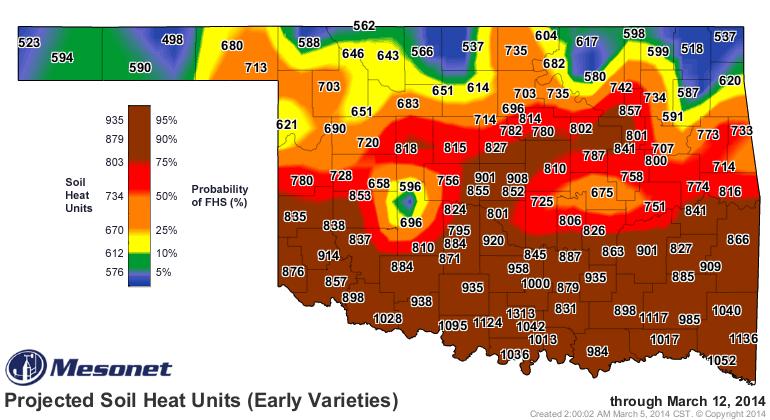
Keep in mind that the numbers reported from Stillwater are likely behind those being observed in southern Oklahoma and ahead of those observed in northern Oklahoma. Dillon Butchee in the Altus area reported finding first hollow stem in Jagger last week. The First Hollow Stem Advisor on the Oklahoma Mesonet indicates that  early varieties in southern Oklahoma are likely past first hollow stem and that early varieties in central Oklahoma will reach this point within a week. Keep in mind the one week projection uses historical weather conditions which exceed our current forecast. Cooler than normal conditions will not last forever, though, and my advice is to move cattle off of wheat pasture in southern Oklahoma yesterday, start moving them off of wheat pasture in central Oklahoma today, and move cattle off wheat pasture in northern Oklahoma next week.

Probability of first hollow stem for early varieties 03/05/2014

Probability of first hollow stem for early varieties 03/05/2014

One week projected probability of first hollow stem for early varieties 03/05/2014

One week projected probability of first hollow stem for early varieties 03/05/2014

Variety cm of hollow stem 03/05/2014
Endurance 0.00
Deliver 0.00
Pete 0.24
OK Bullet 0.00
OK Rising 0.00
Billings 0.62
Ruby Lee 0.04
Garrison 0.22
Duster 0.00
Gallagher 0.39
Iba 0.00
Everest 0.29
Jackpot 0.12
Doans 0.00
Greer 0.31
CJ 0.02
SY Southwind 0.11
Exp F14 0.03
Armour 0.22
WB-Cedar 0.51
WB-Redhawk 0.66
WB-Grainfield 0.10
Winterhawk 0.09
WB4458 0.00
T153 0.00
T154 0.23
T158 0.02
LCS Mint 0.02
LCS Wizard 0.02
LCH11-109 0.11
LCH11-1117 0.10
LCH11-1130 0.16
TAM 112 0.14
TAM 113 0.77
Byrd 0.12
Brawl CL Plus 0.00
Centerfield 0.00
Doublestop CL Plus 0.03
OK09125 0.00
OK09520 0.03
OK10126 0.00
OK08707W-19C13 0.02
OK10805W 0.02
OK10728W 0.02
OK11754WF 0.77
Average 0.15