Oklahoma wheat update 03/28/2014

On Friday, March 28th I made a tour through northwestern Oklahoma to diagnose a few problem fields and get a better feel for the wheat crop condition. I have provided a brief description of what I saw below. I did not make it to southwestern Oklahoma this trip, but by all accounts the wheat is dry, brown, and barely hanging on. A best case scenario in areas southwest of Apache this year is a poor wheat crop. It will have to rain a lot between now and harvest for this to happen.

Reports from Apache eastward are somewhat better. The wheat crop in this area still has potential, but the potential is declining. A farmer from the Hinton area called yesterday and indicated that moisture could still be found about 1 inch below the soil surface, but the top is still very dry. We need a soaking rain to move nitrogen into the rooting zone and to perk the crop up post dormancy.

My first stop this morning was at Lamont. Wheat in this area is smaller than normal and is at approximately Feekes GS5. There were several yellow areas in fields and uneven wheat. Much of this yellowing appeared to be nitrogen deficiency, but not all of it was due to insufficient top dress nitrogen. We simply have not had enough moisture to get good movement of top dress N into the rooting profile and for the wheat crop to take up applied N. Some of the yellowing was also due to drought stress. Some of the yellowing could have been due to brown wheat mite and/or winter grain mite activity (described more below).

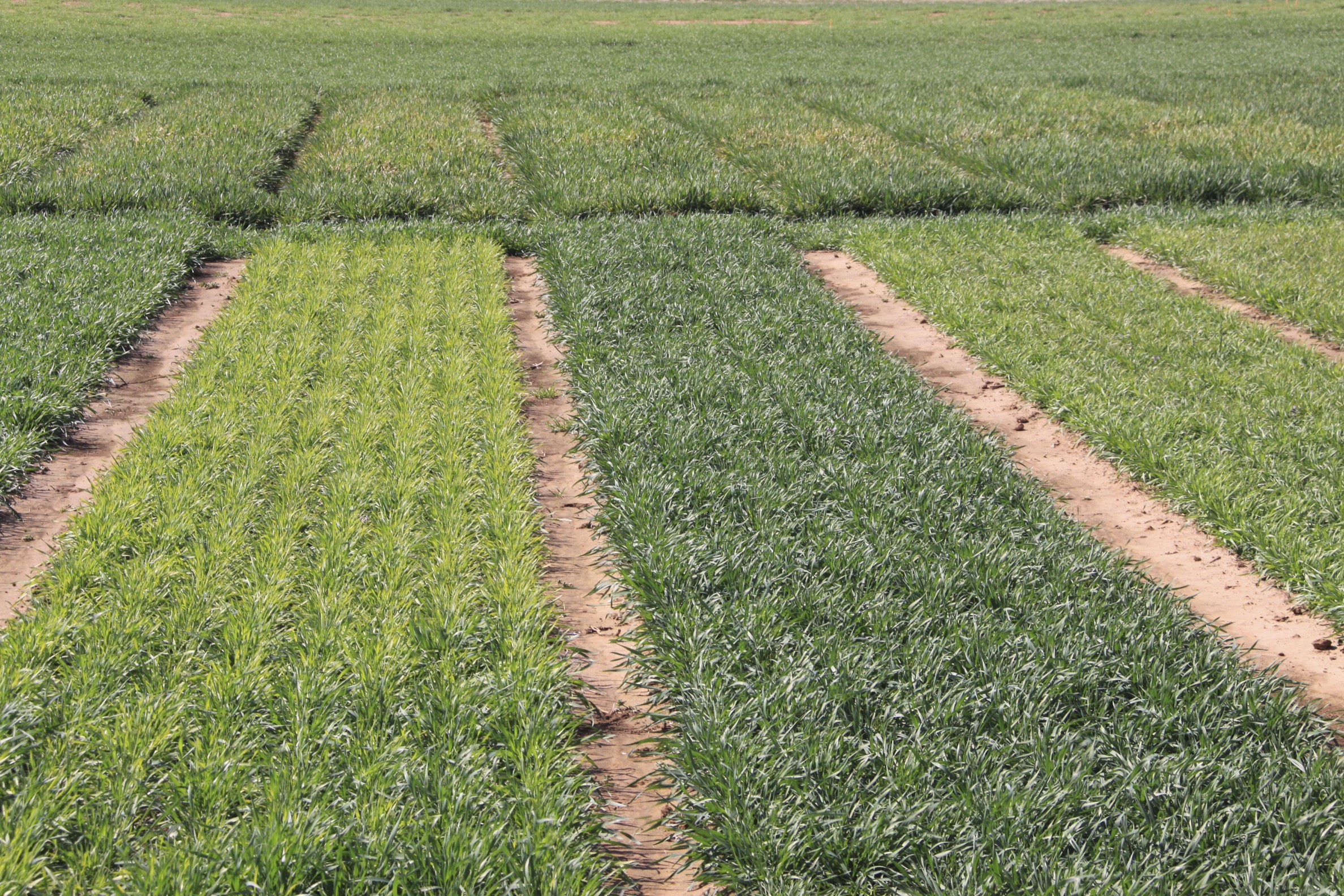
My second stop was at our Cherokee variety plots. Wheat in this area was uneven, similar to Lamont. As shown in the picture below, part of our plot area was showing significant yellowing. Initially, I thought this was due to changes in soil type/nutrient variability. Upon closer inspection, this area was infested with brown wheat mite. These symptoms have only started to show in the last week or so. Thanks to variety trial cooperator Kenneth Failes, this situation will be remedied as soon as the wind settles.

The yellow, stunted areas in our Cherokee variety trial were caused by brown wheat mite

The yellow, stunted areas in our Cherokee variety trial were caused by brown wheat mite


Next stop was Alva, where the trend of uneven and yellow wheat continued. As shown in the picture below, there were several fields in the area with spots of dead or nearly dead wheat. Brown wheat mites were found in most of these fields and probably weakened plants which increased the amount of winterkill. In some fields seed had been placed at the proper depth, but the seed trenches were partially filled with residue rather than soil. Residue provides less insulation than soil and likely made heavy residue areas more prone to winterkill. I also noticed in these fields that the crown of the plant had developed in residue rather than soil, which likely increased winterkill. I looked at additional no-till fields in the area with severe winter injury, but plants that were still viable. Grazed fields seemed to have greater injury than non-grazed.

Areas of winterkill in no-till wheat near Alva

Areas of winterkill in no-till wheat near Alva


Although seeded at the proper depth, some wheat plants in heavy residue areas had crown placement at the soil surface. This increased the severity of winterkill.

Although seeded at the proper depth, some wheat plants in heavy residue areas had crown placement at the soil surface. This increased the severity of winterkill.

I looked at a few fields south of Enid. Unlike the fields in Grant, Alfalfa, and Woods Counties, this primary issue in these fields was winter grain mite instead of brown wheat mite. The symptoms were areas of the field having a silver tint. Some areas had died or lost several tillers and these areas got bigger as the season progressed and dry conditions worsened.

Field affected by winter grain mite south of Enid. Note the silver tint of the wheat on the left side of the terrace.

Field affected by winter grain mite south of Enid. Note the silver tint of the wheat on the left side of the terrace.


I ended my tour at Marshall, Oklahoma where I did not find any insects, but did find some thirsty wheat. All of the insect issues I encountered today can be corrected with scouting and insecticides. Wheat winterkill was present, but rarely affected entire fields and was not that widespread. The primary concern for all of Oklahoma remains lack of moisture. There are some fields in north central and northwestern Oklahoma with good yield potential; however, the best areas are starting to turn blue due to lack of moisture. Another couple of weeks of warm temperatures and wind without rain will turn blue wheat to brown. We need moisture.

Brown wheat mite showing up in winter wheat

by: Tom Royer, OSU Extension Entomologist

Our winter wheat has taken a beating this winter, with cold weather hanging on and some areas not getting that thirst quenching precipitation to help it get a great jump start this spring.  In addition, I have received scattered reports of brown wheat mites showing up and causing problems.  Producers need to remain alert so that their wheat is not suffering dual problems of dry growing conditions PLUS brown wheat mite.

Brown what mite can severely damage wheat that is already stressed due to drought or other adverse environmental conditions.

Brown what mite can severely damage wheat that is already stressed due to drought or other adverse environmental conditions.

Brown wheat mite is small (about the size of this period.) with a metallic brown to black body and 4 pair of yellowish legs.  The forelegs are distinctly longer that the other three pair. Brown wheat mites can complete a cycle in as little as 10-14 days.  They will undergo up to 3 generations each year, but have probably already completed at least one or two by now. Numbers will likely decline if a hard, driving rain occurs.  Spring populations begin to decline in mid-late April when females begin to lay “diapause” eggs.

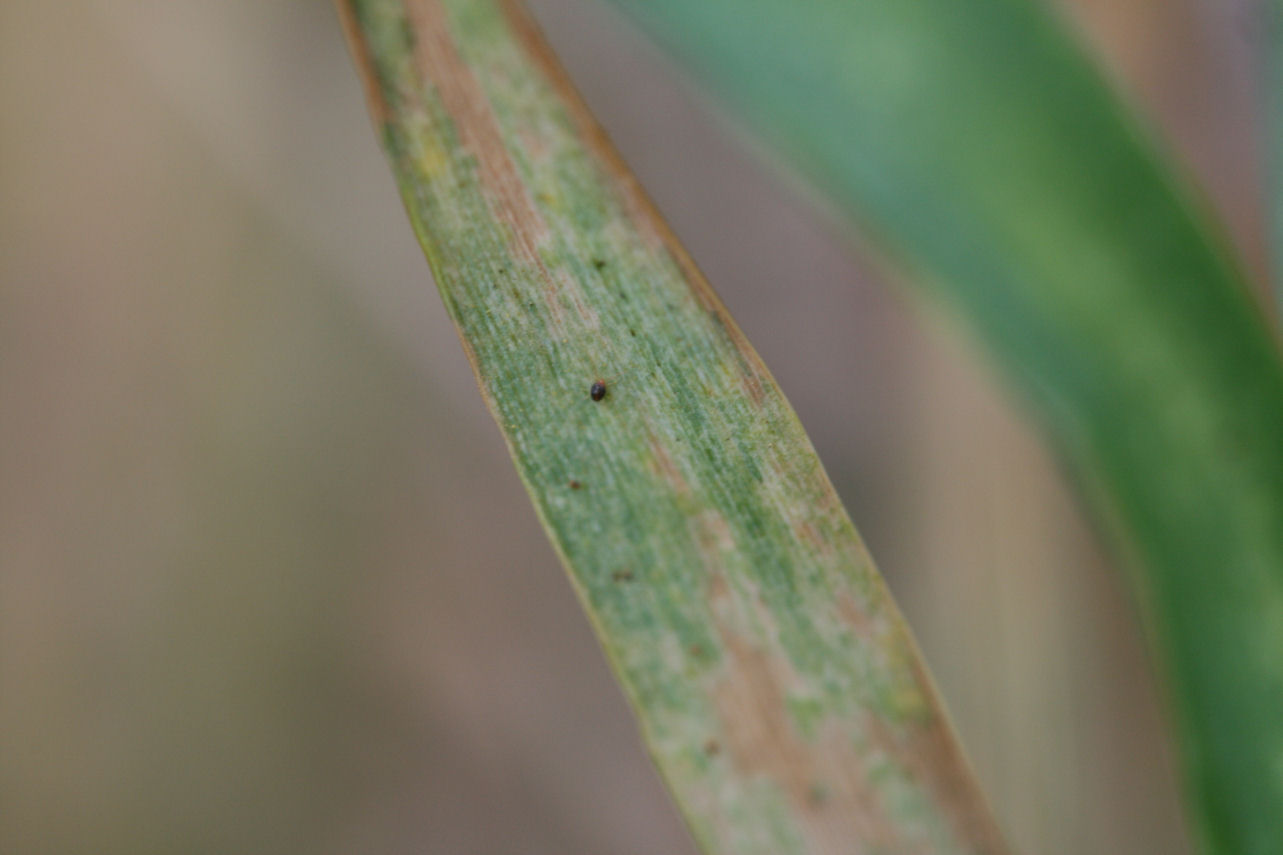
Brown wheat mite causes problems in wheat that is stressed from lack of moisture.  They feed by piercing plant cells in the leaf, which results in “stippling”.  As injury continues the plants become yellow, then dry out and die.  These mites feed during the day, and the best time to scout for them is in mid-afternoon.  They do not produce webbing and will quickly drop to the soil when disturbed. They are very susceptible to hard, driving rains, but until then they can cause yield loss when present in large numbers

A closeup of a brown wheat mite. Photo courtesy Franklin Peairs, CSU.

A closeup of a brown wheat mite. Photo courtesy Franklin Peairs, CSU.

Brown wheat mites are about the size of a period at the end of a sentence and can be difficult to see with the naked eye.

Brown wheat mites are about the size of a period at the end of a sentence and can be difficult to see with the naked eye.

Research suggests that a treatment threshold of 25-50 brown wheat mites per leaf in wheat that is 6-9 inches tall is economically warranted.  An alternative estimation is “several hundred” per foot of row.

Check CR-7194, Management of Insect and Mite Pests in Small Grains for registered insecticides, application rates, and grazing/harvest waiting periods. It can be obtained from any County Extension Office, at www.wheat.okstate.edu, or by clicking here.

Brown wheat mite eggs in soil.

Brown wheat mite eggs in soil.


Wheat disease update – 21 March 2014

Wheat disease updates are written by Dr. Bob Hunger, OSU Extension Plant Pathologist

Oklahoma:  Diseases are still quiet across Oklahoma.  Gary Strickland (Extension Educator – southwest Oklahoma) indicated he has “seen one leaf rut pustule.”  Also, wheat just has not grown in his area and is just starting to get to the point of tillering but there is so little growth he doesn’t feel there is sufficient growth to support much tillering.  He did indicate he has seen and has a lot of reports of brown wheat mites.

Around Stillwater, the wheat soilborne/spindle streak mosaic is the only disease of prominence.  I did find some small pustules of powdery mildew in the extreme low leaves of ‘Pete’ wheat that was in the range of Feekes 6.  Wheat around Stillwater is in much better condition than in western Oklahoma where drought has been severe.  I also have seen quite a few lady beetles in my trials and plots, but have yet to see any aphids.

Reports/excerpts of reports from other states:

Arkansas  Dr. Gene Milus (Professor/Wheat Pathologist, Univ of Arkansas) 20-Mar-2014:  Jason Kelley, Extension wheat agronomist, found fresh leaf rust pustules on volunteer wheat at the Cotton Branch Experiment Station near Marianna on March 20.

Louisiana Dr. Stephen Harrison (Professor/Wheat Breeder, LSU AgCenter) 18-Mar-2014:  I found leaf rust at the Ben Hur Research Farm in Baton Rouge yesterday.  This was in an early-planted field for Hessian Fly where I found a few pustules around Christmas.  The cold and very wet winter put the rust on hold until recently but it is active and should ‘take off’ now.  I have not received any other rust reports from around the state but will check nurseries in north Louisiana tomorrow.

The wheat crop is a little later than normal and has a much tighter range of heading dates due to the cold winter.  The variety trial probably averages second node but is very rapidly developing.

Wheat disease update – 14 March 2014

Wheat disease updates are written by Dr. Bob Hunger, OSU Extension Plant Pathologist

Oklahoma:  No foliar diseases of significance to report in Oklahoma.  Wheat is mostly just coming out of dormancy, and cold/dry conditions have not favored initiation of foliar diseases.  My soilborne/spindle streak nursery is starting to show symptoms of these virus diseases.  The wheat is just starting to “green-up,” so symptoms of this virus complex will become evident over the next couple weeks if a susceptible variety was planted in areas where these diseases are present.

Reports/excerpts of reports from other states:

Texas Dr. Amir Ibrahim (Prof, Small Grains Breeding and Genetics, Texas A&M University) 07-Mar-2014:  Our rust evaluation nursery was planted at Castroville, TX, about 12 miles west of San Antonio.  The wheat crop is now at Feeks stage 7‐9.  There is a mild buildup of leaf rust (Puccinia triticina) in the lower canopy of the spreader rows throughout the field. At this time last year, leaf rust was already 50S on ‘TAM 110’. The unusually cold weather that we have encountered this year did not favor rapid spread, but the disease seems ready to move if the weather starts to warm up.  Stripe rust (Puccinia striiformis) has been detected on some plots located in the middle of the field, and is mostly limited to a 600 ft2 area. Night temperatures for next week will range from 39 – 48 F, which will favor new infections by urediniospores and pick up in sporulation.

Wheat soilborne mosaic virus can cause yellowing in the spring in susceptible varieties such as the one on the left.

Wheat soilborne mosaic virus can cause yellowing in the spring in susceptible varieties such as the one on the left.

First hollow stem advisor available on Mesonet

First hollow stem occurs just prior to jointing and is the optimal time to remove cattle from wheat pasture. A new first hollow stem advisor tool available on the Oklahoma Mesonet provides Oklahoma wheat farmers a real time assessment of the current first hollow stem situation in the state and a forecast for the next two weeks. While the first hollow stem advisor is a valuable tool, it is not a substitute for scouting, as conditions in your field may vary from the estimates provided.

The advisor uses a mathematical model that predicts the probability of first hollow stem based on soil heat units and wheat first hollow stem category (early, middle, or late). The model was developed by J.D. Carlson at OSU using first hollow stem data from the wheat variety testing program, and model development was made possible through a grant from the Oklahoma Wheat Commission.

You can navigate to the first hollow stem advisor from www.mesonet.org by clicking on “Agriculture” then “Crop-Wheat”  and looking for First Hollow Stem Advisor on the lefthand menubar. Or you can click here.  

Screen Shot 2014-02-14 at 1.01.50 PM

Once you are at the first hollow stem advisor page, you will need to make a few selections. First, you have an option of viewing a statewide map or you can view data for a particular site in a table or graph. Next, you can select whether you want to view the current situation or a projection for the next one or two weeks. Finally, you will need to indicate if your variety falls into the early, middle, or late category. Click on the “look up by category” link if you are unsure where your variety falls.

hollowstem_early.current

Above is the statewide map for current conditions as of 14 February 2014. Other than a hot spot near Ardmore, there is less than 5% probability that we are at first hollow stem in Oklahoma. Note, however, that many locations are near the 576 heat unit threshold for 5% probability of first hollow stem. This is where the projection tools come in handy.

hollowstem_early.proj14day

The map above is the two-week first hollow stem projection through 28 February 2014 (i.e the map was created on 14 February 2014). These projections are based on historical weather data for the next two weeks, and do not take into account the current forecast which might be warmer or colder than the historical average. Note that almost the entire state up to I-40 is predicted be at or above the 25% probability level for first hollow stem by February 28. It is recommended that you start scouting once the advisor predicts a 5% probability of first hollow stem in your area. If you are going by the first hollow stem advisor alone (not recommended) cattle should be removed no later than when a 50% probability of first hollow stem has occurred.

First hollow stem nearing

First hollow stem occurs just prior to jointing and is the optimal time to remove cattle from wheat pasture. Given the warm forecast for the next two weeks, it is likely that we will start seeing first hollow stem in Oklahoma wheat fields. Grazing past first hollow stem can reduce wheat grain yield by as much as 5% per day and the added cattle gains are not enough to offset the value of the reduced wheat yield.

Similar to previous years, we will monitor occurrence of first hollow stem in our wheat plots at Stillwater and report the findings on this blog. There is also a new first hollow stem advisor available on the Oklahoma Mesonet that can assist in determining when to start scouting.

Checking for first hollow stem is fairly easy.

  • You must check first hollow stem in a nongrazed area of the same variety and planting date. Variety can affect date of first hollow stem by as much as three weeks and planting date can affect it even more.
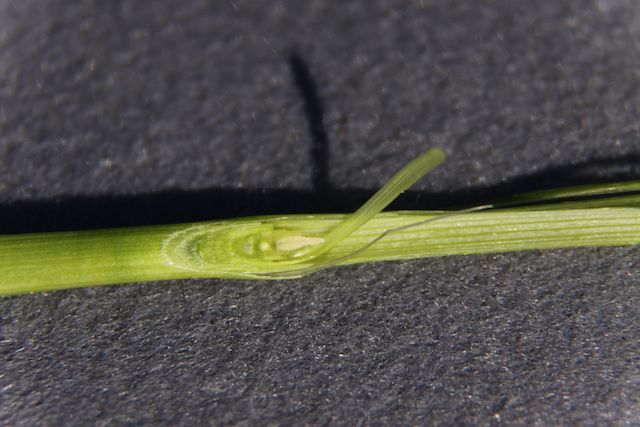
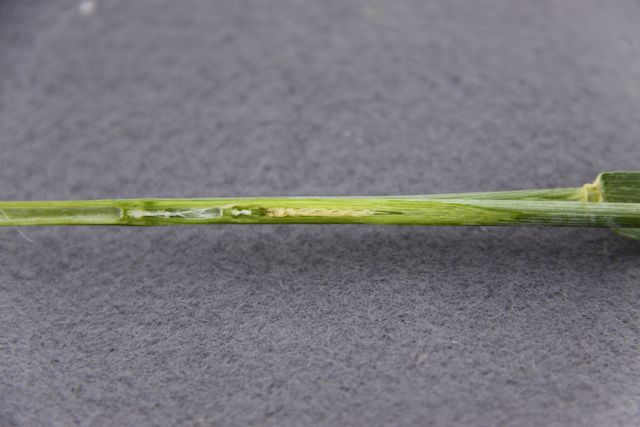
  • Dig or pull up a few plants and split the largest tiller longitudinally (lengthways) and measure the amount of hollow stem present below the developing grain head. You must dig plants because at this stage the developing grain head may still be below the soil surface.
  • If there is 1.5 cm of hollow stem present (see picture below), it is time to remove cattle. 1.5 cm is about the same as the diameter of a dime.
  • Detailed information on first hollow stem can be found at www.wheat.okstate.edu under ‘wheat management’ then ‘grazing’
  • Image

Freeze injury update – worse than we thought

On April 4th I toured southwest Oklahoma and surveyed freeze injury to wheat. In my experience, most freeze events are overhyped; however, this one was the real deal Holyfield.  I traveled a route from Faxon to Chattanooga to Altus to Blair and ended up at Apache. Damage was similar at all sites, with injury ranging from 50 to 80%.

The best looking wheat was the hardest hit. Particularly troubling are some fields in the Altus area that easily had 80 bushel potential prior to the freeze. In most of these fields we are too far past the tillering stage to have yield compensation from secondary tillers. Late-emerging fields that were jointing or smaller escaped the freeze with little injury. Fields that had been heavily grazed and/or under-fertilized also escaped with relatively minor injury.  Conditions improved slightly when I checked wheat in the Chickasha area and injury was more in the 10 – 30% range.

I am frequently asked if the injured wheat head will go ahead and “push through” as the season progresses, and the answer is no. So, if you see heads emerging out of the boot in a few weeks, they are likely not damaged and a head count at this stage will be a reasonable estimate of fertile heads. Since there will not be additional stem elongation in freeze injured wheat, it will not accumulate as much tonnage as in a ‘normal’ year.

I have posted a few pictures below showing freeze injury symptoms. Freeze injury can vary greatly among fields and even within a field. So, it is important to check several sites within a field and split several stems when determining the percent injury. Check early maturing varieties such as Jackpot, Billings, and Everest first, as they are most likely to have injury.

Image

Endurance wheat collected from plots at Chattanooga, OK. The two top heads are freeze damaged and will not recover. Note the shriveled, white appearance of the wheat head. The bottom head was not injured and is healthy green.

A healthy head of Endurance  from Apache, OK.

A healthy head of Endurance from Apache, OK.

Even though this wheat was just past jointing, it was injured by the freeze and the head was lost.

Even though this wheat was just past jointing, it was injured by the freeze and the head was lost.

Freeze injured Billings from the Altus research station

Freeze injured Billings from the Altus research station

A sign of the drought. Wheat seed still easy to find on a sample from near Altus, OK April 4.

A sign of the drought. Wheat seed still easy to find on a sample from near Altus, OK April 4.

How dry is it?

It was too nice of a day to stay in the office yesterday, so I checked on our wheat variety plots. I started at McLoud, moved west to Kingfisher, and ended up at Marshall. As indicated by the pictures and captions below, neither the wheat nor my mood improved as I traveled west. I am sure if I had traveled farther west, this would have gotten worse. The bottom line is that we are in desperate need of moisture in Oklahoma. Early-sown wheat is backpedaling quickly and cannot hold on too much longer. Much of the later sown wheat has yet to emerge. We are certainly not on our way to a record year, but everything could still turn out okay……..if it rains.