Wheat disease update – 26 April 2014

Wheat disease updates are written by Dr. Bob Hunger, OSU Extension Plant Pathologist

Oklahoma:  Wheat around Stillwater is mostly at GS 10.2 to 10.4 (heads ¼ to ½ emerged from boot).  Conditions are still dry, not only around Stillwater, but also around much (if not all) of the state.  Some rain fell this past week in the 1 inch range in a few areas, but in southwestern OK it was most likely too late to help the wheat.  Freeze damage also is becoming much more apparent.

Dr. Jeff Edwards (OkSU Small Grains Exten Spec) and I looked at wheat and attended a field day yesterday evening near Apache, OK (about 75 miles southwest of Oklahoma City).  The variety trial and field at Apache was lost because of freeze.  Wheat at Dr. Edward’s trial at Chickasha (30 miles northeast of Apache) also had some freeze damage but not as severe as the wheat around Apache.  No foliar diseases were seen at any field at which we stopped, and no reports of foliar diseases have come to me since my last update (10-Apr).  As you can tell from the reports below from Texas, there just is not much inoculum south of us to be carried northward, and what does blow up is likely not finding an environment conducive to infecting.

Our diagnostic lab has received few samples.  Of two recent samples from Garfield County (north-central OK), one was positive for Wheat streak mosaic virus (WSMV) and the other was positive for WSMV and High plains virus.  The diseases caused by these viruses, which are transmitted by the wheat curl mite, were fairly widespread in Oklahoma in 2013 and probably will be again in 2014.  However, I suspect that the drought and freeze will mask these infections.

Reports/excerpts of reports from other states:

Texas  Dr. Ron French (Ast Prof, Extn Plant Pathologist, Texas A&M AgriLife Extn Service) 25-Apr-2014:  Was driving all day and night (600 miles) yesterday looking at crops from Castroville to the Lower Rio Grande Valley and back. Today heading back to Amarillo.  Last Tuesday April 15 I drove from Amarillo to Wichita Falls (Northern Central part of the state right along the Oklahoma border) and back to  Amarillo (220 miles NW of Wichita Falls). Looked at commercial wheat and some trial plots in Chillicothe.

Did not see any rust at all and brought samples back just to make sure.  In the Wichita Falls area, wheat was at Feekes 10.4 (3/4 fully headed) on average. So now they should be at least flowering. In the Chillicothe area (65 miles NW of Wichita Falls towards Amarillo) wheat was on average at Feekes 10.3 (heading half complete).  Have not heard of any rust in this area (Rolling Plains and Panhandle) this week.

I have not received any feedback of stripe rust moving north of Ellis County (from my April 10 report), although now it is also in Hill County, adjacent to Ellis, but in a SW direction. In Hill County, wheat with stripe rust was past pollination and into grain fill.  Even in Bell county (Temple area, 120 miles south/southeast of Dallas) there was trace levels of stripe rust and none in the flag leaf.  Except for the Texas Panhandle, all other areas will soon (early next week for the Vernon area) be out of the window for spraying any fungicides.

So the good news is that rust is not moving north, yet. With warm temperatures during the day but cool at night, this might be affecting continuous fungal growth for both stripe and leaf rust fungi.

Texas (from a report issued by Dr. Erick DeWolf at KSU 25-Apr-2014:  Texas has reported some stripe rust activity just south of Dallas but warm temperatures have slowed the progress of that disease. Bob Bowden, USDA Plant Pathologist, reports that leaf rust remains active in research plots near San Antonio, Texas. However, the disease remains at low levels in commercial fields according to Tom Isakeit, Extension Plant Pathologist for Texas A&M. Wheat fields in southern Texas are nearly ready for harvest.

Kansas  Dr. Erick DeWolf, Extension Wheat Pathologist, Kansas State University 24-Apr-2014:  The risk of severe leaf diseases remains low throughout Kansas. My own scouting and reports from K-State agronomists indicate that leaf rust and stripe rust are not present in the state. Tan spot, septoria leaf blotch, and powdery mildew were absent in most fields; however, we did find a small number of fields with low levels of tan spot in Saline, McPherson, and Sedgwick counties. These fields all had wheat residue from previous crops on the soil surface. This residue is important because it often harbors the fungus that causes tan spot.

Drought stress was evident in most fields and the dry conditions are holding disease in check for now. Recent rains have brought some temporary relief to the dry conditions in a few areas of the state. We will continue monitoring the disease situation as this moisture may stimulate some disease. The symptoms of any new infections would not become evident for 7-10 days.  The current risk of severe disease in Kansas and the need for foliar fungicides is low.

Freeze injury update 22 April 2014

Injury symptoms from the April 14th freeze are now showing in the Oklahoma wheat crop. Robert Calhoun and Matt Knori madeTh a trip through north central Oklahoma yesterday splitting stems (some pictures are posted below). Their first stop was our wheat variety trials at Marshall Oklahoma where they found 20% injury in our grazed wheat plots and 51% injury in our non-grazed wheat plots. While planting date and management system clearly affected the level of injury, variety did not seem to have much effect.

Next stop was a grazed field north of Hennessy where they found little injury. The same was true for a field in the Waukomis area and the Lahoma variety trial where they found less than 5% injury. Not too far to the north, however, our Lamont variety trial sustained over 80% injury. I received similar reports of severe wheat freeze injury from Curtis Vap in the Blackwell area.

Late last week our team traveled to Apache to apply fungicides to the wheat variety trial, but never unloaded the sprayer. Freeze injury was severe and clearly visible without splitting stems. Our wheat at the Chickasha research station had little to no damage, and most wheat in the area seemed to dodge the freeze bullet. I will make a bigger loop into southwest Oklahoma later this week and report findings.

Injury symptoms should now be easily identifiable and growers can assess damage to individual fields. I recommend splitting 10 stems at four or five locations throughout the field and determining % injury from these numbers. If injury is extremely variable, increase sample size. While it is fairly easy to determine the extent of injury on individual fields, the hit or miss nature of freeze injury this year makes it difficult to estimate the total impact on the Oklahoma wheat crop as a whole.

The drought has severely limited resilience in our crop and we are entering late April, so I do not anticipate there will be much of a recovery or rebound in fields that were severely damaged. It is important to note that 50% injury does not necessarily mean 50% yield loss. In most cases the actual yield loss will be less than the % injury. So, it is reasonable to expect that 50% injury might only result in a 35 or 40% yield loss. Of course, this depends on several factors such as soil moisture and temperature.

Finally, a word on foliar disease and fungicide application. I would make decisions regarding fungicide application based on variety, current disease reports, and the yield potential of the crop as it stands right now. Our long-term data shows that fungicides protect yield potential to the tune of about 10%. Of course individual variety responses can deviate from this number but 10% is a good rule of thumb. I do not, however, recommend applying a fungicide to “assist the crop in recovery from freeze”. Again, make these decisions based on the remaining yield potential rather than an effort to attempt to nurse the crop back to health after freeze.


Freeze injured wheat from Marshall, OK

Freeze injured wheat from Marshall, OK

As evidenced by this picture from Marshall, Oklahoma, freeze injured wheat can still have a green appearance. You must split stems to accurately assess injury.

As evidenced by this picture from Marshall, Oklahoma, freeze injured wheat can still have a green appearance. You must split stems to accurately assess injury.

Freeze injured wheat at Lamont, Oklahoma. Freeze might have finished this plot, but drought had it down for the count prior to the freeze.

Freeze injured wheat at Lamont, Oklahoma. Freeze might have finished this plot, but drought had it with a standing eight count prior to the freeze.

Freeze injury in Kay County Oklahoma. Photo courtesy Curtis Vap.

Freeze injury in Kay County Oklahoma. Photo courtesy Curtis Vap.


Freeze injury update 15 April 2014

I have posted a few images from the Oklahoma Mesonet below. Most of Oklahoma spent at least four hours below freezing last night and some areas spent an extended period of time below 28F. While temperatures in the wheat canopy might have remained slightly higher than reported air temperatures, they were still probably low enough to result in significant injury to wheat.

Over the next few days growers will need to inspect fields closely to determine the extent of injury. Symptoms may start to appear later this week and will likely be clearly identifiable by early next week. Healthy wheat heads will remain turgid with a green color. Damaged wheat heads will be bleached, yellow, or brown and will easily break when pushed against. I anticipate that we will not have any partial “blanking” of wheat heads and that most wheat heads will either be okay or a complete loss.

What about new tillers? New tillers might emerge, but it is already April 15. In addition we have very dry soil conditions. For these reasons I am doubtful that newly emerging tillers will have much yield potential in areas south of I-40. IF (and that is a big if) weather conditions remain favorable, late emerging tillers in northern Oklahoma might still have a shot at producing grain.

I will survey some fields in a few days and report back with my findings. If you are interested in receiving weather maps and updates such as the ones posted below, subscribe to the OCS Mesonet Ticker by emailing ticker@mesonet.org

Hours below freezing on April 15, 2014

Hours below freezing on April 15, 2014

Hours below 28 F on April 15, 2014

Hours below 28 F on April 15, 2014

Hours below 24F on April 15, 2014

Hours below 24F on April 15, 2014


Wheat disease update – 10 April 2014

Wheat disease updates are written by Dr. Bob Hunger, OSU Extension Plant Pathologist

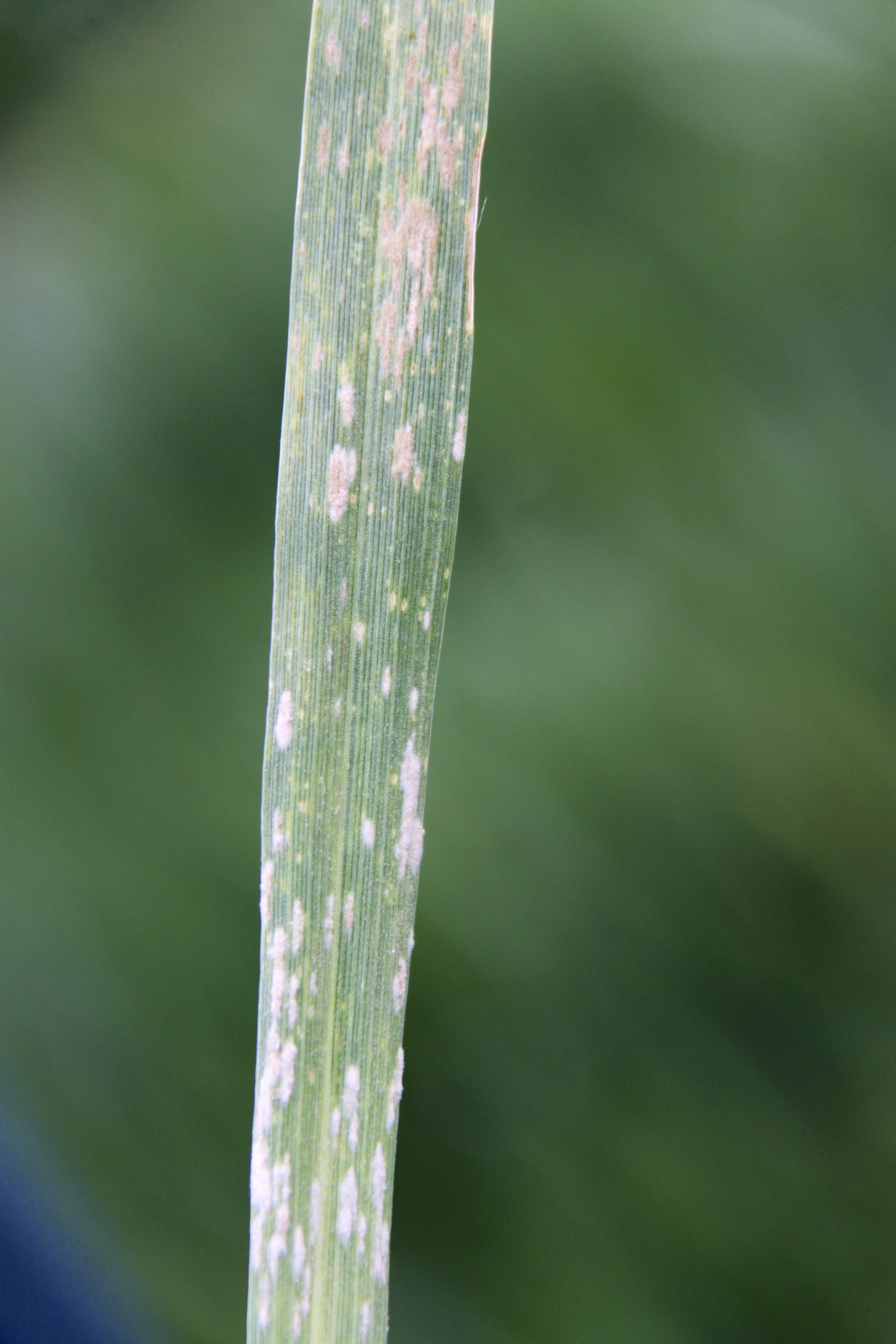
Oklahoma:  Wheat around Stillwater is mostly at GS 7 (2 nodes detectable).  In a few places the flag leaf has emerged but only in one field.  I still have not received reports of significant foliar diseases in Oklahoma, which is not surprising given the dry conditions.  Around Stillwater I have seen some powdery mildew on low foliage in scattered spots.  I and my technician Brian Olson also found tan spot in a no-till field, but only on low foliage and not severe.  The one find of a different disease that is concerning was wheat streak mosaic (WSM) in Dr. Jeff Edward’s variety trial in Kay County near Kildare.  Visiting the trial on April 2nd, yellowing and streaking were present in all varieties but some were much worse than others.  I was not thinking about WSM at the time, but 5 samples I brought back to the lab all tested positive for the virus that causes WSM, so I believe that is what is present.  On a trip today to northern Oklahoma and over to Lahoma in north central Oklahoma, I saw some good and some bad wheat that ranged from GS 6 to GS 7 (or close to it).  However, all the wheat seemed short to me – some not much more than 10-12 inches tall.

Powdery mildew

Powdery mildew

In northwestern Oklahoma, Rick Kochenower (Area Res & Extn Agron Spclt) indicated, “I see a lot of dryland wheat dying but not from disease.”  He said that wheat was just starting to tiller.  In southern/central/southwestern Oklahoma, Mark Gregory (Area Extn Agron Spclt) reported that today he was in wheat towards the eastern side of the district and saw no diseases; also that the wheat furthest along had flag leaves fully extended (GS 9).  Gary Strickland (Extn Educator, Jackson County – southwestern OK) indicated wheat in his area was in the flag leaf stage – anywhere from flag leaf just emerging to fully-emerged.  Drought is the problem; no rust, powdery mildew or other diseases, but brown wheat mites have exploded.

Reports/excerpts of reports from other states:

Texas (southern) Dr. Amir Ibrahim (Prof, Small Grains Breeding & Genetics, Texas A&M Univ) 09-Apr-2014:

Wheat rust conditions at Castroville, TX – Wheat looks very good here and most of it is at the ripening stage. We have been applying a ½ of irrigation per week for the past two weeks. We may put another ½ next week, depending on the conditions. The morning fog at this location is also keeping the rust going.

Wheat stripe rust (P. striiformis)- This week provided an opportunity for taking notes on infection type and severity of wheat stripe rust (P. striiformis). Evidence points to a milder repeat of 2012 virulence that attacked ‘TAM 111’, ‘Garrison’ and other HRW. There is no indication of Yr17 vulnerability, which seemed as a one‐time incident that took place in 2010. Stripe rust is up to 70S on susceptible ‘Patton’.  We don’t expect infection types to be distinguishable next week but ratings for green leaf area duration can be taken. A lot of guessing has to be made, though, as both P. striiformis and P. triticina have been competing for the upper leaf surfaces. The former has started to dry up and newer infections are not likely. This does not overrule establishment farther north of here where conditions are conducive.  ‘Armour’ received a 40 S rating at this site, but ‘Redhawk’ looks very vulnerable with a rating 50S on the flag leaf and homogenous spread across the plot.

Wheat leaf rust (P. triticina): While stripe rust infections are fading, leaf rust (P. triticina) is now moving into the flag leaves of susceptible wheat. I have rated TAM 112 as 15S (FL) today. We have good diversity of races, but the Lr24 virulence is moving faster as evidenced by the rating of 60S on the flag leaves of ‘Jagalene’ as opposed to Lr17Lr39, and Lr41. We plan to come back here on April 21st to take notes on leaf rust, tag plants, and make selections.

Texas  Dr. Ron French (Ast Prof, Extn Plant Pathologist, Texas A&M AgriLife Extn Service) 10-Apr-2014:  I have spent many of the last 14 days traveling the Northern Central part of the state, from Wichita Falls (right along the Oklahoma border) and towards Amarillo (220 miles NW of Wichita Falls), and From Amarillo down to the Plainview area (70 miles south) and the Lubbock area (120 miles south of Amarillo). I have not seen any rust at all in commercial fields. Visual observation but also sampled just in case rusts were latent and not quite rupturing the epidermal tissue. No reports of there being any rusts from consultants as well.

From what I have gathered from consultants, there is/has been stripe rust as far north as Waxahachie, TX (Ellis County), 30 miles south of Dallas. Other locations with stripe rust are around Elgin, TX (Bastrop and Travis Counties, approximately 25 miles East of Austin, TX) and Taylor, TX (Williamson Co, approximately 25 miles south of Austin and approximately 75 miles West of College Station).

As far as leaf rust is concerned, these and other locations in that area have also had leaf rust, and in varieties such as Greer, Cedar, and Coronado.  Low levels but enough to warrant sprays as much of that crop is fully headed. In some locations, 7-10 before getting into the milk stage for Cedar.  I have also been told that Fannin had low levels of rust, something out of the usual.  I need to confirm which rust it is (leaf or stripe).

We are a bit behind other years where we have seen leaf rust by late March/early April as far north as Wichita Falls (a few miles from the Oklahoma border) and early April for stripe rust, North and Northeast of Dallas and close to the Oklahoma border.

With temperatures expected to be in the high 80s and low 90s Fahrenheit in the Texas High Plains sometime this weekend but lower next week but with little to no rain, disease pressure is still not there (humidity-wise) although common heavy winds could bring inoculum our way.

Texas (northern – blacklands area north of Dallas)  Jim Swart (IPM, Texas A&M AgriLife Extension 31-Mar-2014:  Wheat is rapidly recovering from the hard freeze we received in early March.  Winterkill does not appear to be an issue in any of the commercial varieties planted across the region, but some early maturing varieties in our research plots were damaged by the freeze.  Wheat planted in October is jointed (Feekes 6), and some plants are in Feekes 7 (two nodes above the ground).  Wheat planted in November is just beginning to joint.  We have identified a few bird cherry oat aphid infestations in central and southern Hunt County, but most of the area wheat crop has very low numbers of aphids (greenbug and bird cherry oat aphids).  We have not observed any stripe or leaf rust yet.

Louisiana Trey Price (Field Crops Pathologist LSU Ag Ctr, Winnsboro, LS) 31-Mar-2014:  There’s really not much to report at the moment in Louisiana.  Steve spotted leaf rust at Ben Hur Research Station in Baton Rouge a couple of weeks ago, and incidence and severity were low.  I’m unsure of the current status.  We have stripe rust developing in GACT7, a susceptible variety, at the Dean Lee Research Station in Alexandria.  Incidence and severity were less than 1% last week.  In Winnsboro, there are no rust issues on wheat or oats at the moment.  Low incidence and severity of leaf and stripe rust at Crowley (Rice Station, Southwest Louisiana).

Georgia  Dan Bland (Crop & Soil Dept, Univ of Georgia-Griffin) 3-Apr-2014:  We were down visiting our nursery in Plains, GA yesterday and found a lot of leaf rust in a strip of wheat planted about 2 months earlier than the recommended date for the purpose of spreading hessian fly to a small replicated test.  This is done every year so that David Buntin can get pupa and larva counts on the state variety test.  We normally see leaf rust in this area especially if the strip planted is susceptible.  This year Jerry Johnson says it’s the most he’s ever seen for this time of year.  We also saw leaf rust on the lower leaves of the most susceptible lines in another test about 300 yards away.  Leaf rust also has been reported in southeast Georgia.  Plains is in southwest Georgia.

Oregon  Dr. Michael Flowers (Extension Cereal Specialist, Oregon State University, Corvallis, OR) 3-Apr-2014:  After I sent out the note yesterday, reports have been coming in from both the north and south Willamette valley about stripe rust.  Currently there are reports of stripe rust found on Goetze, Kaseberg, Sy Ovation and Tubbs 06.  It appears that maybe we were not as lucky as hoped and that stripe rust did overwinter in some fields throughout (north and south) Willamette Valley
Wheat disease update – 31 March 2014

Wheat disease updates are written by Dr. Bob Hunger, OSU Extension Plant Pathologist

Oklahoma: No reports of significant diseases in Oklahoma. Around Stillwater, wheat soilborne/spindle streak mosaic are still showing strong in my screening nursery, but these virus diseases should not be much of a problem around the state due to resistance in nearly all planted varieties. Looking in the same places as 10 days ago, I did find a slight increase in the number of powdery mildew pustules on low leaves, but these pustules still are small and did not appear to be actively sporulating. Wheat is mostly at the Feekes stage 6 but likely approaching stage 7.

Reports/excerpts of reports from other states:
Many thanks to Dr. Amir Inbrahim for sending the report below as this is the most comprehensive disease report I have heard to date from Texas. I interpret his observations to indicate that both stripe and leaf rust are present (especially leaf rust), but that build-up has not yet hit the upper canopy but in this area producers should be ready to “pull the trigger” to protect wheat with high yield potential. In Oklahoma we will need to wait and see if moisture comes to allow inoculum coming from southern Texas to infect the Oklahoma wheat crop.

Texas Dr. Amir Ibrahim (Prof, Small Grains Breeding and Genetics, Texas A&M University) 30-Mar-2014: I have received reports from our research associates, around March 26, 2014, about the rust situation in South Texas.
Castroville, TX: The wheat crop is now at Feekes growth stages 8-10.5. Cultivars such as ‘Everest’ and ‘Billings’ have already headed at this site. There is a uniform spread of leaf rust (P. triticina) in the lower canopy of the spreader rows throughout the field. The infection has not yet moved up into the middle canopy or the flag leaves. It has been raining during the week of March 24th, and the weather forecast calls for temperatures in the high 80’s for the next few days, which will help promote the spread of the infection. Stripe rust (P. striiformis) has spread throughout the replicated trials, especially on the spreader rows of ‘Patton’. The infection was as high as 60S on the flag leaves of some experimental lines. There is uniform spread on TAM 111 in the range of 20-30S, which points to the presence of 2012 virulence. Temperatures have been cooler than normal which helped the spread of P. striiformis at this site. However, the warming temperatures will slow spread at this site but not necessarily at sites farther north if infection has already started.

Wharton, TX: The Wharton uniform rust nursery is located 90 miles south of College Station. The wheat crop is now at Feekes growth stages 8-10.5. ‘Everest’ has already headed at this site.
There is a uniform spread of leaf rust in the lower canopy of the spreader rows throughout the field. The infection is beginning to move into the mid canopy, and we believe mid-April should be a good target date for taking readings at this site.

Beeville, TX: Beeville is located 50 miles NW of Corpus Christi. We have both spring and winter wheat plots and head-rows at this site. The majority of the winter wheat here is at Feekes 5-7 growth stages, whereas the spring wheat is at 9-10. There is a buildup of leaf rust on TAM 112 in the head-rows and on the spreader rows around the yield trial plots.

College Station, TX: The wheat at this site is at Feekes 7-9 growth stages. There is a buildup of leaf rust in the lower canopy of ‘TAM 110’.

Oklahoma wheat update 03/28/2014

On Friday, March 28th I made a tour through northwestern Oklahoma to diagnose a few problem fields and get a better feel for the wheat crop condition. I have provided a brief description of what I saw below. I did not make it to southwestern Oklahoma this trip, but by all accounts the wheat is dry, brown, and barely hanging on. A best case scenario in areas southwest of Apache this year is a poor wheat crop. It will have to rain a lot between now and harvest for this to happen.

Reports from Apache eastward are somewhat better. The wheat crop in this area still has potential, but the potential is declining. A farmer from the Hinton area called yesterday and indicated that moisture could still be found about 1 inch below the soil surface, but the top is still very dry. We need a soaking rain to move nitrogen into the rooting zone and to perk the crop up post dormancy.

My first stop this morning was at Lamont. Wheat in this area is smaller than normal and is at approximately Feekes GS5. There were several yellow areas in fields and uneven wheat. Much of this yellowing appeared to be nitrogen deficiency, but not all of it was due to insufficient top dress nitrogen. We simply have not had enough moisture to get good movement of top dress N into the rooting profile and for the wheat crop to take up applied N. Some of the yellowing was also due to drought stress. Some of the yellowing could have been due to brown wheat mite and/or winter grain mite activity (described more below).

My second stop was at our Cherokee variety plots. Wheat in this area was uneven, similar to Lamont. As shown in the picture below, part of our plot area was showing significant yellowing. Initially, I thought this was due to changes in soil type/nutrient variability. Upon closer inspection, this area was infested with brown wheat mite. These symptoms have only started to show in the last week or so. Thanks to variety trial cooperator Kenneth Failes, this situation will be remedied as soon as the wind settles.

The yellow, stunted areas in our Cherokee variety trial were caused by brown wheat mite

The yellow, stunted areas in our Cherokee variety trial were caused by brown wheat mite


Next stop was Alva, where the trend of uneven and yellow wheat continued. As shown in the picture below, there were several fields in the area with spots of dead or nearly dead wheat. Brown wheat mites were found in most of these fields and probably weakened plants which increased the amount of winterkill. In some fields seed had been placed at the proper depth, but the seed trenches were partially filled with residue rather than soil. Residue provides less insulation than soil and likely made heavy residue areas more prone to winterkill. I also noticed in these fields that the crown of the plant had developed in residue rather than soil, which likely increased winterkill. I looked at additional no-till fields in the area with severe winter injury, but plants that were still viable. Grazed fields seemed to have greater injury than non-grazed.

Areas of winterkill in no-till wheat near Alva

Areas of winterkill in no-till wheat near Alva


Although seeded at the proper depth, some wheat plants in heavy residue areas had crown placement at the soil surface. This increased the severity of winterkill.

Although seeded at the proper depth, some wheat plants in heavy residue areas had crown placement at the soil surface. This increased the severity of winterkill.

I looked at a few fields south of Enid. Unlike the fields in Grant, Alfalfa, and Woods Counties, this primary issue in these fields was winter grain mite instead of brown wheat mite. The symptoms were areas of the field having a silver tint. Some areas had died or lost several tillers and these areas got bigger as the season progressed and dry conditions worsened.

Field affected by winter grain mite south of Enid. Note the silver tint of the wheat on the left side of the terrace.

Field affected by winter grain mite south of Enid. Note the silver tint of the wheat on the left side of the terrace.


I ended my tour at Marshall, Oklahoma where I did not find any insects, but did find some thirsty wheat. All of the insect issues I encountered today can be corrected with scouting and insecticides. Wheat winterkill was present, but rarely affected entire fields and was not that widespread. The primary concern for all of Oklahoma remains lack of moisture. There are some fields in north central and northwestern Oklahoma with good yield potential; however, the best areas are starting to turn blue due to lack of moisture. Another couple of weeks of warm temperatures and wind without rain will turn blue wheat to brown. We need moisture.

First hollow stem update 03/18/2014

With the exception of Brawl CL Plus, Centerfield, and a few experimental lines all of the varieties in our plots at Stillwater are at first hollow stem. I have posted the measurements from 21 March 2014 below. 

Variety cm of hollow stem 03/21/2014
Endurance .
Deliver .
Pete .
OK Bullet .
OK Rising .
Billings .
Ruby Lee 2.4
Garrison .
Duster .
Gallagher .
Iba 2.6
Everest .
Jackpot .
Doans .
Greer .
CJ .
SY Southwind .
Sy Llano .
Armour .
WB-Cedar .
WB-Redhawk .
WB-Grainfield 3.7
Winterhawk .
WB4458 .
T153 .
T154 .
T158 1.5
LCS Mint 1.5
LCS Wizard .
LCH11-109 .
LCH11-1117 .
LCH11-1130 .
TAM 112 .
TAM 113 .
Byrd .
Brawl CL Plus 0.9
Centerfield 0.8
Doublestop CL Plus 1.9
OK09125 1.1
OK09520 .
OK10126 1.0
OK08707W-19C13 3.4
OK10805W 0.9
OK10728W .
OK11754WF .

Wheat disease update – 21 March 2014

Wheat disease updates are written by Dr. Bob Hunger, OSU Extension Plant Pathologist

Oklahoma:  Diseases are still quiet across Oklahoma.  Gary Strickland (Extension Educator – southwest Oklahoma) indicated he has “seen one leaf rut pustule.”  Also, wheat just has not grown in his area and is just starting to get to the point of tillering but there is so little growth he doesn’t feel there is sufficient growth to support much tillering.  He did indicate he has seen and has a lot of reports of brown wheat mites.

Around Stillwater, the wheat soilborne/spindle streak mosaic is the only disease of prominence.  I did find some small pustules of powdery mildew in the extreme low leaves of ‘Pete’ wheat that was in the range of Feekes 6.  Wheat around Stillwater is in much better condition than in western Oklahoma where drought has been severe.  I also have seen quite a few lady beetles in my trials and plots, but have yet to see any aphids.

Reports/excerpts of reports from other states:

Arkansas  Dr. Gene Milus (Professor/Wheat Pathologist, Univ of Arkansas) 20-Mar-2014:  Jason Kelley, Extension wheat agronomist, found fresh leaf rust pustules on volunteer wheat at the Cotton Branch Experiment Station near Marianna on March 20.

Louisiana Dr. Stephen Harrison (Professor/Wheat Breeder, LSU AgCenter) 18-Mar-2014:  I found leaf rust at the Ben Hur Research Farm in Baton Rouge yesterday.  This was in an early-planted field for Hessian Fly where I found a few pustules around Christmas.  The cold and very wet winter put the rust on hold until recently but it is active and should ‘take off’ now.  I have not received any other rust reports from around the state but will check nurseries in north Louisiana tomorrow.

The wheat crop is a little later than normal and has a much tighter range of heading dates due to the cold winter.  The variety trial probably averages second node but is very rapidly developing.

First hollow stem update 03/18/2014

Most wheat varieties are now at first hollow stem in our plots at Stillwater. I have posted the measurements from 18 March 2014 below.

Variety cm of hollow stem 03/18/2014
Endurance 1.5
Deliver 1.5
Pete 1.7
OK Bullet 3.2
OK Rising 3.0
Billings 2.2
Ruby Lee 1.2
Garrison 1.9
Duster 2.0
Gallagher 3.1
Iba 1.1
Everest 3.6
Jackpot 4.6
Doans 1.9
Greer 1.7
CJ 2.6
SY Southwind 3.6
Sy Llano .
Armour 2.4
WB-Cedar .
WB-Redhawk 2.7
WB-Grainfield 1.3
Winterhawk 1.8
WB4458 1.7
T153 3.0
T154 2.1
T158 1.0
LCS Mint 0.2
LCS Wizard 1.5
LCH11-109 2.0
LCH11-1117 2.4
LCH11-1130 2.3
TAM 112 3.8
TAM 113 3.5
Byrd 2.0
Brawl CL Plus 1.0
Centerfield 0.9
Doublestop CL Plus 0.9
OK09125 1.3
OK09520 1.6
OK10126 0.6
OK08707W-19C13 1.3
OK10805W 1.2
OK10728W 3.3
OK11754WF .
Sample Average 2.1

Wheat disease update – 14 March 2014

Wheat disease updates are written by Dr. Bob Hunger, OSU Extension Plant Pathologist

Oklahoma:  No foliar diseases of significance to report in Oklahoma.  Wheat is mostly just coming out of dormancy, and cold/dry conditions have not favored initiation of foliar diseases.  My soilborne/spindle streak nursery is starting to show symptoms of these virus diseases.  The wheat is just starting to “green-up,” so symptoms of this virus complex will become evident over the next couple weeks if a susceptible variety was planted in areas where these diseases are present.

Reports/excerpts of reports from other states:

Texas Dr. Amir Ibrahim (Prof, Small Grains Breeding and Genetics, Texas A&M University) 07-Mar-2014:  Our rust evaluation nursery was planted at Castroville, TX, about 12 miles west of San Antonio.  The wheat crop is now at Feeks stage 7‐9.  There is a mild buildup of leaf rust (Puccinia triticina) in the lower canopy of the spreader rows throughout the field. At this time last year, leaf rust was already 50S on ‘TAM 110’. The unusually cold weather that we have encountered this year did not favor rapid spread, but the disease seems ready to move if the weather starts to warm up.  Stripe rust (Puccinia striiformis) has been detected on some plots located in the middle of the field, and is mostly limited to a 600 ft2 area. Night temperatures for next week will range from 39 – 48 F, which will favor new infections by urediniospores and pick up in sporulation.

Wheat soilborne mosaic virus can cause yellowing in the spring in susceptible varieties such as the one on the left.

Wheat soilborne mosaic virus can cause yellowing in the spring in susceptible varieties such as the one on the left.