Unknown's avatar

About Amanda De Oliveira Silva

I have served as an Assistant Professor and Small Grains Extension Specialist at Oklahoma State University since August 2019. I believe that close interaction with producers is vital to understand their production strategies and to establish realistic research goals. My program focuses on developing science-based information to improve the agronomic and economic viability of small grains production in Oklahoma and in the Southern Great Plains.

Oklahoma Wheat Harvest In Full Swing from Border to Border

Courtesy Oklahoma Wheat Commission

Oklahoma Wheat harvest is moving forward in all locations across the state with producers making great strides in the hot dry temperatures.  A large majority of the crop in the region from Clinton, Weatherford, Carnegie, south to Pocasset and Chickasha received major hail damage and heavy rains last week and still fighting mud which will impact overall statewide numbers along with severe drought during the growing season in areas West of I-35.   Elevators are reporting more sprout damage across the state in the Southwest, South Central and Central regions due to excessive moisture in places. 

Yields are ranging all over the board. Low teens to mid-20’s in Southwest, Oklahoma. In South Central Oklahoma, yields are being reported from 10 bushels per acre to the mid 30’s.  Yields in central and Northern Oklahoma are ranging higher from 15 bushels to as high as 65 bushels per acre. Most regions are still looking at averages in the high 20’s to mid-30’s for the most part.  It is also important to note several areas in Northwest Oklahoma by Cherokee and Burlington experienced severe drought and large portions of that region will not be harvested.

Test weights have been lowered in Southern Oklahoma to Central Oklahoma, but based on earlier cuttings with higher test weights, most locations are still hoping for a 58 bushel per pound average. Test weights are being reported higher in NW Oklahoma in the Enid area and fields further north and east towards Jefferson, Medford, Lamont and Renfrow with many weights coming in at 60 pounds per bushel or higher. 

Proteins have ranged across the state between 10% and as high as 17% with averages coming in between 12 to 13% in most places. 

Sprout Damage – Elevators are reporting more sprout damage across the state in the Southwest, South Central and Central regions due to excessive moisture in places.  The sprout damage has also been wheat variety specific in many instances.  In Southwest Oklahoma, there may be as much as 10 to 30% sprout damage in 10% of the crop. In South Central, some fields are reported to having 10% to 18% sprout damage on 20% of the loads being taken in.  In Central Oklahoma, sprout damage is anywhere from 2% to 15% with most of the damage in this region falling in the 0 to 2% category, with 5 to 7% of the crop having as much as 15% damage.  

The Oklahoma Wheat Commission is now calling Oklahoma wheat harvest 45% completed.

Southwest

Frederick- Harvest in this region is 95-97% complete. Test weights ranging from 60 to 61 pounds/bushel.  Proteins ranging from 12 to 12.5%. Yields being reported from low teens to high twenties, averaging in the low 20’s.

Altus/ Duke/ Carter- Harvest in this region reported as 90% done. Test weights have dropped some over the past week with the heavy rains and are now trending 56-58 pounds per bushel compared to earlier cuttings making 59 to 60 pounds per bushel.   Yields reported from 5 bushel an acre to mid-20’s. Proteins ranging from 13% to 16%

Lone Wolf/Hobart- Harvest in these regions is reported at 60% complete.  Test weights have dropped slightly and now being reported from 55 to 58 pounds per bushel.  Yields ranging from low teens to mid-20’s.  Proteins reported making from 13% to 16%.

South Central

Apache- Wheat harvest is just getting a good start in this region as producers have been fighting mud from the heavy rains that they received last week.  Test weights have been ranging from 57 pounds to 58 pounds per bushel for the most part.  On the intensive management wheat, they are seeing some 60-pound test weights.   Yields for the most part are ranging from 10 to 35 bushels per acre depending on location, management and variety.  This region 25% harvested.

Western Oklahoma

Sentinel/Rocky- Harvest has made great progress over the weekend and is reported at 80% complete.   Test weights reported in the 56 to 60 pound per bushel range. Yields being reported from 14 to 28 bushels per acre.  Proteins ranging from 13% to 17% depending on variety and management practices.

Central Oklahoma

El Reno- Harvest has been rolling North of El Reno, but South of El Reno, it is still be reported at a standstill as producers are fighting with mud from the heavy rains last week. They are reporting 20% harvested in this region. Yields are being reported from the low 20’s to the low 40’s depending on variety and management.  Test weights ranging from 57 to 59.5 pounds per bushel.  Protein ranging from 11% to 14.5%.

Kingfisher/OmegaHarvest in this region reported to be 60% complete. Test weights have dropped with ranges reported from 57 to 60 pounds per bushel.  Yields averaging in the high 20’s to low 30’s. Proteins have ranged from 10% to 15%, seeing a lot in the 11.5% to 12.5% range.

Reeding- Harvest in this region reported 25% complete. Test weights have dropped with ranges from 57 to 59 pounds per bushel being reported. Yields averaging mid-teens to low 30’s depending on variety and management. Proteins ranging from 11% to 12%.

Loyal- Harvest in this region reported at 20% complete.  Test weights averaging 57 to 59 pounds per bushel.  Yields on early harvested wheat making in the low 20’s to low 40’s.  Protein is ranging from 11.5% to 12.5% on early samples.

Northwest OK

Shattuck/Fort Supply-This region being reported at 15% complete. Test weights ranging from 57 to 62 pounds per bushel depending on variety and management.  Yields ranging from 5 bushels to 25 bushels per acre.  Proteins are ranging from 12% to 14%.

Burlington- Harvest in this region reported at 20% complete. A large area in this region will not be harvested due to the severe drought.  On the crop that will be harvested, test weights for this region is averaging 58 pounds per bushel.  Yields making in the mid 20’s to mid-40’s on the wheat that will be harvested depending on where moisture was received in a timely manner and management practices.  Proteins ranging from 12% to 13%.

Helena/Goltry- Harvest in this region has been moving full speed ahead, this region being reported as 50% harvested.  Yields reported from the mid-teens to low 30’s for the most part.  Test weights ranging from 58 to 60 pounds per bushel.  Proteins are averaging 13%.

Northern Oklahoma

Pond Creek/Lamont- Producers got a good start over the weekend in this region. This area reported to be 10% complete.  Test weights ranging from 58 to 60 pounds per bushel. Yields being reported in the low 30’s to mid-40’s. Proteins ranging from 12% to 16%.

Medford/Deer Creek- Producers in this region are just getting started, as more moisture was received in this area last week.  Test weights on early cuttings ranging from 58 to 60 pounds per bushel.  Yields in this region have been reported to be making better because of timely rains.  The yields are ranging from low 30’s to mid-40’s.   Some reports on management intensive wheat to be making in the high 60’s. Proteins have been ranging from 11% to 16%.

Panhandle- At the time of this report, no harvest was reported as taking place in the Panhandle although we have heard early reports of harvest starting around Baker, Oklahoma.  We plan to have a more in-depth report in this region on Wednesday, June 15th.

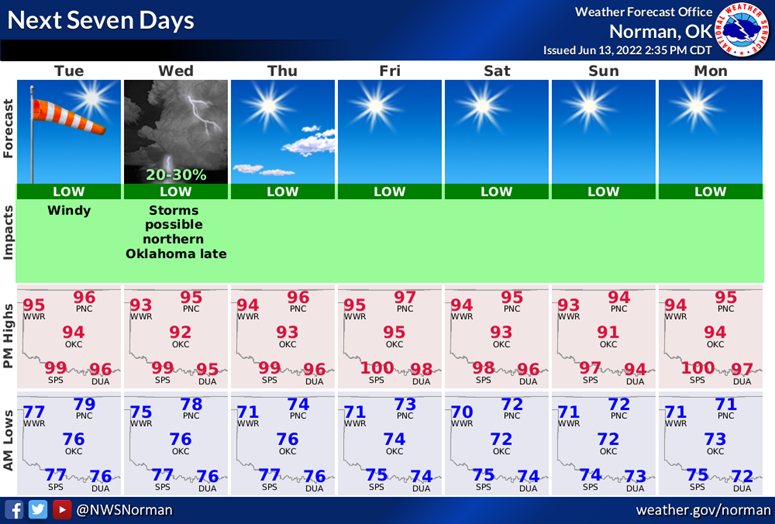
Below see the Heat Maximum and Air Temperatures for Monday June 13th. Also please see the 7-day forecast provided by the Oklahoma Mesonet.  The next harvest report will be scheduled for Wednesday, June 15, 2022.

Pre-harvest sprouting damage in wheat

Amanda de Oliveira Silva, Small Grains Extension Specialist

Pre-harvest sprouting is the onset of grain germination while still on the wheat head. Once wheat reaches physiological maturity, it can initiate germination if exposed to ideal moisture and warm temperatures for a few days. This is the case in some areas of Oklahoma that have received rainfall for several days after wheat has ripened. Genetics and environmental conditions are responsible for the differences in susceptibility to sprouting. Thus, wheat varieties differ in their resistance to sprouting (i.e., some are more prone to sprouting than others).

The occurrence of pre-harvest sprouting damage in the state has been low to moderate so far. But, due to the number of questions/calls I have received with the same concern in the past days, I thought I would share a few thoughts.

Can I use sprout-damaged wheat for seed?

It depends on several factors, but more importantly, is the level of sprout damage that has occurred. Grains that are swollen and with split seed coat, without visible root or shoot emerging from the seed, might still be viable to be used as seed. In this case, a germination test is warranted after harvest and before planting. Suppose the grain shows broken seed coat with visible roots and/or coleoptile. In that case, it should not be kept for seed because they will likely have reduced viability or not be viable at all (Picture 1).

Picture 1. Pre-harvest sprouted wheat damage, showing grain with split seed coat and radicle starting to become visible. The photo was taken on June 10, 2022, by Glen Calvert, the Extension Ag Educator at Washita County.

Will pre-harvest sprouting damage affect quality?

The extent to which pre-harvest sprouting grain will affect quality depends on the level of damage. Grain germination causes the production of alpha amylase, an enzyme that breaks down starch. As the level of sprout damage increases, this enzyme also increases, leading to an impairment of grain quality. Sprouted damaged grain can negatively impact wheat flour and baking quality by affecting mixability, crumb strength, loaf volume, etc.

Resources:

Contact your local county Extension office.

Storage and Use of Low Test Weight and Sprouted Wheat –  Factsheet BAE-1109

Acknowledgments:

Gary Strickland, Jackson County Extension Director and SWREC Regional Agronomy Specialist

Glen Calvert , Extension Educator Ag/4H at Washita County

Oklahoma Wheat Harvest Progresses Slowly with Continued Rains

Courtesy Oklahoma Wheat Commission

Oklahoma Wheat harvest continues to move forward at a slow pace due to untimely rains across the wheat belt. Different moisture amounts have been recorded at different times throughout the past week. Rains hindered progress in parts of Central, North Central and Northwest Oklahoma yesterday and early this morning. In some areas between Clinton and Hydro, 4 to 5 inches of moisture was reported by producers depending on locations. (In some instances, these large amounts came within one hour during the morning hours of June 7.)  The past couple of days and this weekend, harvest has been making progress in Southwest Oklahoma around Grandfield, Frederick, Lone Wolf, Hobart and Altus. Harvest also has made progress in parts of Central Oklahoma around the Cashion, Okarche, Kingfisher, Omega and Watonga areas. Test weights have dropped some in these Southern and Central regions with more 58 and 59’s being reported; however, 60 pound test weights are still being received in all locations that are taking wheat. In Northern Oklahoma on early samples, it is thought test weights will still be favorable because the wheat was not fully ripe. Yields have gotten better as harvest has moved North, in the Cashion, Okarche, Kingfisher and Omega region. We have had reports from 15 bushels to as high as 64 bushels per acre. (The average for this region is being reported in the high 20’s to low 30’s.)  It is important to note in several areas of South Central Oklahoma with locations at Apache, Chickasha, Minco, Hinton and Hydro, producers have really not had an opportunity to get a good start, so nothing has been reported from these locations as far as yield and test weights. Proteins across Oklahoma are ranging from 10 to 17 percent, but overall the majority of the crop is in the 12% to 14% range, with much higher proteins in the Western corridors of the state reporting in the 13% to 15% range. It should be noted we are seeing reports for sprout damage now occurring in locations across the state, but the sprout reports have been minimal with reports of 2% to 5% on some loads depending on variety and location.   The Oklahoma Wheat Commission is now calling Oklahoma wheat harvest 20% completed.

Grandfield/Frederick- Harvest in this region is 95-97% complete. Test weights ranging from 60 to 61 pounds/bushel. Proteins ranging from 12 to 12.5% range. Yields being reported from low teens to high twenties, averaging in the low 20’s.

Lone Wolf/Hobart/ Altus- Harvest in these regions is reported at 50 to 60% complete depending on location. Test weights have dropped slightly and now being reported from 59 to 60 pounds per bushel. Yields ranging from 7 bushels per acre to the mid 20’s depending on location, with proteins reported making from 12% to 17%. Most were ranging mainly from 13% to 15%. 

Apache- Wheat harvest still has not really started in this region.  Four truck loads were taken in yesterday with test weights ranging from 58 to 61 pounds per bushel.  No yields or proteins have been reported as they are waiting for a more representative sample.  1/10th of an inch of rain was received this morning, so producers are hopeful they will get rolling more this afternoon.

Sentinel/Rocky- Harvest has made slow progress in this region from last week due to light rains throughout the week but is considered 30% complete. Test weights reported in the 58 to 61 pound per bushel range. Yields being reported from 14 to 25 bushels per acre. Proteins ranging from 13% to 17% depending on variety and management practices.

Cashion/Okarche/Kingfisher/OmegaHarvest in this region reported to be 10 to 20% completed, depending on location. Test weights have dropped with more falling in the 59 to 60 pound/bushel range than what had previously been reported before the rains in that 61 to 63 pound/bushel range. Yields averaging in the high 20’s to low 30’s. Proteins have ranged from 10% to 15%, seeing a lot in the 11.5% to 12.5% range.

Clinton/Weatherford/Hydro/Minco/Chickasha- Rains this past week and heavy rains early this morning have hindered harvest from taking place in most of these regions. Harvest in these areas are at a complete standstill.

Greenfield- Harvest is just getting started in this region. Test weights on early samples averaging out in the 59 to 60 pounds per bushel. Yields on early harvest wheat making in the low to mid 20’s with hopes better wheat will be harvested in the region once harvest gets rolling.  Protein ranging from 11.3% to 14% on early samples.

Shattuck-Wheat harvest has not really started in this region due to light rains received throughout the week. Yesterday afternoon one load was received North of Fort Supply, but quality and yield was not reported as it would not be a representative sample.

Enid- A few loads have been hauled in at a couple locations. Test weights were ranging from 60 to 61 pounds per bushel on early samples. No yields have been reported.  Proteins on early cuttings averaging 12.5%.  This is based on less than 5 loads being received.

Burlington- A couple of samples were received Sunday and Monday.  Moisture was mid 14’s on Sunday and Monday was 15 percent. Light drizzle was received this morning. It was thought some might try harvesting this afternoon if the sun comes out. No yields, test weights or protein reported as no loads have been taken in.

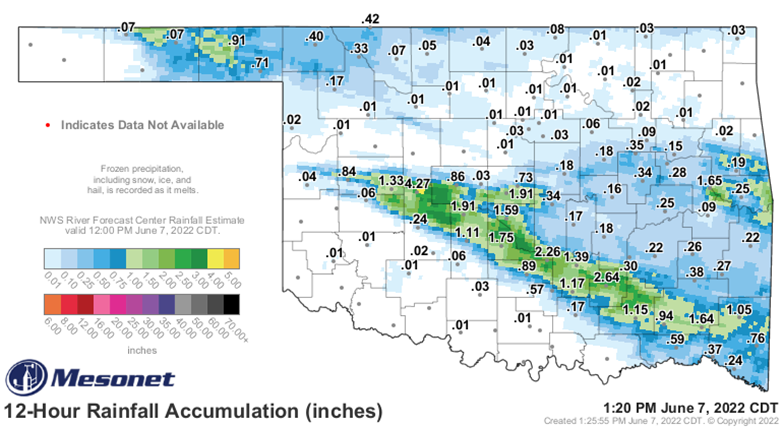
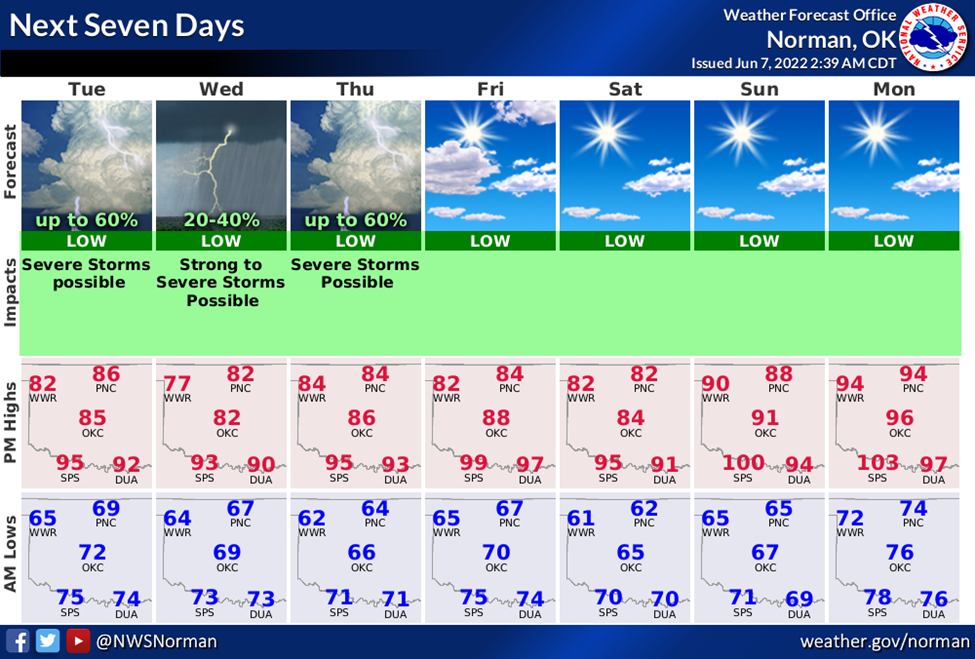
Below see actual rainfall accumulations for the past 12 hours. (Please keep in mind some of the numbers reported in actual report are higher than what Mesonet is showing based on conversations with agricultural producers in the region).   Also please see the forecast for tomorrow along with the 7-day forecast provided by the Oklahoma Mesonet.  The next harvest report will be scheduled for Monday, June 13, 2022.

Wheat Disease Update – 2 June 2022

This article was written by Meriem Aoun, Small Grains Pathologist

Crown and root rot (Figure 1) was among the common diseases throughout the last two weeks of May. We observed this disease in multiple counties in Oklahoma including Cimmaron, Payne, Major, Texas, Beaver, Canadian, Kingfisher, and Alfalfa. Culturing from infected samples at the Plant Disease Diagnostic Lab at OSU showed that most samples were infected by Fusarium pseudograminearum. Fewer samples from Kingfisher, Alfalfa, Beaver, and Payne counties were infected by Bipolaris sorokiniana which causes common root rot. In these samples, Bipolaris Sorokiniana was often detected in combination with Fusarium pseudograminearum. Bipolaris Sorokiniana also caused spot blotch on the leaves in samples from Payne and Garfield counties.

Figure 1. Symptoms of crown/root rot on the winter wheat variety ‘LCS Atomic AX’ in a farmer field in Kingfisher, OK (Photo credit: Mike Johnson, Albaugh LLC).

In Morris (Okmulgee County, East Central OK) and on May 31, I observed high incidence of Fusarium head blight (FHB or scab) as shown in Figure 2. Bleached heads with salmon-pink color spore masses were observed (Figure 3). Precipitations during May (around flowering time of the crop) favored the development of this disease. In addition, corn, which is another susceptible crop, was grown last year in this field contributing to the increase of the fungus inoculum in the soil. The FHB fungus produces a mycotoxin called deoxynivalenol (DON) which contaminates grain, increasing the likelihood for discounts or rejection of entire grain loads at the point of sale. This high FHB incidence in Morris agrees with the forecast from the wheat scab risk tool (www.wheatscab.psu.edu/), which showed that Eastern Oklahoma had medium-to-high scab risk (Figure 4).

Figure 2. Symptoms of Fusarium head blight (scab) in a winter wheat field in Morris (Okmulgee County, Oklahoma).
Figure 3. Wheat head showing Fusarium head blight symptoms. Salmon-pink color on the spikelet corresponds to Fusarium spore masses (photo credit: Brian Olson, OSU Wheat Pathology Lab).
Figure 4. Scab risk map for the US based on six-day weather forecast (wheatscab.psu.edu, checked on June 2, 2022). Warmer red color corresponds to higher disease risk. Eastern Oklahoma had medium-to-high scab risk.

On June 1st, the OSU Disease Diagnostic Lab received a sample from Kay County showing dark chocolate chaff and tenacious glumes on the winter wheat variety ‘Green Hammer’ (Figure 5). I also observed these symptoms in other locations in Oklahoma including Balko (Beaver County), Lahoma (Garfield County), and Morris (Okmulgee County). These symptoms are triggered by environmental stresses such as drought and can be observed on the winter wheat varieties ‘Green Hammer’, ‘Bentley’, ‘Baker’s Ann’, and ‘Joe’.

Figure 5. Dark chocolate chaff and tenacious glumes on winter wheat in Lahoma, Garfield County, Oklahoma.

Oklahoma Wheat Harvest Moves Forward with Abrupt Halt After Untimely Rains

Courtesy Oklahoma Wheat Commission

Oklahoma Wheat harvest made great strides in South Central and Southwest, Oklahoma over the Memorial Day weekend with producers getting started in regions as far north as Omega and Hennessey with some minor cutting being reported by Seiling.  Moisture has been challenging for producers in Central Oklahoma and variety selections made a difference on whether producers were able to get into the fields or not this past week in central Oklahoma. Rains have now delayed harvest from moving forward in all regions of Oklahoma that began on Tuesday evening.  Reports from across the state have been fairly consistent on yields being reported mainly in the mid teens to mid 20’s, across most Southern and Western regions.  The occasional yield of 30 to 40 bushels have been reported on non-grazed management intensive ground.  We have had one or two reports of some fields making 51 to 52 bushels per acre.  It is thought yields will be better as harvest moves further North and reports have trended higher on yields in Central, Oklahoma around the El Reno, Okarche, Kingfisher, Omega areas. Yields in these regions are mainly being reported in the mid 20’s to mid 30’s depending on the variety and management practices. Producers have made great strides down around Grandfield, Tipton, Altus, Fredrick, Walters with approximately half of the crop being reported as harvested.  Harvest is just beginning in the Chickasha and Apache regions with producers getting good starts.  Heavy rains in several areas of Southwest Oklahoma from Hollis, Tipton, Altus to Frederick last night will most likely have an impact on quality from here on out.  South of Altus it was reported that they received 3 inches at the OSU research station and East of Altus some areas received 6 inches of moisture in less than an hour.  Flash flooding happened in several places from Hollis, Tipton and Altus to Frederick. It was reported that a rail line was washed out in Headrick early this morning.  Several places have been without power in this region as of this morning, due to high winds that knocked down power lines.  While yields have been below average the quality of the crop up to this point has been extremely favorable.  All the data on quality was taken before the late Tuesday evening /early Wednesday morning rains, so producers are concerned what things will look like once they get back into the fields.  

Grandfield- Harvest is reported as 50% complete in this region.  Test weights before the rain have been 60 pounds per bushel or higher. Yields making from the mid teens to mid 20’s depending on variety and management. Protein reported from 11.5% to 12%, with some higher proteins reported between 14% and 17%

Devol- Harvest in this region reported at 45% complete. Test weights before the rain making 59 pounds per bushel or higher. (Average is still probably 60+ for this region before the rain.)  Yields being reported in the mid teens to low 20’s.  Some yields reported as low as 6 bushels per acre.  Protein ranging from 11.5% to 12%.

Chattanooga  Harvest in this region reported at 45% complete.  Test weights reported at 60 pounds per bushel or higher with yields in the mid teens to low 20’s for the most part.  Proteins ranging from 11.5% to 12%.

Frederick- Harvest in this region is 50% complete. Test weights ranging from 59 to 62 pounds/bushel.  Proteins ranging from 10 to 13.5% range. Yields being reported from low teens to one coming in at 38 bushels per acre.

Granite/Lone Wolf/Altus/Duke- Harvest in these regions is reported at 40% to 50% complete depending on location.  Test weights in this region before the rains ranging from 59 to 61 pounds per bushel.  (More falling in the 60+ range).  Yields being reported from 7 bushels per acre to the mid 20’s depending on location. We did have a few yields making in the high twenties to mid 30’s but those reports were minimal.  Proteins ranging from 12% to 17%.  Proteins in the 14 to 15% range not uncommon in these Western corridors.

Apache- Wheat harvest was just getting started in this region at the time of this report on Tuesday afternoon.  Only a couple loads of wheat had been taken in.  No yields, protein and test weights were reported as it would not be a good representation of the area at this point in time.

Sentinel/Rocky- Test weights reported in the 59 to 61 pound per bushel range.  (Samples before the rains were more in the 60+ range.)  Producers did get rolling good in this region over the Memorial Day weekend, the crop has been reported as clean with not much dockage.  Yields being reported from 14 to 25 bushels per acre.  Proteins ranging from 11.5% to 15% depending on variety and management practices.

OkarcheOver the weekend and up until yesterday, producers were just getting a good start in this region.  Grain was being taken in South, West, East and North of Okarche.  Test weights have been reported as decent with most being 60 pounds per bushel or higher.  Yields have been reported from as low at 10 bushels per acre to some making in the mid 40’s depending on management and variety.  It is thought in  the region, most will be looking at averages in the mid 20 to high 20 range.  Proteins being reported from 11.5% to 12%.

Kingfisher/Omega-Test weights on the wheat from this area reported at 60 pounds per bushel or higher.  Yields ranging from the mid 20’s to the mid 30’s.  A couple reports of fields with intensive management making in the mid 40’s to as high as 50. Protein ranged from 11.5% to 12.5%

Hennessey- Wheat harvest was just getting started in this region at the time of this report on Tuesday afternoon.  No yields, protein and test weights were reported as it would not be a good representation of the area at the time of the report.

Seiling-Wheat harvest was just getting started in this region at the time of this report on Tuesday afternoon.  No yields, protein and test weights were reported as it would not be a good representation of the area at the time of the report.

Below see actual rainfall accumulations for the past 24 hours. (Please keep in mind some of the numbers reported in actual report are higher than what Mesonet is showing based on conversations with agricultural producers in the region).  Also please see the forecast for tomorrow along with the 7-day forecast provided by the Oklahoma Mesonet.  The next harvest report will be scheduled for Monday, June 6, 2022, please keep in mind predicted weather is showing rains across the state over the weekend so the report might not have much change if producers do not get back into the fields before that time.  

Oklahoma Wheat Harvest at Standstill after Early Start

Courtesy Oklahoma Wheat Commission

Oklahoma wheat harvest is at a standstill after an early season start in Southwest, Oklahoma.   Not much has changed since the last report since no wheat has been taken in. Rains have moved across the state in all regions the past two days.  Even though producers would like to get into fields in all regions, the rain has been welcomed because of the extreme drought conditions across Southwest, Western, Panhandle and Central Oklahoma regions.  Yields are ranging in the mid-teens to mid 20’s. We did have a report of one field making 41 bushels per acre by Chattanooga and we had one report of a field coming in at 38 bushels per acre by Frederick.  It has been noted in some places of South Central, Oklahoma producers are hopeful to have better yields on wheat that had more intensive management plans, however yields will still be extremely poor in most locations.   Proteins have been favorable ranging mostly from 11 to 13%, with a report of one load making 18.36%.  Test weights are ranging all over the board from 58 to 61 pounds/bushel. (It should be noted test weights at this point in time are holding up much better than anticipated with more 60 to 61 pound/bushel test weight wheat). Producers will still have to wait and see how the rains across the state this week will impact those numbers.  Several places in Southwest and far Western Panhandle regions received over an inch of moisture.  In parts of the Panhandle, it has been the first measurable rain over the past 180 days, and in these regions the dryland wheat will most likely not be harvested.

Grandfield-Harvest really started moving over the weekend around this location. 43 truckloads were taken in. Yields being reported in the 20-25 bushel per acre range.  Test weights ranged from 60-61 pounds/bushel.  Protein was ranging from 11 to 13%, with a large amount being reported in the 12 to 12.5% range.  Moisture ranged from 10 to 15%.

Tipton-Harvest in this region also began, yields have been ranging from the mid 15’s to mid 20’s.  Test weights ranging from 59 to 61 pounds/bushel.  Proteins ranging from 11 to 12.5% range. Moisture ranged from 11.5 to 14%.  It is predicted these beginning fields are the poorer quality wheat and producers are hopeful yields might improve slightly as they get into better wheat.

Walters- Harvest started moving good in this region over the weekend. Yields being reported in the mid 20’s, with some reports on some of the wheat with intensive management making 41 bushels per acre.  Test weights ranged from 58 to 62 pounds/bushel. Proteins ranging 11 to 14%.  One protein was reported at 18.36%

Frederick-Test weights ranging from 59 to 62 pounds/bushel.  Proteins ranging from 10 to 13.5% range. Yields being reported from low teens to one coming in at 38 bushels per acre.

Granite/Lone Wolf/Altus- Harvest just started in these regions over the weekend with a little of wheat being taken in these regions.  Test weights ranging from 57 to 58 pounds/bushel on the four loads being reported.  Proteins ranged from 11.2 to 13.1%  Yields reported in mid teens, with one being reported in the low 20’s, this is on early cutting, a more representative sample will come in the next report once harvest gets rolling more.

Below see actual rainfall accumulations for the past two days with comparisons to the 180 day rainfall accumulations across Oklahoma.  Also please see the 7 day forecast provided by the Oklahoma Mesonet. Due to the heavy moisture and cooler temperatures most think it will be the end of Memorial Day weekend or possibly the beginning of next week before producers start getting back into the fields in most locations. For this reason the OWC will not publish a harvest report on Memorial Day but will publish a fully detailed report on Wednesday, June 1, 2022.

Wheat Disease Update – 19 May 2022

This article was written by Meriem Aoun, Small Grains Pathologist

During my visit to wheat fields in Morris (Okmulgee County) on May 16, I observed multiple fungal and bacterial diseases. Wheat crop in Morris looked good and tall compared to other locations in Oklahoma (Figure 1). Morris got substantial amount of precipitation, which favored some fungal and bacterial diseases.

Figure 1. Winter wheat crop in Morris, Oklahoma was in good condition as of May 16, 2022 (Courtesy Dr. Amanda Silva).

Bacterial streak (on the leaf, Figure 2) and black chaff (on the head, Figure 3) were frequently observed on multiple winter wheat varieties including ‘Big country’ and ‘WB 4401’. Bacterial streak and black chaff are two phases of the same disease and are favored by humid and warm climate, which was the case in Morris.

Figure 2. Symptoms of bacterial streak on the winter wheat variety ‘WB 4401’ in Morris, Oklahoma (Courtesy Dr. Amanda Silva; May 16, 2022).
Figure 3. Symptoms of black chaff on glumes and neck (Morris, Oklahoma; May 16, 2022).

In Morris, I also observed Septoria leaf spot and tan spot in the lower and mid canopy, but nothing much on flag leaves. Septoria leaf spot was more common and found on varieties like ‘Skydance’ and ‘Crescent AX’ (Figure 4). Both diseases were also observed in the Stillwater Agronomy Research Station on OSU winter wheat breeding lines. In addition, spot blotch and powdery mildew were found in multiple experimental plots in Stillwater on susceptible winter wheat varieties and OSU breeding lines (Figure 5).

Figure 4. Septoria leaf spot symptoms on the winter wheat variety ‘Crescent AX’ in Morris, Oklahoma (May 16, 2022).
Figure 5. The black spots show symptoms of spot blotch whereas the white patches correspond to powdery mildew infection on an OSU winter wheat breeding line (Stillwater, Oklahoma; May 11, 2022).

Powdery mildew and leaf rust were observed in both Stillwater and Morris (Figure 6 and 7). As I previously reported powdery mildew was observed in multiple locations in Oklahoma since April whereas leaf rust was first observed this year in Oklahoma during the second week of May.

Figure 6. Leaf rust symptoms on the hard red winter wheat variety ‘Baker’s Ann’ (Morris, Oklahoma; May 16, 2022).
Figure 7. Symptoms of leaf rust (circular orange pustules) and powdery mildew (white patches) on the hard red winter wheat variety ‘Baker’s Ann’ (Morris, Oklahoma; May 16, 2022).

In addition to these foliar diseases, I observed some head diseases including sooty mold (black head mold) (Figure 8) in wheat fields in Morris, El Reno, and Stillwater. Humid conditions promote this disease on wheat heads. Often wheat that has been subjected to a stress such as freeze, root rot, or drought shows a greater severity of sooty mold than healthy wheat. I also observed loose smut (Figure 9) in Chickasha, Stillwater, and Morris.

Figure 8. Symptoms of sooty mold on winter wheat in Morris, Oklahoma (May 16, 2022).
Figure 9. Symptoms of loose smut on the winter wheat variety ‘WB 2158’ (May 3, 2022).

Wheat Disease Update – 12 May 2022

This article was written by Meriem Aoun, Small Grains Pathologist

Root/crown/foot rots were observed in multiple wheat fields in April and May in Woods, Cherokee, Blaine, Cotton, and Payne counties. Dr. Amanda Silva reported severely damaged wheat plants in drought stressed fields mainly in Cherokee and Woods counties (Figure 1). Infected plants were stunted and white and had poor root systems. Although the plants were drought stressed throughout the growing season, much of the damage was not noticeable until after wheat heading. Dr. Silva observed pinkish discoloration on infected plants in Cherokee after peeling the leaf sheath in the lower stem internodes, which indicates that the infection was caused by Fusarium (Figure 2).

Figure 1. White, stunted, and drought-stressed plants showing symptoms of root/crown/foot rots (Cherokee county, Oklahoma; photo credit: Dr. Amanda Silva; May 12, 2022).
Figure 2. Pink discoloration indicates that root/crown/foot rot was caused by Fusarium (Cherokee county, Oklahoma; photo credit: Dr. Amanda Silva; May 12, 2022).

The rain in early May in some locations in Oklahoma provided suitable environmental conditions for the appearance of some fungal diseases including rusts. This week, stripe rust was observed in the Stillwater Agronomy Research Station on susceptible wheat varieties like ‘Pete’ and some OSU breeding lines (Figure 3). Leaf rust was found on the susceptible wheat variety ‘OK Bullet” and on some OSU breeding lines (Figure 4). Rust diseases have not been found in other locations in Oklahoma. The current pressure is low and late compared to the previous year due to drought conditions through the growing season. However, rust disease incidence can increase in coming weeks if weather conditions are favorable.

Figure 3. Stripe rust on a susceptible OSU winter wheat breeding line in the Stillwater Agronomy Research Station, Oklahoma (the photo was taken on May 10, 2022).
Figure 4. Initial leaf rust pathogen infection on a winter wheat OSU breeding line in the Stillwater Agronomy Research Station, Oklahoma (the photo was taken on May 10, 2022).

Wheat Disease Update – 28 April 2022

This article was written by Meriem Aoun, Small Grains Pathologist

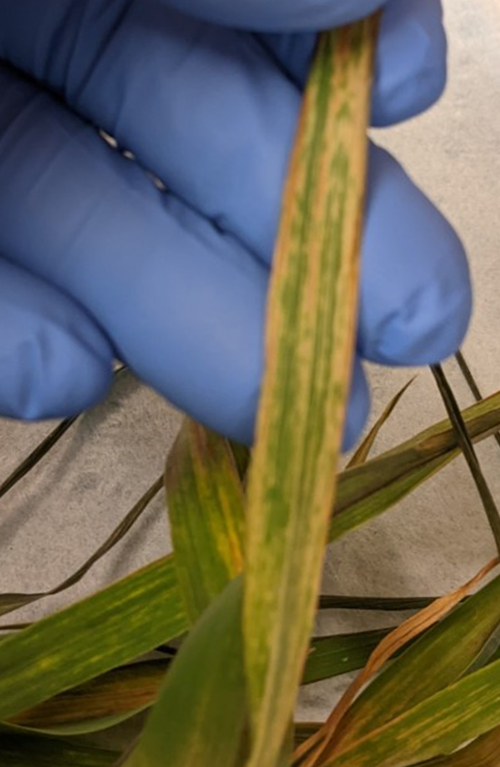
During April, the Plant Disease and Insect Diagnostic Laboratory at OSU received multiple wheat samples showing symptoms of streaking on the leaves. Leaf streaks were greenish yellow and parallel as shown in Figure 1. Enzyme linked immunosorbent assay (ELISA) on these samples from different wheat varieties were positive for wheat streak mosaic virus (WSM). WSM infected samples were from fields in multiple counties in Oklahoma including Payne, Blaine, Cimarron, Harper, Grady, and Garfield. A couple of samples that tested positive for WSM were also positive for high plains virus (HPV) and were from Harper and Blaine counties. Both WSM and HPV are transmitted by wheat curl mite. I also observed symptoms of barley yellow dwarf virus (Figure 2) in fields in Payne, Cleveland, and Grady counties.

Figure 1. Wheat streak mosaic virus symptoms on the wheat variety ‘OK Corral’ (Grady County, April 13, 2022).
Figure 2. Symptoms of barley yellow dwarf infection on the wheat variety ‘OK Corral’ in a farmer field in Cleveland County, OK (the photo was taken by Bradley Secraw, extension educator, at Cleveland County on April 26, 2022).

I also observed leaf spotting on the wheat variety ‘OK Bullet’ in the Stillwater Agronomy Research Station. Culturing from the leaves resulted in the identification of the fungi Bipolaris sorokinana which causes spot blotch and Parastagonospora nodorum which causes septoria nodorum blotch. Parastagonospora nodorum was also recovered from leaf spots on leaves of the variety OK Corral in Cleveland County.

Around mid-April, the OSU Diagnostic Lab received a wheat sample from the varietyDoublestop CL Plus’ from Blaine County. I examined the sample and I found that the infected plants were stunted and brown and showed weak root systems (Figure 3). Culturing from infected tissues identified Bipolaris sorokiniana which causes common root rot and Fusarium sp. which cause root, crown and foot rots. These fungi are favored by drought conditions in Oklahoma during the fall and spring. Dr. Silva and Gary Strickland also reported seeing root rot at Cotton county.

Figure 3. Common root rot and Fusarium root, crown and foot rots in a wheat sample from the wheat variety ‘Doublestop CL Plus’ (Blaine County, April 13, 2022).

Wheat Disease Update – 21 April 2022

This article was written by Meriem Aoun, Small Grains Pathologist

In my previous update on April 12, I reported barley yellow dwarf virus (BYD) infection on the susceptible wheat variety ‘Pete’ in the BYD nursery in the Stillwater Agronomy Research Station. Last week, Dr. Amanda De Oliveira Silva (OSU Extension small grains specialist) observed yellowing of the leaf tips in most of the hard red winter wheat variety demonstration plots in Stillwater (Figure 1). We performed Enzyme linked immunosorbent assay (ELISA) on symptomatic samples from different OSU wheat varieties including ‘OK Corral’, ‘Strad CL Plus’, ‘Guardian’, ‘Baker’s Ann’, ‘Showdown’, and ‘Breakthrough’. All samples were tested positive for BYD. In these demonstration plots, the variety ‘Uncharted’, which carries two BYD resistance genes, Bdv1 and Bdv2, was the most resistant OSU wheat variety to BYD (Figure 1). Dr. Silva indicated that the plots planted earlier in September were more infected than the plots planted later in October. This shows the importance of breaking the ‘green bridge’ to manage this virus which is transmitted by cereal aphids.

Figure 1. The photo on the left shows Barley yellow dwarf (BYD) infection on the wheat variety OK Corral. The photo on the right shows the BYD resistant variety Uncharted which was planted next to other infected plots. The photos were taken in the hard red winter wheat variety demonstration plots in Stillwater, OK on April, 15, 2022.

During the last couple of weeks, the Plant Disease and Insect Diagnostic Laboratory at OSU received wheat samples from Garfield, Blaine, Cleveland, and Harper counties in Oklahoma and from an unknown location in Kansas state. I examined these samples and I observed yellowing and streaking indicative of viral infection (Figure 2). I did not observe any symptoms of fungal diseases on the leaves of the received samples. For the samples received from Garfield county and Kansas state, many of the leaves were dry and brown suggesting freeze damage (Figure 3).

Some of these samples were tested using ELISA for several viruses that affect wheat in the Great Plains. The sample from Cleveland county which was collected on the wheat variety OK Corral was positive for BYD. The sample from Kansas state (from the variety ‘Zenda’) and the sample from Garfield county (from the variety ‘WB 4401’) were tested positive for wheat streak mosaic virus (WSM). ELISA for the remaining samples from Blaine and Harper counties is in progress but the symptoms suggest WSM infection.

Figure 2. Symptoms of wheat streak mosaic virus on the leaves of the wheat variety ‘WB 4401’ (Garfield county, Oklahoma on April 13, 2022).
Figure 3. Freeze damage on the wheat variety ‘WB 4401’ (Garfield county, Oklahoma, photo by Kevin Brown on April 11, 2022).