Checking for first hollow stem

First hollow stem occurs just prior to jointing and is the optimal time to remove cattle from wheat pasture. First hollow stem usually occurs in mid to late February in southern Oklahoma and early March in northern Oklahoma. Grazing past first hollow stem can reduce wheat grain yield by as much as 5% per day and the added cattle gains are not enough to offset the value of the reduced wheat yield.

Similar to previous years, we will monitor occurrence of first hollow stem in our wheat plots at Stillwater and report the findings on this blog. There is also a new first hollow stem advisor available on the Oklahoma Mesonet that can assist in determining when to start scouting.

Checking for first hollow stem is fairly easy.

  • You must check first hollow stem in a nongrazed area of the same variety and planting date. Variety can affect date of first hollow stem by as much as three weeks and planting date can affect it even more.
  • Dig or pull up a few plants and split the largest tiller longitudinally (lengthways) and measure the amount of hollow stem present below the developing grain head. You must dig plants because at this stage the developing grain head may still be below the soil surface.
  • If there is 1.5 cm of hollow stem present (see picture below), it is time to remove cattle. 1.5 cm is about the same as the diameter of a dime.
  • Detailed information on first hollow stem can be found at www.wheat.okstate.edu under ‘wheat management’ then ‘grazing’
  • Image
The plant on the left is past first hollow stem and is jointing. The plant on the right is at first hollow stem

The plant on the left is past first hollow stem and is jointing. The plant on the right is at first hollow stem

Wheat disease update – 11 February 2015

Wheat disease updates are written by Dr. Bob Hunger, OSU Extension Plant Pathologist

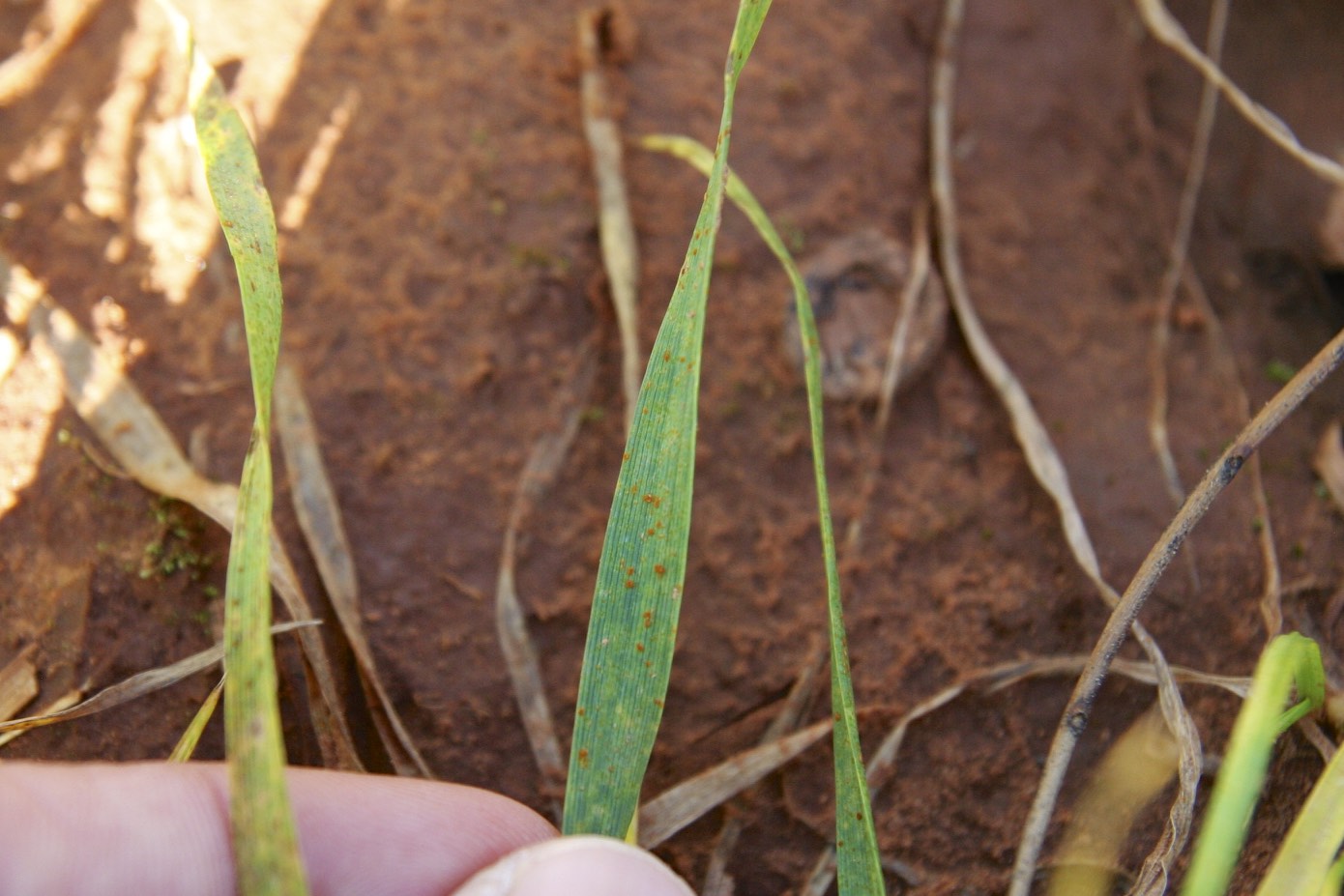
Oklahoma: Reports of diseases in Oklahoma have been sparse (as expected for this time of year) but certainly more numerous than last year when drought curtailed foliar diseases.  Yesterday (10-Feb) I found wheat leaf rust at a low, but consistent level in guard strips of Jagalene planted around a large wheat breeder nursery here in Stillwater.  Susceptible-type pustules were on lower leaves at 15-25%.  As temperature increases and with moisture this rust will increase and spread.

Gary Strickland (Extension Educator – southwest Oklahoma) indicated to me that he had heard reports of some leaf rust in Tillman County and also has seen a few pustules here and there on wheat in Jackson County, but nothing severe.  He has seen no powdery mildew and no root rots to speak of.  He also indicated there were a lot of acres of “little wheat” with some looking good if moisture had been received but that the southwest OK was quickly drying out.

Symptoms of wheat soilborne mosaic/wheat spindle streak mosaic (SB/SS) have shown up in Dr. Edward’s variety demonstration as well as in my SB/SS evaluation nursery, but symptoms are not yet striking as the flush of spring growth has not yet started.

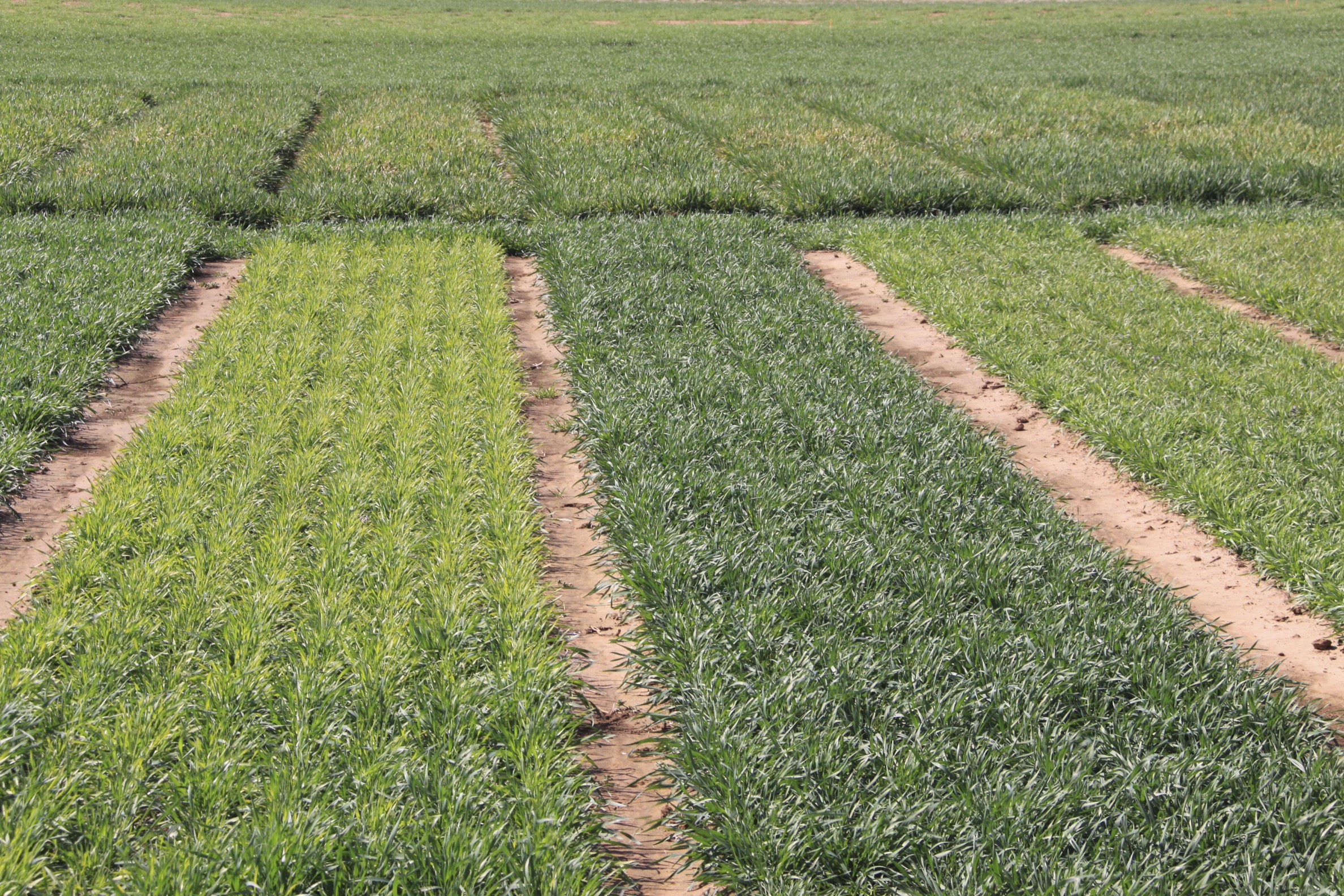
Wheat soilborne mosaic virus can cause yellowing in the spring in susceptible varieties such as the one on the left.

Wheat soilborne mosaic virus can cause yellowing in the spring in susceptible varieties such as the one on the left.


Reports/excerpts of reports from other states:

Louisiana; Dr. Stephen Harrison (Professor; Wheat & Oat Breeder, LSU AGCenter) 3-Feb-2015:  “Stripe rust has been reported in several commercial fields and nurseries around central and northeast Louisiana.”


Texas Dr. Amir Ibrahim (Prof, Small Grains Breeding and Genetics, Texas A&M AgriLife Research) 3-Feb-2015:  “Wheat stripe rust found in Texas Blacklands area:  On January 29th, Russell Sutton, Assistant Research Scientist with the Small Grains program at Texas A&M University and our anchor in the northern Blacklands area and northeast Texas, visited our research plots near Ennis Texas. Russell found a small hot spot of stripe rust on the susceptible variety ‘Patton’ that we use as a spreader. The spot was about three feet in diameter and the lower leaves where heavily infected. The wheat appears to have completed the tillering stage and ready to begin jointing.  Russell will return in two weeks and collect some spores and look for more infection sites.

Time to start topdressing wheat

There are few crop inputs that deliver as much return on investment as nitrogen fertilizer. It takes approximately two pounds of nitrogen, costing approximately $1.00, to produce one bushel of grain worth about $5.00. Of course, nitrogen is not the only yield determining factor in a wheat crop. Also, the law of diminishing marginal returns eventually kicks in, but nitrogen fertilizer is still one of the safest bets in the house.

Top dress nitrogen fertilizer is especially important because it is applied and utilized at a time when the plant is transitioning from vegetative to reproductive growth. Several things, including the number of potential grain sites, are determined just prior to jointing and it is imperative that the plant has the fuel it needs to complete these tasks. Jointing also marks the beginning of rapid nitrogen uptake by the plant which is used to build new leaves, stem, and the developing grain head. The nitrogen stored in these plant parts will be used to fill the grain later in the season, and the plant is dependent on this stored nitrogen to complete grain fill.

In the bullet points below, I will hit the major points regarding top dress nitrogen for wheat.  I have also posted three slide presentations with audio regarding topdressing wheat at my YouTube channel available by clicking here or by searching YouTube for OSU Small Grains. 

When to apply

  • In order to have full benefit, nitrogen must be in the rooting zone by the time wheat is jointing. Jointing occurs around the end of February in southern OK and around the second week of March in northern OK.
  • Moisture is required to move nitrogen into the rooting zone. Since precipitation is usually very limited in January and February in Oklahoma we need the nitrogen out on the field when the precipitation arrives. This, along with the fact that we have 5.5 million acres to cover, means that we need to get started in January to get everything taken care of in a timely fashion.
  • If you are using the Sensor Based Nitrogen Recommendation system your yield predictions and nitrogen recommendations generally become more accurate as the season progresses; however, growers wishing to hedge their nitrogen bet could apply a partial top dress in January or early February and supplement with a second top dress just prior to jointing if SBNR recommendations call for additional nitrogen.
  • Do not apply nitrogen to frozen ground. Nitrogen will move with water. If melting snow or frozen rain is moving to the ditch, so will nitrogen applied to the soil surface.
  • Consider splitting or delaying top dress nitrogen applications to sandy soils until closer to jointing, as leaching can occur.

How much to apply

  • On average it takes about 2 lbs/ac of N for every bushel of wheat yield. In addition, dual-purpose wheat requires 30 lbs/ac of N for every 100 lbs/ac of beef removed. You can subtract your soil test NO3-N from these total requirements.
  • It is okay to adjust topdress N plans based on your current yield potential. When you submitted your soil test, you might have stated a 50 bu/ac yield goal which would require 100 lbs/ac of nitrogen; however, it is important to take a hard look and determine if this yield goal is still realistic based on your current crop status. I am not suggesting to adjust based on what you think the weather might do, but it is okay to take inventory and adjust your topdress N up or down based on current field conditions.
  • Don’t have an N-rich strip? It would be a lot cooler if you did. An N-rich strip would take the guess work out of adjusting your topdress N up or down based on your current crop conditions. Your county extension educator can provide more information on N-rich strips and you can find more information on the web at www.npk.okstate.edu

What source to use

  • The plant does not care about nitrogen source. A pound of nitrogen is a pound of nitrogen. Focus on getting the correct amount applied at the correct time, and choose your product based on price and application uniformity.
  • Use a source that can be applied uniformly. In my experience, spinner trucks or buggies are generally the least uniform. Air trucks or streamers are the most uniform.
  • Streamer nozzles almost eliminate leaf burn from UAN; however, leaf burn is generally not an issue until temperatures warm and/or you are applying fairly large amounts of UAN. Stream nozzles are also not affected much by wind and deliver a uniform pattern in a variety of conditions. There are also some studies that indicate banding of UAN through the use of stream nozzles will reduce nitrogen immobilization on crop residue. All in all, I am a big fan of streamer nozzles. You cannot, however, tank mix herbicides when using streamer nozzles.
    Streamer nozzles provide uniform application of UAN in a wide variety of environmental conditions.

    Streamer nozzles provide uniform application of UAN in a wide variety of environmental conditions.

    Poor nitrogen application can result in a streaked field. Some of the areas in this field were over fertilized while some were under fertilized resulting in wasted nitrogen and less than optimal crop yield.

    Poor nitrogen application can result in a streaked field. Some of the areas in this field were over fertilized while some were under fertilized resulting in wasted nitrogen and less than optimal crop yield.

Winter grain mites in northcentral OK

Jeff Bedwell forwarded reports of winter grain mites in Major and Alfalfa counties over the past week. This does not appear to be a widespread problem, but growers should check wheat fields to see if winter grain mites are present. We had a lot of issues with winter grain mites and brown wheat mites in Oklahoma last year. Unfortunately, many of these fields were not diagnosed until the damage was severe and visible from a distance. In this case, a rescue treatment was still effective at controlling the pest, but some yield loss had already occurred thus reducing the return on pesticide investment.

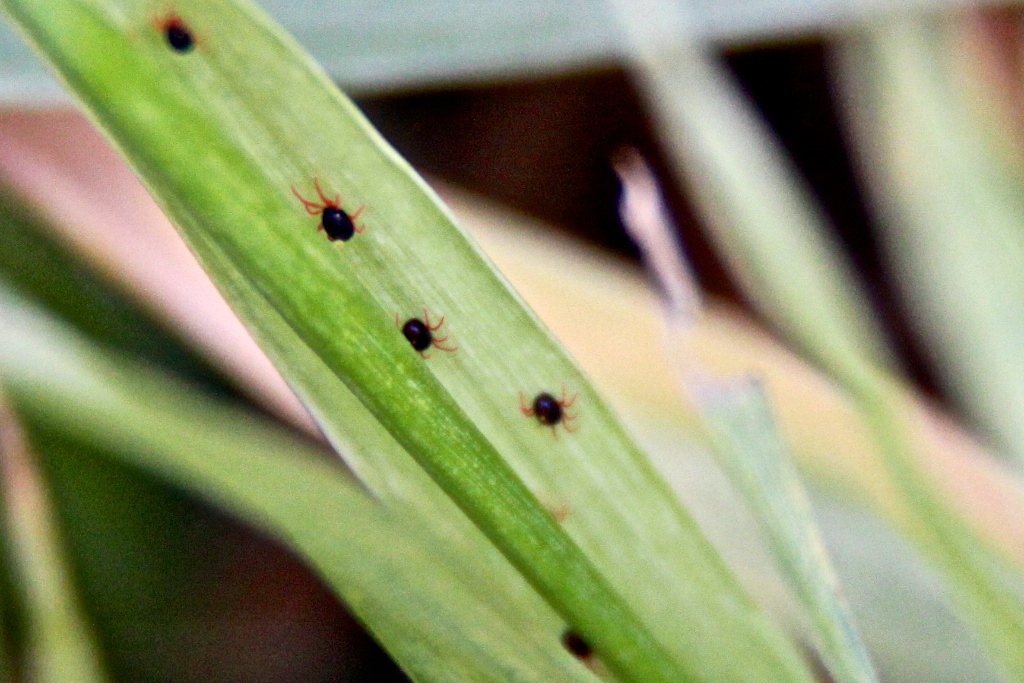
Winter grain mites are small (about 1 mm long) with black bodies and orange-red legs. Winter grain mites complete two generations per year and the adults can live for up to 40 days. The generation we are dealing with now resulted from oversummering eggs laid last spring. The second generation peaks in March/April and results from eggs laid in January/February.

Image

Winter grain mites on wheat near Blair, Oklahoma.


Scouting
Winter grain mites are not a problem you will notice in a timely fashion while standing up. You will need to get close to the soil surface and move residue to find these pests. Winter grain mites are light sensitive and prefer calm air to windy conditions; therefore, scouting early in the morning, late in the evening, or on cloudy days generally works best. Be sure to look under residue in no-till fields and under clumps of soil in conventional-till fields.

Scouting for winter grain mites requires getting close to the soil surface and moving residue to disturb mites.

Scouting for winter grain mites requires getting close to the soil surface and moving residue to disturb mites.

Injury

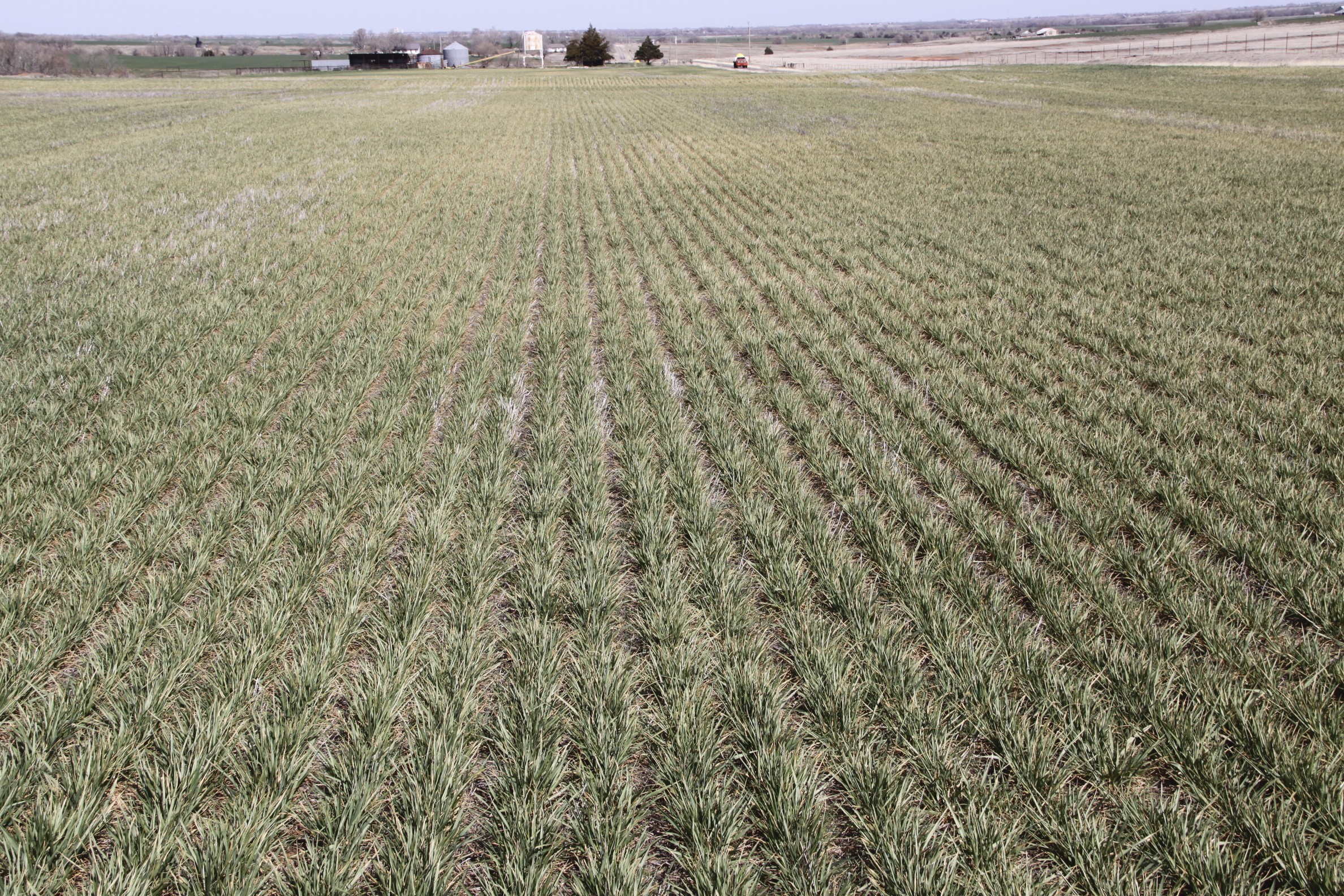
Winter grain mites feed by piercing plant cells in the leaf, which results in “stippling”.  As injury continues, the leaves take on a characteristic grayish or silverish cast.  Winter grain mites are more likely to cause injury in wheat if it is already stressed due to lack of moisture or nutrients. Also be advised that freeze injury can easily be confused for winter grain mite injury.

Wheat damaged by winter grain mite often has a silver or grayish appearance from a distance

Wheat damaged by winter grain mite often has a silver or bronzed appearance from a distance

When to spray
There are no established thresholds for winter grain mite. Healthy, well-fertilized wheat plants can generally outgrow injury, so it takes large numbers to justify control. If there is injury present AND large numbers of mites (~10 per plant) present in grain only wheat this time of year, you might consider control. If the wheat is to be grazed, I would simply monitor the situation in most cases and only spray if injury became severe.

What to spray
Malathion is the only product labeled for wheat in Oklahoma that has winter grain mite on the label. There are many additional products, such as some of the pyrethroids and chlorpyrifos, that are effective at controlling winter grain mite, but they don’t have a specific label for them. These products can be applied under 2ee regulations; however since this pest is not specifically labeled, the user assumes all responsibility for the application of the product.  It is also important to read and follow label directions regarding grazing restrictions for these and all pesticides.  Consult OSU Current Report 7194 Management of insect and mite pests in small grains for a more complete listing of available pesticides.

Wheat disease update – 31 October 2014

Wheat disease updates are written by Dr. Bob Hunger, OSU Extension Plant Pathologist

Oklahoma:  We’ve not seen any diseases so far this fall around Stillwater, but we have been relatively dry and much of the wheat was not planted until the past couple of weeks.  Mark Gregory (Area Extn Agron Spclt – southwestern OK) indicated to me earlier this week that he has not seen or heard any reports of leaf rust or other diseases.  However, Bryan Vincent (Crop Scout – NW/NC Oklahoma) sent me some photos of leaf rust pustules he found in several fields around the Aline-Helena area (30-40 miles northwest of Enid in north-central OK).  The pustules were extremely sparse and found only in very early planted wheat.  Bryan also reported seeing some light tan spot infections.  Leaf rust also has been observed in Kansas, Colorado, and Nebraska (see reports below), and stripe rust has been reported in Wyoming, Montana and the PNW.
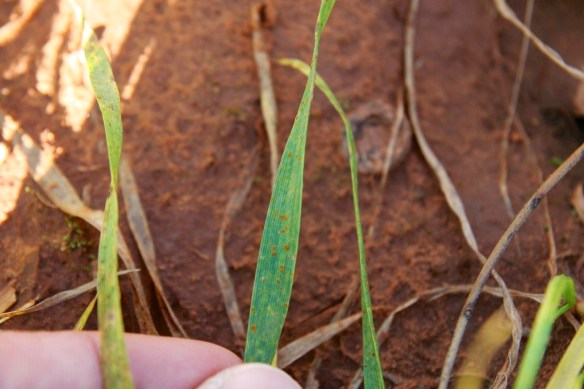
Fall infestations of leaf rust rarely carryover to the spring and generally do not warrant treatment. Monitor fields and consider a split fungicide application in the spring if heavy foliar disease is still present at Feekes GS 6 - 7

Fall infestations of leaf rust generally do not warrant treatment. Monitor fields and consider a split fungicide application in the spring if heavy foliar disease is still present at Feekes GS 6 – 7 in early March

When leaf rust occurs in the fall in Oklahoma, the question arises regarding the value of spraying to control that rust.  Fall-infected leaf rust plants typically have yellowed lower/older leaves with rust pustules, but the youngest 2 or 3 leaves are green and healthy.  As temperature drops through November and December, the older rust-infected leaves die and new infections are greatly slowed and inhibited.  Grazing also helps to remove these leaves and increase air circulation and drying that are conditions less favorable to spread of the disease.  Given these considerations, spraying to control leaf rust in the fall is of limited value.  The primary concern with fall infections of leaf rust is that with a mild winter and sufficient moisture, the rust will survive through the winter and inoculum will be present in fields to start the disease early in the spring.  Hence, monitoring of these fields through the winter and early next spring is recommended to determine if a split application of a fungicide is merited to control the rust (and also possibly tan spot, septoria, and/or powdery mildew) in the early spring.

Reports/excerpts of reports from other states:

Kansas (Dr. Erick De Wolf, Extn Plant Pathologist, Kansas State University) 27-Oct-2014:  Wheat Leaf Rust Update in Kansas:  Planting of the winter wheat crop in Kansas is well underway. Farmers are reporting that wheat has emerged and is looking good in many areas of the state. Wheat planting on some farms was delayed by a late soybean harvest this fall, but these acres should be planted soon.

I was checking wheat this week in Manhattan (Northeast KS) and found leaf rust in some research plots.  This wheat was sown about 2-weeks prior to the optimal planting date but well within the normal planting range for wheat production in the state.  The leaf rust was not difficult to find with disease incidence near 5% some plots. The severity was 2 percent or less on most of the infected leaves. This level of fall infection of leaf rust is common in Kansas; however, 60% of the time cold temperatures and leaf desiccation during the winter months will eliminate the disease in many fields.

Ned Tisserat, retired plant pathologist from Colorado State University, also reported leaf rust in Northeast Colorado this past week. So it is possible that leaf rust is active in other areas of Kansas as well.  I will be checking other locations for leaf rust in Kansas this coming week and let the group now what I find.

Nebraska (Dr. Stephen Wegulo, Extn Plant Pathologist, Univ of Nebraska) 27-Oct-2014:  On Friday last week, Oct 24, I answered a call from a crop consultant who told me there is leaf rust in several wheat fields in the Panhandle of Nebraska.

Greenbugs reported in northwestern Oklahoma

By Tom Royer, OSU Extension Entomologist

Crop consultants have reported greenbugs in a few northwestern Oklahoma wheat fields. The hit or miss nature of greenbugs and other aphid pests in wheat fields can make scouting challenging. Fortunately, there is an online tool called the Cereal Aphid Decision Support Tool that simplifies scouting for greenbugs and also considers the effects of natural predators.

Greenbugs on wheat

Greenbugs on wheat

Start by going to the Cereal Aphids Decision Support Tool on your computer http://entoplp.okstate.edu/gbweb/index3.htm and selecting the Greenbug Calculator.

By answering a few simple questions, you can determine an economic threshold for controlling greenbugs.  This threshold is based on the estimated cost of treating the field and the estimated price of wheat.  Once a threshold is calculated, you can print a Glance ‘n Go scouting form, take it to a field and record your sampling results.  The form will help you to decide if the field needs to be treatment for greenbugs.  There are several things that make Glance ‘n Go a good way to make such a decision. You only have to “Glance” at a tiller to see if it has greenbugs (no counting greenbug numbers).  You can make a decision to treat “on the Go” because you stop sampling once a decision is reached (no set number of samples).  Finally, you can account for the activity of the greenbug’s most important natural enemy, Lysiphlebus testaceipes.

When scouting with the Glance ‘n Go system, keep a running count of tillers that have aphid mummies and a running count of tillers that are infested with one or more greenbugs.  After each set of 5 stops, the Glance ‘n Go form directs you to look at your total number of infested tillers and tillers with mummies.  If there is enough parasitoid (mummy) activity, you will be directed to stop sampling and DON’T TREAT, even if you have exceeded the treatment threshold for greenbugs!  Why? Because research showed that at that level of parasitism, almost all of the healthy-looking greenbugs have been “sentenced to death” and will be ghosts within 3-5 days.  If they have received their “sentence” you can save the cost of an unnecessary insecticide application.

Natural predators can keep greenbug infestations below economic thresholds

Natural predators can keep greenbug infestations below economic thresholds

Treatment thresholds will probably fall around 2-4 greenbugs per tiller, but make sure you are using the Fall (Sept.-December) form, not the spring form.  If a field needs to be treated, check with Current Report CR-7194, “Management of Insect and Mite Pests in Small Grains”.  If you treat for greenbugs and have a failure, please contact our Department and we will investigate further to determine if insecticide resistance might be an issue. Dr. Ed Bynum, Extension Entomologist from Amarillo, reported finding some greenbug populations in 2013 that were shown to be resistant to chlorpyrifos, the active ingredient in Lorsban 4E, and other generic products (Govern 4E, Hatchet, Nufos, Vulcan, Warhawk, Whirlwind).   The bottom line:  he tested some suspect greenbug populations using a diagnostic test that he developed for testing greenbugs in sorghum in the 1990’s, and found that they were resistant to chlorpyrifos at labeled rates.

Fall armyworm on the march!

by: Tom Royer, OSU Extension Entomologist

Fall armyworms are active this fall. I checked a field of wheat this past weekend with significant damage from fall armyworms that averaged 6-7 fall armyworms per square foot. Scout for fall armyworms by examining plants in several (5 or more) locations in the field. Fall armyworms are most active in the morning or late afternoon. Look for “window paned” leaves and count all sizes of larvae.

Fall armyworm damage is characterized by window panning on wheat leaves. Injury can sometimes be greater in field margins as armyworms sometimes move in from adjacent road ditches or weedy areas.

Fall armyworm damage is characterized by window panning on wheat leaves. Injury can sometimes be greater in field margins as armyworms sometimes move in from adjacent road ditches or weedy areas.

Fall armyworms are generally most active early in the morning or late in the evening. Spray when 2-3 armyworms per linear foot of row are present.

Fall armyworms are generally most active early in the morning or late in the evening. Spray when 2-3 armyworms per linear foot of row are present.

Examine plants along the field margin as well as in the interior, because they sometimes move in from road ditches and weedy areas. The caterpillars were widely distributed in the field that I checked, suggesting that they were the result of a large egg lay from a recent adult moth flight. The suggested treatment threshold is 2-3 larvae per linear foot of row in wheat with active feeding. We won’t get relief from fall armyworms until we get a killing frost, since they do not overwinter in Oklahoma.

Consult the newly updated OSU Fact Sheet CR-7194 Management of Insect and Mite Pests of Small Grains for control suggestions.

Wheat protein report – 2014

This blog post contains information from OSU Current Report 2135 Protein Content of Winter Wheat Varieties in Oklahoma. A complete pdf version of the report with a brief explanation of sampling procedures can be found at www.wheat.okstate.edu.

The grass always seems to be greener on the other side when it comes to wheat protein. In a low protein year, everyone is scrambling to find higher protein wheat to blend. In a high protein year, such as this one, the same low protein wheat that was considered marginally acceptable the year before might command a slight premium. While wheat protein is important to end users, wheat protein is just one of many attributes which determine end-use quality and marketability of winter wheat. In fact, some millers and bakers would argue that functionality of wheat protein is more important than the quantity of protein. While varietal differences commonly exist, differences in wheat protein among environments are generally much larger than differences among varieties. Factors such as nitrogen fertility and drought stress, for example, can sharply impact final protein content of the grain, and most producers are better served focusing on good agronomic practices than slight genetic differences in wheat protein content.

To reflect environmental impacts on wheat grain protein content, 2014 wheat variety test data are reported by variety and location in Table 1. The 18.5% average wheat grain protein for the Thomas location is a good example of how fertility and environment can impact protein content. Soil tests at the time of sowing revealed 141 lb/acre of residual nitrogen available, which should be enough to produce a 70 bu/acre wheat crop. Due to extreme drought, however, average grain yield at Thomas was 13 bu/acre. Under these circumstances, wheat plants were able to pull large amounts of nitrogen from the soil and move this nitrogen to the developing grain. Grain size was reduced and grains were shriveled due to drought, thus resulting in abnormally high wheat protein. A similar situation was reported for Altus in 2013.

In Table 2 we reported the wheat grain protein content as a deviation from location mean for each variety, as this provides easier comparison of wheat grain protein among varieties across locations. Billings, for example, is a variety with solidly positive deviation from location means, indicating it has a tendency for above-average grain protein content. Iba, on the other hand, has negative deviations from location means, indicating a tendency for lower than average grain protein content. Adequate nitrogen fertility as recommended by a recent soil test or sensor-based nitrogen management program can help ensure that varieties such as Iba produce grain protein within the acceptable range for end-use customers. Iba is also a prime example of how protein data can sometimes be misused, as the functionality of the protein in Iba is above average, which can offset lower absolute grain protein content.

How to make $100,000 in a day

No, this blog post is not about a get rich quick scheme, but there is a way for the average wheat farmer in the southern Great Plains to add $50,000 to $100,000 to the bottom line in a single day. Most soil tests I have pulled this summer have shown 50 to 90 lb/ac of NO3-N in the top 18 inches of soil. Ninety pounds of N equates to about $45 of N fertilizer, and this knowledge could save a 2,500 acre wheat farmer in excess of $100,000 in fertilizer cost. Soil testing is laborious, but the potential economic returns for spending a day or two soil sampling are outstanding.

There is still time to soil sample. Soil samples only take a few days to process once they are in the OSU lab. It is not unusual for transit time to the lab to the slowest part of the process, so if you need a fast turnaround a trip to drop samples in the Ag Hall basement in Stillwater will help (plus you have probably been wanting cheese fries). If you have already applied pre-plant fertilizer or sown wheat, there is still time to assess soil N availability and uptake via the N-Rich Strip. In its simplest form, the N-rich strip is an area where N is not limiting. Either by visual assessment or with the assistance of an optical sensor, you can use the N-rich strip to determine your top dress N requirement, but you must create the N-rich strip this fall.

Soil testing is not always easy, but it is time well spent. My high school shop teacher would have labeled me a "Primitive Pete" for this photo.

Soil testing is not always easy, but it is time well spent. My high school shop teacher would have labeled me a “Primitive Pete” for this photo.

The bottom line is that a day of soil testing or putting out N-rich strips is well worth your time investment. On another note, how would you like to make money and improve your health at the same time? I have a multi-level marketing opportunity that I can get you in on the ground floor, but don’t tell anyone else. I can only make this deal for you and only today. There will be a small “buy in” fee that you will need to pay cash up front, though.

Partial funding for the research included in this blog post was provided by USDA Project No.2012-02355 through the National Institute for Food and Agriculture’s Agriculture and Food Research Initiative, Regional Approaches for Adaptation to and Mitigation of Climate Variability and Change

Planting wheat in hot soils

Kickoff of the college football season and the start of wheat planting are Labor Day traditions in the southern Great Plains. Many producers are waiting to see if rain forecasted for this weekend materializes, but it is likely that forage-based wheat farmers will start sowing wheat next week whether it rains or not. This means sowing wheat into hot soil conditions which can cause wheat germination and emergence issues. Given the potential problems, there are a few questions producers should ask themselves prior to planting into soil temperatures >90F.

coleoptile length

If the wheat coleoptile does not break the soil surface, the germinating wheat plant will not survive.

Will you have to plant deep to reach moisture? That first structure protruding from a germinating wheat seed is actually not a leaf. It is the coleoptile. The wheat coleoptile is a rigid structure whose sole purpose is to “punch through” the soil surface so that the first true leaf emerges above the soil surface. If this does not happen, the first true leaf will try to extend below the soil surface, turn yellow, and take on an accordion-like appearance (picture above). Modern semi-dwarf wheat varieties have shorter coleoptiles than older, tall wheat varieties and coleoptile length is shortened even further by hot soil conditions. So it is important to plant a variety with a longer coleoptile length (e.g. Garrison or Doans) if planting deeply into hot soils. A rating of coleoptile lengths for wheat varieties can be found in OSU Fact Sheet 2141 OSU Wheat Variety Comparison Chart available at www.wheat.okstate.edu or at the direct link to the publication here.

Is the variety high temperature germination sensitive? High temperature germination sensitivity is a fancy way of saying that some wheat varieties simply don’t germinate well in hot soil conditions (e.g. 2174, Overley). The extent of the sensitivity varies by year, so Overley might germinate fine in 95F soils one year and produce a 10% stand in the same soil conditions the next. When sowing early, it is best to plant varieties that do not have high temperature germination sensitivity (e.g. Duster, Gallagher, or Armour). Soil conditions generally cool due to lower ambient temperatures or cooling rains by about September 20; however our summer temperatures seem to be arriving late this year, so it is best to know the level of germination sensitivity in the variety you are planting. A rating of high temperature germination sensitivity for wheat varieties can be found in the variety comparison chart linked above. A more detailed explanation of the phenomenon can be found in OSU Fact Sheet PSS 2256 Factors affecting wheat germination and stand establishment in hot soils (available by clicking here).

Partial funding for the research included in this blog post was provided by USDA Project No.2012-02355 through the National Institute for Food and Agriculture’s Agriculture and Food Research Initiative, Regional Approaches for Adaptation to and Mitigation of Climate Variability and Change