Time to topdress, but be realistic

Normally, I would be sounding the wheat topdress alarm in early January. When you have 5.5 million acres to cover, it is important to start early. However, this year we have mostly kept the topdress rigs in neutral with a wait and see approach due to the drought. The recent rain brought life to portions of the Oklahoma wheat belt and it is time to make a decision regarding topdress nitrogen. I have posted three slide presentations with audio regarding topdressing wheat at my YouTube channel available by clicking here or by searching YouTube for OSU Small Grains. I have listed some additional facts and items to consider below.

  • In order to have full benefit, nitrogen must be in the rooting zone by the time wheat is jointing. Jointing occurs around the first of March in southern OK and around the second week of March in northern OK.

  • On average it takes about 2 lbs/ac of N for every bushel of wheat yield. In addition, dual-purpose wheat requires 30 lbs/ac of N for every 100 lbs/ac of beef removed. You can subtract your soil test NO3-N from these total requirements.

  • It is okay to adjust topdress N plans based on your current yield potential. When you submitted your soil test, you might have stated a 50 bu/ac yield goal which would require 100 lbs/ac of nitrogen; however, it is important to take a hard look and determine if this yield goal is still realistic based on your current crop status. I am not suggesting to adjust based on what you think the weather might do, but it is okay to take inventory and adjust your topdress N up or down based on current field conditions.

  • Don’t have an N-rich strip? It would be a lot cooler if you did. An N-rich strip would take the guess work out of adjusting your topdress N up or down based on your current crop conditions. Your county extension educator can provide more information on N-rich strips and you can find more information on the web at www.npk.okstate.edu

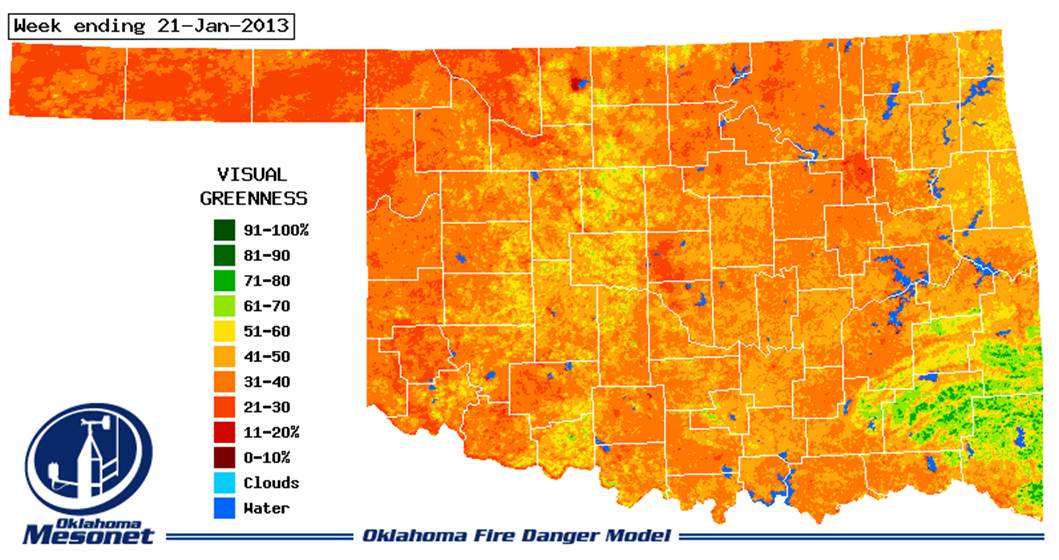
2012 versus 2013 greenness maps

I thought I would share a couple of visual greenness maps sent to me by JD Carlson in Biosystems and Ag Engineering. These are from the Oklahoma Mesonet fire danger model site and provide a visual estimate of green vegetation for mid January 2012 (top) and 2013 (bottom). Note the stark contrast in greenness throughout the wheat belt of western Oklahoma. As indicated in the 2013 map, there are some small pockets of wheat with ample stands and average yield potential, but these are not large enough to make up for all of the red.ImageImage

Check with crop insurance provider prior to drilling mud application

There are more questions than answers when it comes to application of drilling mud to agricultural land. The list of questions expands when the drilling mud is being applied to an established annual crop, such as wheat. We simply do not have enough information to know how a growing crop will respond to drilling mud application from different sources and at different application timings.

If current conditions continue it is highly likely that many Oklahoma wheat farmers will rely on crop insurance to cash flow through 2013. Therefore, wheat farmers should check with their crop insurance provider prior to applying drilling mud to established wheat to see how application of these materials will affect their coverage. Tenants should discuss application of drilling mud with landowners and it is a good idea to address these issue in writing in the lease agreement.

Too little, too late?

It finally rained! Rainfall totals in western Oklahoma (0.1 to 0.3 inches) will not put a dent in the drought, but were probably enough to induce germination of seed resting in dry soil. Oklahoma weather is extremely variable, and who knows when temperatures will warm enough to spur along the germination process. If we retain the recent moisture and have something close to a “normal” year, it is likely that we will see wheat popping through the soil in mid February. I compared February sown winter wheat to spring wheat in a trial at Newkirk, OK a few years ago. The winter wheat made about 15 bu/ac and the spring wheat made about 20 bu/ac. This was in a favorable year that was not plagued by drought. Given current weather trends, a best case scenario for February emerging winter wheat is 50% of normal yield. A worst case scenario is 0 – 10% of normal yield. If I were wagering, I would place my money on 20 – 30% of normal yield potential.

The rainfall might be enough to help emerged wheat west of I-35 survive, but that is about it. Soil moisture is still insufficient to produce a recovery and I would still proceed cautiously regarding inputs on these acres. The rain might have indeed been too little, too late for these acres. IF soil moisture gets recharged by mid February and IF we have a mild spring these acres could have some secondary tillering and make a moderate recovery; however, the odds are against this scenario.rainrfc.48hr

Don’t overgraze no-till

The drought is worsening and forage is getting harder and harder to come by. Crop residue that was once considered of little nutritional value for livestock has become a staple for Oklahoma cattle producers with depleted pasture and hay reserves. John Holman with KSU in Garden City indicated that grazing of sorghum stalks has become commonplace in western KS as well. Some crop residue can be removed without significant damage to long-term gains in soil structure associated with no-till, but overgrazing can lead to some real problems when the wind comes sweeping down the plain.

Wind erosion is commonly thought of as a conventional-till problem, but in an email exchange, Jason Warren recently indicated that there are a few scenarios where wind erosion could actually be worse in no-till than conventional till. No-till results in a relatively smooth, flat soil surface that, in the absence of residue, has few barriers to slow the wind. So, if we have an easily detached soil type (i.e. a sandy soil), a flat surface, and no residue to hold the ground, then we have a recipe for wind erosion. The same would be true for no-till wheat pasture that has been overgrazed. In a wind-erosion-fighting battle royale, I still prefer no-till to conventional till. However, no-till is not immune to wind erosion and it is important to keep some cover on the soil.

Aside from soil protection, it is important to remember that crop residues have value as reservoirs of nutrients.  An estimate of nutrient removal of grain, fiber, and forage crops can be found on one of Brian Arnall’s Pete Sheets at http://npk.okstate.edu/petesheets If the cattle are grazing the residue in-field, most of the nutrients will be returned to the soil. If the residue is being baled, the nutrients are leaving with the hay bales. You can estimate the value of these removed nutrients using the linked Pete Sheet and current fertilizer prices.

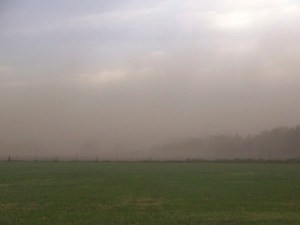
No-till practices to not make soil immune from wind erosion. Adequate cover must be maintained.

No-till practices to not make soil immune from wind erosion. Adequate cover must be maintained.

It’s all about tillers and tiller survival

In order to maximize grain yield, we need between 500 and 900 heads/sq. yd. at harvest.  Wheat sown at 1 bu/ac will generally result in about 175 seeds/sq. yd. meaning that we will need at least three tillers per seed that go on to make a wheat head. Not just any tiller will suffice. If a tiller does not have three large, unfolded leaves by jointing, there is a good shot that it will not make a head.

One of my primary concerns right now is  tillering in many Oklahoma wheat fields will be insufficient to reach the critical 500 heads/sq. yd. number. Even though most of our wheat was sown in October, a lot of it will have a November or December (if we are lucky) germination date. A K-State study from 1995 showed that wheat emerging on November 30th produced an average of only 1.8 viable heads per plant at harvest. If we had known that our emergence date would be in November or December, we would have compensated by doubling or tripling our seeding rate.

September-sown wheat that got a good start but is now backpedaling due to a lack of moisture is a different issue. In the same study mentioned above, wheat emerging October 12 produced 1,850 tillers per plant on average. Only 476 (26%) of these tillers made it to harvest, so it is normal for early-sown wheat to slough off several tillers. This has an energy cost to the plant and is one reason early-sown wheat generally yields less than October sown wheat. We have enough tillers present in our early-sown wheat but are losing them quickly. Rain is needed quickly to stop the losses.

Agronomists are second only to lawyers in including disclaimers and qualifying statements, and there is a lot of wiggle room in the numbers I have provided. A variety that typically produces larger heads (e.g. Billings) can be on the lower end of the 500 – 900 head range and a variety with smaller heads (e.g. Duster) will need to be on the upper end.With a warm winter and rainfall, we could still hit these targets. However, to borrow some terminology from Vegas, I think there are fairly low odds that our wheat will cover the spread when it comes to tillering this year.

How dry is it?

It was too nice of a day to stay in the office yesterday, so I checked on our wheat variety plots. I started at McLoud, moved west to Kingfisher, and ended up at Marshall. As indicated by the pictures and captions below, neither the wheat nor my mood improved as I traveled west. I am sure if I had traveled farther west, this would have gotten worse. The bottom line is that we are in desperate need of moisture in Oklahoma. Early-sown wheat is backpedaling quickly and cannot hold on too much longer. Much of the later sown wheat has yet to emerge. We are certainly not on our way to a record year, but everything could still turn out okay……..if it rains.