Northwestern / north central Oklahoma wheat update – drought, greenbugs, and freeze

Dr. Hunger traveled southwest Oklahoma this week, so I made a trip out Hwy. 60 yesterday to evaluate freeze injury and assess the overall condition of the wheat crop in northwestern and north central Oklahoma. Last week’s warm temperatures and wind have taken their toll on wheat in Kay, Grant, and eastern Garfield Counties. It is not too late for rain to save a partial wheat crop in these areas, but the “full yield potential” ship sailed long ago. Wheat sown behind summer crops is the hardest hit, and wheat in these fields could best be described as yellow and thin. If the weather turned and we received rain in the next week, I would predict that yield potential in these fields would still only be around the 15 bushel mark. Without rain, subtract around 15 bushels. Wheat planted behind summer fallow has held on a little longer, but is clearly showing the signs of extreme drought stress. If we receive rain in the next week (and continue to see rain) these fields could still make 20 – 30 bushels per acre. In the absence of rain in the near future, they will be 10 bushels per acre or less.

Wheat in the Lamont test plot was approximately GS 7 - 8. Flag leaves were rolled and plants were starting to abort tillers.

Wheat in the Lamont test plot was approximately GS 7 – 8. Flag leaves were rolled and plants were starting to abort tillers.


In addition to drought stress, we found freeze injury and greenbugs at Lamont. I was a little surprised to find freeze injury and even more surprised to find the greatest injury in the later-maturing varieties. We split several stems of early varieties such as Ruby Lee and Gallagher and did not find any injury. These varieties would have likely been at approximately GS 7 – 8 when the freeze occurred. We found significant injury in later-maturing varieties such as Endurance, but these varieties were likely only GS 6 – 7 when the freeze occurred. Conventional wisdom regarding freeze injury is that the more advanced the variety, the greater the likelihood of freeze injury. After seeing the same phenomenon last year (i.e. the greatest injury in later maturing varieties) I am changing my thinking on freeze injury and now say that all bets are off when it comes to freeze injury in drought stressed wheat.

Freeze injury was greatest in late-maturing varieties at Lamont.

Freeze injury was greatest in late-maturing varieties at Lamont.


Overall wheat condition started to improve around Nash and Jet, I would say that much of the wheat in this area is CURRENTLY in fair to good condition. I emphasize the currently in the previous sentence, as the only difference between wheat in the Cherokee area and wheat to the east was about one week’s worth of moisture. Some terrace ridges had already started turning blue and moisture was starting to run out. Without rain wheat in this area will rapidly deteriorate from good to poor. One consistent theme throughout the day was greenbugs. Many sites had evidence of parasitic wasp activity (i.e. aphid mummies), but the presence or absence of parasitic wasp activity varied field by field. Dr. Royer has indicated that greenbugs still need to be controlled in drought stressed wheat. If parasitic wasps are active, the best decision is to let them do the aphid killing for you. If no mummies are present, then insecticide control could be justified. The only sure way to make this determination is to use the glance-n-go sampling system.


Greenbugs were alive and well at Lamont
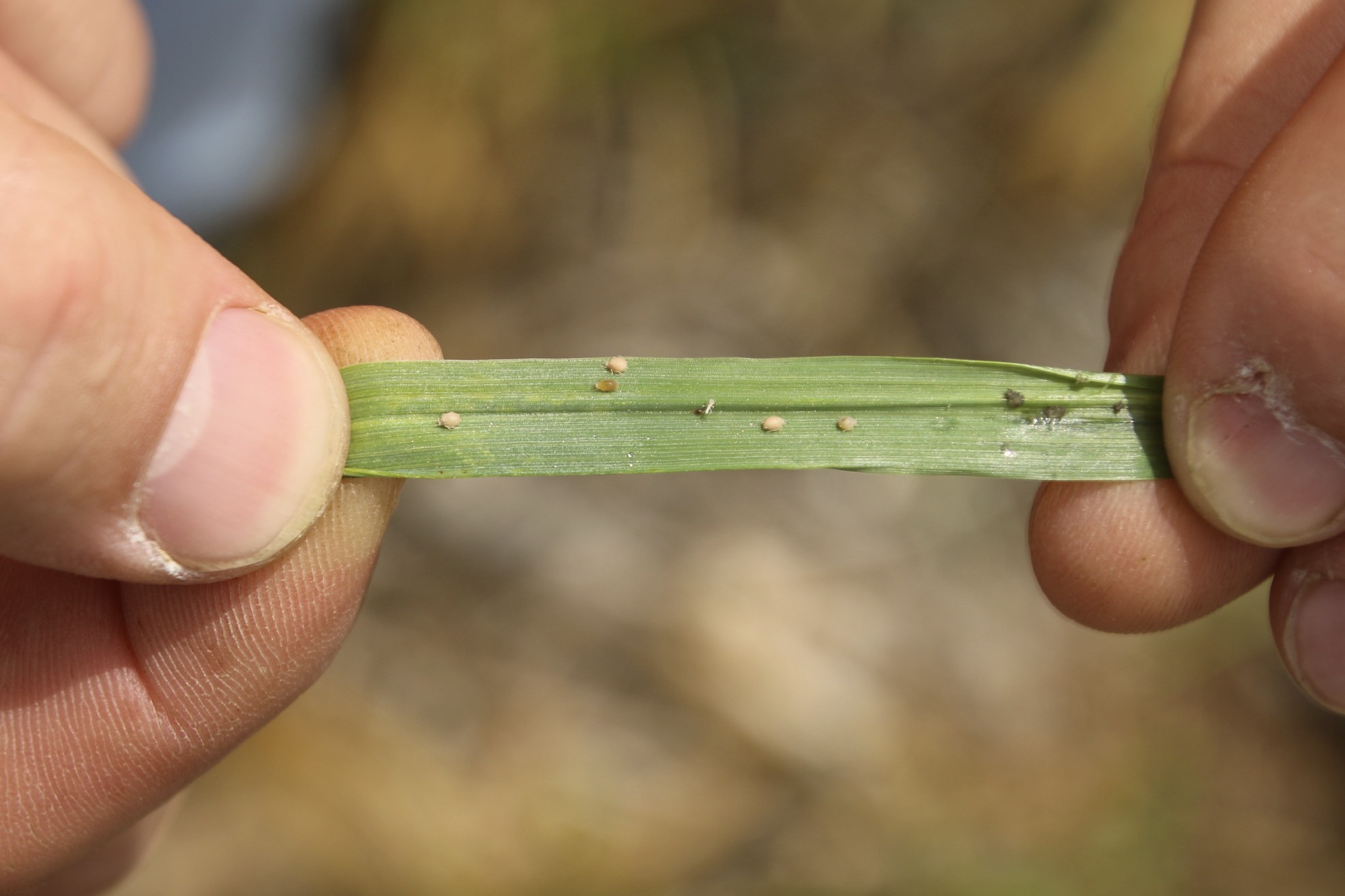
Greenbugs were alive and well at Lamont

Parasitic wasps were keeping greenbug populations under control in this field

Parasitic wasps were keeping greenbug populations under control in this field

Active and parasitized greenbugs on the same plant

Active and parasitized greenbugs on the same plant


Similar to Lamont, we found freeze injury in the Cherokee and Helena areas. Many of the worst looking fields (extensive leaf burn) had only superficial injury and should recover if moisture allows. Conversely, some plants that showed no outward signs of freeze injury had injured heads within.  Most fields I surveyed had less than 10% injury, but one field was a complete loss. On the surface the 10% injury field and 100% loss field looked the same, so I cannot over stress the importance of splitting stems. I have received a few additional reports of freeze injury from Kay County this morning, so it is important for producers throughout northern Oklahoma to evaluate their wheat on a field by field basis.


Plants that look healthy on the exterior could contain damaged wheat heads

Plants that look healthy on the exterior could contain damaged wheat heads

A closeup of the damaged wheat head from the picture above

A closeup of the damaged wheat head from the picture above

Although freeze injury to plant tissue in this field was severe, the wheat heads were mostly left unscathed
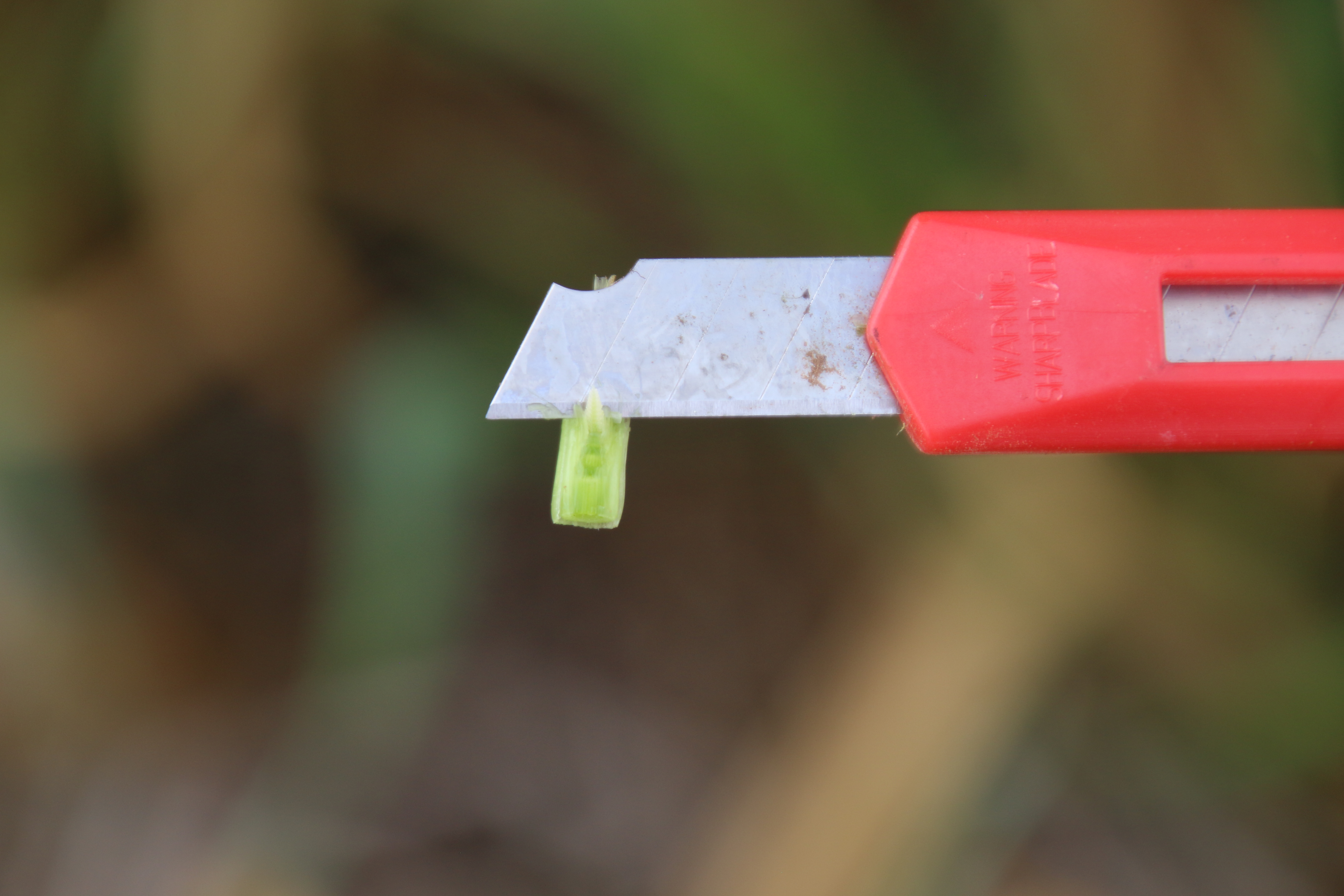
Although freeze injury to plant tissue in this field was severe, the wheat heads were mostly left unscathed

A closeup of a head from the freeze-injured wheat shown above. Although tissue damage is severe, the growing point and wheat head are still viable

A closeup of a head from the freeze-injured wheat shown above. Although tissue damage is severe, the growing point and wheat head are still viable

A final note on freeze injury. Freeze injury appeared to be worst in no-till fields and in areas where residue was heaviest. Based on my observations, this was not due to winterkill or poor seed to soil contact. My best explanation is that the lack of soil cover in conventional till fields allowed stored heat to radiate from the soil surface and slightly warm the crop canopy. The insulating effect of residue in no-till fields did not allow radiant heating to occur. Given the pattern of freeze injury in fields with varying degrees of residue across the field, I feel pretty confident in this analysis of what occurred.

Please use the comment section to share pictures or descriptions of wheat in your area.

Wheat disease update – 09 April 2015

Wheat disease updates are written by Dr. Bob Hunger, OSU Extension Plant Pathologist

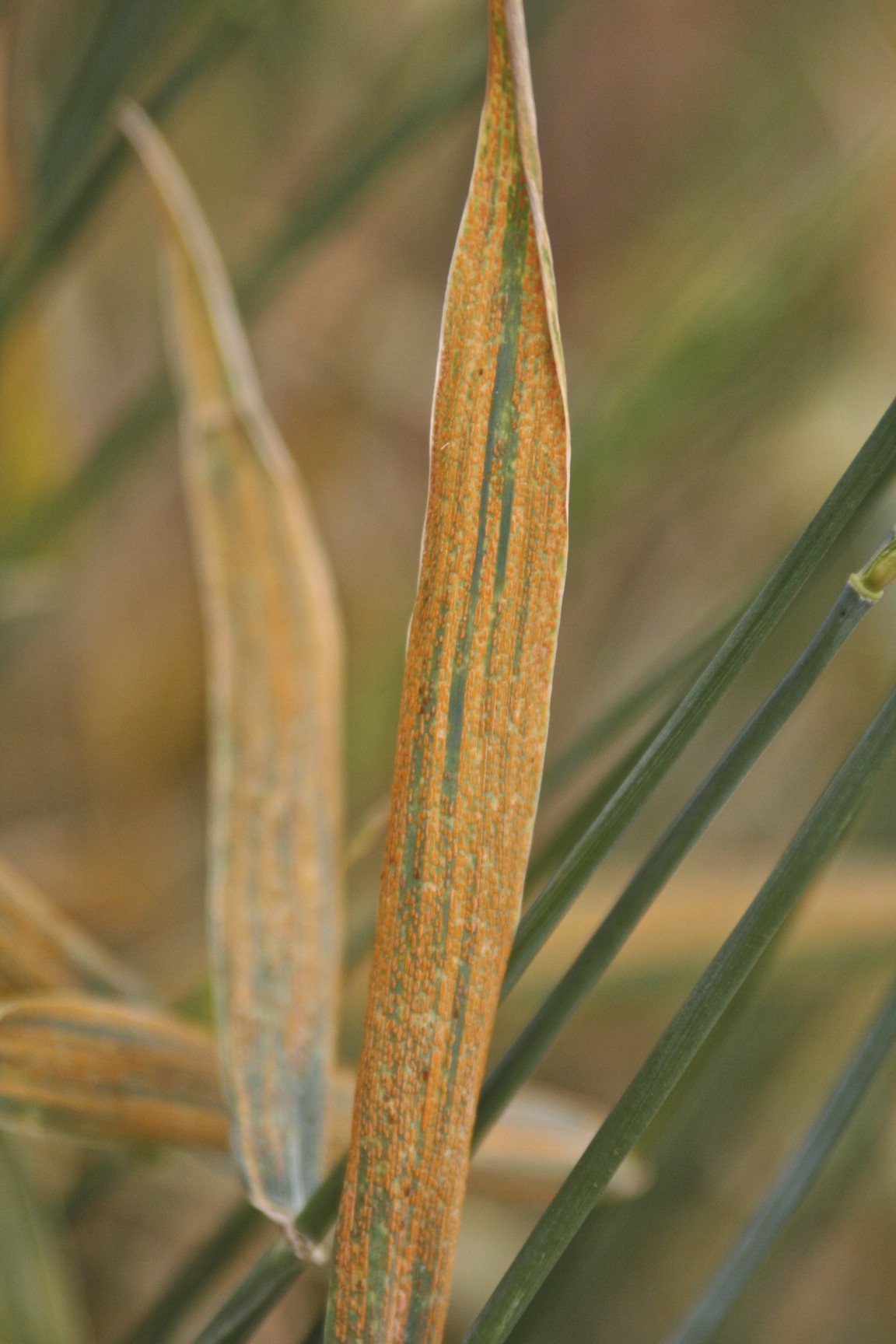
Oklahoma: On April 6, I traveled a route from Clinton (85 miles west of OKC) in west central Oklahoma going northeast through Custer County to Kingfisher (40 miles northwest of OKC) and then to Marshall (35 miles west of Stillwater). Although there was some good wheat on this route (e.g. the variety trials at Kingfisher and Marshall), it is posed to decline quickly unless rain is received. Most of the wheat I looked at in Custer County northeast of Clinton was small and fields were terribly dry. Wheat in this area seemed to be at GS 6-7 and I’m guessing was planted quite late due to the dry fall. The most common problem I saw were greenbug, especially in Custer County. However, as the photos show, there were many mummies present indicating the population should be crashing shortly. I also saw some stripe rust but only an infection here and there. Around the variety trial at Kingfisher, wheat was mostly around GS 9 and I saw no aphids or disease. At Marshall, wheat was at GS 8 and there was some stripe rust but at a low incidence.

Greenbugs and mummies in Custer County, Oklahoma

Greenbugs and mummies in Custer County, Oklahoma

On April 7, I traveled to Frederick in south central OK looking at wheat along the way. At a variety demo 20 miles west of OKC right at I-40, I found the wheat at GS 8 with just a little touch here and there of stripe rust. Soil moisture here looked good; this area must have caught a decent rain in the last week or so. The same could be said at another variety demo straight south about 15 miles south at Minco. Here the wheat in the field surrounding the demo was at GS 9, there was good soil wetness, and the wheat looked good. I did not see any rusts or powdery mildew, but there were occasional BYD spots. Further southwest near Apache (30 miles north of Lawton) wheat was at GS 9-10 and looked very good in the variety trial as well as in fields. However, some leaves were beginning to roll and the need for moisture to continue the crop was evident. I didn’t see any aphids or diseases in wheat west of Apache, but I the variety trial just south of Apache I found some stripe rust and greenbug; both at a very low incidence.

Wheat stripe rust

Wheat stripe rust

The rest of this trip was spent with Aaron Henson (Extension Educator, Tillman County) and Mark Gregory (Area Extn Agron Spec – SW Oklahoma) looking at wheat in Tillman County. Wheat in this area was mostly at GS 9-10 with awns occasionally just emerging from the boot. Some fields we visited were dry and impacted by drought, while others looked good but needed another drink soon. A few fields were outstanding and had good soil moisture. One field in particular was the best wheat I have seen since 2012. It was a field of Ruby Lee that was at GS 10 and had been sprayed on 15-Mar because of reports of severe stripe rust in the area and in northern Texas to the south. A 20 ft strip of unsprayed wheat was left on the outside of the north and west side of the field because of power lines and wind. This strip served as an excellent control to indicate the effect of the spray. The line between sprayed and not- sprayed was visible from the road and even more evident in the field (see photos). Within the not-sprayed strip, flag leaves were green with leaves beneath the flag hit hard with stripe rust (see photos). The field was sprayed a second time on 05-Apr because it has such good potential. Leaves in the sprayed area are completely green. I have difficulty explaining the complete lack of stripe rust on the flag leaves in the not-sprayed area. Likely the flag leaves were not yet emerged at the time of the first spray and then conditions after spraying did not allow spread of stripe rust to them. However, in talking to Aaron and Mark it seems there were conditions after the 15-Mar spraying that would have been conducive for spread of stripe rust. At any rate, this is an excellent example of how a timely spray did a tremendous job of protecting yield potential.

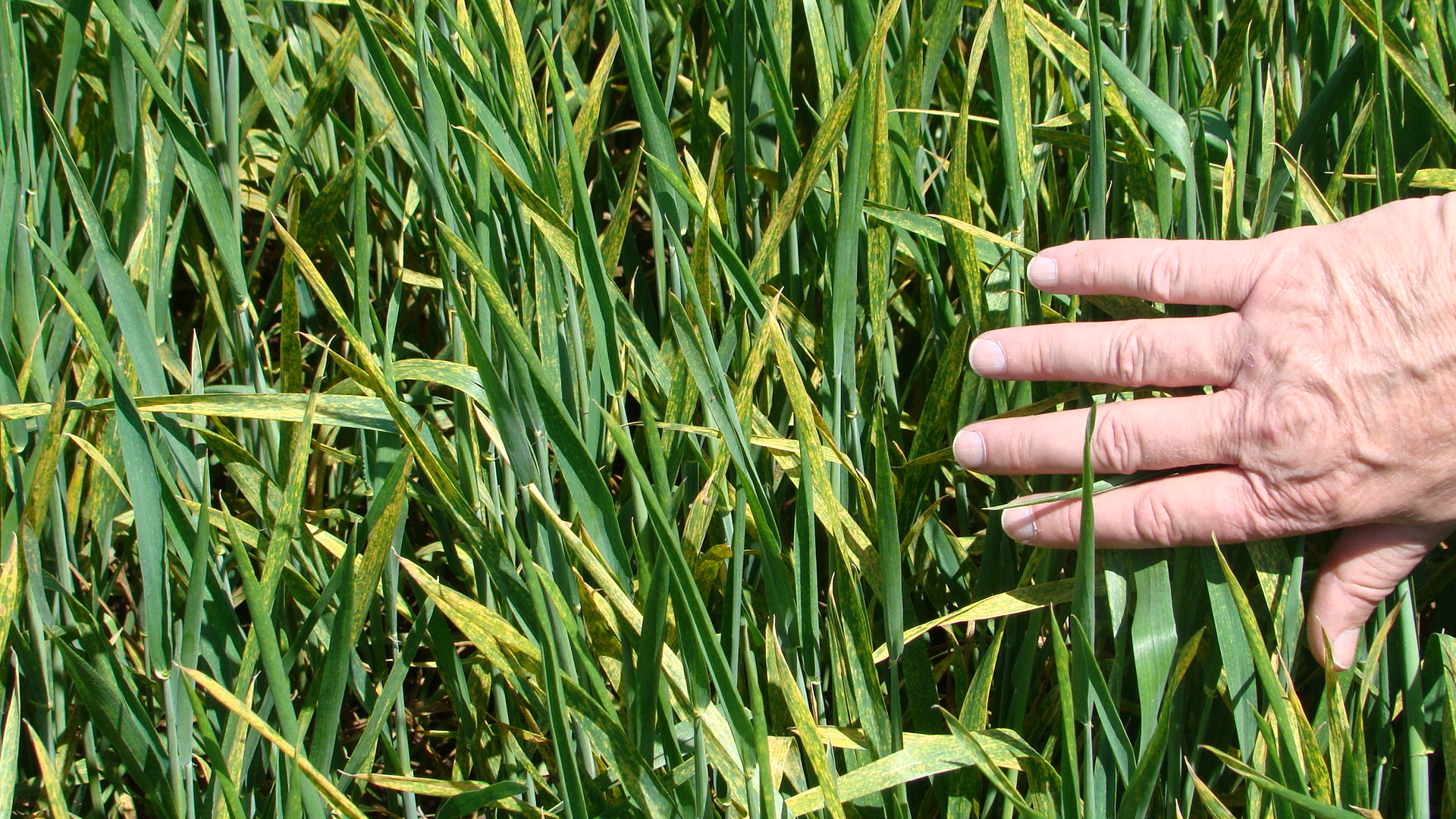
Stripe rust – note yellow cast to wheat in foreground that changes to deep green about halfway into phot


Signs of stripe rust were present in the lower canopy, but stripe rust was not present on flag leaves

Signs of stripe rust were present in the lower canopy, but stripe rust was not present on flag leaves

Fungicide-treated Ruby Lee in the same field as above photos

Fungicide-treated Ruby Lee in the same field as above photos


Other diseases observed across the Oklahoma include wheat streak mosaic, which has been detected in samples from several places including around Stillwater and from Noble County just north of Payne County (where Stillwater is located). However, I have not received indication yet of severe WSM; part of this may be related to the drought in western OK where WSM is typically more common. Recently samples from northwestern OK are beginning to come into the diagnostic lab, but results from some of those samples are still pending.


Reports/excerpts of reports from other states:

Texas Dr. Charlie Rush (Professor, Texas A&M AgriLife Research, Amarillo) 3-Apr-2015: “I haven’t checked all fields as closely as those around Bushland but there are a lot of GB and Russian wheat aphids as well as bird cherry.  Russian seems predominate in my fields.  We sprayed last week but will likely sustain significant yield loss from not spraying earlier.  I suspect we’ll start getting lots of calls and samples that end up being BYDV, although some WSM is also showing up.  Mild winter with more moisture than last few years has resulted in a crop that has looked very promising up to now but without good subsoil moisture what we had in the upper layers of the soil profile is disappearing fast and obvious symptoms of drought are beginning to appear.”

First hollow stem update 03/16/15

First hollow stem is the optimal time to remove cattle from wheat pasture (full explanation). To monitor first hollow stem, we measure hollow stem for the 56 lines in our September-sown wheat forage plots at Stillwater each year. Almost all varieties are well past first hollow stem. Full results are posted in the table below. Varieties with no value for first hollow stem reached first hollow stem on a previous measurement date.

This will be the last first hollow stem update of the 2015 season. You can check progression of first hollow stem around the state by using the First Hollow Stem Advisor on the Oklahoma Mesonet site

First hollow stem measured in wheat sown 09/16/2014 at Stillwater, OK. Varieties with ‘-‘ reached first hollow stem on a previous measurement date
Variety cm of hollow stem 03/16/15
Endurance 0.9
Deliver 1.7
Pete 0.3
OK Rising 1.1
Billings
Ruby Lee 2.1
Garrison 1.9
Duster
Gallagher
Iba
Centerfield 1.0
Doublestop CL Plus 1.5
NF 101
Everest
1863
KanMark 3.0
Oakley CL 2.1
KS061406
Sy Llano
Sy Southwind
Greer
Jackpot
Sy Monument 2.1
06BC722#25
AP09T7631
WB-Cedar
WB-Redhawk
WB4458
WB-Grainfield
Winterhawk
T153
T154
T158 2.4
LCS Mint
LCS Wizard
LCS Pistol
LCH13DH-20-87 6.0
LCH13DH-14-91
TAM 112
TAM 204
TAM 113
TAM 114
CO11D174 .
Byrd
Brawl CL Plus
OK09125
OK1059060-2C14
OK10126
OK11D25056 1.8
OK11231
OK12621 3.9
OK13625
OK0986130-7C13
OK08P707W-19C13 3.8
OK10728W
OK11755W


Wheat disease update – 16 March 2015

Wheat disease updates are written by Dr. Bob Hunger, OSU Extension Plant Pathologist

Oklahoma:  The leaf rust I saw around Stillwater in February seems to have “died out.”  The cold weather we had from late February into early March killed the lower leaves where leaf rust was active and conditions did not allow spread to younger leaves.  Dr. Brett Carver (OSU Wheat Breeder) confirmed this to me this morning as he indicated late last week he did not see any rust (leaf or stripe) around Stillwater or at his nurseries in Lahoma and Marshal.  This also is the case for northern and northwestern OK, as well as for KS (see Dr. De Wolf’s observations under “Other States” below).  Dr. Tom Royer and I visited variety trials at Cherokee and Alva last week.  No foliar diseases were observed but Dr. Royer did find a small greenbug colony on wheat in the field surrounding the Alva trial.  However, with mild temperatures and moisture predicted for the coming week and with inoculum to the south of us in Texas and southern Oklahoma, foliar diseases should be increasing in incidence and severity across central and northern OK.

Leaf and stripe rust are active in Texas (see Dr. Ron French’s observations below), and southern and central Oklahoma.  Mark Gregory (Area Extn Agron Spec – Duncan, OK) has reported seeing both leaf and stripe rust (but more stripe rust) across much of south-central and southwestern OK – especially around Grandfield, OK located north of Wichita Falls, TX.  Similar reports have come from Aaron Henson (Extn Educator; Tillman Cnty) and Gary Strickland (Exten Educator; Jackson Cnty).  Incidence has ranged from scattered to many “hot spots” of stripe rust, and from light to intermediate incidence of leaf rust.

Some of these fields (especially if it is a susceptible variety) will merit an early application of fungicide to curtail foliar disease activity (especially the stripe rust).  Be aware that applying a fungicide now will not last the entire season, and a second application toward head emergence also may be needed if weather continues to be favorable for foliar diseases.  For an early season application I recommend using a full rate (as opposed to a half rate) of a less expensive fungicide because there is so much time left in the growing season.  Then a later season application with a more expensive fungicide may or may not be needed.  Also be sure to not exceed the maximum amount of fungicide applied and to rotate chemistries to prevent resistance. Also consider your variety.  A variety like Ruby Lee that has good yield potential should be protected from early and late stripe or leaf rust, but a variety such as Duster may show some leaf rust early but still has good resistance to this rust.  However, stripe rust on Duster may merit control.  ALSO, in no-till fields watch for incidence of diseases such as tan spot, septoria, and powdery mildew as these diseases likely will be more common in fields with wheat residue and may merit an early season fungicide application.

Reports/excerpts of reports from other states:

Texas  Dr. Ron French (Ast Prof & Extn Plant Pathologist, Texas A&M AgriLife Extension Service, Amarillo) 9-Mar-2015:  “Last week, I was visiting the lower Coastal Bend of Texas (around Kingsville/Corpus Christi) and the Lower Rio Grande Valley of Texas (along the southernmost part of the Texas-Mexico border area). In Weslaco (Hidalgo County, Lower Rio Grande Valley), I visited sentinel plots (21 lines-winter wheat, spring wheat, barley…).”

“In Weslaco (March 4), Puccinia graminis f. sp. tritici, the causal agent of stem rust, was found on leaf tissue only, at trace levels to 1% severity in six 6 lines including  Morocco,  Marvelous, Kyto (CI 8250) and Line B (1% severity). Last year, stem rust was first observed on Siouxland, Panola, and  Morocco but observations were done the week of April 7, 2014.”

“Stripe rust (March 3)on wheat was observed  in 5 lines, ranging from  trace levels in Siouxland  to 25% incidence and 40% severity on Sisson.  Leaf rust was only observed at trace levels in lines such as Siouxland, Panola, and Sisson.  Powdery mildew was only present in the lower canopy of barley  Hypana, Morex DPH, and Hyproly.  Some wheat was already in the boot stage (Morocco, Line B).”

“Last year, dry conditions (little or no rain) were present in this area when stem rust was first observed. This year has seen more rain during the past three weeks, with temperatures ranging from as low as 38° F to as high as 84°F (lower on average for that area). With rain and warmer weather expected this week, disease pressure may be more conducive to seeing more disease development for all rusts.”

“No stem rust was observed in wheat in  the lower coastal bend around Kingsville, approximately 110 miles north of Weslaco. Fields did have stripe rust (up to 20% severity) but had already been sprayed with a fungicide and trace levels of leaf rust could also be observed.”

Kansas  Dr. Erick De Wolf (Prof & Small Grains Extn Pathologist, Kansas State Univ) 11-Mar-2015:  “We did some scouting for rust diseases near Manhattan (Northeastern KS).  We were checking on research plots where rust had been noted last fall but were unable to detect leaf rust in these plots so far this spring.  We noted severe tip die-back of the leaf tissue in these plots and suspect that this winter injury has removed much of the leaf rust from this location. Bethany Grabow, Ph.D candidate with KSU detected a trace of leaf rust on wheat in an adjacent field.  Incidence of disease was <0.01% with only a few pustules detected. This wheat was planted later than the aforementioned plots and did not experience the winter injury to the leaf tissue.  We also noted small colonies of aphids in the research plots with each colony having 3-5 aphids a few winged aphids were also observed near the colonies. We will continue to monitor the diseases this spring and provide more updates soon.”

Wheat leaf rust

Wheat leaf rust

Wheat stripe rust

Wheat stripe rust

First hollow stem update 03/12/15

First hollow stem is the optimal time to remove cattle from wheat pasture (full explanation). To monitor first hollow stem, we measure hollow stem for the 56 lines in our September-sown wheat forage plots at Stillwater each year. In spite of the recent cold snap many varieties are progressing towards first hollow stem. The small grains extension crew split ten stems from lines tested in our program today and Billings, Duster, Iba, Oakley CL, Hot Rod (formerly KS061406), WB Greenfield, and LCS Wizard join the list of varieties at or past first hollow stem. Full results are posted in the table below. Varieties with no value for first hollow stem reached first hollow stem on a previous measurement date.

We will take another set of measurements early next week and report the results on this blog. You can check progression of first hollow stem around the state by using the First Hollow Stem Advisor on the Oklahoma Mesonet site.


First hollow stem measured in wheat sown 09/16/2014 at Stillwater, OK. Varieties with ‘-‘ reached first hollow stem on a previous measurement date
Variety cm of hollow stem 03/12/15
Endurance 0.2
Deliver 1.0
Pete 0.6
OK Rising 1.1
Billings 1.6
Ruby Lee 0.9
Garrison 1.2
Duster 1.8
Gallagher
Iba 1.7
Centerfield 0.8
Doublestop CL Plus 1.4
NF 101
Everest
1863
KanMark
Oakley CL 2.0
Hot Rod 2.8
SY Llano
SY Southwind
Greer
Jackpot
SY Monument 1.2
SY Flint
SY Drifter
WB-Cedar
WB-Redhawk
WB4458
WB-Grainfield 2.0
Winterhawk
T153
T154
T158 0.9
LCS Mint
LCS Wizard 1.5
LCS Pistol
LCH13DH-20-87 2.6
LCH13DH-14-91
TAM 112
TAM 204
TAM 113
TAM 114
CO11D174
Byrd
Brawl CL Plus
OK09125 1.9
OK1059060-2C14 1.6
OK10126
OK11D25056 1.1
OK11231
OK12621 1.2
OK13625
OK0986130-7C13
OK08P707W-19C13 1.3
OK10728W
OK11755W


First hollow stem update 03/09/15

First hollow stem is the optimal time to remove cattle from wheat pasture (full explanation). To monitor first hollow stem, we measure hollow stem for the 56 lines in our September-sown wheat forage plots at Stillwater each year. In spite of the recent cold snap many varieties are progressing towards first hollow stem. The small grains extension crew split ten stems from lines tested in our program today and KanMark, Sy Southwind and Greer join the list of varieties at or past first hollow stem. Full results are posted in the table below. Varieties with no value for first hollow stem reached first hollow stem on a previous measurement date.

We will take another set of measurements later this week and report the results on this blog. Given the warm forecast for the coming week, I predict that all varieties will be well past first hollow stem by Friday. You can check progression of first hollow stem around the state by using the First Hollow Stem Advisor on the Oklahoma Mesonet site.


First hollow stem measured in wheat sown 09/16/2014 at Stillwater, OK. Varieties with ‘-‘ reached first hollow stem on a previous measurement date
Variety cm of hollow stem 03/09/15
Endurance 0.2
Deliver 0.2
Pete 0.3
OK Rising 0.7
Billings 1.0
Ruby Lee 0.6
Garrison 0.9
Duster 0.9
Gallagher
Iba 0.8
Centerfield 0.5
Doublestop CL Plus 0.6
NF 101
Everest
1863
KanMark 1.5
Oakley CL 0.9
KS061406 1.2
Sy Llano
Sy Southwind 2.6
Greer 2.1
Jackpot
Sy Monument 0.7
06BC722#25
AP09T7631 1.5
WB-Cedar
WB-Redhawk
WB4458
WB-Grainfield 0.8
Winterhawk
T153
T154
T158 0.8
LCS Mint
LCS Wizard 0.6
LCS Pistol
LCH13DH-20-87 1.0
LCH13DH-14-91
TAM 112
TAM 204
TAM 113
TAM 114
CO11D174 2.2
Byrd
Brawl CL Plus
OK09125 1.3
OK1059060-2C14 0.9
OK10126
OK11D25056 1.1
OK11231
OK12621 1.1
OK13625
OK0986130-7C13
OK08P707W-19C13 1.4
OK10728W
OK11755W


First hollow stem update 03/05/15

First hollow stem is the optimal time to remove cattle from wheat pasture (full explanation). To monitor first hollow stem, we measure hollow stem for the 56 lines in our September-sown wheat forage plots at Stillwater each year. In spite of the recent cold snap many varieties are progressing towards first hollow stem. The small grains extension crew split ten stems from lines tested in our program today and1863, LCS Mint, TAM 204, TAM 113, TAM 114, and Byrd join the list of varieties at or past first hollow stem. Full results are posted in the table below. Varieties with no value for first hollow stem reached first hollow stem on a previous measurement date.

We will take another set of measurements later this week and report the results on this blog. Given the warm forecast for the coming week, I predict that all varieties will be well past first hollow stem by next Friday. You can check progression of first hollow stem around the state by using the First Hollow Stem Advisor on the Oklahoma Mesonet site.


First hollow stem measured in wheat sown 09/16/2014 at Stillwater, OK. Varieties with a “-” reached first hollow stem on a previous measurement date
Variety cm of hollow stem 03/05/15
Endurance 0.2
Deliver 0.2
Pete 0.1
OK Rising 0.2
Billings 0.7
Ruby Lee 0.6
Garrison 0.5
Duster 0.5
Gallagher
Iba 0.5
Centerfield 0.2
Doublestop CL Plus 0.3
NF 101
Everest
1863 1.6
KanMark 1.1
Oakley CL 0.6
KS061406 1.0
Sy Llano
Sy Southwind 0.9
Greer 1.1
Jackpot
Sy Monument 0.1
06BC722#25 2.8
AP09T7631 1.1
WB-Cedar
WB-Redhawk
WB4458
WB-Grainfield 0.8
Winterhawk
T153
T154
T158 1.3
LCS Mint 1.5
LCS Wizard 0.7
LCS Pistol
LCH13DH-20-87 1.1
LCH13DH-14-91
TAM 112
TAM 204 1.6
TAM 113 1.6
TAM 114 1.9
CO11D174 1.1
Byrd 1.7
Brawl CL Plus
OK09125 0.8
OK1059060-2C14 1.4
OK10126
OK11D25056 0.9
OK11231
OK12621 0.8
OK13625
OK0986130-7C13
OK08P707W-19C13 1.3
OK10728W 1.5
OK11755W
Average 1.0


First hollow stem update 03/02/15

First hollow stem is the optimal time to remove cattle from wheat pasture (full explanation). To monitor first hollow stem, we measure hollow stem for the 56 lines in our September-sown wheat forage plots at Stillwater each year. In spite of the recent cold snap many varieties are progressing towards first hollow stem. The small grains extension crew split ten stems from lines tested in our program today and NF 101 and Brawl CL Plus join the list of varieties at or past first hollow stem. Full results are posted in the table below. We will take another set of measurements later this week and report the results on this blog.

The numbers reported from Stillwater are likely behind those being observed in southern Oklahoma and ahead of those observed in northern Oklahoma. You can check progression of first hollow stem around the state by using the First Hollow Stem Advisor on the Oklahoma Mesonet site.


First hollow stem measured in wheat sown 09/16/2014 at Stillwater, OK.
Variety cm of hollow stem 03/02/15
Endurance 0.5
Deliver 0.4
Pete 0.1
OK Rising 0.1
Billings 0.4
Ruby Lee 0.2
Garrison 0.1
Duster 0.4
Gallagher .
Iba 0.1
Centerfield 0.1
Doublestop CL Plus 0.1
NF 101 1.5
Everest .
1863 0.6
KanMark 0.4
Oakley CL 0.6
KS061406 0.7
Sy Llano .
Sy Southwind 0.2
Greer 0.8
Jackpot .
Sy Monument 0.4
06BC722#25 1.3
AP09T7631 0.4
WB-Cedar .
WB-Redhawk .
WB4458 .
WB-Grainfield 1.1
Winterhawk .
T153 .
T154 .
T158 0.5
LCS Mint 0.8
LCS Wizard 0.9
LCS Pistol .
LCH13DH-20-87 0.8
LCH13DH-14-91 .
TAM 112 .
TAM 204 1.4
TAM 113 1.2
TAM 114 1.4
CO11D174 0.9
Byrd 0.7
Brawl CL Plus 1.8
OK09125 0.5
OK1059060-2C14 0.7
OK10126 .
OK11D25056 0.7
OK11231 2.2
OK12621 0.9
OK13625 .
OK0986130-7C13 .
OK08P707W-19C13 1.2
OK10728W 1.0
OK11755W .
Average 0.7


Wheat disease update – 27 February 2015

Wheat disease updates are written by Dr. Bob Hunger, OSU Extension Plant Pathologist

Oklahoma:  As indicated in the Texas reports below, both leaf rust and stripe rust are present across Texas with stripe rust appearing to be the most prevalent and severe.  This also seems to be the case in Oklahoma – at least across central to southern Oklahoma.  John Fenderson (Monsanto) indicated yesterday that on a recent trip he took across central to southern Oklahoma he saw “clean” wheat around Chickasha but along highway 70 going west to Frederick he saw lots of stripe rust and some leaf rust.  In a few places he saw the ground colored orange from stripe rust spores indicating a stripe rust “hot spot.”  In fields such as this (especially if there are many hot spots), application of a fungicide to control the stripe rust should be considered.  In addition to helping to control the stripe rust, there could be the benefit of also limiting leaf rust, powdery mildew and possibly tan spot/septoria.

Around Stillwater, I have not seen much change since two weeks ago.  I have not confirmed any stripe rust, but have seen leaf rust.  However, we have been mostly quite cold with only slight moisture but stripe rust may also be starting.  I will wait until it warms up a bit before I look again.

Wheat leaf rust

Wheat leaf rust

Wheat stripe rust

Wheat stripe rust

Reports/excerpts of reports from other states:

Texas 

Dr. Amir Ibrahim (Prof, Small Grains Breeding and Genetics, Texas A&M AgriLife Research) 26-Feb-2015:  The wheat crop in South Texas is at now at Feekes stages 5-6 [start of node elongation/first node detectable at base of tiller] depending on the line.   Leaf Rust (P. triticina) is spreading in our trials at College station (Brazos County) and both ‘Baldwin’ catch plot and ‘TAM 110’ are 100S.  As for stripe rust (P. striiformis), the ‘Sisson’ catch plot is 70S whereas the ‘Patton’ border is 100S.  It is noteworthy that we reported stripe rust on Patton near Ennis (Ellis County) on January 29, 2015.

Leaf rust is easy to find, but severity is very low at Bushland (Potter County) in Texas High Plains and Chillicothe (Hardeman County) in Texas Rolling Plains.  Unconfirmed reports also indicated spread of stripe rust in Brady (McCulloch County) in the heart of the state. Reports also indicated that ‘Redhawk’ was especially susceptible there and that some producers are already applying fungicides. Both leaf and stripe rusts are also present in Wharton County in South Texas.

If conditions continue to prevail, we can have significant leaf and stripe rust levels compared to last year, in my opinion.

Dr. Ron French (Ast Prof & Extn Plant Pathologist, Texas A&M AgriLife Extension Service, Amarillo) 25-Feb-2015:  Update on wheat rust in Texas- some commercial fields.  Leaf rust had been reported in Texas in fall 2014 as far north as Hansford County (Texas Panhandle, bordering the Oklahoma Panhandle) and throughout NW Texas, especially the Texas Panhandle. In early winter 2015, leaf rust was still found around the Amarillo area. This winter in Amarillo, we have had temperatures as low as 3°F  and will still be as low as 12°F and not much higher than the mid- 50s F for the next week, including snow.  In some cases when temperatures have dropped this much, some fields with trace levels of leaf rust no longer exhibited leaf rust for a while, whether that meant inoculum did not survive, was not active, or had new inoculum come in to that field. I visited some random fields today in the Amarillo area and was not able to find any leaf rust. This does not mean that leaf rust is not present but that it may be present at really low trace levels.

Last Wednesday, February 18, I did find leaf rust in one wheat field in Wichita County at trace levels in very few plants and only in the lowest two leaves. The biggest wheat in that field was at Feekes 4. Wichita County is in the Texas Rolling Plains and borders Clay, Wilbarger, and Archer Counties in Texas, and Tillman and Cotton Counties in SW Oklahoma. With high temperatures expected not to be higher than 63°F and as low as 25°F for the next seven days, could disappear, as observed in previous years when leaf rust was first observed in mid-to-late March.

Unlike 2014, no leaf rust has been observed so far in the lower Coastal Bend of Texas around Kingsville and Corpus Christi by this time. Some days have been cooler than normal and they have had more rain than in some previous years.

Stripe rust has been present as far west as Tom Green County in west Central Texas, where the city of San Angelo is located. Stripe rust was first observed at the very end of January and beginning of February. Stripe rust levels were significant in lower leaves only and the ground was covered in orange spores. A few fields that were sprayed with Tilt on February 16th had taken advantage of the fact that topdressing of nitrogen was being done on the wheat. Within a week, fields looked great and new growth looks “excellent” (probably a combination of topdressing, moisture from overhead pivot irrigation, root growth, and the fungicide application). At time of spraying, the wheat was fully tillered. Some varieties with some level of stripe rust include TAM 113, Coronado, Greer, Redhawk, Cedar, and TAM 304.

The farthest north I have seen stripe rust is in Wichita County at low trace levels, on February 18th.  The biggest wheat in that field was at Feekes 4. Although normally dry, this area may be getting some snow and rain in the next week or so, so there could be an increase in inoculum. But since temperatures are expected to range from 25° to 41°F on the low side, and between 32-63°F on the high side for the next seven days, this may not be conducive to stripe rust increase or establishment. Time will tell. Other fields in that area have not had stripe rust so far from what I gathered today.

Other locations with stripe rust include fields around De Leon, in Comanche County, located in Central Texas. The application Tilt in February is not uncommon in some locations in southern Texas as powdery mildew can be an issue. This year, applications of Tilt have occurred due to stripe rust concerns and in many cases, taking advantage of top dressing of nitrogen on wheat.

First hollow stem update 02/26/15

First hollow stem is the optimal time to remove cattle from wheat pasture (full explanation). To monitor first hollow stem, we measure hollow stem for the 56 lines in our September-sown wheat forage plots at Stillwater each year. In spite of the recent cold snap many varieties are progressing towards first hollow stem. The small grains extension crew split ten stems from lines tested in our program today and Gallagher, Everest, Jackpot, Winterhawk, T153, T154, LCS Pistol, and TAM 112 join the list of varieties at or past first hollow stem. Full results are posted in the table below. We will take another set of measurements the first of next week and report the results on this blog.

The numbers reported from Stillwater are likely behind those being observed in southern Oklahoma and ahead of those observed in northern Oklahoma. You can check progression of first hollow stem around the state by using the First Hollow Stem Advisor on the Oklahoma Mesonet site.

First hollow stem measured in wheat sown 09/16/2014 at Stillwater, OK. Varieties in red are at or past first hollow stem.
Variety cm of hollow stem 02/26/15
Endurance 0.0
Deliver 0.6
Pete 0.0
OK Rising 0.1
Billings 0.5
Ruby Lee 0.4
Garrison 0.1
Duster 0.1
Gallagher 2.0
Iba 0.1
Centerfield 0.2
Doublestop CL Plus 0.0
NF 101 1.0
Everest 1.6
1863 0.7
KanMark 1.1
Oakley CL 1.0
KS061406 0.8
Sy Llano
Sy Southwind 0.6
Greer 0.8
Jackpot 1.9
Sy Monument 0.0
06BC722#25 0.8
AP09T7631 0.1
WB-Cedar
WB-Redhawk
WB4458 1.7
WB-Grainfield 1.0
Winterhawk 1.9
T153 1.5
T154 2.3
T158 0.1
LCS Mint 1.4
LCS Wizard 0.7
LCS Pistol 1.7
LCH13DH-20-87 0.8
LCH13DH-14-91
TAM 112 1.9
TAM 204 1.3
TAM 113 1.4
TAM 114 1.2
CO11D174 1.1
Byrd 0.7
Brawl CL Plus 0.9
OK09125 0.9
OK1059060-2C14 0.9
OK10126 2.3
OK11D25056 1.5
OK11231 1.4
OK12621 0.6
OK13625
OK0986130-7C13
OK08P707W-19C13 1.0
OK10728W 1.0
OK11755W 2.2
Average 1.0