First hollow stem update 03/14/2014

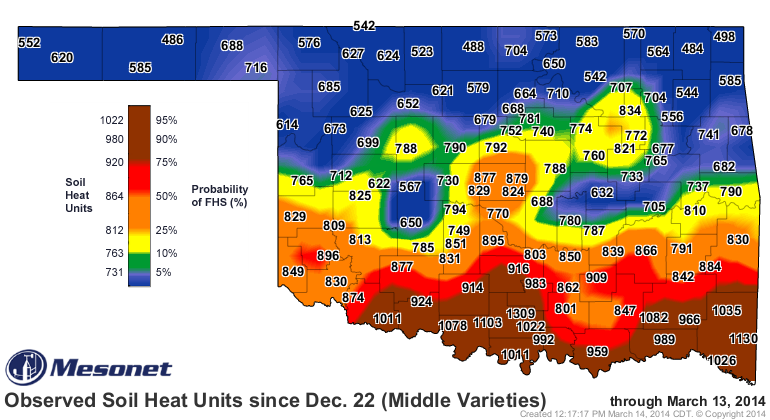
WB-Cedar and Sy Llano reached first hollow stem this week, and there are several additional early-maturing varieties that are near first hollow stem. The results from a March 13 sampling of plots are posted below, and we will post results from another sample early next week. I have also posted the map from the Oklahoma Mesonet’s First Hollow Stem Advisor for medium maturity varieties. As indicated in the map, most wheat south of I-40 is likely at or past first hollow stem.

Probability of first hollow stem for medium maturity wheat varieties on 03/14/14

Probability of first hollow stem for medium maturity wheat varieties on 03/14/14


First hollow stem works as a pull off date for cattle on wheat pasture because it allows the plant a small amount of time prior to jointing to recover some of the green leaf area lost to grazing. As evidenced by the results posted on this blog, first hollow stem is running a good 1.5 to 2 weeks later than normal. Given the situation, it is advisable to consider removing cattle from wheat pasture sooner rather than later. In many cases this would be before the occurrence of first hollow stem. I make this recommendation because once our temperatures start to warm, it is likely that that wheat phenological development will proceed in rapid fashion. We could easily encounter a situation where there are only a few days separating first hollow stem and jointing. Pulling cattle from wheat pasture a little early will allow extra time for recovery, which might be needed this year.

Variety cm of hollow stem 03/13/2014
Endurance 0.5
Deliver 0.7
Pete 1.4
OK Bullet 0.4
OK Rising 0.5
Billings 1.1
Ruby Lee 0.4
Garrison 0.6
Duster 0.1
Gallagher 0.8
Iba 0.3
Everest 1.0
Jackpot 1.1
Doans 0.8
Greer 0.4
CJ 1.1
SY Southwind 1.0
Sy Llano 1.5
Armour 1.0
WB-Cedar 1.7
WB-Redhawk 0.7
WB-Grainfield 0.1
Winterhawk 0.7
WB4458 0.8
T153 0.8
T154 0.9
T158 0.5
LCS Mint 0.2
LCS Wizard 0.4
LCH11-109 0.3
LCH11-1117 0.8
LCH11-1130 0.6
TAM 112 1.3
TAM 113 1.4
Byrd 0.4
Brawl CL Plus 0.6
Centerfield 0.1
Doublestop CL Plus 0.4
OK09125 0.5
OK09520 0.3
OK10126 0.0
OK08707W-19C13 1.4
OK10805W 0.3
OK10728W 1.2
OK11754WF .
Average 0.7

First hollow stem update 03/11/2014

With the exception of one experimental line, there are still no varieties at the first hollow stem stage of growth at Stillwater. The results from a March 10 sampling of plots are posted below, and we will post results from another sample later this week. First hollow stem works as a pull off date for cattle on wheat pasture because it allows the plant a small amount of time prior to jointing to recover some of the green leaf area lost to grazing. As evidenced by the results posted on this blog, first hollow stem is running a good 1.5 to 2 weeks later than normal.

Given the situation, it is advisable to consider removing cattle from wheat pasture sooner rather than later. In many cases this would be before the occurrence of first hollow stem. I make this recommendation because once our temperatures start to warm, it is likely that that wheat phenological development will proceed in rapid fashion. We could easily encounter a situation where there are only a few days separating first hollow stem and jointing. Pulling cattle from wheat pasture a little early will allow extra time for recovery, which might be needed this year.

Variety cm of hollow stem 03/10/2014
Endurance 0.16
Deliver 0.00
Pete 0.32
OK Bullet 0.15
OK Rising 0.15
Billings 0.60
Ruby Lee 0.13
Garrison 0.20
Duster 0.02
Gallagher 0.84
Iba 0.17
Everest 0.60
Jackpot 1.09
Doans 0.04
Greer 0.33
CJ 0.07
SY Southwind 0.57
Exp F14 0.86
Armour 1.00
WB-Cedar 0.97
WB-Redhawk 1.08
WB-Grainfield 0.09
Winterhawk 0.35
WB4458 0.40
T153 0.64
T154 0.37
T158 0.07
LCS Mint 0.29
LCS Wizard 0.00
LCH11-109 0.00
LCH11-1117 0.12
LCH11-1130 0.88
TAM 112 1.03
TAM 113 0.84
Byrd 0.62
Brawl CL Plus 0.00
Centerfield 0.00
Doublestop CL Plus 0.00
OK09125 0.08
OK09520 0.05
OK10126 0.00
OK08707W-19C13 0.55
OK10805W 0.00
OK10728W 0.24
OK11754WF 1.61
Average 0.40

Freeze injury

Freeze injured plants from Cotton County, OK. Note the green, healthy leaf coming through the desiccated leaves in the plant on the right

Freeze injured plants from Cotton County, OK. Note the green, healthy leaf coming through the desiccated leaves in the plant on the right. These plants will make a full recovery with adequate moist and fertility.

Our recent extreme shifts in temperature have resulted in moderate to severe freeze injury in some Oklahoma wheat fields. To be honest, the damage is not as widespread or severe as I thought it would be given that most of our wheat had not had an opportunity to harden off. The dry soil conditions in western and southern Oklahoma did not help the situation, as there was not sufficient soil moisture to buffer the temperature shift in the top few inches of soil.

Freeze injury at this stage of growth (tillering) rarely impacts grain yield, but, as always, there are a few exceptions. Wheat that was very small or late-sown is more susceptible to winter kill. Similarly, wheat that does not have a good root system or that was shallow sown due to crop residue is more susceptible to winter kill. It is best to wait until after a few days of favorable growing conditions to check for freeze injury. Plants with regrowth that is green and healthy should make a full recovery, and this will be the case for most Oklahoma wheat fields.

Freeze injury in late-sown wheat near Enid, OK. Some of the smaller plants might have a tough time recovering, but given favorable conditions, the wheat stand as a whole still has adequate time to "fill in" and compensate for some of the lost plants.

Freeze injury in late-sown wheat near Enid, OK. Some of the smaller plants might have a tough time recovering, but it is still too early to determine whether or not the field as a whole will adequate to produce a decent grain crop.

Wheat disease update – 05 November 2013

Wheat disease updates are written by Dr. Bob Hunger, OSU Extension Plant Pathologist

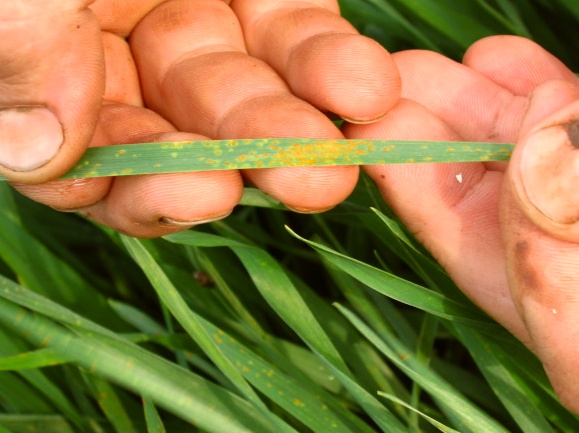
Fall of 2013 has been quiet for wheat diseases with no wheat samples coming into the Diagnostic Lab.  Otherwise, the only report of a wheat disease in the state has been a report I received from Brian Vincent who indicated that Keith Castner (BASF) had observed leaf rust in late October on early planted ‘Duster’ near El Reno, OK.  This finding is not surprising as leaf rust often is observed in Oklahoma in the fall.

Fall leaf rust rarely warrants fungicide application. Cold weather and/or grazing help remove the rust pustules. Fall infestations should be monitored, however, and control measures might be considered if the problem remains after jointing in the spring.

Fall leaf rust rarely warrants fungicide application. Cold weather and/or grazing help remove the rust pustules. Fall infestations should be monitored, however, and control measures might be considered if the problem remains after jointing in the spring.

When leaf rust is observed in the fall, the value of spraying to control that rust is asked.  Fall-infected leaf rust plants typically have yellowed lower/older leaves with rust pustules, but the youngest 2 or 3 leaves are green and healthy.  As temperature drops through November and December, the older rust-infected leaves die and new infections are greatly slowed and inhibited.  Grazing also helps to remove these leaves and increase air circulation and drying that are conditions less favorable to spread of the disease.  Given these consideration, spraying to control leaf rust in the fall is of limited value.  The primary concern with fall infections of leaf rust is that with a mild winter and sufficient moisture, the rust will survive through the winter and inoculum will be present in fields to start the disease early in the spring.  Hence, monitoring of these fields through the winter and early next spring is recommended to see if application of a fungicide to control the rust is indicated in the early spring.

I called around to other extension specialists [northwestern OK/panhandle (Rick Kochenower; Area Research & Extension Specialist – Agronomy), south central OK (Mark Gregory Area Extension Agronomy Specialist), and southwestern OK (Gary Strickland; Extension Educator – Jackson County), and all indicated that no foliar or root diseases have been observed to date.

Recent updates from other states:
Kansas (Dr. Erick De Wolf, Extension Plant Pathologist, Kansas State University):  Leaf rust was found in research plots near Manhattan KS (Northeast Kansas) on Oct 25.  Dr. Bill Bockus reported leaf rust in research plots that were established approximately a month ago (about 2 weeks before the normal planting date), and have ample fall growth.  The leaf rust was observed in multiple foci or “hot spots” but was now present at low levels throughout the plots suggesting the disease has been there for more than 3 weeks.  The incidence was approximately 2-5% with severity of trace to 10% on any given leaf. The leaf rust was found on the wheat variety 1863. This variety is known to be susceptible to leaf rust. An older variety Newton was also infected.

It is not unusual to find leaf rust near Manhattan this time of year.  The winter conditions are often enough to keep the rust population from overwintering in KS, but finding the disease in the fall could be important if we have a mild winter.  It has been several years since leaf rust observed in the fall at this location. The absence of rust in these years was likely related to the drought that dominated the central plains in 2011-2012.  The drought conditions have lessened in recent months and leaf rust is returning to normal fall activity.  We will be monitoring this location and others to check for overwintering leaf rust.

2013 Wheat variety performance test results posted

All Oklahoma wheat variety test sites are now harvested and the results are posted at www.wheat.okstate.edu. I have posted a brief summary of the 2013 crop below. Over the next several weeks, I will be posting additional trial results on this blog along with opinion and analysis of results.


2013 WHEAT CROP OVERVIEW

At the time of writing this report, 2013 Oklahoma wheat production is estimated to be approximately 114 million bushels, which is roughly 26% less than 2012 production (Table 1).  The production decrease was due to the combination of lower yields and fewer harvested acres. Given the challenges faced in the 2012-2013 wheat production year, however, most would consider the average yield and total production to be much better than expected.


Table 1. Oklahoma wheat production for 2012 and 2013 as estimated by OK NASS, June 2013
 

2012

2013

Harvested Acres

4.3 million

3.8 million

Yield (bu/ac)

36

30

Total bushels

154.8 million

114 million


We have had several dry starts for wheat planting in Oklahoma, but the fall of 2012 might go down as the driest of the dry. A few timely rains in late August and early September allowed early and mid-September sown wheat to emerge and get a rapid start on forage production. This was the last substantial rain that most of western Oklahoma received until early 2013. As a result, much of our October-sown crop remained partially emerged in dry soil until after the first of the year.


Wheat that had emerged in September had consumed available water by early November and turned brown by December. Many fields were assumed dead, as there was no green tissue remaining above the soil surface (e.g. Marshall Dual-Purpose trial). This left little to no grazing potential for many dual-purpose wheat producers. Our Stillwater forage trial, for example, had less than 500 lb/ac (estimated) of available forage in early December, which is our normal forage measurement timing.


Rain was not plentiful in early 2013, but there was enough to allow the wheat crop to rebound. Wheat seed that had been lying in the soil germinated and early-emerging fields that had turned brown from drought were resuscitated and brought back to life. Wheat in southwestern OK and the Panhandle remained on life support throughout the season, surviving but never really thriving. Given these extreme circumstances, the grain yield at our Chattanooga, Altus, and Hooker sites are nothing short of amazing. Although wheat finally emerged at our Alva, Balko, Buffalo, Cherokee, Gage, Keyes, and Lamont sites, the stands were far too variable for use in comparing the yield potential of wheat varieties.


Drought was not the only weather-related issue Oklahoma wheat producers dealt with in 2013. There were multiple rounds of freeze events in late March and early April. Wheat in southwest Oklahoma and the Panhandle was affected by different freeze events but both sustained 30 to 80% tiller loss and were largely written off in the weeks following the freezes. Outside of far southwestern OK, cooler than normal conditions and some replenishment of soil moisture allowed regeneration of tillers. This, along with extended grainfill duration, allowed many wheat fields to recover and produce greater than expected grain yields (e.g. Apache variety trial). The cooler than normal spring temperatures were beneficial for wheat grainfill, but also delayed harvest by about one month as compared to 2012 and about two weeks as compared to the long term average.


It was a fairly quiet year regarding foliar disease. Pockets of the state suffered from heavy powdery mildew infestation in March and April, and some wheat producers chose to split-apply fungicides to combat this disease. There were also areas affected by glume blotch, tan spot, and septoria, but there was not much leaf or stripe rust present.


Yellow and purple leaves were tell tale signs that a late spring flush of aphids had transmitted barley yellow dwarf virus to several Oklahoma wheat fields. Armyworms were present late in the season, but generally did not reach threshold levels prior to maturity and few fields were sprayed. Winter grain mites took advantage of slow-growing, drought-stressed wheat and were a frequently reported problem in southwest OK, but the wheat curl mite takes top billing among mite pests in 2013. The wheat curl mite transmits wheat streak mosaic and high plains viruses. These two diseases are fairly common in the Panhandle but do not typically affect wheat in central OK. In 2013 fields as far east as Kingfisher tested positive for wheat streak mosaic and several central OK fields were affected. Growers affected by wheat streak mosaic should take care to ensure that any volunteer wheat or corn is dead at least two weeks prior to planting to reduce the risk of this disease in 2013-2014.
 

Wheat disease update 04 May 2013

Wheat disease updates are written by Dr. Bob Hunger, OSU Extension Wheat Pathologist

Oklahoma:  Over the last week I, Nathalia Grachet (OSU graduate student), and Brian Olson (OSU A&P) extensively looked at wheat around Stillwater, and in central (Minco, Apache), southwestern (Granite), and north central (Lahoma) Oklahoma.  Additionally, OSU Wheat Breeder Brett Carver examined his plots at numerous locations in central, southwestern OK as well as at Stillwater, and Dr. Art Klatt (OSU Wheat Geneticist) examined trials around Stillwater and Perkins.  Wheat in southwestern Oklahoma was damaged from drought and freeze, and little disease was discernible.  Wheat in southwestern Oklahoma (where it was possible) appeared to be at various states of head emergence, and in a few cases was just starting to flower.  In central OK, wheat was in various stages of heading.  Around Stillwater, wheat was just starting head emergence, while at Lahoma wheat was mostly just approaching GS 10 (boot stage).  However, there seems to be quite a bit of variability regarding stage of maturity depending on variety and planting date.

No leaf rust was observed at any location.  The “hot spot” of stripe rust we found at Minco is still active, but my previous update incorrectly identified ‘Duster’ as the variety with the most severe stripe rust.  Actually that was ‘Garrison’.  Stripe rust also was on Duster but not to the same severity nor was significant stripe rust on the flag leaves of Duster.  This is the only location where we observed significant stripe rust.  We also observed powdery mildew and leaf spotting on lower to mid leaves at many locations.  Primarily the leaf spotting appeared to be septoria/stagonospora with some tan spot mixed in, and as expected is usually somewhat more severe in no- or low-till fields.

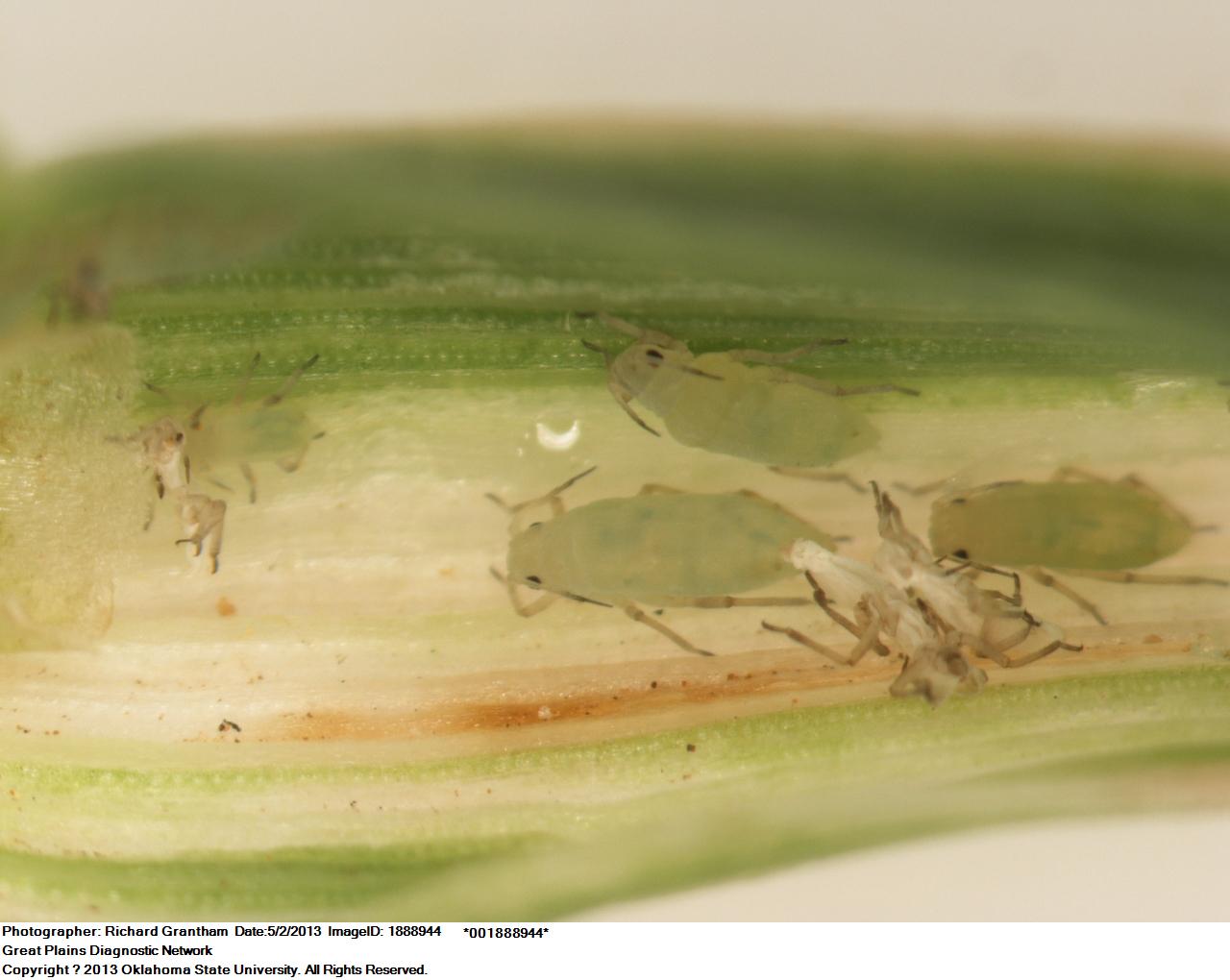
Barley yellow dwarf was commonly observed at many locations with variable severity, but it was often difficult to differentiate damage between BYD, freeze, and drought.  Wheat streak mosaic also was observed across the areas examined (see photo below).  An increasing number of samples from around western OK have kept Jen Olson (Plant Disease Diagnostician) busy.  Most of these samples have tested positive for BYDV, WSMV, or both, but no high plains virus or Triticum mosaic virus has been detected.  This includes the Stillwater area where I have never before (since 1982) observed WSM.  Another interesting find here at Stillwater included occurrence of Russian Wheat Aphid, which was confirmed by Dr. Rick Grantham (Director of the Plant Disease and Insect Diagnostic Lab –  photos below taken by Rick).

Wheat showing symtoms of Wheat Streak Mosiac Virus. There are no curative sprays for this virus, but it can be avoided by ensuring volunteer wheat and other grasses are dead at least two weeks prior to planting

Wheat showing symtoms of Wheat Streak Mosiac Virus. There are no curative sprays for this virus, but it can be avoided by ensuring volunteer wheat and other grasses are dead at least two weeks prior to planting

Symptoms of Russian wheat aphid feeding

Symptoms of Russian wheat aphid feeding

Russian wheat aphids on wheat

Russian wheat aphids on wheat