Watch season-long restrictions when split applying fungicides

By Dr. Bob Hunger, OSU Extension Plant Pathologist

My counterpart in Arkansas, Dr. Gene Milus (University of Arkansas), just sent out an important message about being careful to not exceed the maximum amount of a fungicide applied to a crop in a single year.  Such a consideration could be an issue where more than one fungicide application is made.  This is especially true if a generic of tebuconazole is applied, as this chemical also is in Prosaro;  however, multiple applications of the same fungicide may also exceed the maximum amount of chemical that can be applied in a single year.  Reading the label is the best place to determine the maximum amount of a chemical that can be applied in a single season and the exact amount of a chemical(s) that is in a fungicide.  A quick reference to what chemicals are in the typical fungicides used on wheat in Oklahoma is the OSU Current Report (CR-7668) that Dr. Jeff Edwards and I recently updated (available at www.wheat.okstate.edu)

In Arkansas and many states through the mid-western region of the U.S., two or even three fungicide applications on wheat are more common, with the last application typically targeted toward Fusarium head blight (scab).  In Oklahoma, where scab usually is not a concern, deciding to apply one fungicide application typically has been the only consideration.  However, in recent years making two fungicide applications have become more common because of higher wheat prices, lower cost of fungicides, and increased no-till wheat acres that favor early diseases such as powdery mildew, tan spot, and septoria/stagonospora.  It is in these situations that care must be taken to insure label compliance.  The following message from Dr. Milus addresses this point.  The report below is also at http://www.arkansas-crops.com/ along with other ag news from Arkansas.

Given the early onset of stripe rust and the cool rainy weather in recent weeks, some wheat growers are considering two or three fungicide applications. This is a new phenomenon for Arkansas growers and requires some planning to stay within the legal limits for total amounts of particular fungicides that can be applied to wheat fields. The fungicide label lists to total amount of each active ingredient that can be applied per acre per year. These amounts usually are given in pounds of active ingredient (lb ai) which require some math to translate into fluid ounces (fl oz) of particular products. The total amounts and usual application rates below are for fungicides most likely to be used in Arkansas.

Tebuconazole: total amount = 0.11 lb ai/A = 4 fl oz/A.
Products containing only tebuconazole include Folicur (no longer being sold), Orius, Tebucon, Tebustar, Tebuzol, Tegrol, and Toledo.

Prosaro: total amount = 8.2 fl oz /A = 0.11 lb ai each of prothioconazole and tebuconazole.
(Note that no Prosaro can be applied if 4 fl oz of a tebuconazole product was applied earlier because Prosaro is half tebuconazole.)

Propiconazole: total amount = 0.22 lb ai/A = 8 fl oz/A.
4 fl oz/A = 0.11 lb propiconazole.
Products containing propiconazole include Tilt, Bumper, Fitness, Propiconazole E-AG, and PropiMax

Quilt Excel: total amount = 28 fl oz/A = 0.22 lb propiconazole + 0.26 lb azoxystrobin
14 fl oz Quilt Excel = 0.11 lb propiconazole + 0.13 lb azoxystrobin.
(Therefore 4 fl oz of a propiconazole product + 14 fl oz of Quilt Excel can be legally applied.)

Pyraclostrobin (Headline): total amount = 18 fl oz/A = 0.29 lb ai/A
9 fl oz = 0.147 lb Pyraclostrobin (Note the slight discrepancy between the total amounts expressed as fl oz/A and lb ai/A.)

Metconazole (Caramba): total amount = 34 fl oz/A = 0.20 lb ai/A
17 fl oz = 0.10 lb Metconazole

Twinline: total amount = 18 fl oz/A = 0.10 lb metconazole + 0.15 lb pyraclostrobin
9 fl oz/A = 0.05 lb metconazole + 0.076 lb pyraclostrobin
(Note the discrepancies for total amounts metconazole and pyraclostrobin depending on which products are used.)
Wheat disease update 04/10/13

Wheat disease updates are written by OSU Extension Plant Pathologist Dr. Bob Hunger and posted on the World of Wheat blog.

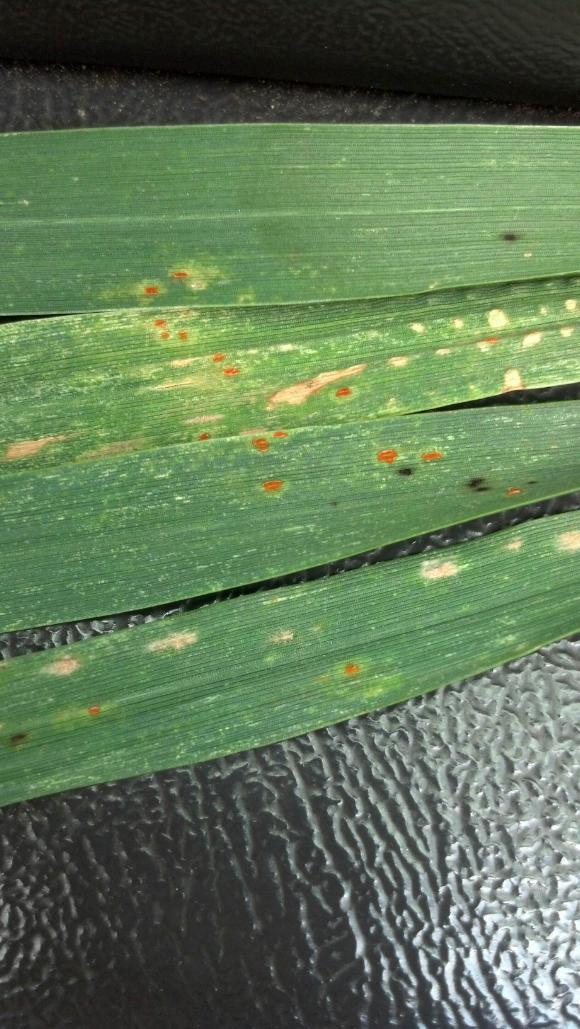
Oklahoma:  A couple of “firsts” occurred this week.  Mark Gregory (Southwest Area Extension Agronomist) reported the first leaf rust in Oklahoma for 2013 (see photo below).  It was on Overley near Devol, OK, which is near the Red River north of Wichita Falls, TX.  The wheat was at GS 10-10.1 (boot to heads just emerging), and was in a field with quite a bit of damage from the freeze.  From Mark’s description, the prevalence was fairly low as he indicated he had to look around quite a bit to find rust pustules.  Along these lines, Dr. Jeff Edwards and I recently updated “Foliar Fungicides and Wheat Production in Oklahoma – April, 2013” (OSU Current Report CR-7668).  This publication provides answers to many of the common questions typically asked about wheat foliar fungicides and provides a table listing the most common fungicides available to control wheat foliar diseases. You can find the publication at http://www.wheat.okstate.edu or by clicking here.

We also had our first confirmed sample of wheat streak mosaic in Fuller wheat from southwestern OK (near Sentinel) in Washita County.  This was in a field that had been sprayed for volunteer wheat last fall.  Perhaps sufficient time was not allowed to elapse between the spraying of the volunteer and the planting of the wheat in the fall – remember, two weeks should be allowed between the complete death (not the spraying) of volunteer wheat and the emergence of seedling wheat in order to kill the wheat curl mites that transmit Wheat streak mosaic virus.

Next week I’ll be looking around more of the state for diseases – thankfully it is too rainy today!!!!

Leaf rust and powdery mildew on Overley at Devol, Oklahoma 04/08/2013

Leaf rust and powdery mildew on Overley at Devol, Oklahoma 04/08/2013

Spring freeze part deux

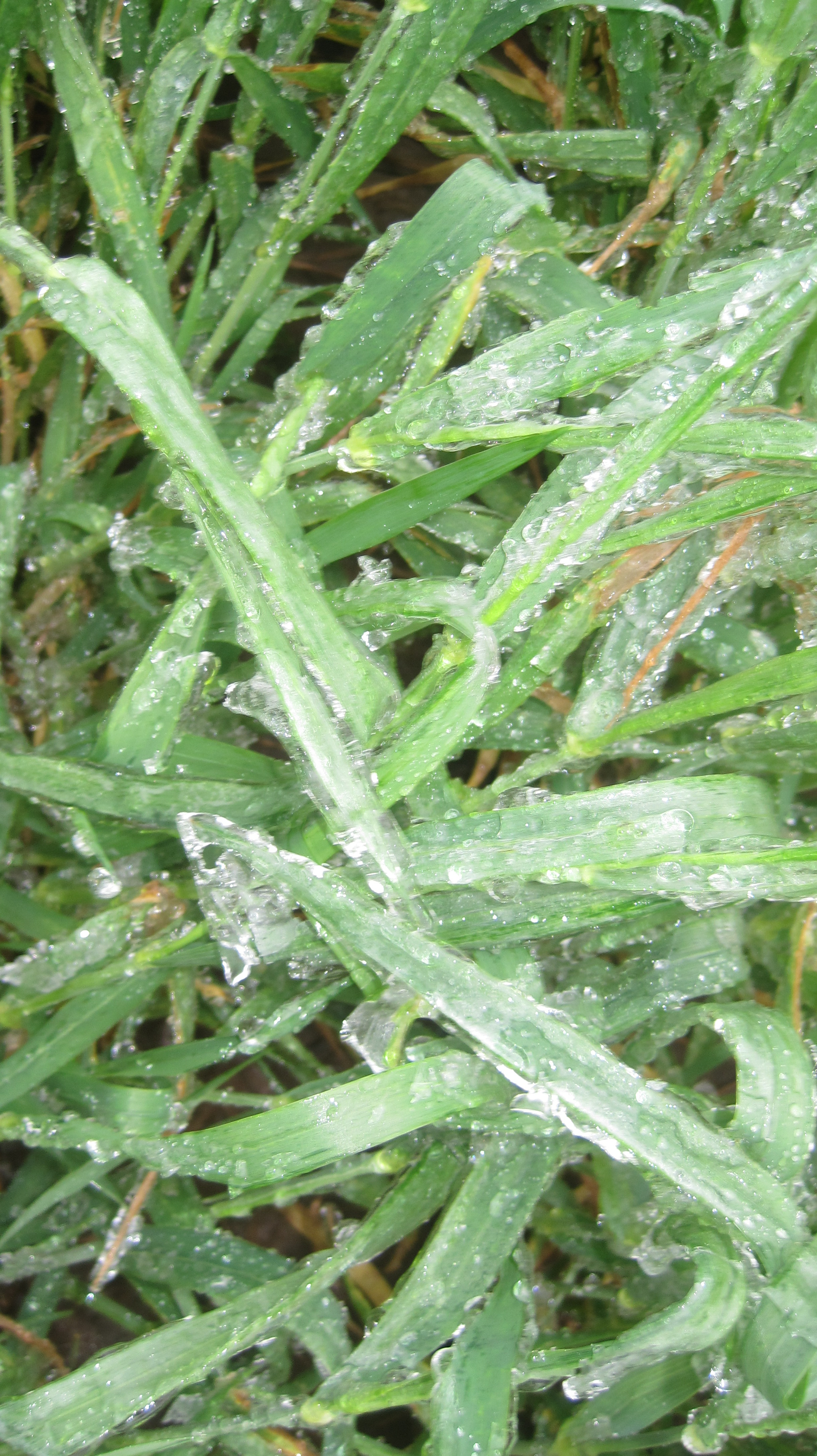
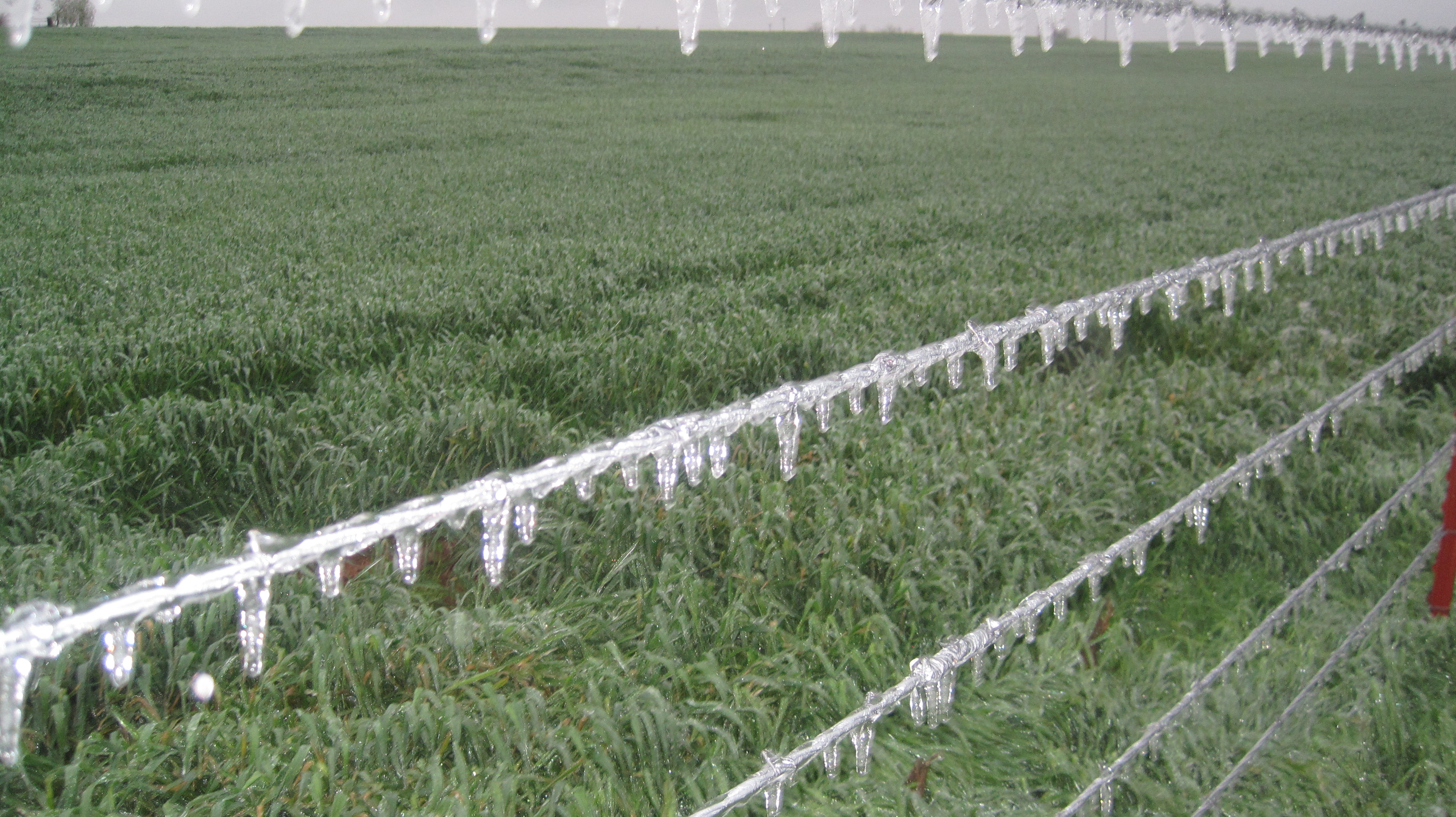
Large amounts of freezing rain, sleet, hail, etc. hit the Oklahoma wheat belt on April 10, 2013 and temperatures are expected to drop to the mid to upper 20’s this evening (I posted a couple of pictures below). Wheat development ranges from early heading in southern Oklahoma to just past jointing in northern Oklahoma and the Oklahoma Panhandle. If forecasts are correct, wheat tillers in southwest Oklahoma that escaped the first freeze have a good chance of being taken out by this freeze.  Central and northcentral Oklahoma has quite a bit of ice-covered wheat. Ice-covered wheat will remain at approximately 32F and this might be just warm enough to escape severe injury. If the ice melts, however, and temps drop into the 20’s even wheat that is just past the jointing stage can be injured. At this stage it is certain that we will have some freeze injury to the majority of the Oklahoma wheat crop, but it will be a good 7 – 10 days before we can accurately assess the level of injury.

I have been asked if there is a 1:1 relationship between % freeze injury and % grain yield loss. Generally, the answer is no. DISCLAIMER — the values I am about to discuss are approximations and have huge margins of error —  An otherwise healthy wheat crop that sustains 10% freeze injury prior to boot would probably suffer yield losses in the order of 0 to 5%. This is because the plant will divert resources to the remaining wheat heads. If damage is sufficient to reduce the final head count below a critical mass (around 400 heads per square yard) the relationship between % freeze injury and % yield loss will be much closer. So a 60% freeze injury might result in a 40 – 50% loss in grain yield. Again, these numbers are rough estimations and environmental conditions following the freeze will greatly impact the plant’s ability to compensate after freeze.

Advanced wheat partially covered by ice at Okarche, OK. Photo courtesy Mike Schulte, Oklahoma Wheat Commission

Advanced wheat partially covered by ice at Okarche, OK. Photo courtesy Mike Schulte, Oklahoma Wheat Commission

Mixture of ice and rain on wheat at Banner Rd. and I 40. Photo courtesy Mike Schulte, Oklahoma Wheat Commission

Mixture of ice and rain on wheat at Banner Rd. and I 40. Photo courtesy Mike Schulte, Oklahoma Wheat Commission

Ice covered wheat in the Alva area. Photo courtesy Woods County Extension Educator, Greg Highfill

Ice covered wheat in the Alva area. Photo courtesy Woods County Extension Educator, Greg Highfill

Freeze injury update – worse than we thought

On April 4th I toured southwest Oklahoma and surveyed freeze injury to wheat. In my experience, most freeze events are overhyped; however, this one was the real deal Holyfield.  I traveled a route from Faxon to Chattanooga to Altus to Blair and ended up at Apache. Damage was similar at all sites, with injury ranging from 50 to 80%.

The best looking wheat was the hardest hit. Particularly troubling are some fields in the Altus area that easily had 80 bushel potential prior to the freeze. In most of these fields we are too far past the tillering stage to have yield compensation from secondary tillers. Late-emerging fields that were jointing or smaller escaped the freeze with little injury. Fields that had been heavily grazed and/or under-fertilized also escaped with relatively minor injury.  Conditions improved slightly when I checked wheat in the Chickasha area and injury was more in the 10 – 30% range.

I am frequently asked if the injured wheat head will go ahead and “push through” as the season progresses, and the answer is no. So, if you see heads emerging out of the boot in a few weeks, they are likely not damaged and a head count at this stage will be a reasonable estimate of fertile heads. Since there will not be additional stem elongation in freeze injured wheat, it will not accumulate as much tonnage as in a ‘normal’ year.

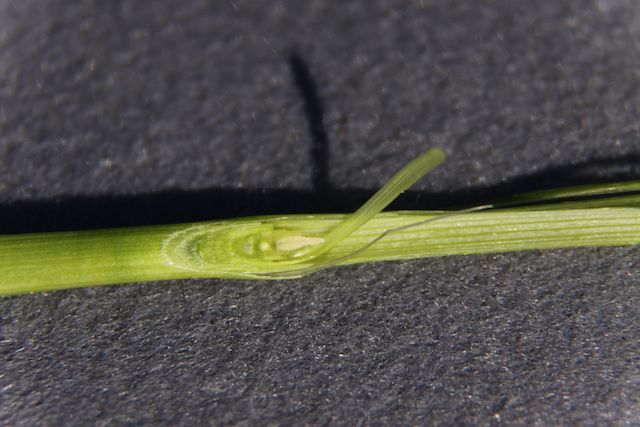
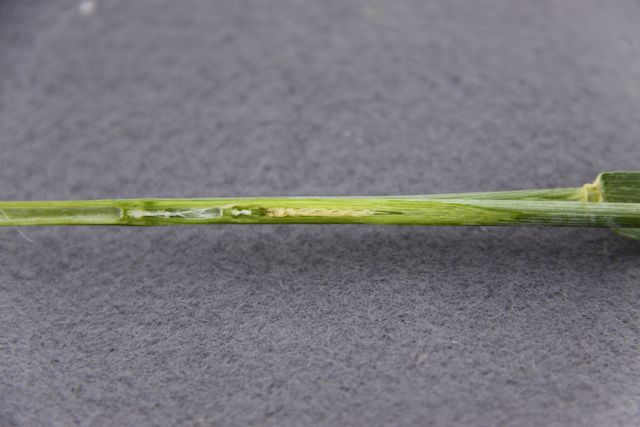
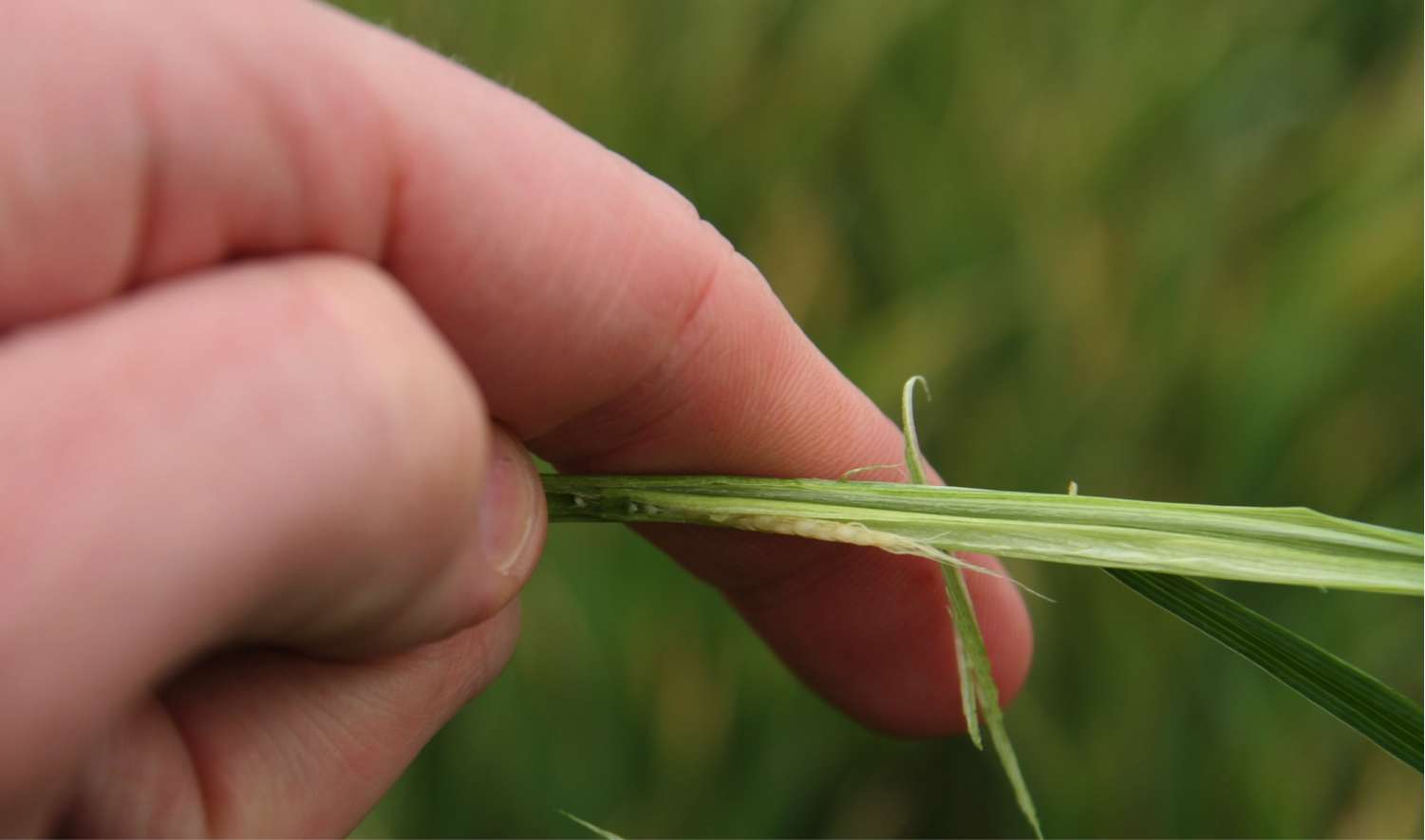
I have posted a few pictures below showing freeze injury symptoms. Freeze injury can vary greatly among fields and even within a field. So, it is important to check several sites within a field and split several stems when determining the percent injury. Check early maturing varieties such as Jackpot, Billings, and Everest first, as they are most likely to have injury.

Image

Endurance wheat collected from plots at Chattanooga, OK. The two top heads are freeze damaged and will not recover. Note the shriveled, white appearance of the wheat head. The bottom head was not injured and is healthy green.

A healthy head of Endurance  from Apache, OK.

A healthy head of Endurance from Apache, OK.

Even though this wheat was just past jointing, it was injured by the freeze and the head was lost.

Even though this wheat was just past jointing, it was injured by the freeze and the head was lost.

Freeze injured Billings from the Altus research station

Freeze injured Billings from the Altus research station

A sign of the drought. Wheat seed still easy to find on a sample from near Altus, OK April 4.

A sign of the drought. Wheat seed still easy to find on a sample from near Altus, OK April 4.

Freeze injury to wheat

Temperatures across Oklahoma dipped into the teens and 20’s March 25 and 26 (see maps below). The rule of thumb is temperatures below 24F will damage wheat at or past the jointing stage, so it was certainly cold enough to injure wheat that was not delayed due to drought stress, grazing, or late emergence.  ImageImage

Freeze injury is not an exact science, and it remains to be seen whether or not we actually have widespread wheat freeze injury in the 2013 wheat crop.  My best guess is that we will have some injury and might lose our primary tillers in more advanced fields. Wheat that is at Feekes growth stage 6 – 7 generally has the ability to compensate for primary tiller loss by keeping secondary tillers that would otherwise be sloughed off in April. In this scenario, the effect on final grain yield would be minimal. Wheat that has already aborted secondary tillers does not have this flex ability and will not recover from freeze injury.  This is why March freezes are generally yield reducing and April freezes are yield eliminating. I will check fields late next week and post the results on this blog.

Freeze injury is not clearly identifiable until 7 – 10 days after the freeze event. So, the best advice for a wheat farmer after a freeze event is to find something else to do for a week or two and then check your crop. I have provided some pictures below with typical injury symptoms and rules of thumb regarding the extent of the injury. Fields should be checked at several random locations by splitting 10 – 20 stems at each location and looking for injury. Don’t focus solely on the large stems. Split a random sampling and determine the percent damage. A good reference for evaluating freeze injury to wheat is K-State Extension Publication C-646 Spring Freeze Injury to Kansas Wheat (access online by clicking here).

This is a healthy wheat head at approximately growth stage 6 - 7. Note the light green color and healthy, turgid appearance.

This is a healthy wheat head at approximately growth stage 6 – 7. Note the light green color and healthy, turgid appearance.

Freeze injury just after jointing. Note the pale, milky color of the head.

Freeze injury just after jointing. Note the pale, milky color of the head. Freeze injury to wheat heads at this growth stage is all or none, so this head is a complete loss.

Leaf tip burn from freeze injury will have no impact on final grain yield

Leaf tip burn from freeze injury will have no impact on final grain yield

Yellowing is a common reaction to light freeze injury. Wheat will recover quickly from this injury.

Yellowing is a common reaction to light freeze injury. Wheat will recover quickly from this injury.

Severe freeze injury at or just after jointing can turn the entire plant brown and fields can exude an odor similar to fermenting silage. If conditions are favorable, the plant can produce new tillers (as shown here) and make a partial recovery. It will take a few weeks after a freeze event to determine if the plant will recover from this type of injury

Severe freeze injury at or just after jointing can turn the entire plant brown and fields can exude an odor similar to fermenting silage. If conditions are favorable, the plant can produce new tillers (as shown here) and make a partial recovery. It will take a few weeks after a freeze event to determine if the plant will recover from this type of injury

It is common for sub-lethal freeze injury to result in bent or weak lower nodes. These plants might look fine, but will lodge during grain fill.

It is common for sub-lethal freeze injury to result in bent or weak lower nodes. These plants might look fine, but will lodge during grain fill.

First hollow stem update 03/08/2013

We are not progressing towards first hollow stem as quickly as I anticipated, but most varieties are getting close. The drought has likely slowed onset of first hollow stem. Keep in mind that drought stressed wheat might need longer to recover from grazing, so it will likely be better to remove cattle a little early in 2013.

CHICKASHA

                 cm of hollow stem

Variety           03/06/13

Jagger             .

Endurance       0.46

Deliver             0.43

Pete                 0.4

Ruby Lee         1.3

Garrison           1.44

Duster              0.49

Gallagher        .

Iba                   0.78

Fuller               1.99

Everest           .

Jackpot            1.69

Doans              0.55

Greer               .

CJ                    0.38

Razor               .

Armour             1.7

WB-Cedar        0.82

WB-Redhawk    2.71

T153                2.27

T154                2.44

T158                0.5

OK08328         0.36

*Average of ten hollow stem measurements in wheat sown 09/20/12 at Chickasha, OK

Stillwater

                 cm of hollow stem

Variety            03/05/13

Jagger                 1.1

Endurance          0.2

Deliver                 0.7

Pete                    0.3

OK Bullet            0.5

OK Rising            0.7

Centerfield          0.3

Ruby Lee             2.4

Garrison               1.6

Duster                  .

Gallgher              0.7

Iba                       0.1

Billings                0.4

Fuller                   1.8

Everest                .

Jackpot                1.5

Doans                  1.7

Greer                   0.5

CJ                        0.2

Razor                   2.8

Armour                1.2

WB-Cedar            1.1

WB-Redhawk       0.9

WB-Duece CL+    .

WB-Grainfield      0.7

Winterhawk          1.2

WB-4458             .

T153                   1.7

T154                   2.0

T158                   0.1

LCS Mint             0.1

LCH08-80            0.1

LCH08 – 109        0.3

T173                   0.4

Byrd                     0.1

Brawl CL+            0.1

TAM 113             0.4

OK09915C          0.4

OK09935C          0.4

OK09634             0.5

OK09125             0.4

OK09528             0.2

OK09729             0.4

OK08328             0.1

*Average of ten hollow stem measurements in wheat sown 09/18/12 at Stillwater, OK


Onset of first hollow stem was affected by severe drought stress

First hollow stem update – 03/01/2013

The OSU Small Grains Extension team checked first hollow stem at Chickasha and Stillwater this week. Measurements from both locations are provided in the tables below. Varieties with 1.5 cm or more of hollow stem are considered to be at first hollow stem. Numbers have not changed much at Chickasha due to the cold weather; however, with temperatures climbing into the 60’s next week we should see rapid progression of first hollow stem. Although planted a few days earlier, Stillwater is about a week behind Chickasha in terms of first hollow stem. This is due to severe drought stress at Stillwater. In fact, there were a few times I questioned wether or not the Stillwater plots would survive. In this situation it is important to not only consider first hollow stem but also the amount of green leaf area remaining after grazing. Wheat with less than 60% ground cover at jointing will likely not achieve full grain yield potential, even if cattle were removed prior to first hollow stem.

CHICKASHA

                     cm of hollow stem

Variety               02/28/13

Jagger                   2.5

Endurance             0.1

Deliver                   0.3

Pete                       0.2

Ruby Lee               1.1

Garrison                 0.8

Duster                    0.5

Gallagher             

Iba                         0.4

Fuller                     1.5

Everest                 –

Jackpot                  0.7

Doans                    0.4

Greer                     1.6

CJ                          0.8

Razor                     4.0

Armour                   1.0

WB-Cedar              1.1

WB-Redhawk          1.1

T153                      1.2

T154                      1.0

T158                      0.3

OK08328               0.4

*Average of ten hollow stem measurements in wheat sown 09/20/12 at Chickasha, OK


Stillwater


                     cm of hollow stem

Variety               02/27/13

Jagger                     0.4

Endurance              0.1

Deliver                     0.7

Pete                        0.3

OK Bullet                0.1

OK Rising                0.4

Centerfield              0.3

Ruby Lee                 1.2

Garrison                   0.5

Duster                      0.0

Gallgher                  0.3

Iba                           0.0

Billings                    0.2

Fuller                       0.5

Everest                    2.3

Jackpot                    0.8

Doans                      0.5

Greer                       0.4

CJ                            0.0

Razor                       0.6

Armour                    0.1

WB-Cedar                0.6

WB-Redhawk           0.9

WB-Duece CL+        4.2

WB-Grainfield          0.4

Winterhawk              0.6

WB-4458                 1.6

T153                       0.9

T154                       0.7

T158                       0.1

LCS Mint                 0.1

LCH08-80                0.0

LCH08 – 109            0.2

T173                       0.0

Byrd                         0.2

Brawl CL+                0.2

TAM 113                 0.3

OK09915C              0.1

OK09935C              0.1

OK09634                 0.0

OK09125                 0.1

OK09528                 0.0

OK09729                 0.2

OK08328                 0.1

*Average of ten hollow stem measurements in wheat sown 09/18/12 at Stillwater, OK


Onset of first hollow stem was affected by severe drought stress

Too little, too late?

It finally rained! Rainfall totals in western Oklahoma (0.1 to 0.3 inches) will not put a dent in the drought, but were probably enough to induce germination of seed resting in dry soil. Oklahoma weather is extremely variable, and who knows when temperatures will warm enough to spur along the germination process. If we retain the recent moisture and have something close to a “normal” year, it is likely that we will see wheat popping through the soil in mid February. I compared February sown winter wheat to spring wheat in a trial at Newkirk, OK a few years ago. The winter wheat made about 15 bu/ac and the spring wheat made about 20 bu/ac. This was in a favorable year that was not plagued by drought. Given current weather trends, a best case scenario for February emerging winter wheat is 50% of normal yield. A worst case scenario is 0 – 10% of normal yield. If I were wagering, I would place my money on 20 – 30% of normal yield potential.

The rainfall might be enough to help emerged wheat west of I-35 survive, but that is about it. Soil moisture is still insufficient to produce a recovery and I would still proceed cautiously regarding inputs on these acres. The rain might have indeed been too little, too late for these acres. IF soil moisture gets recharged by mid February and IF we have a mild spring these acres could have some secondary tillering and make a moderate recovery; however, the odds are against this scenario.rainrfc.48hr

Don’t overgraze no-till

The drought is worsening and forage is getting harder and harder to come by. Crop residue that was once considered of little nutritional value for livestock has become a staple for Oklahoma cattle producers with depleted pasture and hay reserves. John Holman with KSU in Garden City indicated that grazing of sorghum stalks has become commonplace in western KS as well. Some crop residue can be removed without significant damage to long-term gains in soil structure associated with no-till, but overgrazing can lead to some real problems when the wind comes sweeping down the plain.

Wind erosion is commonly thought of as a conventional-till problem, but in an email exchange, Jason Warren recently indicated that there are a few scenarios where wind erosion could actually be worse in no-till than conventional till. No-till results in a relatively smooth, flat soil surface that, in the absence of residue, has few barriers to slow the wind. So, if we have an easily detached soil type (i.e. a sandy soil), a flat surface, and no residue to hold the ground, then we have a recipe for wind erosion. The same would be true for no-till wheat pasture that has been overgrazed. In a wind-erosion-fighting battle royale, I still prefer no-till to conventional till. However, no-till is not immune to wind erosion and it is important to keep some cover on the soil.

Aside from soil protection, it is important to remember that crop residues have value as reservoirs of nutrients.  An estimate of nutrient removal of grain, fiber, and forage crops can be found on one of Brian Arnall’s Pete Sheets at http://npk.okstate.edu/petesheets If the cattle are grazing the residue in-field, most of the nutrients will be returned to the soil. If the residue is being baled, the nutrients are leaving with the hay bales. You can estimate the value of these removed nutrients using the linked Pete Sheet and current fertilizer prices.

No-till practices to not make soil immune from wind erosion. Adequate cover must be maintained.

No-till practices to not make soil immune from wind erosion. Adequate cover must be maintained.

How dry is it?

It was too nice of a day to stay in the office yesterday, so I checked on our wheat variety plots. I started at McLoud, moved west to Kingfisher, and ended up at Marshall. As indicated by the pictures and captions below, neither the wheat nor my mood improved as I traveled west. I am sure if I had traveled farther west, this would have gotten worse. The bottom line is that we are in desperate need of moisture in Oklahoma. Early-sown wheat is backpedaling quickly and cannot hold on too much longer. Much of the later sown wheat has yet to emerge. We are certainly not on our way to a record year, but everything could still turn out okay……..if it rains.