Harvest underway

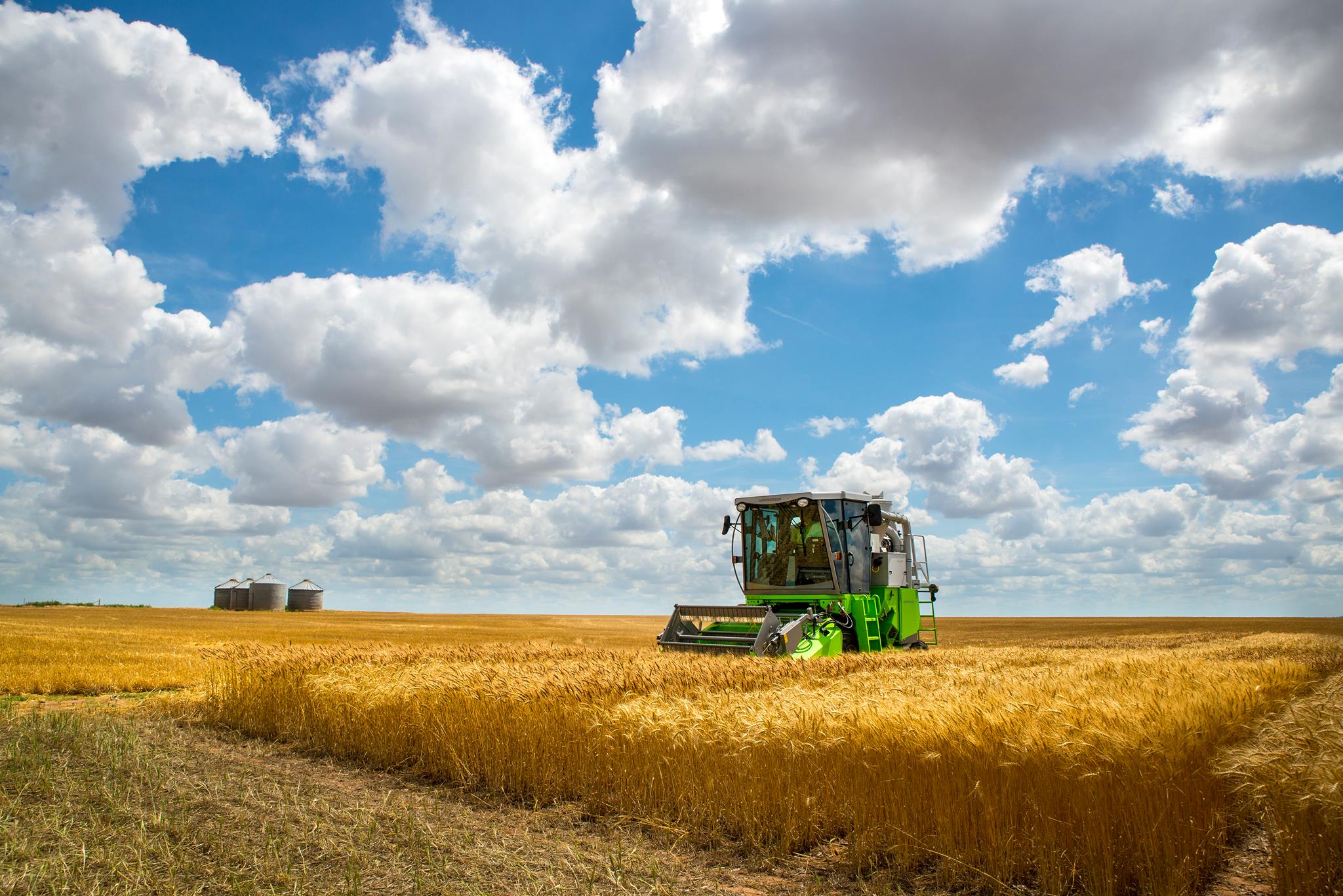
The 2014 Oklahoma wheat harvest is underway and results from the Walters and Thomas wheat variety trials are now posted at http://www.wheat.okstate.edu. Depending on field operations, I usually get variety trial results posted on the web within a day or two of harvest.  The best way to learn when results are posted are to follow me on Twitter @OSU_smallgrains or subscribe to our Extension news list serve (send me an email at jeff.edwards@okstate.edu to be added to the listserv).

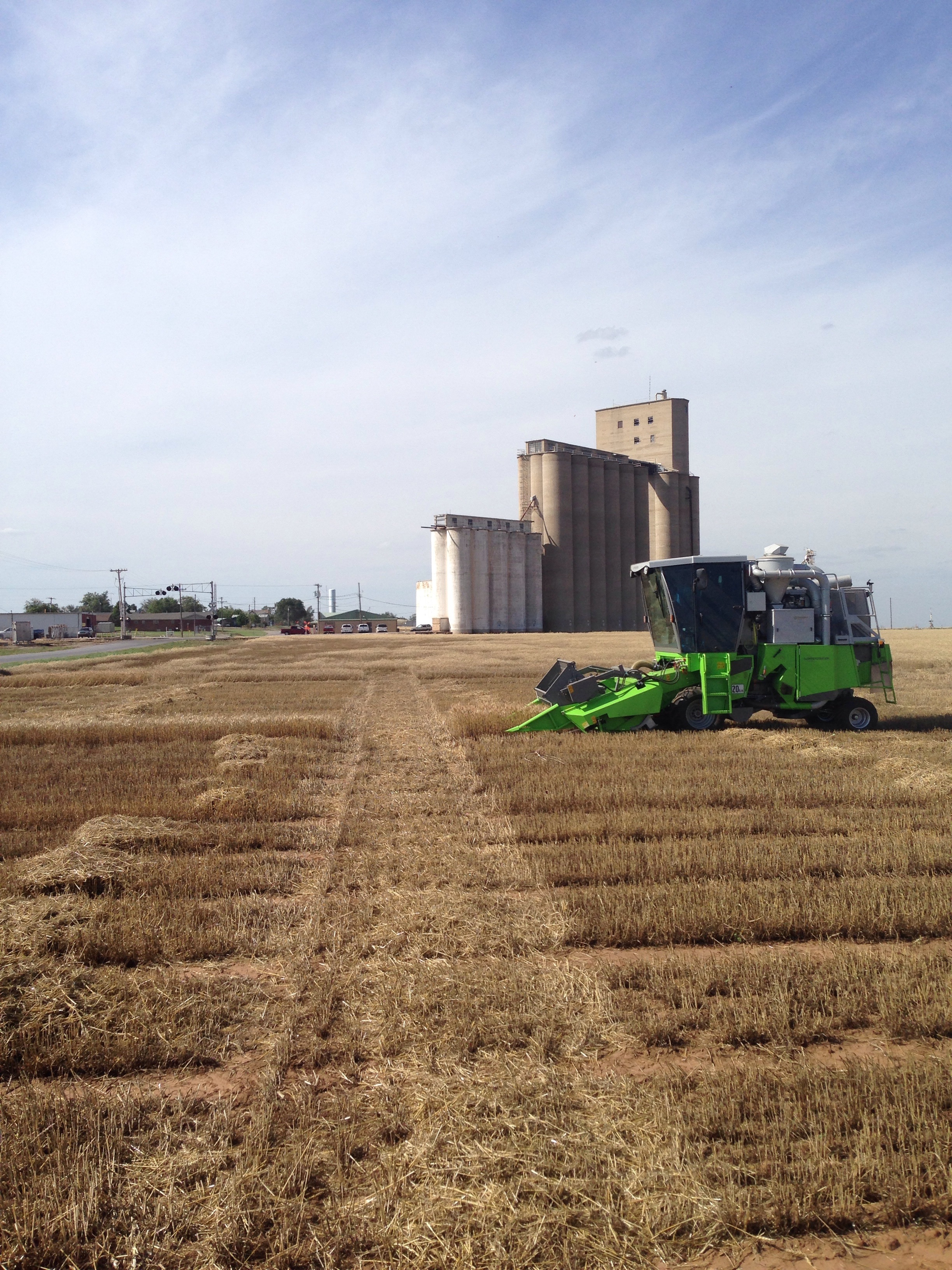
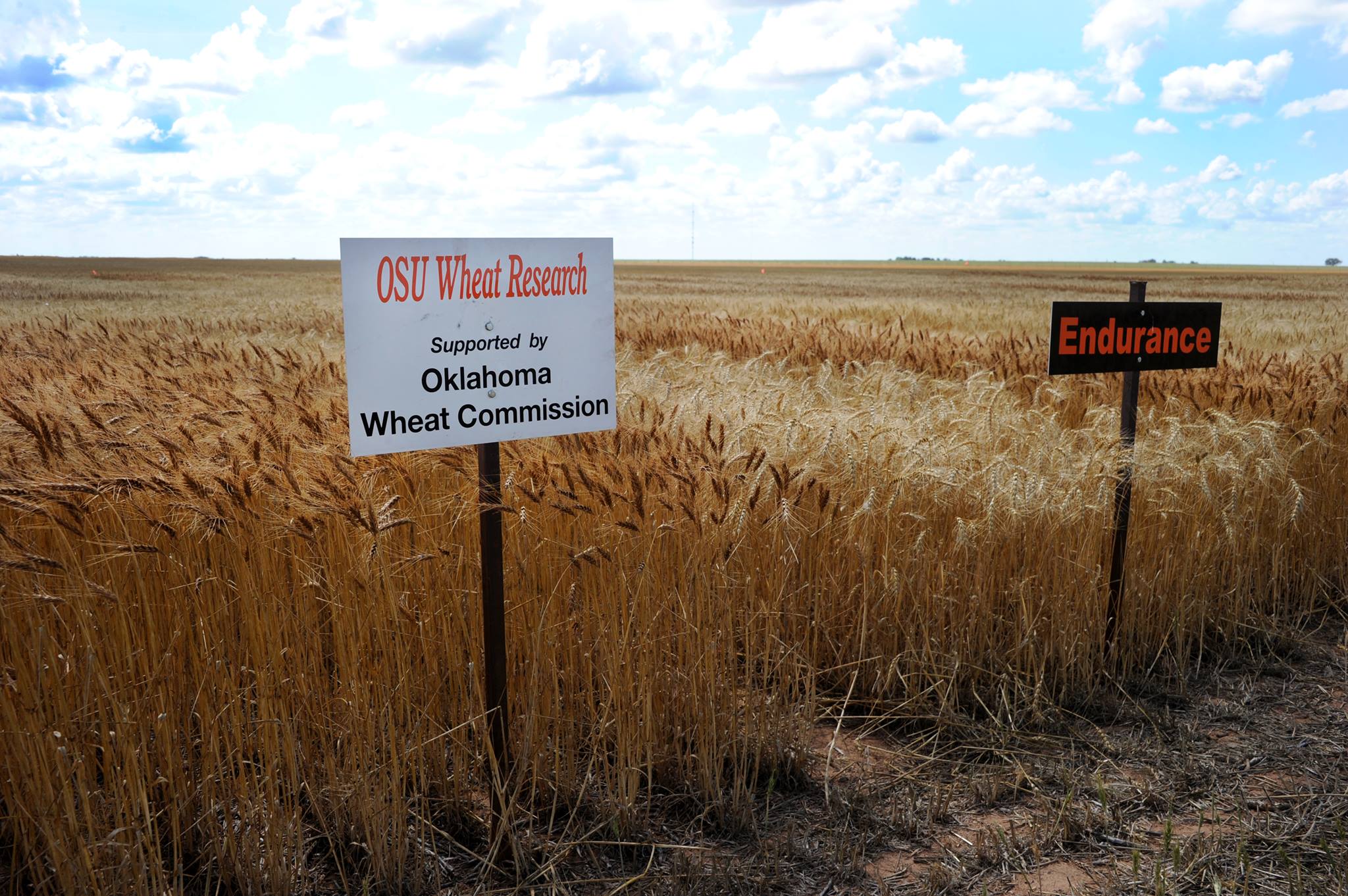
I have posted a few pics from our harvest operations below.


Wheat checkoff dollars make the Oklahoma Wheat Variety Testing program possible. We appreciate the support of our Oklahoma farmers!

Wheat checkoff dollars make the Oklahoma Wheat Variety Testing program possible. We appreciate the support of our Oklahoma farmers!

Harvest at Walters, OK. Photo courtesy Todd Johnson, OSU Ag. Comm. Services.

Harvest at Walters, OK. Photo courtesy Todd Johnson, OSU Ag. Comm. Services.

Changing tires on the side of I-35 is never fun. We blew two more on the way to Thomas the next day and damaged the trailer. Big shout out to Eley's service center in Watonga and Watonga  Machine and Steel for getting us back on the road. Don't get me started on the lack of American made trailer tires!

Changing tires on the side of I-35 is never fun. We blew two more on the way to Thomas the next day and damaged the trailer. Big shout out to Eley’s service center in Watonga and Watonga Machine and Steel for getting us back on the road.

Once we made it Thomas harvest went well. Yields were low, but that was to be expected given the freeze and drought.

Once we made it Thomas harvest went well. Yields were low, but that was to be expected given the freeze and drought.

Banding P as a Band-Aid for low-pH soils.

Great post!

osunpk's avatarDown and Dirty with NPK

In the mid-1970s Dr. Robert Westerman banded 18-46-0 with wheat at planting in a low-pH soil near Haskel Ok. The impact was immediately evident. Soon after Oklahoma State University recommended the “Banding of Phosphate in Wheat: A Temporary Alternative to Liming” Figure 1. This method was a Band-Aid solution for the significant amount Oklahoma winter wheat production area which was either too far from a reliable lime source or under a short term lease contract.

Figure 1. The cover of an extension brochure distributed in Oklahoma during the 1980s. Figure 1. The cover of an extension brochure distributed in Oklahoma during the 1980s.

Still today grain producers throughout the United States commonly farm a large percentage of land that is not their own. In the leasing process agreements can widely vary both on length of the lease and the amount of inputs that the land owner will pay. The wheat belt of Oklahoma is known for having large areas with low soil pH levels…

View original post 1,199 more words

Questions about Clearfield wheat

The introduction of two-gene Clearfield technology and the release of an Oklahoma-developed two-gene Clearfield wheat variety have resulted in increased interest in the Clearfield system in the southern Great Plains. This has also resulted in several questions, some of which I will attempt to answer in this blog post. If you have specific questions regarding rates, timings, etc., I encourage you to contact your local BASF representative.

Are Clearfield wheat varieties GMO’s? No. The Clearfield system is a non-genetically modified crop herbicide tolerance technology.

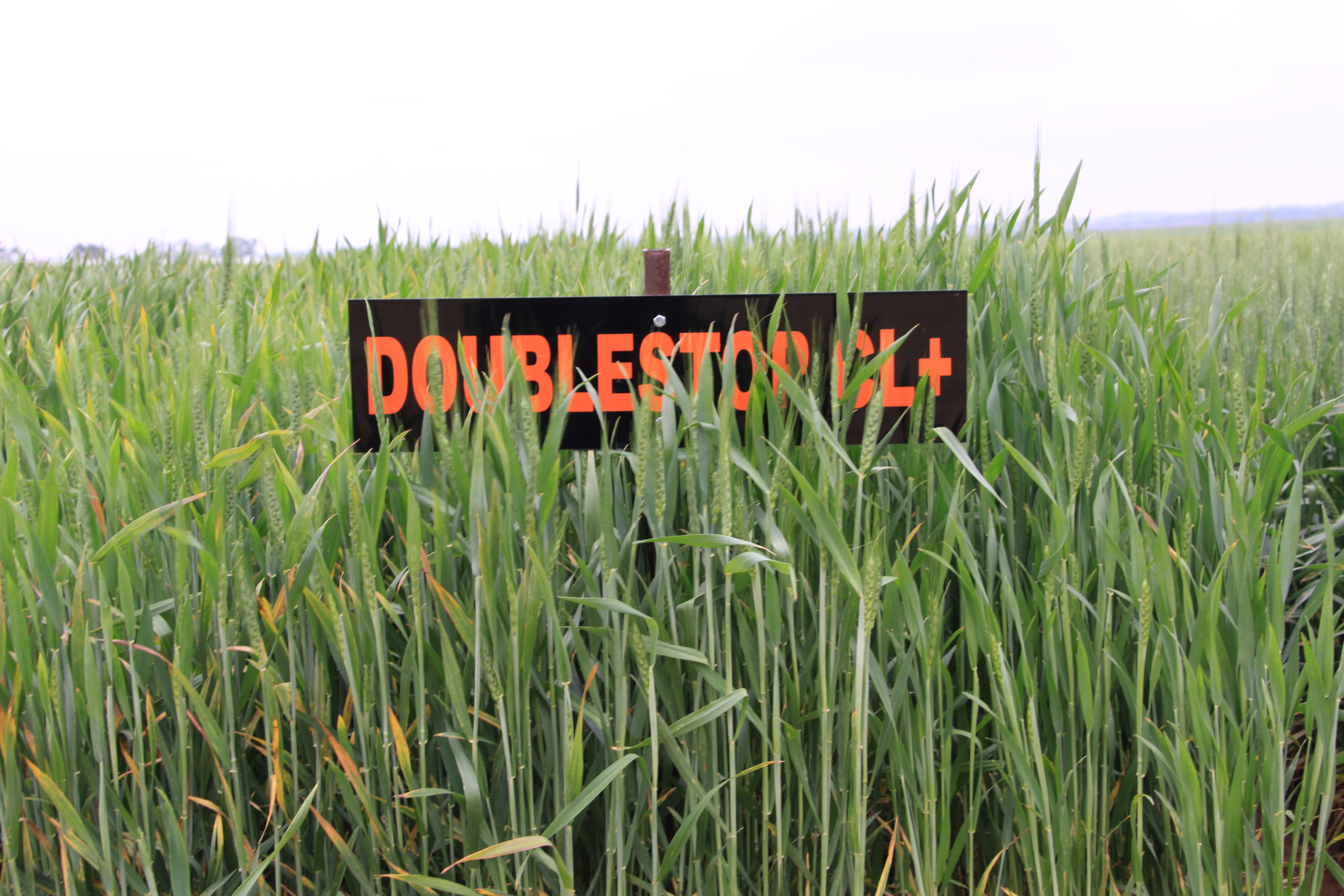
What is two-gene technology and what does it mean? As the name implies, two gene Clearfield varieties have two copies of the gene that confers resistance to imidazolinone herbicides. Two gene varieties have “Plus” or “+” in the name (e.g. Doublestop CL Plus). In wheat two-gene technology provides the option of adding 1% v/v methylated seed oil (MSO) to the spray solution. In my experience, addition of 1% v/v MSO greatly increases Beyond efficacy on feral rye. Methylated seed oil should NOT be added to the spray solution for one-gene Clearfield varieties, as crop injury will occur.

What is the new OSU two-gene Clearfield variety? Doublestop CL Plus was released by OSU in 2013 and is marketed through Oklahoma Genetics Inc. It is a late to first hollow stem and late maturity (about the same as Endurance) variety with a wide area of adaptation. A few of the strengths of Doublestop CL Plus include yield potential, acid soil tolerance, test weight, and milling and baking characteristics. More information on Doublestop CL Plus can be found by clicking here.

Doublestop CL Plus

Can I save seed from Clearfield varieties? No. The gene that confers the Clearfield trait is protected by a utility patent and new seed (registered or certified) must be purchased each year.

Can I grow a Clearfield variety two years in a row? The better question might be should you grow a Clearfield variety two years in a row? Multiple years of using the same herbicide or herbicide mode of action can result in herbicide resistance. Of particular concern is jointed goatgrass, which has the ability to hybridize with wheat. This ability to hybridize could result in a population of resistant jointed goatgrass in a fairly short time period. So, if jointed goatgrass is the primary weed problem, rotating crops and/or herbicide chemistries to avoid consecutive years of Clearfield technology is a good stewardship practice.

Other grasses, such as feral rye, do not have the potential to hybridize, but the potential for weed resistance is still there through selection pressure. In these situations, I would not be as concerned about two consecutive years of a Clearfield system, but would certainly switch herbicide chemistry for a year after that.

Ultimately, it is important to rotate crops and herbicide modes of action to ensure the longevity of the Clearfield system. Weed resistance is bad and it is worse if your farm is the epicenter of the problem. Clearfield stewardship guidelines are available from BASF by clicking here


2013-2014 Wheat fall forage variety trial results

This blog post is an abbreviated posting of our wheat forage results. For the complete report, consult OSU Current Report 2141 Fall forage production and date of first hollow stem in winter wheat varieties during the 2013-2014 crop year by clicking here.

Average daily temperature and rainfall for Stillwater, OK from 09/01/2013 to 03/31/2014

Average daily temperature and rainfall for Stillwater, OK from 09/01/2013 to 03/31/2014

Average daily temperature and rainfall for Chickasha, OK from 09/01/2013 to 03/31/2014

Average daily temperature and rainfall for Chickasha, OK from 09/01/2013 to 03/31/2014

As was the case across most of Oklahoma, our wheat plots were sown into dry topsoil in late September. Soils in southwest and northwest Oklahoma were extremely dry due to multiple years of drought, and wheat pasture was short in these areas of the state. Summer rainfall provided ample subsoil moisture in the central part of the state, but topsoil was largely dry through September. Rains fell across much of the state in October and provided the fuel needed to build wheat pasture. Unfortunately, these October rains would be the only significant rainfall events most of the Oklahoma wheat crop would receive .


Fall forage production by winter wheat at Stillwater and Chickasha averaged 3,240 and 2,580 pounds per acre, respectively (Tables below). There was a large group of varieties at Stillwater and Chickasha that produced statistically equivalent forage yield, and producers are encouraged to consider two and three year averages when available.


Table 2. Fall forage production by winter wheat varieties at Stillwater, OK during the 2013-2014 production year.
Source Variety  2013-2014  2-Year  3-Year
 —————lbs dry forage/acre—————-
Syngenta SY Llano 4,100
AGSECO TAM 113 4,090 3,160 3,220
OGI Billings 3,850 3,200 3,250
LCS LCS Mint 3,690
OGI Duster 3,670 3,180 3,300
OGI Gallagher 3,650 3,230 3,500
LCS T154 3,640 3,040
Syngenta Doans 3,610
WestBred WB4458 3,610 2,920
Syngenta Jackpot 3,600 3,060 3,150
WestBred WB-Cedar 3,560 3,240 3,250
OSU Deliver 3,470 2,770 3,010
WestBred Winterhawk 3,470 2,780 3,020
OGI Garrison 3,350 3,100 3,210
Watley TAM 112 3,230
OGI Doublestop CL Plus 3,200 3,020
OGI Pete 3,160 2,810 3,020
Syngenta CJ 3,130 2,810 2,980
LCS LCH08-80 3,120 2,950
WestBred Armour 3,110 3,000 3,100
LCS LCH11-1117 3,110
OGI Centerfield 3,090 2,820 3,120
OGI OK Bullet 3,090 2,630 2,820
Syngenta SY Southwind 3,090
OSU Endurance 3,080 3,080 3,310
KWA Everest 3,050 2,810 3,010
Syngenta Greer 3,040 2,840 2,960
LCS LCH11-1130 3,040
LCS T158 3,020 2,760 3,000
CWRF Brawl CL Plus 2,980 2,860
OGI Ruby Lee 2,980 2,610 2,900
LCS T153 2,960 2,840 3,090
OGI Iba 2,930 2,770 3,030
WestBred WB-Grainfield 2,910 2,920
WestBred WB-Redhawk 2,850 2,590
LCS LCH11-109 2,750 2,990
OGI OK Rising 2,720 2,720
CWRF Byrd 2,670 2,590
OSU Experimentals
OK09125 2,800 2,540
LSD (0.05) 750 500 400


Table 3. Fall forage production by winter wheat varieties at Chickasha, OK during the 2013-2014 production year.
Source Variety 2013-2014  2-Year
–lbs dry forage/acre–
OGI Duster 2,920 2,920
OGI Gallagher 2,920 3,010
LCS T158 2,900 2,580
CWRF Brawl CL Plus 2,830
KWA Everest 2,750 2,750
OGI Doublestop CL Plus 2,700
WestBred Winterhawk 2,680
LCS LCS Mint 2,660
OSU Endurance 2,630 2,620
WestBred WB-Cedar 2,590 2,630
CWRF Byrd 2,540
Syngenta Jackpot 2,540 2,460
WB-Grainfield WB-Grainfield 2,530
WestBred WB4458 2,520
OGI Iba 2,460 2,460
LCS LCH08-80 2,440
OGI Billings 2,420
OGI Ruby Lee 2,420 2,430
OSU Deliver 2,410 2,200
Syngenta Greer 2,380 2,480
Syngenta Doans 2,210
OGI Garrison 2,160 2,220
OSU Experimentals
OK09125 2,760
Average 2,580 2,560
LSD 430 290

First hollow stem data are reported in ‘day of year’ (day) format (table below). To provide reference, keep in mind that March 1 is day 60. Average occurrence of first hollow stem at Stillwater in 2014 was day 77. This was approximately five days later than 2013 and 25 days later than in 2012 and was the result of much cooler than normal temperatures. Unlike previous years, there was only about ten days difference among varieties in occurrence of first hollow stem.

Table 4. Occurrence of first hollow stem (day of year) for winter wheat varieties sown in 2013 and measured in 2014 at Stillwater, OK
Source Variety Stillwater
–day of year–
Syngenta SY Llano 72
WestBred WB-Cedar 72
OGI Billings 74
Syngenta CJ 74
KWA Everest 74
OGI Gallagher 74
Syngenta Jackpot 74
OGI OK Bullet 74
OGI OK Rising 74
Syngenta SY Southwind 74
LCS T153 74
Watley TAM 112 74
AGSECO TAM 113 74
WestBred Armour 77
CWRF Byrd 77
OSU Deliver 77
Syngenta Doans 77
OGI Duster 77
OSU Endurance 77
OGI Garrison 77
Syngenta Greer 77
LCS LCH11-109 77
LCS LCH11-1117 77
LCS LCH11-1130 77
LCS LCS Wizard 77
OGI Pete 77
LCS T154 77
WestBred WB-Redhawk 77
WestBred WB4458 77
WestBred Winterhawk 77
OGI Doublestop CL Plus 80
OGI Iba 80
LCS LCS Mint 80
OGI Ruby Lee 80
LCS T158 80
WestBred WB-Grainfield 80
CWRF Brawl CL Plus 83
OGI Centerfield 83
OSU Experimentals
OK11754WF 69
OK10728W 74
OK09520 77
OK08707W-19C13 80
OK09125 83
OK10805W 83
OK10126 86
Average 77

Wheat disease update – 03 May 2014

Wheat disease updates are written by Dr. Bob Hunger, OSU Extension Plant Pathologist

Oklahoma:  Wheat around Stillwater is mostly at GS 10.5.1 (start of flowering) and is looking dry.  With temps forecast in the upper 90s for the next 3-4 days and no rain, conditions will continue to deteriorate.  Areas in other parts of the state are worse, with only a few areas better.

This past week I traveled from to southwestern OK stopping at numerous fields along the way as well as the variety trials or demonstrations at Kingfisher (60 miles southwest of Stillwater), Granite (southwestern corner of OK) and El Reno (20 miles west of OKC).  Typically wheat was at my knee height or shorter and thin.  I saw no foliar diseases, but did find several locations where I believe wheat streak mosaic and/or high plains disease was present.  Samples are being evaluated to confirm, but samples processed by the Diagnostic Lab this past week from the panhandle and from central OK would support this (i.e., positive for Wheat streak mosaic virus and/or High plains virus).  I also have noted symptoms of barley yellow dwarf in my trials around Stillwater, but no stunting is associated with these symptoms most likely indicating a spring infection.  I did have a report from Roger Musick in central Oklahoma that he found a high incidence of tan spot and light leaf rust in a no-till wheat field under pivot irrigation.  That is the only confirmed report of foliar disease I have received.

Reports/excerpts of reports from other states:

Mississippi  Dr. Tom Allen (Extn Plant Pathologist, Mississippi State University) 03-May-2014:  Wheat throughout MS ranges from flowering north of Highway 82 to wheat that has likely reached ripening stages south of I-20 (I haven’t seen as much of that wheat in more than 2 weeks).

Trace levels of wheat rust were observed in the Greenwood, MS area on Tuesday by a chemical distributor field rep.  I confirmed the observation by text photo.  In addition, I was able to find a few stripe rust infected leaves on the experiment station in Stoneville last Friday.  I haven’t made much about the stripe rust confirmation because the plants were volunteer plants under a rainout shelter.  I was shocked to see that most of the infected leaves had already formed telia as a result of the warmer temperatures.  At present, we have not confirmed stripe rust in either a commercial field, variety trial plot, or any other part of the state.

Quite frankly, this is one of the cleanest wheat crops I’ve observed.  Until the past week the only observable diseases were bacterial leaf streak throughout much of the state and Barley yellow dwarf virus.  I rated the variety trial south and west of Hattiesburg a few weeks ago and also observed a low level of scab at that location.  Some Septoria leaf blotch has been observed, tan spot in a few fields in eastern MS, and some glume blotch.  In addition, since we were so wet and cold throughout much of the winter, and the rain continued, field work has been way behind so we’re starting to get some calls regarding glyphosate drift as well as paraquat.

Arkansas (Dr. Jason Kelley (Assoc Prof; Wheat & Feed Grains; Univ of Arkansas) 02-May-2014:

This week I visited several wheat fields around the state and looked through the plots that I have at the Lon Mann Research Station at Marianna. Overall I would say the crop is later than it was last year, which seemed very late. Many fields in central Arkansas heading this week, fields in south Arkansas generally headed last week and by this time next week most fields in Northeast Arkansas will likely be fully headed. According to the Arkansas Agricultural Statistics Service report, for the week prior to April 28th only 17% of the crop had headed. This compares to 67% for the five year average and 32% last year.

Overall the crop looks okay, but I can tell the last few weeks of rain has taken a toll on it with yellow pockets of wheat from mud holes is more common than it should be. Foliar disease levels have been low with the exception of Septoria leaf blotch, which is common in most fields lower in the canopy, but has moved up the plant in the last week on more susceptible varieties. I found a small hot spot of stripe rust on Wednesday April 30th at my plots at Marianna. This was the first reported stripe rust in the state. At this point with most wheat headed, heading or will be headed by the end of next week, stripe rust will most likely not have enough time to get well established and be a big issue this year.

Wheat crop update 05/01/2014

I have been out in much of the state with wheat field days this week and wanted to share a few observations. Drought conditions are worsening in most wheat producing areas of the state and yield potential is declining fairly rapidly. An area roughly extending from Chickasha to Enid along highway 81 still has some potential, provided that that we receive rain soon. The same can be said for a few small pockets of wheat that received rain earlier this spring in Alfalfa, Grant, and Kay counties. With temperatures predicted to climb to the upper 90’s next week, however, the potential in these areas could decline rapidly. Most other areas of western Oklahoma have very limited or no yield potential remaining.

The effects of the April 15th freeze are still showing up in the Oklahoma wheat crop. We have several fields with lots of tillers but few heads. Most wheat south of Hwy 51 in Oklahoma is as fully headed as it is going to get. That is, the heads that were not killed by the freeze are fully emerged. Tillers that still look yellow or even green but are not headed out most likely have dead wheat heads inside. These can easily be identified by splitting the stem and examining the wheat head as shown in the pictures below.


Freeze injured wheat can still have green flag leaves but dead wheat heads. This tiller will eventually turn brown.

Freeze injured wheat can still have green flag leaves but dead wheat heads. This tiller will eventually turn brown.

Freeze injured wheat heads will be brown. As indicated in the post above, wheat tillers that are not headed out south of Hwy 51 in Oklahoma likely has this type of freeze injury.

Freeze injured wheat heads will be brown. As indicated in the post above, wheat tillers that are not headed out south of Hwy 51 in Oklahoma likely has this type of freeze injury.


Wheat disease update – 26 April 2014

Wheat disease updates are written by Dr. Bob Hunger, OSU Extension Plant Pathologist

Oklahoma:  Wheat around Stillwater is mostly at GS 10.2 to 10.4 (heads ¼ to ½ emerged from boot).  Conditions are still dry, not only around Stillwater, but also around much (if not all) of the state.  Some rain fell this past week in the 1 inch range in a few areas, but in southwestern OK it was most likely too late to help the wheat.  Freeze damage also is becoming much more apparent.

Dr. Jeff Edwards (OkSU Small Grains Exten Spec) and I looked at wheat and attended a field day yesterday evening near Apache, OK (about 75 miles southwest of Oklahoma City).  The variety trial and field at Apache was lost because of freeze.  Wheat at Dr. Edward’s trial at Chickasha (30 miles northeast of Apache) also had some freeze damage but not as severe as the wheat around Apache.  No foliar diseases were seen at any field at which we stopped, and no reports of foliar diseases have come to me since my last update (10-Apr).  As you can tell from the reports below from Texas, there just is not much inoculum south of us to be carried northward, and what does blow up is likely not finding an environment conducive to infecting.

Our diagnostic lab has received few samples.  Of two recent samples from Garfield County (north-central OK), one was positive for Wheat streak mosaic virus (WSMV) and the other was positive for WSMV and High plains virus.  The diseases caused by these viruses, which are transmitted by the wheat curl mite, were fairly widespread in Oklahoma in 2013 and probably will be again in 2014.  However, I suspect that the drought and freeze will mask these infections.

Reports/excerpts of reports from other states:

Texas  Dr. Ron French (Ast Prof, Extn Plant Pathologist, Texas A&M AgriLife Extn Service) 25-Apr-2014:  Was driving all day and night (600 miles) yesterday looking at crops from Castroville to the Lower Rio Grande Valley and back. Today heading back to Amarillo.  Last Tuesday April 15 I drove from Amarillo to Wichita Falls (Northern Central part of the state right along the Oklahoma border) and back to  Amarillo (220 miles NW of Wichita Falls). Looked at commercial wheat and some trial plots in Chillicothe.

Did not see any rust at all and brought samples back just to make sure.  In the Wichita Falls area, wheat was at Feekes 10.4 (3/4 fully headed) on average. So now they should be at least flowering. In the Chillicothe area (65 miles NW of Wichita Falls towards Amarillo) wheat was on average at Feekes 10.3 (heading half complete).  Have not heard of any rust in this area (Rolling Plains and Panhandle) this week.

I have not received any feedback of stripe rust moving north of Ellis County (from my April 10 report), although now it is also in Hill County, adjacent to Ellis, but in a SW direction. In Hill County, wheat with stripe rust was past pollination and into grain fill.  Even in Bell county (Temple area, 120 miles south/southeast of Dallas) there was trace levels of stripe rust and none in the flag leaf.  Except for the Texas Panhandle, all other areas will soon (early next week for the Vernon area) be out of the window for spraying any fungicides.

So the good news is that rust is not moving north, yet. With warm temperatures during the day but cool at night, this might be affecting continuous fungal growth for both stripe and leaf rust fungi.

Texas (from a report issued by Dr. Erick DeWolf at KSU 25-Apr-2014:  Texas has reported some stripe rust activity just south of Dallas but warm temperatures have slowed the progress of that disease. Bob Bowden, USDA Plant Pathologist, reports that leaf rust remains active in research plots near San Antonio, Texas. However, the disease remains at low levels in commercial fields according to Tom Isakeit, Extension Plant Pathologist for Texas A&M. Wheat fields in southern Texas are nearly ready for harvest.

Kansas  Dr. Erick DeWolf, Extension Wheat Pathologist, Kansas State University 24-Apr-2014:  The risk of severe leaf diseases remains low throughout Kansas. My own scouting and reports from K-State agronomists indicate that leaf rust and stripe rust are not present in the state. Tan spot, septoria leaf blotch, and powdery mildew were absent in most fields; however, we did find a small number of fields with low levels of tan spot in Saline, McPherson, and Sedgwick counties. These fields all had wheat residue from previous crops on the soil surface. This residue is important because it often harbors the fungus that causes tan spot.

Drought stress was evident in most fields and the dry conditions are holding disease in check for now. Recent rains have brought some temporary relief to the dry conditions in a few areas of the state. We will continue monitoring the disease situation as this moisture may stimulate some disease. The symptoms of any new infections would not become evident for 7-10 days.  The current risk of severe disease in Kansas and the need for foliar fungicides is low.
Freeze injury update 22 April 2014

Injury symptoms from the April 14th freeze are now showing in the Oklahoma wheat crop. Robert Calhoun and Matt Knori madeTh a trip through north central Oklahoma yesterday splitting stems (some pictures are posted below). Their first stop was our wheat variety trials at Marshall Oklahoma where they found 20% injury in our grazed wheat plots and 51% injury in our non-grazed wheat plots. While planting date and management system clearly affected the level of injury, variety did not seem to have much effect.

Next stop was a grazed field north of Hennessy where they found little injury. The same was true for a field in the Waukomis area and the Lahoma variety trial where they found less than 5% injury. Not too far to the north, however, our Lamont variety trial sustained over 80% injury. I received similar reports of severe wheat freeze injury from Curtis Vap in the Blackwell area.

Late last week our team traveled to Apache to apply fungicides to the wheat variety trial, but never unloaded the sprayer. Freeze injury was severe and clearly visible without splitting stems. Our wheat at the Chickasha research station had little to no damage, and most wheat in the area seemed to dodge the freeze bullet. I will make a bigger loop into southwest Oklahoma later this week and report findings.

Injury symptoms should now be easily identifiable and growers can assess damage to individual fields. I recommend splitting 10 stems at four or five locations throughout the field and determining % injury from these numbers. If injury is extremely variable, increase sample size. While it is fairly easy to determine the extent of injury on individual fields, the hit or miss nature of freeze injury this year makes it difficult to estimate the total impact on the Oklahoma wheat crop as a whole.

The drought has severely limited resilience in our crop and we are entering late April, so I do not anticipate there will be much of a recovery or rebound in fields that were severely damaged. It is important to note that 50% injury does not necessarily mean 50% yield loss. In most cases the actual yield loss will be less than the % injury. So, it is reasonable to expect that 50% injury might only result in a 35 or 40% yield loss. Of course, this depends on several factors such as soil moisture and temperature.

Finally, a word on foliar disease and fungicide application. I would make decisions regarding fungicide application based on variety, current disease reports, and the yield potential of the crop as it stands right now. Our long-term data shows that fungicides protect yield potential to the tune of about 10%. Of course individual variety responses can deviate from this number but 10% is a good rule of thumb. I do not, however, recommend applying a fungicide to “assist the crop in recovery from freeze”. Again, make these decisions based on the remaining yield potential rather than an effort to attempt to nurse the crop back to health after freeze.


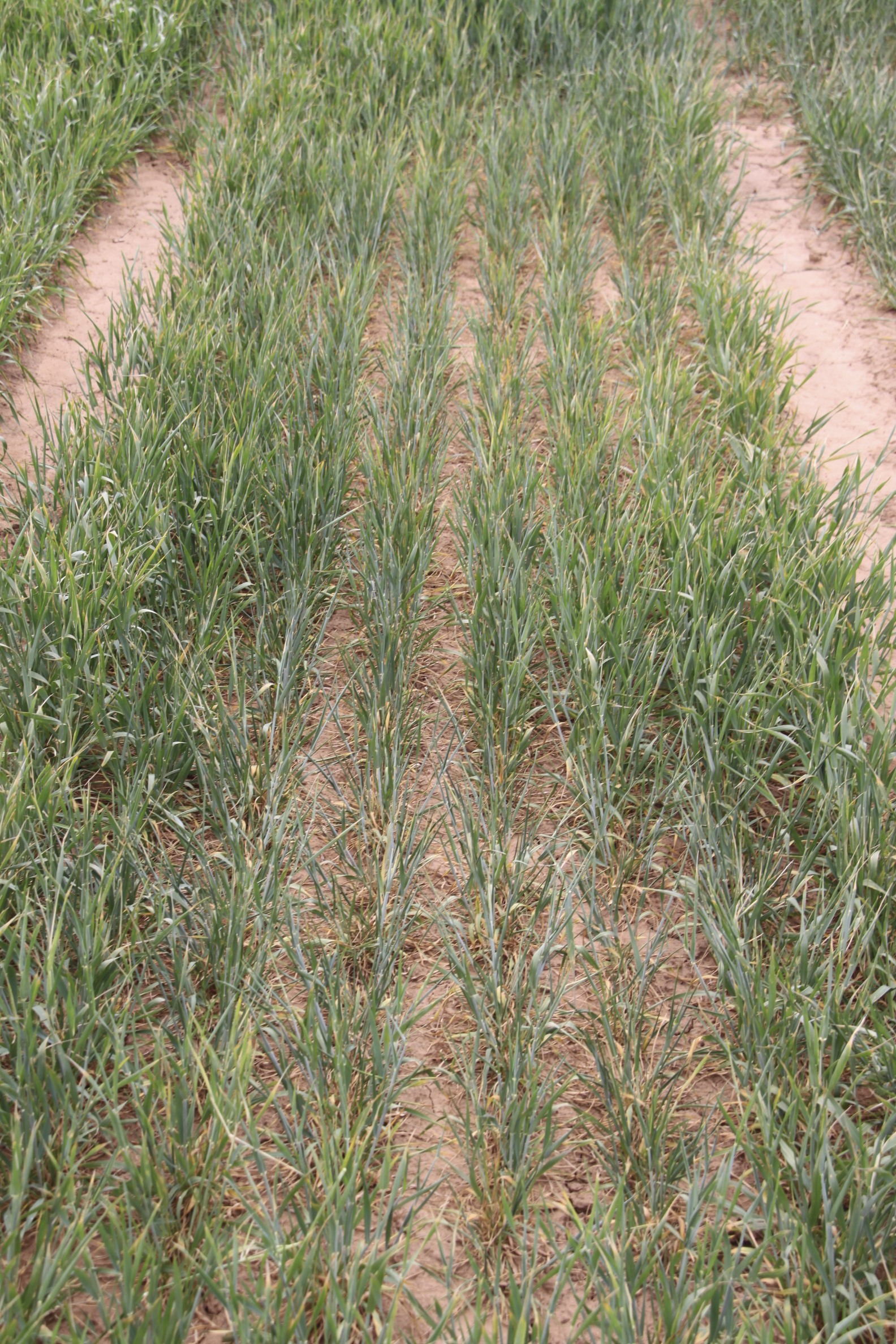
Freeze injured wheat from Marshall, OK

Freeze injured wheat from Marshall, OK

As evidenced by this picture from Marshall, Oklahoma, freeze injured wheat can still have a green appearance. You must split stems to accurately assess injury.

As evidenced by this picture from Marshall, Oklahoma, freeze injured wheat can still have a green appearance. You must split stems to accurately assess injury.

Freeze injured wheat at Lamont, Oklahoma. Freeze might have finished this plot, but drought had it down for the count prior to the freeze.

Freeze injured wheat at Lamont, Oklahoma. Freeze might have finished this plot, but drought had it with a standing eight count prior to the freeze.

Freeze injury in Kay County Oklahoma. Photo courtesy Curtis Vap.

Freeze injury in Kay County Oklahoma. Photo courtesy Curtis Vap.


Freeze injury update 15 April 2014

I have posted a few images from the Oklahoma Mesonet below. Most of Oklahoma spent at least four hours below freezing last night and some areas spent an extended period of time below 28F. While temperatures in the wheat canopy might have remained slightly higher than reported air temperatures, they were still probably low enough to result in significant injury to wheat.

Over the next few days growers will need to inspect fields closely to determine the extent of injury. Symptoms may start to appear later this week and will likely be clearly identifiable by early next week. Healthy wheat heads will remain turgid with a green color. Damaged wheat heads will be bleached, yellow, or brown and will easily break when pushed against. I anticipate that we will not have any partial “blanking” of wheat heads and that most wheat heads will either be okay or a complete loss.

What about new tillers? New tillers might emerge, but it is already April 15. In addition we have very dry soil conditions. For these reasons I am doubtful that newly emerging tillers will have much yield potential in areas south of I-40. IF (and that is a big if) weather conditions remain favorable, late emerging tillers in northern Oklahoma might still have a shot at producing grain.

I will survey some fields in a few days and report back with my findings. If you are interested in receiving weather maps and updates such as the ones posted below, subscribe to the OCS Mesonet Ticker by emailing ticker@mesonet.org

Hours below freezing on April 15, 2014

Hours below freezing on April 15, 2014

Hours below 28 F on April 15, 2014

Hours below 28 F on April 15, 2014

Hours below 24F on April 15, 2014

Hours below 24F on April 15, 2014


Potential for freeze injury

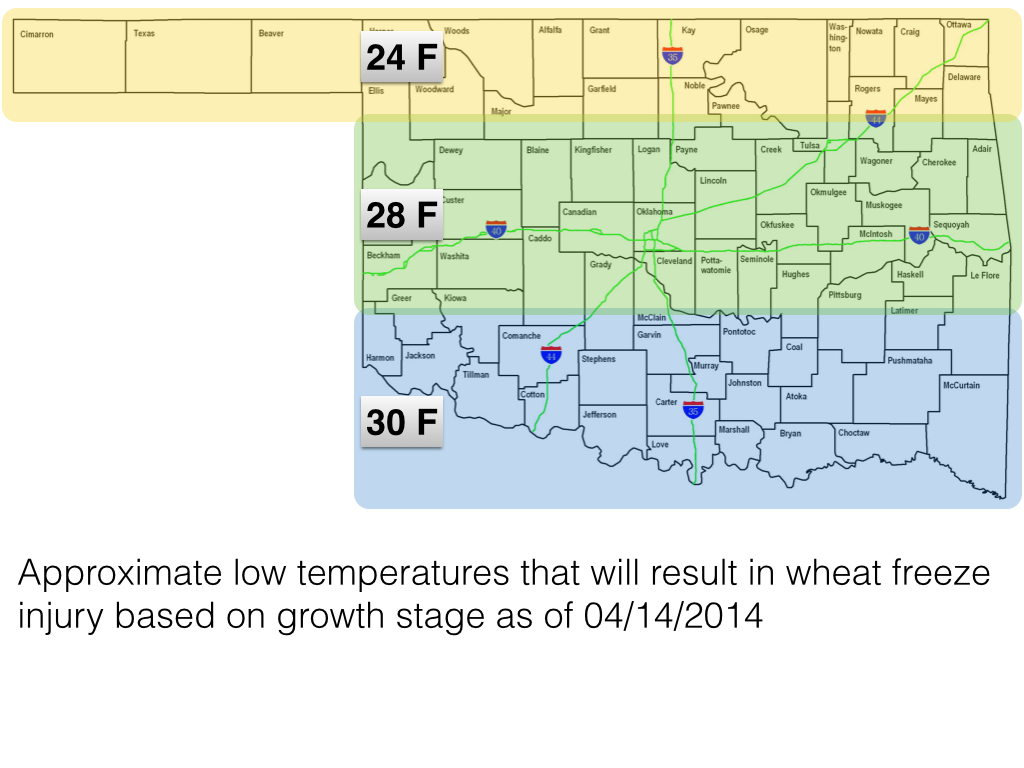
Temperatures are predicted to drop well below freezing tonight (14 April 2014), and there is high potential for freeze injury to Oklahoma wheat. I have posted an excerpt from K-State Extension Publication C-646 Spring Freeze Injury to Kansas Wheat along with a map which provides some rule of thumb temperature thresholds for the current Oklahoma wheat crop. Keep in mind these temperature thresholds are not exact, and temperatures closer to the soil surface might be higher than those reported by weather stations one meter above the soil surface, especially if moisture is present. Wheat in Oklahoma ranges from just past jointing to late boot and if forecasts are correct we will drop below the threshold temperatures where injury might be observed. The extent of injury will depend on how cold we get and how long we stay there. We can lose a few main tillers at this stage and still recover. Given our limited moisture and limited time prior to harvest, though, it is not likely that we will recover from a complete loss of tillers as we have after some March freezes in the past.

Excerpt from KSTATE publication C-646 Spring Freeze Injury to Kansas Wheat

Excerpt from KSTATE publication C-646 Spring Freeze Injury to Kansas Wheat


Approximate temperature thresholds for freeze injury to Oklahoma wheat on 04/14/2014

Approximate temperature thresholds for freeze injury to Oklahoma wheat on 04/14/2014

Freeze injury is not clearly identifiable until 7 – 10 days after the freeze event. So, the best advice for a wheat farmer after a freeze event is to find something else to do for a week or two and then check your crop. I have provided some pictures below with typical injury symptoms and rules of thumb regarding the extent of the injury. Fields should be checked at several random locations by splitting 10 – 20 stems at each location and looking for injury. Don’t focus solely on the large stems. Split a random sampling and determine the percent damage. A good reference for evaluating freeze injury to wheat is K-State Extension Publication C-646 Spring Freeze Injury to Kansas Wheat (access online by clicking here).

This is a healthy wheat head at approximately growth stage 6 - 7. Note the light green color and healthy, turgid appearance.

This is a healthy wheat head at approximately growth stage 6 – 7. Note the light green color and healthy, turgid appearance.

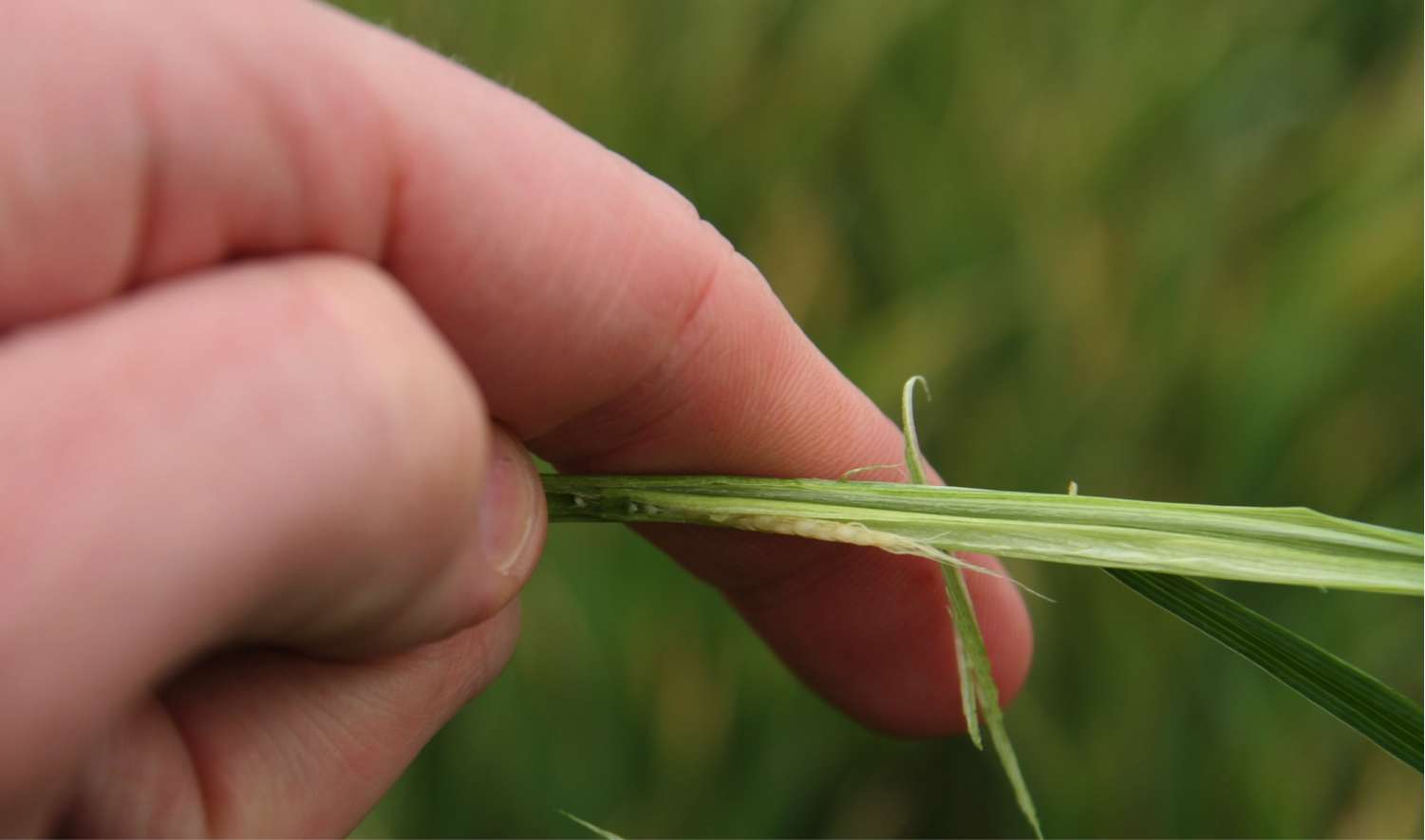
Freeze injury just after jointing. Note the pale, milky color of the head.

Freeze injury just after jointing. Note the pale, milky color of the head. Freeze injury to wheat heads at this growth stage is all or none, so this head is a complete loss.

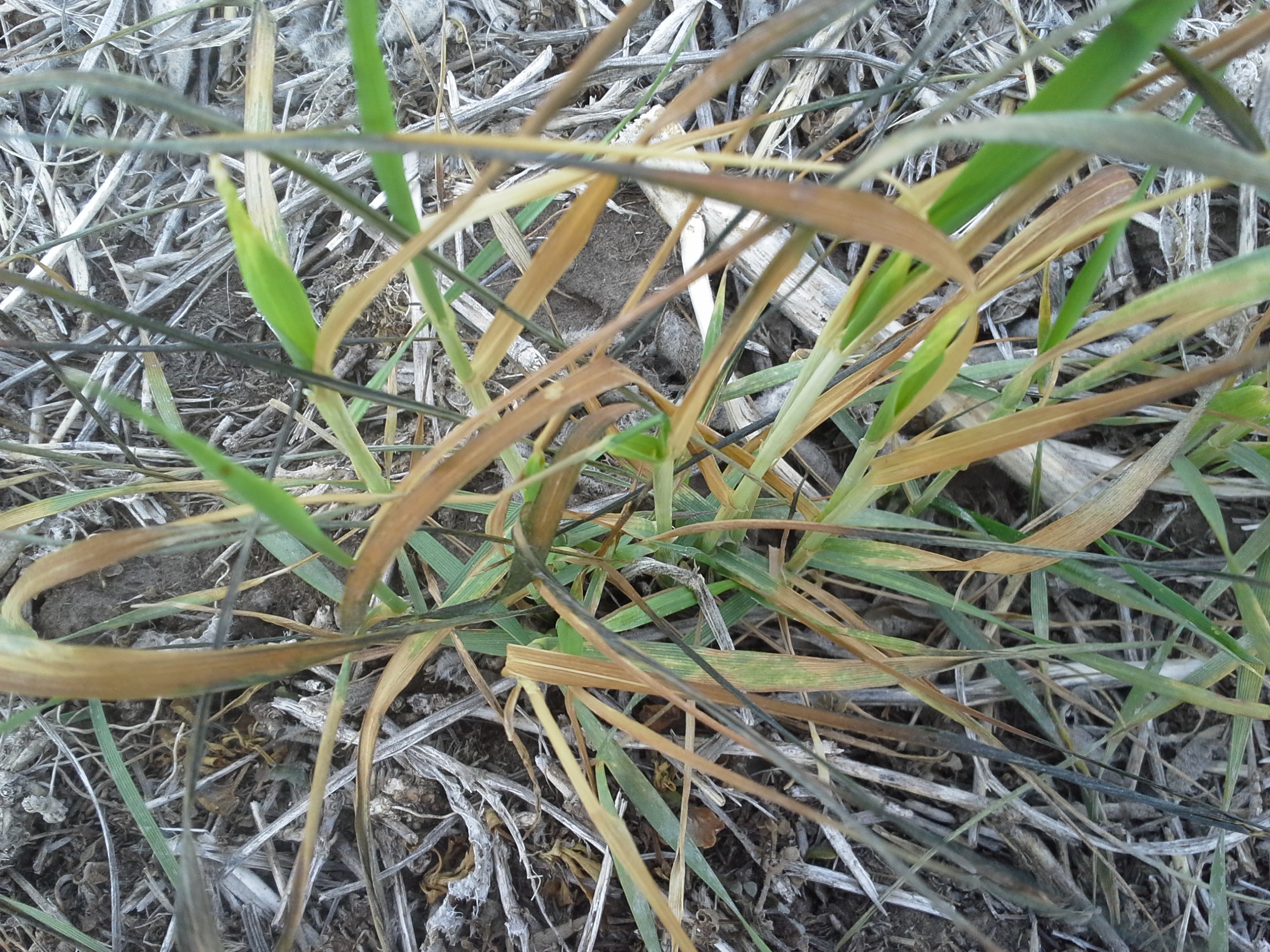
Leaf tip burn from freeze injury will have no impact on final grain yield

Leaf tip burn from freeze injury will have no impact on final grain yield

Yellowing is a common reaction to light freeze injury. Wheat will recover quickly from this injury.

Yellowing is a common reaction to light freeze injury. Wheat will recover quickly from this injury.

Severe freeze injury at or just after jointing can turn the entire plant brown and fields can exude an odor similar to fermenting silage. If conditions are favorable, the plant can produce new tillers (as shown here) and make a partial recovery. It will take a few weeks after a freeze event to determine if the plant will recover from this type of injury

Severe freeze injury at or just after jointing can turn the entire plant brown and fields can exude an odor similar to fermenting silage. If conditions are favorable, the plant can produce new tillers (as shown here) and make a partial recovery. It will take a few weeks after a freeze event to determine if the plant will recover from this type of injury

It is common for sub-lethal freeze injury to result in bent or weak lower nodes. These plants might look fine, but will lodge during grain fill.

It is common for sub-lethal freeze injury to result in bent or weak lower nodes. These plants might look fine, but will lodge during grain fill.